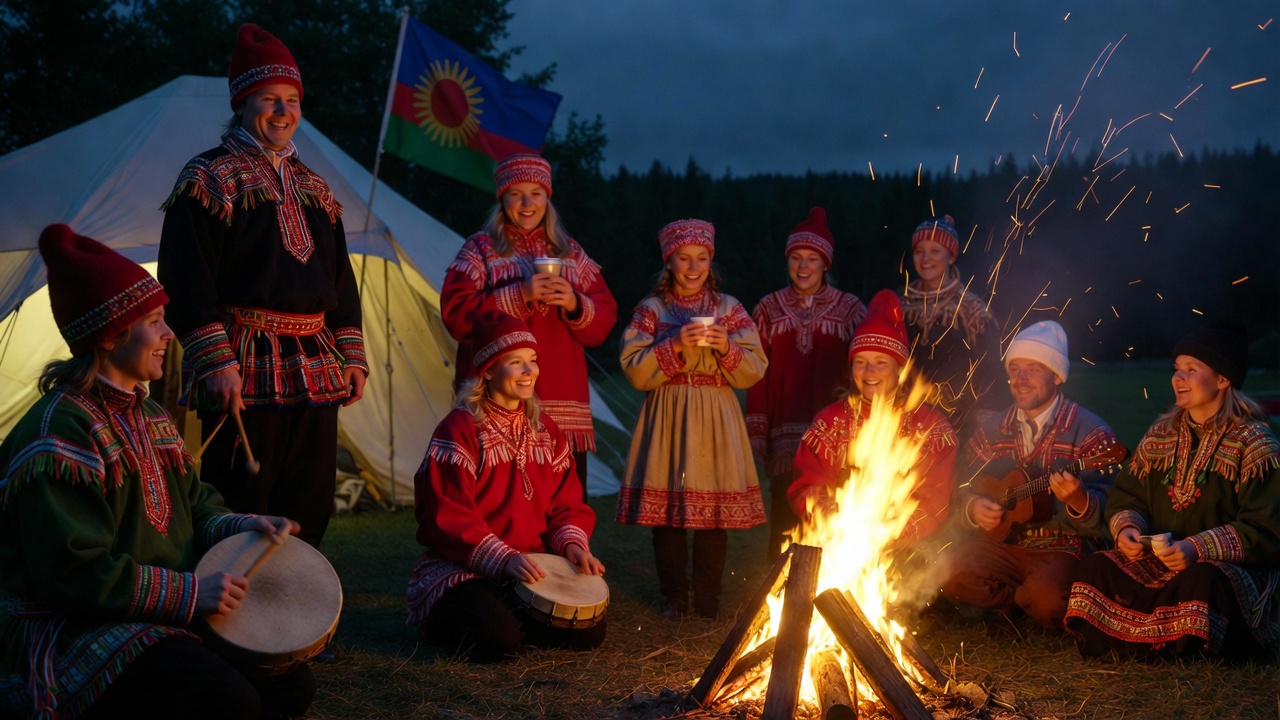
Every year on February 6, the Arctic skies above northern Scandinavia glow not just with the aurora borealis but with the pride of an entire people. Across the snow-covered plateaus of Norway, Sweden, Finland, and the Kola Peninsula of Russia, the Sámi people raise their vibrant flag, sing their ancient anthem, and celebrate what is arguably one of Europe’s most powerful expressions of indigenous identity: Sámi National Day.
Known as Sámi álbmotbeaivi in Northern Sámi, this day carries enormous weight. It is not just a festival or a cultural curiosity. It is a declaration of survival. For a people who endured centuries of forced assimilation, language suppression, and cultural erasure, Sámi National Day is proof that their traditions, their voices, and their way of life persist.
In 2026, this celebration falls on a Friday, February 6, which means festivities across Sápmi — the traditional Sámi homeland — are expected to extend into the weekend. Schools hold special lessons. Towns organize concerts. Families gather around fires and share traditional food. The Sámi flag flies from municipal buildings in all three Nordic countries.
But how much do you really know about this remarkable day? Whether you are planning a trip to the Arctic, studying indigenous cultures, or simply curious about the world’s hidden celebrations, here are 10 fascinating facts about Sámi National Day that will deepen your understanding of one of Europe’s oldest living cultures.
1. Why Is Sámi National Day Celebrated on February 6? The Historic 1917 Congress in Trondheim
The date of Sámi National Day is not arbitrary. February 6 marks the anniversary of the very first Sámi national congress, held in 1917 in the city of Trondheim (known as Tråante in the Southern Sámi language), Norway.
This gathering was groundbreaking. For the first time in recorded history, Sámi delegates from both Norway and Sweden crossed national borders to sit together and discuss shared concerns. Around 150 participants attended, and the topics on the table were urgent: reindeer herding rights, land ownership disputes, language education, and the growing threat of state-driven assimilation policies.
The congress took place inside the Methodist Church in Trondheim, a location that still holds symbolic significance today. According to the Museum of Justice in Norway, this meeting happened during a difficult period when the Norwegian state was pursuing harsh assimilation policies designed to erase Sámi culture entirely.
But it took another 75 years before the date became an official celebration. In 1992, at the 15th Sámi Conference in Helsinki, a formal resolution declared February 6 as the Sámi National Day. The first celebration was held on February 6, 1993 — the same year the United Nations opened the International Year of Indigenous People.
Key timeline:
| Year | Event |
|---|---|
| 1917 | First Sámi national congress held in Trondheim, Norway |
| 1992 | 15th Sámi Conference in Helsinki adopts February 6 as National Day |
| 1993 | First official Sámi National Day celebration |
| 2003 | Sámi flag receives official status in Norway |
| 2004 | University of Helsinki adds the day to Finnish almanacs |
What makes this date even more remarkable is a coincidence discovered only recently. February 6 was also the day when Sámi representatives from the Kola Peninsula in Russia traditionally gathered to meet with Russian officials to discuss community issues. This assembly, called the Kola Sobbar, has been described by researcher Johan Albert Kalstad as the “first Sámi Parliament.” However, this connection was largely forgotten until the early 2000s and did not influence the original choice of date.
2. Who Was Elsa Laula Renberg? The Sámi Woman Who Started It All
Behind every historic movement, there is a person bold enough to light the first spark. For the Sámi people, that person was Elsa Laula Renberg (1877–1931), a Southern Sámi activist, political organizer, and reindeer owner who is widely regarded as one of the most influential figures in Sámi history.
Elsa Laula Renberg did not simply attend the 1917 congress. She organized it. Working alongside Daniel Mortenson and the Brurskanken Sámi Women’s Association, she was the driving force behind bringing Sámi from different regions and countries together for the first time.
Her activism began years earlier. In 1904, at the age of 26, she co-founded the world’s first Sámi political organization, Lapparnas Centralförbund (the Central Lapp Union), in Stockholm. That same year, she published a pamphlet called Inför Lif eller Död? Sanningsord i de Lappska förhållandena — which translates roughly to “Life or Death? True Words About the Lappish Conditions.” According to the Women’s Museum of Norway, this was one of the first published works by a Sámi woman, and it challenged the Swedish government directly on issues of land rights, cultural dignity, and education.
Her background was extraordinary. Born in a Sámi reindeer-herding family near the Norwegian-Swedish border, she broke barriers by pursuing higher education — a rare path for Sámi women at the time. She trained as a midwife in Stockholm, where she encountered political activism through figures like Anna Lindhagen, a suffragist and advocate for Sámi rights.
Elsa even secured audiences with royalty. In 1904, she was one of three Sámi representatives who met King Oscar II to present their grievances. She later traveled across Norway, from Trondheim to Finnmark, delivering lectures on Sámi issues and mobilizing communities.
Tragically, Elsa Laula Renberg died of tuberculosis in 1931, at the age of 53. She passed away disappointed that a strong, united Sámi movement had not fully materialized during her lifetime. But the seeds she planted grew into something permanent. Today, November 29 — her birthday — is one of the official Sámi flag days. And the congress she organized in 1917 became the historical foundation for Sámi National Day.
In 2017, the city of Trondheim held a large-scale centennial jubilee to honor the 1917 congress. Plans were also announced to create “Elsa Laula Park” outside the Methodist Church where the original meeting took place, featuring a Sámi-designed work of art.
3. What Does the Sámi Flag Look Like and What Do Its Colors Mean?
One of the most striking visual elements of Sámi National Day is the Sámi flag — a bold, colorful banner that stands out against the winter snow of the Arctic. If you have ever visited northern Scandinavia in early February, you have likely seen it flying from public buildings, schools, and homes.
The current Sámi flag was designed by Astrid Båhl, a Coast Sámi artist from Ivgobahta (Skibotn) in Troms county, Norway. It was officially adopted on August 15, 1986, at the 13th Nordic Sámi Conference in Åre, Sweden. Båhl’s design won a competition organized by the Sámi newspaper Sámi Áigi, beating more than 70 other submissions.
The flag features four colors: red, blue, green, and yellow. These are not random choices. They are the colors most commonly found on the gákti, the traditional Sámi garment worn for ceremonies, festivals, and daily life. The green stripe was Båhl’s addition to the earlier design, reflecting colors popular in South Sámi clothing traditions.
At the center of the flag is a circle divided into two halves: one red and one blue. The red half represents the sun (Beaivi), and the blue half represents the moon. This motif draws from imagery found on ancient Sámi shaman drums (noaidi drums), where solar symbols were painted in red using extracts from the sacred alder tree.
According to the Sámi Council, Båhl herself described the flag as representing the idea that “Sámi are children of the sun.” This phrase echoes a powerful South Sámi poem called Päiven Pārne (“Sons of the Sun”), written down by the poet-priest Anders Fjellner in the mid-1800s. In this poem, the Sámi are described as descendants of the sun, born from the union between the Sun’s offspring and a mythological female figure from the far North.
The flag was deliberately designed to look different from the Nordic cross flags used by Norway, Sweden, Finland, and Denmark. As noted by the Pacific Sámi Searvi, this was an intentional choice to show that the Sámi nation exists outside the Eurocentric state system.
Official status of the flag today:
- Norway (2003): The Sámi flag received official legal status. Municipalities across Norway are now required to fly the flag on February 6.
- Sweden: The flag holds semi-official standing through the Sámi Parliament, established in 1993.
- Finland: The flag is commonly flown on Sámi National Day, particularly in Lapland.
The Sámi flag is raised on 11 designated flag days each year, commemorating key milestones in Sámi history and culture.
4. How Many Sámi People Are There and Where Do They Live in 2026?
Understanding who the Sámi are is essential to grasping why their National Day matters so deeply. The Sámi people are the only officially recognized indigenous people in the European Union, and their homeland — called Sápmi — stretches across the northern regions of four countries.
Population estimates vary because not all Sámi are registered and self-identification practices differ by country. However, the most widely cited figures place the total Sámi population at approximately 80,000 to 100,000 people:
| Country | Estimated Sámi Population |
|---|---|
| Norway | ~50,000 |
| Sweden | ~20,000–40,000 |
| Finland | ~8,000–10,000 |
| Russia (Kola Peninsula) | ~2,000 |
Norway is home to the largest Sámi community, with significant populations concentrated in the northern counties of Troms and Finnmark. The town of Karasjok (Kárášjohka) serves as the administrative center, hosting both the Norwegian Sámi Parliament and the Sámi Parliament building, which was completed in 2001 and has won architectural design awards.
In Sweden, the Sámi population lives primarily in the northern regions around Kiruna (called Giron in Sámi), Jokkmokk, and Gällivare. Sweden recognizes the Sámi as one of its five official national minorities.
In Finland, the Sámi live mostly in the Utsjoki, Inari, Enontekiö, and Sodankylä municipalities. The Finnish Sámi Parliament is based in Inari.
The situation in Russia is more precarious. The approximately 2,000 Sámi on the Kola Peninsula face unique challenges. Russia’s war in Ukraine and broader geopolitical tensions have further isolated Russian Sámi from their Nordic counterparts, complicating cross-border cultural exchange that has historically been central to Sámi identity.
It is important to understand that the Sámi are not a single homogeneous group. There is remarkable diversity within Sámi culture, reflected in different languages, regional dress styles, livelihoods, and traditions. Some Sámi are reindeer herders. Others are fishers, farmers, or urban professionals. What unites them is a shared cultural heritage and a deep connection to the land, waters, and rhythms of the Arctic.
5. What Are the Nine Sámi Languages and Why Are They Endangered?
One of the most surprising facts about the Sámi people is the sheer linguistic diversity within their community. There are nine distinct Sámi languages, each with its own grammar, vocabulary, and oral traditions. These languages belong to the Uralic language family, making them relatives of Finnish and Estonian — not of Norwegian, Swedish, or Russian.
The nine Sámi languages are:
| Language | Region | Estimated Speakers |
|---|---|---|
| Northern Sámi | Norway, Sweden, Finland | ~25,000 |
| Lule Sámi | Norway, Sweden | ~2,000 |
| Southern Sámi | Norway, Sweden | ~500 |
| Inari Sámi | Finland | ~400 |
| Skolt Sámi | Finland, Russia | ~300 |
| Kildin Sámi | Russia | ~100 |
| Pite Sámi | Sweden, Norway | ~30 |
| Ume Sámi | Sweden | ~10 |
| Ter Sámi | Russia | Nearly extinct |
Northern Sámi is by far the most widely spoken, with around 25,000 speakers. But several of the smaller languages are critically endangered. Ume Sámi has fewer than 10 fluent speakers. Ter Sámi, once spoken on the eastern Kola Peninsula, has virtually no native speakers left.
The decline of these languages is a direct result of the assimilation policies — known as Norwegianization, Swedification, and Finnification — that were enforced from the mid-1800s through the 1960s. Children were taken from their families and placed in boarding schools where speaking Sámi was punished. Traditional names were replaced with Scandinavian ones. The goal was explicit: to erase Sámi identity and absorb the population into the majority culture.
Today, language revitalization is a central focus of Sámi National Day celebrations. Schools across the Nordic countries incorporate Sámi language lessons in early February. The Sámi Parliaments in Norway, Sweden, and Finland have all invested in language education programs, teacher training, and digital resources.
On February 6 each year, greetings in multiple Sámi languages ring out across Sápmi. In Northern Sámi, you say “Lihkku beivviin!” (Happy day!). In Southern Sámi, the greeting is “Lïhke biejjine!”. These small acts of linguistic celebration carry enormous emotional weight for a people who were once punished for speaking their own words.
6. What Is Joik and Why Is It Central to Sámi National Day Celebrations?
If you attend a Sámi National Day event, one thing will captivate you immediately: the sound of joik (also spelled yoik). This is the traditional vocal art of the Sámi people — and it is one of the oldest continuous musical traditions in all of Europe.
Joik is unlike any Western form of music. It is not a song about something. It is an attempt to be that thing — to evoke the very essence of a person, an animal, a mountain, or a landscape through voice alone. The Sámi verb for performing a joik is transitive: you do not joik about your friend; you joik your friend. The distinction is subtle but profound.
As the Sámi performer Elle Márjá Eira explained to Visit Norway, joik has been part of her life since before she could speak. She has described it as something that connects her to her ancestors and to the natural world around her.
Traditional joiks are often short, cyclical, and repetitive. They may use non-lexical syllables — sounds without literal meaning — that carry deep emotional weight. Many Sámi people receive a personal joik as a gift during their lifetime. It functions almost like a musical portrait, capturing something essential about who they are.
The dark history of joik suppression
For centuries, joik was targeted by authorities. During the Christianization of Sápmi, missionaries condemned joiking as sinful because of its association with noaidi (Sámi shaman) practices and pre-Christian spiritual rituals. Under the Norwegianization policies of the 19th and 20th centuries, joiking was forbidden in Sámi schools. According to Wikipedia’s article on joik, as late as the 1950s, it was still banned in some Sámi area schools.
Despite this suppression, joik survived — passed down quietly within families, kept alive in remote communities, and preserved in archives. The Karl Tirén collection, held by Swedish archives and recognized by UNESCO’s Memory of the World program, contains nearly 300 wax cylinder recordings of Sámi joik from the 1910s, providing an invaluable record of the art form during a critical period.
Joik’s modern renaissance
Today, joik is experiencing a powerful revival. Artists like Mari Boine, Nils-Aslak Valkeapää, Jon Henrik Fjällgren, and Sofia Jannok have brought Sámi music to international stages, blending traditional joik with jazz, electronic, pop, and world music genres. The South Sámi artist Marja Mortensson won the Spellemannprisen (Norway’s equivalent of a Grammy award) for her album Mojhtestasse — Cultural Heirlooms.
Perhaps the most globally recognizable echo of joik came in 2013, when the opening sequence of Disney’s Frozen featured Vuelie, a choral piece inspired by a South Sámi joik. While the film took creative liberties, it introduced millions of viewers to the haunting beauty of Sámi vocal traditions.
On Sámi National Day, joik fills town squares, school halls, and family gatherings. It is the heartbeat of the celebration — a living reminder that this is a culture that refused to be silenced.
7. What Traditional Food and Clothing Are Part of Sámi National Day?
Sámi National Day is as much a feast for the senses as it is a political and cultural statement. Two elements are especially prominent: traditional Sámi food and the iconic gákti, the Sámi national costume.
Traditional Sámi food on February 6
The Sámi diet has been shaped by thousands of years of living in one of the harshest environments on Earth. Reindeer meat (reinsdyrkjøtt in Norwegian) is the centerpiece of Sámi cuisine, prepared in countless ways: smoked, dried, cured, stewed, or grilled over an open fire.
Common dishes you might encounter at a Sámi National Day celebration include:
- Bidos — a hearty reindeer stew, slow-cooked with root vegetables and often served in a lávvu (a traditional Sámi tent structure)
- Dried reindeer meat (suovas) — thinly sliced and smoked, often eaten as a snack
- Fresh-water fish — Arctic char, trout, and salmon are staples, especially for the coastal and river Sámi communities
- Gáhkku — a traditional Sámi flat bread, sometimes made with reindeer blood, and often served with butter and coffee
- Cloudberries (luomi) — a treasured Arctic berry, golden-orange in color, served as a dessert or jam
Coffee holds a special place in Sámi culture. Sharing coffee around a fire is a deeply social ritual. It is not unusual for Sámi gatherings to involve round after round of strong coffee, accompanied by dried meat and conversation.
The gákti: a national costume that tells your life story
The gákti is far more than clothing. It is a wearable identity card. Every detail — the colors, the patterns, the belts, the jewelry — communicates specific information about the wearer’s region of origin, marital status, and family background.
As Best of Nordic explains, a trained Sámi eye can instantly identify whether a gákti comes from Kautokeino, Inari, Karasjok, or Jokkmokk. The colors generally align with the Sámi flag: blue, red, yellow, and green. Men’s gáktis often feature wide silver belts, while women’s gáktis may include ornate brooches (solju), pouches, and heirloom pieces.
On Sámi National Day, wearing the gákti is a powerful statement of cultural pride. In cities like Oslo, Tromsø, and Stockholm, you will see Sámi professionals arriving at work in their gáktis. Children dress up in their family’s traditional clothing. Photographs of gákti-clad celebrations flood social media under hashtags like #SámiNationalDay and #Sámiálbmotbeaivi.
8. How Do Norway, Sweden, and Finland Officially Recognize Sámi National Day?
Sámi National Day is unique among indigenous celebrations because it carries official recognition in three sovereign nations simultaneously. This cross-border status reflects the fact that the Sámi homeland, Sápmi, does not correspond to any single country’s borders.
Norway: an official flag day with national ceremonies
In Norway, Sámi National Day is an official flag day. This means that all municipal administrative buildings are required by law to fly the Norwegian flag, and they are encouraged to also fly the Sámi flag. The tradition is particularly notable in Oslo, where the bells in the highest tower of Oslo City Hall play the Sámi national anthem (Sámi soga lávlla) as the flags are raised.
Norway established its Sámi Parliament (Sametinget) in 1989. King Olav V personally opened the Parliament by signing a reindeer hide — a powerful symbolic gesture. The Parliament, based in Karasjok, serves as the political voice of the Sámi people in Norway and plays an active role in National Day celebrations.
Sweden: growing recognition and cultural events
In Sweden, Sámi National Day is an officially recommended flag day. The Swedish government encourages public flagging, and the Sámi Parliament in Kiruna organizes events. The open-air museum Skansen in Stockholm has become a major venue for celebrations, hosting multi-day programs of joik performances, handicraft workshops, food tastings, and cultural exhibitions in partnership with the Stockholm Sámi Association.
The Jokkmokk Winter Market, held annually in February in Swedish Lapland, frequently overlaps with Sámi National Day week. With a history stretching back over 400 years, the market is a vibrant hub for Sámi culture, featuring duodji (traditional handicrafts), joik concerts, and lectures on Sámi issues.
Finland: almanac recognition and educational focus
In Finland, February 6 has appeared in almanacs published by the University of Helsinki since 2004. Finnish authorities recommend general flagging on the day. The Finnish Sámi Parliament, based in Inari, coordinates celebrations that include cultural programs, school workshops, and public events.
Is Sámi National Day a public holiday?
Despite its official recognition, Sámi National Day is not a public holiday in any of the four countries where Sámi people live. Businesses operate on normal schedules. However, for employees of Sámi administrative bodies, schools in Sámi areas, and cultural institutions, the day is often treated as a day of special observation.
There have been growing calls in recent years for Sámi National Day to be given public holiday status, at least in Sámi administrative areas. These discussions gain renewed energy each February, as the celebrations draw increasing media attention and public interest.
9. What Is the Sámi National Anthem and What Does It Mean?
Every nation has an anthem, and the Sámi people are no exception. The Sámi national anthem is called Sámi soga lávlla, which means “Song of the Sámi People” (or, more literally, “Song of the Sámi Family”). It is sung at every Sámi National Day celebration and carries deep emotional and historical significance.
The text was written by Isak Saba (1875–1921), a remarkable figure in Sámi history. Saba was a Coast Sámi from Nesseby in Finnmark, Norway, and in 1906, he became the first Sámi person ever elected to a national parliament when he won a seat in the Norwegian Storting as a Labour Party representative.
Saba wrote the poem in 1906, and it was later set to music by Arne Sørli. The song was officially adopted as the pan-Sámi anthem at the 15th Sámi Conference in Helsinki in 1992 — the same conference that established February 6 as Sámi National Day.
The anthem is sung in the local Sámi language of wherever the ceremony takes place. Because there are nine distinct Sámi languages, this means the anthem is performed in multiple linguistic versions across Sápmi. The opening lines celebrate the vast Sámi homeland — its mountains, coastlines, tundra, and rivers — and pay tribute to the resilience of the Sámi people.
Notably, the anthem refers to the Sámi as “offspring of the Sons of the Sun”, connecting it to the same mythological tradition that inspired the Sámi flag. This phrase, rooted in Anders Fjellner’s epic poem, speaks to a cosmology in which the Sámi see themselves as intimately bound to the natural forces that govern life in the Arctic: the cycles of the sun and moon, the migration of reindeer, and the rhythms of the seasons.
On Sámi National Day in Oslo, a particularly moving tradition takes place. The bells of Oslo City Hall’s highest tower ring out the melody of Sámi soga lávlla as the Sámi flag is raised alongside the Norwegian flag. It is a moment that many describe as one of the most emotionally powerful public rituals in Scandinavia.
10. What Are the Current Challenges Facing the Sámi People in 2026?
Sámi National Day is a celebration, yes. But it is also a day of reflection — a day to acknowledge that the fight for Sámi rights is far from over. In 2026, several urgent issues continue to shape the lives of Sámi communities across Sápmi.
The Norwegian Truth and Reconciliation Commission
In June 2023, Norway’s Truth and Reconciliation Commission delivered its landmark 700-page report to the Storting (Norwegian Parliament). The commission, chaired by Dagfinn Høybråten, spent five years investigating the effects of the Norwegianization policy — the state-driven campaign of forced assimilation that targeted the Sámi, Kven/Norwegian Finns, and Forest Finns from the mid-1800s through the 1960s.
The Norwegian Parliament’s own website describes the commission’s mandate as threefold: to conduct a historical survey, to investigate the effects of Norwegianization policies, and to propose measures for reconciliation. The commission collected over 760 personal testimonies from individuals affected by the policies.
In November 2024, the Storting issued 17 resolutions in response to the report. Most significantly, the Storting formally apologized to the Sámi, Kven/Norwegian Finns, and Forest Finns. Resolution 15 stated the Parliament’s “deepest regret for the abuses that the Norwegianization policy entailed” and acknowledged responsibility for the consequences of this policy.
The Sámi Parliament president responded with cautious optimism but stressed that apologies alone are insufficient. As described in a perspective published by the Arctic Circle Assembly, reconciliation must include concrete investments in language revitalization, cultural preservation, and the protection of Sámi land and water rights.
Similar truth commissions are underway in Sweden (expected to report by the end of 2025) and Finland, signaling a broader Nordic reckoning with colonial history.
The Fosen wind farm controversy
Perhaps no issue has galvanized Sámi activism in recent years more than the Fosen wind farm case. In October 2021, the Norwegian Supreme Court ruled unanimously that the licenses for two wind farms on the Fosen peninsula — Storheia and Roan — were invalid because they violated the cultural rights of South Sámi reindeer herders under Article 27 of the International Covenant on Civil and Political Rights (ICCPR).
As documented by the Norwegian National Human Rights Institution (NIM), this was a historic decision. It was the first time that Sámi parties won in the Supreme Court in a case about a development project in their traditional territories by invoking human rights protections.
Despite the ruling, the 151 wind turbines continued operating for over 500 days. In February and March 2023, Sámi activists — joined by climate activists including Greta Thunberg — staged dramatic protests outside Norway’s Ministry of Energy in Oslo.
A partial agreement between the Norwegian government and the affected Sámi herders was reached in December 2023, but tensions remain. The case has become a powerful symbol of the tension between green energy development and indigenous rights — a debate that resonates far beyond Scandinavia.
Language loss and educational gaps
Despite progress, Sámi languages continue to face existential threats. The Norwegian Truth and Reconciliation Commission found that the Norwegianization policies have had lingering effects well beyond their official end in 1963. Many Sámi families lost their language within one or two generations. Schools in Sámi areas still struggle to find enough qualified teachers who can teach in Sámi languages. Textbooks are scarce. Digital resources are limited.
The Sámi Parliaments in all three Nordic countries have prioritized language education as their most urgent cultural task. On Sámi National Day 2026, this priority is likely to feature prominently in speeches, debates, and media coverage.
Climate change and reindeer herding
The Arctic is warming two to four times faster than the global average. For Sámi reindeer herders, this translates into unpredictable weather patterns, changing vegetation, and increasingly difficult grazing conditions. Rain-on-snow events — where rain falls on frozen ground and then refreezes into an impenetrable ice layer — prevent reindeer from accessing the lichen they depend on for winter food. These events are becoming more frequent as temperatures fluctuate.
Reindeer herding is not just an economic activity for the Sámi. It is a core cultural practice — a way of life that defines identity, shapes language, and connects communities to their ancestral lands. The loss of herding would represent a cultural catastrophe far beyond its economic impact.
How to Celebrate or Observe Sámi National Day in 2026
If you are inspired to mark Sámi National Day this year, here are some respectful and meaningful ways to participate — whether you are in Sápmi or anywhere else in the world.
If you are in the Nordic countries:
- Attend a local celebration. Many cities, including Oslo, Tromsø, Stockholm, Kiruna, Helsinki, and Inari, host public events with joik performances, cultural exhibitions, lectures, and traditional food. Check local event listings for programs in your area.
- Visit Skansen in Stockholm. The open-air museum hosts a multi-day Sámi National Day program every year, organized with the Stockholm Sámi Association.
- Explore the Jokkmokk Winter Market. If you can travel to Swedish Lapland in early February, this centuries-old market offers one of the most immersive Sámi cultural experiences available.
- Visit the Sámi Parliament in Karasjok. The architectural award-winning building hosts exhibitions and events around the National Day.
If you are elsewhere in the world:
- Learn about Sámi history. Read works by Sámi authors, watch Sámi films (the International Sámi Film Institute is a great starting point), or explore the rich archives of Sámi joik music.
- Support Sámi artists and craftspeople. Purchase duodji (traditional handicrafts) directly from Sámi artisans. Look for certified products to ensure authenticity and fair compensation.
- Share and educate. Use social media to raise awareness. Tag posts with #SámiNationalDay, #Sámiálbmotbeaivi, and #February6.
- Respect the culture. Avoid cultural appropriation. If you are attending a Sámi event or purchasing Sámi-inspired products, take the time to understand the cultural context and significance behind what you are experiencing.
Why Sámi National Day Matters for the Whole World
Sámi National Day is not just a Nordic affair. It is a story that belongs to the global conversation about indigenous rights, cultural preservation, and environmental justice.
In a world where indigenous cultures face mounting pressure from climate change, resource extraction, and urbanization, the Sámi experience offers both a cautionary tale and a story of hope. The forced assimilation policies of the past nearly succeeded in destroying Sámi languages, traditions, and ways of life. But the Sámi people resisted. They organized, they protested, they preserved their joik in secret, and they built political institutions to protect their future.
In 2026, as the Sámi flag rises once again over the snow-covered towns of Sápmi, the message is clear: this is a people who will not be erased. February 6 is their day. And it is a day that deserves to be known, respected, and celebrated by people everywhere.
Lihkku sámi álbmotbeivviin! — Happy Sámi National Day!