Arizona Statehood Day falls on February 14 every year. Yes, that’s also Valentine’s Day. But for 7.4 million Arizonans, the date carries a deeper meaning. It marks the anniversary of the day Arizona became the 48th state admitted to the Union in 1912. In 2026, Arizona celebrates its 114th birthday — and the story behind that milestone is far more dramatic than most people realize.
Whether you’re a history buff, a desert traveler, or simply curious about American state holidays, these ten surprising facts about Arizona Statehood Day will change how you think about the Grand Canyon State.
1. Why Arizona Became a State on Valentine’s Day — And It Wasn’t Planned
Here’s a fact that catches nearly everyone off guard. Arizona was never supposed to become a state on Valentine’s Day. The original target date was February 12, 1912 — Abraham Lincoln’s birthday. Republican leaders in the Arizona Territory wanted the new state’s birthday to align with the Great Emancipator’s.
But President William Howard Taft was delayed in New York. He had assumed the signing would take only five minutes, so his advisors scheduled a meeting that ran long. When Taft returned to Washington, February 13 was considered bad luck. Nobody wanted the new state born on the 13th. So the signing was pushed to February 14.
According to Desert Vibe, people at the time were well aware of the coincidence. For its first few years of statehood, “The Valentine State” was one of Arizona’s most popular nicknames. It appeared on postcards, promotional materials, and even early license plates. The nickname only faded after Grand Canyon National Park was established in 1919, when “The Grand Canyon State” became the dominant identity.
2. Arizona Had the Longest Path to Statehood of Any Contiguous U.S. State
Arizona didn’t simply apply for statehood and receive it. The territory waited 49 years — from the creation of the Arizona Territory in 1863 to its admission in 1912. That is the longest wait of any contiguous state in American history.
Between 1877 and 1906, Arizona submitted at least fifteen separate applications for statehood. Every single one died in Congressional committee. Why?
| Factor | Impact on Statehood |
|---|---|
| Apache Wars (1860s–1880s) | Congress viewed Arizona as unstable and costly |
| Low population | Fewer than 100,000 residents through much of the territorial period |
| Confederate sympathizers | Many early political leaders had ties to the Confederacy |
| Copper company influence | Mine owners in Boston and New York preferred territorial status for lower taxes |
| Progressive constitution | President Taft opposed key provisions like judicial recall |
As 12 News reported, Arizona’s path to statehood was “one of the longest of all the states in the union.” The fight involved Congress, presidents, railroad companies, copper barons, and the people of Arizona themselves.
3. Congress Once Tried to Merge Arizona and New Mexico Into a Single State
In 1906, Congress passed the Hamilton Joint Statehood Bill, which proposed combining the territories of Arizona and New Mexico into one giant state. The merged state would have been called “Arizona,” with its capital at Santa Fe.
Arizonans were furious. Newspapers ran headlines like “We want statehood, not matrimony!” Residents feared that New Mexico, with its larger Hispanic population and longer institutional history, would dominate the new state politically.
In the November 1906 referendum, Arizona voters rejected joint statehood by a staggering margin of 16,265 to 3,141 — a ratio of roughly 16 to 1. The Library of Congress notes that this was the most lopsided referendum vote in American territorial history. Ironically, New Mexico voted in favor of the merger, 26,195 to 14,735.
Congress, angered by Arizona’s refusal, slammed the door on statehood for several more years. Arizona would not gain admission until 1912.
4. President Taft Vetoed Arizona’s Statehood Because of Judicial Recall
The most dramatic obstacle to Arizona statehood came from a single constitutional provision. When delegates gathered in Phoenix in 1910 to write their state constitution, progressives dominated the convention. They produced one of the most radical constitutions in the nation, including provisions for direct democracy — initiative, referendum, and recall of judges.
President William Howard Taft, a former federal judge who dreamed of joining the Supreme Court (which he eventually did), was appalled. He called judicial recall “legalized terrorism” against judges. On August 15, 1911, Taft vetoed Arizona’s statehood resolution.
According to the Center for American Civics at ASU, Taft believed judges must be free to apply the law without fear of losing their jobs to public backlash. Arizonans grudgingly removed the judicial recall clause. Taft signed the statehood proclamation on February 14, 1912.
But here’s the twist. Within months of gaining statehood, the new Arizona legislature quietly proposed an amendment restoring judicial recall. Voters approved it before the end of 1912. Taft fumed — but statehood, once granted, could not be revoked. Arizona had outsmarted the President.
5. Arizona’s First Governor Served Seven Terms and Walked to His Inauguration
George W.P. Hunt was Arizona’s first state governor — and arguably its most unforgettable. Born in Missouri in 1859, Hunt arrived in Globe, Arizona Territory, in 1881 with nine dollars in his pocket. He waited tables, worked as a mucker in the Old Dominion Mine, and eventually rose to become a successful merchant and politician.
When Arizona achieved statehood, Hunt refused a carriage for his inauguration. Instead, he walked an entire mile to the Capitol building in Phoenix, declaring himself a man of the people. Standing 5 feet 9 inches and weighing nearly 300 pounds, with a bald head and a thick walrus mustache, he cut an unmistakable figure. He wore white linen suits year-round and earned the nickname “George VII” for his remarkable seven terms as governor.
Hunt’s accomplishments include:
- Abolishing child labor in Arizona
- Establishing workers’ compensation
- Creating old age pensions
- Fighting for organized labor rights
- Serving as U.S. Minister to Siam (now Thailand) between gubernatorial stints
He is buried in a white pyramid-shaped tomb in Phoenix’s Papago Park — a design inspired by the Egyptian pyramids he admired during his travels. The Arizona Memory Project details his seven terms spanning from 1912 to 1933.
6. Arizona’s Economy Was Built on the Famous “Five C’s” at the Time of Statehood
Every Arizona schoolchild from the 1950s through the 1970s learned about the Five C’s — the pillars of the state’s early economy. These five elements are even represented on the Arizona state seal:
| The Five C’s | Role in Arizona’s Economy |
|---|---|
| Copper | Arizona produced more copper than any other state by 1907, earning the nickname “The Copper State” |
| Cattle | By 1918, the state had as many as 1.75 million head of cattle |
| Cotton | Arizona’s arid climate and irrigation made it a prime cotton-growing state |
| Citrus | Oranges, lemons, and grapefruit thrived in the Salt River Valley |
| Climate | Warm, dry weather attracted tourists, retirees, and health-seekers |
According to KJZZ, copper, cattle, and climate remain economically relevant today. Arizona still supplies roughly 66 percent of the nation’s copper from just ten major mines. However, citrus and cotton production have declined significantly due to urban expansion and water challenges.
Some commentators now propose updated “Five C’s” for the modern era: Chips, Climate, Culture, College, and Construction — reflecting Arizona’s booming semiconductor industry and population growth.
7. Arizona Has Had More Female Governors Than Any Other U.S. State
Arizona holds a remarkable distinction in American political history. It is the first state to have had five female governors, and the first state where a woman directly succeeded another woman in the governor’s office. According to the Center for American Women and Politics at Rutgers University, no other state matches this record.
The five women who served as Arizona’s governor:
- Rose Mofford (D) — 1988–1991
- Jane Dee Hull (R) — 1997–2003
- Janet Napolitano (D) — 2003–2009
- Jan Brewer (R) — 2009–2015
- Katie Hobbs (D) — 2023–present
This tradition has roots in Arizona’s frontier culture. As Governing magazine reported, the state’s cowboy heritage meant it was not unusual to find women holding positions of authority. Arizona’s admission to the Union was even delayed partly because of its push for women’s suffrage — years before the 19th Amendment was ratified in 1920.
In 1998, Arizona made national headlines when all five top executive offices — governor, secretary of state, attorney general, treasurer, and superintendent of public instruction — were held by women simultaneously. Known as the “Fabulous Five,” they were sworn in by Sandra Day O’Connor, the first woman to serve on the U.S. Supreme Court — herself an Arizonan.
8. Arizona’s Oldest Rivalry Trophy Predates Statehood by Over Two Decades
Before Arizona was even a state, its two biggest universities were already competing. The Territorial Cup, first awarded in 1889, is the oldest rivalry trophy in college football. It is given annually to the winner of the football game between the University of Arizona Wildcats and the Arizona State University Sun Devils.
That first game took place 23 years before statehood. The rivalry continues today as one of the most passionate in college sports. The fact that the two schools were competing fiercely while Arizona was still a remote, sparsely populated territory speaks volumes about the competitive spirit that has always defined the state.
The Territorial Cup is certified by the NCAA as the oldest trophy in college football — older than any bowl game trophy, older than the Ivy League, and older than Arizona itself.
9. Arizona Statehood Day Celebrations Feature Historic Ceremonies and Free Events
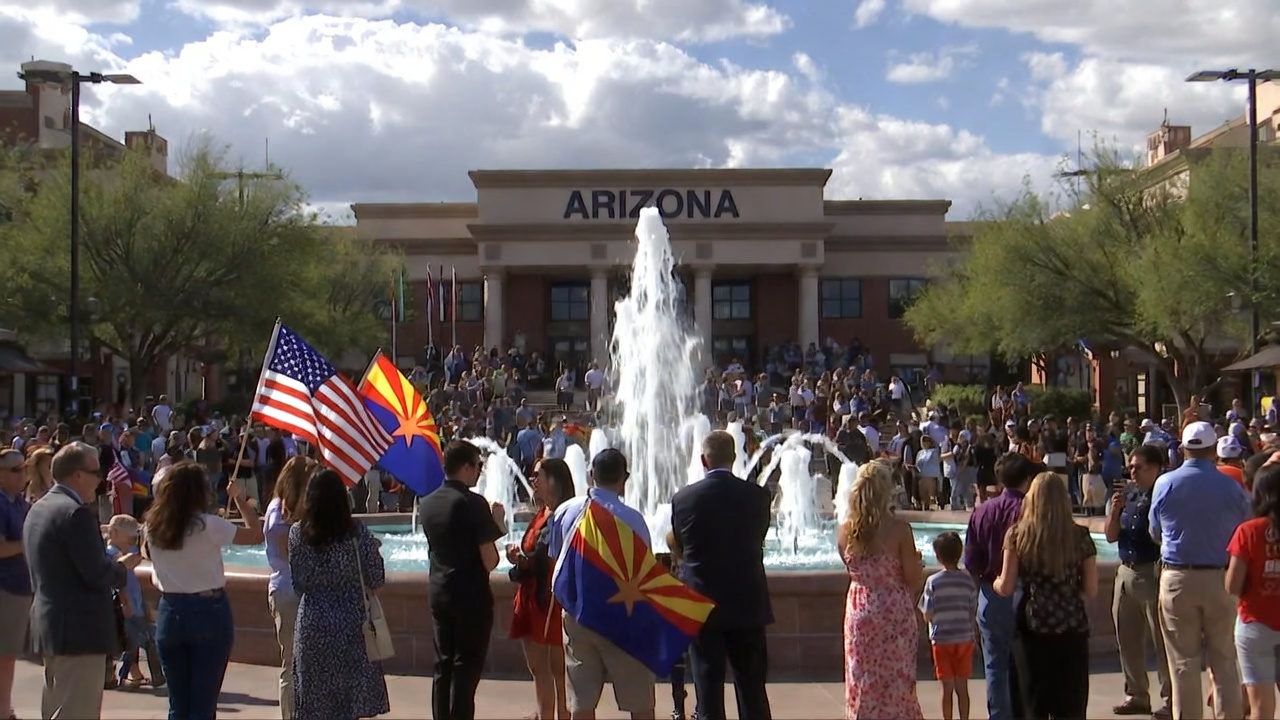
Arizona Statehood Day is not just a date on the calendar. It is a state holiday marked by public celebrations, free museum admissions, and ceremonial events. In 2025, Arizona Secretary of State Adrian Fontes hosted a public reception at the State Historic Capitol Rotunda in Phoenix.
According to the Arizona Secretary of State’s Office, the ceremony featured a recitation of the original statehood proclamation issued by President Taft and a display of the original Arizona State Constitution. The event concluded with cake, coffee, and children’s activities.
In 2026, the Arizona Historical Society is hosting a free open house from 10:00 AM to 3:00 PM at the Arizona History Museum in Tucson. These events give residents and visitors a chance to connect with Arizona’s rich and complex past.
The celebrations also connect to a larger national milestone. In partnership with the America250 Arizona Commission, the state is previewing events for America’s upcoming 250th anniversary in 2026 — linking Arizona’s statehood story to the broader American narrative.
10. Arizona Was Once Part of the Confederacy During the Civil War
This may be the most surprising fact of all. Before Arizona was a state — and before it was even an official U.S. territory — part of Arizona briefly belonged to the Confederate States of America.
At the start of the Civil War, the southern portion of the New Mexico Territory (which included present-day southern Arizona) voted to secede from the Union in March 1861. The Confederacy formally claimed the region as the Confederate Territory of Arizona on August 1, 1861.
The Battle of Picacho Pass, fought on April 15, 1862, near present-day Tucson, was the westernmost battle of the Civil War. Union soldiers from California clashed with Confederate troops from Tucson in a brief but significant engagement.
By July 1862, Union forces had reclaimed the territory. The following year, President Abraham Lincoln signed the Organic Act on February 24, 1863, creating the official U.S. Territory of Arizona — with boundaries that would eventually become the state lines we know today.
As 12 News noted, many of Arizona’s early political leaders were Confederate sympathizers or former Confederates themselves. This complicated legacy is an essential, if uncomfortable, part of understanding why Arizona’s path to statehood took so long.
How to Celebrate Arizona Statehood Day in 2026
Arizona Statehood Day on February 14, 2026 falls on a Saturday, making it an ideal time for celebrations and outings. Here are some ways to mark the occasion:
- Visit the Arizona History Museum in Tucson for a free open house
- Explore the State Capitol Museum in Phoenix and see historical exhibits
- Hike the Arizona Trail or visit Grand Canyon National Park to appreciate the state’s natural beauty
- Sample Arizona cuisine — Sonoran hot dogs, chimichangas, and prickly pear treats are local favorites
- Learn about Arizona’s 22 Indigenous nations, whose presence on this land predates statehood by thousands of years
- Watch programming on Arizona PBS, which airs special statehood-themed content every February 14
Arizona Statehood Day: A Holiday That Shares Its Date With Love
Arizona’s birthday falling on Valentine’s Day is a happy accident — but Arizonans have embraced it fully. The state’s journey from remote frontier territory to the 14th most populous state in America is a story of resilience, rebellion, and reinvention.
From its defiant rejection of joint statehood with New Mexico, to its clever restoration of judicial recall after tricking President Taft, to its trailblazing record of female governors — Arizona has never been a state that follows the crowd.
So on February 14, 2026, while the rest of the country exchanges valentines, spare a thought for the Valentine State. Arizona earned its statehood the hard way. And 114 years later, it’s still writing its own rules.