Every year on February 3, Vietnam marks the founding anniversary of the Communist Party of Vietnam (CPV). In 2026, this date carries special weight. It is the 96th anniversary — and it arrives just days after the landmark 14th National Party Congress wrapped up in Hanoi on January 23. General Secretary Tô Lâm was unanimously re-elected. The economy grew 8.02% in 2025. And the country has declared that it is entering a bold “Era of National Rise.”
For travelers, historians, and anyone curious about Southeast Asia’s most dynamic nation, the 96th anniversary offers a rare window into Vietnam’s identity. This is a country shaped by revolution, war, reform, and renewal — all guided, for better or worse, by the single political party that has ruled for nearly a century.
This guide tells that story. We will walk through the founding of the Communist Party of Vietnam in 1930, the decades of struggle that followed, the Đổi Mới economic reforms that transformed the nation, and the current political moment under Tô Lâm’s leadership. We will also share practical tips for visitors who want to experience Vietnam during this season of patriotic celebration and Lunar New Year festivity.
Let us begin.
What Is the Communist Party of Vietnam Founding Anniversary on February 3?
The Communist Party of Vietnam Founding Anniversary falls on February 3 every year. It commemorates the day in 1930 when revolutionary leader Nguyễn Ái Quốc — the name Hồ Chí Minh used during his years abroad — presided over the unification of several communist factions into a single party.
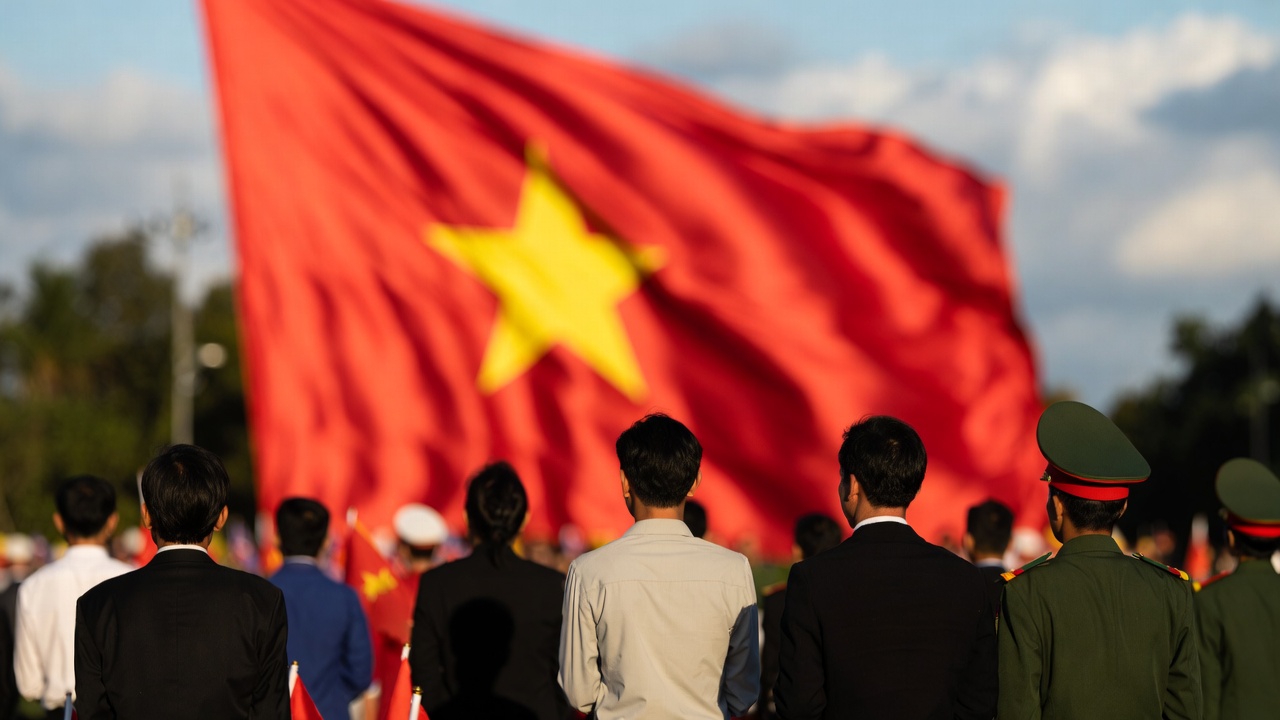
This is not a public holiday in Vietnam. Workers and students do not get a day off. However, it is a deeply observed political occasion. Government buildings fly the national flag alongside the Party flag. State media publish special editorials. Ceremonies are held in Hanoi, Hồ Chí Minh City, and provincial capitals. Art programs, exhibitions, and cultural events honor the Party’s legacy.
In 2026, the anniversary takes on extra meaning. It follows the conclusion of the 14th National Party Congress, held from January 19 to 23 at the Vietnam National Convention Center in Hanoi. The Congress brought together 1,586 delegates representing over 5.6 million Party members nationwide. It elected a new 200-member Central Committee and reaffirmed the nation’s development goals for 2026–2030.
The timing is also notable because February 3, 2026 falls close to Tết Nguyên Đán — the Vietnamese Lunar New Year — one of the most important cultural events in Vietnam. Families reunite. Streets fill with peach blossoms, kumquat trees, and colored lanterns. Fireworks light up the night sky. The overlap of the Party anniversary and Tết season makes early February in Vietnam one of the most vibrant and historically rich times to visit.
How Vietnam Celebrates the 96th Anniversary of the Communist Party
While the founding anniversary is not marked by a national day off, it is observed with solemnity and pride across the country. Here is what you can expect.
Official Ceremonies and Cultural Events in Hanoi and Hồ Chí Minh City
Government officials hold formal ceremonies at key locations. In Hanoi, events typically take place at Ba Đình Square — the same place where Hồ Chí Minh read the Declaration of Independence on September 2, 1945. Senior Party and state leaders deliver speeches. Veterans, “Vietnam Hero Mothers,” and distinguished citizens are honored.
In 2026, one notable event was the inauguration of a memorial house dedicated to President Hồ Chí Minh at the E2 Hill historical site in Điện Biên Province. General Secretary Tô Lâm attended the ceremony on January 31. The memorial house, funded by Hồ Chí Minh City with an investment of approximately VNĐ 35 billion (US$1.35 million), features a 1.33-meter-tall seated bronze statue of Hồ Chí Minh weighing over 500 kilograms. Officials described the site as a “red address” for patriotic education.
The National Library of Vietnam also opened an exhibition titled “The Communist Party of Vietnam Through Its National Congresses” to mark both the 96th anniversary and the success of the 14th Party Congress.
Overseas Vietnamese Communities Mark the Occasion
Vietnamese embassies and consulates around the world also observe the anniversary. In 2026, the Vietnamese Embassy in France hosted a ceremony in Paris, where Ambassador Nguyễn Thị Vân Anh highlighted the CPV’s 96-year journey and its role in advancing Vietnam’s international standing. A separate event themed “Radiant Vietnam” was organized by the Vietnamese Consulate General in Osaka, Japan.
What Travelers Can See and Do
If you are visiting Vietnam around February 3, you will notice patriotic banners and flags throughout major cities. State television broadcasts special documentaries. Museums — especially the Hồ Chí Minh Museum and the Vietnam National Museum of History in Hanoi — often host special exhibitions.
The atmosphere is festive rather than somber. Combined with Tết celebrations, the streets buzz with energy. Flower markets overflow with blooms. Families share traditional dishes like bánh chưng (square sticky rice cake) and bánh tét (cylindrical sticky rice cake). It is an excellent time to experience the deep connection between Vietnamese political identity and cultural life.
How Was the Communist Party of Vietnam Founded in 1930: The Full History
To understand the 96th anniversary, you must understand what Vietnam looked like in the early 20th century.
Vietnam Under French Colonial Rule: The Roots of Revolution
By the late 1800s, France had established control over Vietnam, Laos, and Cambodia under the colonial entity known as French Indochina. Vietnamese people faced heavy taxation, forced labor, land seizures, and strict limits on political freedom. Indigenous culture and education were suppressed. Resentment grew steadily among all classes of society — from peasant farmers to educated elites.
Several nationalist movements rose and fell during this era. Some looked to Confucian scholars for leadership. Others took inspiration from Japan’s Meiji Restoration or China’s republican revolution under Sun Yat-sen. But none succeeded in uniting the fragmented resistance into a durable political force.
Nguyễn Ái Quốc and the Path to Communism
The man who would eventually unite these threads was born Nguyễn Sinh Cung in 1890 in Nghệ An Province, central Vietnam. He left Vietnam in 1911, working aboard ships and traveling through France, England, the United States, and the Soviet Union.
In December 1920, while living in Paris, he attended the 18th Congress of the French Socialist Party in Tours. He voted in favor of joining the Communist International (Comintern), making him one of the founding members of the French Communist Party — and the first Vietnamese communist.
Through the 1920s, Nguyễn Ái Quốc (as he was then known) built connections with revolutionary movements across Asia. In June 1925, he founded the Vietnamese Revolutionary Youth League (Việt Nam Cách Mạng Thanh Niên) in Guangzhou, China. This organization trained young Vietnamese revolutionaries and sent them back home to organize and agitate against colonial rule.
The 1930 Unification Conference in Hong Kong
By 1929, the Vietnamese revolutionary movement had fractured into three competing communist groups: the Indochinese Communist Party, the Communist Party of Annam, and the Communist League of Indochina. Each had its own leadership and base of support. Their rivalry was counterproductive.
Acting on behalf of the Communist International, Nguyễn Ái Quốc convened a unification conference in Kowloon, Hong Kong, from January 6 to February 7, 1930. The conference was held at Wah Yan College. Representatives from the competing factions agreed to merge into a single organization: the Communist Party of Vietnam (Đảng Cộng sản Việt Nam).
The conference adopted several founding documents: an Abridged Political Platform, an Abridged Strategy, an Abridged Workplan, and an Abridged Statute. These texts laid the groundwork for the Party’s revolutionary policies and organizational methods.
Shortly after, at the request of the Comintern, the party changed its name to the Indochinese Communist Party (Đảng Cộng sản Đông Dương) to reflect its broader regional scope. But the founding date — February 3, 1930 — has been celebrated as the official anniversary ever since. The decision to mark February 3 was formally confirmed at the Third National Party Congress in September 1960.
Hồ Chí Minh and the August Revolution: From Party Founding to National Independence
The years between 1930 and 1945 were tumultuous. The young Party faced French repression, internal debate, and the upheaval of World War II.
The Nghệ-Tĩnh Soviet Movement and Early Struggles (1930–1931)
Within months of the Party’s founding, Vietnam was shaken by a wave of peasant uprisings. Poor harvests in 1929 and 1930, combined with crushing debt and colonial exploitation, radicalized many rural communities. In Nghệ An and Hà Tĩnh provinces, peasants formed “soviets” — self-governing councils that challenged French authority.
The French responded with brutal force. The movement was suppressed, and hundreds of Party members were arrested or killed. But the Nghệ-Tĩnh Soviets became a powerful symbol of revolutionary potential.
World War II and the Founding of the Việt Minh (1941)
When Japan occupied Vietnam during World War II, the colonial order was upended. In May 1941, Hồ Chí Minh (as he now called himself) established the Việt Minh (Việt Nam Độc Lập Đồng Minh Hội — League for the Independence of Vietnam). This was a broad nationalist front that included communists and non-communists alike. Its goal was simple: independence from both Japanese and French rule.
The Việt Minh organized guerrilla forces, built a rural support base, and positioned itself as the legitimate voice of Vietnamese nationalism.
The August Revolution and the Declaration of Independence (1945)
When Japan surrendered on August 15, 1945, a power vacuum opened across Indochina. The Việt Minh moved swiftly. In a coordinated uprising known as the August Revolution, they seized power in cities and provinces across Vietnam.
On September 2, 1945, standing before hundreds of thousands of people gathered at Ba Đình Square in Hanoi, Hồ Chí Minh read the Declaration of Independence of the Democratic Republic of Vietnam. He famously opened with words borrowed from the American Declaration of Independence: “All men are created equal. They are endowed by their Creator with certain inalienable rights; among these are Life, Liberty, and the pursuit of Happiness.“
Vietnam had declared itself a sovereign nation. But the fight for true independence was far from over.
Key Milestones in the 96-Year History of the Communist Party of Vietnam
The CPV’s history spans wars, peace, crisis, and transformation. Here are the essential chapters.
| Year | Milestone |
|---|---|
| 1930 | Communist Party of Vietnam founded in Hong Kong |
| 1941 | Việt Minh front established by Hồ Chí Minh |
| 1945 | August Revolution; Declaration of Independence |
| 1946–1954 | First Indochina War against France |
| 1954 | Victory at Điện Biên Phủ; Geneva Accords divide Vietnam |
| 1955–1975 | Vietnam War (Second Indochina War) |
| 1969 | Death of Hồ Chí Minh |
| 1975 | Fall of Saigon; reunification of Vietnam |
| 1976 | Party renamed Communist Party of Vietnam |
| 1986 | Đổi Mới (Renovation) reforms launched |
| 1995 | Vietnam joins ASEAN; normalizes relations with the United States |
| 2007 | Vietnam joins the World Trade Organization (WTO) |
| 2024 | General Secretary Nguyễn Phú Trọng passes away; Tô Lâm assumes leadership |
| 2025 | Vietnam’s GDP grows 8.02%; GDP per capita exceeds US$5,000 |
| 2026 | 14th Party Congress held; 96th founding anniversary; Tô Lâm unanimously re-elected |
The First Indochina War and Điện Biên Phủ (1946–1954)
France attempted to reassert colonial control after World War II. A brutal eight-year war ensued. The decisive battle came at Điện Biên Phủ in 1954, where Việt Minh forces under General Võ Nguyên Giáp defeated the French garrison. The Geneva Accords that followed divided Vietnam at the 17th parallel into a communist North and a Western-backed South.
The Vietnam War and Reunification (1955–1975)
The division did not bring peace. A protracted war followed, involving North Vietnam, South Vietnam, the United States, China, and the Soviet Union. The conflict killed millions of Vietnamese on all sides and left the country physically and economically devastated.
On April 30, 1975, North Vietnamese forces captured Saigon (now Hồ Chí Minh City), ending the war and reunifying the country under communist rule. This date is celebrated annually as Reunification Day in Vietnam.
Post-War Crisis: Why Vietnam Needed Economic Reform
Reunification brought new challenges. The Party attempted to impose a Soviet-style planned economy on the entire country. Agricultural collectivization was enforced in the South. Private enterprise was suppressed. International isolation deepened due to U.S. trade embargoes and the costly military occupation of Cambodia.
The results were dire. Inflation soared past 700%. Food shortages became chronic. The economy stagnated. By the mid-1980s, Vietnam was one of the poorest countries in the world, with a GDP per capita estimated between US$200 and US$300.
Đổi Mới Economic Reforms 1986: How Vietnam Transformed from Poverty to Growth
The most important turning point in the CPV’s post-war history came in December 1986 at the Sixth National Party Congress. Under new General Secretary Nguyễn Văn Linh, the Party launched a sweeping program of economic and political reform known as Đổi Mới — meaning “Renovation” or “Renewal.”
What Were the Key Đổi Mới Reforms?
Đổi Mới was not a single policy. It was a fundamental shift in how the Party governed the economy. The main reforms included:
- Decollectivizing agriculture. Farmers gained the right to use land privately and sell their products on the open market. The results were immediate. By 1989, Vietnam went from chronic food shortages to exporting 1.4 million tons of rice — becoming one of the world’s top rice exporters almost overnight.
- Encouraging private enterprise. The state retreated from direct management of many industries. New laws allowed the establishment of private businesses and reduced bureaucratic barriers.
- Attracting foreign direct investment (FDI). Vietnam’s first Foreign Investment Law was promulgated in December 1987. This opened the door to multinational companies and joint ventures.
- Liberalizing trade. Price controls were removed. The Vietnamese đồng was devalued to encourage exports. Trade restrictions were lifted.
- Reforming state-owned enterprises. While the state sector remained large, the government began to streamline and restructure inefficient state companies.
The Economic Miracle: From US$95 to Over US$5,000 GDP Per Capita
The scale of Vietnam’s economic transformation is remarkable. Before Đổi Mới, GDP per capita was estimated at around US$95 in 1990. By 2000, it had reached US$390. By 2010, Vietnam had achieved lower middle-income status. And by the end of 2025, GDP per capita surpassed US$5,026 for the first time.
Vietnam’s GDP grew from approximately US$6.5 billion in 1990 to an estimated US$514 billion in 2025 — nearly an eighty-fold increase in 35 years.
Poverty reduction has been equally dramatic. In 1990, roughly 60% of the population lived in poverty. By 2020, that figure had dropped to single digits. The World Bank has cited Vietnam as one of the most successful examples of poverty reduction in modern development history.
International Integration After Đổi Mới
Đổi Mới also transformed Vietnam’s place in the world. Key milestones of international integration include:
- 1995: Vietnam joined the Association of Southeast Asian Nations (ASEAN) and normalized diplomatic relations with the United States.
- 2000: Vietnam signed its first bilateral trade agreement with the United States.
- 2007: Vietnam became a member of the World Trade Organization (WTO), opening its markets further to global trade.
- 2018: Vietnam signed the Comprehensive and Progressive Agreement for Trans-Pacific Partnership (CPTPP), a major multilateral trade deal.
These steps helped Vietnam attract massive flows of foreign investment. In 2025, foreign-invested enterprises accounted for 77.3% of total exports, with shipments valued at approximately US$367 billion.
Vietnam Economic Growth 2025 and GDP Forecast for 2026: What the Numbers Show
Vietnam entered 2026 on a strong economic foundation. Understanding the current data is essential context for the 96th anniversary — because the Party stakes much of its legitimacy on economic performance.
Vietnam’s 2025 GDP Growth: The Second-Highest in 15 Years
According to Vietnam’s National Statistics Office, the country’s GDP grew 8.02% in 2025. The economy’s total size reached approximately US$514 billion, an increase of about US$38 billion from the previous year. This was the second-highest annual growth rate since 2011.
Growth accelerated throughout the year, rising from 7.05% in the first quarter to 8.46% in the fourth quarter — the highest Q4 growth recorded during the 2011–2025 period.
Key sectors driving this performance included:
| Sector | Growth Rate (2025) | Share of GDP Growth |
|---|---|---|
| Services | 8.62% | 51.08% |
| Industry & Construction | 8.95% | 43.62% |
| Agriculture, Forestry & Fisheries | 3.78% | 5.30% |
Inflation remained under control at 3.31%. Bank credit growth reached nearly 18%. More than one million active enterprises were registered nationwide by the end of 2025.
Vietnam’s Ambitious 10% GDP Growth Target for 2026
For 2026, the Vietnamese government has set an extraordinarily ambitious target of at least 10% GDP growth. General Secretary Tô Lâm personally championed this goal during the 14th Party Congress, framing it as essential for Vietnam’s “Era of National Rise” and the longer-term vision of becoming a high-income, developed nation by 2045.
During the National Assembly’s 10th session, legislators approved a resolution targeting GDP growth of 10% or higher in 2026, with per capita income expected to reach US$5,400 to US$5,500.
International observers have been cautiously optimistic. The World Bank’s March 2025 forecast projected 6.5% growth for 2026, significantly below Vietnam’s official target. Dr. Can Van Luc, Chief Economist at BIDV and a member of the Prime Minister’s Economic Advisory Council, forecast a more bullish 9–10% growth rate, pointing to planned public investment disbursement of about US$34–35 billion — representing roughly 7% of GDP, the highest public investment ratio in Asia.
Whether or not Vietnam reaches the 10% target, the economic trajectory is clear: this is a nation on the move.
The 14th National Party Congress January 2026: What Happened and Why It Matters
The 14th National Congress of the Communist Party of Vietnam was held from January 19 to 23, 2026, at the Vietnam National Convention Center in Hanoi. It was the most significant political event in Vietnam’s five-year cycle.
Congress Structure and Delegates
The Congress brought together 1,586 delegates from across the country. Its primary tasks were to review the performance of the 13th Central Committee (2021–2025), approve strategic direction for 2026–2030, amend the Party Charter, and elect new leadership for the coming term.
Tô Lâm Re-Elected as General Secretary of Vietnam’s Communist Party
The headline outcome was the unanimous re-election of Tô Lâm as General Secretary. He received 180 out of 180 votes from the newly elected Central Committee members. This marked his continuation as the country’s most powerful political figure.
Tô Lâm, 68, from Hưng Yên Province, is a career public security official who rose through the ranks of the Ministry of Public Security. He assumed the role of General Secretary in 2024 following the death of his predecessor, Nguyễn Phú Trọng, in July of that year. Under Trọng, Lâm had overseen a sweeping anti-corruption campaign that removed dozens of senior officials — including two former presidents and a parliamentary chairman.
In his speech at the Congress, Lâm emphasized the need to “face the truth squarely and assess the situation accurately.” He pledged to push for annual GDP growth of at least 10% through 2030 and highlighted the private sector as one of the economy’s “most important driving forces” — a notable shift for a communist state.
Key Policy Directions for 2026–2030
The Congress adopted several strategic priorities for the next five-year term:
- Economic modernization: Transition from growth driven by cheap labor toward growth anchored in technology, digital infrastructure, and innovation.
- Private sector elevation: Policy documents described the private sector as a critical engine of economic growth — the strongest language the Party has used on this topic.
- Digital transformation: Accelerated investment in AI, data governance, and e-government.
- Environmental protection: Elevated to a “central” task alongside economic and social development.
- International integration: Multilateral diplomacy designated as a “major and strategic direction.”
- Anti-corruption: Continuation of the disciplinary campaign, though some analysts noted it had slowed compared to the Trọng era.
The Congress elected a new 19-member Politburo and a 200-member Central Committee (180 full members and 20 alternate members). This leadership lineup will guide Vietnam through its most ambitious development phase yet.
Who Is Tô Lâm: Vietnam’s General Secretary and His Vision for the Country
Understanding Tô Lâm is essential to understanding Vietnam in 2026.
From Security Chief to Party Leader
Born in 1957, Tô Lâm spent most of his career in Vietnam’s public security apparatus. He served as Minister of Public Security from 2016 to 2024, overseeing the intelligence and domestic security services. He was a key executor of the “Blazing Furnace” anti-corruption campaign initiated by Nguyễn Phú Trọng, which reshaped the Party’s upper ranks.
When Trọng passed away in July 2024 after a prolonged illness, Lâm was selected as his successor. The transition was smooth by Vietnamese political standards, but analysts noted that Lâm was consolidating power in a way that departed from Vietnam’s tradition of collective leadership among the so-called “Four Pillars” — the General Secretary, President, Prime Minister, and National Assembly Chairman.
The “Era of National Rise”
Lâm’s signature slogan is the “Era of National Rise” (Kỷ nguyên vươn mình của dân tộc). He envisions Vietnam becoming a developing country with modern industry and upper-middle income by 2030, and a developed, high-income nation by 2045. These goals were formally adopted by the 14th Party Congress.
To achieve this, Lâm has pushed for faster administrative reform, reduced bureaucratic barriers, and stronger engagement with the global economy. His government has also introduced a significant policy allowing private companies to play a larger role in infrastructure, energy, and industrial projects — sectors traditionally dominated by state-owned enterprises.
Vietnam Travel Guide for the Communist Party Anniversary and Tết Season in February
February is one of the most exciting — and most challenging — months to visit Vietnam. The convergence of the Party founding anniversary and Tết creates a unique cultural atmosphere.
Best Places to Experience the Anniversary Celebrations
- Hanoi: The political heart of the country. Visit the Hồ Chí Minh Mausoleum, the Hồ Chí Minh Museum, and Ba Đình Square. The Old Quarter comes alive with Tết decorations and flower markets.
- Hồ Chí Minh City: The Reunification Palace (formerly Independence Palace) and the War Remnants Museum provide rich historical context. Nguyễn Huệ Walking Street hosts celebrations and street performances.
- Điện Biên Phủ: The site of the famous 1954 battle. In 2026, the new Hồ Chí Minh Memorial House at the E2 Hill historical site adds an important stop for history-focused travelers.
Travel Tips for Vietnam During Tết and Early February
| Tip | Details |
|---|---|
| Book early | Hotels, trains, and flights fill up weeks before Tết. Prices spike. |
| Expect closures | Many small shops, restaurants, and businesses close for 3–7 days around Tết. |
| Transportation challenges | Millions of Vietnamese travel home for the holiday. Roads and stations are crowded. |
| Embrace the festivities | Join locals at flower markets, watch lion dances, and try seasonal foods like bánh chưng. |
| Dress respectfully at memorials | Cover shoulders and knees when visiting the Hồ Chí Minh Mausoleum or pagodas. |
| Learn a few words | “Chúc Mừng Năm Mới” (Happy New Year) will earn warm smiles everywhere. |
Other Festivals Near the Anniversary Date
Early February often overlaps with several cultural events:
- Tết Nguyên Đán (Lunar New Year): The biggest holiday in Vietnam. Multi-day celebrations, fireworks, and family reunions.
- Lim Festival: Held in Bắc Ninh Province (about an hour from Hanoi), this festival features quan họ folk songs — a UNESCO-recognized tradition — performed by men and women from dragon boats on a lake. Usually falls in February.
- Perfume Pagoda Festival: A pilgrimage festival southwest of Hanoi that begins in the first lunar month and can run through early spring.
How the Communist Party of Vietnam Shaped Modern Vietnamese Culture and Identity
The CPV is not only a political entity. Over 96 years, it has deeply influenced Vietnamese culture, education, social values, and national identity.
The Legacy of Hồ Chí Minh in Vietnamese Daily Life
Hồ Chí Minh — often called “Bác Hồ” (Uncle Hồ) by Vietnamese people — remains the most revered figure in the country. His image appears on every denomination of Vietnamese currency. His mausoleum in Hanoi draws millions of visitors each year. His birthday (May 19) is marked with nationwide events.
The Party has promoted “Hồ Chí Minh Thought” as a guiding ideology alongside Marxism-Leninism. In practice, this emphasizes patriotism, self-reliance, moral integrity, and service to the people. Whether one agrees with the Party’s political system or not, the personal mythology of Hồ Chí Minh is deeply woven into Vietnamese identity.
Education and the Party’s Narrative
The Vietnamese education system teaches the Party’s history as a central part of the national story. Students learn about the founding, the wars of independence, and the Đổi Mới reforms. Key dates — February 3, April 30 (Reunification Day), September 2 (National Day) — are embedded in the civic calendar.
Cultural Confidence in a Changing World
As Vietnam has opened to the world economically, its cultural landscape has transformed. Hanoi and Hồ Chí Minh City are cosmopolitan centers with vibrant arts scenes, international cuisine, and a young, tech-savvy population. Over 60% of Vietnamese are under the age of 35.
Yet traditional values endure. Family remains the core social unit. Ancestor worship is practiced across religious lines. Tết is still the most important time of year. The Party positions itself as the guardian of this continuity — linking the revolutionary past to the prosperous future.
Frequently Asked Questions About the Communist Party of Vietnam Anniversary
When was the Communist Party of Vietnam founded? The Communist Party of Vietnam was founded on February 3, 1930, at a unification conference held in Kowloon, Hong Kong, presided over by Nguyễn Ái Quốc (Hồ Chí Minh).
Is February 3 a public holiday in Vietnam? No. The founding anniversary of the Communist Party is not a public holiday. It is a commemorative political occasion observed with ceremonies, media coverage, and cultural events.
Who is the current leader of the Communist Party of Vietnam? As of January 2026, the General Secretary is Tô Lâm, who was unanimously re-elected at the 14th National Party Congress on January 23, 2026.
How many members does the Communist Party of Vietnam have? The CPV has over 5.6 million members, according to figures reported at the 14th Party Congress in January 2026.
What is the Đổi Mới reform? Đổi Mới, meaning “Renovation” or “Renewal,” is the name for the economic reform program launched in 1986 that shifted Vietnam from a centrally planned economy to a market-oriented system, while maintaining one-party political rule.
What is Vietnam’s GDP in 2025? Vietnam’s GDP in 2025 was estimated at approximately US$514 billion, with a growth rate of 8.02% and GDP per capita of US$5,026.
Can tourists visit Vietnam during the Party anniversary and Tết? Yes. February is a wonderful time to visit, but travelers should book accommodations well in advance and be prepared for some business closures during the Tết holiday period.
Understanding Vietnam’s Political System: How the Communist Party Governs Today
For visitors and outside observers, Vietnam’s political system can seem opaque. A brief overview helps make sense of what the anniversary actually celebrates — and what it means in practice.
The Four Pillars of Vietnamese Leadership
Vietnam’s political structure is built around four key positions, sometimes called the “Four Pillars“:
- General Secretary of the Communist Party: The most powerful position. Controls Party direction, ideology, and key personnel decisions. Currently held by Tô Lâm.
- President (State President): The head of state who represents Vietnam in diplomatic and ceremonial functions.
- Prime Minister: The head of government, responsible for day-to-day administration and economic policy. Currently Phạm Minh Chính.
- National Assembly Chairman: The head of the legislature. Currently Trần Thanh Mẫn.
Traditionally, these four roles have been held by four different individuals to maintain a balance of power within the Party. Under Tô Lâm, analysts have noted a possible shift toward greater concentration of power, though the full extent of this remains to be seen.
The Role of the National Assembly
Vietnam’s National Assembly has 500 seats. Elections for the 16th National Assembly are scheduled for March 15, 2026. While all candidates are vetted by the Vietnam Fatherland Front (the Party’s mass organization), there is genuine competition within this framework — multiple candidates often run for each seat, and voters have real choices among approved nominees.
The National Assembly has grown more assertive in recent decades. It debates budgets, questions government ministers, and has occasionally rejected government proposals. Still, major policy direction remains firmly in the hands of the Party leadership.
Why the 96th Anniversary Matters: Vietnam at a Crossroads Between History and Ambition
The 96th anniversary of the Communist Party of Vietnam falls at a defining moment. The country is richer, more connected, and more confident than ever before. GDP per capita has crossed US$5,000. The economy is targeting double-digit growth. A new five-year plan promises modernization, digital transformation, and a stronger private sector.
At the same time, the challenges are real. Vietnam’s growth still relies heavily on exports and foreign investment. Environmental pressures are mounting. Income inequality persists between urban centers and rural provinces. And the question of political reform — how a one-party state governs a rapidly modernizing society — remains unresolved.
The Party itself acknowledges the stakes. At the 14th Congress, General Secretary Tô Lâm set the 100th anniversary of the Party’s founding in 2030 as a major benchmark. By that date, Vietnam aims to be a “developing country with modern industry and high middle income.” The 2045 target — the centennial of national independence — envisions a “developed country with high income.”
These are ambitious goals. Whether or not they are achieved, the 96th anniversary in 2026 marks a moment when Vietnam is looking forward with unusual determination.
For travelers and observers alike, it is a reminder that this small Southeast Asian nation has traveled an extraordinary distance — from colonial subjugation to revolutionary struggle, from wartime devastation to economic miracle, from isolation to global integration.
The story of the Communist Party of Vietnam is, in many ways, the story of Vietnam itself. Ninety-six years on, that story is still being written.
Essential Resources and Further Reading
For those who want to go deeper into the history and current affairs of Vietnam and the CPV, these resources are helpful starting points:
- Vietnam National Congress Website (en.daihoidang.vn) — Official portal for Party Congress documents and historical timelines.
- Vietnam Plus (en.vietnamplus.vn) — English-language news from the Vietnam News Agency, covering politics, economics, and culture.
- Vietnam Briefing (vietnam-briefing.com) — Analysis of Vietnam’s economy, investment climate, and regulatory environment.
- Vietnam Tourism (vietnam.travel) — Official tourism portal with festival guides and destination information.
This guide was researched and written in February 2026 using official government sources, international news reporting, academic studies, and travel resources. All facts have been verified against multiple sources. The author respects Vietnamese culture and presents this information with the aim of fostering cross-cultural understanding.