There is a moment, just before the drums begin, when the entire Munao square in Longchuan County falls silent. Tens of thousands of Jingpo people stand shoulder to shoulder in the early morning chill. The painted Munao Poles — four towering timber columns carved with ferns, swords, mountains, and spiraling migration routes — rise above the crowd like sentinels of an ancient civilization. Then a single gong strike cracks the air. And the earth moves.
This is the Munao Zongge Festival, the grandest traditional celebration of the Jingpo ethnic group in Dehong Dai and Jingpo Autonomous Prefecture, Yunnan Province, China. It is not a performance staged for cameras. It is not a reenactment. It is a living, breathing act of collective memory — a mass dance that traces the ancestral wanderings of the Jingpo people from the Tibetan Plateau to the subtropical valleys of the China–Myanmar border. And it is, without exaggeration, one of the most extraordinary cultural events you can witness anywhere on the planet.
If you are planning to attend the Munao Zongge Festival in 2026, this guide will walk you through everything you need: dates, logistics, cultural context, food, accommodation, etiquette, and day-by-day itineraries. More importantly, it will help you understand why this festival matters — and how to experience it with the respect and curiosity it deserves.
What Is the Munao Zongge Festival and Why Is It Celebrated Every Year in Dehong?
The name Munao Zongge (目瑙纵歌) comes from the Jingpo and Zaiwa languages. It translates roughly to “dancing in mass” or, more poetically, “dance of paradise.” The festival is the single most important cultural event for the Jingpo people, who number approximately 150,000 in China and are concentrated in the mountainous areas of Dehong Prefecture.
The Jingpo are closely related to the Kachin people of northern Myanmar. Dehong shares a 503.8-kilometer border with Myanmar’s Kachin State, and many Kachin from across the border also participate in the festival. The two peoples share language, customs, and kinship ties that predate modern national boundaries.
Historically, the Munao Zongge was held to mark important communal occasions: before setting out for battle, after returning in victory, upon completing a new house, celebrating a marriage, welcoming distinguished guests, or giving thanks for a good harvest. Over time, it evolved into a fixed annual festival, usually beginning on the 15th day of the first month of the Chinese lunar calendar — which places it right after the Lantern Festival and within the broader Chinese New Year period.
In 2006, the Chinese State Council officially added the Munao Zongge Festival to the national list of intangible cultural heritage, recognizing its profound cultural significance. Today the event blends sacred tradition with public celebration. While the ancient rites of sacrifice and shamanic guidance remain at its core, modern additions include musical performances, handicraft exhibitions, food fairs, and cross-border cultural exchanges.
The Origin Legend of the Munao Dance
Every Jingpo child grows up hearing the origin story. In the distant past, nine scorching suns blazed in the sky day and night. Rivers dried up. Crops withered. The Jingpo people, together with the animals and birds of the forest, called an urgent council. One hundred species of birds were chosen as messengers and sent to petition the Sun God.
The birds flew to the celestial palace and sang so beautifully that the Sun God, moved by their voices, destroyed eight of the nine suns. During their time in the palace, the birds witnessed a magnificent group dance performed only in paradise. They memorized every step. When they returned to the green valleys of Dehong — now lush again with fruit-laden trees — they performed the dance in celebration. Jingpo girls passing through the forest saw the birds dancing and learned the steps. From that day forward, the Munao dance has been passed from generation to generation.
It is a story about survival, gratitude, and the sacred connection between the natural world and the human one. When you watch tens of thousands of dancers winding in two great columns around the Munao Poles, you are watching that story come alive.
When Is the Munao Zongge Festival 2026 and How Long Does It Last?
The Munao Zongge Festival begins on the 15th day of the first lunar month each year. In 2026, that date corresponds to approximately Tuesday, March 3. The main celebrations typically last four to five days, running through roughly March 3–7, 2026, though smaller village-level events may extend before and after those dates.
| Detail | Information |
|---|---|
| Festival name | Munao Zongge (目瑙纵歌) |
| 2026 dates (approximate) | March 3–7, 2026 |
| Lunar calendar date | 15th of the 1st month |
| Duration | 4–5 days |
| Main venue | Longchuan County (陇川县), Dehong Prefecture |
| Other celebration sites | Mangshi, Ruili, Yingjiang, Lianghe |
| Ethnic group | Jingpo (景颇族) |
| UNESCO/national heritage status | National Intangible Cultural Heritage (since 2006) |
Important planning note: Because the festival date is based on the lunar calendar, it shifts each year on the Gregorian calendar. Always confirm exact dates with local tourism offices or travel agencies in Dehong before booking. The Dehong Prefecture government typically announces the official schedule in January.
The festival reaches its peak on the first and second days, when the grand opening ceremony and the main mass dances take place. If your schedule is tight, these are the days you cannot miss.
Where Is Dehong Prefecture and How to Get to the Munao Zongge Festival
Understanding Dehong’s Location on the China–Myanmar Border
Dehong Dai and Jingpo Autonomous Prefecture sits in the far west of Yunnan Province, right on the border with Myanmar. The name “Dehong” comes from the Dai language and means “the lower reaches of the Nujiang River.” The prefecture covers about 11,526 square kilometers and includes two cities (Mangshi and Ruili) and three counties (Longchuan, Yingjiang, and Lianghe).
The landscape is dramatic. The Gaoligong Mountains frame the northeast. The southwest slopes gently into subtropical lowlands fed by the Ruili River and the Dayingjiang River. Elevations range from just 210 meters in the Jieyang Valley to 3,404 meters at the peak of Dangniang Mountain. The climate is subtropical monsoon — warm and humid, without harsh winters or scorching summers. In early March, during festival time, daytime temperatures hover around 18–25°C (64–77°F), with cool mornings and evenings.
Flying to Dehong: Mangshi Airport (LUM)
The primary gateway is Dehong Mangshi Airport (IATA: LUM), located about 6.5 kilometers from downtown Mangshi. As of 2025, the airport serves over 20 domestic destinations with airlines including China Eastern, Ruili Airlines, Kunming Airlines, Lucky Air, Sichuan Airlines, and others.
| Route | Approximate Flight Time | Frequency |
|---|---|---|
| Kunming → Mangshi | ~1 hour 10 minutes | ~21 flights daily |
| Chengdu → Mangshi | ~2 hours | Multiple daily |
| Beijing → Mangshi | ~3 hours 50 minutes | Daily |
| Shanghai → Mangshi | ~3 hours 30 minutes | Daily |
| Guangzhou → Mangshi | ~2 hours 30 minutes | Daily |
| Chongqing → Mangshi | ~2 hours | Multiple weekly |
The Kunming–Mangshi route is by far the most popular, accounting for over 80% of all flights. If you are coming from overseas, flying through Kunming Changshui International Airport and connecting to Mangshi is the most efficient route.
From the airport, a shuttle bus runs to downtown Mangshi for about CNY 3, taking approximately 30 minutes. A taxi costs around CNY 35 and takes about 20 minutes.
Getting from Mangshi to Longchuan County
The main Munao Zongge celebrations take place in Longchuan County (陇川县), which is roughly 100 kilometers southwest of Mangshi. Longchuan has the highest concentration of Jingpo people in China and is officially known as “the Hometown of the Munao Dance.”
You have several options to get there:
- Intercity bus: Regular buses run from Mangshi’s North Coach Station to Longchuan. The journey takes approximately 1.5–2 hours and costs around CNY 30–50.
- Private car or taxi: Hiring a car is more flexible, especially during the festival when public transport can be crowded. Negotiate the fare in advance — expect roughly CNY 200–300 for a one-way trip.
- Organized tour: Several Yunnan-based travel agencies offer 4-day Munao Zongge Festival tour packages that include airport transfers, accommodation in Longchuan, and guided participation in the festival.
Driving from Kunming to Dehong
For those who enjoy road trips, the drive from Kunming to Mangshi via the G56 Hangzhou–Ruili Expressway covers roughly 730 kilometers and takes about 9–10 hours. The route passes through spectacular mountain scenery, including sections through Baoshan. Many travelers break the journey with an overnight stop in Baoshan or Tengchong.
The Cultural Significance of the Jingpo Munao Dance Tradition
To properly experience the Munao Zongge, you need to understand what you are witnessing. This is not simply a folk dance festival. It is a living encyclopedia of Jingpo civilization — encoded in movement, music, costume, and carved symbols.
The Munao Poles: Reading the Symbols at the Heart of the Festival
At the center of every Munao dance ground stand four towering wooden poles, each approximately 20 meters high. These poles are the spiritual and visual anchor of the entire festival. They are carved and painted with symbolic patterns that represent the core beliefs, history, and aspirations of the Jingpo people:
- Ferns: Fern sprouts curl like clenched fists and their leaves fan outward like arrows. They symbolize unity and forward progress.
- Swords: The Jingpo are historically a warrior people. Swords represent bravery and resilience.
- The Himalayas: The Jingpo trace their origins to the Qinghai-Tibet Plateau. The mountain motifs recall their epic ancestral migration southward over centuries.
- Crops and livestock: These symbolize the pursuit of prosperity and a good life.
- Gongs and musical instruments: They represent auspiciousness and celebration.
- Spiraling paths: These trace the migration routes of the Jingpo people, from the high plateaus to the valleys of Dehong.
The poles essentially serve as a carved pictorial history book. Standing before them, you are reading a story that stretches back thousands of years.
Twelve Types of Munao Dance
The Munao is not a single dance. There are 12 recognized types, each performed for a different purpose:
- Su Munao — for celebrating a good harvest
- Ba Dang Munao — for celebrating victory in battle
- Dingshuan Munao — for housewarming celebrations
- Deru Munao — war dances and vows before battle
- Tingre Munao — for celebrating site selection and foundation laying
- Naosai Munao — recreational and social dances
- Kenran Munao — wedding dances
- Tingran Munao — dances for making new friends
- Kelong Munao — dances to welcome guests
- Gongran Munao — performed during divorce proceedings
- Zhu Munao — funeral and sacrificial dances
- The Grand Munao Zongge — the mass dance performed at the annual festival
During the festival, the Grand Munao Zongge takes center stage. But you may also see elements of the other forms woven into the program.
The Role of Shamans and Dance Leaders
The mass dance is not a free-for-all. It follows strict choreographic rules that have been handed down for centuries. The dance is led by shamans (known as “Dongsa” or ritual specialists) and their designated assistants, called “Naoshuang” and “Naoba.”
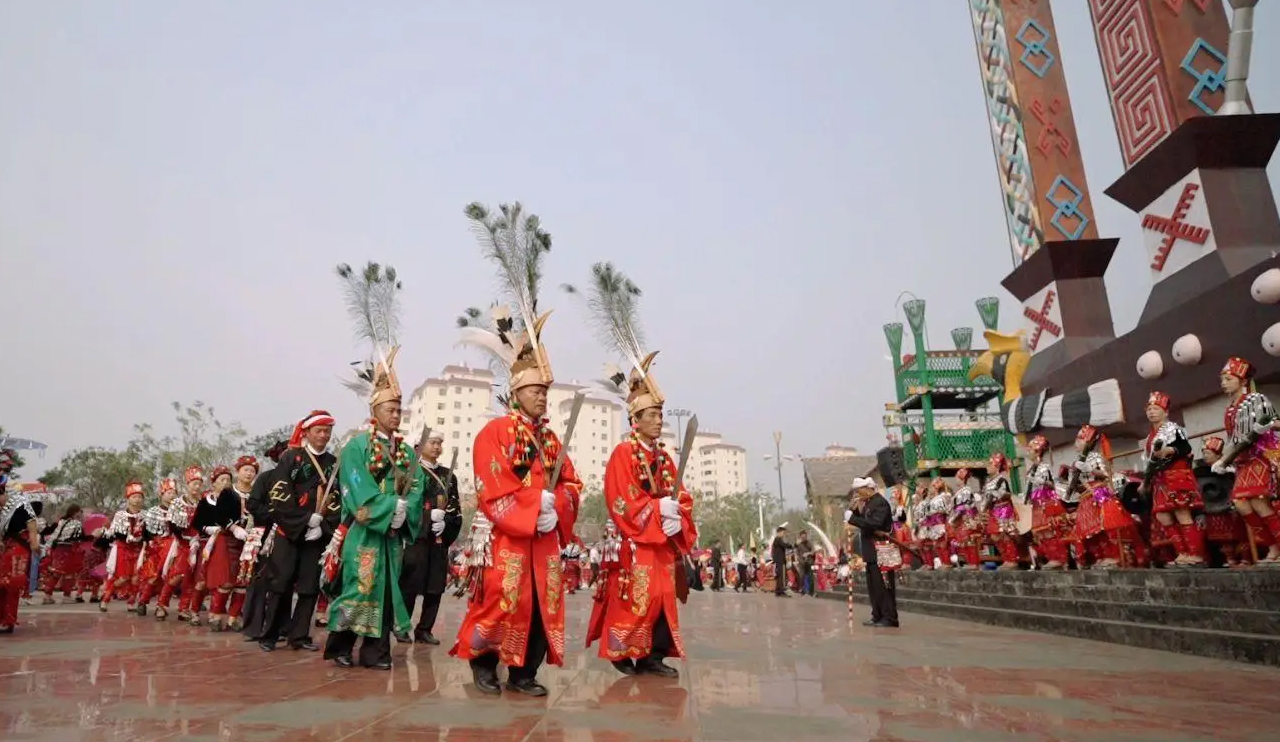
The lead dancers are crowned in a special ceremony before the dancing begins. They wear vintage silk robes, feathered headdresses, and carry gleaming ceremonial swords. These figures stand at the front of the two winding columns, guiding the rhythm and direction of the dance. Traditionally, all 100 or more lead figures must be physically fit and morally upstanding. A chaotic or disorganized dance is considered a bad omen — a sign that misfortune may visit the community.
The dancers move in two enormous, winding columns around the four central poles. The pattern mimics the wandering path of the Jingpo ancestors through mountains and valleys. Men carry long swords. Women carry fans. The rhythm is set by powerful wooden drums, gongs, and the deep pulse of traditional Jingpo music.
When you join the dance — and you will be invited to — follow the person in front of you. Step when they step. The Jingpo believe that dancing together creates spiritual unity and collective good fortune. Your participation is not merely tolerated; it is welcomed as a blessing.
What to Expect Day by Day at the Munao Zongge Festival in Longchuan
While the exact program varies slightly from year to year, the general structure of the festival follows a consistent pattern.
Day 1: The Grand Opening Ceremony and First Mass Dance
The festival opens with a solemn sacrificial ceremony at the Munao square. Jingpo elders and shamans conduct prayers and offerings to ancestor spirits and nature gods, asking for blessings of health, prosperity, and good harvests in the coming year.
After the ritual, the lead dancers — the Naoshuang and Naoba — are officially crowned. Then the drums begin. The first mass dance is considered the most sacred and important. Tens of thousands of people flow into the square, forming the two great columns. The energy is overwhelming. Drums reverberate off the surrounding hills. Silver ornaments flash in the sun. The ground trembles under the collective footfall.
This is the day to arrive early. Stake out a spot near the Munao Poles for the best view.
Day 2: Continued Dancing, Cultural Performances, and Competitions
The second day features more rounds of mass dancing, interspersed with cultural performances. You will see:
- Jingpo Sword Dance — a dynamic, martial performance
- Yinpao Dance — showcasing the grace and beauty of Jingpo women
- Traditional singing — songs that express respect for mountains, rivers, and ancestors
- Sporting competitions — including traditional games and athletic contests
Local and regional officials often attend on Day 2, and there may be formal speeches and cultural award ceremonies.
Days 3–4: Village Celebrations, Food Fairs, and Cross-Border Gatherings
By the third and fourth days, the atmosphere becomes more relaxed and communal. Jingpo families host feasts. The food fair showcases traditional cuisine. Handicraft vendors sell embroidered textiles, silverwork, and woven bamboo goods. Kachin visitors from Myanmar mingle with Chinese Jingpo families. Music continues late into the night.
This is the best time to explore the surrounding Jingpo villages, visit local homes (if invited), and taste home-cooked Jingpo food.
Day 5: Closing Ceremonies and Farewell
The final day features a closing ceremony and a last round of dancing. The mood is bittersweet. Families say goodbye to relatives who have traveled from distant villages or across the border. There is a sense of spiritual renewal — a community recharged and recommitted to its cultural identity.
Traditional Jingpo Food You Must Try During the Munao Zongge Festival
The Jingpo cuisine of Dehong is bold, spicy, and deeply connected to the forests and mountains. It is distinctly different from the sour-forward cooking of their Dai neighbors, and it carries the smoky, pungent flavors of highland Southeast Asian foodways.
The Famous Green Leaf Feast (绿叶宴)
The Green Leaf Feast is the signature communal meal of the Jingpo. Dishes are wrapped and served in fresh banana leaves or other large tropical leaves — no plates, no bowls. The presentation is beautiful and entirely biodegradable. A typical Green Leaf Feast includes:
- Pestled dried beef (舂干巴): The most iconic Jingpo dish. Strips of dried beef are pounded in a mortar with chili, garlic, ginger, and fresh herbs until they form a fragrant, spicy mixture. The texture is chewy, the flavor explosive.
- Bamboo tube rice (竹筒饭): Sticky rice packed into fresh green bamboo tubes and roasted over charcoal. The rice absorbs the delicate, slightly sweet fragrance of the bamboo.
- Bamboo tube chicken: Chicken stuffed into bamboo segments and slow-roasted, yielding incredibly tender meat with a subtle earthy flavor.
- Grilled fish wrapped in banana leaves: River fish seasoned with chili, lemongrass, and wild herbs, then wrapped in leaves and grilled over open flame.
- Wild vegetable salads: Foraged greens dressed with lime juice, chili, and fermented condiments.
Other Must-Try Dishes in Dehong
| Dish | Description |
|---|---|
| Sapie (撒撇) | A tangy, herbaceous Dai dip made with lime juice, bitter herbs, and minced meat |
| Pineapple rice | Fragrant rice stir-fried with diced pineapple, shrimp, and spices, served in a hollowed pineapple shell |
| Dehong barbecue | Street-side grilling of marinated meats, tofu, and vegetables — a beloved evening tradition |
| Cross-Bridge Rice Noodles | The Dehong version features local herbs and fresh hand-pulled noodles in rich broth |
| Jingpo fermented soybean condiments | Tangy, umami-rich side dishes that accompany nearly every meal |
During the festival, food stalls line the streets around the Munao square. Prices are modest. Eating is communal and joyful. Do not be surprised if a Jingpo family waves you over to share their meal. Accepting the invitation is the polite — and delicious — thing to do.
What to Wear and How to Dress for the Jingpo Munao Zongge Festival
Understanding Traditional Jingpo Costume
The visual splendor of the Munao Zongge owes much to the elaborate traditional costumes of the Jingpo people.
Women’s festival costume is especially striking. It typically consists of:
- A collarless black or dark blouse with fitted sleeves
- A brightly colored woven skirt (often red, orange, or pink with intricate geometric patterns)
- Multiple layers of silver jewelry — necklaces, bracelets, earrings, and waist chains
- Embroidered bags and sashes
- A distinctive silver-decorated headdress
The silver ornaments jingle and flash with every dance step. The overall effect is dazzling — a cascade of color and light that transforms the dance square into a shimmering, kinetic tapestry.
Men’s festival costume is more restrained but still elegant:
- A white or dark blue turban
- A round-collar shirt and short dark trousers
- An embroidered shoulder bag
- A long sword carried at the waist — both a ceremonial object and a cultural emblem
What Travelers Should Wear
You do not need to wear traditional costume (though some visitors do rent Jingpo outfits for photos — local shops near the festival ground offer this service). Practical advice:
- Comfortable shoes are essential. You will be standing and walking on unpaved ground for hours. Sturdy sneakers or hiking shoes work best.
- Layers. Early March in Dehong can be cool in the morning (around 10–15°C) and warm by midday (20–25°C). Bring a light jacket you can tie around your waist.
- Sun protection. Hat, sunglasses, and sunscreen. Dehong is sunny, and the Munao square offers little shade.
- Modest, respectful clothing. Avoid overly revealing attire. This is a culturally significant event, not a beach party.
- Rain gear. A compact rain jacket or small umbrella is wise. Subtropical weather can shift quickly.
Best Hotels and Accommodation Near the Munao Zongge Festival in Dehong
Accommodation options in Dehong range from comfortable mid-range hotels to simple guesthouses. Luxury properties are limited. The region’s charm lies in its authenticity, not its five-star resorts.
Staying in Mangshi (Luxi)
Mangshi is the capital of Dehong Prefecture and the most developed city in the region. It offers the widest range of hotels and is well-connected by airport shuttle and bus services. Staying in Mangshi and making day trips to Longchuan during the festival is a practical option.
- Huafeng Peacock Lake Hotel & Resort — the most upscale option in the area, situated by Peacock Lake with good amenities.
- Mangshi Hotel (芒市宾馆) — a well-established mid-range hotel in the city center.
- Various chain hotels — brands like Home Inn and similar Chinese budget chains have properties in Mangshi.
Staying in Longchuan County
For full immersion, staying in Longchuan puts you right at the heart of the festival. Hotels here are simpler but perfectly adequate. During the festival, rooms fill up fast — book at least one to two months in advance.
- Local guesthouses and inns near the Munao square
- Government-run hospitality centers that open extra capacity during the festival
- Homestays arranged through local travel agencies
Staying in Ruili
Ruili City, about 100 kilometers from Mangshi and roughly the same distance from Longchuan, is another base option. It is a lively border town with a wider selection of hotels, including the Jingcheng Dihai Hot-spring Hotel and Resort — Ruili’s only five-star property. Ruili also offers fascinating border-town attractions you can explore before or after the festival.
Pro tip: During the Munao Zongge period, the entire prefecture is buzzing with activity. Book all accommodation early. Do not assume you can find a room on arrival.
Essential Travel Tips for First-Time Visitors to the Munao Zongge Festival
Language and Communication
Mandarin Chinese is widely spoken in Dehong, but many Jingpo people also speak their own language (which belongs to the Tibeto-Burman language family). English is rarely spoken outside of international hotels and organized tours. A few key phrases in Mandarin — or, even better, in Jingpo — will earn you enormous goodwill.
Consider downloading an offline translation app before your trip. Having a Mandarin-speaking friend, guide, or travel companion will significantly enhance your experience.
Money and Payments
Mobile payment (WeChat Pay and Alipay) is ubiquitous in Dehong, even at small street stalls. However, international visitors may find it difficult to set up these services. Bring cash in Chinese yuan as a backup. ATMs are available in Mangshi and Ruili but may be scarce in Longchuan’s rural areas.
Health and Safety
- Altitude: Dehong sits at relatively low elevations (most areas below 1,500 meters), so altitude sickness is not a concern.
- Mosquitoes: The subtropical climate means mosquitoes are present. Bring insect repellent.
- Vaccinations: No specific vaccinations are required for Dehong, but standard travel vaccinations (Hepatitis A, Tetanus) are recommended. Consult your doctor before travel.
- Water: Drink bottled or boiled water. Tap water is not safe for drinking.
- Medical facilities: Mangshi has hospitals and clinics. Longchuan has basic medical facilities. For serious medical needs, Mangshi is the best option.
Photography Etiquette at the Munao Zongge Festival
Photography is generally welcome at the festival — the Jingpo people are proud of their culture and happy to share it. However, observe these courtesies:
- Ask before photographing individuals up close, especially elders, shamans, and families with children.
- Do not disrupt the dance by stepping into the formation for a better angle.
- Avoid flash photography during solemn ritual moments, such as the opening sacrificial ceremony.
- Share your photos if people ask. Many Jingpo festivalgoers appreciate seeing pictures of themselves and will pose happily if you show genuine interest and respect.
- Drones may be restricted. Check with local authorities before flying one.
Exploring Dehong Beyond the Munao Zongge Festival: Top Attractions and Day Trips
The festival is reason enough to visit Dehong. But the prefecture offers much more. If you extend your trip by a few days, these attractions are well worth your time.
Menghuan Grand Golden Pagoda (勐焕大金塔)
Perched atop Leiyaran Mountain beside Peacock Lake in Mangshi, this gleaming golden pagoda is the most photographed landmark in Dehong. It represents the deep roots of Theravada Buddhism among the Dai people of the region. Visit at sunset for the most spectacular views.
Opening hours: 08:30–22:00 Recommended visit time: 1–2 hours
One Village, Two Countries (一寨两国)
Located near Ruili on Provincial Highway 234, this unique Dai village literally straddles the China–Myanmar border. A swing beside the boundary marker lets you ride from one country to the other. It is a charming, lighthearted illustration of the deep cross-border ties that define life in Dehong.
Opening hours: 09:00–18:00 Recommended visit time: 1–2 hours
Moli Tropical Rainforest Scenic Area
This protected area near Ruili offers walking trails through dense subtropical rainforest, past waterfalls and Buddhist shrines. It is a refreshing contrast to the festival crowds — a place of green silence and birdsong.
Opening hours: 08:00–18:00 Recommended visit time: 1–2 hours
Tree-Wrapped Pagoda (树包塔)
In Mangshi, a centuries-old Buddhist brick pagoda has been gradually swallowed by the root system of a massive banyan tree. It is believed to be one of the earliest pagodas built by local Dai people and stands as a powerful symbol of the entwining of nature and faith in Dehong.
Jiegao Border Trade Zone
On the southeast bank of the Ruili River, this bustling trade zone features over 15 shopping streets where Chinese and Burmese merchants sell jade, gemstones, handicrafts, and local products. The largest street is Zhongmian Street. At night, the area transforms into a vibrant night market.
Birdwatching in Yingjiang
Dehong is a premier birdwatching destination, particularly Yingjiang County, home to the famous Yingjiang Hornbill Valley — China’s only reliable site for observing wild hornbills. If you visit during the festival period (early March), you will be in prime birdwatching season.
How the Jingpo People Preserve Their Cultural Heritage Through the Munao Zongge
The Munao Zongge Festival is more than entertainment. It is a deliberate act of cultural preservation by a small ethnic group determined to keep its identity alive in a rapidly modernizing world.
The Jingpo are one of China’s 55 officially recognized ethnic minorities. With only about 150,000 people in China, they are a relatively small community. Their language, customs, and traditional knowledge face the pressures of urbanization, migration, and the gravitational pull of mainstream Han Chinese culture.
The festival serves several critical functions:
It transmits history. The Munao Poles encode the migration routes, totemic beliefs, and epic narrative of the Jingpo people in visual symbols. The dances reenact the ancestral journey. Young Jingpo who participate absorb their heritage through their bodies — through rhythm, movement, and the physical act of dancing beside their elders.
It strengthens community bonds. The festival draws Jingpo from across Dehong, from other parts of Yunnan, and from Myanmar’s Kachin State. It is a reunion — a time when scattered families come together, when old friendships are renewed, and when the Jingpo sense of collective identity is powerfully reaffirmed.
It creates economic opportunity. The festival attracts domestic and international tourists, generating income for local businesses, artisans, and food vendors. The Dehong prefecture government actively promotes the event as a vehicle for sustainable cultural tourism.
It bridges generations. In a world where young people are drawn to cities and smartphones, the festival gives Jingpo youth a visceral, joyful reason to engage with their traditional culture. It is not a museum exhibit. It is a party — a celebration that makes heritage feel alive and relevant.
As Xu Liehong, a 33-year-old Jingpo man, told reporters: he hopes Jingpo culture and traditions will be preserved and inherited. The festival is perhaps the most powerful tool the community has to make that hope a reality.
Responsible Travel Tips: How to Respect Jingpo Culture During the Festival
As a visitor to the Munao Zongge, you are a guest at someone’s most sacred celebration. Here is how to be a good one.
Join the dance when invited. This is not a spectator-only event. When the Jingpo dancers beckon you to join — and they will — step into the column and follow the person in front of you. Your willingness to participate is seen as a sign of respect and friendship.
Do not treat the festival as a costume party. You may be offered the chance to rent or borrow Jingpo clothing for photos. This is fine and often encouraged. But wearing the clothing respectfully — not as a joke or a prop — is essential.
Be mindful during rituals. The opening sacrificial ceremony and the crowning of the Naoshuang and Naoba are solemn occasions. Observe quietly. Do not push to the front. Do not shout or make disruptive noise.
Support local artisans and vendors. Buy handicrafts, embroidery, and food from local sellers. This is the most direct way your visit can benefit the community.
Ask questions with genuine curiosity. The Jingpo are warm, generous people who enjoy sharing their culture. If you approach with respect and real interest, you will find doors opening everywhere.
Learn a few words. Even a simple “Kabu” (a Jingpo greeting) or “Chyeju kaba” (thank you) will light up faces around you.
Do not litter. The Munao square and surrounding areas are culturally significant spaces. Take your trash with you.
Combining the Munao Zongge Festival with a Broader Yunnan Travel Itinerary
Dehong is remote, but that is part of its magic. If you are making the journey to western Yunnan for the festival, consider weaving it into a larger itinerary.
Suggested 10-Day Yunnan and Dehong Itinerary
| Day | Location | Activities |
|---|---|---|
| 1 | Kunming | Arrive, explore Green Lake Park and Yunnan Provincial Museum |
| 2 | Kunming → Mangshi | Fly to Mangshi, visit Tree-Wrapped Pagoda, Menghuan Golden Pagoda |
| 3 | Mangshi → Longchuan | Travel to Longchuan, attend Munao Zongge opening ceremony |
| 4 | Longchuan | Full day at the festival — mass dance, cultural performances |
| 5 | Longchuan → Ruili | Travel to Ruili, explore Jiegao Border Trade Zone |
| 6 | Ruili | One Village Two Countries, Moli Tropical Rainforest |
| 7 | Ruili → Yingjiang | Birdwatching at Hornbill Valley |
| 8 | Yingjiang → Tengchong | Hot springs and volcanic landscapes of Tengchong |
| 9 | Tengchong | Heshun Ancient Town, Beihai Wetlands |
| 10 | Tengchong → Kunming | Fly back to Kunming, depart |
This itinerary combines the festival with border culture, tropical nature, birdwatching, and the volcanic hot springs of Tengchong — offering a comprehensive experience of western Yunnan.
Frequently Asked Questions About Attending the Munao Zongge Festival
Q: Is the Munao Zongge Festival open to foreign tourists? A: Yes. The festival is a public event and foreign visitors are welcome. No special permits are required for the festival itself. However, because Dehong is a border region, you should carry your passport at all times. Some areas near the Myanmar border may require additional documentation.
Q: Can I participate in the dance? A: Absolutely. The Jingpo actively encourage visitors to join. Just follow the line of dancers and match the rhythm. No prior training is needed.
Q: Is the festival safe? A: Yes. The event is well-organized and there is a significant security presence. As with any large gathering, keep an eye on your belongings, but violent crime is extremely rare in Dehong.
Q: Are there ATMs and mobile signals at the festival site? A: Mobile coverage is generally good in Longchuan town. ATMs are available in town, though not directly at the festival site. Bring cash.
Q: What is the best camera for the festival? A: Any camera will do. A wide-angle lens is useful for capturing the scale of the mass dance. A telephoto lens helps for close-up portraits of dancers and their costumes. Smartphone cameras work fine for casual photography.
Q: Can I visit Jingpo villages outside the festival? A: Yes, but always with a local guide or an invitation. Showing up unannounced at a private village is not appropriate. Tour operators in Mangshi and Longchuan can arrange respectful village visits.
Q: Do I need a visa to visit Dehong? A: If you are a foreign national, you will need a valid Chinese visa. Check the latest entry requirements, including any transit visa exemptions, with your nearest Chinese embassy or consulate. As of 2025, China has expanded its visa-free transit policies for citizens of many countries, but rules change frequently — always verify before travel.
The Munao Zongge in the Context of China’s Ethnic Festival Tourism
The Munao Zongge is part of a broader trend in China: the promotion of ethnic minority festivals as vehicles for cultural tourism. Yunnan Province alone is home to 25 officially recognized ethnic groups, each with its own calendar of celebrations. The Water-Splashing Festival of the Dai, the Torch Festival of the Yi, and the Kuoshi Festival of the Lisu are among the most well-known.
What sets the Munao Zongge apart is its authenticity and emotional intensity. Unlike some ethnic festivals that have become heavily commercialized or staged, the Munao Zongge retains a powerful sense of communal purpose. The Jingpo are not performing for tourists. They are dancing for themselves — for their ancestors, for their children, and for the continued survival of their way of life. Tourists are welcome to witness and participate, but the festival’s primary audience is the Jingpo community itself.
This authenticity is what makes it so moving. You will not find a gift shop at the base of the Munao Poles. You will not see a Disney-style recreation of a Jingpo village. What you will see is something rare and precious: a living culture celebrating itself with unrestrained joy.
Packing Checklist for the Munao Zongge Festival in Dehong
Before you go, make sure you have:
- Valid passport and Chinese visa (check latest requirements)
- Cash in Chinese yuan (small bills for food stalls and village purchases)
- Comfortable walking shoes (broken in, closed-toe)
- Layers of clothing (light jacket, short sleeves, long pants)
- Sun protection (hat, sunglasses, SPF 30+ sunscreen)
- Rain jacket or compact umbrella
- Insect repellent
- Reusable water bottle (refill from bottled water)
- Camera and extra batteries/memory cards
- Portable phone charger
- Offline translation app (Mandarin Chinese)
- Basic first-aid kit (band-aids, pain relievers, anti-diarrheal medication)
- Small gifts (if visiting villages — packaged snacks, tea, or small items from your home country are appreciated)
Final Thoughts: Why the Munao Zongge Festival Belongs on Every Traveler’s Bucket List
I have attended festivals on every continent. I have danced at Carnival in Rio, watched fire-walking rituals in Fiji, and stood in the dust of Burning Man. But nothing has moved me quite like the Munao Zongge.
It is the scale — tens of thousands of people dancing as one body, as one heartbeat. It is the sound — the drums that seem to rise from the earth itself, the silver ornaments chiming like a thousand tiny bells. It is the welcome — the Jingpo grandmother who took my hand and pulled me into the line, laughing at my clumsy steps but never letting go.
Most of all, it is the knowledge that this dance is not a performance. It is a prayer. A prayer for rain and harvest. A prayer for peace along a troubled border. A prayer that the children will remember the steps, and their children after them.
Dehong is not easy to reach. That is part of what protects it. The journey demands intention. You must want to be there. And if you make that journey — if you stand in the Munao square at dawn, watching the poles catch the first light, waiting for the gong — you will understand why the Jingpo call it the dance of paradise.
Because for a few days each spring, in the misty western mountains of Yunnan, that is exactly what it is.
Planning your trip? The Munao Zongge Festival in 2026 is expected to take place around March 3–7 in Longchuan County, Dehong Prefecture, Yunnan Province, China. Confirm dates with Dehong Prefecture tourism authorities before booking. Fly into Dehong Mangshi Airport (LUM) via Kunming for the most convenient access.