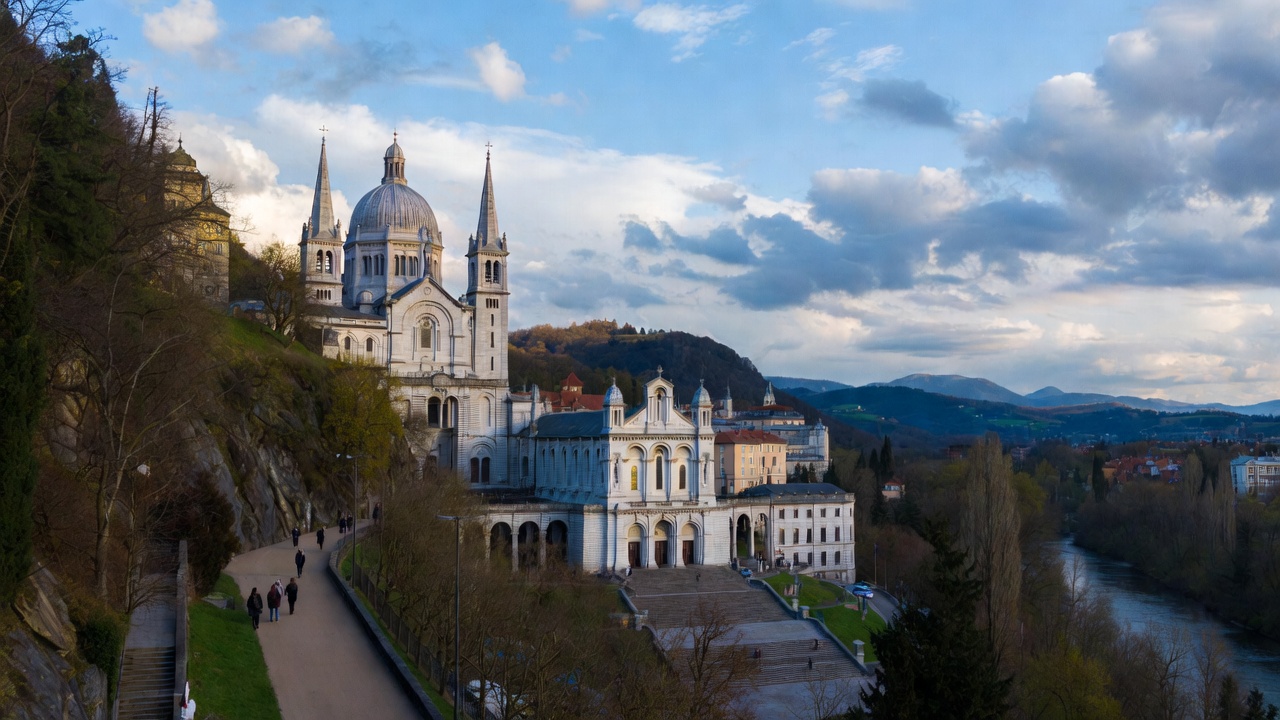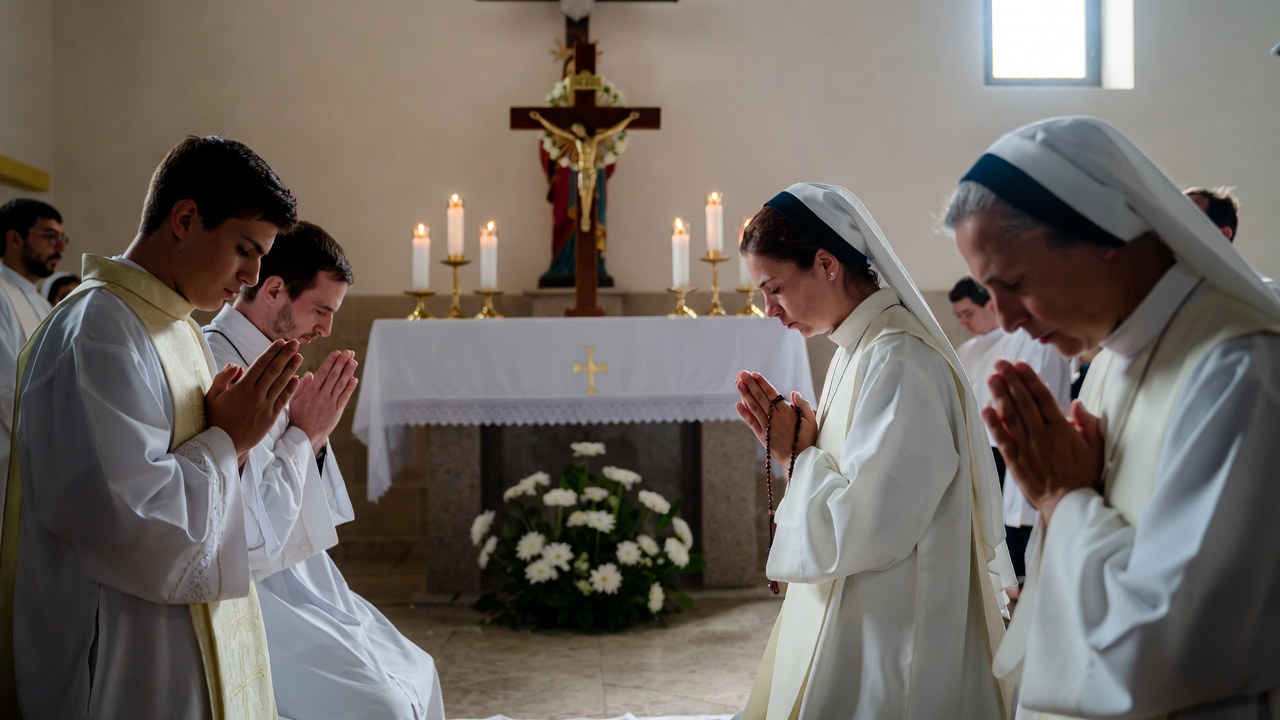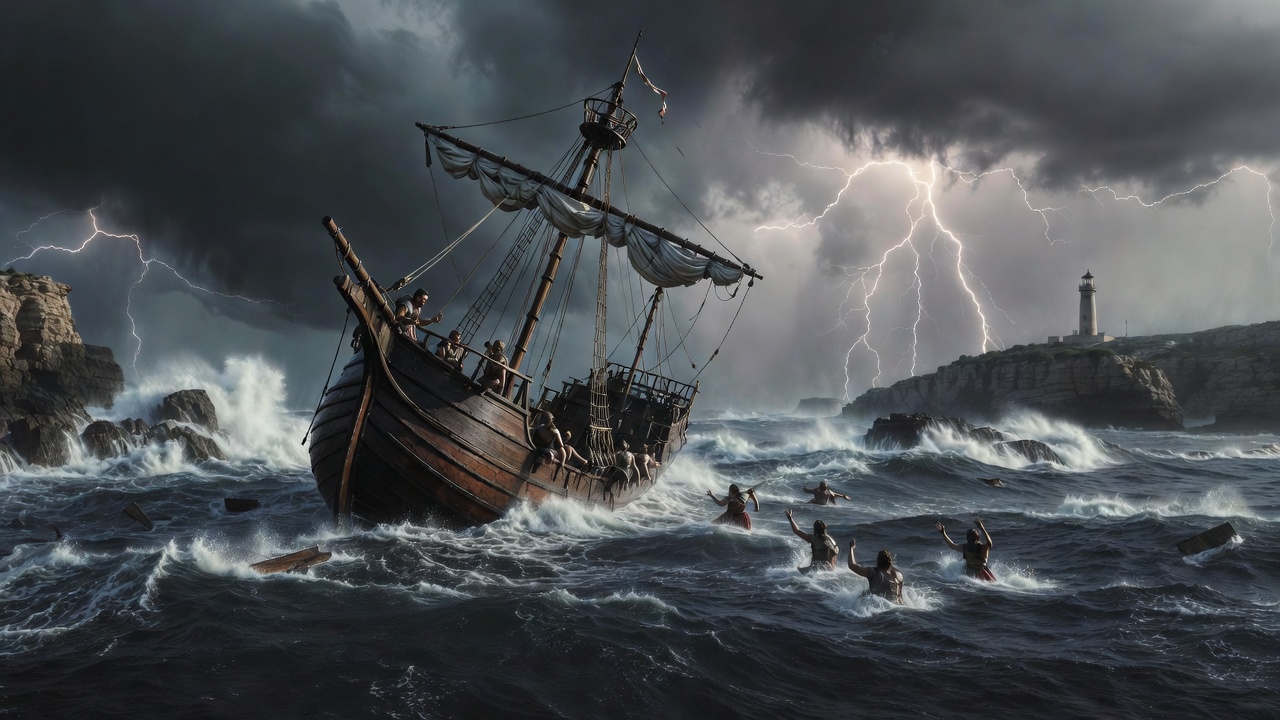
Every February, the narrow limestone streets of Valletta fill with the sound of brass bands, the crack of fireworks over Grand Harbour, and the reverent hush of thousands watching a wooden statue of a saint hoisted onto the shoulders of the city’s strongest men. This is San Pawl Nawfragu — the Feast of St Paul’s Shipwreck — and it is not just a Maltese holiday. It is the founding story of an entire nation’s identity.
Almost two thousand years ago, in roughly 60 AD, a grain freighter carrying 276 souls was torn apart by a Mediterranean storm and driven onto the rocky shores of a small island. Among the survivors was a prisoner named Paul of Tarsus, a man the Roman Empire considered a troublemaker. The local islanders rushed to build fires and offer food. They had no idea that this shipwreck would turn their home into one of Christianity’s earliest outposts — and that their descendants would still be celebrating the event in 2026.
The story is told in remarkable detail in Acts of the Apostles, chapters 27 and 28, written by Luke, a physician and companion of Paul. What makes this account extraordinary is not only its spiritual significance. It is one of the most precise descriptions of ancient seafaring ever recorded. Nautical historians, meteorologists, and underwater archaeologists have studied Luke’s words for centuries, and the evidence continues to surprise them.
This is the true story behind St Paul’s shipwreck — the history, the archaeology, the debate, and the living tradition that still shapes Malta today.
Who Was St Paul the Apostle and Why Was He Sailing to Rome?
Before we follow the ship into the storm, we need to understand the man chained inside it.
Paul of Tarsus (roughly 5–64 AD) was born a Roman citizen in what is now southeastern Turkey. He was a Pharisee by training, a tentmaker by trade, and — after a dramatic conversion on the road to Damascus — the most influential missionary in early Christian history. Over three grueling journeys across the eastern Mediterranean, Paul founded churches in cities from Antioch to Corinth, wrote letters that would become much of the New Testament, and attracted both devoted followers and powerful enemies.
By roughly 58 AD, Paul had returned to Jerusalem, where he was arrested in the Temple compound after a mob accused him of bringing Gentiles into restricted areas. The Roman tribune in Jerusalem, unsure of the charges, transferred Paul to the governor’s seat at Caesarea Maritima on the coast. There, Paul spent two full years in custody under two successive Roman governors — Felix and Festus.
When Festus suggested sending Paul back to Jerusalem for trial — a move Paul considered a death sentence — he exercised a legal right available to every Roman citizen. He appealed to Caesar. Under Roman law, this meant his case had to be heard by the emperor himself, in Rome. Festus had no choice. He arranged for Paul to be transferred by ship, under the custody of a centurion named Julius of the Augustan Cohort.
This is the journey described in Acts 27. Paul was not a free traveler. He was a prisoner under military escort, headed for trial before Emperor Nero. Luke, his physician and companion, traveled with him and recorded every detail of what happened next.
The Voyage from Caesarea to Crete: What Acts 27 Tells Us About Ancient Sailing
Luke’s account of the voyage is remarkably technical. Maritime historians consider it one of the best surviving descriptions of Roman-era seafaring. The details about winds, currents, harbors, and ship handling are so precise that experts have been able to reconstruct the route with confidence.
The voyage began at Caesarea on the coast of modern Israel. Paul, Luke, and a fellow believer named Aristarchus of Thessalonica boarded a coastal vessel from Adramyttium (a port in modern Turkey) that was heading north along the Asian shore. At Sidon, the centurion Julius treated Paul kindly, allowing him to visit friends in the city. From Sidon, the ship sailed north of Cyprus to shelter from headwinds, then worked its way along the southern coast of modern Turkey.
At Myra in Lycia (near present-day Demre, Turkey), Julius transferred his prisoners to a much larger vessel — an Alexandrian grain ship heading for Italy. These grain freighters were among the largest commercial vessels in the Roman world. They carried Egyptian wheat to feed the population of Rome and could hold hundreds of passengers alongside their cargo. The ship carrying Paul had 276 people on board (Acts 27:37).
The grain ship struggled against autumn headwinds. Progress was painfully slow. After many days, they reached the small island of Cnidus off the southwestern tip of Turkey, then gave up trying to sail west and turned south toward Crete. They crept along the southern coast of Crete to a place called Fair Havens (Kaloi Limenes), near the town of Lasea.
Here, a critical decision had to be made. The sailing season was nearly over. Luke records that “the Fast” — the Jewish Day of Atonement, Yom Kippur — had already passed, placing the date in October. Ancient Mediterranean shipping was generally suspended between late October and mid-March because of storms. Paul warned the officers that continuing the voyage would lead to disaster. But the centurion trusted the ship’s captain and pilot more than a prisoner. The majority decided to push on to Phoenix (modern Loutro), a better harbor on Crete’s southern coast, to spend the winter.
They never made it.
Key Ports on Paul’s Voyage to Malta
| Stop | Modern Location | Event |
|---|---|---|
| Caesarea Maritima | Israel | Departure point; Paul as prisoner |
| Sidon | Lebanon | Paul visits friends |
| Myra in Lycia | Demre, Turkey | Transfer to Alexandrian grain ship |
| Cnidus | Datça Peninsula, Turkey | Headwinds force course change |
| Fair Havens (Kaloi Limenes) | Southern Crete, Greece | Paul warns against sailing on |
| Open sea (14 days) | Central Mediterranean | Storm; shipwreck follows |
| Melite (Malta) | Malta | Shipwreck and three-month stay |
The Great Storm of Acts 27: How a Mediterranean Northeaster Destroyed the Ship
What happened next is one of the most dramatic passages in all of ancient literature. Luke describes a fourteen-day ordeal that reads like a modern disaster account, complete with meteorological details that check out perfectly against what we know about autumn storms in the central Mediterranean.
Shortly after leaving Fair Havens, the ship was caught by a violent wind that Luke calls Eurakylōn — a “northeaster” (Acts 27:14). This term appears on a Roman wind-rose discovered in North Africa, confirming it was a recognized weather pattern. The modern equivalent would be a powerful gregale, a northeast gale that strikes the central Mediterranean with particular ferocity in autumn.
The crew could not turn the ship into the wind. Roman grain freighters carried a single large square sail and had limited ability to sail against the wind. The ship was driven helplessly south toward the small island of Cauda (modern Gavdos, south of Crete), where the crew managed to haul aboard the ship’s boat — a small dinghy towed behind the vessel. They also undergirded the ship, passing ropes around the hull to keep it from breaking apart. This technique, called hypozōnnymi in Greek, is well documented in ancient sources and shows that the vessel was already under extreme structural stress.
Their greatest fear was being swept south onto the Syrtis — the treacherous sandbanks off the coast of modern Libya, which were notorious for trapping and destroying ships. To reduce their drift speed, they lowered the sail and set a sea anchor. Even so, the storm did not relent. On the second day, the crew began throwing cargo overboard. On the third day, they threw out the ship’s tackle — spare rigging and equipment.
Luke writes that for many days, neither sun nor stars could be seen. Without celestial navigation, the crew had no idea where they were. All hope of survival was lost.
Then Paul stood up. He told the terrified passengers that an angel had appeared to him in the night with a message: not a single life would be lost, but the ship would be destroyed. They would run aground on an island.
What Meteorologists Say About the Fourteen-Day Drift
The duration and direction of the drift described in Acts 27 have been analyzed by maritime experts. Dr. Graham Hutt, a meteorologist who spent more than thirty years studying Mediterranean weather patterns, confirmed that the storm details in Acts are consistent with known autumn weather systems in the region. A ship disabled by a northeaster south of Crete would drift in a generally northwest direction across the open sea between Crete and Sicily.
The distance from Cauda to the eastern coast of Malta is approximately 476 nautical miles. Based on the known size of Roman grain ships and the typical force of a gregale, experts have calculated an average westward drift rate of roughly 1.5 miles per hour. At that rate, the ship would reach Malta in about thirteen days. Luke records that the ordeal lasted fourteen days (Acts 27:27). The match is remarkably close.
This kind of nautical and meteorological analysis gives scholars confidence in the historical accuracy of Luke’s account. The storm was real. The drift was real. And the island they reached was almost certainly Malta.
Where Did St Paul’s Shipwreck Actually Happen on Malta?
This is where the story gets truly fascinating — and hotly debated.
When dawn finally broke on the fourteenth day, the sailors spotted land they did not recognize. They saw “a bay with a beach” (Acts 27:39) and decided to try to run the ship aground. They cut the anchors loose, untied the steering oars, raised the foresail, and headed for shore.
But before they reached the beach, the ship struck a place where “two seas met” — a sandbar or reef where opposing currents collided. The bow jammed fast and would not move. The stern began to break apart in the pounding waves.
The soldiers wanted to kill the prisoners to prevent them from escaping. But the centurion Julius, wanting to save Paul, stopped them. He ordered everyone who could swim to jump overboard. The rest grabbed planks and floating wreckage. All 276 people made it safely to shore (Acts 27:44).
The Traditional Site: St Paul’s Bay
For roughly five centuries, tradition has placed the shipwreck at St Paul’s Bay (Bajja ta’ San Pawl) on the northeast coast of Malta. This identification was first popularized by scholars in the 1500s and remains the view held by most Maltese today. The bay is a wide inlet that does have a sandy area. A large statue of St Paul, the St Paul’s Islands monument, stands on the rocky islet just offshore.
However, critics point out several problems with this identification. The bay is well-known and would have been familiar to experienced Mediterranean sailors — yet Acts says the crew “did not recognize the land” (Acts 27:39). No physical artifacts from a first-century shipwreck have been found there despite extensive searching. The approach from the southeast, where the storm would have driven the ship, does not match the bay’s northeast orientation.
The Alternative Theory: St Thomas Bay
In recent decades, a compelling alternative has gained attention. Bob Cornuke, a former Los Angeles crime scene investigator turned biblical researcher, argued that the shipwreck occurred at St Thomas Bay (Bajja ta’ San Tumas) on the southeast coast of Malta.
Cornuke treated Acts 27 like a crime scene investigation, listing four criteria from Luke’s text that the shipwreck location must satisfy:
- A bay with a beach — St Thomas Bay has a sandy beach
- A reef or sandbar where “two seas meet” — The Muxnar Reef just outside the bay creates a visible collision of currents
- A water depth of fifteen fathoms (about 90 feet) — Depth soundings at the approach to St Thomas Bay match this figure
- An unfamiliar coast — Sailors approaching from the southeast would not have recognized Malta’s southern shore
The most electrifying piece of evidence came from a retired diver named Ray Ciancio, who told Cornuke that in the early 1960s, divers recovered four anchors at approximately 90 feet of depth just outside St Thomas Bay near Muxnar Reef. These anchors were later donated to the Malta Maritime Museum in Birgu (Vittoriosa), where expert analysis confirmed they were Roman-era anchors from the correct time period.
Acts 27:40 specifically states that the sailors “cut loose the anchors and left them in the sea.” The discovery of four Roman anchors at the exact depth and in a location matching every other detail of Luke’s description is extraordinary, though not all scholars accept the identification.
The Mljet and Kefalonia Hypotheses
Some scholars have argued that the shipwreck did not happen at Malta at all. The Greek text of Acts 28:1 calls the island “Melite” (Μελίτη). While this is widely accepted as a reference to Malta, the name was also historically associated with other islands.
Mljet, a small island off the coast of modern Croatia in the Adriatic Sea, was championed by the Benedictine monk Ignjat Đurđević in 1730. He argued that since Acts 27:27 says the ship was in the “Adriatic Sea”, the shipwreck must have occurred in the Adriatic proper — where Mljet is located.
However, the ancient meaning of “Adria” was much broader than the modern Adriatic Sea. First-century writers, including the historian Josephus, used the term to describe the entire open sea between Crete, Sicily, Italy, and North Africa. Malta sits squarely in this zone. Most scholars today reject the Mljet theory on these grounds.
A more recent theory, advanced by German researcher Heinz Warnecke, placed the shipwreck at Kefalonia in western Greece. Warnecke argued that the locals’ reaction to Paul — calling him a murderer and then a god — fits a Greek-speaking population that worshipped the goddess Dike (justice), and that “barbarians” (barbaroi) in Acts 28:2 better describes the inhabitants of a remote Greek island than the sophisticated Roman citizens of Malta. However, the mainstream scholarly consensus still strongly favors Malta as the site of the shipwreck.
| Proposed Location | Region | Main Argument | Scholarly Consensus |
|---|---|---|---|
| St Paul’s Bay, Malta | Northeast Malta | 500-year tradition | Traditional but debated |
| St Thomas Bay, Malta | Southeast Malta | Matches Luke’s details; Roman anchors found | Growing support |
| Mljet, Croatia | Adriatic Sea | Name “Melite”; “Adriatic Sea” in text | Largely rejected |
| Kefalonia, Greece | Ionian Sea | Cultural/linguistic arguments | Minority view |
What Happened After the Shipwreck: Paul’s Three Months on Malta (Acts 28)
The second half of the shipwreck story — Acts chapter 28 — is in many ways even more important to Malta than the wreck itself. This is the chapter that describes how Paul transformed the island.
The Viper Miracle and the “Unusual Kindness” of the Maltese
When the 276 survivors staggered ashore, wet and shivering, the local inhabitants met them with what Luke memorably calls “unusual kindness” (philanthrōpia ou tēn tuchousan — literally “no ordinary kindness”). The islanders built a fire to warm the survivors against the cold rain.
As Paul gathered a bundle of sticks for the fire, a venomous viper, driven out by the heat, fastened itself onto his hand. The locals saw the snake hanging from his wrist and whispered among themselves. They assumed he must be a murderer: the sea had spared him, but now Dike — divine justice — would not let him live.
But Paul simply shook the snake off into the fire and suffered no harm. The islanders watched for a long time, waiting for him to swell up or drop dead. When nothing happened, they reversed their judgment entirely. They began saying “he was a god” (Acts 28:6).
This episode is deeply embedded in Maltese culture. To this day, it is commonly noted that Malta has no venomous snakes. Some Maltese attribute this to Paul’s blessing on the island. Whether the snake was truly venomous, or whether the species has since gone locally extinct, remains a topic of gentle debate. What is certain is that the viper story is central to Maltese identity and appears in art, church decoration, and local folklore across the islands.
The Healing of Publius’s Father and the Conversion of Malta
Near the landing site were the estates of a man named Publius, whom Luke describes as “the chief man of the island” (protos tēs nēsou — Acts 28:7). This title has been confirmed by inscriptions. A Roman-era inscription found on Malta uses the Latin equivalent “primus” for the island’s chief official, perfectly matching Luke’s terminology.
Publius welcomed Paul and his companions and hosted them for three days. During this time, Publius’s father was sick in bed with fever and dysentery — likely malaria, which was endemic in parts of the ancient Mediterranean. Paul visited the old man, prayed, placed his hands on him, and healed him (Acts 28:8).
Word spread quickly across the small island. Other sick people came to Paul, and he healed them too. In gratitude, the islanders supplied Paul and his companions with everything they needed for the rest of their three-month stay and loaded them with provisions when they finally set sail.
According to strong Maltese tradition, Publius himself converted to Christianity and became the first Bishop of Malta. He is venerated as a saint — St Publius — and is considered the founder of the Maltese Church. The Mdina Cathedral, Malta’s oldest Christian church, is traditionally believed to stand on the site of Publius’s own house.
St Paul’s Grotto in Rabat: Where the Apostle Lived and Preached
If Paul spent three months on Malta during the winter of 60–61 AD, he had to stay somewhere. Maltese tradition holds that he lived and preached in a small cave beneath what is now the town of Rabat, on the outskirts of the ancient Roman capital of Melite (modern Mdina).
This cave is known as St Paul’s Grotto (Il-Grotta ta’ San Pawl). It sits beneath the Basilica of St Paul and is accessed through the adjacent Church of St Publius and the Wignacourt Museum. The grotto is a small, damp, roughly hewn chamber in the island’s limestone bedrock. It is not grand. It is not ornate. But it is one of the oldest continuous places of Christian worship anywhere in the world.
The earliest references to the grotto as a place of veneration date back to the medieval period. In 1600, a Spanish hermit named Juan Beneguas da Cordova came to the grotto and established it as a formal devotional site. In 1617, he handed care of the site to the Knights of St John, the military-religious order that ruled Malta from 1530 to 1798.
Grand Master Alof de Wignacourt built a college above the grotto for a chapter of canons — the Chaplains of the Order — whose mission was to promote devotion to St Paul and maintain the grotto day and night. The statue of St Paul that visitors see in the grotto today was donated by Grand Master Pinto in 1748. A silver vessel was added in 1960 to mark the 1,900th anniversary of the shipwreck.
Famous Pilgrims to St Paul’s Grotto
The grotto has drawn pilgrims of remarkable stature over the centuries:
- Admiral Lord Nelson visited in 1800 during the British blockade of French-held Malta
- Fabio Chigi, later Pope Alexander VII, visited before his election as pope
- Pope John Paul II prayed in the grotto in both 1990 and 2001
- Pope Benedict XVI visited during his apostolic journey to Malta in 2010
- Pope Francis visited the grotto on 2 April 2022 during his own trip to Malta
The grotto also connects to a network of Roman-era catacombs — underground burial chambers used by early Christians who, under Roman law, could not bury their dead inside city walls. These catacombs, along with the nearby St Paul’s Catacombs (a separate and larger complex), cover more than 2,000 square meters and date from as early as the fourth century BC through the seventh century AD.
One remarkable local belief holds that the stone of the grotto possesses healing powers. For centuries, the faithful scraped small amounts of rock from the cave walls to grind into a powder, which they mixed with water and drank as a remedy for illness. Despite this centuries-long practice, local tradition holds that the grotto has never diminished in size — a claim attributed to miraculous intervention. The Basilica of St Paul in Rabat was elevated to a Minor Basilica in 2020, further underscoring the site’s significance.
The Church of St Paul’s Shipwreck in Valletta: Heart of the February 10 Celebration
While the grotto in Rabat marks where Paul lived, the Collegiate Parish Church of St Paul’s Shipwreck (Knisja Kolleġġjata ta’ San Pawl Nawfragu) in Valletta is where Malta celebrates his arrival. This church is the emotional and ceremonial center of the annual feast.
Located on West Street (Triq il-Punent) in the heart of Malta’s capital, the church is one of Valletta’s oldest, dating to the 1570s — just a few years after the Knights of St John founded the city following the Great Siege of 1565. It was among the first parish churches built in the new capital.
The church houses several extraordinary relics:
- A portion of St Paul’s right wrist bone, contained in a gilded reliquary
- A fragment of the marble column on which Paul is traditionally believed to have been beheaded in Rome under Emperor Nero
- The carved wooden statue of St Paul, attributed to the sculptor Melchiorre Gafà and dating from 1659, which is carried through the streets during the annual feast
- The magnificent altarpiece by Matteo Perez d’Aleccio depicting the shipwreck scene
The interior is rich with Baroque painting and gilded decoration, but the church carries its history lightly. It feels like a living parish, not a museum. Locals attend Mass here throughout the year, not just on the feast day.
The Feast of St Paul’s Shipwreck: How Malta Celebrates on February 10
Every year on February 10, Malta marks the Feast of St Paul’s Shipwreck (Il-Festa ta’ San Pawl Nawfragu) as a national public holiday. It is the first major feast day of the Maltese calendar year, and it is celebrated with a passion that surprises visitors who associate Mediterranean festivals only with summer.
This is a winter feast — unique among Malta’s many festa celebrations, which typically take place between June and September. The February date means cooler weather, shorter days, and a different atmosphere. But the devotion runs just as deep, and the spectacle is just as grand.
The Week Before the Feast
The celebrations do not begin on February 10 itself. The buildup starts days earlier with:
- Triduum services — three consecutive days of special prayers and masses at the church
- Band marches through Valletta’s streets, organized by local band clubs
- Street decorations — banners, lights, and religious imagery adorning the main streets
- A pre-feast procession on February 7, when the statue of St Paul is carried through Valletta in a preliminary manifestation, ending with a fireworks display at the Siege Bell Memorial
The Main Feast Day: February 10
The main celebration unfolds in stages:
Morning: The day begins with a Solemn Pontifical Mass at the Collegiate Church of St Paul’s Shipwreck, celebrated by the Archbishop of Malta. This is the spiritual core of the entire feast — a formal, reverent, and deeply emotional service that fills the church to capacity.
Midday: The Fondazzjoni Wirt Artna (Heritage Foundation) fires a full-gun salute from the Upper Barrakka Gardens, a tradition that echoes Malta’s long military history under the Knights of St John and the British Empire. The salute reverberates across Grand Harbour and signals the transition from the solemn morning to the festive afternoon.
Morning and afternoon fireworks: Multiple rounds of fireworks are launched over Grand Harbour, beginning after the early morning Mass (around 8 AM) and continuing at intervals through the day. Fireworks are an essential part of virtually every Maltese feast, no matter how solemn. Malta has one of the highest concentrations of volunteer fireworks factories in the world, and pyrotechnic displays are a source of intense local pride.
Evening: The climactic moment arrives in the late afternoon and evening when the statue of St Paul is lifted from its niche in the church and carried through the streets of Valletta in a grand synodal procession. The statue rests on the shoulders of the city’s strongest men, who carry it slowly through the narrow streets as brass bands play hymns and marches, choral groups sing, and the crowd lines the sidewalks, balconies, and doorways. The atmosphere is both sacred and celebratory — people applaud, cheer, and offer silent prayers as the statue passes.
The procession route winds through Valletta’s main streets before returning to the church. A final evening procession follows at approximately 9:30 PM, bringing the feast to a close with more music, prayer, and fireworks.
What to Eat During the Feast
The feast is also a time for family gatherings and traditional food. While there is no single dish tied exclusively to San Pawl Nawfragu, the February timing means hearty winter fare. Look for:
- Imqaret — deep-fried date pastries, a beloved Maltese street food
- Ħobż biż-żejt — the classic Maltese bread rubbed with tomatoes, olive oil, capers, and tuna
- Ross il-forn — baked rice, a hearty comfort dish
- Mqaret tal-irkotta — ricotta-filled pastries
- Hot drinks including Kinnie (Malta’s famous bitter orange soft drink) and local wine
Archaeological Evidence: Roman Anchors and Underwater Discoveries Near Malta
The question of whether physical evidence supports the biblical account of the shipwreck has driven decades of underwater exploration around Malta’s coasts.
The Four Roman Anchors of St Thomas Bay
The most significant discovery came in the early 1960s, when divers led by Ray Ciancio recovered four large anchors from approximately 90 feet (27 meters) of depth just outside St Thomas Bay, near the dangerous underwater formation known as Muxnar Reef.
These anchors were later examined by experts and identified as Roman-era anchor stocks — the lead or stone crosspieces that weighted the wooden shafts of ancient anchors. The type was consistent with those used on large Alexandrian grain ships during the first century AD, exactly the kind of vessel described in Acts 27.
The anchors were donated to the Malta Maritime Museum in Birgu (Vittoriosa), where they remain today.
Acts 27:28-29 describes the sailors taking depth soundings and finding twenty fathoms (120 feet) and then fifteen fathoms (90 feet) as they approached land. The water depth at the anchor recovery site matches the fifteen-fathom reading almost exactly. The location also sits just outside a bay that matches Luke’s description: a bay with a beach, approached past a reef where “two seas meet”.
The Inscription of Publius
A separate piece of archaeological evidence comes from the title Luke gives to the island’s chief official. Luke calls Publius “protos tēs nēsou” — “the first man of the island.” For years, critics questioned whether this was a real administrative title or simply Luke’s informal description.
Then a first-century Latin inscription was discovered on Malta using the word “primus” — the Latin equivalent of the Greek “protos” — as the official title for Malta’s chief magistrate. This confirmed that Luke used the exact correct terminology for the island’s political structure, a detail that would have been very difficult to fabricate.
How St Paul’s Shipwreck Shaped Maltese Christianity for 2,000 Years
The impact of Paul’s three-month stay on Malta cannot be overstated. The tiny archipelago in the middle of the Mediterranean became one of the earliest Christian communities outside the Levant, and it has remained overwhelmingly Christian ever since.
From Publius to the Present
According to Maltese tradition, the chain of faith runs unbroken from Paul to the present day:
- Publius, healed by Paul, became the first Bishop of Malta
- Early Christians were buried in the catacombs of Rabat, some of the most extensive outside Rome
- Even during the Arab period (869–1091 AD), when Malta was under Islamic rule, archaeological evidence suggests that a Christian community persisted on the islands
- The arrival of the Norman Kingdom of Sicily in 1091 brought full restoration of Christian governance
- The Knights of St John (1530–1798) made Catholic identity central to Malta’s political and cultural life
- Today, roughly 82% of Malta’s population identifies as Roman Catholic, and the Constitution of Malta declares Roman Catholicism as the state religion
When Pope Benedict XVI visited Malta in 2010, he described Paul’s arrival as the greatest gift in the nation’s history. His words reflected a truth that is visible everywhere on the islands — in the 359 churches, in the summer festas, in the daily rhythms of life.
Christian Heritage Sites Connected to St Paul in Malta
| Site | Location | Significance |
|---|---|---|
| St Paul’s Grotto | Rabat | Where Paul reportedly lived and preached |
| Basilica of St Paul | Rabat | Built over the grotto; Minor Basilica since 2020 |
| St Paul’s Catacombs | Rabat | Early Christian burial site; 2,000+ sq meters |
| Church of St Paul’s Shipwreck | Valletta | Houses relics; center of the February feast |
| Mdina Cathedral | Mdina | Traditionally built on the site of Publius’s house |
| St Paul’s Islands monument | St Paul’s Bay | Statue marking the traditional shipwreck site |
| Wignacourt Museum | Rabat | Access to grotto, WWII shelters, catacombs |
Visiting Malta for the Feast of St Paul’s Shipwreck: A 2026 Travel Guide
If this story has moved you — and it moves almost everyone who encounters it — then you might be considering a trip to Malta for the feast. Here is what you need to know for 2026.
When Is the Feast of St Paul’s Shipwreck in 2026?
The feast is always on February 10, regardless of the day of the week. In 2026, February 10 falls on a Tuesday. It is a national public holiday, meaning most businesses and schools are closed. Government offices, banks, and many shops will be shut.
Getting to Malta in February
Malta is well connected by air. Malta International Airport (MLA) receives flights from major European cities year-round. In February, you can expect:
- Temperatures between 10°C and 16°C (50°F–61°F)
- Possible rain — February is one of Malta’s wetter months
- Fewer tourists than summer — Malta welcomed a record-breaking 3.56 million visitors in 2024, but February is solidly off-season
- Lower hotel prices compared to peak summer months
The country’s tourism has been growing rapidly. In the first quarter of 2025, Malta welcomed over 693,000 tourists, an 18.9% increase over the same period in 2024. Valletta is set to host the World Travel & Tourism Council (WTTC) Global Summit in 2026, bringing additional international attention to the destination.
Where to Stay for the Feast
For the best experience, stay in Valletta itself. The capital is compact and walkable. You will be within minutes of the Church of St Paul’s Shipwreck, the Upper Barrakka Gardens, and Grand Harbour. Options range from boutique heritage hotels in converted palazzo buildings to budget guesthouses.
If Valletta is fully booked, Sliema and the Three Cities (Vittoriosa, Senglea, and Cospicua) are excellent alternatives with easy ferry connections across the harbour.
A Suggested Three-Day Itinerary for the Feast
Day 1 (February 9) — Rabat and Mdina:
- Visit St Paul’s Grotto and the Wignacourt Museum (€6 admission; includes audio guide, grotto, WWII shelters, and catacombs)
- Explore the St Paul’s Catacombs (€5 admission; managed by Heritage Malta)
- Walk through the silent streets of Mdina, the ancient walled capital
- Visit the Mdina Cathedral and its museum
Day 2 (February 10) — The Feast in Valletta:
- Attend the morning Pontifical Mass at the Church of St Paul’s Shipwreck
- Watch the fireworks over Grand Harbour after the early morning Mass
- Witness the gun salute from the Upper Barrakka Gardens at midday
- Enjoy a traditional Maltese lunch in one of Valletta’s restaurants
- Follow the afternoon and evening processions through the streets
- Watch the final evening procession and closing fireworks
Day 3 (February 11) — St Paul’s Bay and Coastal Sites:
- Drive or bus to St Paul’s Bay to see the traditional shipwreck site
- Visit the St Paul’s Islands statue and the coastal churches
- Optionally, visit the Malta Maritime Museum in Birgu to see the Roman-era anchors
- Take the ferry across Grand Harbour and explore the Three Cities
Why Acts 27 Is Considered One of the Most Accurate Ancient Texts About Seafaring
Scholars of ancient history hold Luke’s account in Acts 27 in extraordinary regard. It is not only a theological text. It is a primary historical source for understanding how ships operated, how storms were navigated, and how Mediterranean trade routes functioned in the first century AD.
Several details stand out for their precision:
Nautical terminology. Luke uses correct technical terms for ship equipment: the undergirding of the hull (hypozōnnymi), the sea anchor (skeuos), the foresail (artemon), and the steering oars (pēdalion). These terms match what we know from other ancient sources and archaeological finds.
Wind names. The term Eurakylōn (or Euraquilo) for the northeaster appears on a Roman wind-rose from North Africa. Luke was not inventing a colorful name. He was using the standard nautical vocabulary of his era.
Depth soundings. The progression from twenty fathoms to fifteen fathoms (Acts 27:28) matches the bathymetry — the underwater depth profile — of Malta’s southeastern approaches. Sailors would have taken soundings with a lead line exactly as Luke describes.
The timing. The fourteen-day drift, the reference to the Day of Atonement placing the voyage in October, and the three-month winter stay all align with known patterns of ancient Mediterranean shipping.
Administrative titles. Luke’s use of “protos” for the chief official of Malta, confirmed by local inscriptions, demonstrates either firsthand knowledge of the island’s governance or access to an eyewitness who had such knowledge.
The first-century Jewish historian Josephus described his own shipwreck in the same waters with 600 passengers (recorded in his autobiography, Vita). This confirms that large grain ships carrying hundreds of people were a real and documented feature of Mediterranean transport in Paul’s era.
Taken together, these details have led many historians — both religious and secular — to conclude that Acts 27 is the work of an eyewitness with genuine nautical experience, not a later literary invention.
The Debate Over Malta vs. Mljet: Was Acts 28 Really About This Island?
The debate over whether “Melite” in Acts 28:1 refers to Malta or somewhere else has been running for centuries, and it is worth examining in detail because it illuminates how history, geography, politics, and religion can intertwine.
The Case for Mljet
The Croatian island of Mljet (pronounced roughly “mlee-yet”) lies in the Adriatic Sea, near Dubrovnik. During the medieval period, before the Knights of St John came to Malta in 1530, Mljet was widely accepted as the site of Paul’s shipwreck. The island was home to a Benedictine monastery that promoted the tradition.
In 1730, the Benedictine monk Ignjat Đurđević published a detailed argument for Mljet. He noted that Acts 27:27 says the ship was in the “Adria” (Adriatic Sea), and Mljet is in the Adriatic. He even commissioned the Venetian artist Giovanni Battista Tiepolo to design a frontispiece showing the evangelist Luke pointing directly at Mljet.
Why Most Scholars Favor Malta
The Mljet theory has a fundamental problem. In the first century, “Adria” did not mean what “Adriatic” means today. Ancient writers used the term to describe the much larger body of open water between Crete, Sicily, Italy, and North Africa. Josephus, writing in the same era, described his own shipwreck in this same “Adria” — and he was clearly in the central Mediterranean, not the Adriatic proper.
Additional arguments favoring Malta include:
- The fourteen-day drift from Crete matches Malta’s distance but would require the ship to travel much farther north to reach Mljet
- Malta was a significant island with an established Roman administration. Luke’s use of the title “protos” matches Malta’s known political structure
- The underwater archaeology — Roman-era anchors at St Thomas Bay — provides physical evidence on Malta
- The continuous Christian tradition on Malta, dating from the earliest centuries, is consistent with Paul’s evangelizing during his stay
The scholarly consensus today is clear. While the debate is historically interesting, the overwhelming majority of biblical scholars, historians, and archaeologists identify Malta as the island of Acts 28.
How the Shipwreck Story Connects to Malta’s Modern National Identity
The shipwreck is not just ancient history for the Maltese. It is a living part of who they are.
Malta has been ruled by Phoenicians, Romans, Byzantines, Arabs, Normans, the Knights of St John, the French, and the British. It achieved full independence only in 1964 and became a republic in 1974. Through all of these changes, the one constant has been the Catholic faith — and the story of how it arrived.
The Maltese flag features a George Cross, awarded by King George VI for the island’s heroism during World War II. But the deeper symbol of national identity is the cross of St Paul. You will see it everywhere — on church doors, on festa banners, on public monuments, and even on Maltese postage stamps, which have depicted the shipwreck scene since the colonial era.
The story also shapes how the Maltese see themselves. Luke’s phrase about “unusual kindness” — the warmth the islanders showed to the shipwrecked strangers — has become a point of national pride. The Maltese consider themselves a hospitable people, and they trace that quality directly to the moment their ancestors pulled Paul and 275 other terrified, waterlogged strangers from the sea.
In a world where migration across the Mediterranean has become a deeply contentious political issue, some Maltese commentators have noted the irony: the nation’s founding story is about receiving castaways with open arms. The tension between this heritage and modern migration politics is a live conversation in Malta in 2026, and it adds a layer of contemporary relevance to the ancient story.
Practical Tips for Visiting St Paul’s Shipwreck Sites in Malta
Whether you visit during the February feast or at any other time of year, Malta’s St Paul heritage is accessible, well-preserved, and deeply rewarding. Here are some practical details.
St Paul’s Grotto and Wignacourt Museum, Rabat
- Address: College Street, Rabat
- Opening hours: Daily 9:30 AM to 5:00 PM (last admission 4:00 PM)
- Admission: Approximately €6 for adults; reduced rates for students and seniors; audio guides available for €2 extra
- What you will see: The grotto itself, the Wignacourt Museum collection (paintings, silverware, and artifacts), the WWII air-raid shelters tunneled beneath the church, and a section of Roman-era catacombs
- Tips: The catacombs are narrow and can feel claustrophobic. Wear comfortable shoes. If visiting on a Sunday, you may encounter religious processions in Rabat’s streets.
St Paul’s Catacombs, Rabat
- Managed by: Heritage Malta
- Opening hours: Daily 9:00 AM to 5:00 PM (closed on major public holidays)
- Admission: Approximately €5 for adults
- What you will see: More than 2,000 square meters of underground burial chambers dating from the fourth century BC to the seventh century AD
- Tips: This is a separate site from the grotto, located about 200 meters down the road. Allow at least 30–45 minutes.
Church of St Paul’s Shipwreck, Valletta
- Address: Triq il-Punent (West Street), Valletta
- Opening hours: Varies; generally open during morning and afternoon hours. Check locally for Mass times.
- Admission: Free (donations appreciated)
- What you will see: The 1659 wooden statue of St Paul, the reliquary with Paul’s wrist bone, the fragment of the marble pillar, and the altarpiece by Matteo Perez d’Aleccio
Malta Maritime Museum, Birgu (Vittoriosa)
- Managed by: Heritage Malta
- What you will see: Roman-era anchors and other maritime artifacts
- Tips: Birgu is accessible by ferry from Valletta’s waterfront. The museum is housed in the former naval bakery — an impressive building in its own right.
Frequently Asked Questions About St Paul’s Shipwreck in Malta
Is the shipwreck of St Paul historically proven? The shipwreck is not “proven” in the sense of a court verdict. But the narrative in Acts 27–28 is supported by consistent nautical, meteorological, geographical, and archaeological evidence. Most scholars — including secular historians — accept that a historical event underlies the account.
How many people survived the shipwreck? According to Acts 27:37, there were 276 people on board the ship. All survived, as Luke records in Acts 27:44.
What kind of ship was Paul on? An Alexandrian grain freighter — one of the large commercial vessels that carried Egyptian wheat to Rome. These ships could exceed 100 feet in length and carry hundreds of passengers alongside cargo.
Why is February 10 the feast date? February 10 is the date established by the Catholic Church for the Feast of St Paul’s Shipwreck. The actual shipwreck occurred in autumn (October–November) of approximately 60 AD, and Paul stayed on Malta through the winter, departing in roughly January or February of 61 AD.
Are there still vipers on Malta? Malta has no venomous snakes today. Several non-venomous species are present. Whether venomous vipers existed on Malta in the first century and subsequently died out is debated among herpetologists.
Can you dive at the shipwreck site? There is no confirmed wreck to dive on. The ship was wooden and would have disintegrated long ago. However, the waters around St Thomas Bay and St Paul’s Bay are popular dive sites, and Malta is widely considered one of the best diving destinations in the Mediterranean.
Final Thoughts: Why the Story of Acts 27-28 Still Matters in 2026
The story of St Paul’s shipwreck on Malta is many things at once. It is a gripping sea adventure. It is a turning point in the history of Christianity. It is the origin story of a nation’s faith. It is a case study in ancient navigation. And it is a living, breathing tradition that fills the streets of Valletta with music, fireworks, and prayer every February.
What strikes me most, after years of researching festivals around the world, is how deeply the Maltese have woven this story into their daily lives. It is not a museum piece. It is not a tourist attraction (though it is that, too). It is the answer to the question every culture asks itself: Where did we come from? What made us who we are?
For the Maltese, the answer is a storm, a shipwreck, a snake, a healing, and a stranger who arrived in chains and left behind a faith that has outlasted every empire since.
If you stand on the Upper Barrakka Gardens on the morning of February 10, 2026, and feel the cannons fire across Grand Harbour while fireworks crack overhead and a brass band strikes up a march somewhere in the streets below, you will understand. The shipwreck was almost two thousand years ago. But in Malta, it might as well have been yesterday.
Have you visited Malta for the Feast of St Paul’s Shipwreck? Share your experience in the comments below. For more on Mediterranean festivals and the stories behind them, explore our other posts on global celebrations and cultural traditions.