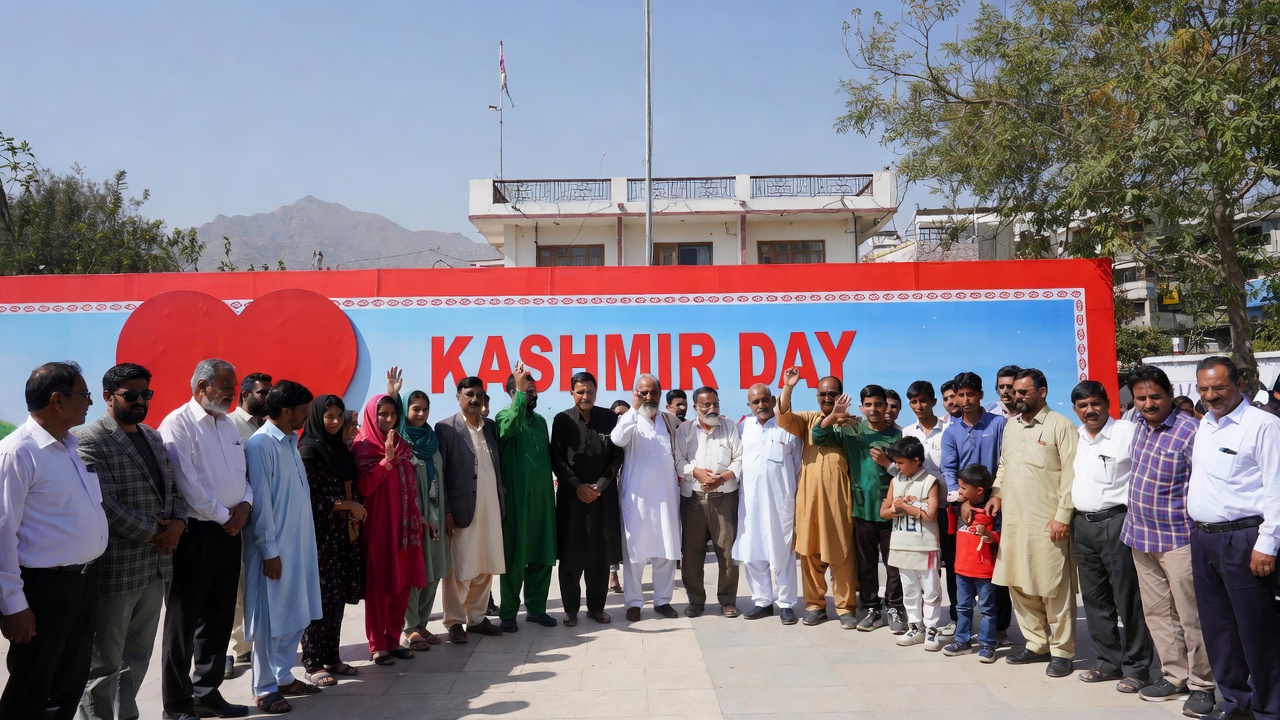
February 5 is around the corner. Schools and colleges across Pakistan and Azad Jammu Kashmir are preparing stages, microphones, and podiums. Students are polishing their notes. Teachers are printing certificates. The annual Kashmir Solidarity Day speech competition season is here again.
Every year on February 5, millions of people pause to remember a cause that has shaped the subcontinent for nearly eight decades. Kashmir Day — officially known as Youm-e-Yakjehti-e-Kashmir — is not just a public holiday in Pakistan. It is a day of reflection, remembrance, and renewed commitment to the people of Kashmir.
If you are a student preparing a speech, a teacher organizing an event, or simply someone who wants to understand this day more deeply, this guide is for you. We will walk through the history, significance, and key talking points for a powerful Kashmir Day speech. We will also provide sample speeches, quotes, and practical tips to help you deliver your message with confidence.
What Is Kashmir Solidarity Day and Why Is It Observed on February 5?
Kashmir Solidarity Day is a national holiday in Pakistan observed every year on February 5. The day is dedicated to expressing support for the people of Kashmir and their right to decide their own future through a free and fair vote.
The idea for this observance first came from Qazi Hussain Ahmad of the Jamaat-e-Islami party in 1990. At that time, Nawaz Sharif, who was the Chief Minister of Punjab, called for a nationwide strike to protest the situation in Kashmir. The ruling Pakistan People’s Party then declared February 5 a public holiday. The modern form of the observance was formalized in 2004 by the Federal Minister for Kashmir Affairs and Northern Areas.
Since that first observance over three decades ago, Kashmir Day has grown into a powerful annual tradition. On this day:
- Government offices, banks, and schools remain closed across Pakistan.
- A one-minute silence is observed at 10:00 AM to honor those who lost their lives in the Kashmir struggle.
- Rallies, seminars, and human chains are organized in major cities.
- Special prayers are held in mosques for the people of Kashmir.
- Schools and colleges host speech competitions, essay contests, and cultural programs.
In 2026, the federal government of Pakistan declared February 5 a public holiday once again. All public and private offices will remain closed. The Sindh provincial government issued its own notification as well. In Punjab, the government announced additional holidays on February 6 and 7 for Basant celebrations, giving many parts of the country a long weekend starting with Kashmir Day.
History of the Kashmir Conflict: Essential Background for Your Speech
No Kashmir Day speech is complete without a solid understanding of the history behind the dispute. Here is a brief but clear timeline that will help any student or speaker build a strong foundation.
The Partition of 1947 and the Birth of a Dispute
When British India was divided into two independent nations in August 1947, the princely states were given the choice to join either India or Pakistan. The decision was generally based on geography and the religious makeup of the population.
Kashmir was a Muslim-majority region. However, its ruler was Maharaja Hari Singh, a Hindu. He initially wanted to remain independent. When tribal fighters entered the region, the Maharaja signed an Instrument of Accession with India under controversial circumstances. India then sent its military into Kashmir.
This led to the first Indo-Pakistani war over Kashmir in 1947–1948.
The United Nations Steps In
India itself brought the Kashmir dispute to the United Nations Security Council on January 1, 1948. The Security Council passed Resolution 47 on April 21, 1948, which recommended a three-step process:
- Pakistan would withdraw its nationals from the region.
- India would reduce its forces to the minimum needed for law and order.
- A free and impartial plebiscite would be held so the people of Kashmir could decide their own future.
Further resolutions in 1948 and 1949 — including the UNCIP Resolutions of August 13, 1948 and January 5, 1949 — reinforced the call for a plebiscite. The UN Digital Library maintains the full text of Resolution 47, which remains an important reference for any serious discussion of Kashmir.
The plebiscite was never held.
Wars, Tensions, and Ongoing Struggle
India and Pakistan fought two more wars partly connected to Kashmir — in 1965 and 1999 (the Kargil conflict). The Simla Agreement of 1972 established the Line of Control (LoC) as the de facto border but did not settle the dispute. The agreement itself listed Kashmir as an outstanding question awaiting final settlement.
Over the decades, the people of Kashmir have carried out widespread protests and a sustained movement for self-determination. The period since 1989 saw a major escalation in tension and conflict within the region.
The Revocation of Article 370 in 2019
One of the most significant recent developments came on August 5, 2019, when the Indian government under Prime Minister Narendra Modi revoked Article 370 of the Indian Constitution. This article had granted the state of Jammu and Kashmir a special autonomous status since 1949.
Under Article 370, Kashmir had its own constitution, its own flag, and control over matters other than defense, foreign affairs, and communications. The related Article 35A prevented non-Kashmiris from buying property or settling permanently in the region.
The revocation was accompanied by a communications blackout, the deployment of tens of thousands of additional troops, and the detention of hundreds of political leaders, including two former Chief Ministers. The state was also divided into two union territories — Jammu and Kashmir, and Ladakh — both under direct control from New Delhi.
Pakistan’s government condemned the move. The Pakistan Parliament passed resolutions expressing solidarity with the people of Kashmir. August 5 has since been observed as Youm-e-Istehsal (Day of Exploitation) in Pakistan.
In December 2023, India’s Supreme Court upheld the revocation of Article 370, ruling it constitutionally valid.
The 2024 Elections in Jammu and Kashmir
In a significant development, legislative assembly elections were held in Jammu and Kashmir in September–October 2024 — the first in over a decade. The Jammu and Kashmir National Conference (JKNC), led by Omar Abdullah, emerged as the largest party with 42 seats out of 90. Abdullah was sworn in as Chief Minister on October 16, 2024, heading a coalition government with the Indian National Congress and other allies.
Pakistan’s government rejected these elections, stating they were not a substitute for the Kashmiri people’s right to self-determination as enshrined in UN resolutions.
This is the political landscape as we observe Kashmir Solidarity Day 2026.
Why Kashmir Day Speech Competitions Are Important for Students
Across Pakistan and Azad Jammu Kashmir, educational institutions play a vital role in keeping the Kashmir cause alive in the hearts of younger generations. Schools and colleges organize:
- Speech competitions in both English and Urdu
- Essay writing contests on Kashmir’s history and significance
- Art and poetry competitions depicting the lives of Kashmiri people
- Tableaus and dramatic performances showing the struggle for freedom
- Debate forums where students discuss pathways to resolution
These activities are not merely academic exercises. They serve three important purposes:
First, they educate young people about a historical issue that directly affects their nation. Second, they build public speaking, research, and critical thinking skills. Third, they create a ripple effect — when students speak about Kashmir, their words reach families, communities, and through social media, audiences around the world.
At Khyber Medical University in Peshawar, for instance, students have participated in speech and essay writing competitions where they delivered addresses in both Urdu and English, performed skits, and sang national songs related to the Kashmir cause. Similarly, the Rawalpindi Arts Council has hosted events with tableaus, Kashmiri songs, and speech competitions in collaboration with private school associations.
How to Write a Powerful Kashmir Day Speech in English
Writing a speech is different from writing an essay. A speech must be heard, felt, and remembered. Here are practical steps to help you craft a strong Kashmir Day speech.
Step 1: Open With a Strong Hook
Your opening should grab attention immediately. You can start with:
- A striking fact (e.g., “For over seven decades, the people of Kashmir have waited for a promise made by the United Nations — a promise that remains unfulfilled.”)
- A rhetorical question (e.g., “What does freedom mean to someone who has never known it?”)
- A quote from a notable figure
- A brief description of life in Kashmir that paints a vivid picture
Avoid starting with “Respected teachers, dear students…” — at least not as your very first words. You can greet the audience after your hook.
Step 2: Establish the Context
Briefly explain what Kashmir Day is, when it is observed, and why it matters. Do not assume your audience knows the full history. Even in Pakistan, many young people may not know all the details.
Step 3: Present the Historical Background
Cover the key milestones:
| Year | Event |
|---|---|
| 1947 | Partition of British India; Kashmir conflict begins |
| 1948 | India takes the dispute to the UN; Security Council passes Resolution 47 |
| 1949 | UNCIP Resolution calls for a free plebiscite; ceasefire established |
| 1965 | Second Indo-Pakistani war |
| 1972 | Simla Agreement signed; Line of Control established |
| 1990 | First Kashmir Solidarity Day observed in Pakistan |
| 2019 | India revokes Article 370; Kashmir’s special status removed |
| 2024 | First assembly elections held in J&K since 2014; Omar Abdullah becomes Chief Minister |
Step 4: Highlight Human Stories
Numbers and dates matter, but human stories move hearts. Talk about the daily realities of life under a heavy military presence. Mention the communication blackouts, the restrictions on movement, and the impact on ordinary families — especially women, children, and the elderly.
Keep your language respectful and factual. Avoid inflammatory rhetoric. The strongest speeches are those that let the facts speak for themselves.
Step 5: Mention International Law and UN Resolutions
Point out that the right to self-determination is a fundamental principle of international law. The UN Security Council’s own resolutions recognize this right for the people of Kashmir. This is not a matter of one country’s opinion — it is a globally acknowledged issue.
Step 6: Call for Peace and Resolution
A good speech does not only look backward. It also looks forward. Call for:
- Dialogue between all parties
- Respect for human rights in the region
- Implementation of UN resolutions
- International attention and accountability
Step 7: End With a Memorable Closing
Your final words should stay with the audience. You can close with a call to action, a powerful quote, or a simple but sincere expression of hope.
Sample Kashmir Day Speech in English for School Students (Short Version)
Below is a sample speech suitable for younger students or short-format competitions. This can be adapted and personalized.
Respected Principal, teachers, and my dear fellow students,
Today, on the fifth of February, we gather not just to mark a date on the calendar. We gather to remember millions of people who have waited for justice for more than seventy-seven years.
Kashmir — often called heaven on earth — has been trapped in a conflict since 1947. When the British left the subcontinent, Kashmir’s future was supposed to be decided by its people. The United Nations passed resolutions calling for a free vote. That vote never happened.
Today, we stand with the people of Kashmir. We remember the mothers who lost their children. We remember the students whose schools were shut down. We remember the families who could not even make a phone call during months of communication blackouts.
Kashmir Day is not about anger. It is about awareness. It is about telling the world that a promise was made, and that promise must be kept.
As students, we may not be able to change borders. But we can raise our voices. We can educate ourselves. We can refuse to forget.
I pray for the day when the beautiful valleys of Kashmir know only peace. When children there can go to school without fear. When families can live with dignity.
Pakistan stands with Kashmir. The world must stand with Kashmir. And until justice is done, we will continue to remember.
Thank you.
Sample Kashmir Day Speech in English for College Students and Events (Detailed Version)
This longer speech is suitable for college-level competitions, seminars, and formal events.
Mr. President, distinguished guests, respected faculty, and my fellow students,
Today marks another February 5 — another Kashmir Solidarity Day. But let us not treat this as just another commemorative event. Let us treat it as what it truly is: a reminder of one of the longest-running unresolved disputes in modern history.
In 1947, when the subcontinent was partitioned, Kashmir should have been allowed to determine its own path. A Muslim-majority region with deep cultural ties to what became Pakistan, its fate was instead decided by a controversial Instrument of Accession signed under duress by its Hindu ruler. What followed was a war, a ceasefire, and a set of promises made at the highest level of international governance.
The United Nations Security Council, in its Resolution 47 of April 1948, clearly stated — and I quote the core principle — that both India and Pakistan desired that the accession of Jammu and Kashmir should be decided through a free and impartial plebiscite. This was not a suggestion. It was a resolution of the world’s most authoritative body on matters of international peace.
Nearly eight decades later, that plebiscite has not taken place.
Let us look at the timeline of what has happened instead. Three wars. Decades of military presence. A Line of Control that divides families. And then, on August 5, 2019, the Indian government took the dramatic step of revoking Article 370 — the very constitutional provision that had given Kashmir a measure of autonomy within the Indian framework.
The revocation was accompanied by a total communications blackout that lasted months. Thousands of additional troops were deployed. Political leaders were detained. The region was split into two union territories under direct central control.
In December 2023, India’s Supreme Court upheld this decision, calling Article 370 a temporary provision. But for the people of Kashmir, their autonomy was not temporary. It was a foundational commitment.
In 2024, legislative elections were held in the region for the first time in a decade. The Jammu and Kashmir National Conference won the most seats, and Omar Abdullah was sworn in as Chief Minister. Yet Pakistan’s government noted that elections under occupation cannot substitute for the right to self-determination.
So where does that leave us in 2026?
It leaves us with a responsibility. As students, as citizens, as human beings, we have a responsibility to keep this issue alive — not through slogans alone, but through knowledge, through research, through informed advocacy.
The Kashmir issue is not just a territorial dispute between two countries. It is fundamentally a question of human rights. The right of a people to choose their own destiny. The right to live without fear. The right to speak, to move, to communicate without restriction.
These are not luxuries. These are basic rights recognized by every international convention and every moral tradition in the world.
My appeal today is simple. Let us not reduce Kashmir to a topic we discuss only once a year. Let us read about it. Let us write about it. Let us speak about it on every platform available to us — in classrooms, in newspapers, on social media, and in international forums.
And let us do so with dignity and facts. The strongest argument for Kashmir is not emotion — it is truth. The truth of broken promises. The truth of unfulfilled resolutions. The truth of a people who deserve better.
I will close with a thought. The United Nations was built on the principle that the strong should not oppress the weak. That disputes should be settled through dialogue, not force. That every people, no matter how small, has the right to be heard.
Kashmir is waiting to be heard. And we — all of us in this room — are its voice.
Thank you.
Best Kashmir Day Quotes to Use in Your Speech or Essay
A well-placed quote adds weight and credibility to any speech. Here are quotes that resonate with the theme of Kashmir Solidarity Day:
| Speaker | Quote |
|---|---|
| Quaid-e-Azam Muhammad Ali Jinnah | “Kashmir is the jugular vein of Pakistan.” |
| Allama Muhammad Iqbal | “If you want to see the beauty of God, go to Kashmir.” |
| Jawaharlal Nehru (India’s first PM) | Nehru himself promised a plebiscite in Kashmir and took the matter to the United Nations. |
| United Nations Security Council Resolution 47 (1948) | The resolution affirmed that the future of Kashmir should be decided through a democratic plebiscite. |
When using quotes in a formal speech, always attribute them clearly. If you are writing an essay for a competition, follow MLA format for citations.
Key Themes and Talking Points for Kashmir Solidarity Day 2026
Here are the most relevant themes to weave into your speech or essay this year:
1. The Right to Self-Determination Under International Law
Self-determination is not just a political slogan. It is a principle enshrined in the Charter of the United Nations and in multiple Security Council resolutions specifically related to Kashmir. The resolutions of 1948 and 1949 explicitly called for a plebiscite. This remains the internationally recognized framework for resolving the dispute.
2. The Impact of the Revocation of Article 370
The August 5, 2019 revocation removed Kashmir’s special status, divided the region into two union territories, and opened the door for non-Kashmiris to buy property and settle in the region. Critics have described this as an attempt at demographic change in a Muslim-majority region. New domicile laws introduced in 2020 allow anyone who has lived in the region for 15 years or studied there for 7 years to apply for permanent resident status.
3. Human Rights Concerns in the Region
Multiple international organizations have documented reports of restrictions on movement, communication blackouts, detentions without charge, and the use of special security laws. Unemployment in the region has been reported at levels nearly twice the national average in India, despite promises of development.
4. The 2024 Elections and Their Significance
The 2024 elections were significant as the first assembly polls in over a decade. While they restored a degree of electoral participation, the fundamental question remains: can elections held under the current framework address the aspirations of the Kashmiri people as recognized by the United Nations?
5. The Role of Youth and Education
Young people are the future advocates for any cause. Encouraging students to study the Kashmir issue, participate in debates, and engage with international law and human rights frameworks is essential for keeping the cause alive in a meaningful way.
Tips for Delivering a Winning Kashmir Day Speech at School or College
Writing a good speech is only half the battle. Delivering it well is equally important. Here are practical tips:
Practice out loud. Read your speech aloud at least five times before the event. This helps you find awkward phrases and adjust your pacing.
Control your pace. Many students rush through their speeches because of nervousness. Speak slowly and clearly. Pause after important points to let them sink in.
Make eye contact. Do not read every word from your paper. Look up. Connect with your audience. Even glancing up every few sentences makes a big difference.
Use your voice. Vary your tone. Speak softly when describing suffering. Raise your voice slightly when making a call to action. Monotone delivery kills even the best-written speech.
Keep it within the time limit. If the competition allows 3 minutes, do not speak for 5. Judges notice and penalize over-time speakers. Practice with a timer.
Dress appropriately. For a formal event, wear clean, pressed clothing. First impressions matter.
Stay factual. Emotional appeals are important, but they must be backed by facts. Judges and audiences respect speakers who are both passionate and well-informed.
How Schools and Colleges Celebrate Kashmir Day Across Pakistan
The way Kashmir Day is observed in educational institutions varies by region and resources, but common activities include:
| Activity | Description |
|---|---|
| Speech Competitions | Students deliver prepared speeches in English and Urdu. Judges score on content, delivery, and time management. |
| Essay Writing Contests | Students write essays on topics like the history of Kashmir, the importance of self-determination, or the role of the UN. |
| Art Competitions | Students create artwork depicting Kashmir’s beauty, its people, and their struggles. |
| Tableaus and Skits | Dramatic performances recreating historical events or depicting daily life in Kashmir. |
| Poetry Recitation | Students recite poetry — both classical and original — related to Kashmir. |
| Seminars and Panel Discussions | College-level events featuring speakers from academia, politics, and civil society. |
| One-Minute Silence | At 10:00 AM, the entire institution observes silence in honor of those who have lost their lives. |
These events serve as both educational opportunities and emotional experiences. They help students connect with a cause that is central to Pakistan’s national identity.
Common Mistakes to Avoid in a Kashmir Day Speech
Even well-meaning speakers sometimes make errors that weaken their message. Here are common mistakes and how to avoid them:
Mistake 1: Using inflammatory or hateful language. A strong speech does not need to demonize anyone. Focus on facts, rights, and human dignity. Inflammatory language can alienate your audience and undermine your credibility.
Mistake 2: Ignoring the human element. Do not make your speech purely about politics and dates. Remember that real people — families, children, students like yourself — are at the center of this issue.
Mistake 3: Being vague about history. If you mention UN resolutions, know which ones you are referring to. If you cite a date, make sure it is accurate. Vague speeches do not win competitions or change minds.
Mistake 4: Going over time. Respect the rules. A concise, well-delivered three-minute speech is far more effective than a rambling seven-minute one.
Mistake 5: Copying someone else’s speech word-for-word. Judges can often tell when a speech has been copied. Use this guide as inspiration, but write in your own voice. Your authenticity is your greatest strength.
The Global Observance of Kashmir Solidarity Day in 2026
Kashmir Day is not observed only in Pakistan. Communities around the world mark this day with events and activities:
- In the United Kingdom, British Kashmiris — particularly those from the Mirpur region — organize rallies and awareness campaigns.
- In the United States, the New York State Assembly passed a resolution in 2021 recognizing February 5 as Kashmir American Day, honoring New York’s Kashmiri community.
- In Canada, community organizations hold seminars and panel discussions.
- In European cities like Brussels and Geneva, advocacy groups organize events near international institutions to raise awareness.
These global observances amplify the message that the Kashmir issue is not a bilateral matter between two countries. It is a matter of international concern and human rights.
Understanding the Cultural Significance of Kashmir Day in Pakistan
Kashmir Solidarity Day holds a deep place in Pakistan’s cultural and emotional landscape. The phrase “Kashmir banega Pakistan” (Kashmir will become part of Pakistan) is one of the most commonly heard slogans on this day. But beyond slogans, the day touches a deeper chord.
For many Pakistanis, especially in Punjab, Khyber Pakhtunkhwa, and Azad Kashmir, there are direct family and cultural ties to people across the Line of Control. The pain of Kashmir is not abstract — it is personal.
The media plays a significant role on this day. Television and radio channels air special programs, documentaries, and talk shows focused on Kashmir. Newspapers publish special editions. Social media platforms are filled with posts using hashtags like #KashmirSolidarityDay and #StandWithKashmir.
The cultural programs held in schools and at community events often feature Kashmiri music, poetry, and art. These artistic expressions serve as a bridge between the political dimensions of the issue and its deeply human core.
The Role of Social Media in Spreading Awareness About Kashmir Day
In the digital age, social media has become one of the most powerful tools for spreading awareness about Kashmir. Students and activists use platforms like X (formerly Twitter), Instagram, Facebook, and TikTok to share information, personal stories, and calls to action.
If you are a student looking to amplify your Kashmir Day speech beyond the walls of your school:
- Record your speech and share it on social media.
- Create infographics with key facts and dates about the Kashmir conflict.
- Use relevant hashtags to join the broader conversation.
- Tag international human rights organizations to draw their attention.
- Write blog posts or articles based on your research.
Remember to always be respectful, factual, and constructive in your online advocacy. Misinformation and inflammatory content do more harm than good.
Frequently Asked Questions About Kashmir Day Speech and Events
What is the best topic for a Kashmir Day speech in 2026?
Focus on timely themes such as the current political situation following the 2024 elections, the continued relevance of UN resolutions, or the impact of the revocation of Article 370 on everyday life in Kashmir.
How long should a Kashmir Day speech be for a school competition?
Most school-level competitions set a time limit of 3 to 5 minutes. This translates to roughly 450 to 750 words of spoken text. Practice with a timer to stay within limits.
Can I use Urdu words or phrases in an English speech?
Yes, sparingly. Using terms like “Azadi” (freedom), “Shuhada” (martyrs), or “Youm-e-Yakjehti” (Day of Solidarity) can add authenticity and cultural depth to your speech. Just make sure to briefly explain any term your audience might not know.
What is the difference between Kashmir Day and Youm-e-Istehsal?
Kashmir Solidarity Day (February 5) has been observed since 1990 to show support for the Kashmiri freedom movement in general. Youm-e-Istehsal (August 5) was introduced after the 2019 revocation of Article 370 to specifically protest that action and its consequences.
Where can I find reliable information for my speech?
Good sources include:
- The United Nations Digital Library for original resolution texts
- Pakistan’s Ministry of Foreign Affairs official statements
- Reports from international organizations
- Reputable news outlets with coverage of the region
Avoid relying on social media posts or unverified blogs as your primary sources.
How to Prepare for a Kashmir Day Debate Competition in English
Many colleges and universities go beyond simple speech competitions. They organize formal debates on the Kashmir issue. If you are preparing for a debate rather than a speech, your approach needs to be slightly different.
In a debate, you must anticipate counterarguments and prepare responses. You need to be familiar not only with Pakistan’s position but also with how other countries and international bodies view the issue. Here are key preparation strategies:
Research both sides thoroughly. You do not have to agree with the opposing view. But understanding it makes your own argument much stronger. Know what India’s official position is. Know what neutral observers and international organizations have said.
Master the legal framework. The strongest arguments in a Kashmir debate are often legal ones. UN Security Council resolutions, international law on self-determination, the Geneva Conventions on occupied territories — these are powerful tools in a debate setting.
Use recent data. Outdated statistics weaken your credibility. Reference reports from the last two to three years. Mention the 2024 elections. Mention the current political leadership in the region. Show that you are up to date.
Stay calm and respectful. Debates can become heated. The student who remains composed while making sharp, fact-based arguments will always outshine the one who shouts. Judges reward intellectual discipline.
Practice rebuttals. Have a friend or teacher challenge your arguments before the competition. This will help you identify weak points in your case and strengthen them before you face real opponents.
The Importance of Balanced and Respectful Language in Kashmir Day Speeches
One of the most important skills for any speaker — especially on a sensitive topic like Kashmir — is the ability to be passionate without being reckless. Words carry weight. They shape perceptions. They can build bridges or burn them.
When delivering a Kashmir Day speech, consider the following principles:
Speak about rights, not revenge. The strongest moral ground is the language of human rights. When you frame the Kashmir issue in terms of self-determination, dignity, and international law, your message resonates with people across political lines.
Acknowledge complexity. The Kashmir conflict is not simple. It involves history, religion, politics, international law, and deeply personal human experiences. A speech that acknowledges this complexity is more credible than one that presents everything in black and white.
Respect all people. Your audience may include people with different perspectives. Speaking with respect does not weaken your argument. It strengthens it. The goal of a Kashmir Day speech is to raise awareness and build solidarity — not to alienate or offend.
Avoid misinformation. Double-check every fact before you include it in your speech. One wrong date or one misquoted resolution can undermine your entire presentation. Accuracy is a form of respect — for your audience and for the people of Kashmir.
Use inclusive language. Remember that the Kashmir issue affects people of all backgrounds, faiths, and age groups within the region. Speak in a way that honors this diversity.
How Teachers and Event Organizers Can Make Kashmir Day Events More Meaningful
If you are a teacher, school administrator, or event organizer planning a Kashmir Day program in 2026, here are ideas to make the event more impactful and educational:
Invite a guest speaker. If possible, invite someone with firsthand knowledge of the Kashmir issue — a journalist, an academic, a policy expert, or a community member with family ties to the region. Personal perspectives add depth that no textbook can match.
Create a learning station. Set up a corner of the auditorium with maps, timelines, and key UN documents related to Kashmir. Students can visit during breaks to learn more.
Organize a documentary screening. There are several well-produced documentaries about the Kashmir conflict from various perspectives. Screening one before the speech competition can give students a visual and emotional context for their speeches.
Encourage original writing. Rather than asking students to memorize speeches from the internet, encourage them to write their own. Provide them with source materials and let them craft arguments in their own voice. This approach produces more genuine and powerful presentations.
Follow up after the event. The conversation should not end when the microphones are turned off. Share a reading list. Start a school or college discussion group on international issues. Assign follow-up projects. Make Kashmir Day the beginning of a learning journey, not the end.
Include a multimedia element. Allow students to create short videos, podcasts, or digital presentations alongside traditional speeches. This engages students who may express themselves better through visual or digital media.
Final Thoughts: Making Your Kashmir Day Speech Count in 2026
As we observe Kashmir Solidarity Day 2026, the world around us continues to change. New governments take office. New challenges emerge. But the core issue remains the same: the people of Kashmir were promised the right to decide their own future, and that promise has not been fulfilled.
Your speech — whether it is three minutes long in a school auditorium or thirty minutes long at a university seminar — can make a difference. It can inform someone who did not know the history. It can move someone who had become indifferent. It can inspire someone to learn more, to speak up, to care.
The best Kashmir Day speech is not the one with the fanciest words. It is the one that is honest, informed, and spoken from the heart.
This February 5, when the one-minute silence falls across Pakistan at 10:00 AM, take that moment to reflect. Reflect on what it means to have freedom. Reflect on what it means to wait for justice. And then use your voice — because the people of Kashmir are counting on voices like yours.