When the first light of spring touches the earth and day meets night in perfect balance, over 300 million people across the globe prepare to celebrate one of humanity’s oldest and most cherished festivals. Nowruz—meaning “new day” in Persian—marks the beginning of the Persian New Year and has been observed for more than 3,000 years. This ancient celebration transcends borders, religions, and cultures. It unites communities from the mountains of Kurdistan to the bazaars of Samarkand, from the fire temples of Mumbai to the streets of Los Angeles.
Whether you are a cultural traveler seeking authentic experiences or someone looking to reconnect with Persian heritage, this guide will take you through the best destinations to experience Nowruz. We explore traditional ceremonies, local customs, festive foods, and practical travel tips for each location. The spring equinox beckons—let the journey begin.
What Is Nowruz and Why Is It Celebrated Worldwide?
Before we explore the best destinations, it helps to understand what makes Nowruz so special. The festival’s roots stretch back to ancient Persia and the Zoroastrian faith. Zoroastrians saw the arrival of spring as a powerful symbol. It represented the triumph of light over darkness and the victory of good over evil.
Nowruz occurs at the exact moment of the vernal equinox, when the sun crosses the celestial equator. In 2025, this precise moment falls on March 20 at approximately 09:01 UTC. The celebration then continues for 13 days. Families gather, homes are cleaned, special foods are prepared, and communities come together in joyous renewal.
The festival’s universal themes of rebirth and hope have allowed it to spread far beyond Iran. Today, Nowruz is celebrated across Central Asia, the Caucasus, the Middle East, the Balkans, and South Asia. Large diaspora communities in North America, Europe, and Australia also keep these traditions alive. In 2009, UNESCO inscribed Nowruz on the Representative List of the Intangible Cultural Heritage of Humanity, recognizing its global cultural significance.
The Haft-Sin Table: Heart of Every Nowruz Celebration
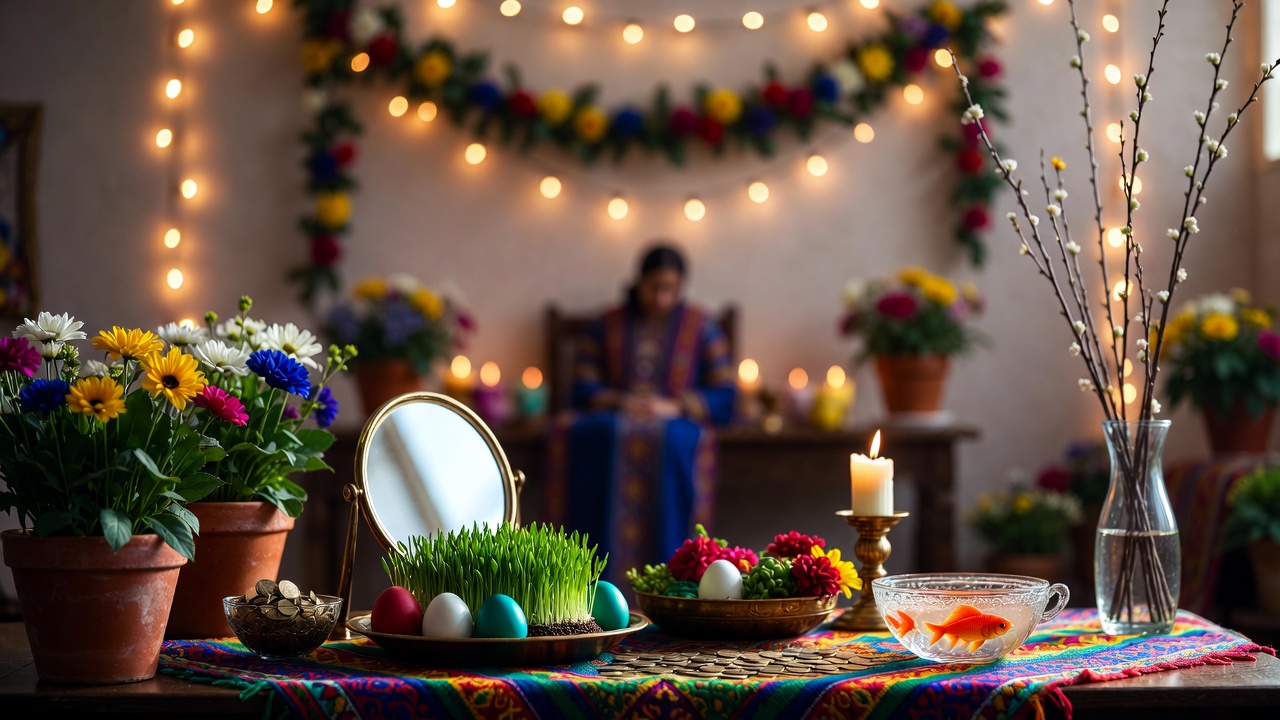
Central to Nowruz celebrations is the Haft-Sin (or Haft-Seen) table. This ceremonial arrangement features seven symbolic items. Each item begins with the Persian letter “S” (or sometimes “Sh” in certain regions). Every element carries deep meaning.
| Item (Persian) | English | Symbolism |
|---|---|---|
| Sabzeh | Sprouted wheat or lentils | Rebirth and renewal |
| Samanu | Sweet wheat pudding | Power and strength |
| Senjed | Dried oleaster fruit | Love and wisdom |
| Seer | Garlic | Health and medicine |
| Seeb | Apple | Beauty and health |
| Serkeh | Vinegar | Patience and age |
| Somagh | Sumac | Sunrise, triumph of light |
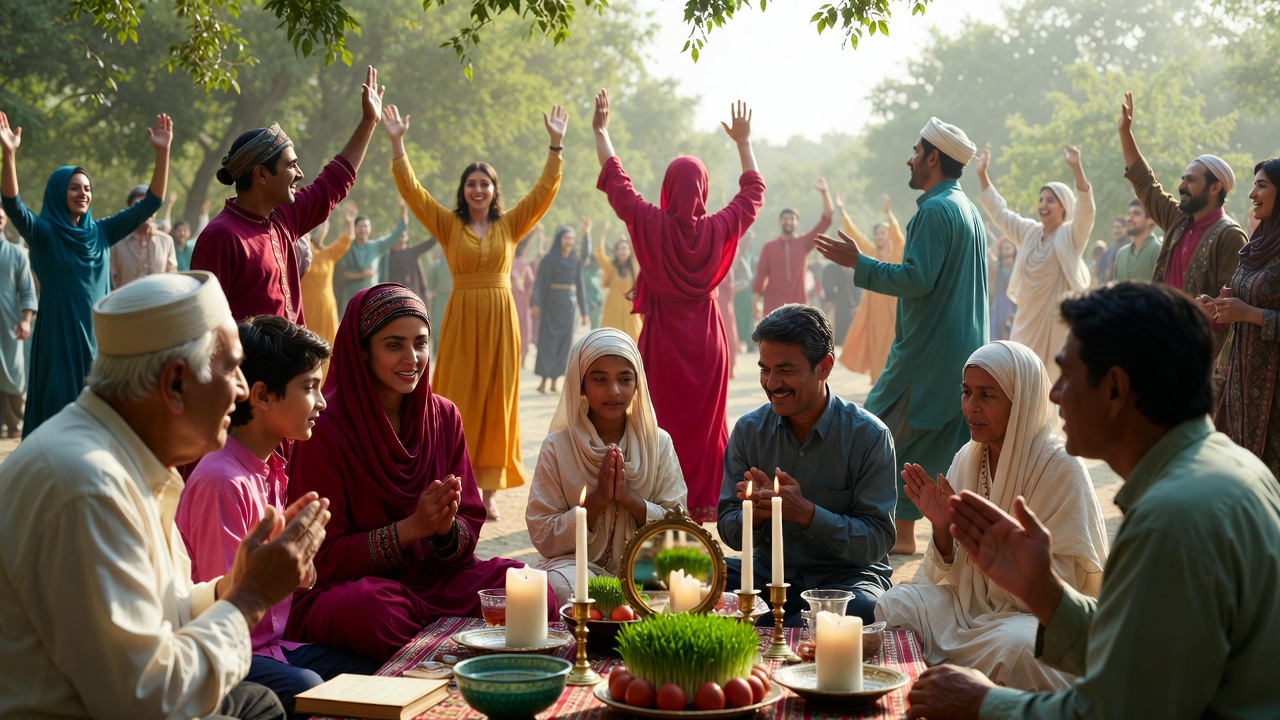
Families often add other meaningful objects to their Haft-Sin displays. These include mirrors for reflection, painted eggs for fertility, goldfish for new life, and candles representing light and happiness. The table becomes the gathering point for family celebrations throughout the 13-day festival.
Celebrating Nowruz in Iran: The Heartland of Persian New Year
Tehran: Experience Nowruz in Iran’s Vibrant Capital
Tehran, the bustling capital of Iran, transforms during Nowruz in unexpected ways. While the city is usually famous for its traffic and crowded streets, the holiday brings an unusual calm. Millions of residents travel to other parts of the country during this period. This leaves Tehran quieter, cleaner, and surprisingly peaceful.
For travelers who choose to stay in the capital, this transformation creates a unique opportunity. The Tehran Municipality organizes special events at iconic landmarks. The celebrations at Milad Tower feature traditional Iranian music, folk performances, and cultural displays—all free of charge. Gardens, monuments, and museums remain open daily, typically from 9:00 AM to 7:00 PM.
The Tajrish Bazaar in northern Tehran offers an especially atmospheric experience. Located at the foothills of the Alborz Mountains near the Imamzadeh Saleh mosque, this historic market fills with holiday preparations in the weeks before Nowruz. Vendors sell samanu (sweet wheat pudding) prepared in large pots, traditional sweets, and all the items needed for the Haft-Sin table.
When to visit Tehran for Nowruz:
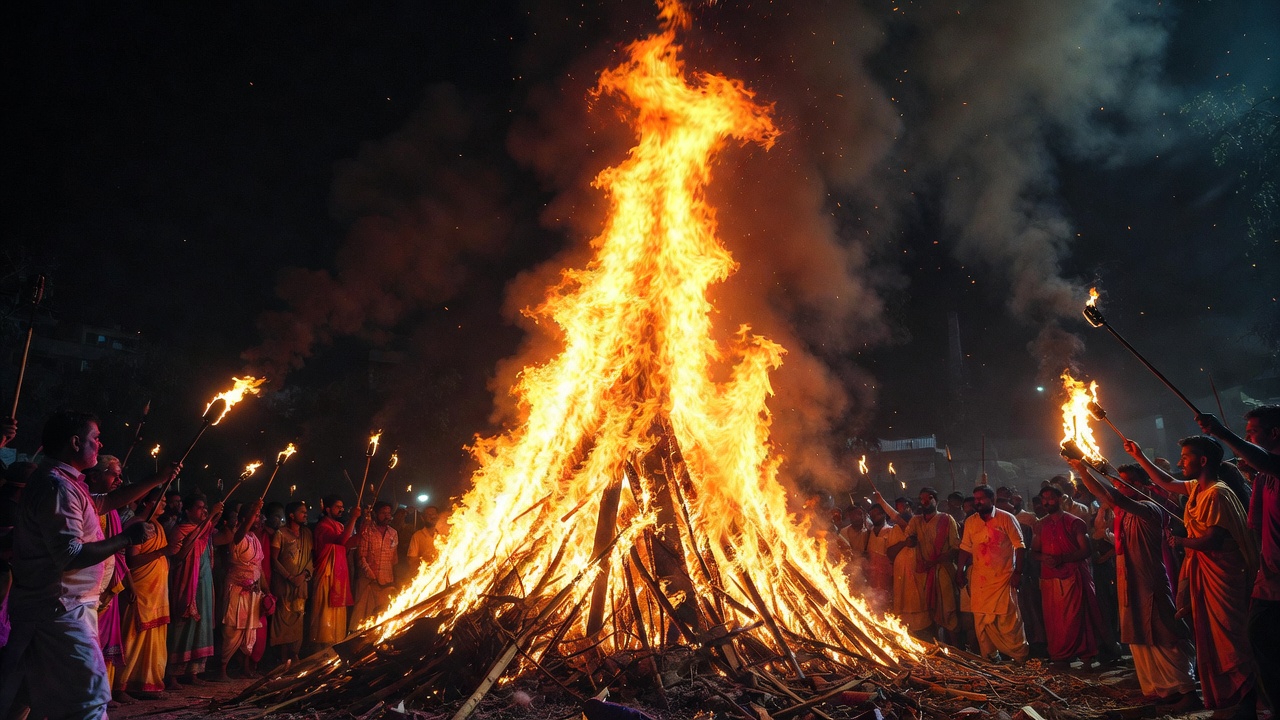
- Chaharshanbe Suri (Fire Festival): The Tuesday evening before Nowruz. People gather to jump over bonfires, chanting traditional phrases to welcome the new year.
- Sa’at-e Tahvil (Exact moment of the New Year): Families gather around Haft-Sin tables to mark the precise moment spring begins.
- First four days of Nowruz: Public holidays when major attractions remain open and special programs run throughout the city.
Practical tip: The Tehran Municipality offers guided city tours during Nowruz. You can join these tours by calling 137 within Iran or emailing [email protected].
Shiraz: Poetry, Gardens, and Orange Blossoms
The city of Shiraz holds a special place in Persian culture. It is the home of Iran’s most beloved poets—Hafez and Saadi. During Nowruz, thousands gather at Hafez’s Mausoleum at the Sa’at-e Tahvil, reading his verses as the new year begins. The tradition of seeking guidance from Hafez’s poetry (called fal-e Hafez) becomes especially meaningful at this time.
Shiraz is also famous for its gardens. Eram Garden, a UNESCO World Heritage Site, bursts into bloom during the spring festival. Fountains sparkle, flowers bloom in every color, and the scent of orange blossoms fills the air. The Nasir al-Mulk Mosque—known as the “Pink Mosque”—offers spectacular displays of colored light through its stained-glass windows, best viewed in the morning hours.
The old Vakil Bazaar comes alive with the aromas of spring. Vendors offer local specialties, handicrafts, and traditional sweets. The narrow streets of the historic neighborhoods fill with families visiting relatives and exchanging gifts.
Must-try in Shiraz: Faloodeh Shirazi—a traditional frozen dessert made with thin rice noodles, rose water, and lime juice. It is the perfect refreshment while exploring spring gardens.
Isfahan: “Half of the World” in Spring
Iranians have long called Isfahan Nesf-e Jahan—”Half of the World.” This poetic name reflects the city’s incredible architectural heritage. During Nowruz, the Naqsh-e Jahan Square (Imam Square)—one of the largest public squares in the world—fills with tourists and locals alike.
The square’s stunning buildings include the Shah Mosque, Ali Qapu Palace, and Sheikh Lotfollah Mosque. During the holiday, the square’s central fountain plays, children fly kites, and families picnic on the grass. The covered bazaars surrounding the square overflow with handicrafts, textiles, and traditional metalwork.
Insider experience: Visit a local Isfahan family during Nowruz to experience Eyd Didani—the tradition of visiting relatives and friends. Many tour agencies arrange these authentic cultural experiences.
Yazd: Desert City Traditions and Fire Temples
Yazd, the ancient desert city of windcatchers, offers a unique Nowruz experience. The city has deep Zoroastrian roots. It still maintains several active fire temples. These temples hold special significance during Nowruz, which remains one of the holiest days in the Zoroastrian calendar.
Before Nowruz, the narrow clay alleys of Yazd’s old town light up during Chaharshanbe Suri. Bonfires appear in every neighborhood. Locals jump over flames while chanting, “Give me your redness, take my yellowness.” This ritual symbolizes leaving behind illness and misfortune.
Amir Chakhmaq Square glows beautifully at sunset during the festival. The famous Yazdi sweets—including baqlava and qottab—make perfect gifts for the holiday season.
Important Note on Traveling to Iran
Travelers planning to visit Iran for Nowruz should research current visa requirements and travel advisories carefully. Booking accommodations well in advance is essential, as hotels fill quickly during this popular season. Prices may be higher than usual, and some attractions may have modified hours.
Azerbaijan Novruz Celebration: Fire and Festivity in the Land of Flames
Azerbaijan—the “Land of Fire”—celebrates Novruz with particular passion. Fire holds sacred meaning here, connected both to ancient Zoroastrian traditions and the country’s natural gas reserves that have burned for centuries. After neighboring Iran, Azerbaijan hosts the longest official observance of Novruz, with five days of public holidays.
The Four Tuesdays Leading to Novruz in Baku
Azerbaijani celebrations begin four weeks before the main event. Each Tuesday is dedicated to one of nature’s fundamental elements:
- Su Chershenbesi (Water Tuesday): Represents purity and rejuvenation
- Odlu Chershenbesi (Fire Tuesday): Symbolizes warmth and vitality
- Yel Chershenbesi (Wind Tuesday): Embraces movement and transformation
- Torpaq Chershenbesi (Earth Tuesday): Awakens nature’s fertility
On the last Tuesday—Akhir Chershenbe—entire families light bonfires. Men, women, and children jump over the flames while reciting: “Give me your redness, take my yellowness.” The fires are never extinguished with water. They are allowed to burn down naturally. Family members then carry the ashes away from the home, symbolically removing the misfortune of the past year.
Baku’s Icherisheher: The Heart of Celebrations
The historic Icherisheher (Old City) of Baku becomes the epicenter of Novruz festivities. The UNESCO-listed ancient walled city fills with traditional music, dance performances, and cultural displays. Special characters parade through the streets:
- Kosa and Kechal: Two beloved comic characters who symbolize winter and spring. Kosa (plump with a fake beard) represents winter, while bald-headed Kechal represents summer. Their playful “fights” symbolize spring’s victory over winter.
- Bahar Kiz (Spring Girl): Represents the arrival of spring and new beginnings
- Haji Firouz: A traditional character who announces the new year
The Fire Temple of Baku (Ateshgah) in Surakhany hosts special celebrations. This historic temple sits atop natural gas vents that have burned for centuries. It draws visitors from across the country during Novruz.
The Azerbaijani Novruz Table
The Azerbaijani holiday table features a khoncha—a special festive tray decorated with symbolic items:
| Item | Significance |
|---|---|
| Semeni (wheat sprouts) | Fertility and new life |
| Candles | Light defeating darkness |
| Painted eggs | Rebirth and spring |
| Mirror | Reflection on the past year |
| Pakhlava | The four cardinal directions |
| Gogal | The sun |
| Shekerbura | The crescent moon |
Traditional foods include fragrant plov (rice pilaf), tender kebabs, and dolma (stuffed vine leaves). The sweet pastries of Novruz—pakhlava, shekerbura, and qoğal—are prepared in every home.
Experiencing Novruz Beyond Baku
For a more intimate experience, consider visiting the Shaki region in northwestern Azerbaijan. The historic town features beautiful architecture, traditional handicrafts, and warm local hospitality. The Guba and Gabala regions also offer authentic celebrations with stunning natural scenery.
Best time to visit Azerbaijan: The main ceremonies take place from March 19-24, with the climax on March 20-21.
Uzbekistan Navruz Tour: Celebrating Along the Ancient Silk Road
Uzbekistan offers perhaps the most visually spectacular Nowruz experience. The ancient Silk Road cities of Samarkand, Bukhara, and Khiva provide a stunning backdrop for spring celebrations. The country treats Navruz as its most important national holiday. Festivities often continue for weeks.
Samarkand: Navruz at the Crossroads of Civilizations
Samarkand has witnessed thousands of years of Navruz celebrations. Alexander the Great was reportedly overwhelmed when he first saw this magnificent city. Today, the legendary Registan Square continues to serve as the center of festivities.
During Navruz, the square’s three magnificent madrasas—Ulugh Beg, Sher-Dor, and Tilla-Kari—form the backdrop for traditional performances. Dancers in colorful costumes, musicians playing doira drums and nay flutes, and singers performing ancient songs fill the square with energy.
What to experience in Samarkand:
- Registan Square celebrations: Traditional music, dance, and cultural performances
- Shah-i-Zinda necropolis: A stunning avenue of mausoleums decorated with brilliant blue tiles
- Gur-e-Amir: The jade-domed mausoleum of Tamerlane
- Siab Bazaar: Overflowing with fresh fruits, nuts, and holiday preparations
- Traditional craft workshops: Silk paper makers and carpet weavers open their doors to visitors
Bukhara: Where Navruz Reaches Its Peak
In Bukhara, the ancient city of traders and scholars, Navruz celebrations reach extraordinary heights. The city becomes a carnival. Dancing, singing, games, performances, and feasting fill every corner.
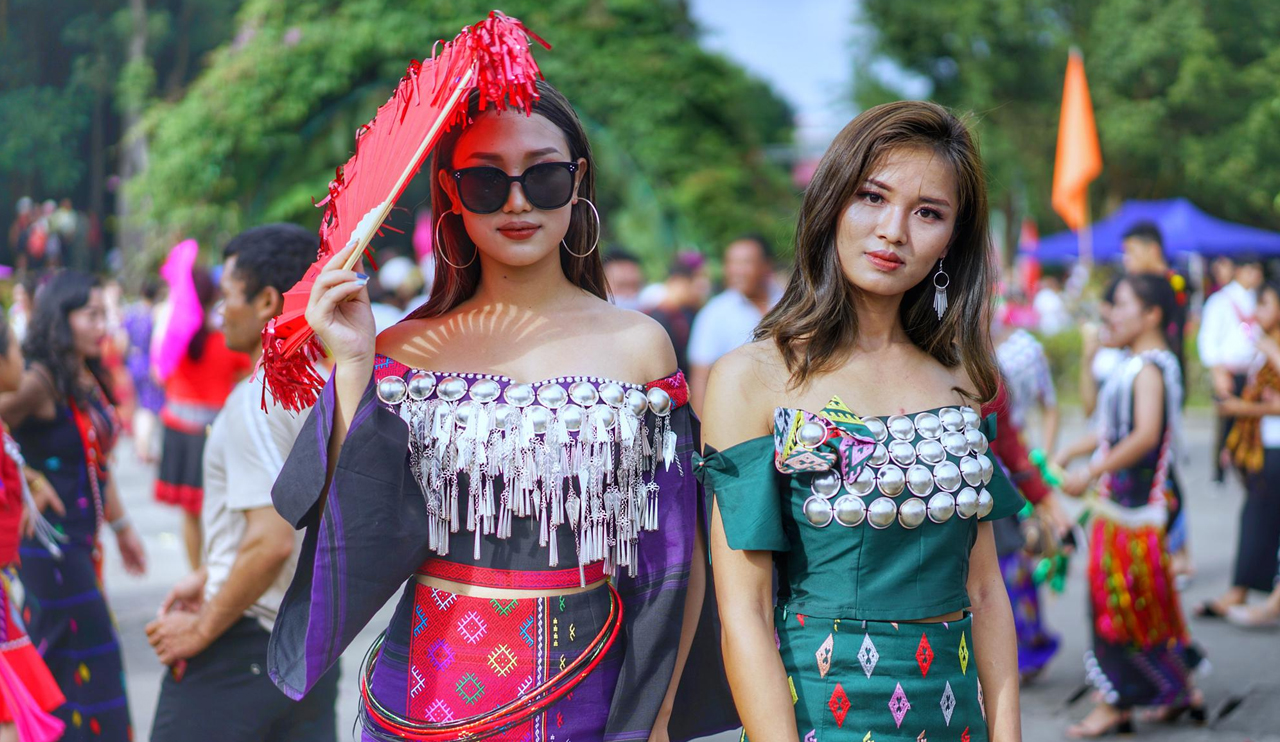
The Ark Citadel and the surrounding plaza host the largest public gatherings. Villages, universities, and community groups set up tables of food for the public. Traditional costumes appear everywhere. Young girls dress in their finest outfits, while men wear embroidered doppi caps and colorful robes.
The Labi Hauz complex—with its historic buildings and shady mulberry trees surrounding a peaceful pond—offers a more intimate celebration setting. A statue of the traditional humorist Khodja Nasriddin sits here, reminding visitors of Central Asian wit and wisdom.
Bukhara’s culinary highlights:
- Sumalak (somolok): The essential Navruz dish, a sweet wheat paste prepared in communal gatherings
- Halim: A slow-cooked wheat and meat porridge
- Plov: The aromatic rice dish that is Uzbekistan’s national treasure
- Green somsa: Special pastries filled with spring herbs
- Bijak: Pastry pockets stuffed with fresh greens
The Art of Making Sumalak
No Uzbek Navruz is complete without sumalak—a sweet dish made from germinated wheat that requires hours of preparation. Women gather in groups, often through the night, taking turns stirring the massive cauldron while singing traditional songs.
According to custom, if you throw a walnut or small stone into the pot while making a wish and it later appears in your bowl, your wish will come true. The communal preparation of sumalak embodies Navruz’s spirit of renewal, cooperation, and hope.
Buzkashi: The Dramatic Horseback Competition
Navruz celebrations in Uzbekistan often feature buzkashi (called kupkari or ulaq locally). This ancient horseback competition tests the strength and skill of riders who compete to seize and carry a goat or calf carcass to a designated goal.
Hundreds of riders on powerful horses surge together in dramatic displays of horsemanship. The game has been played across Central Asia for centuries. Watching a buzkashi match during Navruz offers an unforgettable glimpse into nomadic traditions.
Best Navruz tour itinerary in Uzbekistan:
- Begin in Tashkent with visits to Chorsu Bazaar
- Travel to Khiva for intimate old-town celebrations
- Continue to Bukhara for the peak festivities
- End in Samarkand for world-class architecture and celebrations
Tajikistan Navruz Festival: Mountain Celebrations and Ancient Traditions
Tajikistan, the Persian-speaking heart of Central Asia, celebrates Navruz with particular devotion. The festival signals the arrival of spring after the long mountain winters. Snowdrops—the main symbol of spring—begin to blanket the mountainsides as the holiday approaches.
Dushanbe: The Capital’s Grand Celebrations
The capital city of Dushanbe hosts major events throughout the holiday period. The 2025 celebrations include:
- 4th International Forum “Navruz Dushanbe” (March 20): Cultural and tourist connections
- Main Navruz Ceremony at Victory Park (March 21 morning): The highest point in Dushanbe
- Festive Concert on Istiqlol Square (March 21)
- International Tourism Festival (March 22, Iram Park)
- Festival of National Cuisine (March 22, Iram Park)
Traditional sporting competitions continue throughout the holiday. Gushtingiri (traditional Tajik jacket wrestling) and equestrian sports draw enthusiastic crowds.
The Tajik Navruz Table
In Tajikistan, the traditional display is called Haft Shin—featuring seven items beginning with the Persian letter “Sh” rather than “S.” The distinction reflects regional variations in Persian traditions.
The centerpiece of Tajik celebrations is sumanak—identical to Uzbekistan’s sumalak. Women and girls cook this sweet wheat paste in groups, often through the night, while singing memorable songs. President Emomali Rahmon himself has been photographed helping to stir the traditional sumanak pot, demonstrating its importance to national identity.
Beyond Dushanbe: Mountain Celebrations
For adventurous travelers, Navruz celebrations in the Pamir Mountains offer extraordinary experiences. The remote Gorno-Badakhshan Autonomous Province (GBAO) has developed its own unique traditions over centuries of relative isolation. Local communities gather for folk festivities, traditional games, and communal feasts.
What makes Tajikistan special for Navruz:
- Authentic, less commercialized celebrations
- Stunning mountain scenery
- Strong connection to Persian linguistic and cultural heritage
- Opportunities for cultural exchange with welcoming local families
Kurdish Newroz Celebrations: Fire, Freedom, and Cultural Identity
For the Kurdish people—spread across Turkey, Iraq, Iran, and Syria—Newroz carries profound significance beyond the arrival of spring. The festival has become a powerful symbol of Kurdish identity, resistance, and hope for self-determination.
The Legend of Kawa the Blacksmith
Kurdish Newroz celebrations center on the legend of Kawa (or Kaveh)—a blacksmith who led a rebellion against the tyrannical Assyrian king Zahak (or Dehaq). According to the myth, Zahak had serpents growing from his shoulders that demanded daily sacrifices of young men’s brains. Kawa rose up against this oppression, killed the tyrant, and lit bonfires on the mountaintops to announce freedom.
This legend makes fire central to Kurdish Newroz celebrations. The lighting of massive bonfires symbolizes the triumph over tyranny and the victory of light over darkness.
Diyarbakir: Heart of Kurdish Newroz in Turkey
Diyarbakir, the largest city in southeastern Turkey and an unofficial Kurdish capital, hosts some of the world’s largest Newroz celebrations. Each year, hundreds of thousands gather in Newroz Square for the festivities.
The celebrations feature:
- Massive bonfires lit in the square
- Halparke: Traditional Kurdish folk dances where crowds hold hands and dance in unity
- Traditional colored clothing: Red, yellow, and green—the Kurdish national colors
- Political speeches and cultural performances
- Poetry readings and traditional music
Important context: Kurdish Newroz celebrations in Turkey have historically been politically charged. The festival was banned until 1992, and even after legalization, celebrations sometimes faced restrictions or violence. However, in 2025, significant political developments have created a more hopeful atmosphere. Turkish President Recep Tayyip Erdogan has made unprecedented gestures toward recognizing Newroz, and peace discussions between Turkish authorities and Kurdish leaders have resumed.
Akre, Iraq: Torch Parades in the Mountains
Iraqi Kurdistan hosts some of the most spectacular Newroz celebrations. The ancient town of Akre, near Dohuk, is particularly famous. On the eve of Newroz, thousands of torch-bearing men and women climb the slopes of surrounding mountains, creating an unforgettable spectacle of light.
Since the establishment of the Kurdistan Regional Government in 1992, Iraqi Kurds have celebrated Newroz with increasing freedom. The festival is an official public holiday, and celebrations feature traditional games, music, dance, and family gatherings.
Newroz in Syria: A New Era of Recognition
Following the 2026 northeastern Syria offensive and subsequent political changes, Syrian President Ahmed al-Sharaa issued a historic decree recognizing Kurdish identity and enshrining Nowruz as a national holiday. For Syrian Kurds—who faced decades of restrictions under previous governments—this represents a dramatic shift.
In the Rojava region of northeastern Syria, Newroz celebrations now take place with official recognition. Communities gather freely for bonfires, traditional dances, and cultural performances.
Traveling for Kurdish Newroz
For Diyarbakir, Turkey:
- Newroz celebrations occur March 21
- Major events center on Newroz Square
- Security presence is typically heavy; monitor travel advisories
- Experience is most meaningful with cultural context and local guides
For Iraqi Kurdistan:
- Celebrations occur throughout the region
- Akre (near Dohuk) hosts the most dramatic torch ceremonies
- Erbil offers urban celebrations with greater infrastructure
- Travel is relatively accessible; tourism infrastructure is developed
Afghanistan Nowruz: Ancient Traditions Under Modern Challenges
Afghanistan has celebrated Nowruz for thousands of years. The city of Mazar-i-Sharif historically hosted the largest celebrations in the country, drawing up to 200,000 people to witness the famous banner-raising ceremony at the Blue Mosque (Shrine of Hazrat Ali).
The Jahanda Bala Ceremony
The most important Afghan Nowruz tradition is Jahanda Bala—the banner-raising ceremony on the first day of the new year. A special banner is raised at the Sakhi Shrine (Blue Mosque) in Mazar-i-Sharif. The colors of this banner closely resemble the legendary Derafsh Kaviani (Banner of Kaveh) from Persian mythology.
The Gul-i-Surkh Festival
The Gul-i-Surkh (Red Flower Festival) celebrates the red tulips that bloom across the green plains and hills surrounding Mazar-i-Sharif during the first 40 days of the new year. Traditionally, people from across Afghanistan traveled to attend these festivities.
Afghan Nowruz Traditions
| Tradition | Description |
|---|---|
| Haft Mewa | “Seven Fruits”—a fruit salad of seven dried fruits in syrup |
| Samanak | Sweet wheat dish prepared communally |
| Khaneh Tekani | Thorough spring cleaning of homes |
| Buzkashi | Traditional horseback game |
| Jashn-e Dehqan | “Festival of Farmers”—agricultural celebration |
| Sizdah Bedar | 13th day picnics in nature |
Current Situation (2025)
Since the Taliban’s return to power in August 2021, public Nowruz celebrations in Afghanistan have been significantly restricted. The Taliban has removed Nowruz as an official holiday from the government calendar and has blocked traditional ceremonies like the flag-raising at the Sakhi Shrine in Kabul.
While the Taliban has stated that people are “free to celebrate privately,” restrictions on music, women’s access to public spaces, and large gatherings have made meaningful celebrations difficult. Economic hardships have also affected families’ ability to prepare traditional foods and items.
For travelers: Due to ongoing security concerns and restrictions, tourism to Afghanistan for Nowruz is currently not recommended. However, Afghan diaspora communities worldwide continue to preserve and celebrate Nowruz traditions.
Los Angeles Nowruz Festival: The Largest Celebration Outside Iran
Los Angeles is home to the largest Iranian community outside of Iran, earning the nickname “Tehrangeles.” The city hosts what organizers call “the world’s largest free Nowruz celebration” at UCLA.
Farhang Foundation’s Annual Celebration at UCLA
Since 2010, the Farhang Foundation has organized a spectacular annual Nowruz festival at UCLA’s Dickson Court and Royce Hall. The 2025 celebration marks the 15th anniversary of this beloved tradition.
What to expect:
- Grand Haft-Sîn display: One of the most photographed Nowruz displays in the world, featuring exceptional size and stunning visual impact
- Traditional music performances: Musicians playing tar, setar, daf, and other Persian instruments
- Dance performances: Traditional and contemporary choreography by acclaimed dance companies
- Iranian Tea House: A decorated tent offering tea, shirini (sweets), and traditional snacks
- Food trucks: Offering Persian cuisine and other options
- Children’s activities: Puppetry, storytelling, and hands-on crafts
- Evening concert at Royce Hall: World-renowned Iranian classical musicians
In 2025, the festival features Mahdieh Mohammadkhani—one of Iran’s most acclaimed classical singers—making her first Los Angeles stage appearance in over a decade.
Event details:
- Date: First or second Sunday of March (check farhang.org for exact date)
- Time: Festival 12 PM – 5 PM (free); Concert at 6 PM (ticketed)
- Location: UCLA’s Dickson Court and Royce Hall, 375 Portola Plaza, Los Angeles, CA
Official Recognition in California
On March 19, 2024, Governor Gavin Newsom issued a proclamation declaring March 19 as Nowruz Day in California. The proclamation noted that Los Angeles is home to the largest Iranian community outside of Iran, with “Tehrangeles” serving as a thriving cultural center created by Persian residents and businesses.
Other Nowruz Celebrations in the United States
- New York City: Iranian cultural centers and community organizations host celebrations
- Washington, D.C.: Events at the Kennedy Center and local Iranian-American organizations
- San Francisco Bay Area: Large Persian community celebrations
- Phoenix, Arizona: Persian New Year Festival
London and Europe: Nowruz in the Diaspora
London’s Growing Nowruz Scene
London has become an increasingly important center for Nowruz celebrations in Europe. Parks host Haft-Sin displays, and numerous restaurants offer special Nowruz menus.
Restaurants offering Nowruz experiences:
- Berenjak: Persian-inspired cuisine with Nowruz specials
- Tehran-Berlin: Fusion menu with seasonal celebrations
- Bergamot: Modern Iranian dining
- Plateful Cafe: Traditional Persian dishes
Outside London, Konj Cafe in Edinburgh and Parisa Events in Cardiff offer Welsh and Scottish celebrations.
European Cities with Significant Celebrations
| City | Community | Notable Events |
|---|---|---|
| Cologne, Germany | Large Iranian diaspora | Cultural festivals, concerts |
| Stockholm, Sweden | Persian community | Park celebrations, family gatherings |
| Paris, France | Iranian cultural organizations | Museum events, concerts |
| Vienna, Austria | Persian community | Traditional celebrations |
India Parsi Navroz: Zoroastrian Traditions in the Subcontinent
The Parsi community of India—descendants of Zoroastrians who fled Persia in the 7th century to escape religious persecution—preserves unique Nowruz traditions. Interestingly, Indian Parsis celebrate Nowruz twice a year due to different calendar systems.
Two Dates for Parsi New Year
| Calendar | Typical Date | Description |
|---|---|---|
| Fasli (Iranian) | March 20-21 | Follows spring equinox |
| Shahenshahi | August 15 (2025) | Does not account for leap years; drifts over time |
Most Indian Parsis follow the Shahenshahi calendar, celebrating in August. However, many also observe the spring equinox celebration, especially with growing global connections.
Where to Experience Parsi Navroz in India
Udvada, Gujarat: The Iranshah Atash Behram in Udvada is the most sacred and oldest Zoroastrian fire temple in India. On Navroz, the temple is decorated with flowers, and special prayers are conducted. While non-Parsis cannot enter Zoroastrian fire temples, the town’s rich Parsi heritage and special Navroz foods can be experienced by all visitors.
Mumbai, Maharashtra:
- Fire temples throughout the city: Special prayers and ceremonies
- Iran Culture House: Cultural events and community gatherings
- Parsi cafés and restaurants: Special Navroz menus featuring traditional dishes
Traditional Parsi Navroz foods:
- Salli Boti: Tender meat with crunchy potato sticks
- Berry Pulao: Fragrant rice with dried berries
- Dhansak: Lentils and meat with rice
- Lagan Nu Custard: Traditional egg custard dessert
- Ravo: Sweet semolina pudding
Parsi Navroz Rituals
On Navroz, Parsi families:
- Clean and decorate their homes with flowers and rangoli
- Wear new traditional garments
- Visit fire temples for the Jashan prayer ceremony
- Exchange gifts and share festive meals
- Visit relatives, especially elders
Central Asian Nauryz: Kazakhstan and Kyrgyzstan Celebrations
Kazakhstan: Nauryz on the Steppe
Kazakhstan celebrates Nauryz as a major national holiday. The festival combines Persian traditions with Kazakh nomadic culture, creating unique celebrations.
Key traditions:
- Building yurts: Traditional felt tents are erected and filled with festive foods
- Nauryz kozhe: Special soup featuring seven ingredients (symbolizing perfection)
- Traditional sports: Kokpar (horseback game), wrestling competitions
- Music and dance: Traditional instruments and folk performances
Major celebrations in Kazakhstan (2025):
- Astana: National award ceremony at the Palace of Peace and Reconciliation; traditional eastern fair “Nauryz bazary”
- Almaty: Cultural events at parks; skiing at Shymbulak Resort (combining celebrations with winter sports)
Kyrgyzstan: Nooruz in the Mountains
Kyrgyzstan celebrates Nooruz with particular emphasis on communal traditions:
- Nooruz Kedje (Chon Kedje): A communal soup made from bull meat, prepared in designated public areas
- Traditional horsemanship displays: Demonstrating the equestrian heritage of Kyrgyz culture
- Filling water vessels: On Nooruz Eve, all vessels in the house are filled with water, symbolizing abundance
Bishkek hosts the largest celebrations with folk festivities, concerts, and traditional foods.
Practical Travel Tips for Nowruz Celebrations
Best Time to Visit Each Destination
| Destination | Peak Celebration Dates | Weather |
|---|---|---|
| Iran | March 20-April 2 | Pleasant spring, 15-25°C |
| Azerbaijan | March 19-24 | Cool spring, 10-18°C |
| Uzbekistan | March 20-24 | Mild, 15-22°C |
| Tajikistan | March 19-24 | Variable, 10-20°C |
| Kurdistan (Turkey) | March 21 | Cool, 10-15°C |
| Los Angeles | First/second week of March | Mild, 15-22°C |
Booking Considerations
- Book early: Accommodations fill quickly during Nowruz
- Expect higher prices: Hotels and flights are premium during the holiday
- Check visa requirements: Iran requires advance visas for most nationalities
- Local transportation: Some services may be limited during holidays
- Restaurant reservations: Popular restaurants fill quickly for holiday meals
Cultural Etiquette
Do:
- Learn basic greetings: “Nowruz Mubarak!” (Happy Nowruz!) or “Eid Shoma Mubarak!” (Happy Holiday!)
- Accept invitations to share meals or tea
- Bring small gifts when visiting homes
- Dress modestly, especially when visiting religious or traditional sites
- Show interest in local customs and traditions
Don’t:
- Refuse hospitality outright (a polite declining may be accepted after several offers)
- Take photos without permission, especially of people
- Discuss sensitive political topics
- Compare celebrations negatively between regions
Nowruz Foods You Must Try
Food is central to Nowruz celebrations everywhere. Here are the must-try dishes from each region:
Iran
- Sabzi Polo ba Mahi: Herbed rice with fried fish (traditional Nowruz Eve dish)
- Reshteh Polo: Rice with noodles (for good fortune)
- Kookoo Sabzi: Herby frittata
- Ash-e Reshteh: Noodle soup
- Samanu: Sweet wheat pudding
Azerbaijan
- Plov: Aromatic rice pilaf with meat
- Dolma: Stuffed vine leaves
- Pakhlava: Layered pastry with nuts
- Shekerbura: Moon-shaped pastries with sugar and cardamom
- Gogal: Savory or sweet pastries
Uzbekistan
- Sumalak: Sweet wheat paste (prepared communally)
- Halim: Slow-cooked wheat and meat porridge
- Plov: Rice with meat, carrots, and spices
- Kuk Somsa: Green herb-filled pastries
- Bijak: Pastry pockets with fresh greens
Afghanistan
- Haft Mewa: Seven-fruit salad in syrup
- Samanak: Sweet wheat dish
- Sabzi Chalaw: Rice with spinach
- Kulcha-e Nowrozi: Special Nowruz cookies
Kurdish Regions
- Dolma: Stuffed vegetables
- **Rice pilaf with lamb
- **Raisin and walnut cookies
- Nan-e Nokhodchi: Chickpea cookies
Conclusion: Embracing the Spirit of Renewal
Nowruz has survived for over three millennia because its message is universal. The themes of renewal, hope, family unity, and the triumph of light over darkness resonate across cultures and generations. Whether you experience the ancient fire rituals of Azerbaijan, the Silk Road splendor of Samarkand, the passionate celebrations of Kurdish Diyarbakir, or the vibrant Persian community of Los Angeles, you will find the same essential spirit.
As the vernal equinox approaches and day meets night in perfect balance, millions will gather around Haft-Sin tables. They will jump over bonfires. They will share meals with family and friends. They will look forward to the new year with hope and optimism.
Nowruz Mubarak! May your new year bring health, happiness, and prosperity.
Frequently Asked Questions About Nowruz Travel
When is Nowruz 2025? Nowruz 2025 begins on March 20 at 09:01 UTC, the exact moment of the spring equinox. Celebrations continue for 13 days.
Which country has the biggest Nowruz celebration? Iran has the most extensive national celebration, with official holidays and events across the country. Mazar-i-Sharif, Afghanistan historically hosted the largest single gathering (up to 200,000 people), though this has been restricted recently.
Can non-Iranians participate in Nowruz celebrations? Absolutely! Nowruz is a secular cultural celebration that welcomes people of all backgrounds. Locals are typically delighted to share their traditions with respectful visitors.
What should I wear to Nowruz celebrations? Dress codes vary by location. In Iran, women must wear hijab in public. In Azerbaijan and Central Asia, dress is more relaxed but modest. In Los Angeles and Europe, there is no dress code. Wearing spring colors or traditional attire is always appreciated.
Is it safe to travel during Nowruz? Most Nowruz destinations are safe for travelers. However, always check current travel advisories for your specific destination. Avoid Afghanistan under current conditions. For Kurdish regions, monitor local political situations.
What gifts are appropriate for Nowruz? Traditional gifts include sweets, flowers (especially hyacinths), and items for the Haft-Sin table. Money (eidi) is given to children. When visiting homes, bringing sweets, flowers, or other small gifts is customary.
This article was researched and written with deep respect for the diverse cultures that celebrate Nowruz. Information about specific events should be confirmed with local tourism offices and event organizers before traveling.