When tens of thousands of Jingpo people gather in Yunnan’s westernmost valleys to dance, sing, and pray in unison, something extraordinary happens. The ground trembles under the rhythm of leather drums. Silver ornaments catch the winter sun. Swords flash through the air in choreographed arcs. And you—if you’re fortunate enough to be there—become part of it all.
This is the Munao Zongge Festival, the grandest traditional celebration of the Jingpo ethnic group. It is a living, breathing cultural treasure that has been practiced for centuries in the borderlands where China meets Myanmar. In 2006, the Chinese government officially listed the Munao Zongge Festival as a national intangible cultural heritage, recognizing its irreplaceable role in preserving Jingpo identity and traditions.
Whether you are a cultural traveler seeking off-the-beaten-path experiences, an ethnography enthusiast, or someone who simply wants to witness one of Asia’s most spectacular mass dances, this guide will help you plan the perfect Munao Zongge pilgrimage. I have organized it around the best places to experience this festival in Yunnan, with practical travel advice, cultural context, and insider tips gathered from years of visiting Dehong Prefecture.
What Is the Munao Zongge Festival and Why Is It So Important to the Jingpo People
Before diving into destinations, it is essential to understand what the Munao Zongge Festival actually is—and why it matters so deeply to the people who celebrate it.
“Munao Zongge” is a phrase from the Jingpo language. It translates roughly to “everyone dancing together.” This is not a metaphor. During the festival, anywhere from several thousand to tens of thousands of participants dance in synchronized formation on a massive open square. The spectacle has earned it nicknames such as “the dance of paradise” and “the most spectacular mass dance in the world.”
The Jingpo people are one of China’s 56 officially recognized ethnic groups. Their population in China numbers approximately 150,000, according to the 2010 national census. The vast majority live in Dehong Dai and Jingpo Autonomous Prefecture, the westernmost prefecture of Yunnan Province, which shares a 503-kilometer border with Myanmar. Across that border, the same ethnic group is known as the Kachin people, and cross-border cultural ties remain strong.
Origins Rooted in Legend and Battle
In ancient times, the Munao Zongge was performed before going to battle, upon returning in victory, and to celebrate good harvests. According to Jingpo oral tradition, the dance was originally performed only by the children of the Sun in a celestial palace. After humans learned the dance from birds who had attended the Sun’s carnival, they brought it back to earth. The legend says that once humans mastered the Munao Zongge, they became healthier and luckier. Ever since, the Jingpo have performed the dance to drive away evil spirits, pray for good harvests, and celebrate life’s milestones.
The Festival’s Structure and Rituals
The Munao Zongge Festival typically lasts three to five days. Its core elements include:
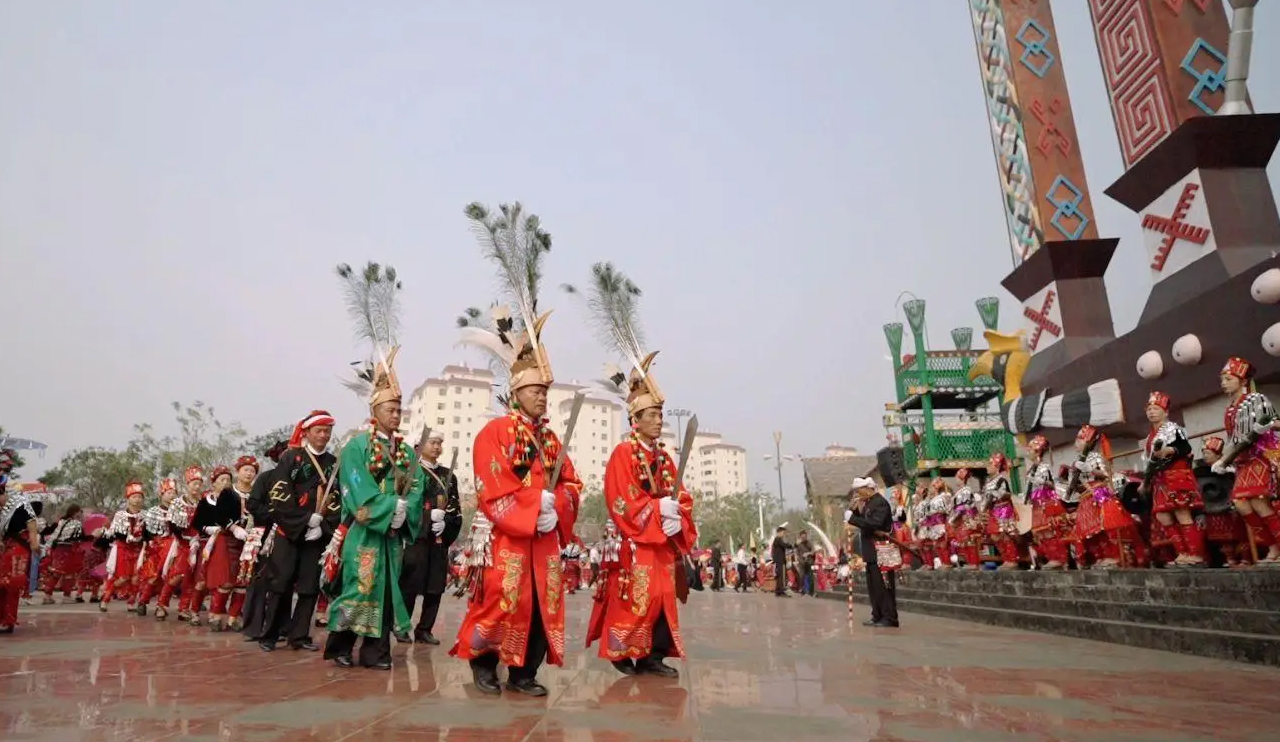
- The Munao Poles (Munao Shidong): Four tall wooden pillars stand at the center of the dance square. These sacred poles are carved with symbolic patterns representing the Jingpo people’s origin story, migration routes, totems, and prayers. The designs include fern spirals (symbolizing unity and progress), swords (bravery and courage), Himalayan peaks (the ancestral homeland), and crops and livestock (hope for prosperity).
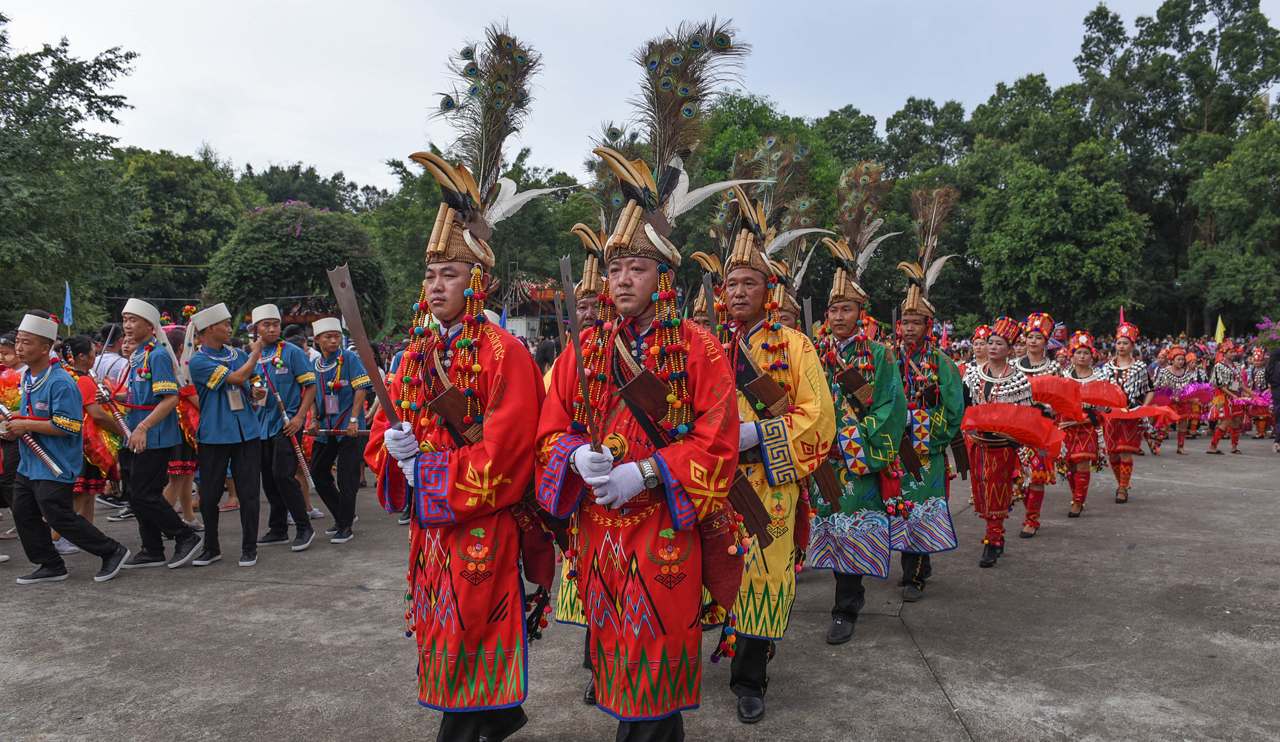
- The Lead Dancers (Naoshuang and Naoba): Four specially chosen elders lead the dance. The Naoshuang perform the ritual dance in elaborate costumes—feathered headdresses, red and green silk robes, silver cloaks, and long ceremonial swords. The Naoba direct the crowd and set the rhythm.
- The Mass Dance: Following the lead dancers, participants form long, spiraling columns. Women wear dazzling traditional costumes adorned with silver jewelry that catches light with every step. Men carry swords, spears, or bows. Everyone moves to the powerful beat of drums and gongs.
- The Green Leaf Banquet: Food is central to the celebration. The Jingpo’s famous “lüyeyan” (green leaf banquet) features meats, vegetables, and rice served on fresh banana and other large tropical leaves—no plates, no cutlery, just hands and nature’s tableware.
The Munao Zongge is no casual affair. Jingpo communities treat the dance with deep solemnity. Well-trained villagers consider a chaotic dance line or misplaced steps to be bad omens that could bring misfortune to the village. Every movement is purposeful. Every rhythm is precise.
When Is the Munao Zongge Festival Celebrated in Yunnan in 2026
Timing your visit correctly is critical. The Munao Zongge Festival follows the Chinese lunar calendar. It traditionally begins around the 15th day of the first lunar month, which coincides with or closely follows the Lantern Festival.
For 2026, the 15th day of the first lunar month falls on March 3. This means the main Munao Zongge celebrations in Dehong Prefecture are expected to take place in early March 2026, lasting approximately three to five days from that date.
However, there are a few important things to know about the timing:
| Detail | Information |
|---|---|
| Traditional date | 15th day of the 1st lunar month |
| 2026 Gregorian date | Around March 3, 2026 |
| Duration | 3–5 days (varies by location) |
| Additional celebrations | Some locations hold Munao Zongge events during China’s National Day Golden Week in early October |
| Best months to visit Dehong | October through May (dry season) |
It is worth noting that since the festival was listed as a national intangible cultural heritage in 2006, some communities have added celebrations during the National Day holiday (October 1–7). This provides travelers who cannot visit in late winter or early spring with a second opportunity to experience the festival.
Pro tip: Exact dates can shift slightly from year to year. Check with local tourism offices in Dehong Prefecture (area code: 0692) or reliable Chinese travel platforms for confirmed dates before booking your trip.
Longchuan County: The Hometown of Munao Zongge and the Best Place to See the Festival
If you can visit only one place for the Munao Zongge Festival, make it Longchuan County (陇川县). This is the undisputed heart of the celebration—the place where the tradition is most deeply rooted and most faithfully preserved.
Why Longchuan Is the Top Destination for Munao Zongge
Longchuan County holds the largest concentration of Jingpo people in all of China. Its Jingpo population numbers over 119,000, making up a significant portion of the county’s residents. The local government has invested heavily in preserving and promoting Munao Zongge, and the county proudly calls itself “the hometown of Munao mass dance.”
The county seat is in Zhangfeng Town (章凤镇), a small but lively border town that sits just kilometers from Myanmar. During the festival, the town’s central square transforms into an ocean of color and movement. In 2023, local authorities reported that more than 200,000 tourists visited Longchuan during the Munao Zongge Festival, with approximately 60,000 people directly participating in the dance (China Daily, Feb 2023).
Jinghan Township’s Pengsheng Tongken Celebration
Within Longchuan County, Jinghan Township (景罕镇) hosts one of the most renowned Munao Zongge celebrations. Known as the Pengsheng Tongken Munao Zongge Festival, this event has been running for decades. It draws participants from across Dehong Prefecture and even from across the Myanmar border. The celebration at Jinghan features full-scale traditional rituals, including the crowning of the Naoshuang lead dancers, animal sacrifice ceremonies, and marathon dance sessions that can last two hours per round.
Guangshan Jingpo Ecological Village
Just two kilometers east of Zhangfeng Town, the Guangshan Jingpo Ecological Park (广山景颇生态园) offers travelers an immersive Jingpo cultural experience any time of year—but it comes alive during the festival season. The village of Guangshan has been inhabited by the Jingpo people since 1947. All houses are built in the traditional Jingpo architectural style: thatched-roof cottages, bamboo stilt houses, and wood-and-tile structures surrounded by banana trees, mango orchards, and jackfruit groves.
The park covers 228.5 hectares and includes a dedicated Munao Zongge dance ground, a traditional Jingpo temple, and a “lover’s woods” path. During the festival, visitors can participate in the Munao dance, taste the traditional green leaf banquet, watch Jingpo singing and dancing performances, and even experience a reenactment of a traditional Jingpo wedding ceremony.
How to Get to Longchuan County
Longchuan does not have its own commercial airport. The nearest airport is Dehong Mangshi Airport (IATA: LUM), which serves the prefectural capital of Mangshi. From Mangshi, it is approximately a two to three hour drive to Zhangfeng Town in Longchuan.
| Route | Distance | Travel Time | Options |
|---|---|---|---|
| Kunming → Mangshi (by air) | ~630 km | ~1 hour | Multiple daily flights on China Eastern, Ruili Airlines, Kunming Airlines |
| Kunming → Mangshi (by road) | ~530 km | 8–9 hours | Via G56 Hangrui Expressway |
| Mangshi → Longchuan (Zhangfeng) | ~130 km | 2–3 hours | Local bus or hired car |
| Ruili → Longchuan (Zhangfeng) | ~90 km | 1.5–2 hours | Local bus or hired car |
Accommodation tip: Longchuan’s hotel options are limited compared to larger cities. During the festival period, rooms fill up quickly. Book well in advance. Options include the Longan Xinma Hot-spring Hotel, Cuizhihun Hotel, and Aishang Boutique Hotel in Longchuan County.
Ruili City: Experience Munao Zongge at the China-Myanmar Border
Ruili City (瑞丽市) is Dehong Prefecture’s most well-known destination among international travelers. It is a vibrant border town sitting directly across the river from Myanmar, famous for its jade markets, tropical scenery, and multicultural street life. It also hosts one of the most exciting Munao Zongge celebrations in the region.
Why Ruili Offers a Unique Munao Zongge Experience
What makes Ruili special is its position as a cross-border cultural hub. During the 2025 Munao Zongge Festival, guests from Myanmar crossed the border to join the celebration in Ruili, wearing their traditional Kachin costumes and dancing alongside their Chinese Jingpo relatives. This cross-border dimension adds a layer of cultural richness that you will not find anywhere else.
The Jingpo (Kachin) people share deep ethno-linguistic roots that span the border. When families separated by the boundary line reunite at the Munao Zongge dance ground, the emotion is palpable. Watching Kachin women from Myanmar’s northern highlands dance arm-in-arm with their Jingpo cousins from Dehong is one of the most moving sights you will ever witness at a cultural festival.
Jiegao Border Trade Zone and Festival Ground
One of the largest Munao Zongge dance grounds is located near Jiegao (姐告), the border trade zone on the southeast bank of the Ruili River. Jiegao is already a fascinating place to visit for its cross-border commerce—more than 15 trading streets where Chinese and Burmese merchants sell jade, gemstones, tropical fruits, and handicrafts. During the festival, the area takes on a carnival atmosphere.
Other Attractions Near Ruili During Festival Season
Ruili’s tropical climate and cultural diversity make it an ideal base for exploring beyond the festival:
- “One Village, Two Countries” Scenic Area: A border village where the international boundary line literally runs through homes and farmland. Residents on one side are Chinese; their neighbors across the garden are Burmese.
- Menghuan Golden Pagoda: A stunning Buddhist pagoda perched on a hilltop near Kongque (Peacock) Lake, offering panoramic views of the surrounding countryside.
- Jiele Grand Golden Pagoda: The largest Theravada Buddhist pagoda in Ruili, an important spiritual site for the local Dai community.
- Moli Tropical Rainforest: A lush nature reserve with waterfalls, hot springs, and boardwalk trails through the jungle canopy.
Getting to Ruili
Ruili is approximately 100 kilometers (62 miles) from Dehong Mangshi Airport and about 160 kilometers from Mangshi city center. The drive takes around two to three hours along a scenic road through tropical valleys. Local buses run regularly between Mangshi and Ruili, and taxis can be hired for about ¥200–300 for the one-way trip.
Yingjiang County: Munao Zongge Near the Yunyan Pagoda
Yingjiang County (盈江县) is another important Jingpo settlement within Dehong Prefecture. While it is less visited by international tourists than Ruili or Longchuan, it offers an authentic and less commercialized Munao Zongge experience.
The Yunyan Pagoda Festival Ground
The Yunyan Pagoda (允燕佛塔) is one of Dehong’s most important Buddhist monuments. This Theravada Buddhist tower, built in the Burmese architectural style, stands on Yunyan Hill on the outskirts of Yingjiang town. Surrounding the pagoda, you will find two significant structures: the Munao Building, dedicated to the Jingpo’s Munao Zongge celebrations, and the Water-Splashing Pagoda, associated with the Dai people’s famous water festival.
During the Munao Zongge Festival, the square around the Yunyan Pagoda fills with Jingpo dancers and onlookers. The setting is remarkable—ancient Buddhist architecture towering above a sea of dancers dressed in silver-studded costumes, with banyan trees swaying in the warm subtropical breeze.
Why Yingjiang Appeals to Adventurous Travelers
Yingjiang is less developed for tourism than Ruili, which is precisely its appeal for independent travelers. The Jingpo communities here are smaller and more intimate. You are more likely to be invited into a local home for a green leaf banquet or to share rice wine with village elders. The festival experience here feels more personal, more familial.
Yingjiang County is also a paradise for birdwatchers. The Tongbiguan Nature Reserve, located within the county, is one of Yunnan’s premier birding destinations, home to hundreds of species including several rare and endemic birds. If you visit during the festival in early March, you will catch the tail end of the excellent winter birding season.
Getting to Yingjiang
Yingjiang is located about 100 kilometers northwest of Mangshi. The drive takes approximately two hours. Local buses connect Mangshi to Yingjiang town, and the road winds through dramatic mountain and valley scenery.
Mangshi City: The Gateway to Munao Zongge Festival in Dehong Prefecture
Mangshi (芒市), also historically called Luxi, is the capital of Dehong Dai and Jingpo Autonomous Prefecture. Its name comes from the Dai language and means “City of Dawn.” While Mangshi is not the primary site for the Munao Zongge Festival, it serves as the logistical gateway for almost all visitors to the region.
Munao Zongge Celebrations in Mangshi
Mangshi holds its own Munao Zongge events, though on a smaller scale than Longchuan. The celebrations here are often incorporated into the Mengbanaxi Custom Festival, which combines Munao Zongge dances with Dai water-splashing rituals and performances by the De’ang, Lisu, and Achang ethnic groups. This multi-ethnic celebration takes place in Mangshi’s central square and offers a broad panorama of Dehong’s cultural diversity.
Mangshi’s Major Attractions
Even if you are using Mangshi primarily as a transit point, it deserves a day or two of exploration:
- Menghuan Golden Pagoda (勐焕大金塔): Asia’s largest hollow Buddhist pagoda, towering over the city with gleaming golden spires. The panoramic views from the hilltop are stunning at sunrise and sunset.
- Menghuan Silver Pagoda (勐焕大银塔): A pure white structure that complements the Golden Pagoda, featuring the famous “Sky Mirror” photo spot.
- Tree-Wrapped Pagoda (树包塔): A centuries-old banyan tree that has completely enveloped an ancient Buddhist pagoda—one of Yunnan’s most photographed oddities.
- Mengbanaxi Rare Park (勐巴娜西珍奇园): A botanical garden and cultural park featuring rare tropical plants, stone fossils, and ethnic cultural displays.
Mangshi as Your Dehong Travel Hub
Mangshi is the most practical base for festival travelers:
- Dehong Mangshi Airport (LUM) is just 6.5 kilometers from the city center. Airlines including China Eastern, Ruili Airlines, Kunming Airlines, and Sichuan Airlines operate flights from Kunming, Beijing, Shanghai, Chengdu, Chongqing, Xi’an, and other major cities.
- Airport shuttle buses run from approximately 09:00 to 20:30, taking about 30 minutes to reach downtown for a fare of just ¥3.
- Taxis from the airport start at ¥8 (metered). Always insist the driver use the meter.
- Local shuttle buses connect Mangshi to Longchuan, Ruili, Yingjiang, and Lianghe. Fares range from ¥20 to ¥50 depending on the destination.
Kunming Yunnan Nationalities Village: A Taste of Munao Zongge Without Traveling to Dehong
Not every traveler has the time to make the journey to remote Dehong Prefecture. If your Yunnan itinerary is focused on Kunming, Dali, or Lijiang, you can still get a taste of the Munao Zongge Festival at the Yunnan Nationalities Village (云南民族村) in Kunming.
What to Expect at the Kunming Celebration
The Yunnan Nationalities Village is a large cultural theme park on the shore of Dianchi Lake in Kunming. It features replicas of traditional villages representing Yunnan’s 25 ethnic minority groups, including the Jingpo. Each year in late February or early March, the Jingpo section of the park hosts a scaled-down Munao Zongge celebration. Activities include:
- Tasting traditional Jingpo rice wine
- Watching Munao Zongge dance performances
- Trying on Jingpo traditional costumes
- Sampling Jingpo snacks and foods
The Honest Truth About the Kunming Version
Let me be candid: the Kunming experience is a representation, not the real thing. It is curated, compact, and designed for tourists. You will not feel the earth shake under tens of thousands of dancing feet. You will not smell the smoke of ceremonial fires drifting through a border-town dawn. You will not hear the raw, unfiltered roar of drums echoing across the Jingpo highlands.
But if your schedule does not permit the trip to Dehong, the Kunming Nationalities Village offers a respectful and educational introduction to Jingpo culture. It can also serve as inspiration to plan a dedicated Munao Zongge trip for the following year.
Traditional Jingpo Food You Must Try During the Munao Zongge Festival
No cultural festival is complete without its food, and the Jingpo people offer one of Yunnan’s most distinctive culinary traditions. Eating at the Munao Zongge Festival is not just about nourishment—it is a communal ritual that strengthens bonds between families, neighbors, and guests.
The Famous Green Leaf Banquet (Lüyeyan)
The green leaf banquet is the Jingpo’s most iconic culinary tradition. Fresh tropical leaves—banana leaves, taro leaves, and others—serve as both tablecloth and plate. Dishes are arranged directly on the leaves, and diners eat with their hands. The banquet typically features:
- Bamboo tube rice (Zhutongfan): Fresh bamboo sections are stuffed with rice, sealed with bamboo leaves, and roasted over a fire. The result is subtly sweet, fragrant, and unlike anything you have tasted before.
- Grilled meats: Chicken, pork, and sometimes game, marinated with local herbs and spices, then grilled over charcoal or roasted in banana leaf wrappings.
- Wild vegetables and herbs: Bamboo shoots, fern tips, wild cress, and foraged greens from the surrounding mountains.
- Jingpo-style pickled dishes: The Jingpo are renowned for their preserved and fermented foods—pickled vegetables, fermented fish paste, and chili-based condiments.
- Sapie (撒撇): A famous Dehong specialty—a sour and spicy appetizer that is an acquired taste for many outsiders but beloved by locals.
Drinks Not to Miss
- Jingpo rice wine: Home-brewed and served generously. Refusing is considered impolite; accepting with both hands shows respect.
- Burmese milk tea: Reflecting the region’s cross-border influences.
- Avocado juice and passionfruit juice: Tropical fruits grow abundantly in Dehong’s warm climate.
What to Wear and How to Behave: Cultural Etiquette for Attending the Munao Zongge Festival
Respectful engagement with the Munao Zongge Festival requires understanding a few cultural norms. The Jingpo people are famously hospitable, but honoring their traditions will enrich your experience enormously.
Dress Comfortably and Respectfully
Wear comfortable shoes—you may be standing and walking for hours, and the dance grounds can be dusty or muddy. Light layers are ideal, as Dehong’s late winter weather can be warm during the day (20–25°C) and cooler in the evening. Bright colors are welcome; the Jingpo appreciate guests who make an effort to dress festively.
Some vendors and cultural organizations near the festival grounds rent or sell traditional Jingpo costumes for visitors to wear during the celebration. This is encouraged and appreciated by the local community. Many travelers find it a wonderful way to feel part of the festivities.
Joining the Dance
Yes, visitors are invited to join the dance. In fact, at the climax of each Munao Zongge session, the Naoba (crowd directors) actively encourage everyone present to join the spiraling columns. Do not be shy. The dance steps are simple enough to learn by following the person in front of you. Just keep to the rhythm of the drums, follow the flow of the line, and let the energy carry you.
Photography and Respect
Photographs are generally welcome, but always ask before photographing individuals up close, especially elders or those in ceremonial roles. During the sacrificial ceremony at the start of the festival, maintain a respectful distance and avoid disruptive behavior.
Accepting Hospitality
If you are offered rice wine, accept graciously with both hands. If invited to a green leaf banquet in someone’s home, remove your shoes before entering. Compliment the food—it will make your hosts beam with pride.
How to Plan a Complete Munao Zongge Festival Trip to Dehong in 2026
Putting it all together, here is a suggested itinerary for making the most of your Munao Zongge experience:
Suggested 5-Day Itinerary
Day 1 — Arrive in Mangshi Fly into Dehong Mangshi Airport from Kunming (approximately 1 hour) or another connecting city. Settle into your hotel. Visit the Menghuan Golden Pagoda at sunset. Explore the Mengbanaxi Night Market for your first taste of Dai-Jingpo cuisine.
Day 2 — Mangshi to Longchuan (Festival Day) Depart early for Longchuan County (2–3 hour drive). Arrive at the Munao Zongge festival ground in time for the opening ceremonies. Watch the crowning of the Naoshuang lead dancers. Witness the first round of mass dancing. Attend the green leaf banquet in the evening.
Day 3 — Longchuan (Festival Continues) Spend a full day immersed in the festival. Join the afternoon dance session. Visit Guangshan Jingpo Ecological Village for additional cultural activities. Explore the local markets for Jingpo handicrafts—handwoven textiles, silver jewelry, and bamboo crafts.
Day 4 — Longchuan to Ruili Drive from Longchuan to Ruili (approximately 1.5–2 hours). Visit the “One Village, Two Countries” scenic area. Explore Jiegao Border Trade Zone and shop for jade and gemstones. If Ruili’s Munao celebrations are still ongoing, join the festivities there.
Day 5 — Ruili to Mangshi and Departure Visit the Moli Tropical Rainforest or the Menghuan Golden Pagoda if you missed it on Day 1. Transfer back to Mangshi Airport for your departure flight.
Budget Estimates (Per Person, Approximate)
| Expense | Estimated Cost (CNY) |
|---|---|
| Round-trip flights (Kunming–Mangshi) | ¥800–1,500 |
| Hotel (4 nights, mid-range) | ¥800–1,600 |
| Local transport (buses, taxis, car hire) | ¥400–800 |
| Meals (5 days) | ¥500–800 |
| Festival activities, park entries | ¥100–300 |
| Total | ¥2,600–5,000 |
Best Time to Visit Dehong for the Munao Zongge Festival and Weather Guide
Dehong Prefecture sits in a subtropical monsoon climate zone. The dry season, from October through May, is the best time to visit. The Munao Zongge Festival in early March falls within this comfortable window.
Weather During Festival Season (Late February–Early March)
| Condition | Typical Range |
|---|---|
| Daytime temperature | 20–27°C (68–81°F) |
| Nighttime temperature | 10–15°C (50–59°F) |
| Rainfall | Minimal (dry season) |
| Humidity | Moderate |
| Sunshine | Abundant |
The weather is warm and dry during the traditional festival period, with pleasant daytime temperatures and cool evenings. This is one of the most comfortable times of year to visit southwest Yunnan.
The Rainy Season Warning
Avoid planning your Munao Zongge trip during June through September. The summer monsoon brings heavy rainfall, frequent thunderstorms, and high humidity to Dehong. Roads between towns can become difficult, and outdoor festival activities may be disrupted.
The Cross-Border Connection: Why Kachin Guests from Myanmar Make the Festival Special
One of the most remarkable aspects of the Munao Zongge Festival is its transnational character. Dehong Prefecture shares a 503-kilometer border with Myanmar’s Kachin State. The Jingpo people of China and the Kachin people of Myanmar are ethnically, linguistically, and culturally the same people—divided by a political boundary but united by tradition.
During the festival, Kachin families from northern Myanmar cross the border to join their Chinese relatives in celebration. The 2025 festival in Ruili drew particular attention for its cross-border cultural exchange, with Kachin performers wearing their traditional costumes and dancing alongside the lead dancers (China Daily, March 2025).
This cross-border participation is not a modern invention. Jingpo and Kachin families have celebrated the Munao Zongge together for generations, long before the current international boundary was drawn. Watching these reunions unfold at the festival gives visitors a profound reminder that culture does not stop at a border checkpoint.
As Jet San Htun, a singer from Myanmar who has attended the Dehong festival multiple times, told CGTN: the experience of celebrating Munao Zongge in Dehong keeps drawing him back across the border.
Understanding the Symbolism: The Sacred Munao Poles and Dance Patterns Explained
The Munao Zongge is not just a dance—it is a visual encyclopedia of Jingpo history and belief. Understanding its symbols will transform your festival experience from spectacle to revelation.
The Four Munao Poles
At the center of every Munao Zongge dance ground stand four tall wooden pillars. These poles are the spiritual and physical heart of the celebration. They are carved and painted with a set of symbolic patterns that have been standardized over centuries:
- Fern spirals: The curling fronds of young ferns resemble clenched fists, while the mature leaves look like arrows pointing forward. Ferns represent unity and progress.
- Crossed swords: A symbol of bravery, strength, and the warrior spirit of the Jingpo ancestors.
- Mountain peaks (Himalaya): Representing the Jingpo people’s ancestral homeland in the highlands of the Tibetan Plateau, from which they migrated southward over centuries.
- Crops, livestock, gongs, and musical instruments: Symbols of prosperity, celebration, and auspiciousness.
Together, the pole carvings tell the story of the Jingpo people—where they came from, what they value, and what they hope for.
The Dance Lines
The spiraling, serpentine dance lines are not random. They trace patterns that represent the migratory routes of the Jingpo ancestors, from the high plateau southward through the mountains to their current homeland. Following the dance line is, in a spiritual sense, walking the path your Jingpo hosts’ ancestors walked thousands of years ago.
Why the Munao Zongge Festival Deserves a Place on Every Cultural Traveler’s Bucket List
In an age of mass tourism and curated “cultural experiences,” the Munao Zongge Festival stands apart. It is not a performance staged for tourists. It is not a reenactment of a forgotten tradition. It is a living, breathing celebration that is as vital to the Jingpo people today as it was to their ancestors centuries ago.
What makes it extraordinary is the combination of scale, authenticity, and accessibility. Where else in the world can you join tens of thousands of people in a synchronized dance that has been performed for generations? Where else can you eat from banana leaves with your hands alongside village elders who are the living custodians of an intangible cultural heritage? Where else can you watch families separated by an international border reunite in celebration?
The Jingpo people of Dehong welcome visitors with warmth and generosity. They are proud of their culture and eager to share it. All they ask is that you come with an open heart and a willingness to dance.
Practical Tips for First-Time Visitors to the Munao Zongge Festival
To wrap up this guide, here are some hard-won practical tips:
1. Book flights and hotels early. Dehong’s tourism infrastructure is growing but still limited. During the festival, accommodations in Longchuan and Ruili fill quickly. Book at least one to two months in advance.
2. Bring cash. While mobile payment (WeChat Pay, Alipay) is widely used in Chinese cities, smaller villages and market stalls in Dehong may still prefer cash. ATMs are available in Mangshi and Ruili but scarce in rural areas.
3. Learn a few Jingpo phrases. Even a simple “Kabye” (hello) or “Chyeju kaba” (thank you) will earn you smiles and goodwill. If you can say “Munao” with enthusiasm while pointing at the dance ground, you have made a friend.
4. Bring sun protection. Dehong sits at a relatively low altitude with strong subtropical sunshine. Sunscreen, a hat, and sunglasses are essential.
5. Respect the sacred elements. Do not touch or lean on the Munao poles. Do not interrupt the Naoshuang lead dancers during their ritual. When in doubt, observe what the local people around you are doing and follow their lead.
6. Hire a local guide. A Jingpo-speaking guide will dramatically enhance your experience. Several Dehong-based tour operators offer Munao Zongge festival packages that include English-speaking guides, transportation, and cultural interpretation.
7. Stay healthy. The regional cuisine can be spicy and unfamiliar. Bring digestive medicine just in case. Drink bottled water. The local Jingpo rice wine is delicious but potent—pace yourself.
8. Allow extra time. Roads in Dehong can be slow. Leave buffer time between destinations. The region’s beauty is best appreciated at a relaxed pace, not in a rush.
Final Thoughts: The Dance That Unites a People
The Munao Zongge is more than a festival. It is a heartbeat—the rhythmic pulse of a people who have danced their way through centuries of migration, warfare, hardship, and celebration. To stand among the Jingpo people on a sunny morning in Longchuan or Ruili, to feel the drums in your chest, to watch the silver ornaments flash in the light as thousands of dancers move as one—this is an experience that changes you.
Yunnan Province has no shortage of spectacular ethnic festivals. The Dai Water-Splashing Festival, the Yi Torch Festival, the Bai March Fair—all are magnificent. But the Munao Zongge has something the others do not: the raw, unscripted power of tens of thousands of people moving together in perfect rhythm, driven by a tradition that stretches back to the very origins of their people.
Come to Dehong in 2026. Bring your dancing shoes. And let the Jingpo people show you what it feels like to truly dance together.
Have you attended the Munao Zongge Festival? Share your experience in the comments below. For more Yunnan travel guides and ethnic festival coverage, bookmark this blog and follow us on social media.