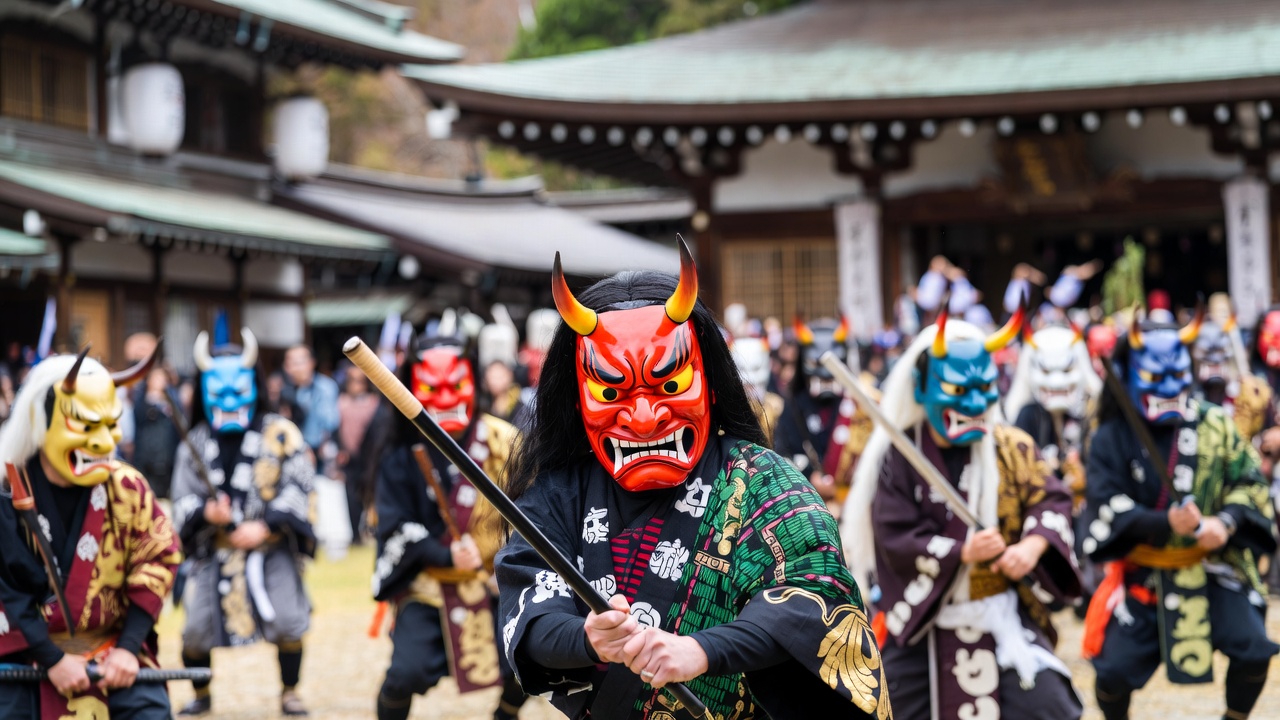
Every February, when the last stubborn chill of winter still grips the Japanese archipelago, something joyful and a little chaotic erupts across the country. Roasted soybeans fly through the air. Children scream with delight. Grown adults in demon masks flee from tiny hands. And somewhere, in a quiet kitchen, a family sits facing south-southeast, silently devouring a fat sushi roll without uttering a single word.
This is Setsubun (節分) — Japan’s beloved ritual for driving out evil and welcoming good fortune at the threshold of spring. In 2026, Setsubun falls on Tuesday, February 3, and temples, shrines, and households across the nation will once again come alive with the familiar cry: “Oni wa soto! Fuku wa uchi!” — “Demons out! Fortune in!”
For travelers heading to Japan in early February, Setsubun is one of the most rewarding cultural experiences you can have. It is not a public holiday. Shops and offices remain open. Trains run on schedule. Yet something magical hums beneath the surface of daily life. And if you know where to go, you can witness rituals that have barely changed in 500 years.
This guide covers everything: the best temples and shrines for Setsubun in Tokyo, Kyoto, Osaka, and Nara, the history and meaning behind each tradition, practical visitor tips, and the food customs you need to know — including the all-important lucky direction for eating your ehomaki sushi roll in 2026.
What Is Setsubun? History and Meaning of Japan’s Bean-Throwing Festival
Before we talk about where to go, it helps to understand what Setsubun actually means. The word itself translates literally to “seasonal division.” It refers to the day before Risshun (立春), the first day of spring according to Japan’s traditional lunisolar calendar.
Japan once recognized four setsubun — one for each seasonal change. But over the centuries, the transition from winter to spring gained special importance. Under the old calendar system, Risshun was treated as a kind of New Year. The day before it, then, became the equivalent of New Year’s Eve: a moment to purge the old year’s bad luck and prepare for the fresh start ahead.
This connection to the old New Year explains why Setsubun rituals focus so heavily on cleansing, protection, and renewal. The Japanese believed that seasonal transitions were spiritually unstable periods. Illness, disaster, and misfortune were thought to slip through more easily at these turning points. Setsubun was created as a defense — a collective effort to push back the unseen threats and step into the new season safely.
The Origins of Mamemaki: Why the Japanese Throw Beans at Demons
The most famous Setsubun custom is mamemaki (豆まき), or bean-throwing. Families and communities hurl roasted soybeans at figures dressed as oni (鬼) — fearsome, horned demons who represent misfortune, disease, and disaster.
The practice has roots in an ancient Chinese exorcism ritual called Tsuina (追儺). Introduced to the Japanese imperial court during the Heian period (794–1185), Tsuina was a court ceremony performed on New Year’s Eve. Interestingly, illustrations from the period show a figure called the Hōsō-shi (方相氏) — a shaman who actually drove away demons. But his frightening appearance caused later generations to mistake him for a demon himself. Over time, the ritual of chasing away evil shifted from a court ceremony to a popular custom involving beans.
Why beans? There is a clever play on words. The Japanese word for beans — mame (豆) — sounds identical to mame (魔目), meaning “demon eyes.” Throwing beans symbolically means destroying the eyes of evil. The beans must be roasted, because a raw bean that sprouts after being thrown was considered an extremely bad omen.
By the Muromachi period (1336–1573), mamemaki had become firmly established as a common practice among ordinary people. Today, it is performed in homes, kindergartens, workplaces, and — most spectacularly — at hundreds of temples and shrines across Japan.
When Is Setsubun 2026? Key Dates and the Lucky Direction for Ehomaki
Setsubun 2026 falls on Tuesday, February 3. This is the most common date in most years, though it can occasionally shift to February 2 or 4 depending on the astronomical calculation of Risshun.
Here is a quick reference for Setsubun dates:
| Year | Setsubun Date | Ehomaki Lucky Direction |
|---|---|---|
| 2025 | February 2 (Sun) | West-Southwest |
| 2026 | February 3 (Tue) | South-Southeast |
| 2027 | February 3 (Wed) | North-Northwest |
| 2028 | February 3 (Thu) | South-Southeast |
The lucky direction (恵方 / ehō) for 2026 is south-southeast. This is the direction you must face while eating your ehomaki sushi roll (more on that tradition below). The direction is determined each year by the position of Toshitokujin (歳徳神), the deity believed to preside over the year’s fortune.
Most Setsubun events at temples and shrines take place on February 3 itself. However, some venues — particularly in Kyoto — hold events on both February 2 and February 3. A few, like Yoshida Shrine, extend their festivities across three full days. Always check the official schedule of any venue you plan to visit.
Best Temples in Tokyo for Setsubun Bean-Throwing Ceremonies 2026
Tokyo hosts some of the largest and most energetic Setsubun celebrations in Japan. These are the top locations to experience mamemaki in the capital.
Sensoji Temple, Asakusa — Tokyo’s Biggest Setsubun Festival
If you want to celebrate Setsubun alongside 100,000 people, Sensoji is the place to be.
Tokyo’s oldest temple, located in the heart of Asakusa, holds one of the city’s grandest bean-throwing events. The day begins around 10:00 AM with local kindergarten children performing Setsubun songs and their own small mamemaki. The atmosphere is warm and charming — tiny hands tossing beans, parents snapping photos.
Things escalate quickly. The Seven Deities of Good Fortune Dance (Shichifukujin no Mai) is performed in the temple grounds, a ritual closely tied to Sensoji’s spiritual heritage. Then comes the main event: waves of bean-throwing sessions, typically running from around 11:30 AM to 4:00 PM, with sessions at intervals.
What makes Sensoji special is the sheer scale and diversity of the crowd. Tourists, families, elderly couples, office workers on their lunch break — everyone comes. And at Sensoji, a unique tradition holds: because the temple’s guardian deity, Kannon Bosatsu, is considered so compassionate that even demons are reformed in her presence, you may hear only “Fuku wa uchi!” (“Fortune in!”) without the usual call to expel demons.
Getting there: 5-minute walk from Asakusa Station (Tokyo Metro Ginza Line, Tobu Skytree Line). Cost: Free.
Zojoji Temple, Shiba Park — Setsubun at the Foot of Tokyo Tower
Set dramatically against the backdrop of Tokyo Tower in Shiba Park, Zojoji Temple offers one of Minato ward’s largest Setsubun gatherings. The temple’s historical connection to the Tokugawa shogunate gives the proceedings an extra layer of gravity.
Roughly 3,000 people attend each year, with Japanese celebrities often joining the bean-throwing on stage. The event typically runs from around 12:20 PM, making it an easy midday stop. The guest bean-throwers are traditionally people born in the current year of the Chinese zodiac, adding a personal astrological dimension to the ceremony.
Getting there: 5-minute walk from Onarimon Station (Toei Mita Line) or Shibakoen Station (Toei Mita Line). Cost: Free.
Ikegami Honmonji Temple — A 50-Meter Stage and Celebrity Guests
Located in Ota ward, a bit south of central Tokyo, Ikegami Honmonji draws over 10,000 visitors annually for its Setsubun celebration. The temple is famous for its massive 50-meter stage from which professional wrestlers, athletes, television personalities, and other celebrities fling soybeans — along with sweets and small gifts — into the packed crowd below.
The festivities begin with a procession at 1:00 PM, building toward the main mamemaki session around 3:00 PM. After the excitement, seek out the temple’s beloved kuzumochi (arrowroot mochi) — a local treat well worth the trip.
Getting there: 10-minute walk from Ikegami Station (Tokyu Ikegami Line). Cost: Free.
Mt. Takao Yakuoin Temple — Setsubun in the Mountains
For those who prefer natural surroundings over urban chaos, the Setsubun festival at Yakuoin Temple on Mt. Takao offers a beautiful alternative. Perched in the forested mountains west of central Tokyo, this festival combines spiritual depth with fresh mountain air.
Beans are thrown by men and women born under the same zodiac cycle as the current year. Prominent singers, sumo wrestlers, and actors often join in. Before the bean-throwing begins, a goma fire ritual is performed to purify the participants — a smoky, meditative ceremony that sets the tone for the day.
The combination of a hike through the forest, the fire ritual, and the lively mamemaki makes Mt. Takao one of the most memorable Setsubun experiences near Tokyo.
Getting there: Take the Keio Line to Takaosanguchi Station, then ride the cable car or hike up to the temple. Cost: Free (cable car is separate).
Shimokitazawa Tengu Festival — Setsubun Meets Street Culture
The Shimokitazawa Tengu Matsuri transforms this trendy, bohemian neighborhood into a whirlwind of parades, street food, and colorful costumes. Sometimes described as a kind of “Japanese Halloween,” the festival features participants in traditional dress, giant tengu (long-nosed goblin) masks, and an elegant Oiran Procession — a recreation of the courtesans’ grand promenade from the Edo period.
Children’s parades fill the morning. The famous Tengu parade rolls through at midday. Bean-throwing follows throughout the area. It is one of the most photogenic and accessible Setsubun events in Tokyo, set against the backdrop of Shimokitazawa’s vintage shops, small theaters, and cozy cafes.
Getting there: Shimokitazawa Station (Odakyu Line, Keio Inokashira Line). Cost: Free.
Top Shrines and Temples in Kyoto for Setsubun Celebrations 2026
Kyoto is the spiritual heartland of Setsubun. The ancient capital hosts an extraordinary range of celebrations — from austere demon-exorcism rites to graceful dances by geiko and maiko. Many locals follow a traditional custom of visiting four locations in a single day: Yoshida Shrine, Mibu-dera Temple, Fushimi Inari Taisha (or Yasaka Shrine), and Kitano Tenmangu. This four-stop pilgrimage is said to trace the path that demons take as they are driven through the city.
Yoshida Shrine Setsubun Festival — Kyoto’s Largest and Most Historic
The Setsubun Festival at Yoshida Shrine is the undisputed centerpiece of Kyoto’s celebrations. Founded in 859, the shrine sits at the foot of Mt. Yoshida in Sakyo ward, guarding the kimon (鬼門) — the northeastern “demon gate” — of the Kyoto Imperial Palace.
The festival runs for three days, with the main events concentrated on February 2 and 3. Around 800 food stalls line the approach to the shrine, and in a typical year, approximately 500,000 visitors pass through the grounds over the two busiest days. The atmosphere is electric — a river of humanity flowing between grilled squid vendors, fortune-telling booths, and omamori (charm) sellers.
The highlight is the Tsuina ritual, which begins at 6:00 PM on February 2. Descended directly from the ancient Heian-era court ceremony, this rite features a performer wearing a striking golden, four-eyed mask who drives rampaging oni from the shrine grounds. It is one of the oldest continuously performed exorcism rituals in Japan, and watching it under the cold night sky feels genuinely transporting.
On February 3, a massive fire-burning ritual (Karosai) takes place, during which old talismans and charms brought by worshippers are burned in a great bonfire, symbolically releasing their protective power.
Getting there: 20-minute walk from Keihan Demachiyanagi Station, or take Kyoto City Bus No. 206 to the Kyodaiseimonmae stop. Cost: Free.
Yasaka Shrine Setsubun — Geiko and Maiko Dances in Gion
The Setsubun celebration at Yasaka Shrine (also known affectionately as Gion-san) is one of the most visually stunning events in all of Japan. Held on February 2 and 3, the festival takes place in the shrine’s dance pavilion, right in the heart of Kyoto’s famous Gion district.
What sets Yasaka apart is the participation of geiko and maiko from Kyoto’s four major entertainment districts (hanamachi). Dressed in full, resplendent kimono, they perform devotional dances before tossing beans into the eager crowd. There are a total of eight dance performances over the two days, each featuring artists from a different hanamachi.
On the second day, an additional shishimai (lion dance) is performed, adding yet another layer to the proceedings. Performances generally run from 11:00 AM to 4:00 PM.
The shrine also sells fukumame (fortune beans) with raffle tickets attached. Every ticket is guaranteed to win a prize, making this one of the most delightful festivals for visitors of all ages.
Getting there: 5-minute walk from Gion-Shijo Station (Keihan Line). Cost: Free.
Mibu-dera Temple — 700 Years of Silent Setsubun Theater
Mibu-dera is a temple that truly earns its nickname: the “Temple of Plays.” For over 700 years, this temple in Nakagyo ward has hosted performances of Mibu Kyogen — a unique form of silent pantomime theater designated as an Important Intangible Folk Cultural Property of Japan.
The Setsubun performances take place on February 2 and 3, with the play “Setsubun” performed eight times per day starting at 1:00 PM. Audiences are rotated for each performance. The play tells the story of a demon being defeated by a woman armed with roasted soybeans — a humorous, wordless drama performed entirely through gesture, movement, and the sounds of bells, drums, and flutes.
What makes Mibu Kyogen remarkable is that the performers are not professional actors. They are local volunteers — about 40 people from the surrounding neighborhood, ranging from elementary school children to seniors in their 80s. This community tradition, born in 1300 from the innovations of the monk Saint Engaku (円覚上人), has never skipped a single year.
Visitors also write their age and gender on unglazed earthenware plates (hōraku) as offerings. These plates are later smashed during a spring performance called Hōraku Wari, which is believed to ward off disaster and fulfill the writer’s prayers.
History enthusiasts will also appreciate that Mibu-dera once served as the headquarters of the Shinsengumi, the famous samurai police force of the late Edo period. Graves of several Shinsengumi members, including a statue of their leader Kondō Isami, are found on the temple grounds.
Getting there: Take Kyoto City Bus No. 28 to the Mibudera Michi stop. Cost: Free for Setsubun performances.
Rozanji Temple — The Dramatic Oni Exorcism Dance
For pure theatrical spectacle, the oni-odori (demon dance) at Rozanji Temple (廬山寺) in Kamigyo ward is hard to beat.
At 3:00 PM on February 3, three oni — red, green, and black — emerge onto a stage built before the main hall, accompanied by the thunderous beat of taiko drums and the wail of conch shells. Each demon represents one of Buddhism’s three poisons: the red oni embodies greed, the green oni represents ill will, and the black oni symbolizes confusion. The red oni carries a torch and a sacred sword. The green oni wields a great axe. The black oni swings a heavy mallet.
The demons rage and dance across the stage before they are finally driven away by the power of chanted prayers and scattered beans. It is a powerful performance that connects directly to Buddhism’s moral teachings about overcoming human weakness.
Rozanji was founded around 938 by Ryōgen (also known as Ganzan-daishi), who served as the head abbot of Enryakuji Temple on Mt. Hiei.
Getting there: Kyoto City Bus Nos. 205, 4, or 7 to the Furitsu Idai Byoin-mae stop. Cost: Free.
Shimogamo Shrine — Archery Rituals and Morning Celebrations
Shimogamo Shrine, a UNESCO World Heritage site, offers a more intimate and solemn Setsubun experience. The festival here focuses on archery rituals — a tradition rooted in the shrine’s ancient role in protecting the capital.
The ceremony of shooting a kaburaya (sacred arrow) at the shrine’s main gate, the Romon, is particularly thrilling. The offerings, archery ceremony, and bean-throwing events begin at 10:00 AM and wrap up by noon, making this an ideal morning activity that leaves the rest of the day free for other Setsubun visits.
Getting there: Short walk from Keihan Demachiyanagi Station. Cost: Free.
Where to Celebrate Setsubun in Osaka: Temples, Towers, and Street Festivals
Osaka brings its signature energy — loud, warm, and generous — to Setsubun. The city’s events tend to be slightly less formal than Kyoto’s but no less memorable.
Sumiyoshi Taisha — Ancient Archery and Demon-Slaying Rituals
Sumiyoshi Taisha is one of Japan’s oldest and most important Shinto shrines, with a history spanning over 1,800 years. Its four main halls, built in the ancient Sumiyoshi-zukuri architectural style, are designated national treasures.
The shrine’s Setsubun celebration centers on the Tsuinahosha Shiki — an archery ceremony in which archers in traditional samurai-era attire shoot arrows at wooden boards inscribed with the character for “oni” (demon). The ritual captivates attendees with its graceful, deliberate movements, performed according to centuries-old etiquette. After the ceremony, visitors can enjoy free servings of zenzai — a warm, sweet red bean soup — perfect for a cold February afternoon.
Getting there: 3-minute walk from Sumiyoshi Taisha Station (Nankai Main Line). Cost: Free.
Osaka Naritasan Fudoson Temple — The 150-Meter Stage
A branch of the famous Naritasan Shinshoji in Chiba, Osaka Naritasan Fudoson Temple in Neyagawa City hosts what is widely considered the Kansai region’s most exciting Setsubun event. The temple features an impressive 150-meter-long stage and an enormous wooden bean container called the Sensho Daifukumasu — said to be the largest of its kind in Japan.
Prominent guests from the worlds of politics, entertainment, and business join the festival as honorary bean-throwers. Like its parent temple in Chiba, Osaka Naritasan omits the “Oni wa soto!” part of the chant, because the temple’s principal deity, Fudo Myō-ō, is believed so powerful that even demons are reformed in his presence.
Getting there: 15-minute walk from Korien Station (Keihan Main Line). Cost: Free.
Tsutenkaku Tower — Setsubun with Osaka’s Beloved Landmark
In the colorful Shinsekai district, the iconic Tsutenkaku Tower holds its annual Setsubun Fukumame Maki — a bean-throwing event that has been a local tradition since 1957. Celebrities from various fields — stage actors, anime voice performers, Olympic athletes — participate each year.
The event takes place right in front of the tower’s entrance, with lucky beans scattered into the cheering crowd. It perfectly captures the spirit of Osaka: unpretentious, lively, and focused on bringing good luck to everyday people.
Getting there: 3-minute walk from Ebisucho Station (Osaka Metro Sakaisuji Line). Cost: Free.
Nara’s Kasuga Taisha Setsubun Mantoro: The 3,000-Lantern Festival
If there is one Setsubun experience that feels genuinely otherworldly, it is the Setsubun Mantoro (節分万燈籠) at Kasuga Taisha in Nara.
On the evening of February 3, more than 3,000 stone and bronze lanterns across the shrine’s vast precincts are lit simultaneously. This tradition has continued for approximately 800 years. Many of the lanterns were originally donated by samurai warriors during Japan’s tumultuous Warring States period. Others were given by ordinary citizens over the centuries.
Walking through the shrine grounds at dusk, you pass rows of moss-covered stone lanterns flickering along garden paths, then step into dim corridors lined with hanging bronze lanterns. Strips of Japanese paper inscribed with visitors’ wishes decorate the garden lanterns. The effect is breathtaking — as if you have stepped back to a time before electricity existed.
The lanterns are lit starting at 6:00 PM, and the grounds take on a sacred, almost dreamlike quality. The experience is deeply meditative and stands in beautiful contrast to the boisterous bean-throwing festivals at other locations. Nara’s famous wild deer, which roam freely through the park, add to the atmosphere — you may spot them resting quietly near the glowing lanterns.
Getting there: 25-minute walk from Kintetsu Nara Station or JR Nara Station. Alternatively, take a Nara Kotsu bus to the Kasuga Taisha Honden stop. Cost: Free.
Naritasan Shinshoji Temple: Japan’s Most Famous Celebrity Setsubun Event
For sheer star power, no Setsubun event in Japan can rival Naritasan Shinshoji Temple in Narita, Chiba Prefecture. Located near Narita International Airport, this grand temple draws massive crowds each year for its spectacular mamemaki.
The ceremony features celebrities, NHK drama actors, kabuki performers, and top sumo wrestlers throwing soybeans from the stage to ecstatic spectators below. The 2025 event, for instance, featured appearances by actors from NHK’s Taiga drama Berabou and sumo wrestler Ōzeki Ōnosato.
There are typically three main bean-throwing sessions throughout the day: at 11:00 AM, 1:30 PM, and 4:00 PM. A participation fee of ¥10,000 allows the public to join as honorary bean-throwers alongside the celebrities — a once-in-a-lifetime experience that includes the loan of a special haori (half-coat) for the ceremony.
Naritasan follows a distinctive tradition: only “Fuku wa uchi!” is chanted, never “Oni wa soto!”. The temple’s guardian deity, Acala (Fudo Myō-ō), is considered so merciful and powerful that even oni repent and reform. There is no need to drive them out.
On February 3, traffic restrictions are enforced in the area around the temple, particularly between JR Narita Station and the temple approach. Plan to arrive early.
Getting there: 10-minute walk from JR Narita Station or Keisei Narita Station. Cost: Free to attend; ¥10,000 to participate as a bean-thrower.
Unique Setsubun Traditions and Regional Festivals Across Japan
Fukuoka: Walking Through the Giant Otafuku Gate
In Fukuoka, several shrines set up enormous Otafuku (お多福) gates — grinning, round-faced masks that symbolize happiness and good fortune. Walking through the mouth of the Otafuku is believed to bring blessings such as household safety and business prosperity. Kushida Shrine in Hakata holds bean-throwing every 30 minutes from 10:00 AM to 4:00 PM on February 3, and its grounds feature one of these massive Otafuku gates.
Tochoji Temple in Hakata, meanwhile, is said to host the oldest Setsubun festival in Fukuoka. On February 3, the Seven Lucky Gods (Shichifukujin) make a special appearance, and beans, rice cakes, mikan (mandarin oranges), and sweets are all scattered into the crowd.
Some Regions Use Peanuts Instead of Soybeans
While most of Japan uses roasted soybeans for mamemaki, some northern regions — particularly parts of Hokkaido, Tohoku, and Niigata — use unshelled peanuts instead. The practical reason is simple: peanuts are easier to find and clean up afterward. The spiritual principle remains the same.
Hiiragi Iwashi — The Sardine Head Charm
In certain areas, you may notice a strange decoration hanging near front doors: a grilled sardine head skewered on a sprig of prickly holly (柊鰯 / hiiragi iwashi). This is an old folk custom based on the belief that oni cannot stand the strong smell of sardines or the pain of holly thorns. It is one of Setsubun’s quieter, more domestic traditions — less dramatic than mamemaki but deeply rooted in everyday folk belief.
How to Eat Ehomaki on Setsubun 2026: Lucky Direction, Rules, and Where to Buy
The other great Setsubun food tradition is ehomaki (恵方巻き) — a thick, uncut sushi roll eaten in a very specific way. Here is what you need to know for 2026.
The 2026 Ehomaki Lucky Direction Is South-Southeast
Each year, the ehomaki direction changes based on the position of Toshitokujin, the deity of fortune. In 2026, the direction is south-southeast. Face this direction when you eat your roll.
Three Rules for Eating Ehomaki Correctly
There are three simple but meaningful rules:
- Do not cut the roll. Eat it whole, in one piece. Cutting the ehomaki symbolizes cutting off your good fortune.
- Face south-southeast. This is the direction where the deity of fortune resides in 2026. Do not look away until you finish eating.
- Eat in complete silence. Speaking while eating is believed to let your luck escape. Focus on your wish for the year.
What Is Inside an Ehomaki?
Traditional ehomaki contain seven ingredients, representing the Seven Lucky Gods (Shichifukujin / 七福神) of Japanese folklore. Common fillings include:
| Ingredient | Symbolism |
|---|---|
| Kanpyō (dried gourd strips) | Longevity and strong bonds |
| Shiitake mushroom | Protection from harm |
| Tamagoyaki (Japanese omelet) | Financial luck (golden color) |
| Unagi or anago (eel) | Success and perseverance |
| Sakura denbu (sweet fish flakes) | Celebration (pink color) |
| Cucumber | Good health |
| Shrimp | Long life (curved shape resembles an elderly person) |
Today, creative variations abound. Convenience stores like 7-Eleven, Lawson, and FamilyMart all offer premium ehomaki rolls. Many can be reserved in advance. FamilyMart’s 2026 lineup includes rolls supervised by renowned restaurant Sanpi-Ryoron and collaborations with the video game Touken Ranbu ONLINE. Department store food halls (depachika) offer luxury versions with wagyu beef, crab, or premium seafood.
Where Ehomaki Came From
Ehomaki is not an ancient tradition. It originated in the Kansai region, most likely among Osaka merchants in the 19th century who ate thick sushi rolls to pray for business success. The custom remained regional until the 1990s, when major convenience store chains launched nationwide promotional campaigns that turned ehomaki into a countrywide phenomenon. Today, ehomaki sales are a massive commercial event, with supermarkets and convenience stores stocking enormous displays in the days leading up to February 3.
Setsubun Food Guide: What to Eat Beyond Ehomaki and Roasted Soybeans
Setsubun is more than just ehomaki and soybeans. Different regions of Japan have their own food customs associated with the festival.
- Roasted soybeans (fukumame): After mamemaki, you eat the same number of beans as your age — or one extra — to wish for good health in the coming year. Bags of fukumame with paper oni masks are sold at every supermarket and convenience store from mid-January.
- Setsubun soba: In some parts of Japan, people eat soba noodles on Setsubun because the day was once considered the real New Year’s Eve. This is similar to the custom of eating toshikoshi soba on December 31.
- Sardines (iwashi): Particularly in the Kansai and Chubu regions, grilled sardines are eaten on Setsubun. The strong smell is believed to repel oni.
- Kenchin-jiru: A hearty vegetable soup with root vegetables, tofu, and konnyaku. Common in the Kanto region as a warming Setsubun meal.
- Konpeito and mochi: At many temple events, colored sugar candies (konpeito), rice cakes (mochi), and even mikan are thrown along with the beans. Catching these is considered especially lucky.
Practical Tips for Attending Setsubun Festivals in Japan 2026
Arriving Early Is Essential
The most popular events — Sensoji in Tokyo, Yoshida Shrine in Kyoto, Naritasan in Chiba — draw enormous crowds. Arrive at least one to two hours before the main mamemaki sessions to secure a good viewing position. At Yoshida Shrine, evening events fill up quickly as well.
Dress for Cold Weather
February in Japan is cold. Tokyo averages around 5–10°C (41–50°F) during the day. Kyoto and Nara can be slightly colder, especially in the evening. Dress in warm layers, and bring hand warmers. If you are attending the Kasuga Taisha lantern festival at night, a warm hat and gloves are essential.
Setsubun Is Not a Public Holiday
Shops, restaurants, and public transport operate on normal schedules. This is actually good news for travelers — it means you can plan Setsubun into a regular sightseeing day without worrying about closures.
Combining Setsubun Visits
In Kyoto, it is entirely possible to visit two or three Setsubun locations in a single day. A popular route:
- Morning: Shimogamo Shrine (archery rituals, ends by noon).
- Afternoon: Mibu-dera Temple (Kyogen performances from 1:00 PM) or Yasaka Shrine (geiko dances from 1:00 PM).
- Evening: Yoshida Shrine (Tsuina ritual at 6:00 PM, food stalls open all day).
What to Bring
- A small bag for catching beans and treats thrown during mamemaki.
- Cash. Many shrine stalls, charm shops, and food vendors do not accept credit cards.
- A compass app on your phone — helpful for finding south-southeast when it is time to eat your ehomaki.
Etiquette Reminders
- Be respectful during rituals. Mamemaki events can feel festive and casual, but they are religious ceremonies at their core. Avoid blocking shrine pathways or climbing on structures for a better view.
- Follow the crowd’s lead. When beans are thrown, it is acceptable to jostle politely for them. But give space to elderly visitors and families with small children.
- Dispose of trash properly. Festival grounds can get crowded. Carry your trash until you find a bin.
Setsubun 2026 Events at a Glance: Quick Reference Table
| Location | City | Date(s) | Key Highlight | Time |
|---|---|---|---|---|
| Sensoji Temple | Tokyo | Feb 3 | Massive crowd, Seven Deities Dance | 10:00 AM – 4:00 PM |
| Zojoji Temple | Tokyo | Feb 3 | Celebrity bean-throwing near Tokyo Tower | From 12:20 PM |
| Ikegami Honmonji | Tokyo | Feb 3 | 50-meter stage, athletes and wrestlers | 1:00 PM – 4:00 PM |
| Mt. Takao Yakuoin | Tokyo | Feb 3 | Mountain temple, goma fire ritual | Afternoon |
| Shimokitazawa Tengu Matsuri | Tokyo | Early Feb | Tengu parade, Oiran procession, street food | Morning – Evening |
| Yoshida Shrine | Kyoto | Feb 2 – 4 | Tsuina exorcism, 800 food stalls | All day; Tsuina at 6:00 PM (Feb 2) |
| Yasaka Shrine | Kyoto | Feb 2 – 3 | Geiko and maiko dances | 11:00 AM – 4:00 PM |
| Mibu-dera Temple | Kyoto | Feb 2 – 3 | Silent Mibu Kyogen theater | 1:00 PM – 8:00 PM |
| Rozanji Temple | Kyoto | Feb 3 | Oni exorcism dance (3 colored demons) | 3:00 PM |
| Shimogamo Shrine | Kyoto | Feb 3 | Sacred archery ritual | 10:00 AM – 12:00 PM |
| Sumiyoshi Taisha | Osaka | Feb 3 | Tsuina archery ceremony, free zenzai | Afternoon |
| Osaka Naritasan Fudoson | Osaka | Feb 3 | 150-meter stage, Kansai’s biggest event | All day |
| Tsutenkaku Tower | Osaka | Feb 3 | Celebrity bean-throwing at Shinsekai | Afternoon |
| Kasuga Taisha | Nara | Feb 3 | 3,000 lanterns illuminated | From 6:00 PM |
| Naritasan Shinshoji | Chiba | Feb 3 | Celebrity and sumo wrestler mamemaki | 11:00 AM, 1:30 PM, 4:00 PM |
| Kushida Shrine | Fukuoka | Feb 3 | Giant Otafuku gate, frequent mamemaki | 10:00 AM – 4:00 PM |
Frequently Asked Questions About Setsubun in Japan 2026
Is Setsubun a public holiday in Japan? No. Setsubun is a traditional observance, not a national holiday. Businesses, shops, and public transport operate normally.
Can foreigners participate in Setsubun events? Absolutely. Setsubun festivals at temples and shrines are open to everyone. No ticket or reservation is needed for most events. You are welcome to catch beans, enjoy the performances, and purchase charms and food.
What is the ehomaki direction in 2026? The lucky direction for eating ehomaki in 2026 is south-southeast. Face this direction, eat the roll whole without cutting it, and maintain silence while eating to seal your wish for the year.
Where can I buy ehomaki? In the days leading up to February 3, ehomaki rolls are available at virtually every supermarket, convenience store (7-Eleven, Lawson, FamilyMart), and department store food hall (depachika) across Japan. Premium rolls may require advance reservation.
Why do some temples only chant “Fuku wa uchi” without “Oni wa soto”? At certain temples — notably Naritasan Shinshoji and its branch temples — the guardian deity is considered so powerful and compassionate that even demons are reformed. There is no need to drive them out; only good fortune is called in.
What should I do with the beans after mamemaki? Gather them and eat the number matching your age (or your age plus one) to pray for health. Clean up any remaining beans. In home celebrations, leftover beans should not be left on the floor — a sprouted bean was historically considered a bad omen.
Is it okay to take photos at Setsubun events? Generally yes, but be mindful of your surroundings. Avoid using flash during solemn rituals. At events featuring geiko and maiko, be respectful — do not block their paths or touch their clothing.
Why Setsubun Is Worth the Trip: A Festival That Connects Past and Present
Setsubun is not Japan’s most famous festival. It does not have the international profile of cherry blossom season, the Gion Matsuri, or the snow festivals of Sapporo. But that is precisely part of its appeal.
When you stand in the cold February air at Yoshida Shrine, watching a golden-masked figure drive demons through flickering firelight while 500,000 people press in around you, you are witnessing something unbroken. This is not a festival recreated for tourists. It is a living tradition, passed down through centuries of actual belief and practice. The beans in your hand are the same kind of beans that Muromachi-era farmers threw. The chant on your lips is the same chant that rang through the streets of Edo.
And then there are the quiet moments. A grandmother in Nara, standing alone near a stone lantern at Kasuga Taisha, her face lit by warm amber light. A father in a tiny Osaka apartment, wearing a cardboard oni mask while his three-year-old pelts him with soybeans and collapses into giggles. A couple at a convenience store, debating which ehomaki to buy, then sitting on a park bench and eating in reverent silence, facing south-southeast.
These are the moments that make Setsubun special. It is a festival that belongs to everyone — to temple priests performing rites unchanged since the Heian period, and to toddlers who just like throwing things. It bridges the sacred and the silly, the ancient and the everyday.
If you are in Japan on February 3, 2026, step into it. Catch a bean. Eat your ehomaki. Shout the old words: Oni wa soto! Fuku wa uchi!
Spring is coming. The demons are leaving. Good fortune is on its way in.
Have you attended a Setsubun celebration in Japan? Share your experiences and tips in the comments below. For more Japan travel guides and festival deep dives, bookmark this page and follow our updates.
Disclaimer: Event schedules and details are based on information available as of early 2026. Organizers may alter schedules, cancel events, or change admission requirements. Always check official venue websites before making travel plans.