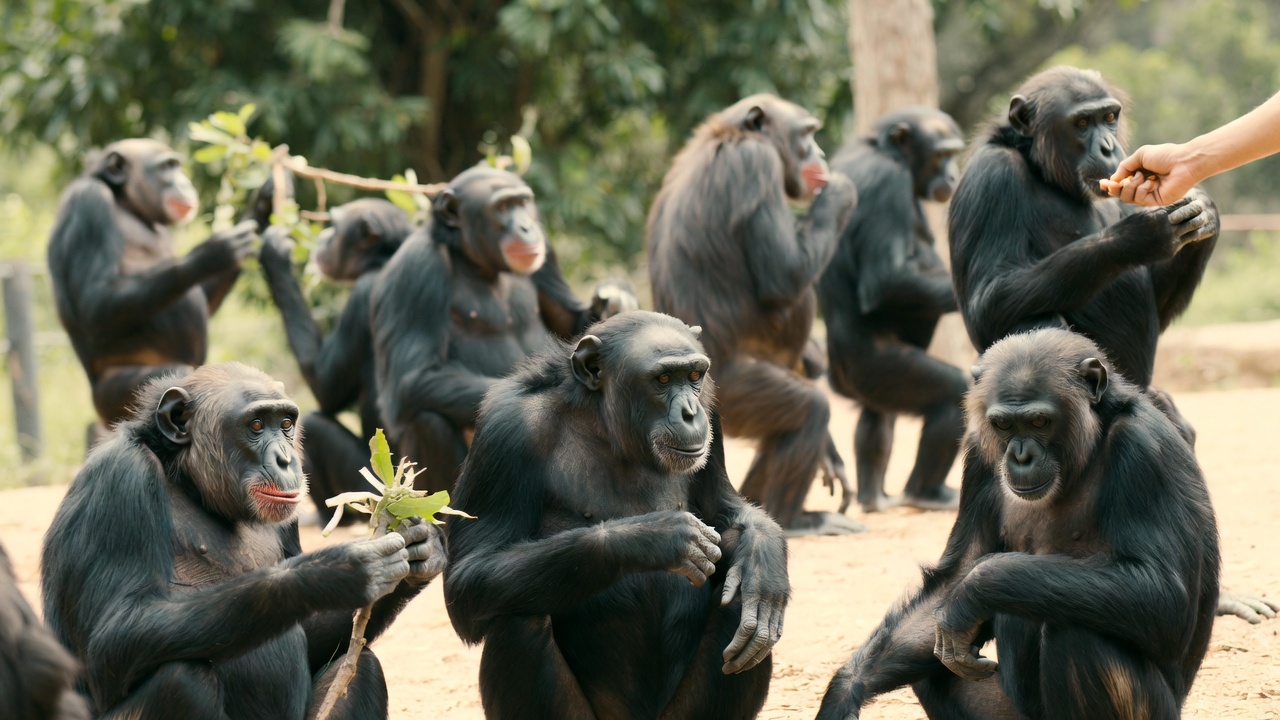
Every February 14, the world celebrates love. But this date also belongs to one of the most misunderstood great apes on Earth. World Bonobo Day, launched in 2017 by the Bonobo Conservation Initiative (BCI), falls on Valentine’s Day for a reason. Bonobos are often called the “make love, not war” apes — creatures that resolve conflict through social bonding rather than violence.
Yet most people cannot tell a bonobo from a chimpanzee. The two species look alike at a glance. They share 99.6% of their DNA with each other and roughly 98.7% with humans, making both of them our closest living relatives. But that remaining sliver of genetic difference tells a powerful story — one of contrasting societies, different bodies, and radically different approaches to getting along.
This World Bonobo Day 2026, let’s set the record straight. What exactly separates these two great apes? And why does it matter now more than ever?
What Is World Bonobo Day and Why Is It Celebrated on Valentine’s Day?
World Bonobo Day is a global awareness event held every February 14. It was founded by the Bonobo Conservation Initiative, a nonprofit dedicated to saving bonobos and their rainforest habitat in the Democratic Republic of the Congo (DRC). Several partner organizations support the event, including Friends of Bonobos, the International Primate Protection League, and the African Wildlife Foundation.
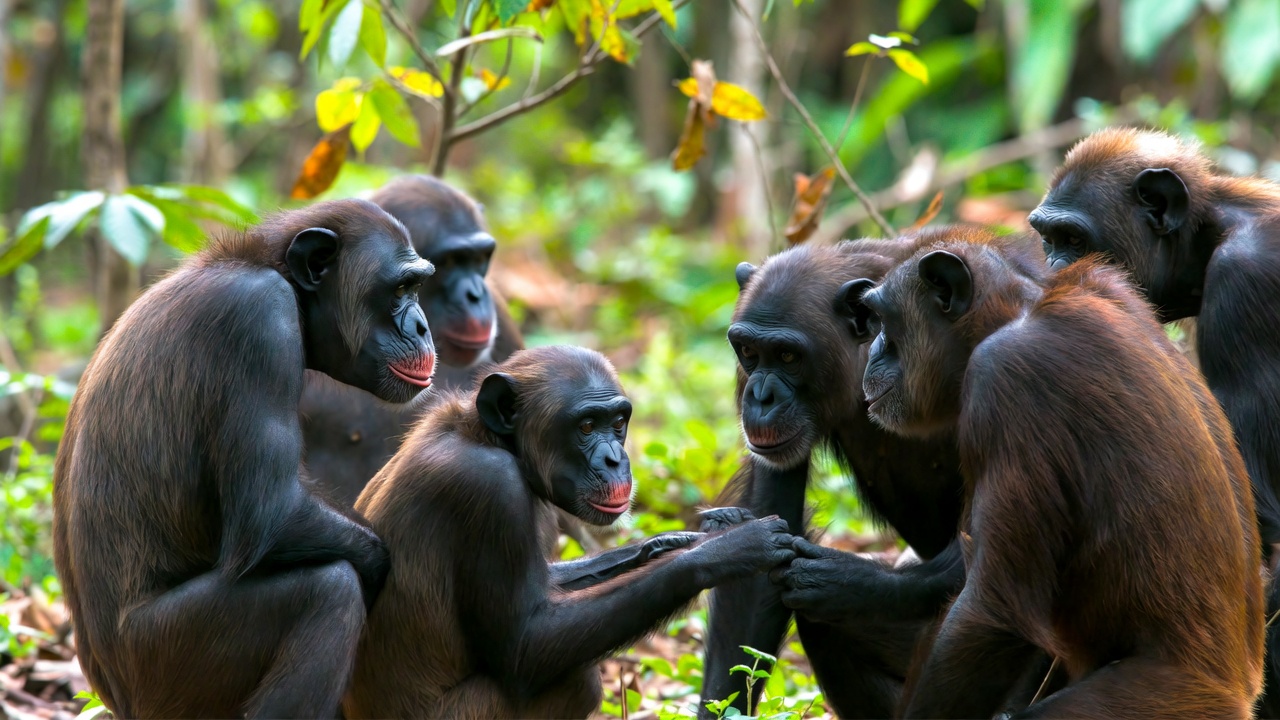
The choice of Valentine’s Day is no accident. Bonobos are famous for using physical intimacy, grooming, and social play to ease tension and build trust within their groups. They kiss. They hug. They share food with strangers. In the world of great apes, bonobos are the diplomats.
Despite these remarkable traits, bonobos remain the least-known great apes on the planet. They were not recognized as a separate species until 1933, when American anatomist Harold Coolidge elevated them from a supposed chimpanzee subspecies to a full species: Pan paniscus. Even today, far fewer studies have been conducted on wild bonobos than on chimpanzees, in large part because their habitat is extremely remote and politically unstable.
World Bonobo Day aims to change that. The event encourages people to learn about bonobos, share educational content, donate to conservation organizations, and reflect on what these peaceful primates can teach us about empathy and cooperation.
Bonobo vs. Chimpanzee: Physical Differences Between the Two Great Apes
At first glance, bonobos and chimpanzees look nearly identical. Both are covered in dark fur and move through the forests of Central Africa on all fours. But look a bit closer, and the physical differences become clear.
Bonobos are smaller and more slender. According to Friends of Bonobos, female bonobos weigh around 34 kg (74 lbs) on average, while female chimpanzees weigh about 42 kg (93 lbs). This lighter build is why bonobos were once mistakenly called “pygmy chimpanzees” — a nickname that stuck for decades but is now considered misleading.
Their faces are perhaps the easiest tell. Bonobo babies are born with dark black faces and distinctive pink lips. Chimpanzee infants, on the other hand, tend to have pale pink faces that darken as they age. Adult bonobos also have longer head hair that parts naturally down the middle, along with tufts of cheek hair that chimpanzees lack.
Body proportions differ too. Bonobos have longer legs, shorter arms, and a narrower trunk relative to chimpanzees. As noted by the World Wildlife Fund, these proportions give bonobos a posture that more closely resembles a human’s. Bonobos also walk upright more readily than chimpanzees, though bipedal walking still makes up less than 1% of their wild locomotion.
Here is a quick comparison:
| Feature | Bonobo (Pan paniscus) | Chimpanzee (Pan troglodytes) |
|---|---|---|
| Body build | Slender, gracile | Stocky, robust |
| Average female weight | ~34 kg (74 lbs) | ~42 kg (93 lbs) |
| Face at birth | Dark with pink lips | Pale pink, darkens with age |
| Head hair | Long, parted in the middle | Shorter, no distinct part |
| Lip color | Pink | Dark |
| Legs | Longer relative to body | Shorter relative to body |
| Tail tuft | Retained into adulthood | Lost after juvenile stage |
Finally, you can tell the two apart by sound. Bonobo calls are higher-pitched. They produce soft, tonal sounds described as “peeps” and “peep-yelps.” Chimpanzees, by contrast, are noisier — their calls include deep hoots, loud grunts, and dramatic screams.
How Do Bonobos and Chimpanzees Differ in Social Structure and Behavior?
The most striking differences between bonobos and chimpanzees are not physical. They are behavioral. These two species have built fundamentally different societies, and studying those societies has reshaped how scientists think about primate evolution.
Matriarchy vs. Patriarchy: Who Leads the Group?
Chimpanzee communities are patriarchal. A single alpha male dominates the group. Males form strong alliances with each other, patrol their territory, and sometimes launch violent raids on neighboring groups. As documented by Ape Initiative, males maintain the strongest social bonds in chimpanzee society. Females are generally subordinate and can be targets of aggression.
Bonobo communities are matriarchal. Females hold the highest rank. Males rank below all adult females in the group. This is remarkable because female bonobos are actually smaller than males — so their power does not come from physical strength. According to Friends of Bonobos, the secret lies in female alliances. When a young female migrates to a new group, she is welcomed warmly. She quickly bonds with other females, and this network of friendships allows females to collectively outrank and discipline aggressive males.
Conflict Resolution: Aggression vs. Social Bonding
Chimpanzees resolve disputes through dominance, intimidation, and sometimes deadly violence. Males have been observed killing rivals, committing infanticide, and sexually coercing females. Inter-group encounters are hostile, and territorial wars between chimpanzee communities have been well documented since Jane Goodall’s groundbreaking research at Gombe.
Bonobos take a strikingly different approach. They use grooming, play, and sexual contact to defuse conflict — not just between potential rivals, but even between different groups that encounter each other in the forest. Bonobos from separate communities have been seen sharing food, playing together, and sleeping near each other. This tolerance toward outsiders is almost unheard of among great apes.
The 2024 Study That Changed the Narrative
A landmark 2024 study published in Current Biology challenged the popular “hippie ape” stereotype. Lead author Maud Mouginot of Boston University and her colleagues compared male aggression across three bonobo communities in the DRC’s Kokolopori Bonobo Reserve and two chimpanzee communities at Tanzania’s Gombe Stream National Park. Using identical field methods for the first time, they tracked individual males from dawn to dusk and logged every aggressive act.
The results were surprising. Male bonobos were 2.8 times more likely to commit an aggressive act against another male than male chimpanzees were. Physical aggression — hitting, kicking, biting — was three times more frequent among bonobos (Mouginot et al., Current Biology, 2024).
But context matters. Bonobo aggression is almost entirely male-on-male and involves one-on-one scuffles. Chimpanzee aggression, while less frequent, is far more severe: it includes lethal attacks, gang violence, infanticide, and sexual coercion of females. As Harvard’s Martin Surbeck, the study’s senior author, explained: “There are different types of aggression, which may underlie different selection pressures” (Harvard Gazette).
In short, bonobos bicker more, but chimpanzees kill. Bonobos have never been observed killing a member of their own species.
Where Do Bonobos and Chimpanzees Live in the Wild?
Geography plays a central role in why these two species exist at all.
Both bonobos and chimpanzees are native to Central Africa. But the Congo River — one of the deepest rivers in the world — physically separates them. Bonobos live only south of the Congo River, within the borders of the Democratic Republic of the Congo. Chimpanzees live north of the river and across a much wider range spanning 12 countries in east, central, and west Africa.
Scientists believe the two species diverged from a common ancestor roughly 1 to 2 million years ago. One leading theory suggests that a drop in the Congo River’s water level allowed a group of ancestral apes to cross to the south bank. When water levels rose again, the two populations became permanently isolated. Because great apes cannot swim, the river has kept them apart ever since.
This geographic split has profound consequences. Bonobos occupy roughly 500,000 sq km of potential range, but their actual populations are scattered and fragmented. Chimpanzees, by contrast, are found across a far larger swath of the continent — from Senegal in the west to Tanzania in the east.
What Do Bonobos Eat Compared to Chimpanzees?
Both species are primarily frugivores — fruit lovers. Tropical forest fruits make up the bulk of their diets. But their secondary food sources reveal important differences.
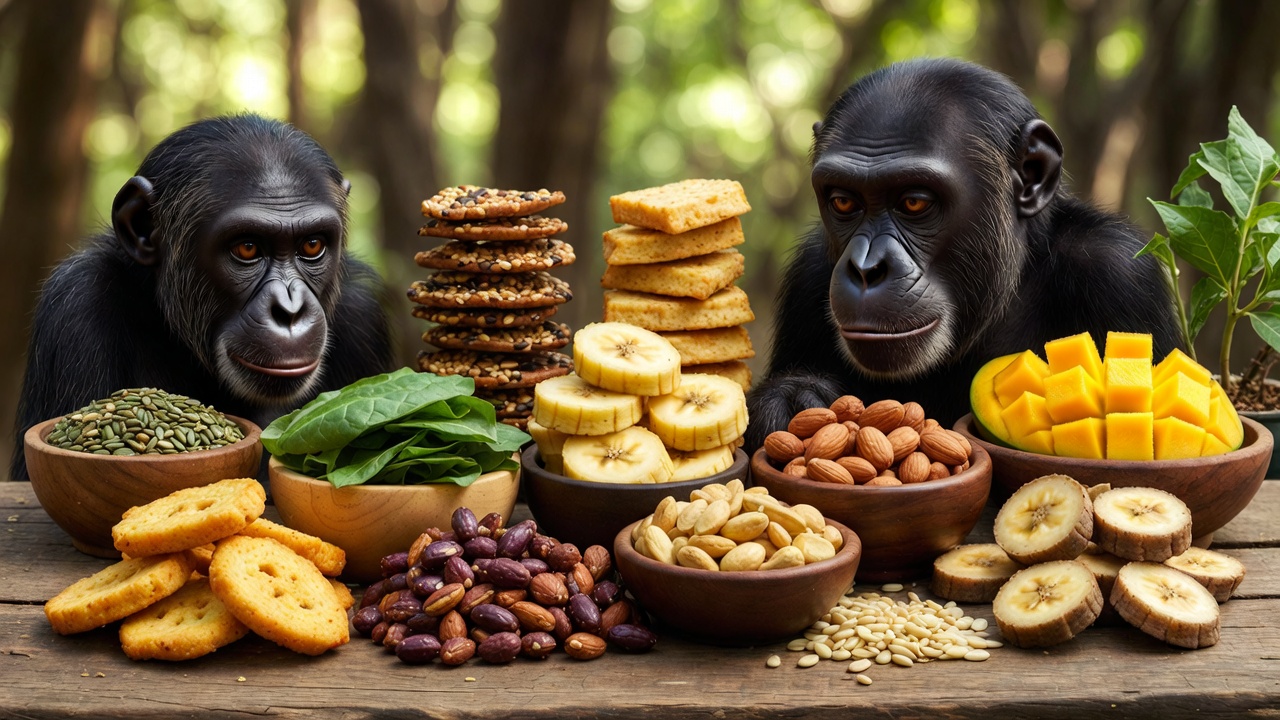
Bonobos lean more toward a plant-based diet. They frequently eat leaves, stems, flowers, and pith in addition to fruit. They do consume insects and occasionally small mammals, but active hunting is rarely observed.
Chimpanzees are more carnivorous. They are well-known hunters, cooperating in groups to catch and eat smaller primates like colobus monkeys. Chimpanzees across Africa also display a vast array of tool use — using sticks to extract termites, stones to crack nuts, and sharpened branches to spear small mammals. As noted in a 2010 study published in PLOS ONE, chimpanzees are far more dependent on extractive foraging that requires tools, while bonobos rely on tools very little in the wild.
This difference in diet and foraging strategy appears to have shaped each species’ cognitive strengths. The same study found that bonobos excel at tasks involving social reasoning and theory of mind, while chimpanzees perform better at tasks requiring physical problem-solving and tool use.
How Many Bonobos and Chimpanzees Are Left in the Wild?
Both species are classified as Endangered on the IUCN Red List, but bonobos face an especially precarious future.
| Metric | Bonobo | Chimpanzee |
|---|---|---|
| IUCN Status | Endangered | Endangered |
| Estimated wild population | 15,000–50,000 | 170,000–300,000 |
| Range | DRC only | 12 countries across Africa |
| Number of subspecies | None recognized | 4 subspecies |
| Key threats | Bushmeat hunting, habitat loss, civil conflict | Habitat loss, poaching, disease |
Population estimates for bonobos vary widely because much of their range has never been surveyed. The Bonobo Conservation Initiative estimates that 10,000 to 20,000 bonobos remain in the wild. The IUCN and WWF cite a broader range of 29,500 to 50,000. But all sources agree: the trend is downward, and it has been for at least 30 years.
A 2024 genetic study from University College London and the Max Planck Institute revealed that the bonobo population actually consists of three genetically distinct groups — central, western, and far-western — that have been living separately for tens of thousands of years. Losing any one of these groups would be devastating. As study author Aida Andrés of UCL told Earth.com: “Losing one of these three groups would be a devastating loss to the total genetic diversity of the species.”
Friends of Bonobos warns that when the species’ conservation status is next updated, bonobos seem likely to be reclassified from “Endangered” to “Critically Endangered.”
Chimpanzee numbers are larger in absolute terms, but the situation is still dire. The western chimpanzee subspecies (Pan troglodytes verus) was uplisted to Critically Endangered in 2016 after an estimated 80% population decline in recent decades. The Nigeria-Cameroon chimpanzee is down to as few as 6,000 individuals.
Why Are Bonobos Endangered and What Are the Main Threats?
Bonobos face a perfect storm of dangers — all of them driven by human activity.
Bushmeat hunting is the greatest direct threat. In the remote forests of the DRC, communities facing poverty and food insecurity rely on wildlife for protein. Smoked bushmeat is one of the few goods durable enough to transport to distant markets. Because bonobos are large and visible, they are easy targets for poachers. Young bonobos are also captured for the illegal pet trade, often after their mothers and other family members are killed.
Habitat destruction compounds the problem. Slash-and-burn agriculture — the dominant farming method in the Congo Basin — strips the soil of nutrients quickly, forcing farmers to clear new forest every few planting cycles. Industrial logging and coltan mining (coltan is a mineral used in smartphones and laptops) are opening up once-inaccessible forest to human activity. The African Wildlife Foundation notes that 99.2% of the bonobo’s range is also suitable for palm oil production, which poses a massive future threat.
Political instability in the DRC has made conservation work extremely difficult. Decades of armed conflict have brought weapons and militias into bonobo territory. Even Salonga National Park — the largest protected area in the bonobo’s range and a UNESCO World Heritage Site — has been invaded by armed poachers.
Bonobos also reproduce very slowly. A female gives birth to a single infant every 4 to 6 years and nurses her baby for about five years. This means populations cannot bounce back quickly from losses.
What Can Bonobos Teach Us About Human Evolution and Empathy?
For decades, chimpanzees dominated the conversation about human origins. Their aggression, territorial warfare, and male-dominated hierarchies seemed to mirror the darker side of human nature. Some scientists even used chimpanzee behavior to argue that violence is “hardwired” into the human lineage.
Bonobos complicate that narrative. They show that cooperation, empathy, and female leadership are just as deeply rooted in our evolutionary family tree. A February 2025 study found that bonobos can detect when a human does not know something — evidence that they may share with us a capacity for theory of mind, the ability to understand that others have different beliefs and knowledge.
Bonobos also play a critical ecological role. They are major seed dispersers in the Congo Basin rainforest. Certain plant species, such as Dialium, may depend on bonobos to activate germination. If bonobos disappear, the forest itself could change in unpredictable ways.
As primatologist Frans de Waal famously argued, studying both chimpanzees and bonobos gives us a fuller picture of what it means to be human. We are not simply “killer apes.” We are also capable of profound kindness, creative conflict resolution, and deep social bonds — just like the bonobo.
How to Celebrate World Bonobo Day 2026 and Support Bonobo Conservation
World Bonobo Day 2026 falls on Saturday, February 14. Here are meaningful ways to get involved:
Learn and share. Bonobos are the least-known great ape. Simply telling a friend or posting on social media about bonobos makes a difference. Use the hashtag #BonoboLove and #WorldBonoboDay to join the conversation.
Donate to bonobo conservation. Organizations doing critical work include:
- Friends of Bonobos — operates Lola ya Bonobo, the world’s only bonobo sanctuary, near Kinshasa in the DRC. They rescue orphaned bonobos, rehabilitate them, and work toward rewilding.
- Bonobo Conservation Initiative — partners with local Congolese communities to protect bonobo habitat through community-based conservation.
- African Wildlife Foundation — supports ranger training, wildlife surveys, and community-driven conservation reserves in the DRC.
- World Wildlife Fund — launched a bonobo habituation program in Salonga National Park in 2023 to develop sustainable bonobo tourism.
Recycle your electronics. Coltan mining destroys bonobo habitat. Recycling old smartphones and laptops keeps coltan in circulation and reduces demand for new mining.
Visit a zoo with bonobos. Several accredited zoos around the world house bonobos and participate in breeding programs. A visit supports both education and conservation funding.
Buy sustainably sourced products. Look for FSC-certified wood and sustainably sourced palm oil to help protect the Congo Basin rainforest.
Final Thoughts: Why the Difference Between Bonobos and Chimpanzees Matters
Bonobos and chimpanzees split from a shared ancestor roughly 1 to 2 million years ago. In that time, they have become two remarkably different species — one built around male alliances, territorial warfare, and tool-driven foraging; the other built around female solidarity, peaceful coexistence, and social intelligence.
Both species are endangered. Both are losing habitat at an alarming rate. And both have something valuable to teach us about what it means to be a primate living in a complex social world.
But bonobos are running out of time faster. Their range is smaller. Their population is lower. Their home country is less stable. And they remain, after nearly a century of recognition as a distinct species, tragically under-studied and under-funded.
This World Bonobo Day, take a moment to learn the difference. Then do something about it. The “hippie apes” are worth fighting for — peacefully, of course.