A Complete Guide to Understanding the World’s Most Spectacular Street Party
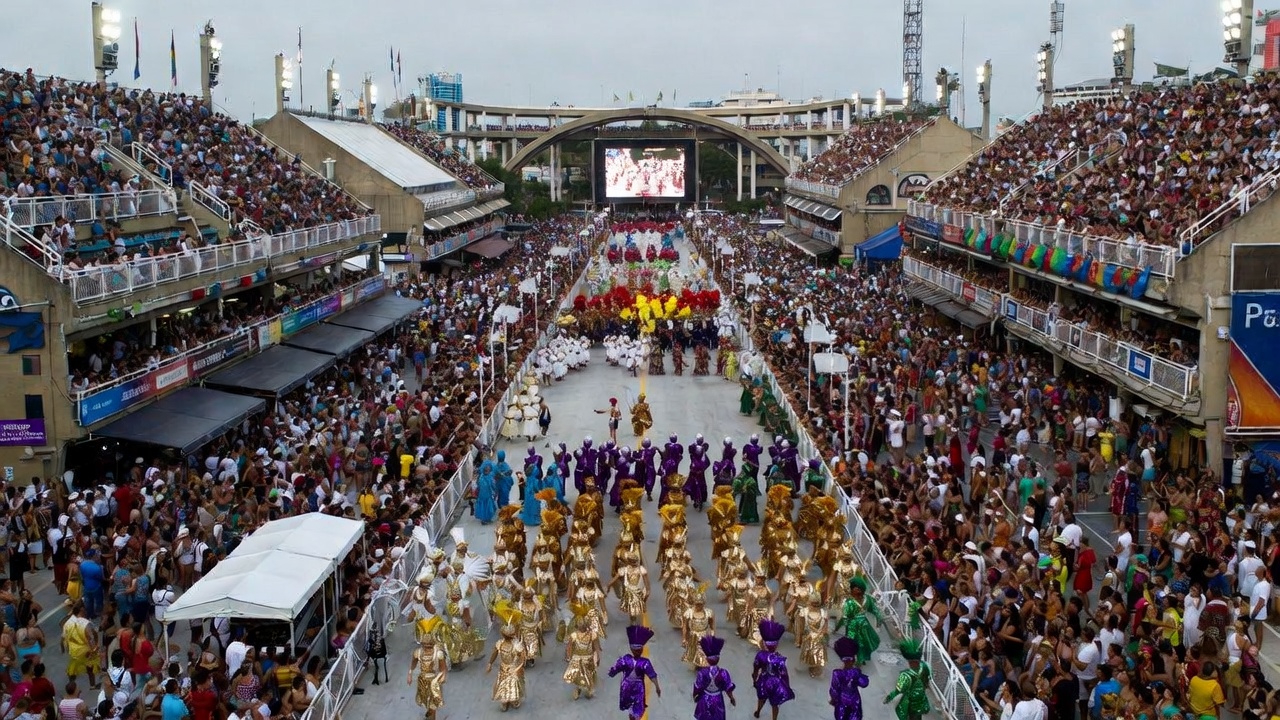
There’s a moment just before dawn in Rio de Janeiro when the city holds its breath. The Sambadrome lights blaze against the purple sky, drums thunder through the humid air, and thousands of sequined dancers prepare to tell stories that have been passed down through generations. This is Carnaval—not merely a festival, but the beating heart of Brazilian culture, a celebration that transforms an entire nation for five days of unbridled joy, artistic expression, and communal belonging.
Having spent more than two decades documenting festivals across six continents, I can say without hesitation that nothing compares to the sheer magnitude, emotional depth, and cultural significance of Brazilian Carnival. It’s not just the biggest party on Earth. It’s a living museum, a spiritual experience, and a testament to the resilience and creativity of the Brazilian people.
In this comprehensive guide, we’ll journey through the centuries-old history of this remarkable celebration, explore the intricate world of samba schools, and provide everything you need to know about experiencing Rio’s Carnival firsthand. Whether you’re planning your first trip to Brazil or simply want to understand why millions of people dedicate their entire year to these five magical days, bem-vindo—welcome to the story of Carnaval.
What is Brazilian Carnival and Why is it Famous Worldwide?
Brazilian Carnival, known locally as Carnaval, is an annual festival held in the days leading up to Lent, the 40-day period of fasting and reflection in the Christian calendar. The celebration officially begins on the Friday before Ash Wednesday and culminates on Fat Tuesday (Terça-feira Gorda), though in practice, festivities often extend several days in either direction.
What sets Brazilian Carnival apart from similar pre-Lent celebrations around the world is its unprecedented scale, artistic complexity, and deep cultural roots. While Venice has its elegant masquerade balls and New Orleans its jazz-fueled parades, Brazil transforms the entire concept of carnival into something altogether different—a nationwide phenomenon that brings together over 46 million participants across the country, according to data from the Brazilian Ministry of Tourism.
The festival manifests differently across Brazil’s diverse regions:
| City | Style | Key Features | Estimated Attendance |
|---|---|---|---|
| Rio de Janeiro | Samba School Parades | Sambadrome competition, elaborate floats | 2+ million |
| Salvador, Bahia | Trio Elétrico | Massive sound trucks, Afro-Brazilian rhythms | 2.5 million |
| Recife/Olinda | Frevo | Acrobatic dancing, giant puppets | 1.5 million |
| São Paulo | Samba Schools | Second-largest parade, diverse themes | 15 million |
| Ouro Preto | Traditional | Colonial-era celebrations, university crowds | 100,000+ |
Rio de Janeiro’s celebration, featuring the world-famous Samba School Parades at the Sambadrome, has become the international symbol of Brazilian Carnival. These aren’t mere parades—they’re competitive artistic productions where schools spend an entire year and millions of dollars preparing elaborate costumes, monumental floats, and choreographed performances that tell complex narratives about Brazilian history, mythology, and social issues.
The economic impact is staggering. According to the Confederação Nacional do Comércio de Bens, Serviços e Turismo (CNC), Rio’s Carnival alone generates approximately R$4 billion (roughly $800 million USD) in revenue for the local economy, supporting hundreds of thousands of jobs in hospitality, transportation, costume production, and entertainment.
But reducing Carnival to economic statistics misses its essence. For Brazilians, Carnaval represents something far more profound: a time when social hierarchies dissolve, when the favela resident and the Zona Sul socialite dance side by side, when the country’s complex racial and cultural heritage is celebrated rather than suppressed. It’s democracy in its most joyful form.
The Fascinating History of Carnival in Brazil: From Portuguese Roots to Global Phenomenon
How Did Carnival Come to Brazil? The Colonial Origins (1641-1808)
The story of Brazilian Carnival begins not in Rio de Janeiro, but in the streets of medieval Europe. The word “carnival” itself derives from the Latin carne vale, meaning “farewell to meat”—a reference to the fasting restrictions of Lent. Pre-Lenten celebrations existed throughout Catholic Europe, characterized by feasting, masking, and the temporary inversion of social norms.
Portuguese colonizers brought this tradition to Brazil in the 17th century in the form of Entrudo, a rather chaotic celebration involving water fights, throwing of mud, flour, and citrus fruits, and general mayhem in the streets. The first documented Entrudo celebrations in Brazil date to 1641 in the coastal cities of Salvador and Rio de Janeiro.
Entrudo was a remarkably egalitarian affair in its own rough way. Enslaved Africans, free people of color, indigenous peoples, and Portuguese colonists all participated, though often in separate spaces. The colonial authorities viewed these celebrations with deep suspicion, periodically attempting to ban or restrict Entrudo due to its perceived disorder and the dangerous mixing of social classes.
Despite official disapproval, Entrudo persisted and evolved. By the late 18th century, it had become an established part of Brazilian life, particularly in urban centers where the dense population made public celebrations possible.
The Transformation Era: From Street Chaos to Organized Celebration (1808-1900)
The arrival of the Portuguese royal family in Brazil in 1808, fleeing Napoleon’s invasion of Portugal, marked a turning point in Brazilian cultural history. The presence of the court in Rio de Janeiro brought European refinement to the colony, and this extended to Carnival celebrations.
The elite began organizing masked balls (bailes de máscaras) modeled on Venetian traditions, held in theaters and grand homes. These events featured European classical music, formal dancing, and elaborate costumes imported from Paris. The first recorded masked ball took place in 1840 at the Hotel Itália in Rio.
Meanwhile, the streets remained the domain of popular celebration. A crucial development occurred in 1855 with the creation of the first Grandes Sociedades Carnavalescas (Great Carnival Societies)—organized groups that paraded through the streets with themed floats, costumes, and music. These societies, such as Congresso das Sumidades Carnavalescas and Tenentes do Diabo, introduced the concept of structured, narrative-driven parades that would eventually evolve into the samba school format.
The abolition of slavery in 1888 had profound implications for Carnival. Suddenly, the African-descended population—which constituted the majority of Rio de Janeiro’s residents—could participate more openly in public celebrations. This period saw the emergence of distinctly Afro-Brazilian musical forms that would later coalesce into samba.
Birth of Samba and the First Samba Schools (1900-1940)
The early 20th century witnessed the most significant transformation in Brazilian Carnival history: the birth of samba and the creation of the first samba schools.
Samba emerged from the predominantly Black neighborhoods of Rio de Janeiro, particularly the area known as Pequena África (Little Africa) around Praça Onze in the Cidade Nova district. Here, Afro-Brazilian women known as tias (aunts) hosted gatherings that preserved African religious traditions, musical practices, and communal celebrations brought from Bahia. The most famous of these was Tia Ciata (Hilária Batista de Almeida), whose home at Rua Visconde de Itaúna 117 became the crucible of samba.
The first recorded samba composition, “Pelo Telefone” (By Telephone), was registered in 1917 by Donga (Ernesto dos Santos), though it likely incorporated elements created collectively at Tia Ciata’s gatherings. This milestone marked samba’s transition from informal folk music to a recognized Brazilian genre.
The first samba school, Deixa Falar (Let Them Talk), was founded on August 12, 1928, in the Estácio neighborhood by Ismael Silva, Nilton Bastos, and other local musicians. The term “escola de samba” (samba school) was coined to give the organizations a respectable, educational connotation that would protect them from police harassment—a very real concern given the authorities’ ongoing efforts to suppress Afro-Brazilian cultural expressions.
Key early samba schools and their founding dates:
- Deixa Falar (Estácio) – 1928 (later became Estácio de Sá)
- Mangueira (Morro da Mangueira) – 1928
- Portela (Oswaldo Cruz) – 1923 (as Conjunto Carnavalesco Oswaldo Cruz)
- Salgueiro (Andaraí) – 1953
- Império Serrano (Madureira) – 1947
The Brazilian government’s stance toward samba schools shifted dramatically under Getúlio Vargas, who served as president from 1930 to 1945. Vargas recognized the political potential of popular culture and began promoting samba and Carnival as symbols of national identity. In 1935, the government officially recognized samba schools and organized the first official parade competition.
This official recognition came with strings attached. Schools were required to feature explicitly Brazilian themes in their presentations, prohibited from depicting foreign subjects, and subjected to various regulations that shaped the modern parade format. This government intervention transformed samba schools from spontaneous community organizations into the highly structured competitive entities we know today.
The Golden Age: Sambadrome and International Recognition (1984-Present)
For decades, Rio’s samba school parades took place on Avenida Presidente Vargas and later on Rua Marquês de Sapucaí in makeshift settings that were assembled and disassembled each year. This changed forever in 1984 when architect Oscar Niemeyer designed the Sambadrome Marquês de Sapucaí, a permanent parade venue that would revolutionize Carnival.
The Sambadrome’s 700-meter parade runway, flanked by concrete grandstands capable of seating 72,500 spectators, transformed the samba school competition into a stadium event comparable to the Olympics or World Cup. The structure gave the parades a new grandeur while also generating consistent revenue that allowed schools to grow increasingly ambitious in their productions.
International recognition followed. Rio’s Carnival was recognized as the world’s largest carnival by Guinness World Records, and the celebration became a key driver of Brazilian tourism. The parades were broadcast globally, introducing samba and Brazilian culture to audiences who had never set foot in South America.
In 2012, Rio’s Carnival was inscribed on the UNESCO Representative List of Intangible Cultural Heritage of Humanity, recognizing its significance as a living expression of Brazilian creativity and community.
Understanding Rio de Janeiro Samba Schools: Structure, Culture, and Competition
What Exactly is a Samba School and How Does it Work?
The term “school” is somewhat misleading to outsiders. A samba school (escola de samba) is not an educational institution but rather a community organization rooted in a specific neighborhood (comunidade) that produces an annual Carnival parade. Think of it as part social club, part performance troupe, part neighborhood association, and part extended family.
Each samba school is legally structured as a non-profit organization (Grêmio Recreativo Escola de Samba, or GRES), with elected leadership and membership open to anyone who wishes to participate. In practice, schools draw their core membership from the surrounding community, often spanning multiple generations of the same families.
The organizational structure of a typical samba school includes:
| Role | Responsibilities |
|---|---|
| Presidente | Overall leadership, fundraising, external relations |
| Carnavalesco | Artistic director who designs the entire parade concept |
| Mestre de Bateria | Director of the percussion section (300-400 members) |
| Passistas | Elite dancers who perform complex samba choreography |
| Mestre-Sala e Porta-Bandeira | Male and female pair who perform the flag-bearing ritual dance |
| Comissão de Frente | Front commission performing the opening choreography |
| Puxador | Lead singer who performs the samba-enredo (theme song) |
| Baianas | Senior women who perform traditional spinning dances |
| Velha Guarda | Honored elder members who preserve school traditions |
| Ala de Compositores | Wing of songwriters who create the annual samba-enredo |
The carnavalesco is arguably the most crucial creative role. This artistic director conceives the parade’s theme (enredo), designs all costumes and floats, choreographs the presentation, and coordinates the thousands of moving parts that must come together on parade night. Top carnavalescos like Paulo Barros, Leandro Vieira, and Rosa Magalhães are celebrities in their own right, commanding salaries in the hundreds of thousands of dollars.
How Do Samba School Parades Work? The Competition Rules Explained
Rio’s samba school competition is organized by LIESA (Liga Independente das Escolas de Samba do Rio de Janeiro), the independent league that manages the Special Group schools—the top tier of the competition.
The hierarchy of samba school divisions functions similarly to professional soccer leagues, with promotion and relegation between levels:
Division Structure:
- Grupo Especial (Special Group) – 12 elite schools
- Série Ouro (Gold Series) – 14 schools
- Série Prata (Silver Series) – 9 schools
- Série Bronze (Bronze Series) – Multiple groups
- Mirim (Youth schools) – Junior divisions
Each Special Group school has exactly 65 minutes to parade down the 700-meter Sambadrome runway with a minimum of 2,500 and maximum of 4,000 participants. Going over or under time results in point deductions that can determine the difference between victory and defeat.
The judging criteria encompass 10 categories, each scored by 4 judges on a scale of 9 to 10:
| Criteria | What Judges Evaluate |
|---|---|
| Bateria | Percussion quality, rhythm, creativity |
| Samba-Enredo | Quality of the theme song composition |
| Harmonia | Synchronization of singing throughout the parade |
| Evolução | Flow and energy of the parade’s progression |
| Enredo | Clarity and development of the narrative theme |
| Conjunto | Overall visual and artistic unity |
| Alegorias e Adereços | Float design and costume accessories |
| Fantasias | Costume design and execution |
| Comissão de Frente | Opening choreography and creativity |
| Mestre-Sala e Porta-Bandeira | Flag-bearing dance performance |
The highest and lowest scores in each category are discarded, and the remaining scores are summed. The school with the highest total wins the championship. The margin is often razor-thin—championships have been decided by fractions of a point.
The bottom two schools in the Special Group are relegated to Série Ouro, while the top two from Série Ouro are promoted. This creates intense pressure and genuine stakes that infuse the competition with drama far beyond mere entertainment.
The Most Famous Samba Schools in Rio de Janeiro History
Several schools have achieved legendary status through consistent excellence and cultural impact:
Mangueira (Estação Primeira de Mangueira)
- Founded: 1928
- Colors: Green and pink
- Titles: 20+ championships
- Character: Known as the “most Brazilian” school, Mangueira emphasizes traditional samba and community roots. Their headquarters in the Mangueira favela host some of Rio’s most authentic rodas de samba (samba circles). Notable members include the legendary Cartola and Nelson Cavaquinho, composers whose songs define the Brazilian songbook.
Portela
- Founded: 1923
- Colors: Blue and white
- Titles: 22+ championships (record holder)
- Character: The most successful school in terms of championships, Portela is known for its musical excellence and devotion to samba tradition. Their mascot is the eagle (águia), and their parades often feature some of the most moving samba-enredos in Carnival history.
Beija-Flor de Nilópolis
- Founded: 1948
- Colors: Blue and white
- Titles: 14 championships
- Character: Known for opulence and spectacle, Beija-Flor (Hummingbird) consistently produces the most elaborate and expensive parades. They pioneered the use of special effects and mechanical floats, though this has sometimes drawn criticism for prioritizing visual impact over traditional samba values.
Salgueiro (Acadêmicos do Salgueiro)
- Founded: 1953
- Colors: Red and white
- Titles: 9 championships
- Character: Revolutionary in their approach, Salgueiro broke barriers in the 1960s by centering Black Brazilian history in their enredos, celebrating figures like Zumbi dos Palmares and the quilombo resistance movements when such themes were socially controversial.
Vila Isabel (Unidos de Vila Isabel)
- Founded: 1946
- Colors: Blue and white
- Titles: 3 championships
- Character: Named after the neighborhood where composer Noel Rosa lived, Vila Isabel is known for musical sophistication and poetic lyrics. Their samba-enredos are often considered among the most beautiful.
What Happens During Rio Carnival Week? A Day-by-Day Guide
Understanding the structure of Carnival week helps visitors maximize their experience. While the celebration varies year to year, the general schedule remains consistent.
Friday Before Carnival: The Official Opening
Carnival officially begins with the symbolic passing of the city keys to Rei Momo, the King of Carnival. This corpulent figure, selected through a competition organized by Riotur (the city’s tourism agency), represents the spirit of excess and celebration that defines the festival.
Key events on opening Friday:
- Rei Momo coronation ceremony at City Hall
- Opening of official street parties (blocos)
- Série Ouro parades at the Sambadrome (evening)
Saturday and Sunday: Peak Street Carnival
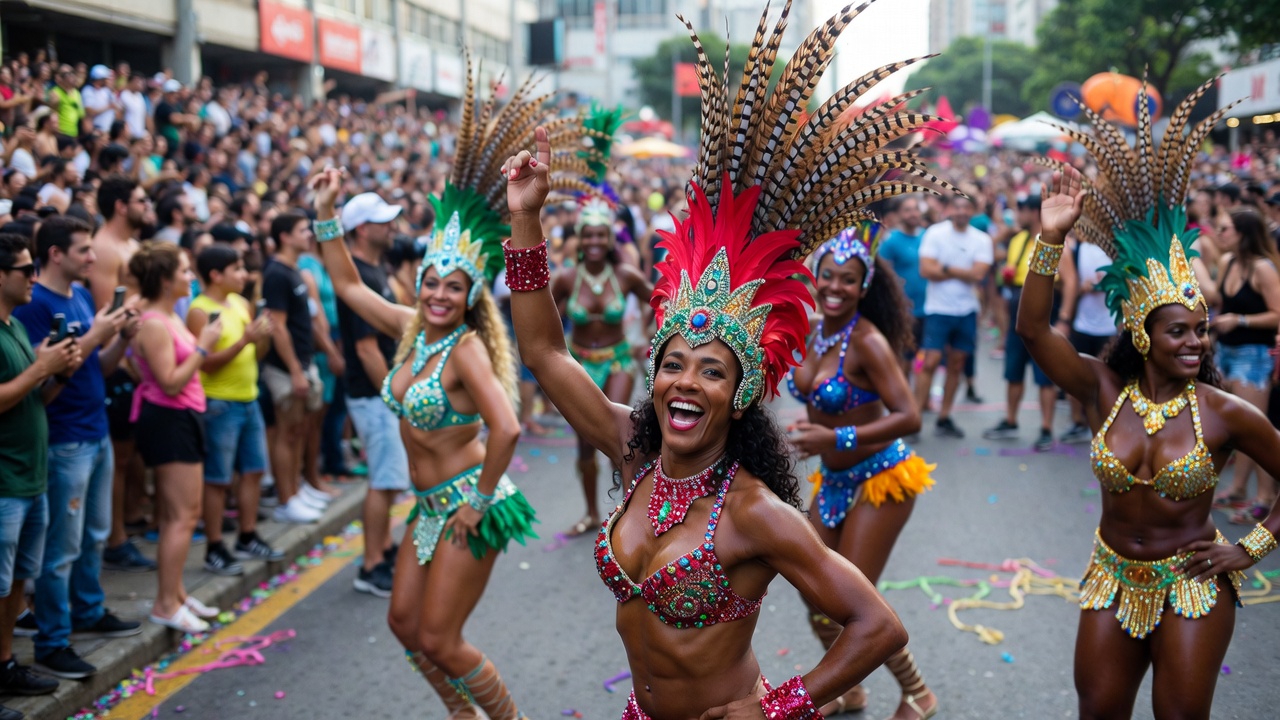
The weekend marks the height of street celebrations. Hundreds of blocos parade through neighborhoods across Rio, each with its own musical style, crowd size, and character.
Major blocos worth experiencing:
| Bloco | Neighborhood | Style | Crowd Size |
|---|---|---|---|
| Cordão da Bola Preta | Centro | Traditional marchinhas | 1+ million |
| Sargento Pimenta | Various | Beatles covers in samba style | 100,000+ |
| Banda de Ipanema | Ipanema | LGBTQ+ friendly, diverse music | 50,000+ |
| Monobloco | Centro | Contemporary percussion | 200,000+ |
| Carmelitas | Santa Teresa | Eclectic, neighborhood vibe | 50,000+ |
| Céu na Terra | Santa Teresa | Samba de raiz (traditional) | 30,000+ |
Pro tip: The largest blocos can be overwhelming for first-timers. Consider starting with medium-sized neighborhood blocos in areas like Santa Teresa or Laranjeiras, where the atmosphere is more intimate and you can actually move.
Sunday and Monday Nights: The Special Group Parades
These are the main event—the Special Group samba school parades at the Sambadrome Marquês de Sapucaí. Six schools parade each night, beginning around 9:00 PM and continuing until dawn.
The atmosphere inside the Sambadrome defies description. When 4,000 costumed performers march past with 300 drummers pounding in perfect synchronization, when the crowd sings the samba-enredo in unison at volumes that shake your chest, when the massive floats emerge from the darkness lit by thousands of lights—it’s an experience that transcends entertainment and approaches the transcendent.
Sambadrome seating options:
| Section | Location | Experience | Price Range |
|---|---|---|---|
| Frisas | Ground level, parade edge | Closest to action, immersive | $$$$ |
| Arquibancadas | Upper grandstands, sectors 4-13 | Best overall views | $$ |
| Camarotes | VIP boxes with amenities | Comfortable, upscale | $$$$$ |
| Pista | Ground level, standing | Authentic, energetic | $$ |
Monday (Traditional Holiday): Carnival Monday Continues
The celebrations continue without pause. Street blocos parade during the day, and the second night of Special Group parades unfolds at the Sambadrome.
Tuesday: Fat Tuesday (Terça-feira Gorda)
The grand finale. This is the last day of celebration before Ash Wednesday and the beginning of Lent. Street parties reach their peak intensity, and Brazilians embrace the final hours of Carnival with particular fervor.
The mood on Tuesday night carries a bittersweet quality. There’s joy, yes, but also the knowledge that tomorrow everything returns to normal—até o ano que vem (until next year).
Ash Wednesday: The Parade of Champions
While Carnival officially ends at midnight on Tuesday, one final Sambadrome event occurs on the Saturday following Ash Wednesday: the Desfile das Campeãs (Parade of Champions). The top-placing schools perform again in a more relaxed, celebratory atmosphere. This is an excellent option for those who couldn’t secure tickets to the main parades.
The Year-Round World of Samba: How Schools Prepare for Carnival
One of the most profound misunderstandings about Brazilian Carnival is thinking of it as a single event. For samba school communities, Carnival is a year-round lifestyle, with the end of one parade marking the beginning of preparation for the next.
March-April: Recovery and Reflection
Immediately following Carnival, schools conduct post-parade analysis. What worked? What didn’t? Which elements of the presentation cost points? This period also involves settling the enormous debts that the parade invariably generates—top schools spend $3-5 million on their presentations, often relying on loans that must be repaid throughout the year.
May-July: Theme Selection and Development
Schools select their enredo (theme) for the following year’s parade, typically announced at a special event for the community. The carnavalesco begins developing the artistic concept, researching the chosen topic, and sketching initial costume and float designs.
Theme selection is both an artistic and political process. Schools consider cultural significance, visual potential, potential sponsors, and the competitive landscape. A school that chose a complex philosophical theme might opt for something more accessible the following year, or vice versa.
July-September: Samba-Enredo Competition
Composers affiliated with the school submit their proposed samba-enredos—the songs that will be sung throughout the parade. This is a beloved community process where competing compositions are performed at the school’s quadra (headquarters) over several weeks. Members vote on their favorites, with the winning song announced at an emotional ceremony.
The samba-enredo must accomplish several goals simultaneously: narrate the parade’s theme clearly, be musically compelling, remain singable for thousands of marchers over 65 minutes, and fit within strict timing requirements. The best compositions achieve a poetry that transcends their practical function.
October-December: Intensive Production
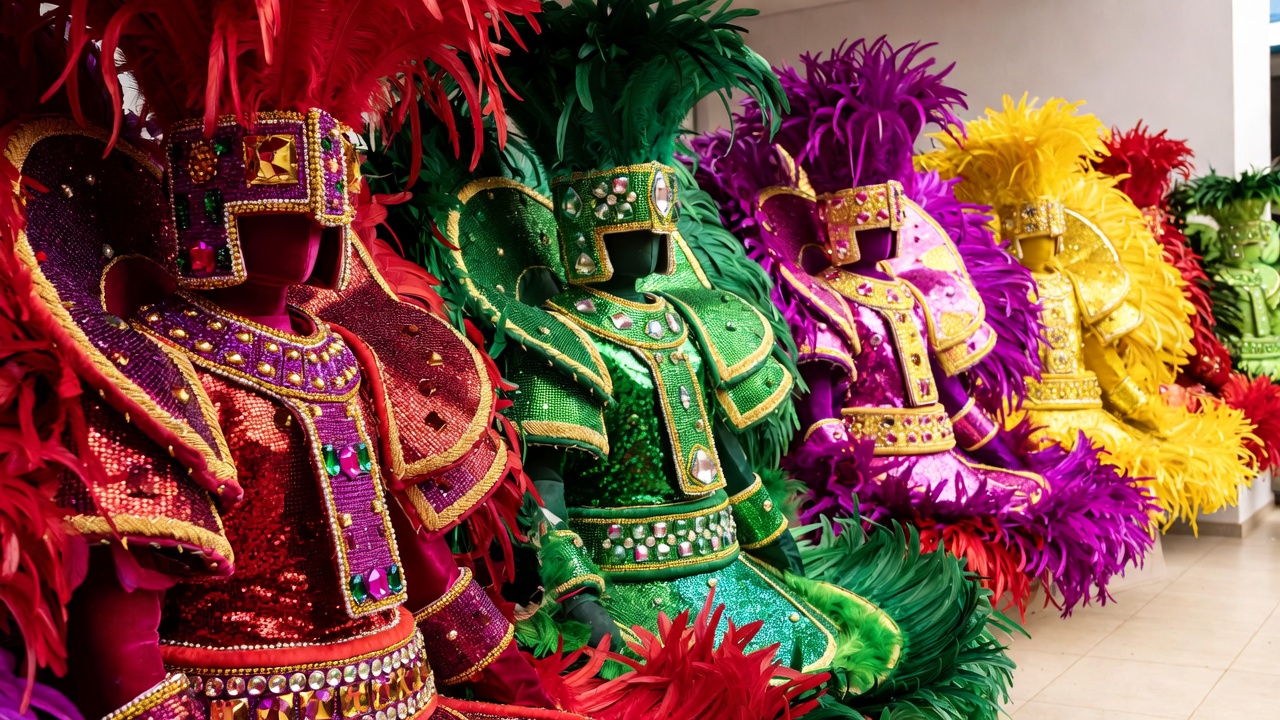
Costume and float production accelerate in the schools’ barracões (warehouse workshops), often located in the industrial Cidade do Samba complex. Hundreds of workers—many volunteers, some paid professionals—cut, sew, sculpt, paint, and assemble the components that will appear on the avenue.
Walking through a barracão during this period offers an extraordinary glimpse into the creative process. Mountains of feathers, racks of costumes in various stages of completion, partially assembled floats revealing their internal structures—it’s like visiting the backstage of the world’s largest theatrical production.
January-February: Final Preparations and Rehearsals
Rehearsals (ensaios) at the school’s quadra intensify, with thousands of members gathering weekly to practice singing the samba-enredo, rehearse choreography, and build community cohesion. These events are open to the public and offer arguably the most authentic Carnival experience available to visitors—far more intimate than the Sambadrome parades, with opportunities to interact directly with school members.
Technical rehearsals at the Sambadrome itself occur in the weeks before Carnival, allowing schools to test floats, timing, and logistics on the actual parade runway.
Experiencing Rio Carnival as a Tourist: Practical Tips and Insider Advice
When Should You Book Your Rio Carnival Trip?
The short answer: as early as possible. Carnival dates vary each year based on the lunar calendar, typically falling between early February and early March. Once dates are confirmed (usually 2+ years in advance), accommodation prices surge and availability evaporates.
Recommended booking timeline:
- 12-18 months ahead: Book flights and accommodation
- 6-9 months ahead: Purchase Sambadrome tickets
- 3-6 months ahead: Reserve any guided experiences or special events
- 1-2 months ahead: Research street party schedules, make restaurant reservations
Where to Stay in Rio de Janeiro During Carnival
Accommodation choices significantly impact your Carnival experience. Consider these neighborhoods:
Copacabana
- Pros: Beach access, extensive hotel options, central to many blocos
- Cons: Can feel touristy, crowded during Carnival
- Best for: First-time visitors seeking convenience
Ipanema/Leblon
- Pros: Upscale atmosphere, excellent restaurants, safer streets
- Cons: Higher prices, some distance from Centro blocos
- Best for: Travelers seeking comfort and quality
Santa Teresa
- Pros: Bohemian character, authentic neighborhood blocos, artistic atmosphere
- Cons: Hilly terrain, fewer hotels, some safety concerns at night
- Best for: Cultural travelers seeking local experience
Lapa/Centro
- Pros: Epicenter of street Carnival, close to Sambadrome
- Cons: Can be rough around edges, requires street smarts
- Best for: Party-focused visitors comfortable with urban environments
How Much Does Rio Carnival Cost? Budgeting Guide
Carnival can be experienced at various price points, from backpacker budgets to luxury splurges.
Budget breakdown (per person, 7-day trip):
| Category | Budget | Mid-Range | Luxury |
|---|---|---|---|
| Flights (from US) | $800-1,200 | $1,200-2,000 | $3,000+ |
| Accommodation | $50-80/night | $150-300/night | $500+/night |
| Sambadrome Tickets | $80-150 | $200-400 | $800-2,000 |
| Food & Drinks | $30-50/day | $80-150/day | $250+/day |
| Transportation | $15-30/day | $50-100/day | $200+/day |
| Total Estimate | $1,500-2,500 | $3,500-5,500 | $10,000+ |
Money-saving tips:
- Street carnival is free. The blocos charge nothing to participate, and some of the most memorable Carnival experiences cost only the price of a beer from a street vendor.
- Consider the Série Ouro parades. The second-tier samba school competition features excellent performances at a fraction of Special Group ticket prices.
- Book accommodation outside tourist zones. Neighborhoods like Tijuca, Méier, or even Niterói (across the bay) offer significant savings while remaining accessible via metro and ferry.
- Attend samba school rehearsals. Many quadras charge modest entry fees ($10-30) for an experience that’s arguably more authentic than the Sambadrome parades.
Safety Tips for Rio Carnival Visitors
Rio de Janeiro has a complex relationship with crime, and Carnival—with its crowds, alcohol, and distractions—presents particular risks. That said, millions of people enjoy Carnival safely each year by exercising reasonable precautions.
Essential safety practices:
- Leave valuables at your hotel. Carry only what you need: some cash, a copy of your ID, and your phone (in a secure pocket or fanny pack worn under clothing).
- Use official transportation. Uber and 99 (the local ride-hailing app) are safer and more reliable than hailing street taxis. The metro is excellent and safe during Carnival, with extended hours.
- Stay with the crowd. The massive bloco crowds are generally safe due to sheer numbers. Danger increases in isolated areas, empty side streets, and the transitional zones at parade edges.
- Watch your drink. As anywhere, be cautious about accepting drinks from strangers, and keep your eye on your beverage.
- Learn basic Portuguese phrases. “Preciso de ajuda” (I need help), “Onde fica a polícia?” (Where is the police?), and “Não entendo” (I don’t understand) can be valuable.
- Trust your instincts. If a situation feels wrong, leave. Don’t worry about being polite—prioritize your safety.
The Cultural Significance of Samba and Carnival in Brazilian Society
Carnival as Resistance: The African Roots of Brazilian Celebration
Any honest discussion of Brazilian Carnival must grapple with its origins in resistance. The celebration that today generates billions in tourism revenue and projects Brazilian soft power worldwide emerged from the cultural survival strategies of enslaved Africans and their descendants.
When Portuguese colonizers brought millions of Africans to Brazil—the country received more enslaved people than any other nation in the Americas—they attempted to suppress African religious practices, languages, and cultural expressions. Yet African traditions survived through creative adaptation, often hiding within the structures of Catholic festivals that colonial authorities permitted.
The maracatu rhythms of Recife, the candomblé-inflected celebrations of Salvador, and the samba of Rio all represent this legacy of cultural persistence. The morro communities (favelas) that birthed samba schools were—and in many cases remain—predominantly Afro-Brazilian, and the celebration carries this heritage in its DNA.
This context gives certain Carnival moments particular power. When schools like Mangueira dedicate their 2019 parade to “História para Ninar Gente Grande” (A History to Lull Adults to Sleep), celebrating overlooked Black Brazilian heroes, they’re not merely choosing a theme—they’re asserting the centrality of Black experience to Brazilian identity in the country’s most visible cultural showcase.
The relationship between Carnival and racial politics remains complex and sometimes contradictory. The famous Brazilian saying that “no Carnaval não existe preconceito” (in Carnival there is no prejudice) reflects both a genuine aspiration and a kind of willful blindness. The same celebration that elevates Black culture can also exoticize and commodify it, and the question of who profits from samba’s success remains contentious.
Carnival Economics: Who Benefits from Brazil’s Biggest Party?
The economic dimensions of modern Carnival reveal both opportunities and inequalities. The massive tourism revenue supports real jobs—seamstresses, float builders, musicians, hotel workers, street vendors—many in communities with limited formal employment options.
Yet the benefits are unevenly distributed. International hotel chains capture tourist spending that might otherwise flow to local businesses. Schools that originated in poor Black communities now receive significant funding from corporate sponsors and, controversially, from bicheiros (illegal gambling operators) who have historically provided crucial financial support while wielding outsized influence.
The Brazilian government at various levels invests in Carnival infrastructure and promotion, viewing the celebration as a development driver. The construction of the Cidade do Samba (Samba City)—a complex housing workshops for all Special Group schools—represented a significant public investment aimed at professionalizing samba school operations while preserving their community roots.
This professionalization creates tensions. As productions grow more elaborate and budgets swell into the millions, schools must balance artistic ambition against financial sustainability. The desire to win championships—with the prestige and income that victory brings—can conflict with the community participation that gives samba schools their soul.
The Spiritual Dimension: Carnival and Brazilian Religious Syncretism
Carnival’s relationship with Catholicism—it is, after all, a pre-Lenten celebration—intertwines with Brazil’s broader religious syncretism. The country hosts the world’s largest Catholic population alongside vibrant Afro-Brazilian religions like Candomblé and Umbanda, Protestant and evangelical movements, Spiritism, and secular traditions.
Many Carnival participants experience the celebration as spiritually meaningful regardless of formal religious affiliation. The communal singing, the rhythmic movement, the submission of individual identity to collective expression—these elements echo religious practice across multiple traditions.
Samba schools often incorporate religious imagery in their parades, sometimes generating controversy. The 2020 Mangueira parade featuring a Black Jesus figure provoked intense debate about the boundaries of artistic expression in religious representation. Yet such controversies also demonstrate Carnival’s continued capacity to engage with profound questions of identity and meaning.
For some practitioners, the line between Carnival participation and religious observance barely exists. Certain baianas (the women in traditional white dresses who dance in every parade) are mães de santo (priestesses) in Candomblé, and their presence sanctifies the proceedings. The percussion patterns of the bateria echo rhythms used in sacred ceremonies. The colors of certain schools correspond to orixás (deities) in the Afro-Brazilian pantheon.
Beyond Rio: Experiencing Carnival in Other Brazilian Cities
While Rio de Janeiro dominates international attention, Carnival celebrations across Brazil offer distinct experiences that serious festival travelers should consider.
Salvador Bahia Carnival: The Largest Street Party on Earth
If Rio’s Carnival is a competition, Salvador’s is a continuous three-million-person block party. The Bahian celebration features massive sound trucks called trio elétricos that crawl through the streets blasting amplified music while crowds dance behind them.
What makes Salvador distinct:
- Scale: More participants than Rio, with estimates exceeding 2.5 million daily
- Music: Axé, pagode, and other Bahian genres dominate rather than traditional samba
- Structure: Less formal than Rio’s samba school parades; more continuous street celebration
- African heritage: Salvador’s population is approximately 80% Afro-Brazilian, and this heritage permeates every aspect of Carnival
Three main celebration circuits:
- Circuito Dodô (Barra-Ondina): Oceanfront route, most famous trios, highest ticket prices for blocos
- Circuito Osmar (Campo Grande): More traditional, family-friendly atmosphere
- Circuito Batatinha (Pelourinho): Historic center, smallest circuit, most cultural emphasis
Recife and Olinda Pernambuco Carnival: Where Tradition Meets Innovation
The twin cities of Recife and Olinda in the northeastern state of Pernambuco host Carnival celebrations that many Brazilian culture enthusiasts consider the most authentically rooted in tradition.
Key elements:
- Frevo: The signature Pernambuco rhythm, featuring acrobatic dancing with small umbrellas
- Maracatu: Ancient Afro-Brazilian tradition with elaborate costumes and hypnotic drumming
- Galo da Madrugada: The “Dawn Rooster” parade in Recife, recognized by Guinness as the world’s largest Carnival parade by number of participants (over 2 million)
- Bonecos gigantes: The giant puppets of Olinda, towering figures that dance through the colonial streets
Olinda’s celebration unfolds through the UNESCO World Heritage colonial town’s steep cobblestone streets, creating an intimacy impossible in larger cities. The frevo dancers’ acrobatics, the haunting maracatu drums, and the surreal sight of giant puppets lurching through crowds make this arguably Brazil’s most photogenic Carnival.
São Paulo Carnival: The Growing Giant
São Paulo, Brazil’s largest city, has historically played second fiddle to Rio in Carnival prestige. Yet its celebration has grown dramatically, now drawing over 15 million participants to street events while its samba schools increasingly challenge Rio’s dominance in artistic quality.
Why consider São Paulo:
- Accessibility: Often easier to find accommodation; huge hotel infrastructure
- Street carnival: Blocos throughout the city, with different neighborhoods offering distinct vibes
- Competitive parades: The Sambadrome competition features top-tier schools and increasing budgets
- Cost: Generally less expensive than Rio, with more dining and nightlife options
The Future of Brazilian Carnival: Challenges and Evolution
Climate Change and Carnival: Environmental Concerns
As global temperatures rise, the outdoor celebrations face increasing challenges. The combination of dense crowds, physical exertion, and tropical heat has always posed health risks during Carnival—risks that climate change exacerbates.
The 2024 Carnival in Rio occurred during a heat wave that saw “feels like” temperatures exceeding 60°C (140°F), leading to medical emergencies and at least one reported death. Cities now deploy extensive medical infrastructure during Carnival, but the sustainability of celebrations in increasingly extreme conditions remains uncertain.
Environmental concerns extend beyond heat. Samba schools have begun incorporating ecological themes into their parades, with Imperatriz Leopoldinense’s 2017 presentation on the Amazon rainforest generating controversy when it appeared to criticize governmental environmental policies. The materials used in costume and float production—often involving plastics, feathers, and other potentially problematic inputs—face growing scrutiny.
Technology and Transformation: How Digital Change Affects Carnival
The relationship between Carnival and technology evolves constantly. Smartphones have transformed how participants experience and share the celebration, with Instagram stories and TikTok videos bringing Carnival imagery to global audiences in real-time.
Yet technology creates tensions too. The presence of thousands of cameras changes behavior, sometimes diminishing the spontaneity that makes Carnival special. Samba schools debate how to protect parade designs in an era when images leak instantly. The gamification of Carnival experiences—rating apps, influencer partnerships, sponsored content—raises questions about authenticity.
Paradoxically, technology has also enabled new forms of participation that extend Carnival’s reach. Virtual celebrations during the COVID-19 pandemic (when in-person events were canceled in 2021 and modified in 2022) demonstrated both the limitations and possibilities of digital Carnival experiences.
Preserving Tradition While Embracing Change
The central tension facing Brazilian Carnival—how to maintain cultural authenticity while evolving with contemporary society—plays out in countless debates within the samba community.
Points of ongoing discussion include:
- Commercialization: As sponsor money becomes essential to competitive parades, how do schools preserve community character?
- Celebrity destaques: The tradition of placing celebrities atop floats generates publicity but can feel disconnected from community roots
- Musical evolution: Should samba-enredos maintain traditional structures or experiment with contemporary influences?
- Inclusivity: How should schools balance historical traditions with contemporary expectations around gender, sexuality, and accessibility?
These debates reflect broader questions about cultural heritage preservation in a globalizing world. Carnival’s remarkable vitality after five centuries suggests that the Brazilian celebration possesses unusual adaptive capacity—but each generation must navigate its own balance between innovation and tradition.
Final Thoughts: Why Brazilian Carnival Matters
After witnessing more festivals than I can count, after dancing through Holi celebrations in India, watching fire dancers in Fiji, and marching in parades from New Orleans to Nice, I keep returning to Brazil. Not just because Carnival is the biggest or loudest or most visually spectacular celebration on Earth—though it is all those things—but because of what happens beneath the surface.
In a world increasingly fragmented by difference, Brazilian Carnival offers a glimpse of something rare: genuine communal joy that crosses social boundaries, however imperfectly and temporarily. The favela resident and the Copacabana millionaire sing the same samba-enredo. The grandmother in her baiana dress and the teenager in sequined bikini dance the same steps. The competition matters—schools desperately want to win—but so does the collective experience of creation and celebration.
This doesn’t mean Carnival transcends Brazil’s deep inequalities or racial tensions. It doesn’t. The celebration exists within Brazilian society, not outside it. But for five days each year, something shifts. Possibilities open. The country glimpses a version of itself that might be.
If you have the chance to experience Brazilian Carnival firsthand, take it. Come with respect, come with openness, come prepared to be overwhelmed and transformed. Learn the samba-enredo before you arrive. Practice saying the words that matter: obrigado (thank you), com licença (excuse me), boa festa (have a good party).
And when you find yourself in the Sambadrome at 4 AM, surrounded by strangers who have become temporary family, singing words you barely understand while tears stream down your face for reasons you can’t explain—you’ll understand why millions of people spend their entire year waiting for these five days.
O Carnaval não é apenas uma festa. É a própria alma do Brasil.
Carnival is not just a party. It is the very soul of Brazil.
Até o ano que vem—until next year.
Frequently Asked Questions About Rio de Janeiro Carnival
When is Brazilian Carnival 2026? Carnival 2026 is scheduled for February 14-17, 2026, with the Special Group parades occurring on Sunday, February 15 and Monday, February 16.
Can foreigners participate in samba school parades? Yes! Most schools sell fantasias (costumes) to anyone who wishes to parade, with prices ranging from $200 to $2,000+ depending on the school, costume elaborateness, and placement within the parade. Contact schools directly through their official websites or work with tourism agencies that specialize in Carnival packages.
Is Carnival safe for solo travelers? Yes, with appropriate precautions. Many solo travelers enjoy Carnival successfully by staying aware of their surroundings, avoiding isolated areas, and joining organized groups or blocos. The buddy system—even with temporary friends made during celebrations—increases safety significantly.
What should I wear to Carnival? For street parties: Comfortable clothes you don’t mind getting dirty, closed-toe shoes (your feet will be stepped on), minimal jewelry, secure pockets or cross-body bags. Many participants wear costumes, glitter, and colorful accessories—join in the spirit!
For the Sambadrome: Smart casual to dressy depending on your seating section. Camarotes (VIP boxes) sometimes have dress codes. Bring a light jacket as the concrete can get cool in the early morning hours.
How do I buy Sambadrome tickets? Official tickets are sold through LIESA’s partner ticketing platforms. Tickets typically go on sale 2-3 months before Carnival. Third-party resellers exist but charge significant premiums. For the best selection, book as early as possible.
What’s the best neighborhood bloco for first-time visitors? Consider Céu na Terra or Carmelitas in Santa Teresa for a manageable crowd size with authentic atmosphere, or Banda de Ipanema for a welcoming, LGBTQ+-friendly environment. Avoid mega-blocos like Bola Preta for your first experience—they’re extraordinary but overwhelming for newcomers.
Do I need to speak Portuguese to enjoy Carnival? No, but basic phrases dramatically enhance the experience. Learn the words to at least one samba-enredo before you go—the experience of singing along with 70,000 people changes everything, even if your pronunciation isn’t perfect.
Have you experienced Brazilian Carnival? Share your stories and tips in the comments below. And if you found this guide helpful, please share it with fellow travelers planning their own Carnival adventure.