North Korea’s Military Foundation Day is one of the most dramatic national celebrations on Earth. Tanks roll through Kim Il Sung Square. Tens of thousands of soldiers march in perfect unison. Fireworks light up the Pyongyang skyline. For any traveler fascinated by the world’s most secretive nation, the question is obvious: Can tourists actually visit North Korea during Military Foundation Day?
The answer, as of early 2026, is complicated. North Korea remains largely closed to international tourism. The country has been slowly and unpredictably reopening its doors since the COVID-19 pandemic. But the situation changes month by month, sometimes week by week, with little warning or explanation.
This guide breaks down everything you need to know. We cover the history and meaning of Military Foundation Day, the current state of tourism access, which nationalities can and cannot enter, what past visitors have experienced during military celebrations, and what the future may hold. Whether you are a serious planner or simply curious, this is the most thorough resource available on this topic in 2026.
What Is North Korea Military Foundation Day and Why Does It Matter?
Military Foundation Day is one of the most important national holidays in the Democratic People’s Republic of Korea (DPRK). It celebrates the origins of the Korean People’s Army (KPA), which holds a central place in North Korean society, politics, and national identity.
Here is where it gets interesting. North Korea actually observes two separate military-related holidays, each tied to a different founding date. Understanding this distinction is essential for anyone researching travel to the DPRK during military celebrations.
The two dates are:
- April 25 — Marks the founding of the Korean People’s Revolutionary Army (KPRA) in 1932. According to North Korean historiography, this was the anti-Japanese guerrilla unit established by Kim Il Sung during Japan’s colonial rule of Korea. This date is often called “Military Foundation Day” or “Chosun People’s Army Foundation Day.” It became an official national holiday in 1996.
- February 8 — Marks the formal establishment of the Korean People’s Army in 1948, when the Soviet Union recognized it as the military of the newly formed North Korean state. This date was the original Army Day holiday until 1978, when it was replaced by April 25. In 2015, Kim Jong Un revived February 8 as a separate celebration alongside the April date.
The April 25 date is generally considered the larger occasion. It has historically been associated with major military parades in Pyongyang, particularly on quinquennial anniversaries (every five or ten years). The 2022 celebration, for example, featured a dramatic nighttime military parade marking the 90th anniversary of the KPRA. That parade was notable for the first public appearance of Ministry of State Security agents and female traffic police officers from the Korean People’s Internal Security Forces.
For travelers, Military Foundation Day matters because it is one of the few occasions when North Korea puts its military might on full public display. These parades attract global media attention and are among the most sought-after spectacles for the small number of tourists who have historically visited the DPRK.
How North Korea Celebrates Military Foundation Day: Parades, Mass Dances, and Banquets
The celebrations on Military Foundation Day are extensive and deeply choreographed. They represent a blend of military spectacle, political theater, and genuine public holiday.
Here is what typically happens in Pyongyang during Military Foundation Day:
The country holds a commemorative assembly in the capital. Senior political and military leaders deliver speeches. State media broadcasts special programming. Concerts and cultural performances take place across the city.
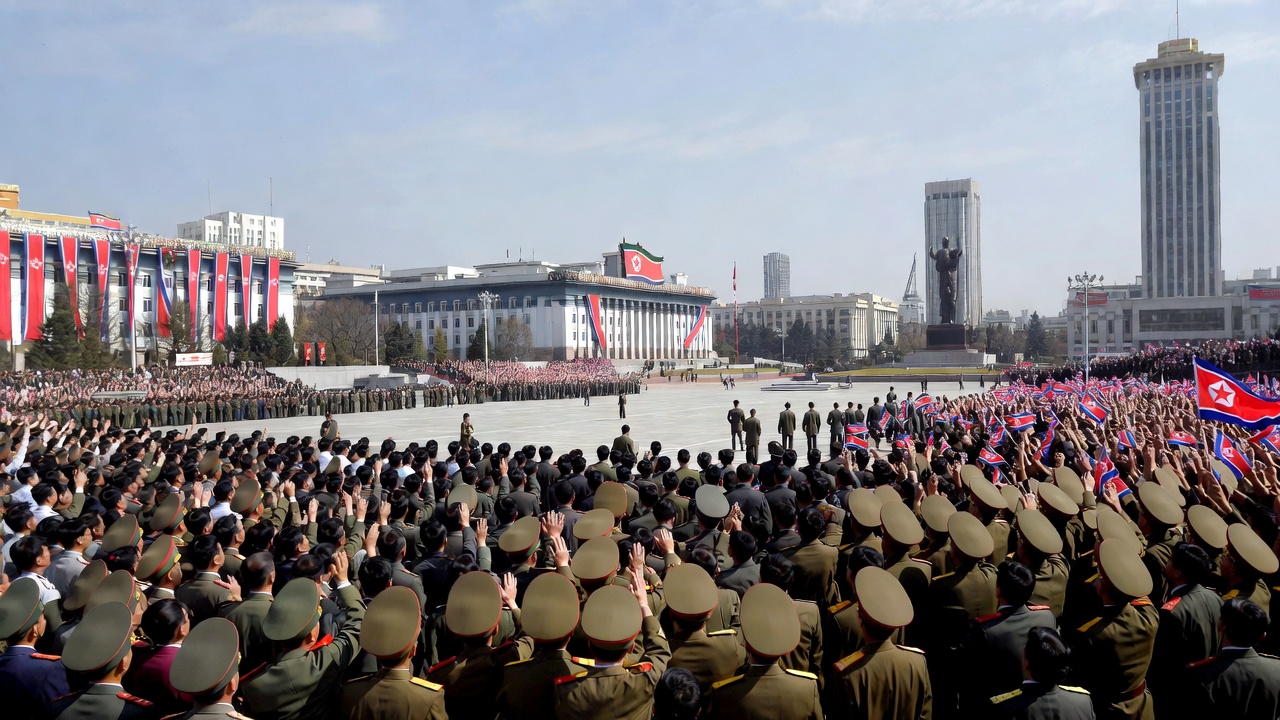
The highlight is the military parade on Kim Il Sung Square. These parades have been a tradition since the very first one in 1948, which took place at Pyongyang Station with about 20,000 North Korean soldiers and Soviet generals in attendance. Since 1958, the large-scale parades have followed a pattern borrowed from Chinese practice, occurring every five years on major anniversaries.
A typical military parade includes:
- Tens of thousands of soldiers marching in the famous goose step
- Displays of tanks, artillery, and mobile missile launchers
- Flyovers by military aircraft
- A review by the Supreme Leader from the state grandstand
- Massed military bands performing patriotic music
- The raising of the national flag and the Workers’ Party banner
- Historical columns wearing uniforms from the Korean War and World War II resistance era
In addition to the parade, mass dances are a staple of the celebrations. Thousands of university students perform synchronized dances in public squares. Civilians are given the day off work. Families celebrate with picnics and gatherings. Banquets are held for military officials. During the 2023 celebrations, Kim Jong Un attended a banquet at what was identified as the Yanggakdo Hotel, accompanied by his wife Ri Sol-ju and his daughter Kim Ju Ae.
It is worth noting that not every Military Foundation Day features a full military parade. The large-scale parades with heavy military hardware tend to occur on significant anniversary years. In non-anniversary years, the celebrations may be limited to mass dances, concerts, commemorative assemblies, and smaller-scale events.
Is North Korea Open to Tourists in 2026? Current Border Status Explained
This is the most critical question for anyone considering a visit. As of early 2026, North Korea remains officially closed to standard international tourism. The only exception is Russian nationals, who are permitted to visit under limited and tightly controlled arrangements.
Here is a timeline of the key developments:
| Date | Event |
|---|---|
| January 2020 | North Korea closes its borders entirely due to COVID-19 — one of the first countries to do so |
| February 2024 | First group of approximately 100 Russian tourists allowed in for a ski trip |
| Throughout 2024 | About 880 Russian tourists visit North Korea in total |
| August 2024 | North Korea announces plans to open Samjiyon to tourism by December 2024 |
| February 20, 2025 | Rason Special Economic Zone briefly reopens to tourists of all eligible nationalities |
| March 5, 2025 | Rason tourism abruptly suspended with no explanation |
| April 2025 | Pyongyang International Marathon takes place as a special delegation event |
| July 2025 | Wonsan-Kalma Beach Resort opens to domestic tourists |
| October 2025 | Mass Games return for the 80th anniversary of the Workers’ Party of Korea |
| January 2026 | North Korea remains closed to general international tourism; only Russian nationals permitted |
The brief reopening of Rason in February 2025 was a landmark moment. Koryo Tours, one of the leading DPRK tour operators, led the first group of Western tourists into the country in over five years. Thirteen international tourists from the UK, Canada, Greece, New Zealand, France, Germany, Austria, Australia, and Italy crossed by land from China into the Rason Special Economic Zone. They visited factories, shops, schools, and statues of Kim Il Sung and Kim Jong Il during a five-day trip.
But the excitement was short-lived. On March 5, 2025, North Korean authorities suspended all non-Russian tourism access without providing any official reason. Some analysts speculated that the closure was linked to concerns about social media content. Others suggested it was connected to North Korea’s desire to keep information about its military involvement in Russia’s war in Ukraine under wraps, given that Rason is close to Rajin Port, where North Korean troops reportedly departed for Russia.
The bottom line for 2026: There is no confirmed date for a broader reopening. The Pyongyang International Marathon 2026 has been confirmed and sold out through Koryo Tours, but it operates as a special delegation event rather than through general tourism channels. This does not signal a wider reopening of the border for regular travelers.
Can Americans Travel to North Korea for Military Foundation Day?
No. As of 2026, U.S. citizens cannot legally travel to North Korea. This restriction is separate from North Korea’s own border policies.
Since September 1, 2017, the U.S. State Department has declared all U.S. passports invalid for travel to, in, or through North Korea. This measure was imposed after the arrest and subsequent death of American student Otto Warmbier, who was detained in North Korea in 2016 for allegedly stealing a propaganda poster. He was released in a vegetative state and died six days after returning to the United States.
The U.S. State Department renewed this restriction most recently in May 2025. The current extension runs through August 31, 2026, unless further extended or revoked by the Secretary of State.
The official notice states that the government has determined there is a continuing serious risk of arrest and long-term detention for U.S. citizens in North Korea, constituting an imminent danger to their physical safety.
Key facts about the U.S. travel ban:
- Traveling to North Korea with a U.S. passport without special validation is a federal felony
- The State Department may revoke your passport if you travel to North Korea without authorization
- Special validation passports are available only in extremely limited circumstances and only when the trip serves the U.S. national interest
- Eligible categories include professional journalists, humanitarian workers, and certain other approved travelers
- There is no U.S. embassy or consulate in North Korea. The Embassy of Sweden serves as the protecting power for American citizens
- North Korea has detained at least 16 U.S. citizens in the past decade
For Americans with dual citizenship, the situation is legally ambiguous. The U.S. restriction applies specifically to the use of U.S. passports, not to U.S. citizenship broadly. Some dual nationals have reportedly used their non-U.S. passport to enter North Korea. However, this approach carries significant legal and safety risks, and no U.S. consular assistance would be available inside the country.
Which Nationalities Can Visit North Korea During National Holidays in 2026?
Understanding nationality restrictions is essential for planning any trip to the DPRK. Even when North Korea’s borders are open to tourism, not everyone is welcome.
Currently permitted (as of early 2026):
- Russian nationals — The only nationality with consistent tourism access since February 2024, though visits remain limited in scope and frequency
Historically restricted (even when borders were open):
- South Korean citizens — Effectively banned by both governments. South Korean law requires government approval for any travel to North Korea, and this is not granted for tourism
- U.S. citizens — Banned by the U.S. government since September 2017
- Malaysian citizens — Malaysia issued a travel ban for its citizens in late 2017, which remains in effect
- Journalists and professional photographers — Cannot enter on a tourist visa without prior approval from North Korean authorities
Most other nationalities were historically able to visit North Korea as tourists when the borders were fully open. Before the pandemic, the DPRK welcomed visitors from across Europe, Asia, Africa, the Americas, and Oceania. Koryo Tours notes that the process was “surprisingly easy” for most passport holders, with the tour company handling visa arrangements.
The brief Rason reopening in February 2025 confirmed that North Korea was willing to accept tourists from a wide range of nationalities, including citizens of the UK, Canada, France, Germany, Australia, New Zealand, Greece, Austria, and Italy. However, this access was revoked within two weeks.
Before the pandemic, more than 90% of North Korea’s international tourists came from neighboring China. Up to 300,000 Chinese tourists visited annually, according to the Institute for National Security Strategy, a think tank run by South Korea’s intelligence agency. Chinese group tours to North Korea remain stalled as of early 2026.
What Do Tourists Experience During North Korean Military Celebrations?
For the small number of foreigners who have visited North Korea during military holidays in previous years, the experience was unlike anything else in the world of travel.
Before the 2020 border closure, tour operators like Young Pioneer Tours and Koryo Tours regularly organized trips timed to coincide with major national holidays, including Military Foundation Day. Tourists who were present during military parades described the experience as both awe-inspiring and surreal.
Here is what visitors have reported:
The atmosphere in Pyongyang transforms. The city, already meticulously maintained, takes on an even more polished appearance. Flags and banners line the streets. Loudspeakers broadcast patriotic music. Citizens dress in their finest clothes. There is a palpable sense of pride and excitement among the local population.
Tourists were sometimes allowed to watch parades from designated viewing areas. The exact level of access varied from year to year and was never guaranteed. Tour operators with strong local relationships, such as Young Pioneer Tours and Koryo Tours, were sometimes able to secure prime viewing positions near Kim Il Sung Square. However, as Young Pioneer Tours notes, military parades “will take place regardless of if the tourists are there to watch them.”
Mass dances were a highlight. After the military portion of the celebrations, over 10,000 university students would perform synchronized dances to North Korean music. Tourists were often invited to join in. This was one of the rare moments of genuine interaction between foreign visitors and North Korean citizens.
Evening celebrations included fireworks. Pyongyang’s skyline, dominated by the unfinished Ryugyong Hotel and the Juche Tower, provided a dramatic backdrop for elaborate fireworks displays over the Taedong River.
However, access was always unpredictable. North Korea’s approach to allowing tourists near military events was inconsistent. In some years, tourists were given close access. In others, they were kept at a distance or had their itineraries changed at the last minute. Photography restrictions were strictly enforced, with guides instructing visitors on what they could and could not photograph. Images of the leaders had to be full-body shots. Military installations and construction sites were off-limits.
North Korea Tourism Rules Every Visitor Must Know Before Traveling
Whether visiting during Military Foundation Day or any other time, travelers to North Korea face a unique set of rules that apply nowhere else on Earth. These rules are not suggestions. Breaking them can result in detention, imprisonment, or worse.
The fundamental rules of travel in North Korea:
1. You must travel as part of an organized tour. Independent travel is not permitted under any circumstances. Even “private” tours require two North Korean guides and a driver at all times. You cannot wander the streets alone. You cannot choose your own restaurants, hotels, or sightseeing destinations. Every aspect of your itinerary is pre-approved by North Korean authorities.
2. You must follow your guides’ instructions at all times. Your guides are responsible for your behavior. If you break the rules, they face consequences that may be far more severe than your own. This is not a theoretical concern. Tour operators emphasize this point repeatedly during pre-departure briefings.
3. You must show respect to the leaders. Kim Il Sung, Kim Jong Il, and Kim Jong Un are treated with a level of reverence that most Westerners will find unfamiliar. Visitors are expected to bow at statues and monuments of the leaders. Photographs of leader statues must show the full body and must not be cropped. Any disrespectful comment about the leadership, even a joke, can have serious consequences.
4. Do not bring restricted materials. Religious texts, South Korean media, Western newspapers, and any material critical of North Korea are prohibited. All published materials and electronic devices must be declared upon arrival. Authorities may search your belongings.
5. Photography is strictly controlled. Always ask your guide before taking any photograph. Images of military installations, construction sites, and anything your guide deems sensitive will be deleted. In some cases, guides have had tourists’ cameras inspected upon departure and photos deleted.
6. Do not attempt to interact privately with North Korean citizens. Any unsanctioned conversation with a local person can be interpreted as espionage. Interactions happen only in structured, approved settings.
7. Do not use or carry illegal drugs. Penalties are severe and can include lengthy imprisonment.
8. Foreigners cannot use public transportation. All transportation is provided by the tour.
These rules apply during Military Foundation Day and every other day of the year. The Canadian government travel advisory warns that “any behaviour deemed inappropriate by North Korea could lead to fines, arrest or detention, including everyday interactions.” The Australian government similarly warns that “travelling as part of a tour or with a guide doesn’t give you special protection from North Korean laws.”
How to Book a Tour to North Korea: Authorized Tour Operators and Costs
Even when North Korea’s borders are open, you cannot simply buy a plane ticket and show up. All tourism is managed through a small number of authorized tour operators, most of which are based in Beijing.
The major North Korea tour operators include:
- Koryo Tours — Founded in 1993 and widely regarded as the most experienced Western tour operator for North Korea. They are the official partners of the Pyongyang International Marathon. Their Rason tours in February 2025 were priced from approximately €645 per person for five days.
- Young Pioneer Tours (YPT) — Known for budget-friendly tours and an adventurous travel philosophy. YPT’s co-founder has made over 100 visits to North Korea since 2012.
- KTG Tours — Specializes in small-group and private tours with a focus on cultural immersion.
- Uri Tours — A U.S.-based company (though tours depart from China) that has been operating since 2009.
- Beyond the Borders Tours — Another operator that has been closely monitoring the reopening situation.
What is included in a typical North Korea tour:
All meals, accommodation, transportation within the country, guides, and visa processing are typically included in the tour price. Tourists pay in euros, Chinese yuan, or U.S. dollars. The local currency, the Korean won, cannot be taken out of the country. Tipping guides and drivers is customary. A tip of approximately €7 per tourist per day is common, plus small gifts such as cosmetics or cigarettes from your home country.
How the visa process works:
Your tour operator handles the visa application on your behalf. North Korean tourist visas are issued on a separate piece of paper rather than stamped directly into your passport. This means there is no North Korean stamp in your passport after the trip. Visa processing typically takes several weeks and requires submitting personal information, employment details, and passport copies to the tour company, which then forwards them to the relevant North Korean authorities.
As of early 2026, most tour operators are accepting expressions of interest and waiting list registrations but are not actively selling general tourism packages. The Pyongyang Marathon 2026, organized through Koryo Tours, sold out within five hours of applications opening, demonstrating the enormous pent-up demand for DPRK travel.
The History of April 25 Military Foundation Day in North Korea: From Anti-Japanese Guerrillas to Nuclear Parades
To truly understand Military Foundation Day, you need to understand its historical roots. The holiday is not just a celebration of military strength. It is a foundational narrative of the North Korean state itself.
The origin story begins in 1932. According to North Korean historiography, Kim Il Sung founded the Korean People’s Revolutionary Army (KPRA) on April 25, 1932, as an anti-Japanese guerrilla unit. This was during Japan’s colonial occupation of Korea, which lasted from 1910 to 1945. The KPRA fought as part of the broader Northeast Anti-Japanese United Army, a Chinese-led coalition of resistance fighters in Manchuria.
The formal military came later. After the Soviet Union liberated northern Korea in 1945, a communist government was established under Kim Il Sung. The Korean People’s Army (KPA) was formally established on February 8, 1948, just months before the Democratic People’s Republic of Korea was proclaimed on September 9 of that year. The first military parade was held that same day at Pyongyang Station.
The holiday’s date has shifted multiple times:
- 1948–1978: February 8 served as Military Foundation Day
- 1978–2015: April 25 replaced February 8 as the sole military anniversary
- 2015–present: Kim Jong Un revived February 8 as a separate “Army Day” celebration, so both dates are now observed
The April 25 date holds special significance because it ties the military’s origins to the anti-Japanese resistance led by Kim Il Sung. This narrative is central to the regime’s legitimacy. It portrays the Kim family as liberators of the Korean people and positions the military as an institution rooted in revolutionary struggle, not merely Cold War politics.
Major anniversary years for April 25 have produced some of the most spectacular parades in DPRK history:
| Year | Anniversary | Notable Features |
|---|---|---|
| 1992 | 60th | Over 20,000 troops; Kim Jong Il’s only recorded public speech |
| 2002 | 70th | Large parade with military hardware |
| 2007 | 75th | Parade noted for Kim Jong Il’s absence, sparking health speculation |
| 2012 | 80th | Banquet at Mokran House; display of new missile systems |
| 2017 | 85th | Display of submarine-launched ballistic missiles |
| 2022 | 90th | Nighttime parade; first appearance of Ministry of State Security agents |
In 2026, April 25 marks the 94th anniversary of the KPRA’s founding. This is not a major quinquennial milestone, which means a full-scale military parade with heavy weaponry is less likely than in a year like 2027 (95th) or 2032 (100th). However, mass dances, commemorative assemblies, concerts, and smaller military events are still expected.
Is It Safe to Travel to North Korea? Risks and Ethical Considerations for Tourists
Safety in North Korea operates on a different logic than almost anywhere else. The country has extremely low street crime. You will not be pickpocketed or mugged. But the risks come from a different direction entirely.
The primary safety risk is political. North Korea has detained at least 16 U.S. citizens in the past decade. The most infamous case is that of Otto Warmbier, a University of Virginia student who was arrested in January 2016 for allegedly removing a propaganda poster from a hotel hallway. He was sentenced to 15 years of hard labor and was returned to the United States in June 2017 in a vegetative state. He died six days later. A U.S. federal judge subsequently ruled that North Korea was responsible for his torture and death.
Other detained foreigners have included journalists, missionaries, and tourists who were accused of various offenses ranging from espionage to “hostile acts.” In most cases, detainees were eventually released after diplomatic negotiations, but their detentions lasted weeks to years.
Experienced tour operators emphasize that following the rules is the key to safety. Koryo Tours states that “based on our experience of running tours for the last 25 years, if no rules are broken there will be no issue with tour safety, or how you are treated.” However, they also note that “breaking the rules is when safety becomes compromised.”
The ethical dimension is equally important. Tourism to North Korea is a deeply contested topic. Critics argue that tourist dollars directly fund the North Korean government, which the United Nations has found to be responsible for crimes against humanity, including political imprisonment, torture, public executions, forced disappearances, and systematic forced labor. A human rights expert quoted by The World from PRX noted that tourism money “will directly go to the North Korean government” and urged potential visitors to consider how tourism infrastructure may have been built using forced labor.
Supporters of North Korea tourism counter that engagement, even limited and controlled, provides North Korean citizens with rare exposure to foreigners and the outside world. Simon Cockerell of Koryo Tours has argued that showing North Koreans “the variety of different foreigners” helps them “start to realize that the outside world is far more complicated than their state media suggests.”
This is not a question with an easy answer. Every potential visitor must weigh these considerations carefully and make their own informed decision.
North Korea Military Foundation Day 2026: What to Expect This April
Based on current information, here is what we can reasonably expect for Military Foundation Day on April 25, 2026:
Inside North Korea:
- A national public holiday with citizens given the day off work
- Commemorative assemblies and political speeches in Pyongyang
- Mass dances in public squares, likely including Kim Il Sung Square
- Concerts and cultural performances
- Special programming on Korean Central Television
- A military parade is possible but not guaranteed, as 2026 is not a major anniversary year (94th anniversary of the KPRA)
For international tourists:
- General tourism to North Korea remains closed as of early 2026, with only Russian nationals permitted under limited arrangements
- The Pyongyang Marathon 2026 is scheduled for early April 2026, approximately three weeks before Military Foundation Day. It operates as a special delegation event, not general tourism
- There is no confirmed pathway for tourists to attend Military Foundation Day celebrations in 2026
- Tour operators including Koryo Tours, Young Pioneer Tours, and Beyond the Borders Tours continue to monitor the situation and will announce any changes
The geopolitical context matters. North Korea’s tourism decisions are deeply influenced by its broader foreign policy. The country’s relationship with Russia has strengthened significantly since 2022, with North Korea reportedly supplying weapons and troops for Russia’s war in Ukraine. Relations with China have been more complicated. These dynamics affect who is allowed into the country and when.
The return of the Mass Games in October 2025 for the 80th anniversary of the Workers’ Party of Korea was a positive cultural signal, but it did not translate into a border reopening for general tourism. Similarly, the Pyongyang Marathon, while exciting for the few dozen participants, operates through special invitation channels that bypass normal tourism infrastructure.
Alternatives to Visiting North Korea: How to Experience Military Foundation Day from Outside
If you cannot enter North Korea in 2026 — and for the vast majority of nationalities, you cannot — there are still ways to engage with and learn about Military Foundation Day and North Korean military culture.
Visit the DMZ from South Korea. The Demilitarized Zone separating North and South Korea is one of the most heavily fortified borders in the world. Tours from Seoul take you to the Joint Security Area (JSA) at Panmunjom, where you can literally stand at the border between the two Koreas. You can also visit the Dora Observatory, which offers views into North Korea, and the “Third Tunnel of Aggression,” a North Korean-built tunnel discovered under the border. DMZ tours are widely available and can be booked through most Seoul-based travel agencies.
Watch the military parade broadcasts. Korean Central Television (KCTV) broadcasts military parades, and footage typically appears on international news outlets and YouTube within hours. These broadcasts provide a detailed view of the parade, including the military hardware, troop formations, and leadership appearances.
Visit the North Korea-China border. The Chinese city of Dandong sits directly across the Yalu River from the North Korean city of Sinuiju. From Dandong, you can see into North Korea from the Broken Bridge or the Sino-Korean Friendship Bridge. There is even a theme park-style area called Changbai Millennium Cliff City that allows visitors to look across the border. The Tumen River border area in China’s Jilin Province offers similar vantage points.
Explore museums and exhibitions. The Korean War Memorial Museum in Seoul provides extensive context for understanding the military dynamics of the Korean Peninsula. The National Museum of Korean Contemporary History and the War Memorial of Korea are also excellent resources.
Read firsthand accounts. Several journalists and tourists have published detailed accounts of visiting North Korea during military celebrations. Books like “Without You, There Is No Us” by Suki Kim and “Dear Leader” by Jang Jin-sung offer deeply personal perspectives on life inside the country.
When Will North Korea Fully Reopen to International Tourists?
This is the question every DPRK-focused tour operator is asked daily. The honest answer is: nobody knows.
Young Pioneer Tours states plainly in their January 2026 update that “as of now, North Korea remains completely shut off to all forms of international tourism until further notice.” They add that “the answer could be anywhere from tomorrow to 2026, or even beyond — there are just too many variables.”
Beyond the Borders Tours similarly notes that “the DPRK remains closed for standard tourism, and we continue to monitor developments closely.”
Several factors will influence the timeline:
1. The Wonsan-Kalma Beach Resort. This massive tourism complex on North Korea’s east coast opened to domestic tourists in July 2025. It represents years of investment and was clearly built with foreign visitors in mind. Some analysts believe its completion could be a trigger for a broader reopening, particularly for Chinese tourists.
2. North Korea-Russia relations. The deepening alliance between Pyongyang and Moscow has made Russian tourists the priority. Whether and when this access expands to other nationalities likely depends on North Korea’s evolving diplomatic calculations.
3. North Korea-China relations. Before the pandemic, Chinese tourists accounted for over 90% of all international visitors to North Korea. The resumption of Chinese group tours would be the single biggest indicator of a genuine reopening. As of early 2026, this has not happened.
4. Information control concerns. The abrupt closure of Rason tourism in March 2025 highlighted North Korea’s anxiety about foreigners sharing unflattering content on social media. Any future reopening will likely come with even stricter controls on photography and digital sharing.
5. The Ninth Party Congress. North Korea’s 2026 calendar suggests major celebrations will be front-loaded around the Ninth Party Congress of the Workers’ Party of Korea. This political event could either accelerate or delay tourism decisions depending on the leadership’s priorities.
Practical Travel Tips for Planning a Future North Korea Trip During Military Holidays
While you may not be able to visit North Korea during Military Foundation Day in 2026, it is not too early to prepare for the eventual reopening. Here are practical steps you can take now.
Register with tour operators. Sign up for newsletters and waiting lists with Koryo Tours, Young Pioneer Tours, KTG Tours, Uri Tours, and Beyond the Borders Tours. When the border reopens, spots will fill up extremely fast. The Pyongyang Marathon 2026 sold out within five hours.
Get your passport in order. Ensure your passport has at least six months of validity beyond your intended travel dates. If traveling via China, you will also need a Chinese visa, potentially a multiple-entry visa if you plan to return to China after your North Korea trip.
Understand the financial logistics. Tours to North Korea are typically paid in advance via bank transfer. Inside the country, you can use euros, Chinese yuan, or U.S. dollars. Credit cards are not accepted. ATMs do not exist for tourists. Bring enough cash for souvenirs, optional activities (such as the elevator at the Juche Tower, which costs €5), and tips for your guides.
Prepare mentally. Visiting North Korea is not like visiting any other country. Read extensively about the rules, the culture, and the experiences of previous visitors. Watch documentaries. Understand that you will be in a tightly controlled environment where your freedom of movement, speech, and photography will be significantly restricted.
Consider the timing. If and when North Korea reopens, the period around Military Foundation Day (April 25) and the Day of the Sun (Kim Il Sung’s birthday, April 15) offers the best chance of seeing large-scale celebrations. These two holidays fall just ten days apart, making mid-to-late April the peak season for festive tourism. The weather in Pyongyang is also pleasant in late April, with spring temperatures and blooming flowers.
Check your government’s travel advisory. Many countries issue specific warnings about travel to North Korea. The U.S. maintains a Level 4 “Do Not Travel” advisory. The UK, Canada, Australia, and many other nations advise against all travel or all but essential travel to the DPRK. These advisories affect your travel insurance options and your government’s ability to assist you if something goes wrong.
Frequently Asked Questions About Visiting North Korea During Military Foundation Day
Can I visit North Korea during Military Foundation Day in 2026? Almost certainly not, unless you hold a Russian passport and can arrange access through the limited Russian tourism channels. General international tourism remains suspended.
When is Military Foundation Day in 2026? The main celebration falls on Saturday, April 25, 2026 (the anniversary of the KPRA founding in 1932). The secondary Army Day falls on Sunday, February 8, 2026 (the anniversary of the KPA founding in 1948).
Will there be a military parade on April 25, 2026? Unknown. Major military parades typically occur on quinquennial and decennial anniversaries. The 94th anniversary in 2026 is not a major milestone, making a full-scale parade less likely but not impossible.
Can Americans travel to North Korea at all? Not legally, without special validation from the U.S. State Department. The passport restriction runs through August 31, 2026.
How much does a trip to North Korea cost? Before the pandemic, typical group tours ranged from $600 to $2,500 depending on duration and itinerary. The 2025 Rason tours started from approximately €645 for five days. Private and specialty tours cost significantly more.
Is it ethical to visit North Korea? This is a deeply personal decision. Tourism revenue directly benefits the North Korean government, which has been documented by the United Nations as committing serious human rights abuses. At the same time, some argue that controlled engagement provides limited but meaningful exposure for North Korean citizens to the outside world.
What happens if I break the rules in North Korea? Consequences can range from having photos deleted and being sent back to your hotel, to arrest, detention, trial, and imprisonment. The case of Otto Warmbier is a stark reminder of the worst-case scenario.
Can I use my mobile phone in North Korea? Tourists could historically bring mobile phones into the country, but they had no access to the North Korean mobile network or the internet. Some restrictions on bringing phones in were relaxed in recent years, but functionality remains extremely limited.
Final Thoughts: The Future of Tourism to North Korea on Military Foundation Day
Military Foundation Day remains one of the most fascinating and inaccessible events on the global festival calendar. The sight of tens of thousands of soldiers marching through Kim Il Sung Square, the rumble of tanks and missile launchers, the synchronized mass dances, and the fireworks over the Taedong River represent a spectacle found nowhere else on Earth.
But in 2026, that spectacle remains behind closed doors for nearly all international travelers. North Korea’s post-pandemic reopening has been agonizingly slow, marked by false starts, sudden reversals, and an absence of transparency that is entirely consistent with the country’s broader approach to the outside world.
The signals are mixed. The Pyongyang Marathon continues. The Wonsan-Kalma resort is operational. Russian tourists maintain limited access. Tour operators remain cautiously optimistic. But a full reopening that would allow tourists to visit Pyongyang during Military Foundation Day has not materialized.
For now, the best approach is patience, preparation, and realistic expectations. Sign up with reputable tour operators. Stay informed through their updates. And remember that when North Korea does eventually reopen its doors more widely, the demand will be enormous and the available spots will be limited.
Military Foundation Day will come and go in April 2026, as it has every year since 1996. The soldiers will march. The bands will play. The leaders will watch from the grandstand. And for the rest of the world, it will remain one of the most compelling events we can only observe from afar — for now.