February 3, 2026 — From a secret founding meeting in Hong Kong to leading one of Asia’s fastest-growing economies, the Communist Party of Vietnam (CPV) marks 96 years of revolution, reform, and renewal. Here is the full story of the milestones that shaped a nation.
As lanterns sway over the ancient streets of Hội An and fireworks bloom above the Hà Nội skyline, Vietnam enters the Lunar New Year of 2026 with a rare sense of collective momentum. The country has just wrapped up its landmark 14th National Party Congress, the most watched political gathering in Vietnamese politics. And on February 3, 2026, the Communist Party of Vietnam celebrates its 96th founding anniversary — a date that resonates in every village hall, factory floor, and government office across the S-shaped nation.
But this is not just a ceremonial occasion. The anniversary falls at a pivotal moment. Vietnam’s GDP grew by 8.02 percent in 2025, the strongest annual expansion since 2022. Per capita income crossed $5,000 for the first time. The country now holds Comprehensive Strategic Partnerships with all five permanent members of the United Nations Security Council — a diplomatic feat shared by only a handful of middle-power nations on the planet.
This blog post takes a deep, factual look at the most significant achievements of the Communist Party of Vietnam across its 96-year history. We trace the arc from colonial resistance through socialist revolution, from the economic despair of the early 1980s through the Đổi Mới reforms, and into the present era of digital transformation, infrastructure investment, and global integration. Whether you are a student of Southeast Asian politics, a traveler planning a trip to Vietnam, or simply curious about how one of the world’s poorest countries became one of its most dynamic economies, this guide will give you the full picture.
How the Communist Party of Vietnam Was Founded in 1930 and Why It Matters Today
Understanding Vietnam’s modern trajectory begins with a single date: February 3, 1930. On that day, in the colonial port of Hong Kong, a young revolutionary named Nguyễn Ái Quốc — later known to the world as Hồ Chí Minh — unified three competing communist organizations into a single political force. The new party was originally called the Vietnamese Communist Party, soon renamed the Communist Party of Indochina, and later settled as the Communist Party of Vietnam (Đảng Cộng sản Việt Nam).
The founding came at a time of global upheaval. World War I had reshaped the colonial order. The Russian Revolution of 1917 had introduced Marxism-Leninism as a viable political framework for colonized peoples. In Vietnam, French colonial rule had intensified exploitation of land and labor, fueling a wave of patriotic and worker movements across Tonkin, Annam, and Cochinchina.
Hồ Chí Minh’s genius was to merge Marxist ideology with Vietnamese nationalism. The Party did not simply oppose capitalism. It opposed colonialism. That distinction gave the CPV broad-based support among peasants, workers, intellectuals, and religious communities. It transformed the struggle for independence into a mass movement rather than an elite conspiracy.
The party’s early years were defined by hardship. French authorities arrested, tortured, and executed Party members by the thousands. The first National Party Congress in 1935 was held in secret in Macau. Underground cells operated across the country, sheltered by sympathetic families. In places like Thượng Cát in Hà Nội — recently recognized with commemorative plaques ahead of the 96th anniversary — communal houses, temples, and private homes served as safe havens for senior cadres and as hiding places for Party documents.
Despite repression, the Party survived and grew. By 1945, it was ready to lead the August Revolution, seizing power from the Japanese occupation and declaring Vietnamese independence on September 2, 1945. Hồ Chí Minh read the Declaration of Independence in Hanoi’s Ba Đình Square, opening with words borrowed from the American Declaration of Independence — a deliberate gesture of universalism.
Why does this founding story still matter in 2026? Because it defines the CPV’s self-identity as both a revolutionary organization and a national liberation movement. Every anniversary celebration — from the fireworks at Mỹ Đình Stadium to the gift-giving ceremonies in Mekong Delta communes — reinforces this narrative of struggle, sacrifice, and collective triumph.
Vietnam’s Struggle for Independence and National Reunification Under Party Leadership
The three decades after the Party’s founding were defined by war. From 1946 to 1954, the First Indochina War pitted Vietnamese forces against the French colonial military. The decisive victory came at Điện Biên Phủ in May 1954, a battle that ended French colonial rule in Southeast Asia and sent shockwaves through the Western world.
The Geneva Accords of 1954 divided Vietnam at the 17th parallel. The North, under Party leadership, embarked on socialist construction. The South came under the influence of the United States and its local allies. The failure to hold reunification elections as promised by the Geneva Accords led to the Second Indochina War — known in the West as the Vietnam War — which lasted from the early 1960s until 1975.
On April 30, 1975, North Vietnamese forces entered Sài Gòn, ending the war and reunifying the country. The human cost was staggering. Millions of Vietnamese lost their lives. Cities, farmlands, forests, and infrastructure lay devastated. Unexploded ordnance and the long-term effects of chemical defoliants like Agent Orange continued to claim victims for decades afterward.
The Party’s role in these wars is a matter of fierce historical debate internationally. But within Vietnam, the narrative is clear. The CPV led the nation through its darkest chapters and delivered on its founding promise of independence. Every year, the anniversary celebrations on February 3 include tributes to revolutionary martyrs, visits to war memorials, and gift-giving to policy beneficiary families — veterans, their widows, and their descendants. In January 2026, National Assembly Chairman Trần Thanh Mẫn visited policy beneficiary families in Cần Thơ, offering incense to late leaders and presenting Tết gifts to poor households, continuing a tradition that binds the Party to its wartime legacy.
How the Đổi Mới Reforms Transformed Vietnam’s Economy After 1986
The decade after reunification was among the most difficult in Vietnamese history. The centrally planned economy faltered. Inflation soared to 300–400 percent per year in the mid-1980s. Food shortages were common. International isolation — due to the Cambodian conflict and the U.S. trade embargo — choked off foreign investment. By the early 1980s, Vietnam was one of the poorest countries on earth, with a per capita income estimated between $200 and $300.
The turning point came at the Sixth National Party Congress in December 1986, which launched the Đổi Mới (Renovation) reforms. The word “Đổi Mới” literally means “change for the new,” and it represented a fundamental shift in the Party’s economic thinking. The key reforms included:
- Abolishing collective farming and granting land-use rights to individual households
- Removing price controls to let markets determine the cost of goods
- Encouraging foreign direct investment through new legal frameworks
- Reducing subsidies to inefficient state-owned enterprises
- Devaluing the đồng and raising interest rates to stabilize the currency
The results came fast. By 1989, Vietnam had transformed from a country with chronic food shortages into a rice exporter. By 1993, inflation had dropped to about 8 percent per year. Foreign investment began flowing in. Private businesses started to appear. According to the International Monetary Fund, per capita growth since 1990 has averaged 5.6 percent annually, a rate second only to China.
Đổi Mới was not a rejection of socialism. The Party framed it as a correction — moving from a bureaucratic, subsidy-dependent system to a “socialist-oriented market economy” that combined state planning with market mechanisms. This ideological flexibility became the CPV’s signature and set the template for Vietnam’s development model over the next four decades.
Vietnam’s Poverty Reduction Success Story: From 60 Percent to Under 5 Percent
No achievement of the Đổi Mới era has drawn more international praise than Vietnam’s record on poverty reduction. The numbers are extraordinary.
| Year | Poverty Rate | Key Milestone |
|---|---|---|
| 1993 | ~60% | Baseline after first nationwide survey |
| 1998 | 37% | Early gains from agricultural reform |
| 2002 | 28.9% | Over 30 million people lifted out of poverty |
| 2010 | 14% | Middle-income status reached |
| 2012 | 9.6% | UN Millennium Development Goal met early |
| 2020 | 4.8% | Multidimensional poverty standard adopted |
| 2024 | 2.93% | Continued decline under new criteria |
The World Bank has called Vietnam “one of the world’s greatest poverty reduction success stories.” The United Nations Development Programme has similarly highlighted Vietnam’s progress, noting that the country is among 25 nations that halved their Multidimensional Poverty Index within 15 years.
Vietnam is also the first and only country in Asia to implement a comprehensive, inclusive, and multidimensional poverty reduction program. Since 2016, the government has measured poverty not just by income but by deprivations in health, education, housing, clean water, and access to information. This approach allows policymakers to target quality of life rather than income alone.
Key programs driving this progress include:
- The National Target Programme on Sustainable Poverty Reduction, which mobilizes tens of trillions of đồng annually
- Programme 135, which channels infrastructure investment to the poorest districts
- The Vietnam Bank for Social Policies, which offers preferential loans to poor households for farming and small business
Per capita income has risen from just $185 in 1993 to approximately $5,026 in 2025 — a more than 27-fold increase.
Vietnam’s GDP Growth in 2025: Why the Economy Grew Over 8 Percent
The year 2025 was a standout year for the Vietnamese economy. According to the General Statistics Office, full-year GDP grew by an estimated 8.02 percent, the strongest performance since 2022 during the entire 2011–2025 period.
The growth followed a “quarter-on-quarter acceleration” pattern:
| Quarter | GDP Growth (YoY) |
|---|---|
| Q1 2025 | 7.05% |
| Q2 2025 | 8.16% |
| Q3 2025 | 8.25% |
| Q4 2025 | 8.46% |
Q4 2025 marked the fastest quarterly pace since Q4 2007, with broad-based gains across all sectors.
Key economic indicators for 2025:
- GDP: approximately $514 billion, ranking 32nd globally
- Per capita GDP: approximately $5,026, up $326 from 2024
- Total import-export turnover: over $930 billion, up 18.2% year on year
- Disbursed FDI: $27.62 billion, up 9%, the highest since 2021
- Inflation (CPI): 3.31%, meeting the National Assembly’s target
- International tourist arrivals: nearly 21.2 million, a record high
- Credit growth: nearly 18 percent
All 15 out of 15 key socio-economic targets set by the National Assembly were met or exceeded.
The International Monetary Fund ranked Vietnam among the top 10 fastest-growing economies worldwide. The government has now set an ambitious GDP growth target of at least 10 percent for 2026, signaling confidence in the country’s continued expansion.
What Happened at the 14th National Party Congress in January 2026
The 14th National Congress of the Communist Party of Vietnam took place from January 19 to 23, 2026 at the National Convention Center in Hà Nội. It was the most consequential political event in Vietnam in five years, drawing 1,586 delegates representing more than 5.6 million Party members nationwide.
The Congress accomplished several landmark outcomes:
1. Leadership continuity. The 14th Central Committee, comprising 180 official members and 20 alternates, unanimously re-elected Tô Lâm as General Secretary. His re-election consolidated continuity at the highest level of decision-making and was positively received by international investors.
2. A 19-member Politburo was elected, maintaining the body’s typical size while introducing some new faces alongside experienced leaders.
3. Strategic documents were adopted outlining Vietnam’s development direction for the 2026–2031 term, with a vision extending to 2045 — when the country aims to achieve developed-nation status.
4. Three strategic breakthroughs were identified: institutional reform, education quality and talent attraction, and infrastructure investment.
5. The concept of the “Era of National Rise” (Kỷ nguyên vươn mình) was formally introduced as the guiding philosophy for the new term.
General Secretary Tô Lâm described the Congress as a historic milestone in the Party’s 96-year journey, emphasizing themes of “solidarity, democracy, discipline, breakthrough, and development.” The Congress was noted for its shorter-than-expected duration — finishing two days ahead of the original schedule — which analysts interpreted as a sign of strong internal consensus.
International reactions were broadly positive. Singapore’s Prime Minister Lawrence Wong congratulated the Congress and expressed admiration for Vietnam’s achievements. Russia’s President Vladimir Putin held phone talks with General Secretary Tô Lâm to offer congratulations. Researchers from India, China, and the European Union praised the Congress for its emphasis on people-centered development and institutional reform.
Vietnam’s Diplomatic Achievements: 14 Comprehensive Strategic Partnerships with Major Powers
Few aspects of the CPV’s 96-year record are more striking than the transformation of Vietnam’s foreign relations. A country that fought wars against France, Japan, the United States, China, and Cambodia has, within a single generation, built a diplomatic network that spans every major power center on the planet.
As of late 2025, Vietnam holds Comprehensive Strategic Partnerships — the highest tier in its diplomatic hierarchy — with 14 countries:
| Partner | Year of CSP |
|---|---|
| China | 2008 |
| Russia | 2012 |
| India | 2016 |
| South Korea | 2022 |
| United States | 2023 |
| Japan | 2023 |
| Australia | 2024 |
| France | 2024 |
| Malaysia | 2024 |
| New Zealand | 2025 |
| Indonesia | 2025 |
| Singapore | 2025 |
| Thailand | 2025 |
| United Kingdom | 2025 |
With the UK upgrade in October 2025, Vietnam now has Comprehensive Strategic Partnerships with all five permanent members of the United Nations Security Council — the U.S., China, Russia, France, and the UK. This is a diplomatic milestone that places Vietnam alongside a small group of middle-power nations capable of maintaining deep ties with rival global powers simultaneously.
Vietnam’s foreign policy principle of “independence, self-reliance, multilateralism, and diversification” — known in Vietnamese as “đa dạng hóa, đa phương hóa” — has allowed it to navigate U.S.-China tensions, maintain friendly relations with both Washington and Beijing, and position itself as a trusted manufacturing and investment hub. In 2025 alone, Vietnam also upgraded relations to Strategic Partnerships with eight additional countries, including the Czech Republic, Azerbaijan, Belarus, Kazakhstan, Bulgaria, Finland, Mongolia, and Ireland.
The year 2025 also saw Vietnam host three major multilateral events: the ASEAN Future Forum, the P4G Summit, and the signing ceremony of the United Nations Convention against Cybercrime — designated the “Hanoi Convention” by the UN, a notable symbolic honor.
Vietnam’s Anti-Corruption Blazing Furnace Campaign: Results and Impact on Governance
One of the defining initiatives of the CPV over the past decade is the sweeping anti-corruption campaign known as the “Blazing Furnace” (đốt lò). Launched in earnest by the late General Secretary Nguyễn Phú Trọng around 2013, the campaign has become one of the most aggressive anti-graft drives in Asia.
The stated goal was to create conditions where public servants “cannot, do not want to, dare not, and do not need to” commit corruption.
Key results of the campaign:
- Over the past decade, more than 167,700 officials and party members have been disciplined
- Among them: four Politburo members, 36 Central Committee members, and more than 50 general-rank officers in the armed forces
- Since the 13th National Congress in 2021, over 7,500 individuals were criminally investigated for corruption-related charges
- The rate of businesses reporting paying unofficial fees (bribes) dropped from 70% in 2006 to 41.4% in 2021, according to the Provincial Competitiveness Index survey
The campaign has been continued and intensified under General Secretary Tô Lâm, who as former Minister of Public Security played a central role in many high-profile investigations. His pledge to leave “no stone unturned” in fighting corruption has been reflected in ongoing prosecutions and institutional reforms aimed at strengthening the judiciary, the public prosecutor’s office, and law enforcement.
Internationally, the campaign has drawn mixed reactions. Supporters credit it with restoring public confidence and reducing informal business costs. Critics note that while senior officials have been punished, everyday petty corruption persists, and the campaign has sometimes been perceived as a tool for political consolidation. Regardless, the 14th National Party Congress reaffirmed anti-corruption, anti-waste, and disciplinary enforcement as permanent features of public administration in the new term.
How Vietnam Preserved Its Cultural Heritage with Nine UNESCO World Heritage Sites
Beyond economic and political achievements, the CPV-led government has invested in preserving Vietnam’s extraordinary cultural and natural patrimony. As of 2025, Vietnam has nine UNESCO World Heritage Sites — the second-highest number in Southeast Asia after Indonesia.
Vietnam’s UNESCO World Heritage Sites:
| Site | Type | Year Inscribed |
|---|---|---|
| Complex of Huế Monuments | Cultural | 1993 |
| Hạ Long Bay – Cát Bà Archipelago | Natural | 1994 (extended 2000, 2023) |
| Hội An Ancient Town | Cultural | 1999 |
| Mỹ Sơn Sanctuary | Cultural | 1999 |
| Phong Nha – Kẻ Bàng National Park | Natural | 2003 (extended 2015) |
| Imperial Citadel of Thăng Long | Cultural | 2010 |
| Citadel of the Hồ Dynasty | Cultural | 2011 |
| Tràng An Landscape Complex | Mixed | 2014 |
| Yên Tử – Vĩnh Nghiêm – Côn Sơn, Kiếp Bạc | Cultural | 2025 |
The newest addition, the Yên Tử – Vĩnh Nghiêm – Côn Sơn, Kiếp Bạc Complex, was inscribed in July 2025 after years of meticulous preparation. It reflects the deep Buddhist spiritual traditions of northern Vietnam and the legacy of the Trần Dynasty.
Beyond World Heritage Sites, Vietnam also boasts 17 intangible cultural heritage elements recognized by UNESCO, including Nhã nhạc (royal court music), Quan họ folk singing, the art of Đờn ca tài tử, the worship of Hùng Kings, and — most recently — the Đông Hồ folk painting craft, inscribed in December 2025.
In 2025, Hồ Chí Minh City was admitted to the UNESCO Creative Cities Network as a Creative City of Film. Hà Nội was recognized as a member of the Global Learning Cities Network. And at the 43rd session of the UNESCO General Assembly, Vietnam successfully proposed a resolution — co-sponsored by 71 countries — to launch an International Decade for Culture and Sustainable Development (2027–2036).
These achievements reflect the Party’s understanding that cultural soft power is just as important as economic hard power in building Vietnam’s international profile.
Vietnam’s Infrastructure Development: Expressways, Airports, and the Path to 5,000 Kilometers
Infrastructure has been a central pillar of the CPV’s development strategy since the Đổi Mới era. But the pace of construction has accelerated dramatically in the 2020s.
The 14th National Party Congress set a target of completing at least 5,000 kilometers of expressways by 2030, part of a broader push to modernize Vietnam’s transport network. This is a massive undertaking for a country that had only a few hundred kilometers of expressway as recently as 2015.
Key infrastructure milestones:
- The North-South Expressway project, stretching from Hà Nội to Cần Thơ, is among the largest transport projects in Vietnam’s history. Several sections have already been completed, with the remainder under accelerated construction.
- Long Thành International Airport in Đồng Nai province, designed to handle up to 100 million passengers per year at full capacity, is one of the biggest aviation projects in Southeast Asia.
- Metro systems are under development in both Hà Nội and Hồ Chí Minh City. Hà Nội’s Cát Linh – Hà Đông metro line, built with Chinese assistance, began operations in 2021.
- A nationwide push for 5G deployment, digital government services, and smart city infrastructure is underway, with the government targeting digital economy growth as a key driver of the next development phase.
In December 2025, a nationwide ceremony marking the inauguration or groundbreaking of large-scale projects was held simultaneously at 79 locations across the country, signaling the government’s determination to accelerate infrastructure investment as the country enters the new five-year plan.
Vietnam’s Science, Technology, and Digital Transformation Goals for 2030
The 14th National Party Congress identified science, technology, innovation, and digital transformation as key drivers of Vietnam’s development in the new era. This is not mere rhetoric. It represents a fundamental shift in the country’s growth model — from one driven by labor and capital accumulation to one anchored in technology adoption, digital infrastructure, and high-skilled human capital.
Key indicators as of late 2025:
- Vietnam maintained 44th place out of 139 countries in the Global Innovation Index
- The digital economy is growing rapidly, with e-commerce, fintech, and digital services expanding at double-digit rates
- Vietnam ranks among the world’s leading destinations for software outsourcing and IT services
- Major technology companies including Samsung, Intel, Apple, and LG have significant manufacturing operations in Vietnam
- Apple is projected to produce 20% of all iPads and Apple Watches, 5% of MacBooks, and 65% of all AirPods in Vietnam
- The government’s National Digital Transformation Programme targets making Vietnam a digital economy by 2035
The Politburo’s resolution on breakthroughs in science and technology sets ambitious targets for 2030, aiming for Vietnam to achieve advanced capabilities in science, technology, and innovation among upper-middle-income countries.
This technology push is closely linked to the country’s education reforms. Vietnam’s students consistently perform well in international assessments like PISA, often outscoring wealthier nations. The government is now investing in higher education, vocational training, and STEM programs to build the skilled workforce needed for a knowledge-based economy.
Tourism in Vietnam Reached Record Highs in 2025: What the Numbers Tell Us
Vietnam’s tourism sector had a milestone year in 2025. International arrivals reached nearly 21.2 million — the highest level on record — up more than 20.4 percent from 2024. Hà Nội alone welcomed over 33.7 million visitors (domestic and international combined), with international arrivals exceeding 7.82 million.
The New York Times placed Vietnam at 34th position in its list of the top 52 global destinations for 2026, recognizing the country as a rapidly evolving tourism hub with increasingly diverse and high-quality experiences.
What makes Vietnam a standout destination:
- Nine UNESCO World Heritage Sites spanning natural wonders and imperial history
- World-renowned cuisine, from phở and bánh mì to regional specialties
- Affordable luxury: Vietnam offers exceptional value for money at every budget level
- Geographic diversity: from the terraced rice paddies of Sapa to the white-sand beaches of Phú Quốc
- Cultural depth: centuries of Vietnamese, Chinese, Cham, and French influence create a rich layered experience
The CPV-led government has invested heavily in tourism infrastructure, visa liberalization, and destination marketing. Vietnam’s e-visa system, expanded in 2023, allows citizens of all countries to apply online. Several nationalities enjoy visa-free stays of up to 45 days.
Google searches for “spa in Vietnam” rose by 175 percent in 2024, one year after Vietnam was named Asia’s Best Spa Destination at the World Spa Awards 2023. This wellness tourism trend is expected to continue driving growth in the coming years.
Vietnam’s Social Welfare Achievements: Housing, Healthcare, and Education Reforms
The CPV has consistently framed social welfare as a core responsibility of the Party-led state. The 14th National Party Congress reaffirmed the principle of “people as the centre and subject” of all policymaking, alongside the principle of “people as the foundation.”
Housing: One of the most visible social programs of recent years is the campaign to eliminate makeshift and dilapidated houses. Launched in earnest in 2024, the program exceeded expectations by early 2026. Over 334,000 homes were completed nationwide, funded by more than 24.7 trillion VND (nearly $937 million) from government budgets, businesses, and public contributions. In 2025 alone, the social housing sector achieved an estimated 102,146 units, meeting 102 percent of the annual target.
Healthcare: Vietnam’s universal health insurance coverage has expanded dramatically. From just 16 percent in 1992, coverage reached roughly 93 percent by the mid-2020s. Infant mortality dropped from 32.6 per 1,000 births in 1993 to approximately 16 in recent years. Vietnam’s universal health index score of 73 exceeds global averages.
Education: Vietnam has achieved near-universal access to primary education and boasts literacy rates above 95 percent. The country’s students perform exceptionally well in international assessments. The government is now expanding boarding school models for disadvantaged areas and increasing investment in vocational training and digital skills.
Wages: From January 1, 2026, Vietnam’s regional minimum wage increased by an average of 7.2 percent, with monthly wage increases of 250,000–350,000 VND ($9.48–$13.27), under a new government decree.
Overseas Vietnamese: The diaspora has grown from 2.7 million in 2004 to nearly 6.5 million in over 130 countries, contributing approximately $15 billion annually in remittances and investing in 457 projects worth $1.729 billion domestically.
What Vietnam’s Vision 2045 Means for the Next Two Decades of Development
The 14th National Party Congress formalized Vietnam’s long-term ambition: becoming a high-income, innovation-driven, developed nation by 2045 — the centennial of the country’s declaration of independence. This is paired with a medium-term goal of becoming a modern industrialized economy by 2030.
Key targets for the 2026–2031 cycle include:
- Sustained high GDP growth (targeting at least 10% in 2026)
- Accelerated digital transformation and AI adoption
- Completion of at least 5,000 km of expressways by 2030
- Per capita GDP reaching approximately $8,500 by 2030
- Green transition and net-zero emissions by 2050
- Upgraded stock market to “emerging market” status
- Hosting APEC 2027 as a showcase of Vietnam’s global standing
The transition from growth driven by cheap labor and raw materials to growth anchored in technology, innovation, and human capital is the central challenge. The Party’s response has been to invest heavily in institutional reform, digital infrastructure, education, and international partnerships.
Vietnam’s 16 free trade agreements — including the EU-Vietnam Free Trade Agreement (EVFTA), the Comprehensive and Progressive Agreement for Trans-Pacific Partnership (CPTPP), and the Regional Comprehensive Economic Partnership (RCEP) — provide a robust framework for trade expansion.
If Vietnam achieves even a fraction of its stated ambitions, it will represent one of the most remarkable national transformations in modern history — from a war-devastated, aid-dependent country to a globally competitive economy within the span of a single century.
How Vietnam Celebrates the Communist Party’s Founding Anniversary Each Year
The founding anniversary of the CPV is not a single-day event. It unfolds over weeks, blending political ceremony with popular celebration, particularly as it falls close to Tết Nguyên Đán (Lunar New Year), Vietnam’s most important holiday.
Typical celebrations include:
- High-level tributes: Senior leaders visit revolutionary memorial sites, offer incense to fallen heroes, and present gifts to policy beneficiary families. In 2026, General Secretary Tô Lâm inaugurated a memorial house dedicated to President Hồ Chí Minh at the historic E2 Hill site in Điện Biên Phủ — the iconic battlefield where French colonial rule ended.
- Music and cultural shows: Grand concerts, titled “Under the Glorious Flag of the Party,” are held in major cities. The 2026 event at Mỹ Đình Stadium in Hà Nội featured performances blending traditional and contemporary art forms, followed by a large-scale fireworks display.
- Youth volunteer programs: Local Youth Unions organize volunteer activities, gift distributions, and educational events. In Khánh Hòa province, the Phước Hữu Commune Youth Union distributed 100 gift packages to students and organized scholarship awards for academically outstanding children from disadvantaged families.
- Workers’ markets and Tết preparations: The Vietnam General Confederation of Labour organized the “Trade Union Tết Market – Spring 2026” in Hồ Chí Minh City, with 120 booths offering discounts of 10–30 percent on essential goods, helping workers afford Tết celebrations.
- International celebrations: Vietnamese embassies worldwide host ceremonies. In Paris, the Vietnamese Embassy marked the anniversary alongside UNESCO representatives, highlighting Vietnam’s cultural diplomacy achievements.
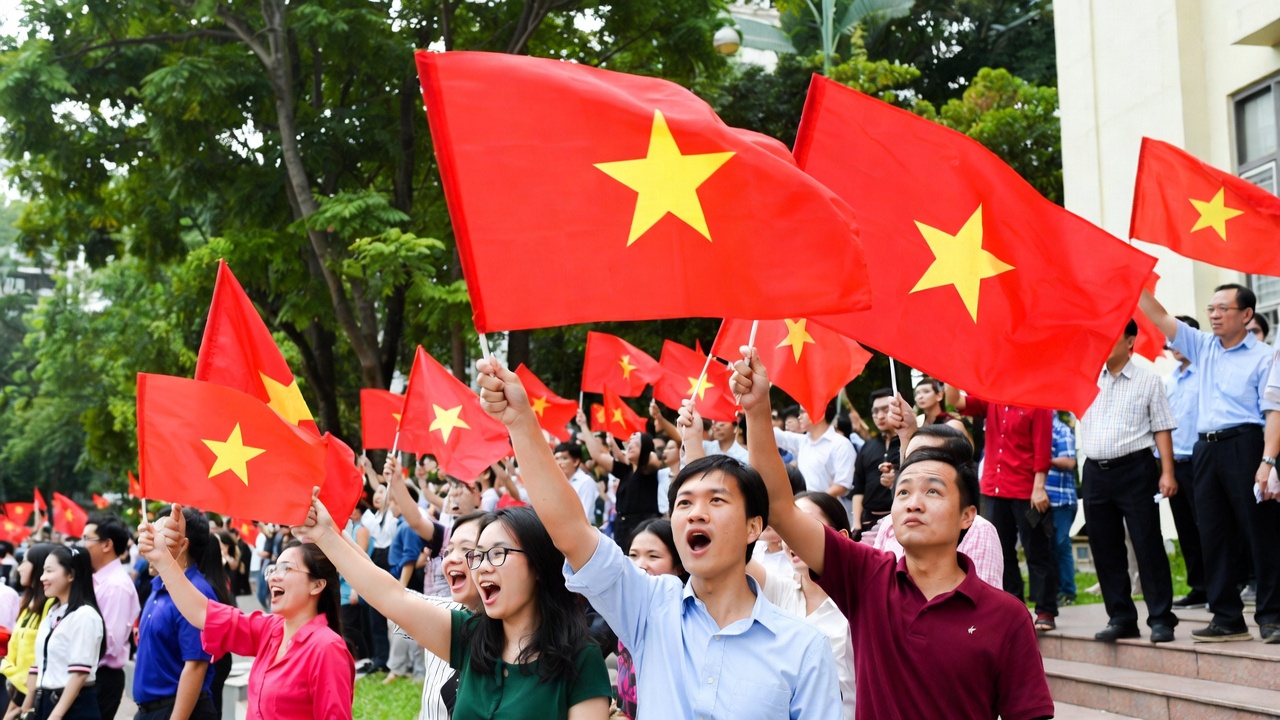
These celebrations are deeply woven into Vietnamese daily life. They are not simply political events. They are family events, community events, and cultural events. The anniversary of the Party’s founding and the arrival of the Lunar New Year create a season of collective reflection, gratitude, and hope.
The Communist Party of Vietnam’s Role in Shaping Southeast Asia’s Political Landscape
The CPV’s 96-year trajectory holds lessons for the broader Southeast Asian region and the developing world. Vietnam’s combination of one-party governance with market economics, aggressive poverty reduction, and strategic multilateral diplomacy offers a distinctive model — one that does not fit neatly into Western frameworks of development.
Several features of the Vietnamese model stand out:
- Pragmatic ideology: The CPV has demonstrated a willingness to adapt its policies to changing circumstances, from the Đổi Mới reforms to the current embrace of digital transformation and AI.
- Institutional discipline: The anti-corruption campaign, whatever its political dimensions, has introduced a new level of accountability within the Party apparatus.
- Strategic patience: Vietnam’s diplomatic network was built over decades, with each partnership upgrade carefully calibrated to national interests.
- Investment in people: Education, healthcare, and social welfare have been consistently prioritized, even during periods of economic difficulty.
Vietnam’s rise has attracted close international attention. Researchers from India’s Syamaprasad College have studied the Congress’s governance reforms. The US-ASEAN Business Council has published detailed analyses of the 14th Congress’s implications for investors. And countries from the Philippines to Bangladesh have looked to Vietnam’s anti-corruption experience for lessons.
As Vietnam prepares to host APEC 2027, it will have an opportunity to present its development story to the world’s most influential economic leaders. The 96th anniversary of the CPV is not just a Vietnamese milestone. It is a reference point for understanding how developing nations can navigate the complexities of globalization, governance, and growth.
Conclusion: Why the 96th Anniversary Marks a Turning Point for Vietnam
Ninety-six years after a small group of revolutionaries met in secret in Hong Kong, the Communist Party of Vietnam leads a country of 100 million people, with an economy valued at over half a trillion dollars, diplomatic partnerships spanning every continent, and a cultural heritage recognized the world over.
The 96th anniversary, falling just days after the successful conclusion of the 14th National Party Congress, carries a special weight. It marks the beginning of what the Party calls the “Era of National Rise” — a period in which Vietnam aims to transition from a developing country to a modern, industrialized, high-income nation.
That ambition is enormous. The challenges — from income inequality and environmental degradation to the pressures of great-power competition and the need for deeper institutional reform — are real. But the trajectory of the past four decades, from the ruins of war to one of the world’s most dynamic economies, suggests that counting Vietnam out would be a mistake.
As Vietnamese families gather for Tết, as firecrackers echo through the old quarters of Hà Nội and Hội An, as children receive red envelopes and elders share stories of harder times, the 96th anniversary of the Communist Party of Vietnam is a reminder: this country has been remaking itself for nearly a century, and it is far from finished.