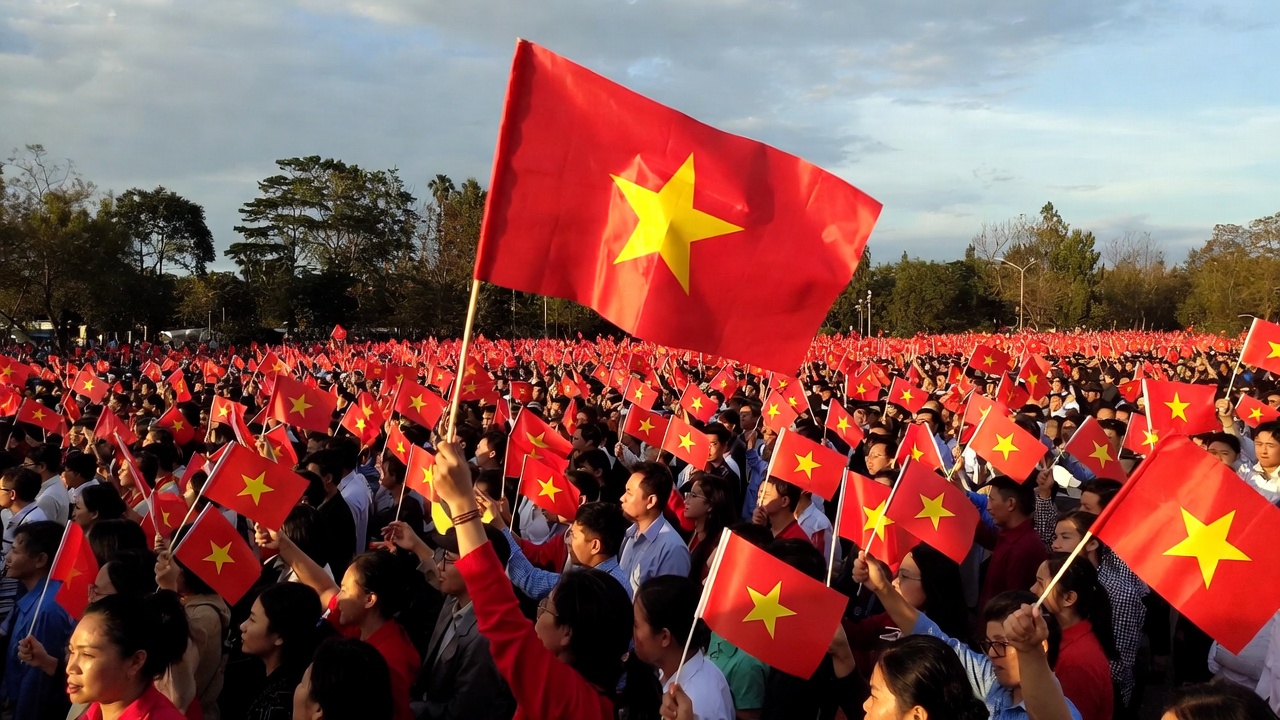
On February 3, 2026, the Communist Party of Vietnam (CPV) marks its 96th founding anniversary. The celebration arrives at one of the most important turning points in the party’s nearly century-long history. Just days earlier, on January 23, the CPV concluded its landmark 14th National Congress in Hanoi — a once-every-five-years gathering that has charted a bold new course for the country through 2030 and beyond. General Secretary To Lam was unanimously re-elected to lead the party into what Vietnamese leaders now call the “Era of the Nation’s Rise.”
This year’s anniversary is not simply a day for looking back. It is a moment for understanding how Vietnam — a country of over 100 million people and one of Asia’s fastest-growing economies — is reshaping its place in the world. At the heart of that effort sits a vast web of party-to-party relationships. The ties between the CPV and the Communist Party of China (CPC) stand front and center, but they are only one thread in a much larger fabric that stretches from Havana to Vientiane, from Moscow to Pyongyang.
This post traces that story in full. We begin with the founding of the CPV itself — an event that took place not on Vietnamese soil, but in a British-colonial classroom in Hong Kong. We move through 96 years of revolution, reform, and rapid development. And we arrive at the present day, where Vietnam’s leaders are using party diplomacy to navigate a changing global order and build what they call a “community with a shared future.”
The History of the Communist Party of Vietnam: From Hong Kong to Hanoi
The Communist Party of Vietnam was not born inside Vietnam. Its founding conference took place on February 3, 1930, at Wah Yan College in Kowloon, Hong Kong — then a British colony. The man who presided over that gathering was Nguyen Ai Quoc, later known to the world as Ho Chi Minh.
Ho Chi Minh’s path to that moment had wound through three continents. Born in central Vietnam in 1890, he left the country as a young man and spent years in France, where he worked menial jobs while becoming active in the socialist movement. He traveled to Moscow in 1923 for training at the Communist International (Comintern) headquarters. And then, in late 1924, he arrived in Guangzhou (Canton) in southern China.
Guangzhou was a turning point. The city was a stronghold of the Chinese revolutionary movement. With support from the Communist Party of China, Ho established the Vietnam Revolutionary Youth League there in 1925. He opened a political training school for Vietnamese exiles and gave lectures on Marxism-Leninism at the Whampoa Military Academy. These activities laid the groundwork — in theory, personnel, and organization — for what would come next.
When Chiang Kai-shek’s crackdown on communists forced Ho out of Guangzhou in 1927, he continued his work through Southeast Asia and the Soviet Union. By early 1930, he had gathered representatives from two rival Vietnamese communist factions in Hong Kong. The result was a unified party, initially called the Vietnamese Communist Party, later renamed the Indochinese Communist Party at Moscow’s suggestion.
That founding moment carries lasting meaning for Vietnam-China relations. As Chinese researcher Ling Dequan told Vietnam News Agency in 2025, Ho Chi Minh’s revolutionary work in Guangzhou “laid the cornerstone for the profound friendship, sharing, and solidarity between the two countries.” The Vietnamese revolutionaries and the CPC were intertwined from the very beginning.
How Ho Chi Minh’s Ties with China Shaped Vietnam’s Revolutionary Path
The bond forged in Guangzhou deepened over the following decades. After the People’s Republic of China was founded on October 1, 1949, Beijing became one of Hanoi’s most important allies.
During the First Indochina War (1946–1954), China provided substantial military aid to Ho Chi Minh’s forces. Chinese military advisors helped plan the decisive Battle of Dien Bien Phu in 1954, which ended French colonial rule and led to the partition of Vietnam at the 17th parallel.
During the Vietnam War (or the American War, as it is known in Vietnam), China again provided military supplies, technical assistance, and diplomatic support to North Vietnam. Hundreds of thousands of Chinese engineering and anti-aircraft troops served in northern Vietnam between 1965 and 1970, helping to defend against American air strikes.
However, the relationship also had its bitter chapters. After reunification in 1975, Vietnam’s alignment with the Soviet Union and its 1978 intervention in Cambodia strained ties badly. The Sino-Vietnamese War of February 1979, though brief, left deep scars. Border tensions and diplomatic estrangement continued through the 1980s.
Normalization came in 1991, when the CPV’s General Secretary Nguyen Van Linh and Chairman Do Muoi traveled to China. Both countries agreed to develop bilateral relations on the basis of the principles of “long-term stability, future orientation, good-neighborly friendship, and all-round cooperation.” That formula — refined, expanded, and repeated in nearly every joint statement since — remains the foundation of the relationship today.
CPV 14th National Congress 2026: Key Outcomes and Strategic Direction for Vietnam
The 14th National Congress of the Communist Party of Vietnam took place from January 19 to 23, 2026, at the Vietnam National Convention Center in Hanoi. It brought together 1,686 delegates representing over 5.6 million party members nationwide.
The congress elected a new 200-member Central Committee (180 official members and 20 alternates). To Lam was unanimously re-elected as General Secretary — a choice that, as one senior researcher at the Centre for Southeast Asian Studies noted, “clearly reflected a choice for stability and continuity.”
The congress adopted a resolution setting several ambitious targets for the 2026–2030 period:
| Target | Goal |
|---|---|
| Average annual GDP growth | At least 10% |
| Per capita income by 2030 | Approximately $8,500 |
| Economic status by 2030 | Upper-middle-income country with modern industry |
| Long-term vision (by 2045) | High-income developed nation |
| Core growth model | Innovation, digital transformation, green growth |
These goals mark a dramatic acceleration from the previous term’s targets. The 13th Congress (2021) had aimed for 6.5–7% annual growth — a figure Vietnam already exceeded in 2025, when it posted 8.02% GDP growth, its strongest performance since 2011.
In his closing remarks, General Secretary To Lam stressed the need to “face the truth squarely and assess the situation accurately.” He also pledged to intensify the anti-corruption campaign — a signature policy priority that he inherited and accelerated after assuming leadership following the death of his predecessor, Nguyen Phu Trong, in July 2024.
Another major theme was the “Streamlining Revolution” — a sweeping overhaul of the party and state apparatus. Under To Lam’s leadership, the number of Vietnam’s provinces was reduced from 63 to 34. Key party commissions and government ministries were cut by 30%. Provincial party secretaries were rotated to serve outside their home provinces, breaking old patterns of local political entrenchment.
Vietnam-China Relations in 2026: Building a Community with a Shared Future
The CPV’s 96th anniversary falls at a high point in Vietnam-China relations. The two countries’ leaders have described the relationship using the phrase “good neighbors, good friends, good comrades, good partners” — a formulation that captures the layered nature of the bond.
High-Level Engagement After the 14th Congress
The CPC Central Committee sent a congratulatory message to the CPV on the opening of the 14th Congress. It praised Vietnam for “maintaining political and social stability, experiencing rapid and sustainable economic development, and seeing its international status rise steadily.” The message affirmed that the CPC and the Chinese government “attach great importance to developing relations between the two parties and countries.”
Days later, on January 26, 2026, Xi Jinping held phone talks with To Lam. Xi congratulated To Lam on his re-election and expressed confidence that Vietnam would fulfill the goals set by the congress. He called on both sides to “keep to their paths and not sway in their commitment, unite and cooperate to promote development, and work together towards a bright future.”
To Lam, for his part, said that “China’s development has consistently provided inspiration and valuable experience for Vietnam’s development.” He reaffirmed Vietnam’s adherence to the One China policy and expressed support for Xi Jinping’s vision of a community with a shared future for humanity, the Belt and Road Initiative, and China’s global governance initiatives.
The “Six Mores” Framework
The bilateral relationship now operates under the overarching framework of “six mores” — a formulation designed to guide the building of a Vietnam-China community with a shared future that carries strategic significance. This vision was articulated during the leaders’ exchanges in 2023–2024 and further reinforced after the 14th Congress.
Chinese Ambassador to Vietnam He Wei described 2025 as a year of “scale, substance, and innovation” in Vietnam-China relations, noting:
- In the first 11 months of 2025, bilateral trade exceeded $267.7 billion, surpassing the total for the entire previous year.
- The two countries signed 45 cooperation documents during Xi Jinping’s state visit to Vietnam in April 2025.
- New areas of cooperation opened up in artificial intelligence, infrastructure connectivity, and social welfare.
- The first-ever meeting of the “3+3” strategic dialogue mechanism (Diplomacy, Defense, Security) was held.
Xi Jinping’s 2025 State Visit to Vietnam
In April 2025, Xi Jinping made a state visit to Vietnam, meeting with General Secretary To Lam and other Vietnamese leaders. The visit came as both countries marked the 75th anniversary of diplomatic relations (1950–2025). During the visit, the two sides issued a joint statement on deepening their comprehensive strategic cooperative partnership and accelerating the construction of a Vietnam-China community with a shared future.
Xi also urged Vietnam to oppose “unilateral bullying” — widely interpreted as a reference to U.S. tariff policies under President Donald Trump. This diplomatic nudge highlighted how the CPC-CPV relationship extends beyond bilateral ties into strategic alignment on global issues.
Vietnam and China Bilateral Trade: A $260 Billion Economic Partnership
The economic dimension of the Vietnam-China relationship has grown enormously over the past two decades. The numbers tell a clear story.
China has been Vietnam’s largest trading partner since 2004. Vietnam has been China’s largest trading partner in ASEAN since 2016. By 2024, Vietnam had become China’s fourth-largest trading partner globally.
| Year | Bilateral Trade (USD) | Key Milestone |
|---|---|---|
| 2004 | ~$7 billion | China becomes Vietnam’s largest trading partner |
| 2016 | ~$72 billion | Vietnam becomes China’s top ASEAN trade partner |
| 2020 | $133 billion | Trade exceeds $100 billion for the first time |
| 2024 | $260.65 billion | Record year; 13.5% year-on-year growth |
| 2025 (first 11 months) | >$267.7 billion | Already surpassed full-year 2024 total |
Trade is deeply complementary. China exports to Vietnam primarily consist of machinery, electronic components, and raw materials — inputs for Vietnam’s booming manufacturing sector. Vietnam exports to China include agricultural products (durian, lychee, coffee, seafood), electronics, and textiles.
A few specific data points illustrate the depth of these ties:
- Over 60% of Vietnam’s fruit and vegetable exports go to China.
- Vietnamese durian exports to China reached $3.4 billion in 2025, accounting for over 90% of Vietnam’s total durian export value.
- In the first four months of 2025, more than 200,000 tons of Vietnamese fruit worth 700 million yuan entered China through Hekou Customs in Yunnan province.
- Chinese direct investment in Vietnam reached over $2.5 billion in 2024 alone.
Infrastructure connectivity is another area of rapid growth. Three standard-gauge railway lines in northern Vietnam are being built with Chinese cooperation. These rail links are expected to reduce transit times and logistics costs, further deepening supply chain integration between the two economies.
How the CPC and CPV Share Governance Experience and Socialist Ideology
The party-to-party relationship between the CPC and CPV goes well beyond trade and diplomacy. At its core, it is an ideological partnership between two ruling communist parties that share a common Marxist-Leninist heritage and face similar challenges of governance in the 21st century.
Both parties have followed broadly similar paths of economic reform while maintaining single-party political control. China launched its reform and opening-up under Deng Xiaoping in 1978. Vietnam launched its own version — known as Doi Moi (Renovation) — in 1986. Both processes introduced market mechanisms into state-planned economies while preserving the leading role of the communist party.
Today, the two parties engage in regular exchanges on governance, including:
- High-level meetings between party leaders and Politburo members
- Theory seminars on Marxism-Leninism, party building, and socialist modernization
- Training programs for cadres, often held in China’s party schools
- Anti-corruption cooperation, a shared priority under both Xi Jinping and To Lam
Xi Jinping’s phone call with To Lam after the 14th Congress specifically called for both sides to “strengthen exchanges and mutual learning on party and state governance” and to “make good use of mechanisms such as high-level meetings, theory seminars and training sessions.”
The ideological alignment is not merely rhetorical. Both parties face the challenge of maintaining legitimacy in societies that are rapidly modernizing and increasingly connected to the global economy. Both have responded with campaigns against corruption, investments in digital governance, and efforts to articulate updated versions of socialist theory that can accommodate private enterprise, technological innovation, and global integration.
CPV Relations with the Lao People’s Revolutionary Party and Indochina Solidarity
Vietnam’s closest party-to-party relationship, historically and today, is with the Lao People’s Revolutionary Party (LPRP). The CPV, the LPRP, and the Cambodian People’s Party (CPP) all trace their origins to the Indochinese Communist Party, which Ho Chi Minh founded in 1930. The CPV maintains that all three parties are “spiritual incarnations” of that original organization.
Vietnam and Laos describe their relationship as a “great friendship, special solidarity, and comprehensive cooperation.” The two ruling parties hold regular summits, exchange cadres, and coordinate on economic policy, border management, and security.
The 12th National Congress of the LPRP took place in early January 2026, just weeks before the CPV’s own congress. General Secretary of the LPRP and Laotian President Thongloun Sisoulith personally visited Hanoi to congratulate To Lam on his re-election and the success of the 14th CPV Congress.
Vietnam also maintains strong ties with the CPP in Cambodia. Vice President of the CPP Men Sam An visited Hanoi after the 14th Congress. To Lam announced plans for a state visit to Cambodia in early February 2026, underscoring the continued importance of the Indochina solidarity bloc in Vietnamese foreign policy.
Vietnam and Cuba Communist Party Ties: A Special Friendship Across the Pacific
If the CPV-CPC relationship is defined by geographic proximity and economic interdependence, the bond between Vietnam and Cuba is defined by ideological solidarity and shared history. The two countries’ relationship is often called a “special friendship” — a term that carries deep emotional resonance in both Hanoi and Havana.
Cuba was one of the first countries to establish an embassy in Hanoi. It was also one of the first to set up a solidarity committee with the Vietnamese people during the American War. In 1973, Fidel Castro became the first foreign leader to visit the liberated territories of South Vietnam. Subsequent Cuban leaders, including Raul Castro and Miguel Diaz-Canel, have maintained the tradition of high-level exchanges.
After the 14th Congress concluded, To Lam held phone talks with Diaz-Canel — who serves as First Secretary of the Communist Party of Cuba and President of Cuba. The conversation reaffirmed mutual support and commitment to socialist construction.
2025 was designated the “Vietnam-Cuba Friendship Year.” The celebration included cultural exchanges, academic events, and the publication of a 180-page book honoring the bilateral relationship. As the two countries share the distinction of being among only five constitutionally socialist states in the world (alongside China, Laos, and North Korea), their bond carries both symbolic and strategic weight.
CPV and Russia: How Communist Party Networks Sustain Diplomatic Relationships
Russia holds a special place in Vietnamese party diplomacy — not because Russia is still governed by a communist party (it is not), but because of deep historical ties dating to the Soviet era. The Soviet Union was one of Vietnam’s most important allies during the Vietnam War and throughout the Cold War. Marxism-Leninism itself reached Vietnam partly through Soviet channels.
Today, the CPV maintains relationships with multiple Russian political parties, including the Communist Party of the Russian Federation (CPRF) and the A Just Russia – For Truth party.
After To Lam’s re-election, CPRF Chairman Gennady Zyuganov sent congratulatory messages expressing confidence that the CPV would continue “guiding the country along the path chosen by President Ho Chi Minh.” A Just Russia leader Sergei Mironov praised To Lam’s “strong political reputation” and “major contributions to strengthening the Russia-Vietnam comprehensive strategic partnership.”
The 14th Congress also received attention from Russia’s official media. On January 28, 2026, Russia’s TASS news agency published a detailed article by its bureau chief in Vietnam, Yuri Denisovich, offering positive assessments of the congress outcomes and their significance for bilateral relations.
In Saint Petersburg, a roundtable discussion was held on January 30 to analyze the 14th Congress outcomes and celebrate the CPV’s 96th anniversary. Vice Chairman of Saint Petersburg’s Committee for External Relations Vyacheslav Kalganov described the congress as “a political event of decisive significance to all aspects of Vietnam’s social life.”
International Meeting of Communist and Workers’ Parties: Vietnam’s Role in Global Left-Wing Solidarity
The CPV is an active participant in the International Meeting of Communist and Workers’ Parties (IMCWP), the most important regular gathering of communist and left-wing parties worldwide. The IMCWP originated in 1998, when the Communist Party of Greece (KKE) invited parties to an annual conference for sharing experiences and issuing joint declarations.
Vietnam hosted the 18th IMCWP in Hanoi in October 2016, welcoming over 100 representatives from communist and workers’ parties around the world. The CPV was elected to the meeting’s working group. The event emphasized the importance of fighting for peace and socialism, protecting national independence and sovereignty, and settling disputes through peaceful means and international law.
The CPV currently maintains relations with over 100 communist and workers’ parties globally. This extensive network gives Vietnam a unique diplomatic channel — one that operates alongside, but independently of, conventional state-to-state relations.
Key events in the global communist party calendar in early 2026 further illustrate this network:
| Date | Event | Location |
|---|---|---|
| January 6–8, 2026 | 12th National Congress of the Lao People’s Revolutionary Party | Vientiane, Laos |
| January 19–25, 2026 | 14th National Congress of the CPV | Hanoi, Vietnam |
| January 29–31, 2026 | 22nd Congress of the KKE | Athens, Greece |
| February 27 – March 1, 2026 | 15th National Congress of the Communist Party of Australia | Melbourne, Australia |
The clustering of these events in early 2026 means that communist parties worldwide are actively exchanging delegations, messages, and strategic assessments — with Vietnam at the center of the conversation.
Vietnam’s Doi Moi Reforms and Their Influence on Socialist Economic Models Worldwide
The story of the CPV cannot be told without understanding Doi Moi — the “Renovation” reforms launched at the 6th National Congress in December 1986. At that time, Vietnam was in severe economic crisis. Inflation was running above 700%. The planned economy had stagnated. Millions of people were living in poverty.
Doi Moi introduced market mechanisms into the Vietnamese economy while preserving the CPV’s leading political role. Key reforms included:
- Decollectivization of agriculture, which allowed farmers to sell surplus crops on the open market
- Opening the economy to foreign investment, starting with the 1987 Foreign Investment Law
- Price liberalization and the gradual dismantling of state subsidies
- Encouragement of private enterprise, eventually allowing CPV members to engage in business (a barrier removed in 2006)
The results have been transformative. Vietnam went from one of the poorest countries in the world to a middle-income economy. GDP per capita rose from about $100 in the late 1980s to over $5,000 in 2025. The poverty rate fell from over 50% to under 5%. Vietnam became one of the world’s top 20 trading economies, with total import-export turnover exceeding $930 billion in 2025.
Doi Moi has influenced other socialist countries. Cuba, Laos, and even China have studied Vietnam’s approach to combining market reforms with one-party governance. The CPV’s experience serves as a reference point in discussions about how socialist parties can adapt to globalization without surrendering political control.
At the 14th Congress, the CPV set its sights on the next chapter: a growth model centered on science, technology, innovation, and digital transformation. This new model builds on Doi Moi’s foundations while acknowledging that the era of growth driven primarily by cheap labor and natural resources is coming to an end.
Vietnam GDP Growth 2025 and the CPV’s Bold Economic Vision for 2030
Vietnam’s economic performance in 2025 has given the CPV significant credibility as it sets ambitious targets for the decade ahead.
According to Vietnam’s National Statistics Office, GDP grew 8.02% in 2025 — with growth accelerating through the year, from 7.05% in the first quarter to 8.46% in the fourth. This was the country’s strongest full-year performance since 2011.
Key economic indicators for 2025 include:
| Indicator | 2025 Result |
|---|---|
| GDP growth | 8.02% |
| Q4 2025 GDP growth | 8.46% (fastest since Q4 2007) |
| Total GDP | ~$514 billion (32nd globally) |
| Per capita income | ~$5,026 |
| Total trade turnover | >$930 billion (up 18.2% YoY) |
| Disbursed FDI | $27.62 billion (up 9%, highest since 2021) |
| Newly registered FDI | >$38.4 billion |
| CPI inflation | 3.31% (within target) |
| Credit growth | ~18% |
The International Monetary Fund ranked Vietnam among the top 10 fastest-growing economies worldwide. International observers described it as one of the few bright spots in a subdued global economy.
These results provided the foundation for the 14th Congress’s target of at least 10% annual GDP growth for 2026–2030. Many independent analysts consider this target extremely ambitious. David Dapice, Emeritus Professor of Economics at Tufts University, wrote that “growth of 8 percent in 2026 is possible if there are few major negative shocks,” but that “sustaining a 10 percent growth rate will be difficult.”
Still, the Vietnamese government has put significant policy support behind the goal. The National Assembly approved 10% growth as the target for 2026. Public investment is planned at about $34–35 billion, or 7% of GDP — the highest public investment-to-GDP ratio in Asia. Dr. Can Van Luc, Chief Economist at BIDV, forecasts that successful public investment disbursement alone could contribute up to 2 percentage points to GDP growth.
How CPV Celebrates Its Founding Anniversary: Traditions and Cultural Significance
February 3 is not just a political date for Vietnam. It is woven into the nation’s cultural and ceremonial calendar, particularly in years — like 2026 — when the anniversary coincides with the Lunar New Year season.
The CPV’s founding anniversary is traditionally marked by a range of activities:
- Tribute ceremonies at the Ho Chi Minh Mausoleum in Hanoi, where party and state leaders pay their respects to the founder
- Incense offerings at memorial sites for past revolutionary leaders across the country
- Exhibitions featuring rare photographs and documents from the party’s history
- Cultural performances and public events celebrating national unity and revolutionary heritage
- Overseas ceremonies at Vietnamese embassies and diplomatic missions worldwide
In 2026, these celebrations carry extra weight because they also mark the success of the 14th National Congress. At the Vietnamese Embassy in France, Ambassador Nguyen Thi Van Anh hosted a ceremony that highlighted “the historical significance of the CPV’s 96-year journey of development and revolutionary leadership.” The Presidential Office headquarters in Hanoi were ceremonially reopened on February 2 after renovation — a symbolic gesture linking revolutionary heritage with modern governance.
National Assembly Chairman Tran Thanh Man traveled to the southern province of Vinh Long to pay tribute to past leaders, including late Chairman of the Council of Ministers Pham Hung and late Prime Minister Vo Van Kiet. An exhibition at the Ho Chi Minh Relic Site in the Presidential Palace traces President Ho Chi Minh’s enduring ties with the Vietnamese National Assembly over 80 years of national history.
South China Sea Disputes and How CPV-CPC Party Channels Manage Strategic Tensions
No account of Vietnam-China relations would be complete without acknowledging the South China Sea disputes. Both countries claim overlapping territory in the Spratly Islands and Paracel Islands, and tensions have periodically flared over fishing rights, oil exploration, and island construction.
These disputes are real and ongoing. They have led to diplomatic protests, maritime confrontations, and popular protests in Vietnam. In 2014, China’s placement of an oil rig in waters near the Paracel Islands triggered a major diplomatic crisis.
Yet what is notable about the CPV-CPC relationship is how party-to-party channels have served as a mechanism for managing these tensions. When state-level diplomacy becomes strained, party channels often remain open. The regular exchange of high-level visits, theory seminars, and defense consultations creates a network of relationships that can absorb shocks and prevent escalation.
The “3+3” strategic dialogue mechanism — covering diplomacy, defense, and security — is the latest institutional expression of this approach. Its first meeting in 2025 created a new forum for discussing sensitive issues that might otherwise spiral.
In their January 2026 phone call, both Xi Jinping and To Lam emphasized the need to “guard against and defuse various risks and challenges” and to “jointly oppose hegemonism and bloc confrontation.” These phrases carry multiple meanings. They signal alignment on some global issues while also implicitly acknowledging that the bilateral relationship itself requires careful management.
What the CPV’s 96th Anniversary Means for the Future of Global Communist Movements
As the CPV enters its 97th year of existence, its significance extends beyond Vietnam’s borders. In a world where the number of one-party socialist states has shrunk to five — China, Vietnam, Cuba, Laos, and North Korea — the CPV’s continued vitality matters for the global left.
Several factors make the CPV’s story especially relevant in 2026:
Economic success as a legitimacy model. Vietnam’s rapid growth under CPV leadership offers a counter-narrative to the assumption that economic development requires multiparty democracy. The party’s ability to deliver rising living standards — GDP per capita has increased roughly 50-fold since Doi Moi — has sustained its domestic legitimacy.
Institutional adaptation. The “Streamlining Revolution” demonstrates the CPV’s willingness to restructure itself. Reducing the number of provinces from 63 to 34, cutting ministries, and rotating leaders all suggest a party that is actively trying to modernize its governance model.
Anti-corruption as ideology. The CPV’s intensifying anti-corruption campaign under both Nguyen Phu Trong and To Lam mirrors similar campaigns in China under Xi Jinping. Both parties have framed anti-corruption not as a mere policy initiative but as an existential imperative — a fight, as professor Andrey Vassoevych of Saint Petersburg’s Herzen University put it, “against enemies within the country.”
Multilateral party diplomacy. The CPV’s network of over 100 party relationships gives it a form of soft power that few other political organizations possess. This network operates on a different logic than conventional diplomacy — one based on shared ideology, historical solidarity, and mutual learning rather than on purely national interests.
Hélène Luc, Honorary Senator and Honorary President of the France-Vietnam Friendship Association, captured this dimension when she said the 14th Congress “demonstrated that the world can indeed choose a different way of living — one based on peaceful coexistence, the promotion of multilateralism, mutual respect among nations, and the use of science, knowledge and social wealth as foundations to serve humanity.”
Visiting Vietnam During the CPV Founding Anniversary: A Travel Guide for Cultural Enthusiasts
For travelers interested in political history and cultural immersion, February in Vietnam offers a unique experience. The CPV’s founding anniversary often falls near or during Tet — the Lunar New Year — creating a period of exceptional cultural richness.
What to See
- Ho Chi Minh Mausoleum, Hanoi: The granite mausoleum on Ba Dinh Square is where the founder’s embalmed body lies in state. It is especially visited around party anniversaries and national holidays.
- Ho Chi Minh Relic Site at the Presidential Palace, Hanoi: The 2026 exhibition here traces 80 years of Ho Chi Minh’s relationship with the National Assembly through rare photographs and documents.
- Cu Chi Tunnels, Ho Chi Minh City: A vast underground network used during the Vietnam War, offering insight into the revolutionary struggle that the CPV led.
- Vinh Long Province: Memorial sites for revolutionary leaders, including the memorial to late Prime Minister Vo Van Kiet, who was one of the key architects of Doi Moi.
- Dien Bien Phu: Site of the 1954 battle that ended French colonialism in Vietnam. A museum and battlefield memorials mark the CPV’s first great military victory.
Practical Tips for February Travel
- Book early. February is peak season due to Tet. Hotels and transport fill up quickly.
- Respect the ceremonies. Public events related to the founding anniversary are solemn occasions. Dress modestly and observe quietly.
- Learn basic phrases. Even a few words of Vietnamese will be warmly received. “Chúc mừng năm mới” (Happy New Year) is essential during Tet.
- Try Tet food. Look for banh chung (sticky rice cake), mut (candied fruit), and thit kho hot vit (braised pork with eggs) — traditional Tet dishes found everywhere in February.
Frequently Asked Questions About the CPV 96th Anniversary and Vietnam-China Ties
When was the Communist Party of Vietnam founded? The CPV was founded on February 3, 1930, at a conference in Hong Kong presided over by Ho Chi Minh.
Who is the current General Secretary of the CPV? To Lam was re-elected as General Secretary at the 14th National Congress in January 2026.
How many members does the CPV have? The CPV has over 5.6 million members as of 2026.
What is the CPV’s relationship with the Communist Party of China? The CPC and CPV maintain close political, ideological, and economic ties. Both are ruling communist parties in neighboring socialist states. They cooperate on governance, party-building, defense, and economic development under the framework of building a “community with a shared future.”
How large is Vietnam-China bilateral trade? Bilateral trade exceeded $267.7 billion in the first 11 months of 2025, surpassing the full-year 2024 total of $260.65 billion. China has been Vietnam’s largest trading partner since 2004.
What were the key outcomes of the CPV’s 14th National Congress? The congress set targets including at least 10% annual GDP growth for 2026–2030, elected a new Central Committee, re-elected To Lam as General Secretary, and emphasized innovation, digital transformation, and green growth as the core of a new development model.
What is Doi Moi? Doi Moi (“Renovation”) refers to the economic reforms launched in 1986 that introduced market mechanisms into Vietnam’s planned economy while preserving the CPV’s leading role.
Conclusion: 96 Years of the CPV and What Comes Next for Vietnam’s Party Diplomacy
Ninety-six years after Ho Chi Minh gathered a small group of revolutionaries in a Hong Kong classroom, the Communist Party of Vietnam leads a country of 100 million people with a $514 billion economy and a growing voice in global affairs.
The 14th National Congress has set the stage for what Vietnamese leaders describe as a transformational decade. The targets are bold — 10% annual growth, upper-middle-income status by 2030, high-income status by 2045. The reforms are sweeping — fewer provinces, leaner ministries, stronger anti-corruption enforcement.
At the center of this effort is a dense network of party-to-party relationships. The CPC stands at the top of that network, with a relationship that stretches back a full century to the streets of Guangzhou. But the web extends far beyond Beijing — to Vientiane, Havana, Moscow, Athens, and beyond.
As the red banners and flower displays mark another founding anniversary in Hanoi’s Ba Dinh Square, the CPV is sending a clear message: it intends not just to celebrate its past, but to shape its future. And it plans to do so not alone, but in partnership with a global network of like-minded parties — each navigating, in their own way, the complex terrain between revolutionary heritage and 21st-century reality.