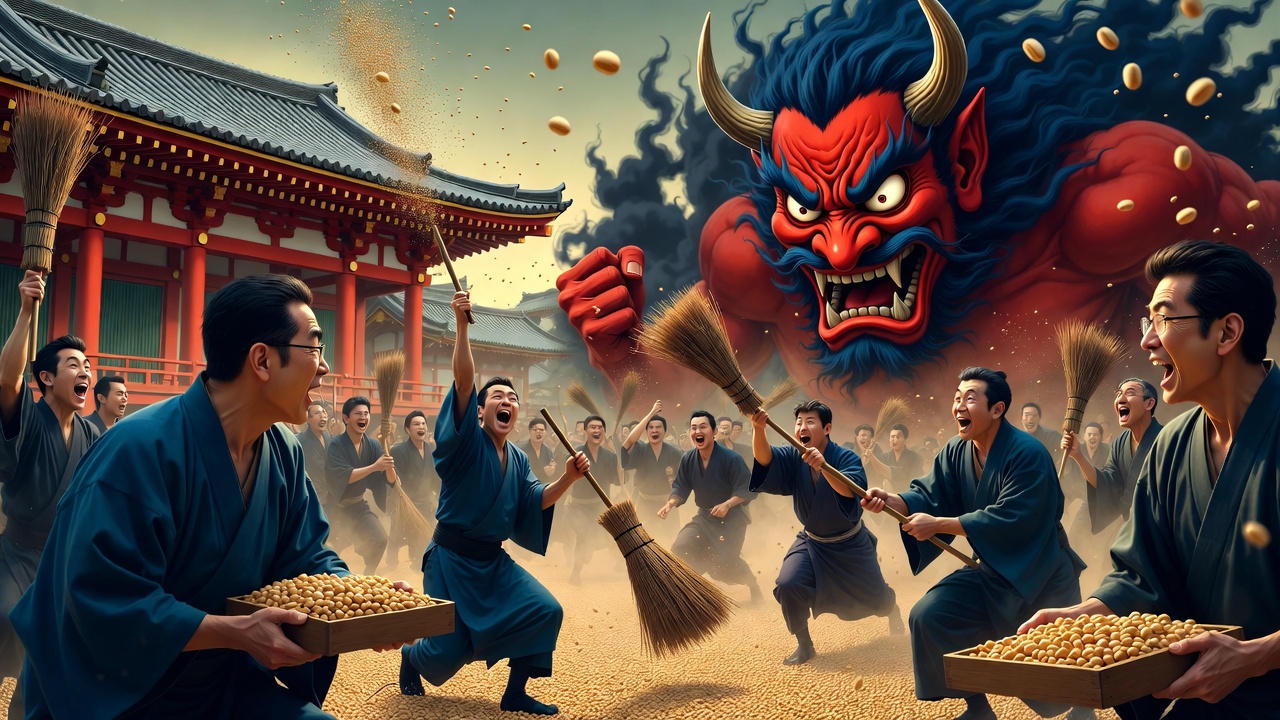
There is something deeply satisfying about hurling a fistful of roasted soybeans at a demon. Not a metaphorical demon. An actual person dressed in a terrifying red-and-blue horned mask, crouching on your doorstep while your children shriek with delight. This is Setsubun — one of Japan’s most beloved seasonal traditions — and it happens every year at the threshold between winter and spring.
On February 3, 2026, millions of Japanese families will open their front doors, grab handfuls of roasted soybeans, and shout the famous chant: “Oni wa soto! Fuku wa uchi!” — “Demons out! Good fortune in!” Temples and shrines from Hokkaido to Kyushu will host massive bean-throwing ceremonies, with sumo wrestlers, actors, and local celebrities joining the festivities. Supermarket shelves will overflow with thick sushi rolls called ehomaki, demon masks, and bags of lucky beans.
But Setsubun is far more than a quirky custom. It is a living ritual with roots stretching back over 1,300 years to ancient China. It carries layers of meaning — seasonal, spiritual, communal — that reveal how the Japanese people have always understood the fragile boundary between fortune and misfortune.
Whether you are planning to visit Japan this February, want to celebrate at home with your family, or simply want to understand one of the world’s most fascinating seasonal festivals, this guide covers everything. From the exact meaning of the Setsubun chant to the regional variations that surprise even Japanese locals, from the correct way to throw beans to where to find the best festivals in 2026 — it is all here.
Let’s begin.
What Is Setsubun? The Meaning Behind Japan’s Spring Purification Festival
Setsubun (節分) literally translates to “seasonal division.” It marks the day just before Risshun (立春), the first day of spring according to Japan’s traditional lunisolar calendar. While the word technically applies to the transitions between all four seasons, today it almost exclusively refers to the spring Setsubun — the most culturally significant of the four.
Why spring? In the old Japanese calendar, Risshun was considered the beginning of the new year. That made Setsubun something like New Year’s Eve — a final opportunity to purge the bad luck of the old year before welcoming the fresh start of spring.
This is the core idea behind every Setsubun ritual. Drive out evil. Invite good fortune. The bean-throwing, the chanting, the sardine heads on holly branches, the silent eating of sushi rolls — all of it serves this single purpose: to cleanse the passage between seasons and protect the household from misfortune.
Setsubun is not a national public holiday in Japan. Businesses and schools operate on normal schedules. Yet nearly every family, kindergarten, temple, and shrine in the country observes it in some form. It is one of those traditions that lives not in government decrees but in the daily rhythms of Japanese life — in the smell of roasting soybeans, in the laughter of children chasing a father in an oni mask, in the quiet moment of eating ehomaki while facing south-southeast and making a silent wish.
When Is Setsubun in 2026? Date, Day of the Week, and Why It Sometimes Shifts
Setsubun 2026 falls on Tuesday, February 3.
Most years, Setsubun lands on February 3. But not always. Because it is defined as “the day before Risshun,” and the exact astronomical timing of Risshun can vary slightly, the date occasionally shifts. In 2021 and 2025, for example, Setsubun fell on February 2 — the first time in decades it had moved off the third.
Here is a quick reference for recent and upcoming Setsubun dates:
| Year | Setsubun Date | Day of the Week |
|---|---|---|
| 2024 | February 3 | Saturday |
| 2025 | February 2 | Sunday |
| 2026 | February 3 | Tuesday |
| 2027 | February 3 | Wednesday |
Key 2026 detail: The lucky direction (eho) for eating ehomaki in 2026 is south-southeast (南南東). This direction changes annually based on the Chinese zodiac cycle and the deity known as Toshitokujin (歳徳神), the guardian deity believed to reside in the year’s most fortunate compass direction. We will explain how to use this direction later in the ehomaki section.
The Ancient History and Origins of Setsubun Bean-Throwing in Japan
Setsubun’s roots reach far beyond Japan. The tradition of ritual purification at the turn of the seasons traveled from China to Japan in the 8th century, arriving as a court ceremony called Tsuina (追儺).
From Chinese Court Ritual to Japanese Folk Tradition
According to the historical chronicle Shoku Nihongi, Tsuina was first performed in Japan in 706 CE at the imperial court. It was a formal ceremony held on the last day of the year under the old lunar calendar. Court officials decorated the palace gates with clay figures of oxen and children. They carried peach branches and walking sticks to drive away evil spirits believed to cause disease and disaster.
A key figure in the Tsuina ceremony was the Hōsō-shi (方相氏), a shaman dressed in a fearsome costume to exorcise demons. Here is where a fascinating twist occurred: over the centuries, the terrifying appearance of the Hōsō-shi was confused with the oni (demons) themselves. The exorcist became the monster. As Fun! Japan notes, this misidentification gradually transformed Setsubun from a court-sponsored rite of exorcism into a folk festival where ordinary people drove away oni from their own homes.
The Muromachi Period: Beans Enter the Picture
The custom of bean-throwing (mamemaki) became established during the Muromachi period (1336–1573). According to the Ainōshō, a dictionary compiled during this era, the practice originated from a legend set during the reign of Emperor Uda in the 10th century. A monk on Mt. Kurama supposedly escaped disaster by blinding an oni with roasted soybeans.
The choice of beans was no accident. The Japanese word for bean — mame (豆) — can also be written with characters meaning “devil’s eye” (魔目). Some scholars point out that the pronunciation is close to mametsu (魔滅), meaning “to destroy the devil.” Language, symbolism, and ritual fused together.
The Edo Period: Setsubun Goes Nationwide
During the Edo period (1603–1867), bean-throwing expanded from aristocratic households to ordinary homes, Shinto shrines, and Buddhist temples across Japan. This was also the era when the custom of hanging sardine heads on holly branches (hiiragi iwashi) at the entrance of homes began in earnest. The sharp holly thorns were believed to prick the eyes of oni, while the pungent smell of grilled sardine drove them away.
By the end of the Edo period, Setsubun had become the boisterous, family-centered celebration it remains today.
Oni Wa Soto Fuku Wa Uchi: What Does the Setsubun Chant Mean in English?
The beating heart of Setsubun is a single, powerful phrase:
鬼は外!福は内! Oni wa soto! Fuku wa uchi! “Demons out! Good fortune in!”
This is the chant shouted by millions of Japanese people every February as they throw roasted soybeans — either out their front doors, or at a family member wearing an oni mask. Let’s break it down word by word.
| Japanese | Romaji | English |
|---|---|---|
| 鬼 | Oni | Demon, ogre |
| は | wa | (topic marker) |
| 外 | soto | Outside |
| 福 | fuku | Good fortune, blessings |
| 内 | uchi | Inside, home |
The structure is beautifully simple. The first half banishes evil. The second half welcomes blessings. Together, the two phrases create a complete act of spiritual cleansing — pushing out the old year’s misfortune and pulling in the new year’s luck.
Who Leads the Chant?
Traditionally, the person who leads the mamemaki in the household is the toshiotoko (年男) — a male family member whose Chinese zodiac sign matches the current year. In practice, this role is now typically played by the head of the household, regardless of zodiac year. In many modern Japanese families, the father puts on an oni mask and the children chase him with beans while shouting the chant.
Why Roasted Soybeans?
The beans used in mamemaki are roasted soybeans, called fukumame (福豆) — literally, “fortune beans.” They must be roasted, not raw. Japanese folk belief holds that if a raw bean were accidentally left behind and sprouted, it would bring bad luck. Roasting neutralizes this risk and symbolizes purification by fire.
After the bean-throwing, family members gather the beans and eat one bean for each year of their age — plus one extra bean for good luck in the year ahead. This custom is believed to protect against illness and ensure good health.
In Hokkaido and parts of the Tōhoku region, families use unshelled peanuts instead of soybeans. The practical reason? Peanuts are easier to clean up afterward and more hygienic when thrown on the floor. The spiritual intent remains the same.
Regional Variations of Setsubun Chants Across Japan You Should Know
One of the most delightful surprises about Setsubun is that not everyone in Japan says the same chant. While “Oni wa soto! Fuku wa uchi!” is by far the most common version, temples, shrines, and entire cities have developed their own distinctive variations. These alternative chants reveal deeper layers of local belief and folklore.
Here is a guide to the most notable regional Setsubun chants:
| Location | Chant (Japanese) | Chant (Romaji) | Meaning |
|---|---|---|---|
| Most of Japan | 鬼は外!福は内! | Oni wa soto! Fuku wa uchi! | Demons out! Good fortune in! |
| Sensōji Temple, Tokyo | 千秋万歳 福は内! | Senshū banzei, fuku wa uchi! | Long life and good fortune, come in! |
| Naritasan Shinshōji, Chiba | 福は内!福は内! | Fuku wa uchi! Fuku wa uchi! | Good fortune in! Good fortune in! |
| Kijin Shrine, Saitama | 福は内、鬼は内、悪魔は外! | Fuku wa uchi, oni wa uchi, akuma wa soto! | Fortune in! Oni in! Evil spirits out! |
| Kinpusenji Temple, Nara | 福は内、鬼も内! | Fuku wa uchi, oni mo uchi! | Fortune in! Oni in, too! |
| Aizuwakamatsu, Fukushima | 鬼の目玉ぶっつぶせ! | Oni no medama buttsubuse! | Crush the demons’ eyeballs! |
| Sendai, Miyagi | (Standard chant + ) 鬼の面玉ぶっつぶせ! | Oni no mentama butsubuse! | Crush the oni’s eyeballs! |
Why Some Places Welcome Demons Inside
The variations at Sensōji Temple in Tokyo’s Asakusa district are particularly fascinating. At Sensōji, worshippers believe that no demons can possibly approach the Kannon Bodhisattva enshrined there. So there is no need to shout “Demons out!” Instead, the crowd chants only the welcoming half: “Long life and good fortune, come in!”
At Naritasan Shinshōji Temple in Chiba Prefecture — one of the most famous Setsubun venues in all of Japan — the custom is similar. Because the temple’s guardian deity, Fudō Myō-ō (不動明王), is considered so powerful and compassionate that even wicked oni repent in his presence, participants chant only “Fuku wa uchi!” The reasoning is extraordinary: there are no demons to cast out, because the deity’s mercy has already reformed them.
At Kijin Shrine in Saitama Prefecture, demons are actually worshipped as protective gods. The shrine’s chant welcomes oni inside alongside good fortune, banishing only akuma (evil spirits) — drawing a clear distinction between the fearsome-but-redeemable oni and genuinely malevolent forces.
These variations reflect a deeply Japanese spiritual sensibility. As folklorist and translator Hiroko Yoda observed, what she finds compelling about these alternative chants is the idea that “bad” can be changed to work for “good” — an inclusive approach to spiritual forces that runs throughout Japanese tradition.
The Aizuwakamatsu Exception
Then there is Aizuwakamatsu in Fukushima Prefecture, where the locals take a decidedly less diplomatic approach. Their chant — “Oni no medama buttsubuse!” — translates to “Crush the demons’ eyeballs!” No mercy. No redemption. Just direct, visceral aggression toward evil. It is a reminder that Setsubun customs, while broadly unified, contain fascinating extremes.
How to Do Mamemaki: A Step-by-Step Guide to Setsubun Bean-Throwing
Mamemaki (豆撒き) — literally “bean scattering” — is the central ritual of Setsubun. It is practiced in homes, kindergartens, temples, and shrines across Japan. Here is how to do it properly, following traditional customs.
What You Need
- Roasted soybeans (fukumame): Available at every supermarket and convenience store in Japan from mid-January. They come in bags, often with a paper oni mask included.
- An oni mask: One family member (traditionally the father) wears the mask and plays the demon.
- A masu (wooden measuring cup): The traditional container for holding beans. Not strictly necessary, but adds authenticity.
Step-by-Step Bean-Throwing Procedure
1. Wait until evening. Traditionally, oni come at night. Mamemaki should be performed after dark, when the whole family is home together.
2. Open all doors and windows. This gives the demons a path to escape.
3. The designated thrower takes a handful of beans. Traditionally, this is the toshiotoko (the man born in the corresponding zodiac year) or the male head of household. In modern families, everyone participates.
4. Stand at the entrance and throw beans outward while shouting: “Oni wa soto!” (“Demons out!”) Repeat at each entrance and window.
5. Close the doors and windows. This traps the good fortune inside and prevents demons from returning.
6. Throw beans inside the house while shouting: “Fuku wa uchi!” (“Good fortune in!”) Scatter beans in each room.
7. Pick up the beans and eat them. Each person eats the same number of beans as their age, plus one extra for good luck in the coming year.
The Family Version
In many households, the process is more playful than solemn. Dad puts on the oni mask. The kids load up with beans. Everyone chases him around the house, pelting him with soybeans while screaming the chant at the top of their lungs. Dad stumbles out the door in theatrical defeat. The door slams shut. Laughter fills the house.
This family-friendly version is how most Japanese children first experience Setsubun — and it creates memories that last a lifetime.
Ehomaki 2026 Lucky Direction: How to Eat the Setsubun Sushi Roll for Good Fortune
No modern Setsubun celebration is complete without ehomaki (恵方巻) — the thick, uncut sushi roll that has become one of Japan’s most iconic seasonal foods.
What Is Ehomaki?
The word breaks down simply: eho (恵方) means “lucky direction,” and maki (巻き) means “roll.” Ehomaki is a type of futomaki — a thick sushi roll — traditionally filled with seven ingredients representing the Seven Lucky Gods (Shichifukujin) of Japanese folklore.
The Origins of Ehomaki
Ehomaki originated as a regional custom in the Kansai area — particularly Osaka — where merchants are believed to have started the practice in the 19th century to pray for business success. For decades, it remained a Kansai-only tradition.
The nationwide explosion came in 1989, when a major Japanese convenience store chain renamed the tradition “ehomaki” and launched an aggressive marketing campaign. As Nippon.com reports, the custom spread across Japan in the 1990s through promotional efforts by convenience store chains. Today, ehomaki is sold at virtually every supermarket, convenience store, department store basement (depachika), and sushi restaurant in the country.
The 2026 Lucky Direction (Eho) for Eating Ehomaki
In 2026, the lucky direction is south-southeast (南南東).
This direction is determined by the position of Toshitokujin, the deity of good fortune for the year. The direction rotates annually according to the Chinese zodiac cycle. As LIVE JAPAN explains, the deity Toshitokujin is believed to reside in this direction for the year, and facing it while performing rituals is thought to invite prosperity and health.
Here are the ehomaki lucky directions for recent and upcoming years:
| Year | Lucky Direction (Eho) |
|---|---|
| 2024 | East-northeast |
| 2025 | West-southwest |
| 2026 | South-southeast |
| 2027 | North-northwest |
Three Rules for Eating Ehomaki Correctly
Follow these three rules to ensure your ehomaki brings maximum good fortune:
1. Do not cut the roll. Eat it whole, uncut. Cutting the roll is believed to “cut off” your good fortune — severing the continuous flow of blessings.
2. Face the lucky direction. In 2026, face south-southeast. Use a compass app on your phone if needed. Once you start eating, do not look away.
3. Eat in complete silence. Do not speak a single word until you have finished the entire roll. Speaking is believed to let your luck escape. Many people make a wish silently in their heart while eating.
What Are the Seven Traditional Ehomaki Ingredients?
While there are no strict rules about specific fillings, traditional ehomaki contains seven ingredients. Each carries symbolic meaning:
| Ingredient | Symbolism |
|---|---|
| Kanpyō (dried gourd) | Longevity and strong bonds |
| Shiitake mushroom | Protection from harm |
| Datemaki / Tamagoyaki (egg omelet) | Financial luck (golden color) |
| Unagi / Anago (eel) | Success and advancement |
| Sakura denbu (sweet fish flakes) | Joy and celebration |
| Ebi (shrimp) | Long life (curved shape resembles an elderly person’s back) |
| Cucumber | Freshness, renewal |
In recent years, Japanese convenience stores and department stores have gotten highly creative with ehomaki offerings. In 2026, chains like FamilyMart, 7-Eleven, and Lawson are selling premium ehomaki supervised by renowned restaurants, including options featuring seafood, wagyu beef, and even Korean-style kimbap. MATCHA travel guide notes that convenience stores offer a range of choices, often requiring advance reservations for premium varieties. Even dessert versions made from sponge cake, cream, and fruit have appeared on the market.
The trend in 2026 is toward family-friendly and flexible celebrations. Families with young children are choosing easy-to-eat rolls. Many households opt for ready-made ehomaki rather than preparing them from scratch. The spirit of the tradition — facing the lucky direction, eating in silence, making a wish — remains the same.
Hiiragi Iwashi: The Sardine Head and Holly Branch Tradition That Wards Off Demons
Of all Setsubun customs, hiiragi iwashi (柊鰯) is perhaps the most visually striking — and the least known outside Japan. It involves placing a grilled sardine head impaled on a sprig of holly at the entrance of the home.
How Does Hiiragi Iwashi Work?
The logic is beautifully direct. Oni are believed to despise two things: the pungent smell of grilled sardine and the sharp thorns of holly leaves. Combine the two, and you create an impenetrable barrier against demons.
Some folk traditions say the sardine smell lures the oni to the doorway, where the holly thorns then prick their eyes, driving them away in pain. Others say the smell itself is repulsive enough to keep demons at a distance. Either way, the hiiragi iwashi acts as a protective talisman for the household.
Historical Roots
This custom is ancient — so ancient that scholars have not been able to pinpoint its exact origin. The earliest written reference appears in the Tosa Nikki (土佐日記), a diary compiled in 935 CE during the Heian period by Kino Tsurayuki. At that time, a mullet head (not sardine) was pierced with holly and attached to a sacred shimenawa rope hung above the door during the New Year holiday.
Over the centuries, mullet was replaced by sardine, and the custom became specifically associated with Setsubun. It was widely practiced during the Edo period and appears in ukiyo-e woodblock prints and kibyōshi illustrated fiction of the era.
Where Can You Still See Hiiragi Iwashi Today?
Hiiragi iwashi is not as commonly displayed as it once was. You are most likely to see it in:
- Nara City — where many families still maintain the tradition and it remains a common sight during Setsubun
- Parts of the Kanto region and Fukushima Prefecture — where the custom persists
- Traditional neighborhoods and older establishments in Kyoto and Osaka — though it is rare in urban centers
In the area around Tokyo, some families add mamegara — soybean sprigs with the seeds removed — to the holly and sardine head display, creating an even more elaborate ward against evil.
How to Make Your Own Hiiragi Iwashi
If you want to try this at home, here is what you need:
- Grill a whole sardine. Eat the body (it’s delicious with rice and soy sauce).
- Save the head. The head should be well-roasted and have a strong smell.
- Find or purchase a sprig of holly with sharp, prickly leaves.
- Skewer the sardine head onto the holly branch.
- Place it at your front entrance, traditionally facing the northeast — the direction known as kimon (鬼門), or the “demon gate.”
The display can remain up for just the day of Setsubun or, in some regional customs, through the end of February.
Best Setsubun Festivals and Temples to Visit in Japan in 2026
Setsubun bean-throwing at temples and shrines is a spectacle. Crowds of thousands pack the grounds. Celebrities, sumo wrestlers, and local politicians stand on elevated platforms and hurl beans, snacks, and lucky charms into the jostling masses below. It is chaotic, thrilling, and genuinely fun.
Here are the most famous Setsubun events across Japan, all taking place on February 3, 2026, unless otherwise noted.
Tokyo
Sensōji Temple (Asakusa) Tokyo’s oldest and most famous temple draws enormous crowds for Setsubun. The chant here is unique: instead of “Oni wa soto,” participants shout “Senshū banzei, fuku wa uchi!” (“Long life and good fortune, come in!”). This is because worshippers believe demons cannot exist in the presence of the temple’s enshrined Kannon Bodhisattva. The Fukujyu no Mai (Dance of the Seven Lucky Gods) is performed before the bean-throwing, which features celebrities connected to Asakusa.
Zōjō-ji Temple (Minato) Located near Tokyo Tower, Zōjō-ji hosts one of Tokyo’s largest Setsubun events. Thousands gather to watch celebrities, politicians, and sumo wrestlers throw beans from the temple stage.
Ikegami Honmon-ji Temple (Ōta) This Nichiren Buddhist temple hosts a tsuinashiki (ceremony to ward off evil spirits) followed by a massive bean-tossing event and a prayer parade. The ceremony regularly draws more than 10,000 participants.
Mt. Takao (Yakuō-in Temple) West of central Tokyo, Mt. Takao’s Yakuō-in Temple holds a memorable Setsubun event. A goma fire ritual (purification by fire) precedes the bean-throwing. Beans are thrown by men and women born under the current year’s zodiac sign, along with invited celebrities and sumo wrestlers.
Chiba
Naritasan Shinshōji Temple Perhaps the most famous Setsubun event in all of Japan. The temple’s Special Tsuina Bean-Throwing Ceremony (特別追儺豆まき式) is a regular fixture on national TV news broadcasts. Sumo wrestlers and famous actors participate as special “age men” (toshiotoko). Here, only “Fuku wa uchi!” is chanted — never “Oni wa soto” — because the deity Fudō Myō-ō is believed to be so compassionate that even oni reform in his presence. The temple holds three special ceremonies at 11:00, 13:30, and 16:00, plus a Kaiun (Good Fortune) Bean-Throwing open to anyone who pays the ¥10,000 participation fee. Six sessions run throughout the day.
Kyoto
Yoshida Shrine One of the oldest and most elaborate Setsubun events in the Kansai region. The shrine’s Tsuina ceremony dates back centuries and involves costumed performers driving away demons in a dramatic ritual. The grounds are lined with hundreds of food stalls and lucky charm vendors.
Yasaka Shrine (Gion) Located in Kyoto’s iconic geisha district, Yasaka Shrine’s Setsubun celebration features maiko and geiko (Kyoto’s apprentice and full geisha) performing traditional dances before throwing beans to the crowd. It is one of the most photogenic Setsubun events in the country.
Nara
Kasuga Taisha Shrine — Setsubun Mantōrō Nara’s grand Kasuga Taisha hosts the enchanting Setsubun Mantōrō (万燈籠) lantern festival. More than 3,000 stone and bronze lanterns on the shrine grounds are lit at dusk, casting the ancient grounds in a warm, otherworldly glow. This tradition has continued for approximately 800 years. Many of the lanterns were originally donated by samurai during the Warring States Period. The event begins at 18:00 on February 3, 2026, and admission is free.
Osaka
Osaka Naritasan Fudōson Temple (Neyagawa) A branch temple of the famous Naritasan Shinshōji in Chiba. The Osaka celebration features a 150-meter-long stage and Japan’s largest wooden bean container (masu). Prominent figures from Kansai’s political, business, and entertainment worlds participate.
Fukuoka
Tōchō-ji Temple Widely considered the oldest Setsubun festival in Fukuoka. The highlight is the Shōfuku Mamemaki ceremony, where beans, rice cakes, mikan oranges, and sweets are thrown to the crowd. The Seven Lucky Gods (Shichifukujin) make an appearance, drawing large numbers of visitors.
Kushida Shrine Hakata’s most famous shrine features a giant Otafuku mask gate — the smiling face of the goddess of good fortune. Walking through Otafuku’s mouth is said to bring blessings of household safety and business success. Bean-throwing sessions run every 30 minutes from 10:00 to 16:00 on February 3, with free entry.
How to Celebrate Setsubun at Home in 2026: A Complete Family Guide
You do not need to be in Japan to celebrate Setsubun. The beauty of this tradition is its simplicity. Here is how to hold your own Setsubun celebration at home — whether you are in Tokyo, Toronto, or anywhere in between.
What to Buy or Prepare
- Roasted soybeans. In Japan, these are sold everywhere as fukumame. Outside Japan, look for dry-roasted soybeans at Asian grocery stores, or roast your own: spread raw soybeans on a baking sheet and bake at 180°C (350°F) for about 30 minutes, stirring occasionally.
- An oni mask. Print one from the internet or make one with your children using red paper, horns made from yellow paper, and a string to attach it. Many Japanese craft websites offer free printable templates.
- Ehomaki sushi roll. Make your own thick futomaki at home with seven fillings of your choice, or purchase one from a Japanese restaurant.
- Holly and sardines (optional). For the hiiragi iwashi tradition, grill sardines and save a head to skewer onto a holly sprig.
A Suggested Setsubun Evening Schedule
5:00 PM — Preparation. Make or assemble your ehomaki together as a family. Prepare roasted soybeans. Make or put on oni masks.
6:00 PM — Ehomaki Time. Face south-southeast (use a compass app). Each person holds their uncut ehomaki roll, makes a silent wish, and eats the entire roll without speaking.
6:30 PM — Mamemaki. One family member dons the oni mask. Everyone else grabs handfuls of beans. Open the front door. Shout “Oni wa soto!” and throw beans outward. Close the door. Shout “Fuku wa uchi!” and throw beans inside. Chase the oni around the house if you like.
7:00 PM — Bean Counting. Gather the scattered beans. Each person eats one bean for each year of their age, plus one for good luck.
7:15 PM — Clean Up. Pick up any remaining beans. (Tip: use unshelled peanuts instead of soybeans if you prefer easier cleanup.)
Making It Fun for Children
Setsubun is an incredibly child-friendly festival. Here are ideas to make it special for young participants:
- Craft session: Make oni masks and masu (bean cups) from paper and cardboard.
- Storytelling: Share the legend of the Mt. Kurama monk who blinded an oni with soybeans.
- Counting game: Have children count their beans before eating them — a fun math activity for younger kids.
- Oni dance: Play Setsubun songs (available on YouTube) and let the children dance while the “oni” chases them.
The Watanabe Family Exception: Why Some Japanese Families Skip Bean-Throwing Entirely
One of the most charming footnotes of Setsubun lore involves anyone with the surname Watanabe.
During the Heian period (794–1185), a warrior named Watanabe no Tsuna — a retainer of the legendary Minamoto no Yorimitsu — became famous for defeating some of the most fearsome oni in Japanese mythology, including Shuten-dōji and Ibaraki-dōji. His reputation was so formidable that oni were believed to flee from anyone bearing the Watanabe name.
Because of this legend, some families with the surname Watanabe have not practiced mamemaki for generations. They simply do not need to. The demons already know to stay away.
According to Wikipedia’s article on Setsubun, Watanabe no Tsuna was the first person to adopt the Watanabe surname, and today it is the fifth most common surname in Japan, with approximately 1.08 million people bearing it as of 2017.
Setsubun Foods Beyond Ehomaki: Regional Dishes for the Bean-Throwing Festival
Ehomaki gets most of the attention, but Setsubun’s culinary traditions extend far beyond sushi rolls. Different regions of Japan have their own lucky foods for the occasion.
| Food | Region | Significance |
|---|---|---|
| Ehomaki (sushi roll) | Nationwide (origin: Kansai) | Good fortune when eaten facing the lucky direction |
| Iwashi (sardines) | Western Japan | Grilled sardines ward off evil; body is eaten, head used for hiiragi iwashi |
| Setsubun soba | Central Japan | Buckwheat noodles symbolize a clean break from the old year |
| Kenchin-jiru | Kanto region | Hearty vegetable soup with tofu for warmth and nourishment |
| Konnyaku (konjac) | Parts of central Japan | Called “stomach broom” — cleanses the body for the new season |
| Shimotsukare | Tochigi Prefecture | A dish made from leftover New Year’s salmon heads, soybeans, and root vegetables |
| Fukucha (lucky tea) | Nationwide | Tea served with soybeans and salted kelp to invite good fortune |
| Shōgazake (ginger sake) | Various regions | Special sake brewed with ginger, drunk on Setsubun for health |
In Fukuoka’s Setsubun festivals, temples throw not just beans but also mikan oranges, rice cakes, and candy — turning the mamemaki into a lively scramble where catching thrown items is part of the fun.
Understanding Oni: What Are Japanese Demons and Why Do We Banish Them on Setsubun?
To truly appreciate Setsubun, you need to understand the oni — the demons at the center of the festival.
What Are Oni?
Oni (鬼) are supernatural creatures from Japanese folklore. They are typically depicted as large, fearsome humanoid figures with horns, wild hair, sharp fangs, and skin colored red or blue. They often carry iron clubs (kanabō) and wear loincloths made of tiger skin.
But oni in Japanese culture are not simply “evil.” They are complex beings that exist on a spectrum from terrifying to comedic to sympathetic. Some are violent destroyers. Others are tricksters. Some — as seen in the Setsubun chant variations — can even be reformed and welcomed inside.
Why Horns and Tiger Skin?
The imagery has a specific origin. In Japan’s traditional directional system, the northeast direction was called Ushitora (丑寅) — a compound of the zodiac animals for ox (ushi) and tiger (tora). The northeast was considered the kimon (鬼門), the “demon gate” through which evil enters. This is why oni are depicted with ox horns and wearing tiger-skin clothing — they embody the directional symbolism of the demon gate itself.
Oni as Metaphors for Misfortune
In the context of Setsubun, oni represent invisible disasters — illness, natural calamity, financial ruin, and personal misfortune. Driving oni away is a symbolic act of asserting control over the forces of chaos that threaten daily life. It is a deeply human impulse, given a colorful and communal form through centuries of ritual.
The Otafuku Connection
Alongside oni, another figure appears frequently in Setsubun imagery: Otafuku (also known as Okame or O-fuku). She is a woman with a round, smiling face who symbolizes good fortune and happiness. Her connection to Setsubun comes from a traditional Kyōgen performance in which Otafuku’s kindness persuades an oni to change its ways. This story links her directly to the chant “Fuku wa uchi!” — she is the embodiment of the good fortune we invite inside.
Setsubun Travel Tips for Foreign Visitors to Japan in February 2026
If you are visiting Japan around February 3, 2026, attending a Setsubun festival is an unforgettable experience. Here are practical tips to make the most of it.
Getting There
- Naritasan Shinshōji Temple is about 90 minutes from central Tokyo by train (Keisei Line or JR Narita Line). On Setsubun, traffic restrictions are enforced around the temple from 10:00 to 17:00.
- Sensōji Temple is easily reached via the Asakusa Station on the Ginza or Asakusa Line.
- Yoshida Shrine in Kyoto is accessible by city bus from Kyoto Station.
Practical Advice
- Arrive early. Major temple events draw thousands of people. For the best experience, arrive at least one hour before the scheduled mamemaki.
- Dress warmly. Early February in Japan is cold. Temperatures in Tokyo typically hover around 5–10°C (41–50°F). Kyoto can be even colder.
- Watch for flying objects. Mamemaki at temples involves beans, rice cakes, and snacks being thrown into packed crowds. Keep your eyes up and your hands ready. Catching beans is considered lucky.
- Be respectful. Remove your hat during ceremonies. Follow the lead of Japanese attendees. Photography is generally welcome but avoid using flash during rituals.
- Buy supplies early. Setsubun beans, oni masks, and ehomaki are widely available at supermarkets and convenience stores starting in mid-January. On February 3 itself, ehomaki sell out quickly — especially premium varieties.
Can Foreigners Participate?
Absolutely. Setsubun is one of Japan’s most welcoming festivals for international visitors. At temple events, everyone is invited to catch beans and join the festivities. At Naritasan Shinshōji, anyone can participate in the Kaiun Bean-Throwing by paying the ¥10,000 fee — you will receive a ceremonial haori jacket and throw beans from the main stage alongside the priests and celebrities.
Setsubun in Modern Japanese Pop Culture and Daily Life
Setsubun has evolved well beyond its ritual roots. It saturates modern Japanese life in February.
Retail and Convenience Store Culture
From mid-January, every konbini (convenience store) in Japan launches its Setsubun campaign. Pre-order catalogs for ehomaki appear in 7-Eleven, Lawson, and FamilyMart. In 2026, FamilyMart offers seven types of ehomaki, including rolls supervised by the renowned Japanese restaurant Sanpi-Ryōron, Korean-style kimbap rolls, and even a limited-edition collaboration with the video game Touken Ranbu ONLINE, packaged in a special collector’s box. Supermarket chain Aeon released a gokubutomaki — an enormous sushi roll priced at ¥6,458 — designed to feed an entire family.
Schools and Kindergartens
Children across Japan make oni masks as craft projects in the weeks before Setsubun. Kindergartens and daycare centers hold their own mamemaki events, where teachers dress as oni and the students throw beans with gleeful abandon. For many Japanese children, their Setsubun memories center on these early school experiences.
Television and Media
Major Setsubun events at temples like Naritasan Shinshōji are broadcast on national news programs, with cameras following celebrity bean-throwers. Social media fills with photos of homemade ehomaki, children in oni costumes, and family mamemaki scenes.
Pets and Setsubun
In recent years, pet-friendly Setsubun costumes have become a phenomenon. Shops like 3COINS sell tiny oni wigs and horns designed for cats and dogs. Social media platforms overflow with photos of bewildered Shiba Inus in demon masks.
Frequently Asked Questions About Setsubun 2026
Q: Is Setsubun a public holiday in Japan? No. Setsubun is a traditional observance, not an official public holiday. Businesses, schools, and government offices operate on normal schedules.
Q: What direction do I face to eat ehomaki in 2026? South-southeast. Use a compass app on your phone.
Q: Can I use peanuts instead of soybeans for bean-throwing? Yes. Many families in Hokkaido and the Tōhoku region use unshelled peanuts. They are easier to clean up and more hygienic.
Q: How many beans should I eat after mamemaki? Eat one bean for each year of your age, plus one for good luck in the coming year.
Q: What if I can’t finish my entire ehomaki in one sitting? Traditionally, you should eat the whole roll without stopping or speaking. In practice, many people — especially children — eat what they can. The intent matters more than perfection.
Q: Are Setsubun events free to attend? Most temple and shrine mamemaki events offer free admission and participation. Some temples, such as Naritasan Shinshōji, offer a paid experience (around ¥10,000) where you can throw beans from the main stage.
Q: What is the zodiac animal for 2026? 2026 is the Year of the Horse (午年, Uma-doshi) in the Chinese zodiac cycle.
Q: Where can I buy Setsubun supplies outside Japan? Check Japanese grocery stores, Asian supermarkets, or online retailers. For ehomaki, any thick sushi roll made at home with seven fillings of your choice will work.
Final Thoughts: Why Setsubun Matters in 2026 and Beyond
Setsubun endures because it speaks to something universal. Every culture, in every era, has grappled with the question of how to manage the transition between what was and what will be. How do we leave behind last year’s grief, failure, and bad luck? How do we open ourselves to the possibility that the next season might be better?
Japan’s answer is characteristically concrete and communal. You gather your family. You roast soybeans. You open your door. You shout at the darkness with all the force your lungs can produce: “Oni wa soto! Fuku wa uchi!” — Demons out! Good fortune in!
And then you close the door, sit down together, face south-southeast, and eat your sushi roll in silence — making a wish for the year to come.
It is absurd and wonderful and deeply moving, all at once.
On February 3, 2026, whether you are standing in the shadow of Sensōji Temple with thousands of strangers or sitting on your living room floor with your children and a bag of roasted soybeans, you are participating in a ritual that has connected Japanese families to the rhythms of the natural world for over a thousand years.
The demons are not metaphorical. The fortune is not abstract. The beans are very real, and they are coming at you fast.
Happy Setsubun. May your aim be true and your year be blessed.
Have you celebrated Setsubun before? Planning to attend a temple event in 2026? Share your experience in the comments below.