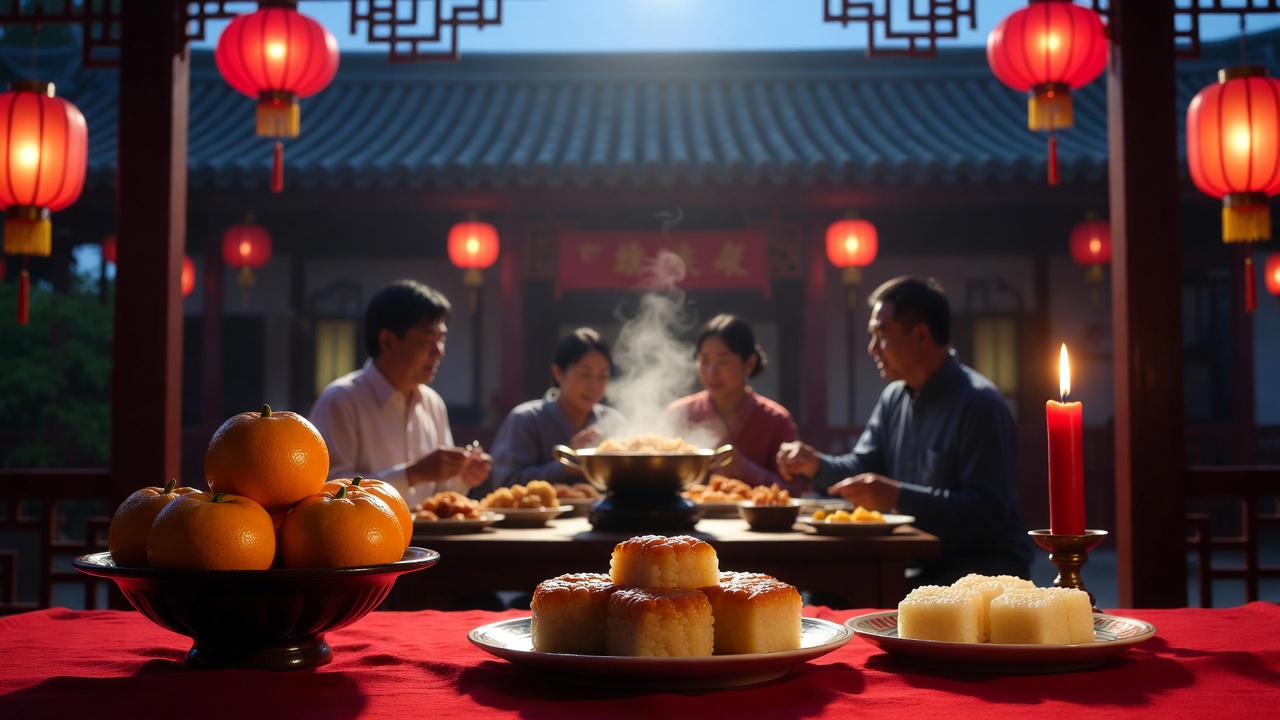
On the evening of February 16, 2026, families across China and Chinese communities around the world will gather for one of the most meaningful nights of the year — Chinese New Year’s Eve (除夕, Chúxī). By the time midnight strikes and firecrackers split the winter silence, a new lunar year will have arrived: the Year of the Fire Horse, an extraordinary zodiac cycle that only comes around once every 60 years.
But long before the reunion dinner is served and the red envelopes exchanged, every Chinese household buzzes with another kind of energy — the joyful work of decorating the home. In Chinese tradition, New Year decorations are never just ornamental. They are acts of intention. Each red lantern, paper cutting, and spring couplet carries a wish: for prosperity, health, family togetherness, and the safe passage of another year.
The good news? You do not need to spend a fortune at the store. Some of the most beautiful and culturally meaningful decorations can be made by hand at your kitchen table using paper, scissors, glue, and a little patience. This guide walks you through easy, budget-friendly DIY decorations for Chinese New Year’s Eve 2026, complete with the cultural stories behind each one. Whether you are a Chinese family keeping traditions alive abroad, a teacher planning classroom activities, or simply someone who admires the richness of Chinese folk culture — there is a project here for you.
Why Homemade Chinese New Year Decorations Matter More Than Store-Bought Ones
Walk through any Chinese neighborhood in the weeks before Spring Festival and you will see shops overflowing with mass-produced red banners, plastic lanterns, and glittering ornaments. They are convenient, sure. But in Chinese folk tradition, the act of making decorations by hand is part of the celebration itself.
Think about it this way. When a grandmother in rural Shaanxi sits by the window cutting paper into the shape of a horse — slowly, carefully, with a pair of scissors she has used for decades — she is doing more than making wall décor. She is passing down a living art form. She is channeling her wishes for her grandchildren into something tangible. The finished piece is not a product; it is a prayer made visible.
Handmade decorations also carry a warmth that factory-made items cannot replicate. A slightly uneven paper lantern crafted by a five-year-old. A spring couplet written in shaky but heartfelt brush calligraphy by a teenager. These imperfect creations become the decorations families remember most, the ones they photograph and talk about years later.
There is also a practical reason to go the DIY route. The materials are inexpensive and widely available. Red paper, gold paper, scissors, glue, string, and markers — that is genuinely all you need for most of the projects in this guide. A single trip to a craft store (or a rummage through your home office supplies) will set you up for an entire evening of creative fun.
How to Make Paper Lanterns for Chinese New Year at Home
If there is one decoration that instantly transforms a room into a festive space, it is the red paper lantern (红灯笼, hóng dēnglóng). Lanterns are among the oldest symbols of Chinese New Year. Historical records trace the tradition of lantern-making back to the Eastern Han Dynasty (25–220 AD), when people first stretched silk or paper over bamboo frames to shield candle flames from the wind. Over centuries, these humble light sources evolved into dazzling works of art — and a powerful symbol of hope, warmth, and reunion.
The round shape of a traditional lantern represents completeness and family unity. The red color wards off evil and invites good luck. Hanging lanterns at doorways and windows signals that a household is ready to receive the blessings of the new year.
Here is the wonderful thing: you can make a beautiful paper lantern in under ten minutes with materials you probably already have.
What you will need:
- One sheet of red construction paper or cardstock (A4 or letter size)
- One sheet of gold or yellow paper
- Scissors
- Ruler and pencil
- Glue stick or tape
- Optional: string or ribbon for hanging; battery-operated tea light
Step-by-step instructions:
- Cut a handle strip. Slice a strip roughly one inch (2.5 cm) wide from the short edge of your red paper. Set this aside — it becomes the handle later.
- Fold the paper. Take the remaining red sheet and fold it in half lengthwise, so the fold is along the longer edge.
- Draw your cut lines. Using your ruler, draw a horizontal guide line about one inch (2.5 cm) from the open (unfolded) edge. This is your “stop line.” Then draw vertical lines from the folded edge up to this stop line, spaced about ¾ inch (2 cm) apart.
- Cut the slits. Carefully cut along each vertical line, stopping at the guide line. Do not cut past it.
- Open and shape. Unfold the paper. Gently curl it into a cylinder so the two short edges meet. Tape or glue these edges together. The cut slits will bow outward, creating the lantern’s classic rounded belly.
- Attach the handle. Tape or staple the gold strip you set aside earlier across the top opening of the lantern.
- Add a golden liner (optional). For extra richness, roll a smaller piece of gold paper into a cylinder and slide it inside the lantern so the gold peeks through the slits.
Display tips:
String several lanterns together on a ribbon to create a garland across a doorway or mantelpiece. If you want a soft glow, place a battery-operated LED tea light inside — never use a real candle with paper. And remember this old Chinese superstition: avoid grouping lanterns in sets of four, since the number four (四, sì) sounds like the word for “death” (死, sǐ) in Mandarin. Instead, hang them in pairs, threes, or ideally eights — eight being the luckiest number, because 八 (bā) sounds like 发 (fā), meaning “to prosper.”
DIY Spring Festival Couplets: Write Your Own Lucky Messages for 2026
No Chinese New Year doorway is complete without a pair of spring couplets (春联, chūnlián) — two vertical strips of red paper bearing poetic phrases, flanking the door, with a horizontal banner across the top. This tradition stretches back over a thousand years to the Shu Kingdom era, when people carved protective blessings onto peach wood tablets and hung them at their gates to ward off evil spirits.
Today, spring couplets are written in bold black or gold ink on vivid red paper. The two side phrases should match each other in rhythm, tone, and meaning — one line expressing a hope, the other its complement. The horizontal scroll above sums up the household’s wish for the year in a few characters.
You do not need to be a calligraphy master to make your own. Here is a simple approach anyone can try.
What you will need:
- Red paper or cardstock, cut into three strips (two long vertical strips, roughly 6 × 30 inches each; one shorter horizontal strip, roughly 4 × 18 inches)
- Black ink, a thick black marker, or gold paint pen
- A calligraphy brush (optional — a wide-tip marker works fine)
- A reference guide for Chinese characters (or a printed template to trace)
Popular couplet phrases for 2026 (Year of the Horse):
| Chinese | Pinyin | English Meaning |
|---|---|---|
| 马到成功 | Mǎ dào chéng gōng | Success arrives with the horse |
| 龙马精神 | Lóng mǎ jīng shén | The spirit of the dragon-horse (vigor and vitality) |
| 一马当先 | Yī mǎ dāng xiān | Take the lead like a galloping horse |
| 万事如意 | Wàn shì rú yì | May all your wishes come true |
| 金玉满堂 | Jīn yù mǎn táng | May gold and jade fill your hall |
For a complete couplet pair, you might write “一马当先迎新岁” (Take the lead like a horse to welcome the new year) on the right side, and “万象更新庆丰年” (All things renew to celebrate a bountiful year) on the left. Across the top: “马到成功”.
Tips for beginners: If you are not confident writing Chinese characters freehand, try this: print the characters in a large font on regular paper, place the printout beneath your red paper on a bright window or light box, and trace the outlines through the paper. Then fill in the strokes with your marker or paint pen. The result will look surprisingly polished.
Once your couplets are dry, paste them on either side of your front door with double-sided tape or a dab of rice paste. The right-hand couplet goes on the right when you face the door from outside; the left-hand couplet on the left. The horizontal scroll goes across the top. Step back and admire your work — you have just followed a tradition that Chinese families have practiced for a millennium.
How to Make Chinese Paper Cuttings for Windows (Jiǎnzhǐ) Step by Step
Of all the folk arts associated with Chinese New Year, paper cutting (剪纸, jiǎnzhǐ) may be the most magical. With nothing more than red paper and a sharp pair of scissors, skilled artisans create breathtakingly detailed images: fish leaping over waves, peonies in full bloom, the twelve zodiac animals galloping and swooping and coiling through intricate borders.
Paper cutting is a UNESCO-recognized Intangible Cultural Heritage of China. For centuries, families in northern China especially have pasted delicate paper cutouts onto their windows before New Year’s Eve. The light shining through the red paper casts warm, rosy shadows indoors — a gentle, beautiful detail that rewards a close look.
For 2026, the most fitting motif is the horse (马, mǎ). Horse paper cuttings symbolize energy, freedom, and forward momentum — perfect sentiments for the Fire Horse year.
What you will need:
- Red paper (thin, like tissue weight or standard origami paper — it is easier to cut than thick cardstock)
- Sharp scissors (small, pointed craft scissors work best for detail)
- Pencil
- A printed horse template or your own freehand drawing
- Rice paste, tape, or reusable adhesive putty for mounting
Beginner-friendly instructions:
- Fold your paper. For a symmetrical design, fold the red paper in half. If you want a more elaborate radial pattern, fold it into quarters or even sixths.
- Draw your design on the fold. Sketch half of a horse profile along the folded edge, so that when you cut and unfold, you get a complete, mirror-image horse. Add simple details: a flowing mane, a raised hoof, a curling tail.
- Cut carefully. Start with the interior details first (the mane, the eye, decorative cut-outs within the body), then work outward to the overall silhouette. This prevents the paper from weakening prematurely.
- Unfold and flatten. Open your cutout gently. Press it under a heavy book for a few hours to remove the fold crease.
- Mount on your window. Apply a thin layer of rice paste (or a few small loops of tape) to the back, then press the cutout onto a clean window. When sunlight streams through, the red paper will glow like stained glass.
Design ideas beyond the horse:
- Fish (鱼, yú): a pun on the word for “abundance” (余, yú). The phrase 年年有余 (nián nián yǒu yú) means “surplus year after year.”
- The character 福 (fú): meaning “good fortune.” Traditionally displayed upside down, because the word for “upside down” (倒, dào) sounds identical to “to arrive” (到, dào). So an inverted 福 means “good fortune has arrived.”
- Peonies: the “king of flowers” in Chinese culture, symbolizing prosperity and honor.
Even a simple cutout made by a child — slightly lopsided, charmingly rough around the edges — carries genuine cultural meaning. The beauty of jiǎnzhǐ is that it welcomes all skill levels.
Easy DIY Red Envelopes (Hóngbāo) You Can Make with Kids
The red envelope (红包, hóngbāo in Mandarin; 利是, lì shì in Cantonese) is perhaps the most universally recognized symbol of Chinese New Year gift-giving. Elders give these bright red packets — filled with crisp, new bills — to children and unmarried younger family members. The gesture symbolizes the transfer of blessings, good luck, and protection into the new year.
While store-bought hóngbāo are beautiful (and widely available in Asian grocery stores and stationery shops), making your own adds a personal touch that recipients will treasure. This is an especially wonderful project to do with kids, because the process is simple and the result is immediately useful.
What you will need:
- Red paper or lightweight red cardstock
- Scissors
- Glue stick
- Ruler and pencil
- Gold marker, gold paint pen, or glitter glue for decoration
- Optional: stickers featuring horse motifs for 2026
Simple envelope method (no template needed):
- Cut your red paper into a rectangle roughly 6 × 9 inches (15 × 23 cm).
- Fold the left and right edges inward by about ¾ inch (2 cm) each, creating the side flaps. Glue them down.
- Fold the bottom edge up about 2.5 inches (6 cm) and glue it to the side flaps, forming the pocket.
- Leave the top flap free — this is where you will tuck the closure after inserting money.
- Decorate the front. Write “恭喜发财” (Gōngxǐ fācái — “Wishing you prosperity”) or the character 福 in gold. Add horse stickers, draw gold coins, or apply glitter glue borders.
Cultural notes to keep in mind:
- Always use new, crisp bills. Wrinkled or worn money is considered disrespectful.
- Avoid the number four in the amount you give (no $4, $40, or $400). The number eight is ideal ($8, $88, $168).
- Red envelopes are given with both hands and received with both hands — a sign of respect in Chinese culture.
- It is customary to not open the envelope in front of the giver. Opening it later is the polite practice.
Making these envelopes together as a family the night before New Year’s Eve can become a beloved annual ritual — the kind of quiet, meaningful activity that brings generations together around the table.
DIY Paper Firecrackers: Safe and Festive Chinese New Year Decorations for Indoor Spaces
Real firecrackers are the thundering heartbeat of Chinese New Year. According to legend, the mythical beast Nian (年) would emerge on New Year’s Eve to terrorize villages, but it feared three things: the color red, bright light, and loud noises. So people began lighting firecrackers to scare it away — a tradition that persists today in many parts of China, though urban restrictions have made real fireworks increasingly rare.
For families who want the festive look without the bang (and the fire hazard), paper firecrackers are a perfect DIY alternative. They are safe for indoor use, easy to make, and look stunning when hung in clusters from doorways or ceilings.
What you will need:
- Red paper or red cardstock
- Gold paper or gold wrapping paper
- Scissors
- Glue
- Red string, cord, or yarn
- Optional: gold tassels or ribbon
How to make them:
- Make the tubes. Cut red paper into rectangles about 4 × 6 inches (10 × 15 cm). Roll each rectangle into a tight tube roughly the diameter of your thumb, and glue the edge to secure it. You will want at least eight to ten tubes for a good-looking string.
- Add gold bands. Cut thin strips of gold paper (about ½ inch wide) and wrap one around each end of every red tube, gluing in place. This mimics the look of traditional firecrackers.
- String them together. Cut a long piece of red string. Thread it through the tubes, knotting between each one to keep them spaced about an inch apart. Leave extra string at the top for hanging.
- Add a tassel. At the bottom, tie a gold tassel or a bundle of short red and gold ribbons.
- Hang your firecracker string from a doorframe, a ceiling hook, or a curtain rod. The gentle swaying of the paper tubes and tassels adds life and movement to your décor.
Grouped in a cluster of two or three strings of different lengths, paper firecrackers create a dramatic visual impact — especially against a white wall or beside a doorway framed with spring couplets.
How to Make a Lucky Fortune Fish Decoration for Lunar New Year
In Chinese culture, fish carry one of the most beloved symbolic meanings of any New Year decoration. The Chinese word for fish, 鱼 (yú), is a homophone for 余, meaning “surplus” or “abundance.” The classic New Year greeting 年年有余 (nián nián yǒu yú) — “May you have abundance year after year” — hinges on this linguistic play. This is why fish appear everywhere during the Spring Festival: on dinner tables (a whole steamed fish is nearly mandatory at the reunion meal), on paper cuttings, on paintings, and as hanging ornaments.
A simple paper fish is one of the easiest and most cheerful DIY decorations you can make.
What you will need:
- Red and gold cardstock or construction paper
- Scissors
- Glue
- Black marker
- String for hanging
- Optional: sequins, glitter, or metallic paper scraps
Instructions:
- Cut two identical fish shapes from red paper — think of a simple, rounded fish profile about 8 inches (20 cm) long.
- Decorate each side. Use gold paper to cut out scales (small half-circles work perfectly). Glue them in overlapping rows along the body. Add a gold circle for the eye.
- Assemble. Glue the two fish shapes together along the edges, leaving a small opening at the top. Before sealing completely, insert a loop of string for hanging.
- Add details. Use a black marker to draw the mouth and fin lines. If you have sequins or glitter, add them to the tail and fins for extra sparkle.
Hang your fortune fish near the entrance of your home or above the dining table. In Chinese tradition, a fish displayed head-up symbolizes rising prosperity. Some families even tuck a coin or two inside the body for added luck.
Year of the Fire Horse Craft Ideas: DIY Horse Decorations for Chinese New Year 2026
Since 2026 is the Year of the Fire Horse — a combination that occurs only once every sixty years — incorporating horse motifs into your decorations is especially meaningful this year. The horse is the seventh animal in the Chinese zodiac and represents energy, confidence, freedom, and perseverance. Paired with the Fire element, these qualities ignite into a spirit of bold action and passionate momentum.
Here are three horse-themed DIY ideas for 2026:
1. Accordion-fold Horse Garland
Cut a long strip of red paper and fold it accordion-style into sections about 4 inches wide. Draw half a horse silhouette on the top fold, making sure the design touches both folded edges. Cut out the shape, unfold, and you will have a chain of connected horses. Decorate with gold paint or markers and string across a wall.
2. Horse Bookmark Corners
Cut a square of red paper about 6 × 6 inches. Fold it into a triangle. Fold the left and right points up to meet the top point, then tuck them into a pocket. Draw or glue a horse face on the front. These make thoughtful little gifts to tuck into red envelopes or hand out to guests.
3. Standing Horse Card
Fold a piece of red cardstock in half. Draw a horse shape so that the horse’s back runs along the fold. Cut around the outline, leaving the fold intact along the back. When opened, the card stands up on its own. Write a New Year greeting inside — perhaps 马到成功 (Mǎ dào chéng gōng), “Success arrives with the horse.”
Upside-Down “Fu” Character: The Simplest Good Luck Decoration You Can Make in Five Minutes
If you have time for only one decoration, make it this one.
The character 福 (fú) means “good fortune,” “blessing,” or “happiness.” During Chinese New Year, families across China write this single character on a diamond-shaped piece of red paper and paste it on their front door — upside down. The reason is a delightful play on words: 福倒了 (fú dào le) can mean either “the fú is upside down” or “good fortune has arrived,” since 倒 (dào, to invert) sounds exactly like 到 (dào, to arrive).
How to make it:
- Cut a square of red paper, roughly 10 × 10 inches.
- Rotate it 45 degrees so it sits as a diamond shape.
- Using a thick black marker or gold paint pen, write the character 福 in the center. (If you are not comfortable writing it freehand, print a large template and trace it.)
- Let the ink dry.
- Paste the diamond upside down on your front door.
That is it. Five minutes, one sheet of paper, and you have announced to every visitor — and to the universe — that good fortune is welcome in your home.
Chinese New Year Table Decorations You Can DIY for the Reunion Dinner
The reunion dinner (年夜饭, niányèfàn) on New Year’s Eve is the emotional heart of the entire Spring Festival. For many Chinese families, it is the one meal of the year when every generation sits together at the same table. The decorations surrounding this dinner should feel warm, abundant, and auspicious.
Here are a few ideas you can prepare in advance:
Tangerine and Kumquat Centerpiece
Pile tangerines and kumquats into a red or gold bowl for the center of your table. In Cantonese, the word for tangerine (柑, gām) sounds like “gold,” while kumquat (金桔, jīnjú) literally contains the character for gold. These fruits are living symbols of wealth and good luck. Tie a few with red ribbon or tuck sprigs of green leaves around them for contrast.
DIY Place Cards with Lucky Greetings
Cut small rectangles of red cardstock. Write each family member’s name on one side and a personalized New Year wish on the other — perhaps a specific blessing related to their hopes for the year. Prop them up at each place setting using a small slit cut into a tangerine or a folded piece of gold cardstock.
Paper Fan Table Runner
Make a series of small paper fans from red and gold paper (fold accordion-style, pinch one end, and spread the other into a semi-circle). Arrange these fans in a row down the center of the table, interspersed with tea light candles in safe holders. The effect is both elegant and unmistakably festive.
Gold Coin Scatter
Buy a bag of chocolate gold coins (widely available in Asian grocery stores) and scatter them across the tablecloth. They add a playful shimmer and double as after-dinner treats for the children.
Best Materials and Supplies for DIY Chinese New Year Crafts (Complete Checklist)
Before you begin, gather your supplies. Having everything on hand means you can settle in for a relaxed crafting session rather than running out for one more tube of glue.
| Material | What It Is Used For | Where to Find It |
|---|---|---|
| Red construction paper or cardstock | Lanterns, couplets, envelopes, paper cuttings, firecrackers | Craft stores, office supply shops, online |
| Gold or yellow paper | Lantern accents, firecracker bands, fan decorations | Craft stores, dollar stores |
| Scissors (two sizes) | Large pair for rough cuts; small pointed pair for detail paper cutting | Household supply, craft stores |
| Glue stick and/or white glue | Assembling lanterns, envelopes, and cuttings | Widely available |
| Ruler and pencil | Measuring and marking fold lines | Household supply |
| Black marker or gold paint pen | Writing characters on couplets and fú diamonds | Craft stores, stationery shops |
| Red string, cord, or yarn | Stringing lanterns and firecrackers | Craft stores, dollar stores |
| Calligraphy brush and ink (optional) | Writing authentic spring couplets | Asian stationery stores, online |
| Battery-operated LED tea lights | Safe illumination for paper lanterns | Dollar stores, home goods shops |
| Double-sided tape or rice paste | Mounting decorations on doors and windows | Grocery stores, craft stores |
Budget estimate: Most families can gather all needed materials for under $15–20 USD, especially if they already have scissors, glue, and a ruler at home.
When to Put Up Chinese New Year Decorations and When to Take Them Down
Timing matters. In Chinese tradition, there is a right time to decorate — and a right time to put it all away.
Most families begin decorating one to three days before New Year’s Eve. The ideal sequence is to first clean the entire house (a ritual called 扫尘, sǎo chén, meaning “sweeping away the dust,” which symbolizes clearing out the old year’s bad luck), and then to decorate the freshly cleaned home. Cleaning after New Year’s Day is considered taboo — you might accidentally sweep away the new year’s good fortune.
For 2026, this means starting your deep clean around February 13–14 and putting up decorations on February 15 or 16 at the latest. The spring couplets should be pasted on the door by New Year’s Eve (February 16).
Decorations traditionally stay up through the Lantern Festival (元宵节, Yuánxiāo Jié), which falls on the fifteenth day of the first lunar month. In 2026, that date is March 3. After the Lantern Festival, it is customary to take down your decorations. In some regions, families respectfully burn used paper decorations rather than simply discarding them, honoring the blessings these objects carried.
Cultural Tips for Non-Chinese Families Celebrating Lunar New Year with DIY Crafts
Chinese New Year is celebrated by billions of people — not only in China but also across Southeast Asia, in Chinatowns worldwide, and in an ever-growing number of multicultural communities. If your family is not Chinese but wants to join in the festivities through crafting, here are a few respectful guidelines:
Learn the meaning before you make. Each decoration carries cultural significance. Understanding why the character 福 is hung upside down, or why red is the dominant color, transforms a craft project from a surface-level activity into a genuine cultural exchange.
Use authentic references. When writing Chinese characters, double-check the correct stroke order and character form. An incorrectly written character can change its meaning entirely — or worse, become unintentionally disrespectful.
Support authentic businesses. If you buy materials like calligraphy brushes, ink, or specialty paper, consider purchasing from Chinese-owned shops rather than mass-market imitations. This supports the communities that have kept these traditions alive.
Participate with humility and curiosity. Attend community Lunar New Year events. Ask questions. Listen to the stories behind the traditions. The families you meet will almost certainly appreciate your interest.
As the Asia for Educators program at Columbia University reminds us, Chinese New Year customs vary not only from region to region but from family to family. There is no single “correct” way to celebrate. What matters most is the sincerity you bring to the experience.
Frequently Asked Questions About DIY Chinese New Year’s Eve Decorations
What is the most important color for Chinese New Year decorations?
Red is the dominant color. It symbolizes joy, energy, and good luck, and is traditionally believed to repel evil spirits. Gold is the second most important color, representing wealth and prosperity. Together, red and gold form the visual foundation of nearly every Spring Festival decoration.
Can I use colors other than red and gold?
Yes, but with care. Pink and orange are acceptable and carry positive associations. However, avoid white and black as primary decoration colors — in Chinese culture, these are associated with mourning and funerals.
What are the lucky numbers for the Year of the Fire Horse in 2026?
The lucky numbers associated with the Horse in 2026 are 2, 3, 7, and 9. When grouping decorations, these numbers make auspicious choices.
Is it okay to use the character 福 if I am not Chinese?
Yes, as long as you write it correctly and display it respectfully (traditionally upside down on the front door). Many Chinese families are happy to see others appreciate this custom. If in doubt, ask a Chinese friend or neighbor — it can be a wonderful conversation starter.
What do I do with decorations after the festival ends?
Take them down after the Lantern Festival (March 3, 2026). Paper decorations can be burned respectfully or recycled. Reusable items like fabric lanterns or kumquat trees can be stored for next year.
Make It a Family Tradition: Crafting Together on Chinese New Year’s Eve
Here is one final thought as you plan your decorating.
In the rush of modern life — especially during the Chūn Yùn (春运), the colossal annual travel season when hundreds of millions of people in China journey home for the holiday — it can be easy to treat decorations as just another item on the to-do list. Buy them, hang them, move on.
But the families I have visited and studied across China, from Beijing’s hutongs to Fujian’s coastal villages, all share a common memory: the evenings spent making things together. A grandfather teaching a child to fold a paper lantern. A mother and daughter writing spring couplets at the kitchen table, ink-stained fingers and all. The smell of paste and paper mixing with the aroma of dumplings steaming on the stove.
These are the moments that give Chinese New Year’s Eve its soul. The decorations are beautiful, yes. But the real beauty is in the making — in the quiet, joyful work of preparing your home, and your heart, for a brand new year.
新年快乐!马到成功! Xīnnián kuàilè! Mǎ dào chéng gōng! Happy New Year! May success arrive with the Horse!