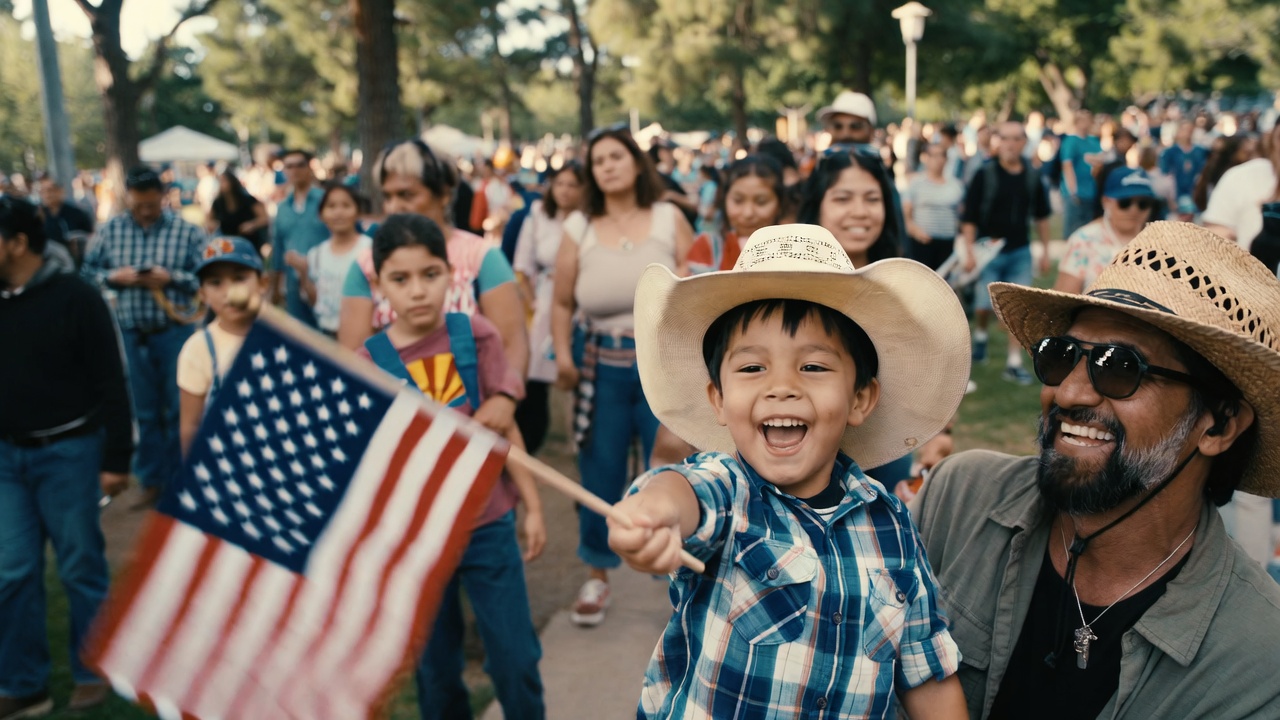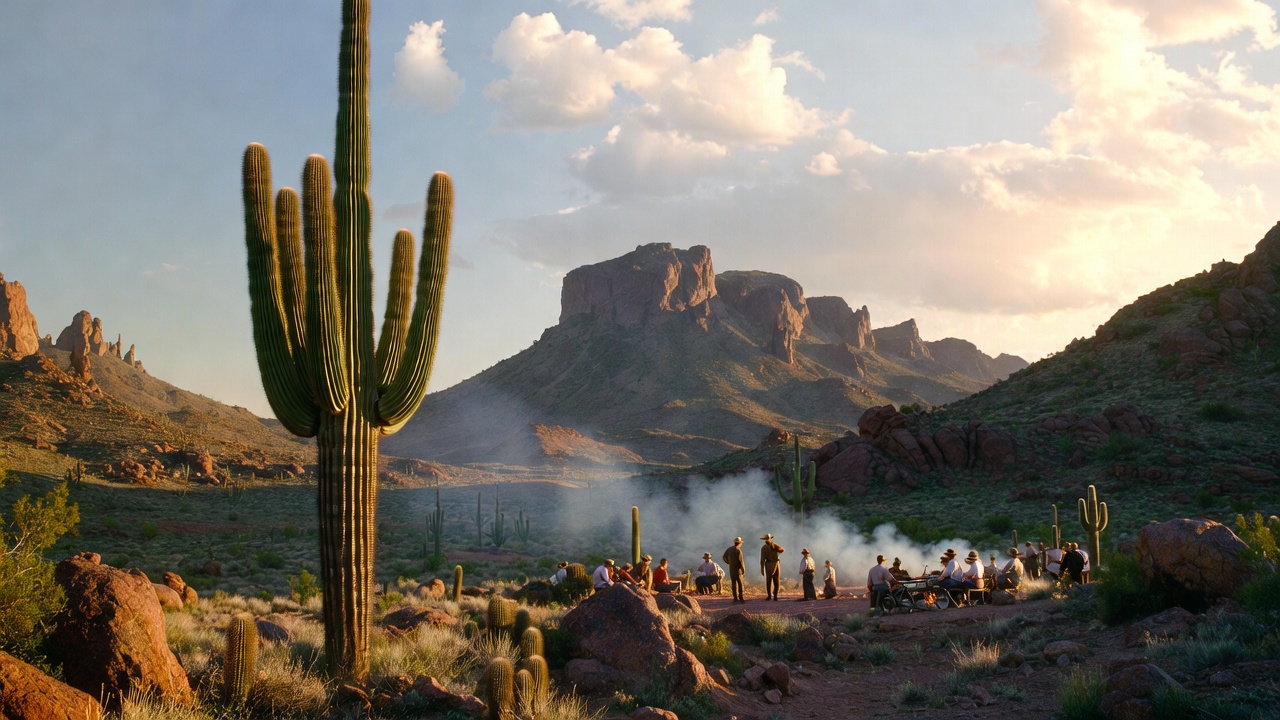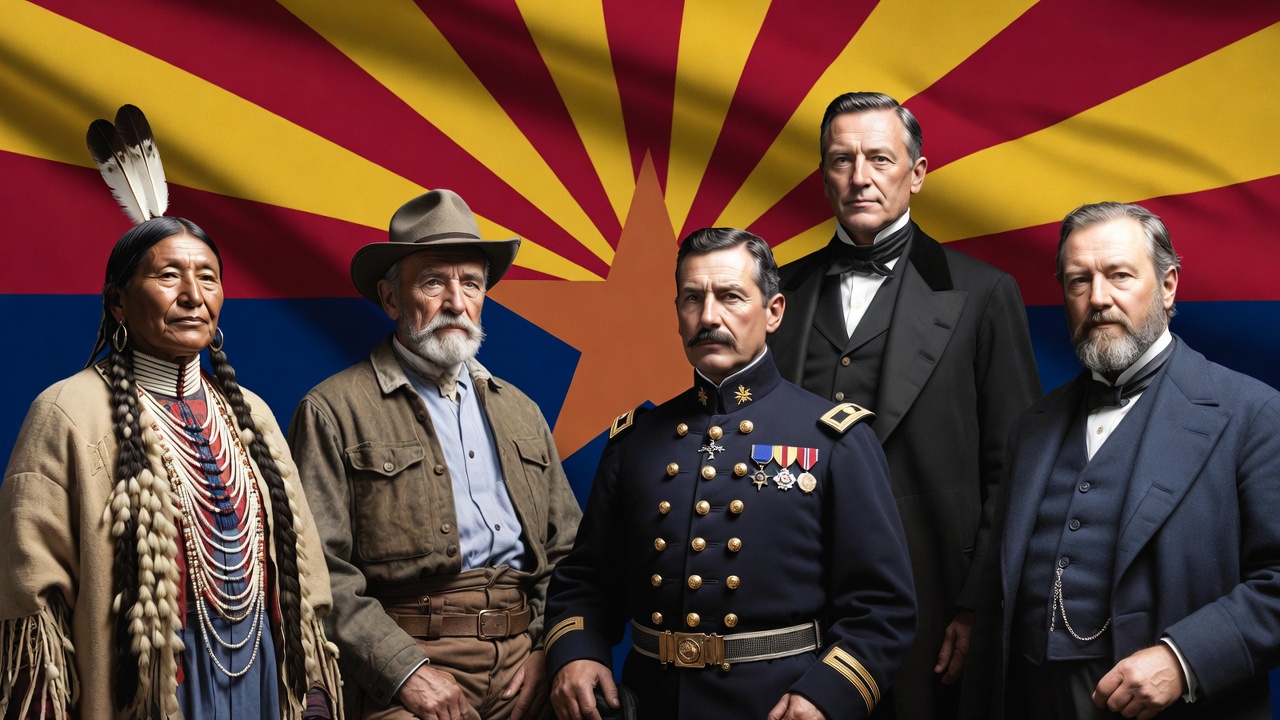
Every year on February 14, while the rest of the country exchanges Valentine’s cards, Arizonans celebrate something older than any box of chocolates — their birthday as a state. Arizona Statehood Day marks the anniversary of the moment President William Howard Taft signed the proclamation admitting Arizona as the 48th state on February 14, 1912. In 2026, the Grand Canyon State turns 114 years old, and communities from Prescott to Tucson are once again gathering to honor the people who made it happen.
But Statehood Day is not just about dates and documents. It is about people. Arizona’s road to statehood was paved by sheriffs who chased train robbers on horseback, politicians who walked a mile to their own inaugurations, and soldiers who believed dying for “a new star on the flag” was worth the sacrifice. Their stories reveal a state built on grit, independence, and no small amount of stubbornness.
This post looks at the famous Arizonans whose lives shaped Statehood Day — and whose legacies still echo across the desert in 2026.
How Arizona Became the 48th State on February 14, 1912
Arizona’s path to statehood was one of the longest and most contentious in American history. The region had been home to Indigenous peoples — the Hohokam, Ancestral Puebloans, Mogollon, and others — for thousands of years before Spanish missionaries arrived in the late 1600s. It passed from Spain to Mexico in 1821, and then to the United States through the Treaty of Guadalupe Hidalgo (1848) and the Gadsden Purchase (1853).
Congress carved out the Arizona Territory from New Mexico on February 24, 1863, during the Civil War. But statehood remained frustratingly out of reach for almost half a century. Arizona’s population was small. Its reputation was rough. The rest of the country saw it as a land of “desert and jackrabbits,” as one ASU historical account put it.
In 1906, a Congressional bill proposed merging Arizona and New Mexico into a single state. Arizonans flatly refused. They wanted their own star on the flag — or nothing at all.
The final hurdle came in 1911. Arizona drafted a progressive constitution that included initiative, referendum, and the recall of judges. President Taft, a former judge himself, despised the judicial recall provision and vetoed the statehood bill. He called it “legalized terrorism” against judges, according to the Center for American Civics at ASU. Arizona agreed to remove the provision. Taft signed the proclamation on February 14, 1912. And then — in a move Taft fully expected — Arizona restored judicial recall the very same year.
It was classic Arizona: do what you must, then do what you want.
George W.P. Hunt: Arizona’s First Governor Who Walked to His Own Inauguration
No figure looms larger over Arizona Statehood Day than George Wylie Paul Hunt, the state’s first governor. Born in Huntsville, Missouri, in 1859, Hunt ran away from home at 18 and spent years drifting across Kansas, Colorado, and New Mexico before arriving in Globe, Arizona Territory, in 1881 with little more than two burros and empty pockets. His first job was waiting tables at a café.
Over the next two decades, Hunt clawed his way up. He became a clerk, then president, of the Old Dominion Commercial Company. He entered politics, serving in the Arizona Territorial Legislature and eventually presiding as president of the 1910 Constitutional Convention — the very convention that wrote the document Taft found so troubling.
When Hunt was sworn in as governor on February 14, 1912, he famously refused a carriage ride and walked one mile from his hotel to the Capitol building. He wanted Arizonans to see him as one of their own — a man of the people.
Hunt went on to serve an astonishing seven terms as governor, earning the nickname “George VII.” Humorist Will Rogers once joked that he wanted to be adopted by Hunt so he could inherit the “hereditary governorship.” At 5-foot-9 and nearly 300 pounds, bald, and sporting a walrus mustache, Hunt was as distinctive in appearance as he was in politics, according to the National Governors Association.
During his many terms, Hunt fought for women’s suffrage, workers’ compensation, child labor restrictions, and the abolition of capital punishment. He championed Arizona’s share of Colorado River water — an issue that would define the state for the next century.
Hunt died on Christmas Eve, 1934, and is buried in a pyramid-shaped tomb at Papago Park in Phoenix. From that desert butte, the copper dome of the state Capitol is visible in the distance — a fitting view for the man who built so much of what Arizona became.
Carl Hayden: Arizona’s First Congressman and the Silent Senator Who Shaped the Modern West
If Hunt was the face of Statehood Day, Carl Trumbull Hayden was its workhorse. Born in 1877 in Hayden’s Ferry (now Tempe), Hayden was the son of a pioneering rancher and mill operator who founded the town. His mother gave him the nickname “the senator” as a boy because of how much he loved reciting political speeches. The nickname turned out to be prophetic.
At age 25, Hayden traveled to Washington to lobby for the Salt River Project during debates over the Federal Reclamation Act of 1902. A decade later, he returned as Arizona’s first-ever congressman. He was sworn into the 62nd Congress on February 19, 1912, just five days after statehood, carrying credentials from the territorial governor, according to the U.S. Senate Historical Office.
Before running for Congress, Hayden served as the gun-toting sheriff of Maricopa County. In 1910, he famously captured fleeing train robbers by pursuing them first in a rail car, then on horseback, and finally by commandeering an automobile that he drove along the railroad tracks. It was the kind of story that could only come from territorial Arizona.
In Congress, Hayden became known as the “Silent Senator” — a man who rarely gave speeches but wielded quiet, enormous influence. He described himself as a “workhorse” rather than a “show horse.” Over 56 years in Congress (15 in the House, 42 in the Senate), he steered bills to passage that created the Grand Canyon National Park, expanded Arizona’s highway system, and — most importantly — secured water for a desert state.
The crowning achievement of Hayden’s career was the Central Arizona Project (CAP), a massive system of aqueducts spanning 336 miles from Lake Havasu to south of Tucson. He nurtured the project from its first proposal in 1947 to final approval in 1968. President Lyndon Johnson declared September 30, 1968, as “Carl Hayden Day” in the senator’s honor when he signed the Colorado River Basin Project Act. Fellow Arizonan Barry Goldwater later said that Hayden “did more for Arizona than any other person”.
Today, the CAP provides water to more than 5 million people in Arizona. Without it, the modern cities of Phoenix and Tucson as we know them would not exist. Every faucet that runs in central Arizona is, in a real sense, Carl Hayden’s legacy.
Barry Goldwater: The Arizona-Born Icon Who Redefined American Conservatism
Barry Morris Goldwater was born in Phoenix on January 2, 1909 — three years before Arizona even became a state. His family operated Goldwater’s Department Store, a Phoenix institution since 1896. Growing up in a territory still settling its frontier identity, Goldwater developed the rugged independence and blunt honesty that would later define his political career.
After managing the family store and serving as a World War II pilot, Goldwater entered politics. He won a seat on the Phoenix City Council in 1949 and then, in a stunning upset in 1952, defeated the sitting Senate Majority Leader Ernest McFarland to claim a U.S. Senate seat.
Goldwater’s 1960 book, The Conscience of a Conservative, became a landmark of American political thought. He ran for president in 1964, losing to Lyndon Johnson in a landslide. But the ideas he championed — limited government, strong national defense, individual liberty — planted seeds that grew into the modern conservative movement. Arizona Senator John McCain, who succeeded Goldwater in the Senate in 1987, later said that Goldwater “transformed the Republican Party from an Eastern elitist organization to the breeding ground for the election of Ronald Reagan”.
Goldwater’s ties to Statehood Day run deep. He was born before Arizona had its star on the flag. His uncle, Morris Goldwater, served in both the Arizona territorial and state legislatures and as mayor of Prescott. The Goldwater family was woven into Arizona’s civic fabric from its earliest days.
In his later years, Goldwater surprised many by criticizing the religious right and supporting causes like gay rights and medical marijuana. He remained, to the end, an Arizonan above all else — someone who valued independence over ideology.
Today, Goldwater’s name graces the Barry M. Goldwater Terminal at Phoenix Sky Harbor International Airport, a high school in northern Phoenix, and a statue in National Statuary Hall at the U.S. Capitol, unveiled in 2015. On Statehood Day, his legacy reminds Arizonans of a time when their state was still so young that a future presidential candidate could be born before its flag even existed.
Sandra Day O’Connor: From an Arizona Cattle Ranch to the U.S. Supreme Court
Few Arizonans carried the state’s spirit further than Sandra Day O’Connor, the first woman to serve on the United States Supreme Court. Born in El Paso, Texas, in 1930, she grew up on the Lazy B, a 198,000-acre cattle ranch that straddled the Arizona–New Mexico border near Duncan. The ranch had no running water or electricity until she was seven years old, according to the Sandra Day O’Connor Institute.
O’Connor learned to drive before she could see over the dashboard. She shot coyotes, rode horses, and changed flat tires by herself. The nearest paved road was nine miles away. It was the kind of upbringing that built resilience — a quality she carried into every courtroom she entered.
After graduating third in her class at Stanford Law School in 1952, O’Connor could not find a single law firm willing to hire a woman. She turned to public service instead. Settling in Phoenix, she served as Assistant Attorney General of Arizona, was appointed to the Arizona State Senate in 1969, and became the first woman majority leader of any state senate in the country. She later served as a judge on both the Maricopa County Superior Court and the Arizona Court of Appeals.
In 1981, President Ronald Reagan nominated O’Connor to the Supreme Court. The Senate confirmed her 99 to 0. She served for 25 years, often casting the decisive swing vote on issues including gender discrimination, abortion rights, and federalism. She retired in 2006 and returned to Arizona, where she founded the Sandra Day O’Connor Institute in 2009 to promote civic engagement and civics education.
O’Connor passed away on December 1, 2023, in Phoenix at the age of 93. Her former adobe home in the state was listed on the National Register of Historic Places in 2019. Arizona State University’s law school bears her name — the Sandra Day O’Connor College of Law — making it the first law school in the country named after a woman.
O’Connor’s connection to Statehood Day is one of values. She grew up on land that had only recently become part of a state, in conditions closer to the frontier than to modernity. She once reflected on the Arizona landscape: “In the West in remote areas… you see this enormous heaven and what a small place mankind has in that space.” Her career proved that from that vast, quiet space, extraordinary things could rise.
Buckey O’Neill and the Rough Riders: How Arizona Soldiers Helped Win Statehood
Before politicians and judges carried Arizona’s flag, soldiers did — sometimes literally. The story of William Owen “Buckey” O’Neill and Roosevelt’s Rough Riders is one of the most dramatic chapters in the lead-up to Statehood Day.
O’Neill was a sheriff, newspaper editor, lawyer, and mayor of Prescott. His nickname came from his habit of “bucking the tiger” — playing against the odds — at faro games in the saloons of Whiskey Row. As sheriff of Yavapai County, he became a legend in 1889 when he tracked and captured four train robbers after a 12-day pursuit through the canyons, according to Sharlot Hall Museum archives.
When the Spanish-American War broke out in 1898, O’Neill and fellow Arizonans Alexander Brodie and James McClintock helped organize the 1st U.S. Volunteer Cavalry, better known as the Rough Riders. O’Neill was the first man to volunteer for the regiment. His motivation, beyond adventure, was statehood. As he famously said: “Who wouldn’t give his life for a star on the flag?”
On July 1, 1898, during the Battle of San Juan Hill in Cuba, O’Neill was pacing in front of his men, smoking a cigarette under enemy fire. When a sergeant urged him to take cover, he reportedly replied that no Spanish bullet could kill him. Moments later, he was struck and killed instantly. He was 38 years old.
Theodore Roosevelt called O’Neill’s death “the most serious loss that I or the regiment could have suffered.” Had O’Neill lived, historians believe he almost certainly would have become governor of Arizona, and possibly more.
The Rough Riders’ heroism gave Arizona exactly what it needed: national visibility and respect. The hundreds of Arizonans who returned from Cuba went on to become the state’s governors, legislators, and civic leaders. Their sacrifice helped transform Arizona’s image from a lawless desert to a territory worthy of statehood. As ASU historian Hank Williamson noted, the Rough Riders “put the final touches on a territory that had long yearned for respectability,” according to ASU News.
O’Neill is buried at Arlington National Cemetery. His monument — a heroic equestrian bronze by sculptor Solon Borglum — still rears on the courthouse plaza in Prescott, Arizona, where both Barry Goldwater and John McCain chose to launch their presidential campaigns.
Famous Arizonans Who Shaped Statehood Day: A Quick Reference Table
| Name | Born | Key Role | Connection to Statehood |
|---|---|---|---|
| George W.P. Hunt | 1859, Missouri | First Governor of Arizona (7 terms) | Presided over Constitutional Convention; sworn in on Statehood Day, Feb. 14, 1912 |
| Carl Hayden | 1877, Tempe, AZ | First Congressman; longest-serving member of Congress (56 years) | Sworn into Congress 5 days after statehood; secured the Central Arizona Project |
| Barry Goldwater | 1909, Phoenix, AZ | U.S. Senator (30 years); 1964 presidential nominee | Born 3 years before statehood; family roots in territorial Arizona |
| Sandra Day O’Connor | 1930, El Paso, TX | First woman on the U.S. Supreme Court | Raised on Arizona ranch; served in all three branches of state government |
| Buckey O’Neill | 1860, Missouri | Sheriff, mayor, Rough Rider captain | Died in Cuba fighting for “a new star on the flag”; helped build Arizona’s national reputation |
How Arizona Celebrates Statehood Day in 2026 with Historical Events and Open Houses
In 2026, Statehood Day falls on a Saturday, February 14 — giving Arizonans a full day to celebrate. Communities across the state are hosting events that connect the present to the past.
The Arizona Historical Society is holding free open houses from 10:00 AM to 3:00 PM at both the Arizona History Museum in Tucson and the Arizona Heritage Center in Tempe. Visitors can explore exhibits, view historical artifacts, and watch a screening of Arizona (1940), the first film shot at Old Tucson Studios.
The Arizona Capitol Museum in Phoenix is hosting an open house with interactive exhibits on Arizona history, government, and civic life. Meanwhile, the Sharlot Hall Museum in Prescott — the old territorial capital — is offering free admission and unveiling a new large-scale mural depicting Prescott in the early 1900s, including the historic Whiskey Row where Buckey O’Neill once gambled.
One of the most notable new additions in 2026 is the Road to 250: Arizona Traveling Museum, launched on Statehood Day in partnership with the America250 Arizona Commission. This mobile museum, housed in a custom trailer, explores Arizona’s role in 250 years of American history through hands-on exhibits and a replica Liberty Bell. Its inaugural stop is in Prescott.
In previous years, the Secretary of State’s Office has hosted a ceremonial recitation of the original statehood proclamation signed by President Taft, along with a public display of Arizona’s original state Constitution. These traditions continue to draw crowds to the Capitol Rotunda.
Why Arizona Statehood Day Matters More Than Ever in 2026
Arizona Statehood Day is not just a history lesson. It is a living tradition that reflects the character of the state itself.
Consider the through-line. George W.P. Hunt walked to his inauguration to prove he was a common man. Carl Hayden quietly worked for decades to bring water to a desert. Barry Goldwater spoke his mind even when it cost him an election. Sandra Day O’Connor refused to accept that a woman could not practice law. Buckey O’Neill rode into battle for a star on a flag he would never see fly over a state.
Each of these Arizonans carried something forward: a belief that the place they lived in was worth fighting for. That spirit — stubborn, self-reliant, and deeply tied to the land — is what Statehood Day celebrates.
In 2026, as Arizona also begins to participate in America’s 250th anniversary celebrations, the state has an opportunity to share its story with the nation. It is a story of Indigenous nations whose roots stretch back millennia. It is a story of Spanish missionaries, Mexican ranchers, and American settlers. It is a story of miners, cowboys, suffragettes, soldiers, and statesmen. Most of all, it is a story of people who refused to be overlooked.
On February 14, whether you are visiting the Grand Canyon, strolling through the Sharlot Hall Museum, or just turning on the tap in Phoenix, take a moment to remember the Arizonans who made it all possible. Their stories are the real gift of Statehood Day.