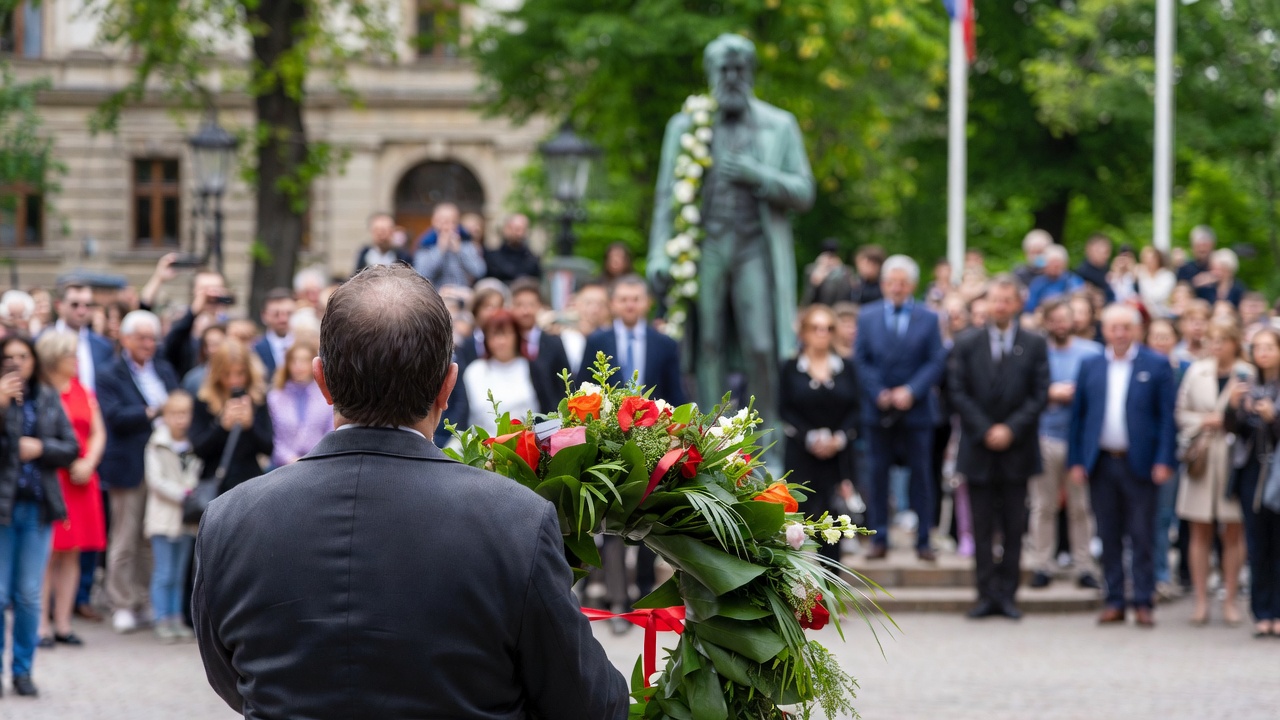
Every country has its heroes. Most nations raise statues to generals, kings, or revolutionaries. Slovenia chose a poet. On February 8 each year, this small Alpine republic of just over two million people pauses its daily rhythms to honor a man who died penniless, heartbroken, and largely unrecognized in 1849. His name was France Prešeren (pronounced fran-TSE pre-SHEH-ren), and his legacy has shaped an entire nation’s identity — from the words of its national anthem to the coin in its pocket.
Welcome to Prešeren Day (Prešernov dan), the Slovenian Cultural Holiday. It is not simply a day off work. It is a living declaration that art, language, and poetry are the spine of a nation. If you are planning a trip to Slovenia in early February, or if you are a lover of European Romanticism searching for a story that still resonates in 2026, this guide is for you.
Who Was France Prešeren and Why Is He Slovenia’s National Poet?
France Prešeren was born on December 3, 1800, in the village of Vrba, nestled at the foot of Mount Stol in the Upper Carniolan region of what was then part of the Habsburg monarchy. He was the third of eight children and the first son of a well-off farming family. His mother, Mina, was ambitious and literate. She taught her children to read and write, and she dreamed that her firstborn son would become a priest.
He did not become a priest. He became something far more dangerous to the ruling order — a poet who wrote in Slovene.
At the age of eight, young France was sent to elementary schools in Grosuplje and Ribnica, both run by the Roman Catholic clergy. In 1812, he moved to Ljubljana to attend the State Gymnasium, where he learned Latin, Ancient Greek, and German. German was the language of education, administration, and high culture across all Slovene-speaking lands at the time. Writing serious literature in Slovene was considered a quaint, even foolish, endeavor.
In 1821, Prešeren enrolled at the University of Vienna to study philosophy and then law. It was there, surrounded by the intellectual ferment of a great European capital, that he discovered the Romantic poets. He read Homer, Dante, Boccaccio, and Goethe. More importantly, his close friend and mentor Matija Čop, a literary scholar of extraordinary breadth, introduced him to the potential of Slovene poetry. Together, they would fight what became known as the “Alphabet War” (abecedna vojna) — a fierce public debate about Slovene orthography and the right of the Slovene language to stand as a serious literary medium.
Prešeren earned his Doctorate of Law on March 27, 1827, finishing all his exams with honors. But from the very beginning, his heart belonged to verse.
The Life and Love of France Prešeren: A Romantic Poet’s Tragic Story
Prešeren’s personal life reads like one of his own poems — passionate, melancholy, and unfulfilled.
Julija Primic: The Unrequited Love That Inspired Slovenian Poetry
In the spring of 1833, Prešeren first laid eyes on Julija Primic at the Church of the Annunciation in the Trnovo neighborhood of Ljubljana. Julija was the daughter of a wealthy German-speaking merchant. She was elegant, refined, and entirely out of reach for a struggling young lawyer with bohemian habits and radical literary friends.
Prešeren poured his devotion into verse. He dedicated to Julija what many scholars regard as his masterpiece: the Sonetni venec (Wreath of Sonnets), published in 1834. This extraordinary work consists of 14 interlocking sonnets and a “master sonnet” whose lines are formed from the first lines of each of the preceding poems. Hidden within the structure is an acrostic that spells out Julija’s name — Primicovi Julji (“To Julija Primic”). The acrostic was noticed almost immediately, and it caused a minor scandal. Julija herself was reportedly unimpressed.
She married one of Prešeren’s former schoolmates, a wealthy nobleman and judge named von Scheuchenstuehl, in 1835. Prešeren, following the advice of his friend Čop, transformed his personal grief into universal art. He recast Julija as a Petrarchan “Laura,” a literary figure that transcended the real woman — much as Dante had done with Beatrice.
Loss, Grief, and the End of a Golden Period
The year 1835 was catastrophic for Prešeren. In July, his best friend and intellectual champion Matija Čop drowned while swimming in the Sava River near Ljubljana. Julija married someone else. And his benefactor, great-uncle Jožef, also died that year.
Out of this tangle of grief, Prešeren produced what many consider the high point of his literary career: the epic poem Krst pri Savici (The Baptism on the Savica), published in 1836. Set in the 8th-century principality of Carantania, the poem tells the story of the pagan warrior Črtomir and his beloved Bogomila, torn apart by the violent Christianization of the Slavic population. It was dedicated to the memory of Čop. It remains required reading in Slovenian schools to this day.
After 1836, Prešeren’s literary output declined. The death of another close friend, Andrej Smole, in 1840 pushed him deeper into despair. He entered into a relationship with a housemaid named Ana Jelovšek, with whom he had three children out of wedlock. He drank heavily. For 14 years, the Austrian authorities refused to grant him an independent law practice, considering him politically suspicious and morally suspect.
He was finally permitted to open his own office in the town of Kranj in 1846. He moved there and spent his final years in relative obscurity, struggling with liver disease.
France Prešeren died on February 8, 1849. He was 48 years old. He was buried at the old Kranj cemetery, now known as Prešeren’s Grove (Prešernov gaj).
What Is Zdravljica (A Toast) and Why Did It Become Slovenia’s National Anthem?
Of all the works Prešeren composed, none has had a greater impact on Slovenian identity than Zdravljica — “A Toast.”
Written around St. Martin’s Day in November 1844, Zdravljica is a drinking song and a carmen figuratum — a poem whose stanzas are shaped like wine glasses on the page. But beneath its convivial surface runs a bold political message: a call for Slovene national liberation, equality among nations, and freedom of thought.
The poem was inspired by the ideals of the French Revolution — liberté, égalité, fraternité. In a time when the Habsburg censors monitored every printed word, this was radical material.
Censorship and the Road to Publication
When Prešeren prepared his collected poems (Poezije) for publication in 1847, the Austrian censor — ironically, a fellow Slovene named Franz Miklosich — flagged Zdravljica. The censor detected pan-Slavic sentiment in the fourth stanza and refused to allow its publication. Prešeren considered the poem mutilated without both the third and fourth stanzas, and he chose to exclude it entirely from his collection.
It was only after the March Revolution of 1848, when Habsburg censorship was temporarily abolished, that the full version of Zdravljica was finally published. It appeared on April 26, 1848, in the newspaper Kmetijske in rokodelske novice (Farming and Craft News), edited by the conservative Slovene leader Janez Bleiweis.
Four years after it was written, Slovenes living under the Habsburg Empire embraced the poem as a declaration of national unity.
From Poem to National Anthem
Zdravljica’s journey from a censored drinking song to a national anthem spans nearly 150 years:
| Year | Event |
|---|---|
| 1844 | Prešeren writes Zdravljica |
| 1847 | Excluded from Poezije due to censorship |
| 1848 | Published in full after the March Revolution |
| 1905 | Set to choral music by composer Stanko Premrl |
| 1937 | Seventh stanza used as motto of the Slovenian Communist Party manifesto |
| 1941–45 | Widely recited by Slovenian Partisans during WWII |
| 1989 | Adopted as the anthem of the Socialist Republic of Slovenia |
| 1991 | Became the national anthem of independent Slovenia |
| 2020 | Awarded the European Heritage Label |
The seventh stanza of Zdravljica is the text of the anthem. Its message is remarkably gentle for a national anthem. There are no drums of war, no calls to arms, no enemies named. Instead, it is a wish for peace and brotherhood among all nations. In English translation, the stanza reads roughly:
God’s blessing on all nations, / Who long and work for that bright day, / When o’er earth’s habitations / No war, no strife shall hold its sway; / Who long to see / That all men free / No more shall foes, but neighbours be.
This makes Slovenia’s anthem virtually unique in the world — a toast to universal peace rather than a battle hymn. The European Commission recognized this uniqueness in 2020 when it awarded Zdravljica the European Heritage Label, citing its significance in the broader European movement for freedom of expression.
How Slovenia Celebrates Prešeren Day on February 8: Traditions and Events
Prešeren Day (Prešernov dan, slovenski kulturni praznik) is a public holiday and a work-free day in Slovenia. Most shops and businesses close. But far from being an empty day on the calendar, it is one of the most culturally vibrant days of the Slovenian year.
Free Museums and Galleries Across Slovenia
On Prešeren Day, all state and municipal museums and galleries open their doors for free. This tradition encourages Slovenians and visitors alike to engage directly with the country’s artistic heritage. Some of the most popular free-entry institutions include:
- National Gallery of Slovenia (Ljubljana)
- Museum of Modern Art (Ljubljana)
- Slovene Ethnographic Museum (Ljubljana)
- City Museum of Ljubljana
- Ljubljana Castle — with free guided tours and exhibitions
- Cukrarna Gallery (Ljubljana)
- Gorenjska Museum (Kranj) — home to the Prešeren memorial exhibition
- Dolenjska Museum (Novo Mesto)
- Idrija Municipal Museum — featuring traditional Idrija lace and mercury mining heritage
- Pomurje Museum (Murska Sobota)
This is one of the best days of the year to explore Slovenian culture without spending a single euro on admission.
The Prešeren Fair in Kranj: Where the Poet Spent His Final Years
The most atmospheric celebration takes place in Kranj, the town where Prešeren spent his last years and where he died. Every February 8, the Prešeren Fair (Prešernov sejem) transforms the old town center into a living tableau of 19th-century life.
What you can expect at the Prešeren Fair:
- Townspeople in period costume strolling through the cobblestone streets
- Traditional craft stalls selling cottage industry products
- Choirs singing Prešeren’s poems set to music
- Poetry recitations in Slovene and other languages
- Folk dance performances by local groups
- Horse-drawn carriage rides through the old town
- Street organ music echoing through the medieval lanes
The Prešeren Fair is one of the most beloved events on the Slovenian cultural calendar. It turns Kranj’s historic center — perched above the dramatic Kokra River canyon — into a place where the past feels alive.
LUV Fest in Ljubljana: Love, Art, and Prešeren
In Ljubljana, Prešeren Day marks the opening of LUV Fest, a festival that runs from February 8 to March 12. The festival connects the anniversary of Prešeren’s death with St. Gregory’s Day (March 12), traditionally known in Slovenia as the day “the birds get married” — a Slovenian holiday of love.
LUV Fest features intimate concerts, open-air art galleries, exhibitions, guided walks, and culinary experiences throughout Ljubljana. In 2026, the festival’s central art installation, titled Brstenje (Sprouting) by artist Nika Erjavec, extends from the city’s streetlights, using light effects to evoke the spring awakening of nature.
Vrba: Pilgrimage to the Poet’s Birthplace
For the most devoted literary pilgrims, a visit to Vrba na Gorenjskem is essential. Prešeren’s birth house has been converted into a museum, and on Prešeren Day, the village hosts special events along the Žirovnica Cultural Heritage Trail. This walking path connects the birth houses of several important Slovenian cultural figures, including Prešeren and Matija Čop. You can even take a ride in a traditional lojtrnik — a horse-drawn hay cart typical of the Gorenjska region.
The Prešeren Award: Slovenia’s Highest Honor for Artistic Achievement
On the eve of Prešeren Day — February 7 — Slovenia holds a state ceremony at the Cankarjev dom Culture and Congress Centre in Ljubljana. This is the annual Prešeren Award Ceremony, and it is the most prestigious event in Slovenian cultural life.
The Prešeren Award (Prešernova nagrada) and the Prešeren Fund Award (nagrada Prešernovega sklada) are the highest decorations in the Republic of Slovenia for achievements in the field of artistic creation. They have been bestowed annually since 1947.
How the Prešeren Award Works
| Award | Description | Number per Year |
|---|---|---|
| Prešeren Award (Grand Prize) | Lifetime achievement in the arts | Up to 2 laureates |
| Prešeren Fund Award | Outstanding artistic achievement in the past 3 years | Up to 6 recipients |
The awards are decided by the Prešeren Fund Management Board, whose 15 members — artists, critics, historians, and cultural workers — are nominated by the Slovenian Government and elected by the National Assembly. Winners are announced in mid-January and honored at the February 7 ceremony.
2026 Prešeren Award Winners
The 2026 Prešeren Prizes were awarded to two distinguished artists, as announced by The Slovenia Times:
- Mateja Bučar, a dancer and choreographer, honored for her choreographic body of work that is considered unique in Slovenia
- Saša J. Mächtig, an architect and industrial designer best known for creating the iconic K67 kiosk — a modular polyfiber, steel, and glass structure designed in 1966 that became an icon of global industrial design and has been part of New York’s Museum of Modern Art (MoMA) collection since the 1970s
The six Prešeren Fund Prizes for 2026 went to documentary filmmaker Petra Seliškar, poet Ana Pepelnik, performance artist Jasmina Cibic, composer Petra Strahovnik, actor Tina Vrbnjak, and director Gregor Božič. Notably, all six Fund Prize recipients in 2026 are women — the highest number of female recipients in the award’s history. This marks the fourth consecutive year in which the lifetime achievement award has been given to both a woman and a man.
Prešeren Square in Ljubljana: The Heart of Slovenian National Identity
Ljubljana is one of the few capital cities in the world whose main square is named after a poet rather than a monarch, general, or politician. Prešeren Square (Prešernov trg) sits at the very center of the city, where medieval roads converge in front of the pink facade of the Franciscan Church of the Annunciation.
The Prešeren Monument: A Poet Gazing at His Lost Love
The Prešeren Monument was unveiled on September 10, 1905, before a crowd of over 20,000 people. Designed by sculptor Ivan Zajec and architect Max Fabiani, the bronze statue stands 9.6 meters tall (including the pedestal). It depicts Prešeren in formal 19th-century attire, holding a book that represents his collected Poezije. Above him, a half-naked muse sits on a rock, extending a laurel branch over his head.
The monument caused immediate controversy. The naked muse drew sharp criticism from Bishop Anton Bonaventura Jeglič, who objected to the female nude being displayed in such close proximity to the Franciscan church. The debate became a broader cultural conflict between liberal and clerical forces in Ljubljana — a fitting echo of the struggles Prešeren himself had faced during his lifetime.
What many visitors do not realize at first is the direction of the poet’s gaze. Prešeren’s statue faces across the square toward the building on Wolfova ulica where Julija Primic once lived. A small bust of Julija is mounted on the facade of that building. Even in bronze, the poet is forever looking at the woman he loved but could never have.
The Triple Bridge and Beyond
From Prešeren Square, you can walk across architect Jože Plečnik’s famous Triple Bridge (Tromostovje) into the medieval old town. Or you can stroll along the Ljubljanica River, past cafe terraces and street musicians, to the Dragon Bridge and the Central Market. Every corner of this city bears traces of the poet’s legacy — from Čopova ulica (named after Prešeren’s friend and mentor) to the stories of Urška and the Water Man from Prešeren’s ballad Povodni mož.
In June 1991, Prešeren Square and the Prešeren Monument were declared a cultural monument of national significance. Since 2008, a scale model of the square has been on display at Mini-Europe in Brussels, alongside landmarks like the Eiffel Tower and the Colosseum.
Visiting Prešeren’s Slovenia: A Cultural Travel Itinerary for 2026
If you want to experience Prešeren’s Slovenia firsthand, here is a suggested three-day itinerary centered around the February 8 holiday.
Day 1: Ljubljana — The Poet’s City
Morning: Start at Prešeren Square. Stand before the monument. Look up at the muse with her laurel branch. Then look across at the building where Julija Primic once lived. Walk south across the Triple Bridge into the old town.
Midday: Visit the National Gallery of Slovenia (free on Prešeren Day) to see works by Ivana Kobilca, one of Slovenia’s greatest painters. The gallery’s permanent collection traces Slovenian art from the medieval period to the early 20th century.
Afternoon: Walk to the Trnovo Church, where Prešeren first saw Julija. This modest church sits in a quiet residential neighborhood south of the city center. It is a place of pilgrimage for anyone who appreciates the connection between love and art.
Evening: Attend the Prešeren Award Ceremony at Cankarjev dom (if it falls on the eve, February 7). Or catch one of the many LUV Fest events — concerts, exhibitions, and art installations — taking place around the city.
Day 2: Kranj — The Poet’s Final Home
Morning: Take a 30-minute drive (or train ride) northwest from Ljubljana to Kranj, the capital of the Slovenian Alps. Arrive in time for the Prešeren Fair, which fills the old town center with the sights, sounds, and smells of 19th-century Slovenia.
Midday: Visit the Prešeren House (Prešernova hiša), the memorial museum in the building where the poet spent his final years. The apartment at Tavčar Street 8 has been preserved as a modest exhibition of his life and work.
Afternoon: Walk to Prešeren’s Grove (Prešernov gaj), the old cemetery where the poet is buried. The tombstone is considered one of the most important freestanding monuments of mid-19th-century Slovenia. Nearby, the Pavšlar House — a 16th-century building — houses a gallery of all Prešeren Award winners.
Evening: Catch a performance at the Prešeren Theatre (Prešernovo gledališče), which stands in the old town center beneath a large statue of the poet. Each spring, the theatre hosts the Week of Slovenian Drama, a major national festival.
Day 3: Vrba and the Gorenjska Region — The Poet’s Birthplace
Morning: Drive to Vrba na Gorenjskem, about 40 minutes from Kranj, at the foot of Mount Stol (2,236 m). Visit Prešeren’s birth house, now a museum, and walk the Žirovnica Cultural Heritage Trail that connects the birth houses of several key figures in Slovenian culture.
Midday: Enjoy a traditional Gorenjska lunch at a local gostilna (inn). Try štruklji (rolled dumplings), žganci (buckwheat mush), or potica (the famous Slovenian nut roll).
Afternoon: If the weather is clear, take in the views of the Julian Alps and the Karavanke mountain range. The Gorenjska region is one of the most beautiful corners of Central Europe — the landscape that shaped Prešeren’s early imagination.
France Prešeren’s Most Famous Poems and Literary Legacy
Prešeren’s body of work is relatively small — he published just one collection of poems during his lifetime. But the quality and influence of that work is immense. He introduced several new poetic forms to Slovene literature and raised existing ones to levels that many scholars believe have never been surpassed.
Key Works at a Glance
| Work | Year | Form | Significance |
|---|---|---|---|
| Povodni mož (The Water Man) | c. 1825 | Ballad | First Slovenian ballad |
| Slovo od mladosti (Farewell to Youth) | 1830 | Poem | Early masterwork of Romantic melancholy |
| Sonetni venec (Wreath of Sonnets) | 1834 | Sonnet crown | One of the first in Europe to use the interlocking 14+1 sonnet form with acrostic |
| Krst pri Savici (The Baptism on the Savica) | 1836 | Epic-lyric poem | Prešeren’s longest and most celebrated narrative poem |
| Zdravljica (A Toast) | 1844 | Carmen figuratum | National anthem of Slovenia since 1991 |
| Poezije (Poems) | 1847 | Collected works | The only collection published in his lifetime |
Prešeren wrote poetry in both Slovene and German. He mastered forms ranging from the ghazal to the ballad to the sonnet. His Wreath of Sonnets, in particular, was a formal tour de force that placed Slovene literature on the map of European Romanticism.
According to Encyclopaedia Britannica, Prešeren was “Slovenia’s national poet and its sole successful contributor to European Romanticism.” That description — penned by Professor Henry R. Cooper Jr. of Indiana University — captures something essential: Prešeren was not merely important in a local context. He was a significant European Romantic, working in a language that most of Europe had never heard of, and producing work that stands alongside the Romantics of any tradition.
How Prešeren’s Poetry Shaped Slovenian National Identity and Independence
The connection between Prešeren’s verse and Slovenian nationhood is not symbolic. It is direct and structural.
Language as Resistance
In the early 19th century, Slovene was considered a peasant language. German dominated education, law, commerce, and culture across the Slovene-speaking lands of the Habsburg Empire. By choosing to write serious, formally ambitious poetry in Slovene, Prešeren was making a political statement. Together with Matija Čop, he fought the so-called “ABC War” of 1833 — a fierce public dispute about Slovene orthography that was really a fight about whether Slovene deserved to be treated as a language of high culture.
Prešeren’s answer was unequivocal: he simply wrote masterpieces in Slovene. The quality of the work was the argument.
From Poetry to Nationhood
The path from Prešeren’s poetry to Slovenian independence in 1991 is remarkably direct:
- 1844–1848: Zdravljica becomes a symbol of Slovene national consciousness during the Spring of Nations
- 1905: The Prešeren Monument is erected in Ljubljana, making the poet a permanent fixture of the national landscape
- 1937: The seventh stanza of Zdravljica is used as a motto by the founding congress of the Slovenian Communist Party
- 1941–1945: Prešeren’s poems are widely recited by Slovenian Partisans during WWII resistance
- 1945: Prešeren Day is proclaimed as the Slovenian Cultural Holiday by the Slovene Liberation Front
- 1989: Zdravljica is adopted as the regional anthem of the Socialist Republic of Slovenia — one of the first official steps toward independence
- 1991: Slovenia declares independence. Zdravljica becomes the national anthem. Prešeren Day is declared a work-free public holiday.
The word “prešeren” itself means “happy” in Slovenian — a beautiful coincidence that adds a layer of warmth to his legacy. Streets, squares, schools, theaters, and even a rose are named after him. His face and a verse from Zdravljica appear on the Slovenian two-euro coin. His image was also featured on the 1,000 tolar banknote before Slovenia adopted the euro in 2007.
The European Heritage Label and Zdravljica’s International Significance
In March 2020, the European Commission awarded Zdravljica the European Heritage Label. This distinction is given to sites and cultural objects that have played a significant role in the history, culture, and development of the European Union.
The jury’s justification highlighted that Zdravljica is representative of the Spring of Nations in 1848 — a pivotal moment in European history when citizens across the continent demanded an end to censorship, the right to freedom of expression, and the recognition of national and linguistic identities.
The label acknowledged the role of literature written in national and minority languages in kindling nationalist feelings and shaping demands for civil liberties. In this context, Zdravljica is not merely a Slovenian treasure. It is a European one — a reminder that a poem written by an obscure lawyer in a language spoken by fewer than two million people could carry a message of universal fraternity that still resonates across borders.
Prešeren Day vs. Merry Day of Culture: Two Dates, One Poet
An interesting feature of Slovenian cultural life is that Prešeren is honored on two separate dates:
| Date | Name | Status |
|---|---|---|
| February 8 | Prešeren Day (Prešernov dan) — Slovenian Cultural Holiday | Official public holiday (work-free) |
| December 3 | This Happy Day of Culture (Ta veseli dan kulture) | Widely celebrated but not an official public holiday |
February 8 marks the anniversary of Prešeren’s death. December 3 marks the anniversary of his birth.
The December date gained popularity partly in response to a debate that erupted when Prešeren Day was declared a work-free holiday in 1991. Some critics argued that turning a cultural holiday into a day off would lead to its trivialization — people would go shopping or skiing instead of attending cultural events. The December 3 celebration emerged as an alternative focused more squarely on cultural engagement. On both dates, most of Slovenia’s cultural institutions offer free admission.
Today, both dates are celebrated with equal enthusiasm, and there is no real tension between them. Together, they ensure that Prešeren’s legacy is revisited at least twice a year.
Practical Tips for Visiting Slovenia During Prešeren Day 2026
If you are considering a trip to Slovenia around February 8, 2026, here are some practical details to help you plan.
What Is Open and What Is Closed?
Open (and free):
- State and municipal museums and galleries across the country
- Cultural events, concerts, exhibitions, and workshops
- Many restaurants and cafes, especially in Ljubljana and Kranj
Closed or limited:
- Most supermarkets and shopping centers
- Government offices and banks
- Some private businesses
Weather and What to Pack
February in Slovenia is winter. Expect temperatures between -5°C and 5°C (23–41°F) in Ljubljana and colder in the mountains. Snow is possible, especially in the Gorenjska region around Vrba and Kranj. Pack warm layers, a good waterproof jacket, and sturdy walking shoes.
Getting Around
- Ljubljana to Kranj: 30 minutes by car, or a direct train/bus
- Ljubljana to Vrba: About 55 minutes by car via the A2 motorway toward Jesenice
- Within Ljubljana: The city center is compact and easily walkable. The main Prešeren Day events are concentrated around Prešeren Square, the old town, and the Cankarjev dom area.
Connecting with the Kurentovanje Carnival
If your schedule is flexible, consider extending your visit. In 2026, the famous Kurentovanje Carnival in Ptuj runs from February 7 to February 17. Ptuj, in eastern Slovenia, hosts one of the most spectacular pre-Lenten carnival celebrations in Central Europe, featuring the iconic Kurent masks and costumes. Combining Prešeren Day with Kurentovanje gives you a remarkable window into both the literary and folk traditions of Slovenia.
Why Prešeren Day Matters Beyond Slovenia: Lessons for a Globalized World
There is something deeply moving about a country that designates a poet’s death as its primary cultural holiday. In a world where national holidays tend to commemorate military victories, political revolutions, or religious events, Slovenia’s choice stands apart.
Prešeren Day is a reminder of several truths that transcend borders:
Language is identity. When Prešeren chose to write in Slovene rather than German, he was asserting that a people’s language — no matter how small its community of speakers — is worthy of the highest art.
Art can build a nation. Slovenians did not win their independence on a battlefield. They built their national consciousness through poetry, music, and cultural education. Prešeren’s verse was a foundation stone.
Peace is a national value. In choosing Zdravljica — a toast to all nations, not a war cry — as their anthem, Slovenians made a deliberate statement about who they are and who they aspire to be.
Culture belongs to everyone. The tradition of opening all museums and galleries for free on Prešeren Day is a practical expression of a beautiful principle: that art and knowledge should be accessible to all, not just those who can afford admission.
As Slovenia enters 2026, the legacy of France Prešeren remains as vital as ever. The 2026 Prešeren Award ceremony, honoring the visionary industrial designer Saša J. Mächtig and the groundbreaking choreographer Mateja Bučar, demonstrates that the spirit of creative excellence Prešeren embodied continues to evolve and expand into new disciplines.
Frequently Asked Questions About Prešeren Day and France Prešeren
When is Prešeren Day in 2026? Prešeren Day falls on Sunday, February 8, 2026. It is a national public holiday in Slovenia.
Is Prešeren Day a work-free holiday? Yes. Since 1991, Prešeren Day has been a work-free public holiday. Most shops and businesses close, but museums and galleries are open for free.
What is the Slovenian national anthem? The Slovenian national anthem is the seventh stanza of Zdravljica (A Toast), a poem by France Prešeren, set to music by the composer Stanko Premrl in 1905.
Where is Prešeren buried? Prešeren is buried at the old Kranj cemetery, now called Prešeren’s Grove (Prešernov gaj), in the town of Kranj.
Where was Prešeren born? He was born in Vrba na Gorenjskem, in the Upper Carniola region of present-day Slovenia.
What does the word “prešeren” mean in Slovenian? The word prešeren means “happy” or “joyful” in Slovenian — a poignant irony given the poet’s often melancholy life.
Is Prešeren on any Slovenian currency? Yes. Prešeren’s portrait and a verse from Zdravljica appear on the Slovenian two-euro coin, which entered circulation when Slovenia adopted the euro in 2007.
What is the European Heritage Label awarded to Zdravljica? In 2020, Zdravljica was awarded the European Heritage Label by the European Commission for its significance in the 1848 Spring of Nations and its contribution to the ideals of freedom, equality, and cultural identity in Europe.
Final Reflections: Standing at Prešeren Square on a February Evening
I remember the first time I stood in Prešeren Square on the evening of February 8. The air was cold. Frost clung to the edges of the Ljubljanica River. The pink facade of the Franciscan Church glowed under the streetlights. And there he was — the bronze poet, coat unbuttoned, book in hand, gazing across the square at the window of a woman who never loved him back.
Around me, Ljubljana was alive. Families walked with children. Couples held hands. Somewhere in a nearby hall, an orchestra was performing. In a cafe on Čopova, someone was reading aloud from Prešeren’s sonnets.
I thought about how rare it is — how almost unbelievable — that a nation of two million people made a poet the center of its identity. Not a king. Not a general. Not a tech billionaire. A man who wrote in a language that barely had a literary tradition when he was born, who loved a woman who married someone else, who died at 48 with a failing liver and a modest law practice.
And yet his words became the anthem. His face went on the coin. His death became the holiday. His square became the meeting place of a nation.
If that is not proof that poetry matters, nothing is.
Happy Prešeren Day. Or, as they say in Slovenia: Vse najboljše ob kulturnem prazniku!
Have you visited Slovenia during Prešeren Day? Share your experience in the comments below. And if you’re planning your first trip, don’t miss the free museums, the Prešeren Fair in Kranj, and the chance to stand at that remarkable square where a poet looks forever at his lost love.