Baseball is not just a sport in Japan. It is a way of life. Walk through any Japanese city on a warm spring evening, and you will hear the roar of fans echoing from packed stadiums. Step into a neighborhood konbini (convenience store), and you will find baseball cards beside the rice balls. Turn on the television, and you will see highlights from the night’s games leading the evening news. Nippon Professional Baseball (NPB) — Japan’s premier professional baseball league — has shaped the country’s identity for nearly a century. It is the second-wealthiest baseball league on earth, trailing only Major League Baseball (MLB) in revenue, and remains the most lucrative professional sports league in all of Asia.
This is the story of how a game imported from America became Japan’s national pastime. It is a story of war and peace, corporate power and player rebellion, legendary home runs and heartbreaking strikeouts. Most of all, it is a story about culture — about how Japan took a foreign game and made it unmistakably its own.
How Baseball Was Introduced to Japan in the Meiji Era
The origins of Japanese baseball trace back to the early years of the Meiji Restoration, a period when Japan flung open its doors to Western ideas, technology, and culture. Sometime between 1867 and 1872, an American educator named Horace Wilson introduced the sport to students at Kaisei Gakko (now the University of Tokyo). Another American teacher, Leroy Lansing Janes, and a Japanese engineer named Hiroshi Hiraoka — who had learned the game while studying in the United States — also helped spread baseball across the country during this same period.
The game spread quickly through schools and universities. By the 1890s, baseball had taken deep root in Japan’s academic culture. The Japanese word for baseball, yakyū (野球), combines the characters for “field” and “ball.” The term was coined in 1894 by journalist Shūhei Chūma and has been used ever since.
University rivalries became the earliest engines of baseball passion. The Waseda–Keio rivalry, which began in 1903, is one of the oldest and most storied in Japanese sports. These campus matches drew thousands of spectators and set the stage for a future professional league.
High school baseball also became a national sensation. The National High School Baseball Championship — popularly known as “Summer Kōshien” after the stadium where it is held — debuted in 1915 and is still broadcast nationwide every August. For many Japanese families, watching Kōshien is a cherished summer tradition, much like the NCAA basketball tournament is for American households. Future NPB legends like Sadaharu Oh, Hideki Matsui, Yu Darvish, and Shohei Ohtani all first became household names on the Kōshien stage.
The Birth of Professional Baseball in Japan: 1920s and 1930s
The path to professional baseball in Japan was not smooth. Two professional teams were formed in 1920, but the venture collapsed by 1923 due to financial troubles. Repeated attempts to revive a pro league failed throughout the decade, and the effort was formally abandoned in 1929.
The breakthrough came through an unlikely combination of American star power and Japanese media ambition.
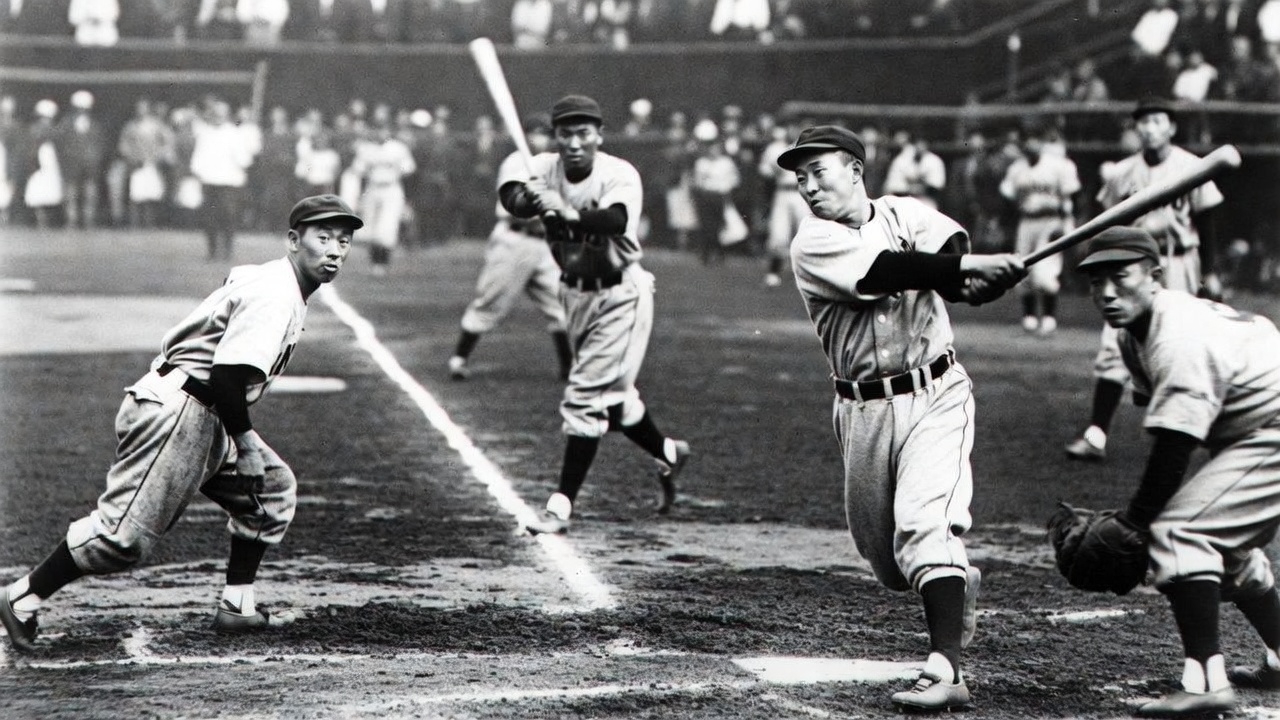
In 1934, media mogul Matsutarō Shōriki, the publisher of the Yomiuri Shimbun newspaper, organized a tour of American All-Stars that included Babe Ruth, Lou Gehrig, Jimmie Foxx, and Charlie Gehringer. The games drew massive crowds and ignited a national frenzy for professional baseball.
To field a Japanese team worthy of competing against these American legends, Shōriki founded the Dai Nippon Tokyo Yakyu Kurabu (Greater Japan Tokyo Baseball Club) in late 1934. This team barnstormed through the United States in 1935, winning 93 of 102 games against semi-pro and Pacific Coast League opponents. American outfielder Lefty O’Doul, who served as baseball’s goodwill ambassador to Japan before and after World War II, helped the squad adopt a new identity: the Tokyo Giants, later known as the Yomiuri Giants.
A second professional team, the Osaka Baseball Club (later the Hanshin Tigers), was founded in 1935. By 1936, Japan had enough professional teams to launch the Japanese Baseball League (JBL) with seven clubs. The league held its first full seasons in 1937, playing fall and spring schedules.
| Year | Milestone |
|---|---|
| 1872 | Horace Wilson introduces baseball at Kaisei Gakko |
| 1903 | Waseda–Keio university rivalry begins |
| 1915 | First National High School Baseball Championship (Kōshien) |
| 1920 | First professional teams formed (disbanded by 1923) |
| 1934 | American All-Stars tour Japan; Yomiuri Giants founded |
| 1936 | Japanese Baseball League (JBL) established with 7 teams |
Japanese Baseball During World War II and the Wartime Struggles
As Japan plunged deeper into militarism in the late 1930s, baseball — an American sport — came under suspicion. In October 1940, the JBL banned the use of English in baseball. Team names were changed to Japanese equivalents: the Osaka Tigers became “Hanshin,” the Korakuen Eagles became “Kurowashi,” and so on. Even basic English terms for strikes and balls were replaced with Japanese words on the field.
The league’s first president, Jiro Morioka, negotiated tirelessly with the Japanese Imperial Army to keep professional baseball alive during the war years. Games continued even as players were drafted into military service and stadiums were threatened by air raids. The schedule was shortened and rosters thinned, but the JBL refused to die.
The 1944 season was ultimately cancelled as Allied bombing intensified across the Japanese home islands. But remarkably, the league resumed play in 1945, even before the formal surrender in August. In the rubble of postwar Japan, baseball became one of the first cultural activities to return. American occupation authorities under General Douglas MacArthur actively encouraged the sport as a tool of democratic reconstruction and goodwill.
How Nippon Professional Baseball Was Founded in 1950
The postwar boom in baseball’s popularity led to rapid expansion. By the late 1940s, the single-league JBL could no longer contain the number of teams and talent flooding in. In 1949, the JBL reorganized itself, and on November 26, 1949, Nippon Professional Baseball (NPB) was formally established. The new structure, which took effect for the 1950 season, split the teams into two six-team leagues:
- Central League (CL): Home to established powerhouses like the Yomiuri Giants and Hanshin Tigers.
- Pacific League (PL): Composed largely of newer franchises and expansion clubs, later adopting the designated hitter rule in 1975.
The two leagues would compete against each other in the Japan Series — a best-of-seven championship modeled on MLB’s World Series — starting in 1950. The inaugural Japan Series was won by the Mainichi Orions (now the Chiba Lotte Marines), who defeated the Shochiku Robins in six games.
The two-league, 12-team structure established in 1950 has remained virtually unchanged for over 75 years. This remarkable stability stands in contrast to American sports, where expansion, relocation, and franchise creation have been constant. NPB’s endurance reflects something deep in Japanese culture: a reverence for institutional continuity and tradition.
The Golden Age of the Yomiuri Giants and the V9 Dynasty
No team has defined NPB more than the Yomiuri Giants. Often called “the Yankees of Japan,” the Giants have won a record 22 Japan Series championships — more than any other franchise. But their greatest achievement remains the legendary V9 dynasty: nine consecutive Japan Series titles from 1965 to 1973.
This extraordinary run was powered by two of the greatest players in baseball history: Sadaharu Oh and Shigeo Nagashima.
Sadaharu Oh: The World’s All-Time Home Run King
Sadaharu Oh played 22 seasons for the Yomiuri Giants from 1959 to 1980. He holds the world professional baseball record of 868 career home runs — more than 100 ahead of MLB record-holder Barry Bonds (762). Oh led the Central League in home runs for 15 seasons, won nine MVP awards, and earned two consecutive Triple Crowns in 1973 and 1974.
Oh’s signature was his “flamingo” batting stance — a technique developed with hitting coach Hiroshi Arakawa that drew on principles of Zen Buddhism and the martial art of aikido. Standing on one leg while awaiting the pitch, Oh channeled an almost spiritual concentration into each swing. As the National Baseball Hall of Fame has documented, Oh and Arakawa “combined elements of martial arts, Zen principles and baseball mechanics to create a brand new style of swing.”
Oh’s record of 55 home runs in a single season, set in 1964, stood for nearly five decades. It was finally broken in 2013 by Wladimir Balentien, who hit 60, and the Japanese-born record was surpassed in 2022 by Munetaka Murakami of the Yakult Swallows with 56.
Shigeo Nagashima: Mr. Baseball
Shigeo Nagashima, who batted fourth behind Oh in the Giants’ fearsome lineup, was beloved not just for his talent but for his charisma and flair. One of the most iconic moments in Japanese sports history came in 1959, when Nagashima hit a walk-off home run in the tenran jiai — a game attended by the Emperor. Upon retiring in 1974, Nagashima uttered the famous line: “Waga Giants wa eikyū ni fumetsu desu” (“My Giants will live on forever”), a phrase that entered the fabric of Japanese popular culture.
Together, Oh and Nagashima were known as the “O-N Cannon” (ON Hō). Both received the People’s Honour Award — Japan’s highest civilian honor for cultural contribution — after their playing careers ended.
The Black Mist Scandal and Match-Fixing in Japanese Baseball
The golden age was not without its shadows. Between 1969 and 1971, the Black Mist Scandal (Kuro Kiri Jiken) rocked NPB. Several players across multiple teams were found to have been involved in match-fixing, bribery, and gambling with organized crime figures.
The scandal led to lifetime bans, suspensions, and a public reckoning for the sport. It also reinforced the importance of wa (harmony) and institutional trust in Japanese baseball — values that clubs and the league worked hard to restore in the decades that followed.
How NPB Differs from MLB: Rules, Culture, and Playing Style
While NPB and MLB share the same fundamental game, the two leagues have notable differences that reflect their distinct cultural contexts.
| Feature | NPB | MLB |
|---|---|---|
| Regular season games | 143 | 162 |
| Baseball size | Slightly smaller | Standard |
| Strike zone | Slightly smaller | Standard |
| Tie games | Allowed (12-inning limit in regular season) | No ties (extra innings until a winner) |
| Foreign player limit | Max 4 per 25-man roster | No limit |
| Team ownership | Typically corporate-owned (named after sponsors) | Privately owned (named after cities) |
| Weekly schedule | 6 games per week (Mondays off) | Up to 7 games per week |
In Japanese baseball, teams are traditionally named after their corporate owners, not their cities. The Yomiuri Giants are named after the Yomiuri media group. The Fukuoka SoftBank Hawks carry the name of the SoftBank telecommunications conglomerate. This corporate identity is woven into every aspect of the fan experience, from stadium branding to merchandise.
The playing style also differs. As American writer Robert Whiting observed in his influential 1977 book The Chrysanthemum and the Bat, Japanese baseball emphasizes group identity, cooperation, hard work, respect for seniority, and the concept of wa (team harmony). Training in Japan is famously intense — longer practices, more repetition, and a greater emphasis on fundamentals than is typical in the American game.
Japanese fans, or ouendan, are equally distinctive. Each team’s cheering section sings organized fight songs, waves flags, and performs coordinated chants for every batter. The atmosphere in an NPB stadium is more like a concert than a casual afternoon at the ballpark. Visiting Japan specifically for a baseball game has become a popular item on travel bucket lists around the world.
The 2004 Player Strike That Changed Japanese Baseball Forever
The year 2004 marked the most dramatic labor confrontation in NPB history. When the Osaka Kintetsu Buffaloes announced a merger with the Orix BlueWave, players and fans were outraged. The merger would reduce the Pacific League from six teams to five, threatening the entire two-league structure that had existed since 1950.
Atsuya Furuta, head of the Japan Professional Baseball Players’ Association, led the fight against the contraction plan. Yomiuri Giants owner Tsuneo Watanabe inflamed tensions by dismissing Furuta as “a mere player” who had no say in the league’s future. The remark sparked a firestorm.
On September 18–19, 2004, NPB players went on strike — the first labor strike in the league’s history. The two-day walkout generated massive media coverage and overwhelming public sympathy for the players.
The strike was settled on September 23, when owners agreed to a critical compromise: the Pacific League would add a new expansion team to maintain the 12-team, two-league system. The Tōhoku Rakuten Golden Eagles, based in Sendai, began play in the 2005 season. The strike also led to important reforms, including the introduction of interleague play and changes to the draft system.
The Climax Series and Postseason Format in NPB
NPB’s postseason has evolved significantly over the decades. For most of its history, the Japan Series simply pitted the two league champions against each other. But in 2004, the Pacific League introduced a stepladder playoff format. The Central League followed suit in 2007, and the intra-league playoffs were renamed the Climax Series.
Here is how the current postseason works:
- First Stage: The second-place and third-place teams in each league play a best-of-three series.
- Final Stage: The winner faces the league champion in a best-of-six series. The league champion receives an automatic one-game advantage.
- Japan Series: The Climax Series winners from each league meet in a best-of-seven championship.
This format has produced thrilling upsets. In 2024, the third-seeded Yokohama DeNA BayStars stunned the heavily favored Fukuoka SoftBank Hawks — who had led the Pacific League all year — to win the Japan Series as massive underdogs. It was the kind of Cinderella story that keeps fans coming back year after year.
From Hideo Nomo to Shohei Ohtani: How NPB Players Conquered Major League Baseball
The relationship between NPB and MLB is one of the most fascinating dynamics in global sports. For decades, the talent pipeline flowed in only one direction — American coaches and players came to Japan. Then, in 1995, everything changed.
Hideo Nomo: The Pioneer Who Broke the Barrier
Hideo Nomo of the Kintetsu Buffaloes found a loophole in his NPB contract. By “retiring” from Japanese baseball, he freed himself to sign with the Los Angeles Dodgers. His trademark “tornado” windup captivated American fans, and Nomo won the 1995 NL Rookie of the Year Award. He proved that Japanese pitchers could dominate in MLB, opening the floodgates for future stars.
The Posting System: A Bridge Between Leagues
After Nomo’s departure — and similar contract maneuvers by Hideki Irabu and Alfonso Soriano — NPB and MLB negotiated the posting system in 1998. Under this system, an NPB player who wishes to move to MLB is “posted” by his team. All 30 MLB clubs then have 45 days to negotiate a contract. If a deal is reached, the MLB team pays a release fee to the NPB club, based on a percentage of the contract value.
Players with nine or more years of NPB service are exempt from posting and can become international free agents. Those posted before reaching that threshold need their team’s agreement to enter the process.
The Stars Who Crossed the Pacific
Since Nomo’s pioneering move, more than 60 NPB players have played in Major League Baseball. Here are some of the most impactful:
| Player | NPB Team | MLB Team(s) | Key Achievement |
|---|---|---|---|
| Ichiro Suzuki | Orix BlueWave | Mariners, Yankees, Marlins | 3,089 MLB hits; 4,367 combined career hits; 2025 Hall of Fame inductee |
| Hideki Matsui | Yomiuri Giants | Yankees, Angels, others | 2009 World Series MVP |
| Daisuke Matsuzaka | Seibu Lions | Red Sox, Mets | 2007 World Series champion |
| Yu Darvish | Nippon-Ham Fighters | Rangers, Dodgers, Cubs, Padres | First Japanese pitcher with 2,000 MLB strikeouts |
| Masahiro Tanaka | Rakuten Golden Eagles | Yankees | Seven-year, $155M contract in 2014 |
| Shohei Ohtani | Nippon-Ham Fighters | Angels, Dodgers | Two-way superstar; multiple AL MVP winner |
| Yoshinobu Yamamoto | Orix Buffaloes | Dodgers | 12-year, $325M contract; 2025 World Series MVP |
Ichiro Suzuki: The First Japanese-Born Hall of Famer
Ichiro Suzuki deserves special attention as perhaps the most transformative figure in the NPB-to-MLB pipeline. After winning seven consecutive Pacific League batting titles with the Orix BlueWave, Ichiro was posted to MLB in 2000. The Seattle Mariners paid Orix $13.25 million for negotiating rights and signed him to a three-year deal.
In his debut season of 2001, Ichiro won both the AL Rookie of the Year and AL MVP awards — an almost unheard-of combination. He recorded 242 hits, and three years later, he set the MLB single-season hit record with 262. Over 19 MLB seasons, Ichiro accumulated 3,089 hits, and when combined with his 1,278 NPB hits, his career total of 4,367 is the most in professional baseball history.
On January 21, 2025, Ichiro was elected to the National Baseball Hall of Fame in his first year of eligibility, receiving 393 of 394 votes — one vote short of unanimous. He became the first Japanese-born and first Asian-born player ever inducted into Cooperstown. He was formally enshrined on July 27, 2025, and the Seattle Mariners retired his No. 51 jersey on August 9, 2025.
Shohei Ohtani: The Two-Way Phenomenon
Shohei Ohtani stands alone as a talent without precedent. During his five seasons with the Hokkaido Nippon-Ham Fighters from 2013 to 2017, Ohtani established himself as both an elite pitcher and a devastating hitter — the first player in NPB history to achieve double-digit wins and double-digit home runs in the same season. He also set the NPB record for the fastest pitch by a Japanese-born player: 165 km/h (102.5 mph).
After being posted in 2017, Ohtani signed with the Los Angeles Angels and immediately became a global sensation. His ability to pitch and hit at the highest level drew comparisons to Babe Ruth — comparisons that Ohtani has lived up to and, by many measures, exceeded. He won the 2018 AL Rookie of the Year and the 2021 AL MVP, and his historic 2023 season (in which he hit 44 home runs while also pitching) cemented his status as one of the greatest baseball players of any era. His subsequent $700 million contract with the Los Angeles Dodgers became the largest in team sports history.
In 2024, Ohtani helped the Dodgers win the World Series, and the “Ohtani Rule” — which allows a starting pitcher to remain in the game as designated hitter even after being removed from the mound — has been adopted in both MLB (2022) and NPB (2023).
NPB Fan Culture: The Ouendan Cheering Tradition That Defines Japanese Baseball
No guide to Nippon Professional Baseball is complete without understanding the fan culture that makes attending an NPB game one of the most exhilarating sporting experiences on the planet.
Unlike the relatively relaxed atmosphere of many American ballparks, Japanese baseball games are organized spectacles of sound and color. Each team’s ouendan (cheering section) has a dedicated leader — often a man standing on a platform with a trumpet and megaphone — who directs the crowd through a repertoire of fight songs, chants, and coordinated movements. Every batter in the lineup has his own personal fight song, and the entire section sings it in unison each time he comes to the plate.
Visiting fans are given equal respect. Even at away games, the visiting team’s ouendan occupies a designated section and performs their songs with the same fervor as the home crowd. This mutual respect between fan groups is a reflection of the wa (harmony) that permeates Japanese baseball culture.
Certain fan traditions have become legendary. The Hanshin Tigers faithful are known for releasing thousands of yellow balloons at the end of the seventh inning — a ritual known as jet fūsen. After the Tigers famously won the 1985 Japan Series, jubilant Osaka fans threw a statue of Colonel Sanders from a nearby KFC into the Dōtonbori Canal, spawning the legendary “Curse of the Colonel” that supposedly kept the Tigers from winning another championship for 38 years (until they finally broke through in 2023).
Best NPB Stadiums to Visit for International Baseball Fans
If you are planning a trip to Japan and want to experience NPB firsthand, here are the must-visit ballparks.
Tokyo Dome (Big Egg) — Home of the Yomiuri Giants and the site of the very first World Baseball Classic game in 2006. Located in central Tokyo, the dome seats approximately 46,000 fans and is one of the most recognizable venues in Asian sports. Every seat in the house feels close to the action.
Hanshin Koshien Stadium — This hallowed ground in Nishinomiya, Hyogo Prefecture, is home to the Hanshin Tigers and the annual high school baseball championship. Built in 1924, Koshien is to Japanese baseball what Wrigley Field is to American baseball: an open-air cathedral where history lives in every blade of grass. If you can only visit one Japanese ballpark, make it this one.
Mizuho PayPay Dome — The Fukuoka SoftBank Hawks play here, and it is among the most modern sporting venues in Asia. The dome features premium dining, high-definition video boards, and themed entertainment zones that make game day a full-experience event.
ES CON FIELD Hokkaido — Opened in 2023 as the new home of the Hokkaido Nippon-Ham Fighters, this retractable-roof stadium in Kitahiroshima has already drawn international acclaim for its stunning architecture and immersive fan experience. It is surrounded by a leisure and shopping complex that makes it worth the visit even on non-game days.
Jingu Stadium — Home of the Tokyo Yakult Swallows, Jingu opened in 1926 and is one of the oldest active ballparks in Japan. It was one of the stadiums where Babe Ruth played during the legendary 1934 American All-Stars tour. Watching a game here, surrounded by the tree-lined avenues of Meiji Jingu Gaien, feels like stepping back in time.
Practical tip: NPB tickets are generally much more affordable than MLB tickets. Outfield seats, which place you in the heart of the ouendan cheering section, can cost as little as ¥1,500 to ¥3,000 (roughly $10 to $20 USD). For the full cultural immersion, sit with the fans, learn the fight songs, and let the ouendan leaders guide you through the experience.
Record-Breaking NPB Attendance and the League’s Growing Global Popularity
NPB’s popularity is not just holding steady — it is surging. In the 2025 season, NPB set a second consecutive year of attendance records, with over 27 million fans passing through the turnstiles, an average of roughly 31,515 per game. These numbers reflect a vibrant, growing sport that continues to capture the imagination of new generations.
Several factors are driving this growth. The success of Japanese players in MLB has raised global awareness of NPB. The World Baseball Classic (WBC) — in which Japan has won three titles (2006, 2009, and 2023) — has showcased Japanese talent on the world stage. And the league itself has invested heavily in stadium upgrades, digital streaming, and fan engagement.
The Fukuoka SoftBank Hawks have been at the forefront of modernization. Their home venue, Mizuho PayPay Dome, features cutting-edge amenities and one of the best game-day experiences in Asian sports. The Hokkaido Nippon-Ham Fighters opened their spectacular new ballpark, ES CON FIELD Hokkaido, in 2023 — a state-of-the-art retractable-roof facility that has drawn rave reviews from fans and media alike.
The 2025 Japan Series: SoftBank Hawks Reclaim the Championship
The 2025 NPB season capped off with a thrilling Japan Series between the Fukuoka SoftBank Hawks and the Hanshin Tigers.
The Hawks’ path to the championship was anything but easy. They started the season with a dismal 9-16-2 record through May 1, as injuries sidelined stars like Yuki Yanagita, Kensuke Kondoh, and Ukyo Shuto. But manager Hiroki Kokubo rallied his squad, and SoftBank surged through the summer to finish with the best record in Japan.
In the Pacific League Climax Series, the Hawks nearly suffered an unprecedented collapse, falling behind 3-0 in their series against the Hokkaido Nippon-Ham Fighters before the Fighters clawed back to force a winner-take-all Game 7. SoftBank survived, winning 2-1 in the decisive contest.
The Hanshin Tigers, managed by former player and MLB veteran Kyuji Fujikawa in his rookie managerial season, had cruised to the Central League pennant — the earliest clinch in CL history on September 7. After sweeping the Yokohama DeNA BayStars in the CL Climax Series, the Tigers entered the Japan Series looking for their third championship in franchise history.
The Hawks dropped Game 1 on the road but then won four straight, including three one-run thrillers at Koshien Stadium. Hotaka Yamakawa was named Japan Series MVP after homering in three consecutive games. In the decisive Game 5, veteran Yuki Yanagita tied the game with a clutch two-run homer in the eighth inning, and Isami Nomura launched a walk-off solo blast in the 11th to clinch the title.
It was SoftBank’s 12th Japan Series championship and their first since 2020, ending a streak that included a heartbreaking loss to the underdog BayStars the previous year.
The NPB-to-MLB Pipeline in 2026: Okamoto, Murakami, and the Next Wave
The story of Japanese baseball in MLB continues to evolve. This winter, the posting system is producing one of the most exciting crops of NPB talent ever to cross the Pacific.
Kazuma Okamoto, the six-time All-Star slugger from the Yomiuri Giants, has been posted to MLB teams — a historic first for the Giants, who have never before posted a star player in his prime. Munetaka Murakami of the Yakult Swallows, who holds the NPB single-season home run record among Japanese-born players with 56 (set in 2022), is also expected to be posted. And right-hander Tatsuya Imai of the Saitama Seibu Lions is considered the top pitching prospect heading to North America.
These moves follow the blockbuster arrivals of Yoshinobu Yamamoto (who signed a $325 million deal with the Dodgers after the 2023 season) and fireballer Rōki Sasaki (who joined the Dodgers on a minor-league deal in early 2025). With Shohei Ohtani already anchoring the Dodgers’ lineup, Los Angeles has become a virtual embassy for Japanese baseball talent.
The Future of Nippon Professional Baseball: What Comes Next
As NPB approaches its 77th year since the 1950 reorganization, the league faces both tremendous opportunities and real challenges.
On the opportunity side: NPB’s global profile has never been higher. The success of Japanese players in MLB, the booming international popularity of the WBC, and record domestic attendance figures all point to a sport on the rise. The 2026 World Baseball Classic, expected to feature another powerhouse Samurai Japan roster, will further elevate the league’s international visibility.
On the challenge side: Japan’s aging population and declining birth rate pose long-term questions for fan development and talent pipelines. The ongoing departure of top players to MLB — while a testament to NPB’s quality — also risks depleting the domestic product. The league must balance the prestige of producing MLB stars with the need to keep its own competition compelling.
NPB is also working to grow the women’s game. The Japan Women’s Baseball League, which began play in 2010, continues to expand, and the women’s national team has achieved considerable international success.
What seems certain is that baseball will remain at the heart of Japanese culture. From the cherry blossom-lined walks to Kōshien every summer, to the thunderous ouendan chants in packed domes every autumn, to the quiet pride of a nation watching its sons succeed on the world’s biggest stages — yakyū endures.
A Complete Timeline of Nippon Professional Baseball History
| Year | Event |
|---|---|
| 1872 | Horace Wilson introduces baseball to Japan |
| 1903 | Waseda–Keio university rivalry begins |
| 1915 | First National High School Baseball Championship |
| 1920 | First professional teams formed in Japan |
| 1934 | American All-Stars tour Japan; Yomiuri Giants founded |
| 1936 | Japanese Baseball League (JBL) officially established |
| 1940 | English banned from Japanese baseball during wartime |
| 1944 | JBL season cancelled due to Allied bombing |
| 1950 | NPB established with Central and Pacific Leagues; first Japan Series held |
| 1959 | Sadaharu Oh hits his first career home run |
| 1964 | Oh sets single-season HR record with 55 |
| 1965–1973 | Yomiuri Giants’ legendary V9 dynasty |
| 1969–1971 | Black Mist Scandal rocks NPB |
| 1975 | Pacific League adopts the designated hitter rule |
| 1977 | Oh surpasses Hank Aaron’s home run record |
| 1980 | Sadaharu Oh retires with 868 career home runs |
| 1995 | Hideo Nomo joins the Los Angeles Dodgers |
| 1998 | Posting system established between NPB and MLB |
| 2001 | Ichiro Suzuki wins AL Rookie of the Year and MVP |
| 2004 | First player strike in NPB history; Rakuten Golden Eagles created |
| 2006 | Japan wins inaugural World Baseball Classic |
| 2007 | Climax Series introduced in both leagues |
| 2013 | Wladimir Balentien hits 60 home runs, breaking Oh’s record |
| 2018 | Shohei Ohtani wins AL Rookie of the Year |
| 2022 | Munetaka Murakami hits 56 HR, new record for Japanese-born players |
| 2023 | Japan wins third World Baseball Classic; Hanshin Tigers end 38-year title drought |
| 2024 | Yokohama DeNA BayStars win Japan Series as underdogs |
| 2025 | Ichiro inducted into Baseball Hall of Fame; SoftBank Hawks win Japan Series; NPB sets attendance records |
| 2026 | Okamoto, Murakami headline new wave of NPB-to-MLB postings |
Frequently Asked Questions About Nippon Professional Baseball
What does NPB stand for? NPB stands for Nippon Professional Baseball (日本プロフェッショナル野球組織). It is the highest level of professional baseball in Japan.
How many teams are in NPB? NPB has 12 teams, split evenly between the Central League and the Pacific League.
When does the NPB season run? The NPB regular season typically runs from late March to early October, followed by the Climax Series and Japan Series in October and November.
Who has won the most Japan Series championships? The Yomiuri Giants hold the record with 22 Japan Series titles.
Can NPB players move to MLB? Yes. Players with fewer than nine years of NPB service can use the posting system to negotiate with MLB teams. Players with nine or more years of service can become international free agents.
What is the biggest difference between NPB and MLB? Beyond the shorter schedule and smaller ball, the biggest cultural difference is the emphasis on team harmony (wa), corporate ownership, and the intense, organized fan culture at NPB games.
Final Thoughts: Why the History of Japanese Professional Baseball Matters
Nippon Professional Baseball is far more than a sports league. It is a mirror of modern Japan — a place where ancient values of discipline, respect, and collective spirit meet the electric energy of contemporary pop culture. From Sadaharu Oh’s flamingo stance to Shohei Ohtani’s 102-mph fastball, from the ouendan trumpets at Koshien to the blinking neon of the Tokyo Dome, NPB tells the story of a nation that took something foreign and made it beautifully, unmistakably its own.
Whether you are a lifelong baseball fan planning your first trip to Japan, or a curious traveler who stumbled upon this story, one thing is certain: once you experience yakyū — once you feel the thunder of 40,000 voices singing in unison under the lights — you will never forget it.
The ball is always in play in Japan. And the next chapter of NPB’s story is just beginning.