February in Malta is nothing like you would expect. The Mediterranean light is soft. The limestone buildings glow amber. The streets of Valletta are hung with red-and-white banners. And on the morning of February 10, the entire island shuts down — not out of grief, but out of gratitude. This is the Feast of Saint Paul’s Shipwreck, known in Maltese as Il-Festa tan-Nawfraġju ta’ San Pawl. It is the first major outdoor feast of the Maltese calendar year, and for many travellers, it is the most authentic window into a culture where faith, identity, and celebration have been intertwined for nearly two thousand years.
If you have ever wondered what it means when people say Malta is “the most Catholic country in Europe,” this feast day will answer your question more vividly than any textbook ever could.
This guide covers everything you need to know — the history, the rituals, the food, the practicalities — so you can experience the feast not as a tourist standing on the margins, but as an informed and respectful guest walking alongside the Maltese people on one of the most significant days of their year.
What Is the Feast of Saint Paul’s Shipwreck in Malta and Why Does It Matter?
The Feast of Saint Paul’s Shipwreck is a national public holiday in Malta, observed every year on February 10. In 2026, the feast falls on a Tuesday. Unlike some public holidays that many citizens treat as a generic day off, this particular feast is woven into the country’s founding mythology. It commemorates the event that, according to Christian tradition, introduced Christianity to the Maltese islands — an event that took place roughly 1,966 years ago.
Malta is a nation of 14 official public holidays, which is among the highest in the European Union. Nine of those holidays are religious. But even among these, the Feast of Saint Paul’s Shipwreck holds a special status. Saint Paul is not merely a patron saint here. He is regarded as the spiritual father of the Maltese people. His story is not just a chapter from the Bible — it is the origin story of Maltese Christianity itself.
On this day, schools close. Shops shutter. Families gather. The streets of the capital fill with brass bands, processions, and the smell of street food. And the entire island — from Valletta to Gozo — acknowledges that its spiritual identity began with a storm at sea, a broken ship, and a man who stepped ashore uninvited.
The Biblical Story Behind Malta’s Most Important Religious Festival
To understand the feast, you must first understand the story. It is recorded in the Acts of the Apostles, chapters 27 and 28, and it reads like a Mediterranean adventure tale.
Around 60 A.D., the Apostle Paul was a prisoner of Rome. He had appealed his case to Caesar and was being transported by ship from the eastern Mediterranean toward the imperial capital. The vessel carried approximately 276 people — soldiers, sailors, prisoners, and passengers. Somewhere in the central Mediterranean, the ship was caught in a violent storm that lasted fourteen days. The crew lost all hope. But Paul, claiming divine assurance, told them that every soul on board would survive, even though the ship itself would be lost.
The ship eventually ran aground near the north coast of what the ancient text calls “Melita” — the island we now know as Malta. All 276 people made it safely to shore. The local inhabitants — described in the original Greek text as barbaroi, meaning people who spoke a non-Greek language — showed them “unusual kindness.” They built a fire for the cold, shipwrecked strangers.
What happened next is one of the most famous miracle stories in early Christianity. While Paul was gathering firewood, a venomous snake bit his hand. The locals expected him to swell up and die. When he remained unharmed, they concluded he must be a god. Paul then healed the father of Publius, the chief official of the island, who was suffering from fever and dysentery. Word spread. Other sick people on the island came to Paul and were cured.
Paul remained in Malta for three months over the winter before departing for Rome on another ship. During that time, according to Maltese tradition, he planted the seeds of Christianity that would grow into the defining characteristic of the nation. Publius is venerated as the first Bishop of Malta. The Maltese believe that Paul preached in a cave — now known as St. Paul’s Grotto in the town of Rabat — and that his brief stay permanently altered the spiritual trajectory of the islands.
This is not a minor detail in the Maltese psyche. It is the foundation.
How the Collegiate Parish Church of Saint Paul’s Shipwreck Became the Heart of the Celebration
The spiritual and ceremonial centre of the feast is the Collegiate Parish Church of Saint Paul’s Shipwreck (Parroċċa San Pawl Nawfragu), located on St. Paul’s Street (Triq San Pawl) in Valletta. If you visit only one building during the feast, make it this one.
The church traces its origins to the 1570s, when Valletta was being built as a new fortress capital after the Great Siege of 1565. It was designed by Girolamo Cassar, the same Maltese architect responsible for St. John’s Co-Cathedral and many of the Knights’ auberges. The original structure was completed in 1582. In the mid-17th century, the church was entrusted to the Jesuit Fathers and underwent significant reconstruction. The current facade dates from 1885, designed by Nicholas Zammit.
But the exterior tells only part of the story. Step inside and you enter a treasure house of devotional art:
- The titular statue of Saint Paul — carved in 1659 by the Roman sculptor Melchiorre Cafà (the brother of Lorenzo Gafà, who designed the dome). This gilded wooden masterpiece shows Paul in the act of preaching. It is considered a prototype for all subsequent statues of St. Paul in Malta. On feast day, this statue is carried shoulder-high through the streets of Valletta.
- The main altarpiece — a dramatic depiction of the shipwreck, painted by Matteo Perez d’Aleccio, a follower of Michelangelo.
- The relic of Saint Paul’s wrist bone — a fragment encased in a golden reliquary, donated to the church in 1823 by Vincenzo Aloisio Bonavia.
- A piece of the column on which Saint Paul is traditionally believed to have been beheaded in Rome in 64 A.D. — donated by Pope Pius VII in 1818.
- Ceiling frescoes by the Italian artist Attilio Palombi, depicting romanticised scenes from the Apostle’s life.
The church is listed on Malta’s National Inventory of Cultural Property. The Maltese historian Gian Francesco Abela described it as early as 1647 as “a most beautiful temple.” Nearly four centuries later, the description still holds.
Practical tip: The church is located on a narrow, steep side street and is easy to miss. Enter from Triq Santa Luċija (St. Lucia’s Street). A dress code applies — shoulders must be covered, and shorts are not permitted. Shoulder coverings are provided at the entrance for those who need them.
What Happens on Feast Day: A Complete Schedule of Events and Traditions in Valletta
The Feast of Saint Paul’s Shipwreck is not a single event. It is a full day of overlapping rituals, both sacred and secular, that unfolds across Valletta from early morning until late at night. Here is what to expect in 2026.
Morning: Mass and Fireworks Over Grand Harbour
The day begins early. A Solemn Mass is celebrated at the Church of Saint Paul’s Shipwreck, typically around 8:00 AM. Immediately afterward — and this is the part that startles unprepared visitors — fireworks erupt over Grand Harbour. Yes, fireworks in the morning. In Malta, daytime fireworks (petards and aerial shells) are a standard feature of religious feasts, and they are not subtle. The explosions echo off the limestone walls of the fortified harbour, and the sound carries across the entire capital.
This is your wake-up call, Maltese style.
Midday: Street Decorations and Band Marches
By late morning, the streets of Valletta are fully dressed for the occasion. Red-and-white banners — the colours associated with Saint Paul — hang from balconies. Statues of the Apostle appear in niches and doorways. Temporary lights are strung across the streets, ready to glow in the evening.
Brass band marches (marċi) begin threading through Valletta’s grid-plan streets. The route traditionally passes through Triq San Pawl, Triq ir-Repubblika, Triq il-Merkanti, and other main thoroughfares. Band clubs are a cornerstone of Maltese festive culture, and their role on feast day is both musical and social. Listen for the distinctive sound of Maltese march compositions — bold, brassy, and unapologetically loud.
Afternoon: English-Language Mass and the Procession
An English-language Mass is typically held at approximately 3:45 PM, making the religious observance accessible to non-Maltese speakers and visiting pilgrims. This is followed by the day’s emotional centrepiece: the procession with the statue of Saint Paul, which generally begins around 5:30 PM.
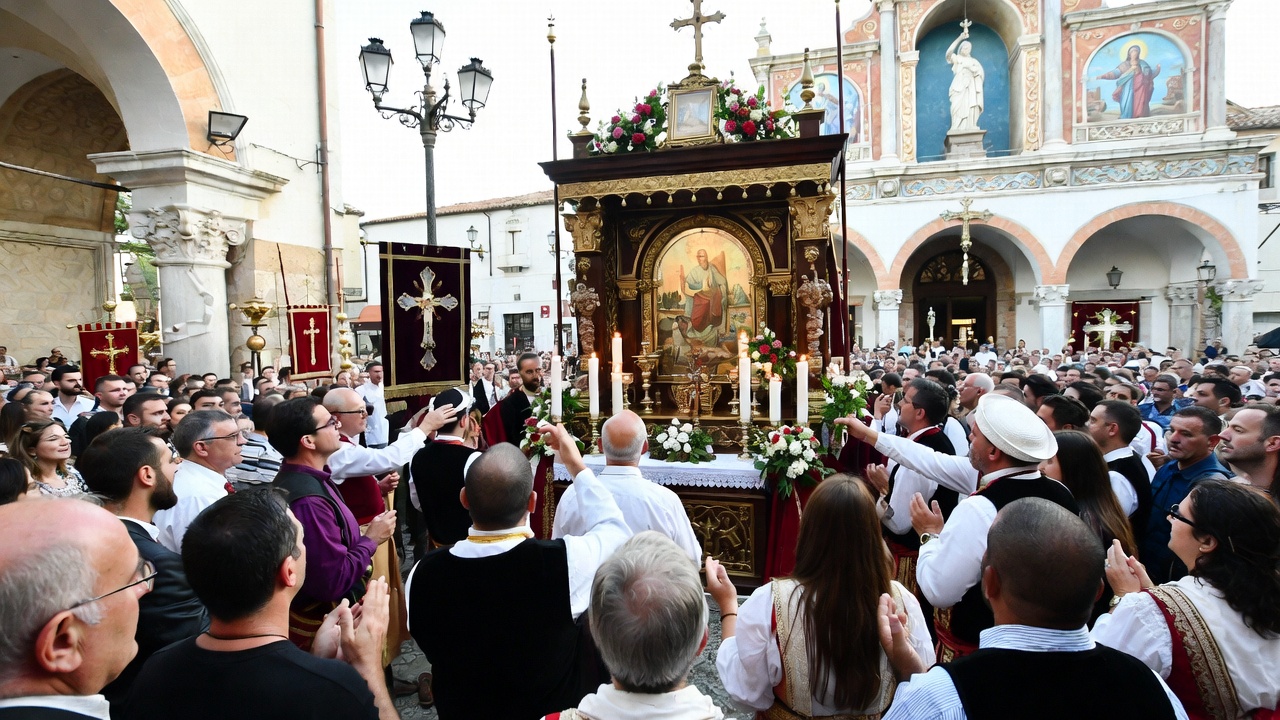
The statue carved by Melchiorre Cafà is carried out of the church on the shoulders of bearers and paraded through the streets of Valletta. The procession is accompanied by clergy, band musicians, and costumed participants. Crowds line the streets. Locals applaud and cross themselves as the statue passes. It is both a solemn and joyous occasion — closer in spirit to a family celebration than to a funeral march.
Evening: The Grand Procession and Street Celebrations
A second, larger procession takes place at approximately 9:30 PM, accompanied by additional religious ceremonies. By this time, the temporary street lighting is fully illuminated, and the atmosphere shifts from devotional to festive. Street food vendors are in full swing. Families with children, groups of friends, and elderly couples all mingle in the same narrow streets.
More fireworks cap the evening — this time in full darkness, launched from barges in Grand Harbour or from vantage points around the city. If the weather cooperates, the display is magnificent against the backdrop of the illuminated fortifications.
Traditional Maltese Food to Try During the Saint Paul’s Shipwreck Feast
No Maltese feast is complete without food, and the Feast of Saint Paul’s Shipwreck is no exception. While the feast does not have a single signature dish the way Easter has figolla or Christmas has qaghaq tal-ghasel, the food stalls and restaurants of Valletta offer a rich spread of traditional fare. Here is what to look for.
| Dish | Description | Where to Find It |
|---|---|---|
| Pastizzi | Flaky, diamond-shaped pastries filled with ricotta or mashed peas. The undisputed king of Maltese street food. About €0.50 each. | Any pastizzeria in Valletta — try Crystal Palace on Republic Street. |
| Hobż biż-żejt | Crusty Maltese bread (ftira) rubbed with tomato paste, drenched in olive oil, and filled with tuna, capers, olives, and local cheese (ġbejna). | Bakeries and snack bars throughout the city. |
| Stuffat tal-fenek | Slow-cooked rabbit stew in a rich tomato and red wine sauce. The national dish of Malta. | Sit-down restaurants. Try places in the Republic Street area. |
| Imqaret | Deep-fried pastries filled with dates and spiced with cinnamon, cloves, and aniseed. | Street food stalls during the feast. |
| Maltese sausage | Pork sausage seasoned with parsley, garlic, and coriander. Often grilled and served from street vendors. | Feast-day street stalls. |
| Ġbejna | Small rounds of sheep or goat cheese — fresh, sundried, or peppered. | Delis and market stalls. |
| Kinnie | Malta’s signature soft drink — a bittersweet citrus soda made from bitter oranges and aromatic herbs. An acquired taste for some, a revelation for others. | Widely available. |
| Cisk Lager | Malta’s most popular locally brewed beer. Light, crisp, and ideal for a feast-day evening stroll. | Bars and vendors. |
A note on timing: Because the feast falls in February, the food scene will lean toward hearty, warming dishes rather than the lighter fare of summer feasts. Expect soups, stews, and baked pasta (timpana) alongside the street snacks.
Where to Visit in Malta to Follow the Footsteps of Saint Paul
The feast day celebrations are concentrated in Valletta, but the broader story of Saint Paul in Malta extends across the island. If you are visiting for more than a single day — and you should — these sites form a compelling pilgrimage route, whether you approach them as a devotional exercise or as a cultural itinerary.
St. Paul’s Grotto and the Basilica of Saint Paul in Rabat
The most sacred Pauline site outside Valletta is St. Paul’s Grotto in the town of Rabat, located directly adjacent to the ancient walled city of Mdina. According to tradition, Paul lived and preached in this underground cave during his three-month stay on the island.
The grotto sits beneath the Basilica of Saint Paul, a 17th-century Baroque church that replaced an earlier structure completed in 1578. The basilica was elevated to a Minor Basilica in 2020. You can access the grotto through the adjacent Sanctuary of St. Publius. A statue of Saint Paul, donated by Grand Master Pinto in 1748, stands within the cave.
The site has been visited by multiple popes, including Pope John Paul II (in 1990 and 2001) and Pope Benedict XVI (in 2010).
Opening hours: Monday to Saturday, 9:00 AM – 5:00 PM (last entry 4:30 PM). Closed on Sundays and public holidays. Note that since the feast day on February 10 is a public holiday, the grotto may be closed — plan your visit for the day before or after.
Getting there: Bus route 51 or 52 from Valletta to Rabat. The journey takes about 30 minutes. Alternatively, drive — free parking is widely available in Rabat.
St. Paul’s Catacombs in Rabat
A short walk from the basilica, the St. Paul’s Catacombs are one of Malta’s most important archaeological sites. Managed by Heritage Malta, this vast underground burial complex dates from Punic, Roman, and Byzantine times and represents the earliest and largest archaeological evidence of Christianity in Malta.
The catacombs cover approximately 2,000 square metres of underground passages and burial chambers. Only a portion is open to the public, but the visit takes between one and two hours and includes a museum with interpretive displays.
Opening hours (winter): Tuesday to Sunday, 9:00 AM – 5:00 PM. Closed on Mondays. Admission: Adults approximately €6, children under 5 free.
St. Paul’s Bay and St. Paul’s Islands
The traditional site of the actual shipwreck is St. Paul’s Bay (San Pawl il-Baħar), on Malta’s northern coast. Just offshore sit the St. Paul’s Islands — two small rocky islets where a tall statue of Saint Paul marks the spot where the ship is believed to have run aground.
You cannot land on the islands without a private boat, but the statue is clearly visible from the mainland. The bay itself is a pleasant area to explore, with several churches and shrines dedicated to Saint Paul scattered around the coastline. The small chapel of San Pawl Milqi — “Saint Paul Welcomed” — sits on a hill overlooking the bay and marks the traditional site where Paul healed Publius’s father.
Mdina Cathedral
The Mdina Cathedral (Cathedral of Saint Paul), situated in Malta’s former capital, is built on the site traditionally believed to be the villa of Publius, the Roman governor who welcomed Paul. While the current cathedral dates from the late 17th century (designed by Lorenzo Gafà), the site itself connects directly to the Pauline narrative.
What to Wear and How to Dress for Malta’s Feast of Saint Paul in February
February in Malta is not the sun-drenched Mediterranean postcard that most travellers imagine. It is winter — mild by Northern European standards, but winter nonetheless. Proper preparation will make your feast day far more enjoyable.
Average February temperatures in Valletta:
| Condition | Details |
|---|---|
| Daytime high | 15–17°C (59–63°F) |
| Nighttime low | 9–11°C (48–52°F) |
| Sunshine hours | 6 hours per day |
| Rainy days | 10–12 days per month |
| Average rainfall | 55–63 mm |
| Sea temperature | 15°C (59°F) — not swimming weather |
What to pack:
- Layers. Mornings are cool and often damp. Midday can feel surprisingly warm in direct sun. Evenings get cold quickly.
- A warm jacket or coat. You will need one for the evening procession.
- A waterproof layer. Rain showers are common in February, and they can arrive without much warning. A packable rain jacket is essential.
- A compact umbrella. Useful both for rain and for the occasional burst of sea spray on windy days.
- Comfortable walking shoes. Valletta’s streets are paved with limestone slabs that can become slippery when wet. Avoid smooth-soled shoes.
- Shoulder-covering garments. Required for entering churches. A light scarf or shawl works well for this purpose.
- No shorts. Church dress codes in Malta are enforced. Knee-length skirts or trousers are necessary if you plan to enter any religious site.
How to Get to Valletta for the Feast Day: Malta Airport Transport and Travel Tips
Malta International Airport (MLA) at Luqa is the country’s only airport and is well connected to major European cities. The airport sits approximately 9 kilometres from Valletta, making the transfer straightforward.
Transfer Options from Malta Airport to Valletta
| Option | Cost (approx.) | Duration | Notes |
|---|---|---|---|
| Public bus (TD4) | €2.50 per person | 20–30 minutes | Direct service to Valletta City Gate bus terminal. Runs every 30 minutes. Buy tickets at the Malta Public Transport booth in Arrivals or pay contactless on the bus. |
| App-based taxi (Bolt/Uber/eCabs) | €12–20 | 15–20 minutes | Download the app before arrival. Drivers drop you close to your accommodation. Free Wi-Fi is available at the airport. |
| Fixed-rate airport taxi | ~€17–20 | 15–20 minutes | Pre-pay at the taxi counter in the Arrivals Hall. No need to negotiate. |
| Private transfer | €27–30 | 15–20 minutes | Pre-booked. Driver meets you at Arrivals. Best for families or groups with luggage. |
| Car rental | Varies | 15–20 minutes | Not recommended for Valletta stays. Parking inside the city is extremely limited and subject to a paid access system. |
Important tip: If you are staying in Valletta, do not rent a car. The historic city centre is largely pedestrianised, and parking is a notorious challenge. Public transport, taxis, and ride-hailing apps will serve you much better.
Language: English is one of Malta’s two official languages (alongside Maltese). You will have no difficulty communicating with drivers, hotel staff, or shopkeepers.
Currency: Malta uses the Euro (€). Credit and debit cards are widely accepted, but carry some cash for bus fares, pastizzi shops, and feast-day street vendors.
Where to Stay in Valletta for the Saint Paul’s Shipwreck Feast Weekend
Valletta is a compact city, and almost any accommodation within the walls will place you within walking distance of the feast celebrations. Here are the main areas to consider.
Within Valletta’s walls: This is the ideal location for the feast. You will be steps from the Church of Saint Paul’s Shipwreck, the procession route, and the evening fireworks. Valletta offers everything from boutique hotels in converted palazzi to budget-friendly guesthouses and Airbnb apartments. Book early — the feast is a public holiday and accommodation fills up.
Sliema and St. Julian’s: These neighbouring seaside towns are connected to Valletta by a short ferry ride (from Sliema) or bus. They offer a wider range of hotel chains, restaurants, and nightlife. The ferry crossing to Valletta takes about 10 minutes and provides spectacular views of the fortifications.
Mdina and Rabat: If you want a quieter base and plan to explore the Pauline sites outside Valletta, consider staying in or near Mdina. The Xara Palace Relais & Châteaux is one of Malta’s finest luxury properties, housed in a 17th-century palace within Mdina’s walls.
Understanding the Cultural Significance of Maltese Festa Traditions for Travellers
To appreciate the Feast of Saint Paul’s Shipwreck fully, it helps to understand the broader concept of the Maltese festa — the village feast tradition that is central to life on the islands.
Malta celebrates approximately 94 feasts each year across both Malta and Gozo. Most take place between May and September, but the Feast of Saint Paul’s Shipwreck is notable for being the first outdoor feast of the calendar year, bringing the festa spirit to the cold, short days of February.
In 2023, UNESCO recognised the Maltese festa as part of the Intangible Cultural Heritage of Humanity — a designation that acknowledges the tradition’s deep significance as a living expression of community identity, religious devotion, and artistic heritage.
Every festa shares certain core elements:
- Religious processions featuring statues of saints carried through the streets
- Brass band marches organised by local band clubs, who compete with fierce pride
- Street decorations — banners, lights, and elaborate temporary installations
- Fireworks — both daytime petards and evening aerial displays
- Street food — from traditional sweets to modern fast food
- Community gatherings that bring together families, neighbours, and visitors
The festa is not just a religious event. It is a social institution. It is where communities express their identity, where rivalries between neighbouring parishes play out in healthy competition, and where the Maltese connection between faith and daily life is most visible. As a visitor, you are not merely permitted to attend — you are welcomed. But you should be aware that for the people around you, this is personal. It is not a performance staged for tourists. It is an expression of something they genuinely feel.
Tips for Respectful and Enjoyable Travel During Malta’s Religious Festivals
Attending a Maltese feast is a privilege, and a little cultural sensitivity goes a long way. Here are practical tips drawn from years of attending these celebrations.
Do:
- Dress modestly when entering churches. Cover your shoulders and knees.
- Applaud when the statue passes during the procession. This is the expected local response — clapping, cheering, and sometimes throwing confetti.
- Try the local food. Refusing pastizzi would be like refusing a handshake.
- Arrive early for Mass or processions if you want a good viewing spot. Streets fill up fast.
- Be patient with crowd density. Valletta’s streets are narrow, and feast-day foot traffic can be intense.
- Talk to people. The Maltese are famously warm and proud of their traditions. Ask questions. They will happily explain.
Do not:
- Block the procession route. Stay on the pavements or behind barriers.
- Use flash photography inside the church during Mass.
- Treat the procession as a mere spectacle. For many participants, this is an act of deep personal devotion.
- Expect everything to be open. It is a public holiday. Many shops, banks, and public services are closed.
- Complain about the noise. Fireworks and brass bands are loud. That is the point. Bring earplugs if you are sensitive to sound, but do not ask them to turn it down.
How Malta’s Feast of Saint Paul Compares to Other Mediterranean Religious Festivals
The Feast of Saint Paul’s Shipwreck sits within a broader Mediterranean tradition of patron saint celebrations, but it has characteristics that make it unique.
| Feature | Malta (St. Paul’s Shipwreck) | Spain (Semana Santa) | Italy (Festa di San Gennaro) | Greece (Easter) |
|---|---|---|---|---|
| Date | Fixed: February 10 | Variable: March/April | Fixed: September 19 | Variable: March/April |
| Scale | National public holiday | Regional (Seville, Málaga) | Local (Naples/NYC) | National |
| Procession style | Single statue, brass bands | Multiple pasos, penitents | Statue, street fair | Midnight liturgy, candlelight |
| Fireworks | Morning and evening | Minimal | Yes | Midnight fireworks |
| Food focus | Street food, fenkata | Torrijas, bacalao | Zeppole, sausage | Lamb, tsoureki |
| Unique element | Commemorates a specific biblical event on the island itself | Week-long series of processions | Liquefaction of saint’s blood | Resurrection at midnight |
What makes Malta’s celebration distinctive is its direct biblical connection. Most patron saint festivals celebrate a saint’s life or martyrdom. Malta’s feast celebrates a specific event — a shipwreck — that happened on Maltese soil and is recorded in the New Testament. This gives the celebration a historical immediacy that few other festivals can match. The Maltese are not just honouring a distant saint. They are re-enacting a chapter of their own national origin story.
Day Trips from Valletta During the Saint Paul’s Shipwreck Festival Week
If you are spending several days in Malta around the feast, you will find no shortage of things to see and do beyond the celebrations themselves. February is actually an excellent time for sightseeing — fewer crowds, mild temperatures, and a countryside that is surprisingly green and lush after winter rains.
Mdina: The Silent City and Its Pauline Heritage
Malta’s ancient capital, known as “The Silent City” (il-Belt is-Sieket), is a walled medieval town perched on a hilltop in the centre of the island. Walking through its narrow streets — which were used as filming locations for Game of Thrones — feels like stepping back several centuries. Key highlights include the Mdina Cathedral (built on the traditional site of Publius’s villa), the Palazzo Falson Historic House Museum, and the views from the bastions.
Mdina is just a 3-minute walk from Rabat, where you will find St. Paul’s Grotto and the Catacombs. Combine both in a single half-day trip.
Getting there: Bus routes 51, 52, or 53 from Valletta. Journey time approximately 30 minutes.
Gozo: Malta’s Quieter Sister Island
If you have a full day to spare, take the ferry to Gozo (Għawdex). The island has its own Pauline connections — a St. Paul’s Shipwreck Church in the village of Munxar, and another in the seaside village of Marsalforn, which local legend identifies as the port from which Paul departed Malta.
Gozo is accessible via the Gozo Channel Line car ferry from Ċirkewwa (a 25-minute crossing) or the Gozo Fast Ferry for pedestrians from Valletta (about 45 minutes).
The Megalithic Temples
Malta is home to some of the oldest freestanding structures on Earth. The temples of Ħaġar Qim and Mnajdra, dating from 3600–3200 B.C., are UNESCO World Heritage Sites and are well worth a visit. They predate Stonehenge by a thousand years and the Egyptian pyramids by several centuries.
Practical Travel Information: Planning Your Trip to Malta for February 2026
Here is a quick-reference summary of essential travel details for planning your visit.
| Detail | Information |
|---|---|
| Feast date in 2026 | Tuesday, February 10 |
| Holiday type | National public holiday (non-working day) |
| Main celebration venue | Collegiate Parish Church of St. Paul’s Shipwreck, Valletta |
| Country | Republic of Malta |
| Official languages | Maltese, English |
| Currency | Euro (€) |
| Time zone | CET (UTC+1) |
| Visa | EU/Schengen rules apply. Check requirements for your nationality. |
| Airport | Malta International Airport (MLA), Luqa |
| Driving side | Left |
| Electricity | 230V, Type G (British-style three-pin plugs) — bring an adapter if coming from continental Europe or the Americas |
| Tap water | Technically safe but desalinated; most locals drink bottled or filtered water |
| Emergency number | 112 |
| Average temperature on Feb 10 | High: 15–17°C / Low: 9–11°C |
Frequently Asked Questions About Malta’s Feast of Saint Paul’s Shipwreck
Is the Feast of Saint Paul’s Shipwreck a public holiday in Malta? Yes. It is one of Malta’s 14 official public holidays. Most businesses, schools, and government offices are closed.
Can non-Catholics attend the procession and church services? Absolutely. Visitors of all backgrounds are welcome at both the church services and the street processions. You do not need to be Catholic to attend — just be respectful of the setting.
Are there fireworks during the feast? Yes, both in the morning (after the early Mass) and in the evening. Daytime fireworks are a distinctively Maltese tradition that may catch first-time visitors off guard.
Is February a good time to visit Malta? February is ideal for travellers who prefer mild weather, fewer crowds, and lower prices. It is not beach season, but it is perfect for sightseeing, cultural experiences, and events like the feast. The island is green and scenic after winter rains, and you will have major attractions largely to yourself.
Where can I watch the procession? Line the streets along the procession route in Valletta, which passes through Triq San Pawl, Triq ir-Repubblika, Triq il-Merkanti, and surrounding streets. Arrive early for the best spots. Balconies of hotels and guesthouses along the route offer prime viewing if you can secure one.
What language is the Mass celebrated in? The main Solemn Mass is in Maltese. An English-language Mass is typically held in the mid-afternoon (around 3:45 PM).
Is the feast safe for families with children? Yes. The feast is a family occasion, and you will see many Maltese families with young children. Be aware that the fireworks are loud — ear protection for small children is advisable.
Final Thoughts: Why Every Traveller Should Experience Malta’s First Feast of the Year
There is something about the Feast of Saint Paul’s Shipwreck that cannot be replicated anywhere else in the world. It is the combination of scale and intimacy — a national holiday that still feels like a neighbourhood party. It is the historical depth — a celebration of an event that is simultaneously biblical, historical, and deeply personal to an entire nation. And it is the Maltese character itself — warm, proud, devout, and genuinely happy to share their traditions with strangers.
Malta is a country of just over 500,000 people spread across an island smaller than most large cities. Yet it sustains a cultural and religious life of extraordinary richness. The Feast of Saint Paul’s Shipwreck is perhaps the purest distillation of that richness — a single day that captures what it means to be Maltese.
If you go, and I hope you do, remember this: nearly two thousand years ago, a storm-tossed ship broke apart on the rocky shores of this tiny island, and 276 people stumbled ashore into the arms of strangers who showed them unusual kindness. The feast is, at its heart, a celebration of that kindness — and of the belief that what begins in shipwreck can end in something beautiful.
Il-Festa t-Tajba. Happy feast.