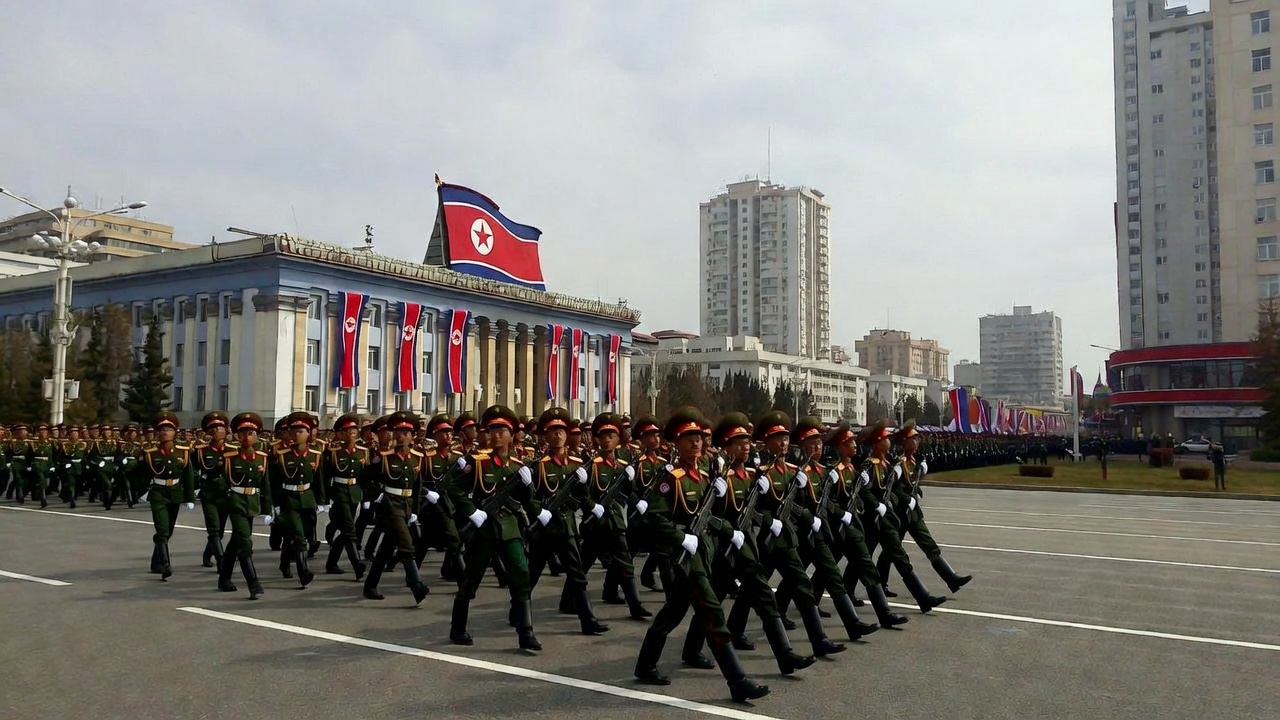
Few national celebrations on earth are as tightly choreographed—or as intensely watched by the outside world—as North Korea’s Army Day. Every year, the Democratic People’s Republic of Korea (DPRK) transforms its capital, Pyongyang, into an open-air theatre of military pride. Columns of goose-stepping soldiers fill the vast expanse of Kim Il Sung Square. Thousands of university students swirl through synchronized mass dances under the night sky. Fireworks burst over the Taedong River, their reflections rippling past the Juche Tower. For North Korean citizens, these ceremonies are far more than spectacle. They are a reaffirmation of national identity, an act of collective devotion to the country’s armed forces, and a living link to the anti-Japanese guerrilla struggle that the state considers its founding myth.
This guide explores the history, rituals, and cultural meaning behind North Korea’s Army Day celebrations. It covers everything from the complicated calendar debate over the holiday’s correct date to the sheer logistics of staging a military parade for tens of thousands of participants. Whether you are a student of Northeast Asian affairs, a cultural anthropologist, or simply a curious traveller drawn to the world’s most unusual public holidays, the information here is grounded in verifiable reporting and cross-referenced sources.
What Is North Korea Army Day and Why Does It Matter?
North Korea Army Day is a national public holiday that honors the Korean People’s Army (KPA), the armed forces of the DPRK. The holiday carries enormous political weight. North Korea is technically still at war with South Korea. No peace treaty was ever signed after the 1950–1953 Korean War; only an armistice holds the ceasefire in place. In this context, the military occupies a central role in the state’s ideology, its propaganda, and its sense of national survival.
The KPA is not a small institution. According to estimates compiled by the U.S. Defense Intelligence Agency and South Korea’s Ministry of National Defense, North Korea maintains roughly 1.2 million active-duty personnel and approximately 6.3 million reservists and paramilitary members. That makes it one of the largest standing military forces on the planet for a country of only about 26 million people. The International Institute for Strategic Studies (IISS) has noted that the ratio of military personnel to the general population in North Korea is among the highest of any nation.
Given these numbers, Army Day is not a minor footnote on the DPRK calendar. It is one of the most significant dates of the year—a day when soldiers receive commendations, citizens get a day off work, and Pyongyang puts on its most impressive public performances.
The History of North Korea Military Foundation Day: Two Dates, One Army
One of the most confusing aspects of North Korea’s military holiday is that it has two competing dates: February 8 and April 25. Understanding why requires a short trip through the country’s official historiography.
February 8, 1948: The Formal Founding of the Korean People’s Army
On February 8, 1948, Kim Il Sung formally established the Korean People’s Army as the official military of what would soon become the DPRK. The Soviet Union, which occupied the northern half of the Korean Peninsula after Japan’s surrender in 1945, recognized the new force. The very first military parade in North Korean history took place that day at Pyongyang Station, with Soviet generals from the 25th Army in attendance. Roughly 20,000 North Korean soldiers participated.
For the next three decades, February 8 was celebrated as the army’s birthday. It was the default Army Day.
April 25, 1932: The Anti-Japanese Guerrilla Origin Story
According to DPRK official history, Kim Il Sung founded the Korean People’s Revolutionary Army (KPRA)—an anti-Japanese guerrilla force—on April 25, 1932, in Manchuria. The KPRA is considered the ideological and organizational ancestor of the modern KPA. In 1978, Kim Il Sung shifted the focus of Army Day from February 8 to April 25, retroactively anchoring the military’s origins in the anti-colonial resistance rather than in the post-war state-building period.
The April 25 date carried a powerful political message. It tied the army directly to the anti-Japanese guerrilla struggle, which is the bedrock of the Kim family’s claim to legitimacy. It also predated the creation of South Korea’s military, allowing Pyongyang to assert historical primacy.
Kim Jong Un Restores February 8 in 2015
In 2015, current leader Kim Jong Un made a notable decision. He restored February 8 as an official Army Day celebration, alongside the April 25 Military Foundation Day. This gave the DPRK two separate military-related holidays. The move was seen by analysts as Kim Jong Un putting his own stamp on the national calendar, much as his father and grandfather had done before him.
Today, both dates are observed, though they carry slightly different emphases. February 8 focuses on the formal army’s founding in 1948, while April 25 celebrates the older guerrilla tradition. Military parades tend to occur on major quinquennial anniversaries (every five years) of these dates, following a practice also observed in China.
| Date | Holiday Name | Significance | Established |
|---|---|---|---|
| February 8 | Army Day (KPA Founding) | Formal founding of the Korean People’s Army in 1948 | Restored by Kim Jong Un in 2015 |
| April 25 | Military Foundation Day (KPRA Founding) | Founding of the anti-Japanese guerrilla army in 1932 | Official holiday since 1996 |
How North Korea Celebrates Army Day with Military Parades in Pyongyang
The military parade is the centrepiece of any major Army Day celebration. It is the event that the world sees on television, the spectacle that fills the front pages of newspapers from Seoul to Washington. And it is, by any measure, an extraordinary logistical undertaking.
Where the Parade Happens: Kim Il Sung Square
All major military parades of a national scale take place at Kim Il Sung Square in the heart of Pyongyang. The square sits on the western bank of the Taedong River, directly across from the Juche Tower. It covers roughly 75,000 square meters, making it one of the largest public squares in Asia. It was originally designed in the early 1950s and has been expanded and renovated several times since.
The reviewing stand—where the Supreme Leader and other senior officials watch the proceedings—sits at the front of the Grand People’s Study House, a massive library building that serves as the square’s architectural backdrop. The layout is deliberately designed so that marching columns pass directly beneath the gaze of the national leadership.
How the Parade Is Prepared: The Mirim Training Facility
Preparations for a North Korean military parade begin four to six months before the event, according to satellite imagery analysis by organizations such as 38 North, a program affiliated with the Stimson Center. The primary rehearsal site is the Mirim Parade Training Facility, located on the east side of Pyongyang at the site of a former air force base.
At Mirim, there is a full-scale replica of Kim Il Sung Square. Troops practice their formations, the spacing of their march columns, and the timing of their movements on this mock-up. Vehicles, tanks, and missile launchers are staged in nearby parking areas. Satellite images routinely show hundreds of buses parked at the adjacent April 25 Hotel, where organizers and participants are housed during the rehearsal period.
The rehearsal process is rigorous. Troops arrive weeks in advance. They practice in all weather conditions. The final product—a parade of seemingly flawless precision—is the result of months of exhaustive repetition.
What You See During a North Korea Army Day Parade
A typical large-scale military parade features the following elements:
- Marching infantry columns: Tens of thousands of soldiers march in tight formation through the square. The marching style is a distinctive high-stepping gait, historically influenced by the Soviet goose step, though North Korea has adapted the style to its own aesthetic over the decades.
- Armored vehicles and tanks: Columns of tanks, armored personnel carriers, and self-propelled artillery roll through the square. In recent parades, North Korea has displayed upgraded main battle tanks alongside older Soviet-era models.
- Ballistic missiles and strategic weapons: The most closely watched segment. Missile launchers mounted on multi-axle trucks carry intercontinental ballistic missiles (ICBMs), short-range ballistic missiles, and cruise missiles through the square. Weapons analysts worldwide scrutinize each frame of footage for new hardware.
- Special forces and elite units: Detachments from the Korean People’s Army Special Operation Force, one of the largest special operations forces in the world, participate in the parade. The Seoul Guards 105th Armored Division, a storied unit from the Korean War, is also frequently represented.
- Paramilitary and civilian units: On some occasions, the parade includes formations from the Worker-Peasant Red Guards, firefighters, university students, and workers from major state enterprises.
- Air force flybys: Fighter jets and helicopters sometimes overfly the square during the parade. Parachutists have also been deployed to land directly in the square carrying the national flag.
The parade is broadcast live on Korean Central Television (KCTV) and is the single most-watched domestic broadcast of the year.
North Korea Mass Dances on Army Day: Thousands Dance in Unison
If the military parade is the steel fist of North Korea’s Army Day celebrations, the mass dance is the silk glove. These events are among the most visually striking public performances in the world, and they are a feature of nearly every major holiday in the DPRK—Army Day included.
What Is a North Korean Mass Dance?
A mass dance (집단무도회, jipdan mudohoe) is a large-scale choreographed dance performance held in public spaces. It typically involves hundreds to several thousand participants, most of whom are university students. The dances last approximately one hour and consist of about seven different routines set to a mix of revolutionary songs and Korean folk music. Live orchestras sometimes accompany the dancers.
Mass dances are not the same as the Mass Games (also known as the Arirang performance), which are much larger gymnasium-based spectacles involving tens of thousands of gymnasts and card-flipping displays. The mass dance is an outdoor, citywide affair that happens simultaneously in multiple locations.
Where Mass Dances Take Place in Pyongyang
On major holidays, mass dances occur at several locations across the capital:
- Kim Il Sung Square — the largest and most prominent venue
- Monument to Party Founding — a striking three-handed sculpture representing the Workers’ Party
- Arch of Triumph — modeled on the Paris original but taller, at 60 meters
- Pyongyang Indoor Stadium — the adjacent open area
- Juche Tower — on the east bank of the Taedong River
- Grand People’s Theatre — another central Pyongyang landmark
In addition to Pyongyang, mass dances take place in cities and towns throughout the country, including Kaesong, Wonsan, and Hamhung. Every major township participates in its own version, though the Pyongyang performances draw the largest crowds and the most media attention.
What the Dancers Wear and How They Move
Most female participants wear the Chosŏn-ot (조선옷), the traditional Korean dress known more widely by its South Korean name, hanbok. The dresses are brightly colored—vivid pinks, greens, blues, and whites—and create a swirling kaleidoscope effect when thousands of women dance together. Male dancers typically wear their university uniforms or formal attire.
The dance movements themselves are relatively simple. The spectacle comes not from complexity but from scale and synchronization. Dancers move in concentric circles, linking hands with partners, stepping and turning in unison to the music. The movements draw from both traditional Korean folk dance and choreography developed specifically for these state occasions.
Can Foreign Visitors Join the Mass Dance?
Yes. Tour operators who organize visits to North Korea have consistently reported that foreign visitors are encouraged—and sometimes gently pressured—to join the dancing. The steps are not difficult, and local dancers are typically welcoming and patient with visitors who struggle to keep up. For many foreign tourists, participating in a mass dance is one of the most memorable experiences of a trip to the DPRK.
North Korea Fireworks Display on Army Day: Lighting Up the Pyongyang Sky
Fireworks are the final act of any major Army Day celebration. They transform Pyongyang’s skyline into a canvas of color and light, and they serve as the emotional climax of a day that begins with solemn military ceremony and ends with public jubilation.
How Pyongyang Stages Its Fireworks
Fireworks are typically launched from positions along the Taedong River and near Kim Il Sung Square. On particularly major anniversaries, additional launch sites are set up near the May Day Stadium, the world’s largest stadium by capacity, located on Rungna Island in the middle of the river.
The displays are large-scale by any international standard. They incorporate traditional pyrotechnics alongside what appears to be increasingly sophisticated choreography—bursts timed to patriotic music, cascading effects over the river, and multi-colored sequences that can last 20 to 30 minutes or more.
Fireworks and the New Year’s Connection
North Korea’s tradition of public fireworks extends beyond Army Day to other holidays, most notably New Year’s Eve. On December 31, 2025, leader Kim Jong Un attended New Year celebrations at the May Day Stadium in Pyongyang that included fireworks, patriotic songs and dances, and a taekwondo demonstration, according to the official Korean Central News Agency (KCNA). His daughter, Kim Ju Ae, accompanied him. The event drew tens of thousands of citizens to the stadium and surrounding areas.
These fireworks events are not purely aesthetic. They carry strong political messaging. Each display is framed by state media as a celebration of national achievements and a promise of future strength.
North Korea Army Day Celebrations Beyond the Parade: Concerts, Banquets, and Visits
The military parade, mass dances, and fireworks are the most visible elements of Army Day. But the celebrations extend far beyond these headline events.
Commemorative Assemblies and Political Speeches
On the morning of Army Day, a national commemorative assembly is held in Pyongyang. Senior military and party officials deliver speeches praising the KPA’s history, its role in defending the nation, and its readiness for any future conflict. These speeches are carried in full by KCNA and broadcast on KCTV.
The language of these speeches follows well-established patterns. Themes include self-reliance (juche), loyalty to the Supreme Leader, the heritage of the anti-Japanese struggle, and vigilance against what the state calls “hostile forces.”
Banquets and Receptions
State banquets are held for senior military leaders and party officials. During the 2023 Army Day celebrations, Kim Jong Un visited the lodging quarters of generals of the Korean People’s Army and participated in a banquet with his wife, Ri Sol Ju, and his daughter, Kim Ju Ae. The location was identified as the Yanggakdo Hotel, one of Pyongyang’s premier hotels situated on an island in the Taedong River.
The Mokran House (also known as Banquet Hall 7), located in the Ch’anggwang-dong neighborhood, has also been used for Army Day banquets in past years.
Visits to Monuments and Mausoleums
On major holidays, North Korean citizens are expected to pay their respects at key memorial sites. The most important of these is the Kumsusan Palace of the Sun, the mausoleum where the preserved bodies of Kim Il Sung and Kim Jong Il lie in state. Long queues of citizens and soldiers file through the darkened, red-lit chambers to bow before the two former leaders.
Citizens also lay floral tributes at the Mansudae Grand Monument, where enormous bronze statues of Kim Il Sung and Kim Jong Il stand on Mansu Hill overlooking the city.
Cultural Performances and Art Exhibitions
Concerts, art exhibitions, and theatrical performances are organized in the days surrounding Army Day. The Mansudae Art Theatre, the East Pyongyang Grand Theatre, and other venues host performances that blend traditional Korean music with revolutionary themes. The Kimilsungia-Kimjongilia Exhibition Hall also opens special floral displays, showcasing the orchid and begonia varieties named after the two late leaders.
The October 2025 Workers’ Party Parade: A Recent Case Study in North Korean Military Spectacle
While Army Day has its own dedicated parades, the most recent large-scale military parade in North Korea occurred on October 10, 2025, marking the 80th anniversary of the founding of the Workers’ Party of Korea. This event offers a useful and up-to-date window into how Pyongyang stages its military celebrations.
Foreign Dignitaries in Attendance
The October 2025 parade was notable for the high-level foreign delegations it attracted. Chinese Premier Li Qiang, former Russian President Dmitry Medvedev (now deputy head of Russia’s Security Council), and Vietnamese Communist Party General Secretary To Lam all traveled to Pyongyang for the event. Kim Jong Un took the central position on the reviewing stand, with Li Qiang to his right and To Lam to his left.
The presence of these dignitaries reflected North Korea’s growing diplomatic activity, particularly its deepening military relationship with Russia and its efforts to maintain strong ties with China.
New Weapons on Display
The parade featured the first public display of the Hwasong-20, described by KCNA as the country’s “most powerful nuclear strategic weapon system.” The new intercontinental ballistic missile was mounted on an 11-axle launcher truck and is believed by analysts to be capable of carrying multiple warheads. The parade also showcased the Hwasong-11Ma, a hypersonic glide vehicle, as well as upgraded Cheonma-20 main battle tanks and long-range strategic cruise missiles.
Troops Who Fought in Russia
In a development that drew significant international attention, the parade included formations of North Korean soldiers who had been deployed to Russia and reportedly participated in combat operations in the Kursk region of Ukraine. State media described them as an “invincible overseas operations unit.” They marched under both North Korean and Russian flags.
The Role of Weather
The October 2025 parade took place at night and in rain. Due to the weather, the planned air force flypast and drone show were cancelled at the last minute. This is a reminder that even the most meticulously planned state ceremonies are subject to the unpredictable realities of nature.
North Korea Public Holidays Calendar: Where Army Day Fits Among Other Major Celebrations
Army Day does not exist in isolation. It is one of more than 17 officially recognized national holidays in the DPRK, many of which feature similar celebrations including mass dances, concerts, and sometimes military parades.
| Holiday | Date | Significance |
|---|---|---|
| New Year’s Day | January 1 | New Year celebrations, fireworks |
| Army Day (KPA Founding) | February 8 | Formal founding of the Korean People’s Army |
| Day of the Shining Star | February 16 | Birthday of Kim Jong Il |
| Day of the Sun | April 15 | Birthday of Kim Il Sung (most important holiday) |
| Military Foundation Day | April 25 | Founding of the anti-Japanese guerrilla army |
| May Day | May 1 | International Workers’ Day |
| Victory Day | July 27 | Korean War armistice anniversary |
| Liberation Day | August 15 | Liberation from Japanese colonial rule |
| National Day | September 9 | Founding of the DPRK in 1948 |
| Party Foundation Day | October 10 | Founding of the Workers’ Party of Korea |
The Day of the Sun (April 15) is generally considered the single most important holiday of the year. It commemorates the birth of Kim Il Sung, the country’s founder and “Eternal President.” Because it falls just ten days before the April 25 Military Foundation Day, the two holidays sometimes overlap in their preparations and celebrations. In some years, a military parade planned for one date is shifted to the other.
What Is It Like to Visit North Korea During Army Day? A Travel Guide for Outsiders
Travel to North Korea is heavily restricted. Foreign visitors must book through a small number of authorized tour operators and are accompanied by government-assigned guides at all times. However, for those who do visit during a major holiday, the experience is unlike anything else in world travel.
What Tourists Can Expect
Visitors who are in Pyongyang during Army Day or another major celebration may have the opportunity to:
- Watch a military parade from designated viewing areas (though access to Kim Il Sung Square during the parade itself is typically restricted)
- Participate in a mass dance at one of the public locations around the city
- View the fireworks display alongside tens of thousands of local citizens
- Visit the Kumsusan Palace of the Sun and the Mansudae Grand Monument
- Tour the Kimilsungia-Kimjongilia Exhibition during its holiday displays
- Attend cultural performances at Pyongyang’s theatres
Practical Considerations for Travel During DPRK Holidays
Photography rules: Visitors are generally allowed to photograph parades and mass dances but must follow their guides’ instructions. Some military hardware and certain buildings may not be photographed.
Dress code: Visitors should dress smartly, particularly when visiting monuments and mausoleums. Casual clothing is acceptable at mass dances and fireworks events but respectful attire is always appreciated.
Weather: The February 8 Army Day falls in the depths of the North Korean winter. Temperatures in Pyongyang in February can drop to minus 10°C (14°F) or colder. Warm layers, thermal undergarments, and insulated footwear are essential. The April 25 Military Foundation Day falls in spring, with milder but still cool temperatures.
Tour booking: Organized tours over holiday periods tend to fill up quickly and often cost more than off-peak visits. Tour companies that specialize in DPRK travel typically announce holiday itineraries several months in advance.
How North Korea Prepares for Army Day: Behind the Scenes of a National Holiday
The smooth execution of Army Day celebrations requires preparation that begins months in advance and involves virtually every level of North Korean society. While the military parade rehearsals at the Mirim facility are the most well-documented aspect of this process, civilian preparations are equally extensive.
Schools, Universities, and Workplaces
In the weeks leading up to a major Army Day, universities across Pyongyang begin daily rehearsals for the mass dances. Students practice after classes, often for several hours at a time, learning the choreography for each of the seven standard dances. Dance instructors—sometimes professional performers from the state cultural apparatus—oversee the rehearsals and ensure that formations, timing, and spacing meet the required standards.
Workplaces and schools also prepare contributions. Factories may produce special commemorative goods. Schools organize essay competitions, art projects, and poetry readings centered on the military’s role in national defense. Local party committees coordinate neighborhood activities, ensuring that even citizens in smaller cities and rural areas participate in some form of celebration.
Logistics of Feeding and Transporting Tens of Thousands
A military parade involving tens of thousands of troops and a mass dance involving thousands of students across multiple city locations requires formidable logistics. Soldiers participating in the parade are transported to Pyongyang from bases across the country. They are housed at military facilities and the April 25 Hotel complex near the Mirim training ground. Food, uniforms, and equipment must be supplied for the duration of the rehearsal period.
For mass dances, the logistical challenges are different but no less significant. Dance venues must be prepared. Sound systems and sometimes live orchestras must be positioned at each location. Traffic is redirected. Security cordons are established around key sites. The entire city effectively reconfigures itself around the celebrations.
The Role of State Media in Building Anticipation
In the days before Army Day, KCNA and Rodong Sinmun (the Workers’ Party newspaper) publish a steady stream of articles and editorials praising the KPA’s history and accomplishments. Television broadcasts feature documentaries about past military victories, interviews with veterans, and previews of cultural performances. This media campaign serves to build anticipation and to frame the celebrations within the regime’s broader ideological narrative.
The Cultural Significance of Mass Military Celebrations in North Korean Society
To outside observers, North Korea’s Army Day celebrations can appear as pure propaganda—an exercise in state-directed spectacle designed to project power. That reading is not wrong, but it is incomplete. For North Korean citizens, these events carry layers of meaning that are rooted in the country’s unique history and social structure.
The Army as a National Symbol of Survival
North Korea was devastated during the Korean War. American bombing campaigns destroyed an estimated 85 percent of the country’s infrastructure. The memory of that destruction is kept alive in the national consciousness through monuments, museums, films, and education. The KPA is presented not merely as a fighting force but as the institution that ensured the nation’s survival. Army Day, in this context, is a day of gratitude and remembrance.
The Role of Collective Participation
The mass dances, the torch processions, the parades—these are not events that North Koreans passively watch. They are events in which millions actively participate. The emphasis on collective action is consistent with the Juche ideology’s stress on self-reliance and communal effort. Participating in a mass dance or standing in a crowd to cheer a parade is, within the DPRK’s value system, an act of patriotic duty.
The Political Messaging of Army Day Celebrations
Every element of Army Day is carefully calibrated to convey specific political messages. The weapons displayed in the parade signal military strength to foreign adversaries. The speeches invoke the Kim family’s legacy. The mass dances project an image of a unified, joyful populace. The fireworks suggest celebration and prosperity. Nothing is left to chance.
How North Korea’s Army Day Compares to Other Military Holidays Around the World
North Korea is not the only country that marks its military heritage with parades and public celebrations. Comparing the DPRK’s approach with that of other nations helps put the scale and style of its observances in context.
| Country | Holiday | Key Features |
|---|---|---|
| North Korea | Army Day (Feb 8) / Military Foundation Day (Apr 25) | Massive military parades, mass dances, fireworks, state banquets |
| China | National Day (October 1) | Military parade every 10 years; 2024 Victory Day parade in Beijing attended by Kim Jong Un |
| Russia | Victory Day (May 9) | Red Square military parade; flyovers; veterans’ march |
| France | Bastille Day (July 14) | Champs-Élysées military parade; air show; fireworks |
| United States | Veterans Day (November 11) | Commemorative ceremonies; no regular military parade |
| South Korea | Armed Forces Day (October 1) | Military parade and demonstrations; public events |
What sets North Korea apart is the sheer scale of civilian participation and the degree to which military celebrations are woven into the fabric of everyday life. In most countries, military holidays are observed primarily by the armed forces and veterans. In North Korea, the entire population is mobilized.
What to Know About North Korea Army Day in 2026 and Beyond
As of early 2026, the DPRK continues to observe both February 8 and April 25 as military-related holidays. The February 8, 2026 date marks the 78th anniversary of the formal founding of the Korean People’s Army. The April 25, 2026 date marks the 94th anniversary of the founding of the Korean People’s Revolutionary Army.
Neither date falls on a major quinquennial or decennial milestone, so a full-scale military parade in 2026 is considered less likely than in major anniversary years. However, the DPRK has occasionally held parades on non-milestone years when the political context called for a show of strength.
Key Upcoming Milestones to Watch
- February 8, 2028: 80th anniversary of the formal KPA founding — a major decennial milestone likely to feature a large military parade
- April 25, 2027: 95th anniversary of the KPRA founding — a quinquennial year that may see a significant parade
- September 9, 2028: 80th anniversary of the founding of the DPRK — another major decennial milestone
Even in years without a parade, Army Day will feature mass dances, fireworks, commemorative assemblies, concerts, and floral tributes at monuments across the country. The celebrations may be smaller in scale but they are never absent.
Frequently Asked Questions About North Korea Army Day Celebrations
When is North Korea Army Day? North Korea observes two military-related holidays. February 8 marks the formal founding of the Korean People’s Army in 1948. April 25 marks the founding of the anti-Japanese guerrilla force in 1932.
Are military parades held every year? No. Large military parades are typically held on quinquennial (every 5 years) or decennial (every 10 years) anniversaries. Smaller celebrations with mass dances and fireworks occur every year.
Can foreigners watch the military parade? Foreign tourists in Pyongyang during a parade may be able to view it from designated areas, but access to Kim Il Sung Square during the event is restricted. Tour operators can arrange viewing opportunities when available.
What is the difference between the mass dance and the Mass Games? The mass dance is a citywide outdoor dance event involving hundreds to thousands of participants. The Mass Games (Arirang) is a stadium-based performance involving tens of thousands of gymnasts and card-display performers. They are separate events.
How many soldiers does North Korea have? Approximately 1.2 to 1.3 million active-duty personnel, with an additional 6 million or more in reserves and paramilitary organizations.
What weapons are shown at the parades? Parades have featured tanks, armored vehicles, artillery, short-range ballistic missiles, cruise missiles, and intercontinental ballistic missiles (ICBMs). The most recent major display in October 2025 included the new Hwasong-20 ICBM.
Final Thoughts: Understanding North Korea Through Its Army Day Traditions
North Korea’s Army Day celebrations are a window into the country’s soul—or at least into the image the state wants to project to both its citizens and the world. The parades are not merely military exercises. They are political theatre, cultural ritual, and communal experience all rolled into one.
For the outside world, these events provide some of the only regular glimpses into the inner workings of one of the most closed societies on earth. The weapons displayed at parades offer clues about the country’s military capabilities. The speeches signal the regime’s priorities. The scale of public participation reflects the extraordinary degree of social mobilization that the state demands and, by most accounts, receives.
For North Korean citizens, Army Day is simply part of life—a holiday of genuine significance in a country where the military is not separate from society but deeply embedded within it. The soldiers who march through Kim Il Sung Square are not distant professionals. They are sons, daughters, neighbors, and classmates. The mass dances are not performances watched on a screen. They are events in which you participate yourself, linking hands with strangers and friends alike, moving together under the Pyongyang sky.
Whether one views these celebrations with admiration, criticism, or simply curiosity, they remain among the most extraordinary public events staged anywhere in the world. And as long as the Korean People’s Army exists, Army Day will endure as one of the defining rituals of North Korean life.