Every February 8, Slovenia pauses. Shops close. Schools fall silent. Museums swing open their doors. The entire nation turns its attention to something rare in modern Europe — a public holiday dedicated not to a king, a general, or a revolution, but to a poet.
That poet is France Prešeren (1800–1849), and the holiday is Prešeren Day (Prešernov dan), also known as the Slovenian Cultural Holiday (slovenski kulturni praznik). It is one of the most deeply felt celebrations in this small Alpine country. For Slovenians, this day is not merely a remembrance of a long-dead writer. It is a celebration of language, identity, and artistic expression — the very things that make Slovenia, Slovenia.
If you are planning to visit Slovenia in February, or simply want to understand the soul of this nation, Prešeren Day is where you should start. In this guide, we explore everything — from the history behind the holiday to the lively street festivals, free museum days, and prestigious award ceremonies that define it.
Who Was France Prešeren and Why Is He Slovenia’s National Poet?
Before we can understand the holiday, we need to understand the man.
France Prešeren was born on December 3, 1800, in the village of Vrba, nestled in the Upper Carniola region at the foot of the Karavanke Alps. He was the third child in a farming family, but his mother was ambitious and educated. She sent young France to study with his priest uncles at an early age.
Prešeren eventually moved to Ljubljana for secondary school and then to Vienna, where he studied law. But it was in the lecture halls of the Habsburg capital that he discovered something far more powerful than jurisprudence — the world of European Romanticism. He read Homer, Dante, Goethe, and Byron. He absorbed the literary movements sweeping across the continent. And he began to write poetry — not in German, the prestige language of the empire, but in Slovenian.
This was a radical act. In the early nineteenth century, Slovenian was widely dismissed as a peasant tongue, unsuitable for serious literature. Prešeren, guided by his brilliant friend and literary mentor Matija Čop, set out to prove the doubters wrong. Together, they fought the so-called “Alphabet War” (abecedna vojna) — a fierce cultural debate about the future of the Slovenian language.
Prešeren introduced genres previously unknown in Slovenian letters. He wrote sonnets, ghazals, ballads, and the sonnet wreath (sonetni venec), a complex poetic form he mastered so completely that many scholars believe his work in the genre has never been surpassed in the Slovenian language. His epic poem “The Baptism on the Savica” (Krst pri Savici, 1836) became a cornerstone of the national literary canon.
His personal life, however, was marked by sorrow. He fell hopelessly in love with Julija Primic, the daughter of a wealthy Ljubljana merchant, after catching sight of her at the Church of St. John the Baptist in Trnovo. She never returned his feelings and married another man. His closest friend, Čop, drowned in the Sava River in 1835. Prešeren struggled with poverty, alcoholism, and repeated rejections from the Habsburg authorities who blocked his attempts to open a law practice for over fourteen years.
He died on February 8, 1849, in Kranj, at the age of 48, relatively unknown outside Slovenian literary circles. Today, his face appears on the Slovenian two-euro coin. His statue stands at the heart of Ljubljana. His poem became the national anthem. And the anniversary of his death has become the most important cultural holiday in the country.
What Is Zdravljica and How Did It Become Slovenia’s National Anthem?
The most celebrated work from Prešeren’s later years is “Zdravljica” (pronounced zdrav-LYEE-tsa), which translates to “A Toast.” He wrote it around St. Martin’s Day in 1844, but its path to the public was anything but straightforward.
“Zdravljica” is what literary scholars call a carmen figuratum — a pattern poem in which the shape of the text on the page mirrors its subject. Each stanza is arranged in the form of a wine glass, echoing the toast the poem celebrates. But the wine glass holds much more than wine. It holds a vision of freedom, equality, and peaceful coexistence among nations.
The poem was inspired by the ideals of the French Revolution — liberté, égalité, fraternité. In it, Prešeren raises his glass to a world where every nation is free, where neighbors live in peace, and where no one is ruled by force. He wrote it in Slovenian, but its message was universal.
The Habsburg censors did not see it that way. When Prešeren submitted the poem for inclusion in his 1847 collected works (Poezije), the censor — ironically, a fellow Slovenian named Franz Miklosich — detected pan-Slavic sentiments in the fourth stanza and refused to allow it to be published. Prešeren, unwilling to publish a mutilated version, withdrew the entire poem from the collection. “Zdravljica” was only published in April 1848, after the March Revolution temporarily abolished censorship across the empire.
After decades of quiet admiration, the poem gained immense symbolic weight during World War II, when Slovene artists and intellectuals faced brutal repression. Partisans reprinted “Zdravljica” as an act of cultural resistance. In 1989, as Yugoslavia was beginning to fracture, the poem replaced the old anthem and became the official anthem of the Republic of Slovenia.
When Slovenia declared independence in 1991, it was the seventh stanza of “Zdravljica” that became the text of the new nation’s anthem. That stanza speaks of a day when all the world’s nations will live as free neighbors, with no room for hatred or conflict. A line from the poem is also engraved on a memorial outside the Justus Lipsius building of the Council of the European Union in Brussels, and the poem received the European Heritage Label in 2020 — a recognition of its importance to the shared history of Europe.
History of Prešeren Day: How February 8 Became Slovenia’s Cultural Holiday
The story of Prešeren Day as an official holiday begins not in peacetime, but in war.
During World War II, Slovenia was carved up and occupied by Nazi Germany, Fascist Italy, and Hungary. Slovenian language and culture were systematically suppressed. Slovenian names were changed, books were burned, and artistic expression was forbidden. In this climate of repression, the anniversary of Prešeren’s death became a powerful focal point for cultural resistance.
The first significant observance came on February 7, 1941, when the date was celebrated in connection with all-Slavic unity. But the formal proposal to mark February 8 as the Slovenian Cultural Holiday came in January 1945, in the liberated town of Črnomelj. It was put forward by Bogomil Gerlanc, a cultural worker of the Slovene Liberation Front.
On January 28, 1945, the Presidency of the Slovene National Liberation Council issued a decree officially proclaiming February 8 as the Slovenian cultural holiday. The decree was published in the newspaper Slovenski poročevalec on February 1, 1945 — just days before the first official celebration.
The holiday survived every political transformation that followed. It remained a public holiday during the era of the Socialist Republic of Slovenia within Yugoslavia. It was also celebrated by Slovenian communities in Austrian Carinthia and in Italy — wherever Slovenians lived, they observed the day with cultural festivals, school excursions, and memorial events.
However, for decades, Prešeren Day was not a work-free day. People commemorated it with cultural events after work and school. That changed in 1991, the year Slovenia declared independence. The new republic elevated Prešeren Day to a work-free public holiday, giving all citizens a day off to engage with the cultural celebrations.
This decision was not without controversy. Some critics feared that making it a day off would lead to the trivialization of a holiday meant for cultural reflection — that people would simply sleep in or go shopping rather than visit museums or attend poetry readings. Partly in response, December 3, the anniversary of Prešeren’s birth, has become a secondary cultural celebration known as “This Happy Day of Culture” (Ta veseli dan kulture). On that day, too, museums and galleries open their doors for free, though only February 8 holds the status of an official national holiday.
Prešeren Awards Ceremony: Slovenia’s Highest Honor for Artistic Achievement
Perhaps the most prestigious event connected to Prešeren Day takes place on its eve — February 7 — when the nation gathers to witness the awarding of the Prešeren Prizes.
The Prešeren Award (Prešernova nagrada), sometimes called the Grand Prešeren Award, is the highest honor in the Republic of Slovenia for achievements in artistic creation. It has been bestowed annually since 1947, making it one of the longest-running cultural awards in the country.
Here is how it works:
| Award | Number Given | Purpose |
|---|---|---|
| Prešeren Award (Grand) | Up to 2 per year | Lifetime achievement in the arts |
| Prešeren Fund Award (Small) | Up to 6 per year | Outstanding recent artistic achievement (within past 3 years) |
The awards cover a broad range of artistic disciplines, including literature, visual arts, music, film, dance, theatre, architecture, and translation. The Prešeren Fund Management Board, composed of 15 members appointed by the Slovenian Government and elected by the National Assembly, oversees the selection process.
The ceremony itself is held at Cankarjev dom, Ljubljana’s premier cultural and congress center, and is broadcast live on national television on the First Programme of RTV Slovenija. It is a grand, formal affair — one of the few moments in the Slovenian calendar when the entire nation collectively acknowledges the importance of artistic work to its identity.
Over the decades, the list of laureates has grown into a who’s who of Slovenian culture: novelists, poets, sculptors, filmmakers, dancers, and musicians. Since independence in 1991, the majority of Grand Prešeren Award winners have been literary artists, underscoring the deep connection between Slovenian identity and the written word.
Winners are also honored in Kranj, where the Gallery of Prešeren Award Laureates is housed in the historic Pavšlar House, a sixteenth-century building in the old town center. This gallery presents the works of visual artists who have received the prize, offering visitors one of the best surveys of contemporary Slovenian art in the country.
Free Museums and Galleries on Prešeren Day in Slovenia
One of the most beloved features of Prešeren Day is a simple but powerful gesture: free admission to museums and galleries across the entire country.
On February 8, every state and municipal museum and gallery in Slovenia opens its doors to the public without charge. This tradition transforms the holiday into a genuine celebration of access — a day when culture is not a privilege but a shared right. Families, students, tourists, and art enthusiasts flood the halls of institutions that might otherwise see only modest weekday attendance.
In Ljubljana, the options are vast. Here are some of the key venues that typically offer free entry:
- National Gallery of Slovenia (Narodna galerija) — home to the largest collection of fine art in the country, from medieval frescoes to Impressionist canvases
- Museum of Modern Art (Moderna galerija) — showcasing twentieth and twenty-first century Slovenian and international art
- City Museum of Ljubljana (Mestni muzej Ljubljana) — with exhibitions spanning from prehistoric settlements to the twentieth century
- Slovenian Ethnographic Museum (Slovenski etnografski muzej) — presenting the everyday and festive cultural heritage of the Slovenian people
- Ljubljana Castle — offering free guided tours, access to permanent exhibitions on Slovenian history, the castle armory, and the Museum of Puppetry
- Cukrarna Gallery — a contemporary art space in a beautifully restored former sugar refinery
- Slovenian Museum of Natural History — a family favorite
Beyond the capital, the tradition extends nationwide. In Maribor, the Regional Museum and the oldest living grapevine open their doors. In Novo Mesto, the Dolenjska Museum offers hands-on archaeological activities for children. In Idrija, young visitors can learn about the town’s renowned lace-making tradition. In Koper, a Cultural Caravan brings art and performance to the coastal city.
For travelers, Prešeren Day is one of the best days of the year to visit Slovenia’s cultural institutions. But be prepared — the free entry attracts large crowds, especially in Ljubljana. Arriving early is strongly recommended.
A practical note for 2026: Prešeren Day falls on a Sunday this year. While museums will be open with free entry as usual, many shops and supermarkets will be closed. Stock up on essentials beforehand.
How the City of Kranj Celebrates Prešeren Day with the Famous Prešeren Fair
If Ljubljana is the political and cultural capital of Prešeren Day, then Kranj is its emotional heart.
Prešeren spent the final years of his life in Kranj, a picturesque town where the Sava and Kokra rivers meet beneath the Julian Alps. He moved there in 1846, after finally receiving permission to open his own law practice. He died in Kranj on February 8, 1849. His grave lies in what is now known as Prešeren’s Grove (Prešernov gaj), the old town cemetery transformed into a memorial park.
Because of this deep connection, Kranj has earned the unofficial title of “Prešeren’s Town” — and every year, it hosts the Prešeren Fair (Prešernov smenj), one of the largest and most spirited cultural events in Slovenia on this holiday.
The Prešeren Fair draws more than 20,000 visitors each year, transforming the old town center into a living tableau of nineteenth-century Romanticism. Here is what you can expect:
- Townspeople in period costumes strolling the cobblestone streets, recreating the atmosphere of Prešeren’s era
- Traditional craftsmen and artisans displaying their work at handicraft stalls — from woodworking and blacksmithing to embroidery and pottery
- Choirs and vocal groups performing throughout the day, filling the squares with song
- Recitations of Prešeren’s poems at multiple locations, keeping his words alive in their original Slovenian
- Folk dance performances by local groups
- Carriage rides through the old town for couples and families, and pony rides for children
- A street food festival called Prešerna kuhna (Prešeren’s kitchen), featuring traditional Gorenjska cuisine and local specialties served from 10 AM onward
- Free entry to the Prešeren House (the memorial museum in his former home), the Town Hall, Khislstein Castle, and other cultural institutions
The fair officially opens at 11:00 AM in front of the Prešeren Theatre, where the largest statue of the poet in the world — a five-meter bronze work unveiled in 1952 — stands guard. Events run until the evening, culminating in a special gathering called the “Gathering of the Muses on the Carniolan Parnassus” (Shod muz na kranjskem Parnasu). This closing event brings together the artists and writers who have received the Prešeren Award or Prešeren Fund Award, making them available to the public in an intimate setting.
In recent years, the town has expanded the celebrations into an eight-day festival called “Prešeren Festival Every Day” (Vsak dan prešernovo), running from February 1 to 8. During this extended program, Kranj’s cultural institutions — the Gorenjska Museum, City Library, Prešeren Theatre, and Layer House — offer special guided tours, exhibitions, workshops, and concerts at reduced prices or for free.
The atmosphere in Kranj on February 8 is unlike anything else in Slovenia. The entire town seems to step backward in time, inviting visitors to experience the world as Prešeren knew it. For anyone visiting Slovenia during the first week of February, a trip to Kranj is essential.
Prešeren Square in Ljubljana: The Symbolic Heart of Slovenian Culture
No visit to Slovenia — on Prešeren Day or any other — is complete without a stop at Prešeren Square (Prešernov trg), the central square of Ljubljana.
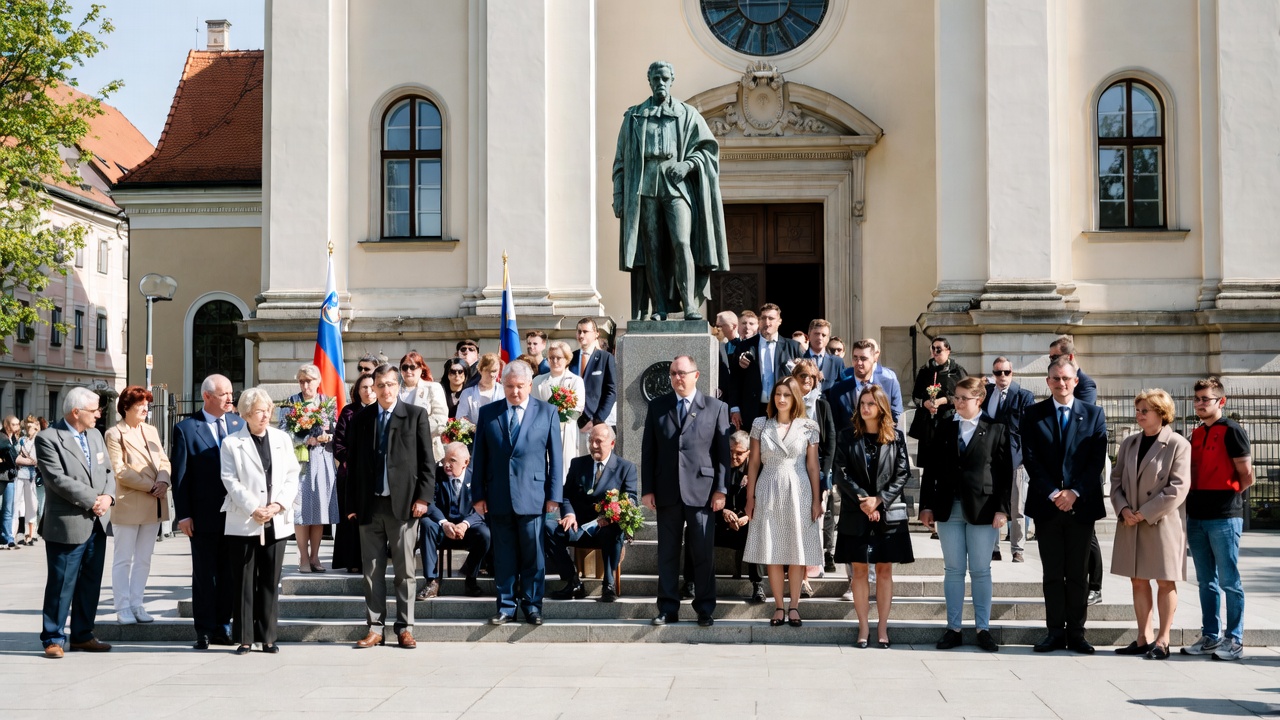
This is one of the few capital city squares in Europe that is named after a poet, not a politician or military leader. At its eastern edge stands the Prešeren Monument, a bronze statue unveiled in 1905 before a crowd of more than 20,000 people. The sculpture, designed by Ivan Zajec with a pedestal by the architect Max Fabiani, depicts the poet in formal attire, holding a book of his collected poems. Above him, a half-naked muse sits on a rock, extending a laurel branch over his head — a symbol of poetic inspiration.
The statue faces a specific direction with intention. Prešeren’s bronze gaze is fixed on the facade of a building across the square, on Wolfova Street, where a small bust of Julija Primic is mounted. Even in death, the poet is forever looking toward the woman he loved but could never have. This romantic detail has made the monument one of the most photographed spots in Ljubljana.
On Prešeren Day, the square becomes a gathering place for open-air poetry recitals. In the days leading up to the holiday, choirs and vocal groups perform at various locations that Prešeren himself once frequented in the city. The square’s proximity to Plečnik’s famous Triple Bridge (Tromostovje) and the Franciscan Church of the Annunciation creates a stunning backdrop for these performances.
The entire square and the monument were declared a cultural monument of national significance in June 1991 — the same month Slovenia declared its independence.
LUV Fest in Ljubljana: Where Prešeren Day Meets a Festival of Love and Art
Since 2023, Prešeren Day has served as the launch date for one of Ljubljana’s most exciting newer cultural events: LUV Fest, a festival of love, art, and wandering.
Organized by Ljubljana Tourism, LUV Fest runs from February 8 to March 12, bridging the gap between Prešeren Day and St. Gregory’s Day (Gregorjevo) — a traditional Slovenian holiday when, according to folk custom, birds choose their mates and spring begins to stir. The festival’s name, LUV, is a playful nod to the theme that connects all its events: love in all its forms — romantic, familial, artistic, and communal.
In 2026, LUV Fest returns for its fourth edition with a program that spans the city. Highlights include:
- Open-air art galleries installed along Ljubljana’s streets, turning the city into a walkable exhibition
- The “Brstenje” (Sprouting) light installation by artist Nika Erjavec on Čufarjeva Street, symbolizing the awakening of nature and the city
- The Art Vital exhibition at the Cukrarna Gallery, exploring the collaborative work and love story of performance artists Ulay and Marina Abramović
- A production of Wagner’s “Tristan and Isolde” at the Slovenian National Opera and Ballet
- Love-themed guided tours of Ljubljana, revealing the city’s hidden romantic stories — from Prešeren’s unrequited love to the scandalous affairs of Ljubljana’s historic residents
- Creative workshops for couples and families, including jewellery-making, pottery, and ring-forging classes
- The 9th Winter Festival of the Ljubljana Festival, offering a rich program of classical concerts featuring international pianists and chamber ensembles
- Themed culinary experiences at local restaurants and cafés
The festival concludes on March 12 with Gregorjevo, when Slovenians follow the centuries-old custom of floating small decorated boats called gregorčki down the Gradaščica stream — a symbolic gesture welcoming the arrival of spring.
LUV Fest has quickly earned international recognition. It received third place at the European Destination of Sustainable Cultural Tourism Award 2025 in the category of services for visitors and residents. For travelers visiting Ljubljana in February or early March, it transforms the city into one of the most culturally vibrant destinations in Central Europe.
Exploring Prešeren’s Birthplace in Vrba: A Cultural Heritage Trail in the Alps
For those who want to go deeper into the story of France Prešeren, there is no better place than Vrba na Gorenjskem — the tiny village in the foothills of Mount Stol where the poet was born.
Prešeren’s birth house (Prešernova rojstna hiša) has been turned into a memorial museum. It preserves the modest rural setting where the future national poet spent his earliest years. The house, once known locally as “Pr’ Ribč” (meaning “At the fisherman’s”), sits along the Žirovnica Cultural Heritage Trail — a 10-kilometer walking path that connects the birth houses and memorial sites of several important Slovenian cultural figures.
On Prešeren Day, this trail comes alive. Hundreds of visitors — locals and tourists alike — walk the path, stopping at each point to learn about life in early nineteenth-century Carniola. Guided walks, special lectures, and family-friendly activities make it a particularly rewarding experience on the holiday. While the trail is open year-round, there is something special about walking it on February 8, surrounded by fellow admirers of Slovenian heritage, with the snow-capped Alps as a backdrop.
The Žirovnica municipality embraces its identity as the cradle of Slovenian poetry. Beyond Prešeren’s birth house, the trail includes sites connected to Matija Čop, Prešeren’s great literary collaborator, and other figures who shaped the cultural life of this region.
What to Do on Prešeren Day: A Complete Guide for Visitors to Slovenia
Prešeren Day is one of the most rewarding days to be in Slovenia as a visitor, but it does require a bit of planning. Here is a practical guide to making the most of it.
Morning: Explore Free Museums
Start your day early, especially if you are in Ljubljana. Free museum entry draws large crowds, and the most popular institutions — the National Gallery, the Museum of Modern Art, and the City Museum — tend to fill up quickly. Many museums open at 10:00 AM.
Midday: Head to Kranj for the Prešeren Fair
If you can make it to Kranj (about 30 minutes from Ljubljana by car or train), the Prešeren Fair is the day’s most distinctive experience. The fair runs from 10:00 AM to 10:00 PM. Arrive before noon to catch the official opening and to enjoy the street food festival, Prešerna kuhna, at its freshest.
Tip: In past years, Kranj has offered free city bus transport on Prešeren Day, and discounted railway tickets for visitors traveling from Ljubljana.
Afternoon: Visit Prešeren Square and Attend a Recital
Back in Ljubljana, make your way to Prešeren Square for the open-air recitals. Choirs and vocal groups often perform in the days leading up to the holiday as well, so keep your ears open if you are in the city earlier in the week.
Evening: Watch the Award Ceremony
The Prešeren Award ceremony takes place on February 7 (the eve of the holiday) at Cankarjev dom and is broadcast live on national television. If you cannot attend in person, watching the broadcast in a local café or your accommodation is a uniquely Slovenian experience.
Things to Keep in Mind
| Detail | Information |
|---|---|
| Date | February 8 (every year) |
| 2026 Day of the Week | Sunday |
| Public Holiday? | Yes — work-free day |
| Shops and Supermarkets | Mostly closed |
| Museums and Galleries | Free entry nationwide |
| Key Locations | Ljubljana, Kranj, Vrba na Gorenjskem |
| Weather | Cold; expect temperatures around 0–5°C. Dress warmly. |
December 3: Slovenia’s “Other” Prešeren Holiday You Should Know About
Many visitors are surprised to learn that Slovenia has not one, but two annual celebrations connected to France Prešeren.
In addition to Prešeren Day on February 8, Slovenians also observe “This Happy Day of Culture” (Ta veseli dan kulture) on December 3, the anniversary of Prešeren’s birth. While this date is not an official public holiday and is not a work-free day, it has grown in popularity over the years and is now almost equally celebrated alongside the February holiday.
On December 3, most of Slovenia’s cultural institutions once again open their doors for free. Museums stay open late — sometimes until midnight or even later — and special educational events, lectures, concerts, and workshops take place across the country.
The name of the celebration, “This Happy Day,” is itself a line from Prešeren’s poetry. It reflects the more optimistic, forward-looking tone of the December celebration. While February 8 carries the solemn weight of remembering the poet’s death, December 3 is a joyful occasion — a birthday party for the nation’s cultural identity.
Together, the two dates create a cultural bookend for the Slovenian year: one in the dark of early February, one in the festive season of early December. Both serve as reminders that, for a nation of just over two million people, culture is not an afterthought. It is a foundation.
Why Prešeren Day Matters: Culture as the Foundation of Slovenian National Identity
It is worth stepping back to consider what it means that a nation defines itself not through military victories or economic might, but through poetry.
Slovenia is a young country — it declared independence only in 1991. Yet its cultural identity stretches back centuries, rooted in a language that has survived the rule of the Holy Roman Empire, the Habsburg monarchy, Napoleon’s Illyrian Provinces, and Tito’s Yugoslavia. For much of that history, Slovenians had no sovereign state, no army, no seat at the table of European nations. What they had was their language. And the person who proved, beyond any doubt, that the Slovenian language could stand alongside Italian, German, French, and English as a vehicle for the highest forms of literary expression was France Prešeren.
That is why Prešeren Day is not just a cultural footnote. It is a declaration of identity. When Slovenians mark this holiday, they are affirming that their nation exists because their culture endures. The Prešeren Awards remind the country that artistic creation is not a luxury — it is the very engine of national consciousness.
As scholars have noted, Prešeren is to Slovenians what Goethe is to Germans, Dante to Italians, Pushkin to Russians, and Robert Burns to Scots. But there is a key difference. For those larger nations, the national poet is one pillar among many — a cultural figure in a country defined by empires, revolutions, and global influence. For Slovenians, the poet is not merely one pillar. He is, in many ways, the foundation itself.
That is what makes Prešeren Day more than a holiday. It is a living answer to a question every small nation must face: What makes us who we are?
Planning Your Trip to Slovenia for Prešeren Day 2026
If the idea of spending February 8 in Slovenia appeals to you, here are some practical tips for planning your visit.
Getting There: Ljubljana is well connected by air through Ljubljana Jože Pučnik Airport (LJU), with direct flights from major European cities including London, Paris, Frankfurt, Munich, Istanbul, and Brussels. The city is also easily reachable by train from Vienna (approximately 6 hours), Venice (about 4 hours), and Zagreb (about 2.5 hours).
Where to Stay: Ljubljana offers a wide range of accommodation, from boutique hotels in the old town to hostels and apartments. During the first week of February, many hotels participate in LUV Fest with special packages and promotions. Book early — the combination of the holiday and the festival increases demand.
Getting Around: Ljubljana’s compact old town is entirely walkable. For the trip to Kranj, take a direct train from Ljubljana’s central station (about 25 minutes) or rent a car. Vrba na Gorenjskem is best reached by car and is roughly a 45-minute drive from Ljubljana.
Language: Slovenian is the official language, but English is widely spoken, especially in Ljubljana and among younger generations. Learning a few basic Slovenian phrases — hvala (thank you), prosim (please), and dober dan (good day) — will be warmly appreciated.
Currency: Slovenia uses the euro (€).
What to Bring: February in Slovenia is cold. Average temperatures hover between 0°C and 5°C (32–41°F), and snow is possible, especially in the Alpine regions around Kranj and Vrba. Pack warm layers, waterproof shoes, and a good coat.
Frequently Asked Questions About Prešeren Day in Slovenia
Is Prešeren Day a public holiday in Slovenia? Yes. February 8 is an official public holiday and a work-free day. Most businesses, shops, and supermarkets are closed.
Are museums really free on Prešeren Day? Yes. All state and municipal museums and galleries across Slovenia offer free admission on February 8.
What happens at the Prešeren Fair in Kranj? The Prešeren Fair transforms Kranj’s old town into a nineteenth-century street festival, with costumed performers, traditional crafts, food stalls, poetry recitals, choir performances, and carriage rides. It draws more than 20,000 visitors annually.
Can I visit Prešeren’s birthplace? Yes. Prešeren’s birth house in Vrba na Gorenjskem is open to visitors as a memorial museum. The Žirovnica Cultural Heritage Trail connects it to other important sites in the region.
What is the LUV Fest? LUV Fest is a festival of love, art, and wandering that takes place in Ljubljana from February 8 to March 12. It features art installations, concerts, workshops, guided tours, and culinary experiences, all under the theme of love.
Who receives the Prešeren Award? The Prešeren Award is Slovenia’s highest honor for artistic achievement. Up to two Grand Prešeren Awards and six Prešeren Fund Awards are given annually at a ceremony on February 7 at Cankarjev dom in Ljubljana.
Is February a good time to visit Slovenia? Yes, especially around Prešeren Day and the LUV Fest. The weather is cold but the cultural calendar is exceptionally rich. Free museum days, the Prešeren Fair, and the festival atmosphere make it a unique time to experience the country.
Final Thoughts: Celebrating a Poet Who Built a Nation
There is a word in Slovenian that captures the spirit of this holiday perfectly: prešeren — which, beyond being the poet’s surname, also means “happy” or “cheerful” in everyday Slovenian.
On February 8, Slovenia is prešeren in every sense of the word. The nation is happy to honor its greatest poet. It is cheerful in its celebration of art, language, and identity. And it is profoundly grateful for the stubborn, lovesick, brilliant man who proved — in verse after unforgettable verse — that a small language spoken by a small people could carry the weight of the greatest poetry in Europe.
Whether you find yourself in the grand halls of a Ljubljana museum, at a craft stall in snowy Kranj, or walking the Alpine trails near Vrba with a book of sonnets in your hand, you will feel it: the deep, unshakeable conviction that culture is not a luxury. It is the very reason a nation exists.
Živijo! — Cheers. And happy Prešeren Day.
Have you experienced Prešeren Day in Slovenia? Share your story in the comments below. For more guides on European cultural festivals and hidden holiday traditions, explore the rest of our blog.