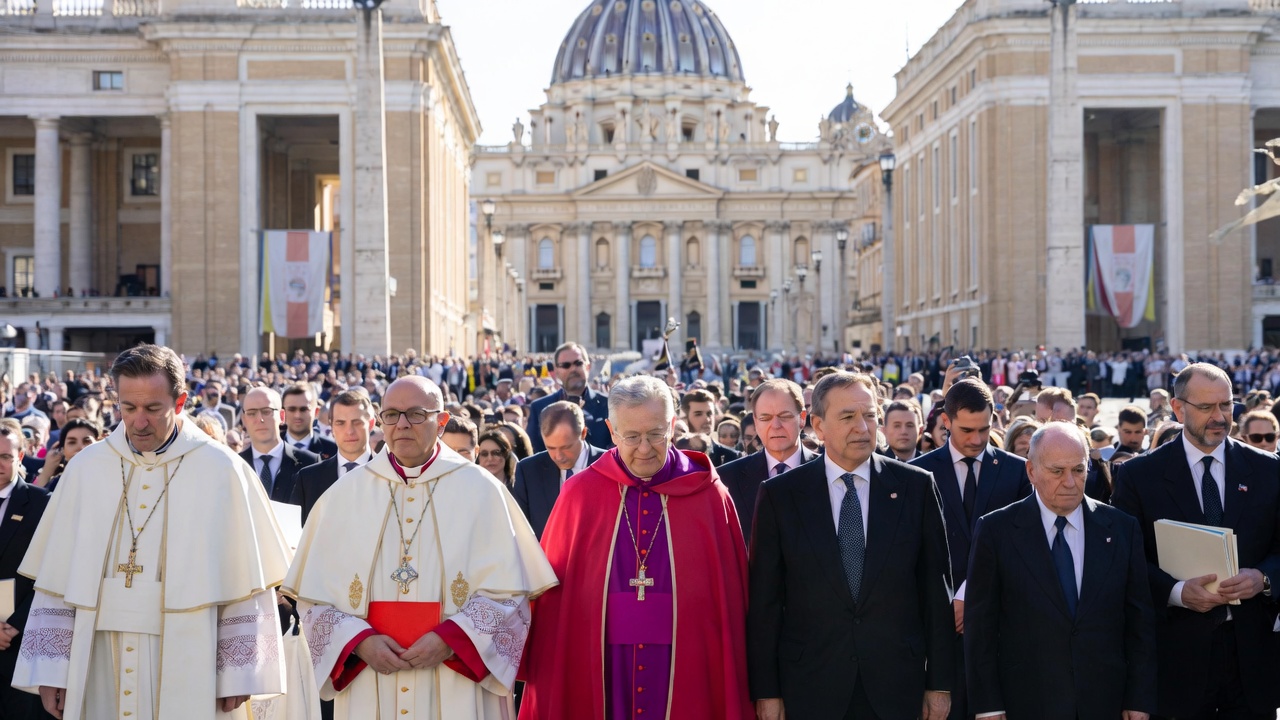
If you walk down the grand Via della Conciliazione in Rome today, you see a wide, sunlit boulevard stretching from the Castel Sant’Angelo straight to St. Peter’s Square. Tourists snap photos. Pilgrims clutch rosaries. Souvenir vendors hawk postcards. It all feels timeless, as though this view of St. Peter’s dome has existed since the Renaissance.
It has not. That avenue did not exist before 1936. And the reason it was built — the reason Vatican City exists as a sovereign nation at all — traces back to a single rainy Monday in February 1929. On that day, inside the Lateran Palace, two men signed a set of agreements that ended nearly sixty years of hostility between the Italian state and the Catholic Church. One was a Fascist dictator. The other was a cardinal acting on behalf of the Pope. Together, they redrew the political, spiritual, and physical map of Rome in ways still felt today.
This is the story of the Lateran Treaty — what led to it, what it contained, and how it permanently transformed the Eternal City.
What Was the Roman Question That Led to the Lateran Treaty?
To understand the Lateran Treaty, you must first understand the crisis it resolved. That crisis had a name: the Roman Question (La Questione Romana).
For over a thousand years, the Pope governed a large swath of central Italy known as the Papal States. These territories included not just Rome but stretched across Romagna, Umbria, the Marche, and parts of Emilia. The Pope was both a spiritual leader and a temporal king. He held armies. He collected taxes. He ran a government.
Then came the Risorgimento — the 19th-century movement to unify the Italian peninsula into a single nation. One by one, the Papal States fell. In 1860, the Kingdom of Sardinia absorbed Romagna and the eastern papal territories. And on September 20, 1870, Italian troops under General Raffaele Cadorna breached the walls at the Porta Pia and captured Rome itself. Pope Pius IX lost his last remaining stronghold.
The newly unified Kingdom of Italy made Rome its capital. But the Pope refused to accept this. Pius IX called himself a “prisoner of the Vatican” and retreated behind the walls of the papal palace. He would not set foot on Italian-controlled soil. He forbade Catholics from participating in Italian political life through a directive called the non expedit.
In 1871, the Italian government tried to smooth things over. It passed the Law of Guarantees, which offered the Pope the use of the Vatican and Lateran palaces, sovereign honors, and an annual payment of 3.25 million lire. The Pope rejected every bit of it. He viewed it as a unilateral gesture — not a negotiation between equals. Accepting it would mean acknowledging that Italy had lawful authority over Rome.
For 59 years, this standoff persisted. Five Popes in a row considered themselves prisoners. The Church and the Italian state existed in a condition of mutual non-recognition. The impact was not just symbolic. During World War I, foreign ambassadors accredited to the Holy See could not maintain their embassies in Rome because Italy could not guarantee their diplomatic independence. The Pope’s ability to conduct international relations was crippled.
Something had to give. By the 1920s, both sides had compelling reasons to negotiate.
Why Did Mussolini and Pope Pius XI Agree to Negotiate?
The two men who made the Lateran Treaty possible were an unlikely pair: Benito Mussolini, Italy’s Fascist prime minister, and Pope Pius XI, elected to the papacy in 1922.
Mussolini needed the Church. His Fascist regime, which he consolidated after the 1922 March on Rome, sought total control over Italian society. But Italy was overwhelmingly Catholic. Mussolini could not afford to alienate the Church — especially not while he feared communist influence among the working class. A deal with the Vatican would give his government moral legitimacy and broad popular support.
Pius XI needed independence. He understood that the Pope’s spiritual mission required genuine freedom from any state’s political authority. The humiliation of World War I — when foreign diplomats could not safely operate near the Vatican — proved that the status quo was untenable. Pius XI signaled his openness from the very start of his papacy. At his coronation in February 1922, he appeared on the outer balcony of St. Peter’s to bless the crowds gathered in the square. No Pope had done so since 1870. It was a deliberate gesture of reconciliation.
Secret negotiations began in 1926. Mussolini appointed the Italian diplomat Domenico Barone as his envoy. The Pope chose Francesco Pacelli — a Vatican lawyer and the brother of the future Pope Pius XII. For three years, they met behind closed doors, hammering out terms.
By early 1929, a deal was in place. The formal signing took place on February 11, 1929, at the Lateran Palace — chosen as neutral ground, belonging neither to the Vatican nor to the Italian government’s Quirinal Palace. The signatories were Cardinal Pietro Gasparri, the Vatican Secretary of State, and Benito Mussolini, acting on behalf of King Victor Emmanuel III.
The Italian parliament ratified the agreements on June 7, 1929.
What Are the Three Parts of the Lateran Pacts of 1929?
The Lateran Treaty is often spoken of as a single document. In reality, the Lateran Pacts comprised three distinct agreements, each addressing a different dimension of the Church-state relationship.
1. The Treaty of Conciliation (27 Articles)
This was the political heart of the agreement. Its key provisions included:
- Vatican City was recognized as an independent sovereign state under the full authority of the Holy See. At roughly 44 hectares (109 acres), it became — and remains — the smallest internationally recognized independent state in the world.
- Italy recognized the Pope’s sovereignty over this territory and guaranteed that it would never be violated.
- The Pope, in turn, recognized the Kingdom of Italy with Rome as its capital. He declared the Roman Question “definitively and irrevocably settled.”
- The Pope pledged perpetual neutrality in international conflicts and agreed not to mediate disputes unless all parties invited him to do so.
- Italy affirmed, in Article 1, that “the Catholic, Apostolic and Roman Religion is the only religion of the State.”
- Certain properties outside Vatican City — including the patriarchal basilicas of St. John Lateran, Santa Maria Maggiore, and St. Paul Outside the Walls — were granted extraterritorial status, meaning they were owned by the Holy See but located on Italian soil.
- The Vatican was granted the right to issue its own coinage and postage stamps, maintain diplomatic missions, and operate its own railway station, telegraph, and telephone systems.
2. The Financial Convention (3 Articles)
This settled the Vatican’s financial claims. Under its terms:
- Italy agreed to pay the Holy See 750 million lire in cash upon ratification.
- Italy also issued Italian government bonds valued at 1 billion lire, bearing 5% annual interest.
- The Holy See accepted this as full and final compensation for the loss of the Papal States and all associated properties seized since 1870.
Remarkably, this sum was actually less than what Italy had offered back in 1871 through the rejected Law of Guarantees. But by 1929, the Pope was more interested in sovereignty than in money. The financial settlement became the seed capital for what eventually grew into the Vatican’s modern financial infrastructure, including the Institute for the Works of Religion — commonly known as the Vatican Bank, established in 1942.
3. The Concordat (45 Articles)
The concordat regulated the day-to-day relationship between the Catholic Church and the Italian state. It covered an enormous range of topics:
- Catholicism was confirmed as Italy’s state religion.
- Religious education was made mandatory in Italian public schools.
- Church marriages were given automatic civil legal validity — meaning a Catholic wedding did not require a separate civil ceremony.
- The Italian state agreed to enforce canon law regarding marriage, including restrictions on divorce.
- Catholic clergy were exempted from military service and jury duty.
- The government pledged to prevent any activity in Rome “at variance with the city’s sacred character.”
- Anti-clerical laws passed during the Risorgimento era were revoked.
- Bishops were required to swear an oath of loyalty to the Italian state before taking office.
The concordat was by far the most controversial component. While the treaty and financial convention were largely accepted, the concordat’s sweeping privileges for the Catholic Church drew sharp criticism from secularists, religious minorities, and political liberals.
| Component | Articles | Key Provision |
|---|---|---|
| Treaty of Conciliation | 27 | Created Vatican City as a sovereign state |
| Financial Convention | 3 | Paid 750 million lire + 1 billion in bonds |
| Concordat | 45 | Made Catholicism the state religion of Italy |
How the Lateran Treaty Physically Transformed the Streets of Rome
The Lateran Treaty did not just redraw political boundaries on paper. It reshaped the physical city of Rome in dramatic and permanent ways. The most visible transformation was the construction of the Via della Conciliazione — the Road of Reconciliation.
The Building of the Via della Conciliazione in Rome
To celebrate the agreement, Mussolini commissioned a grand boulevard linking St. Peter’s Square to the banks of the Tiber River. This was no modest street-widening project. It required the demolition of an entire historic neighborhood: the Borgo district, one of Rome’s oldest residential quarters.
The Borgo’s dense tangle of medieval streets, Renaissance palaces, and baroque churches had stood for nearly 500 years. The neighborhood was known as the Spina di Borgo — the “spine” of buildings between two parallel streets that ran toward St. Peter’s. When Gian Lorenzo Bernini designed the sweeping colonnades of St. Peter’s Square in the 1660s, the Spina blocked the view of the basilica from the Tiber. This was deliberate. Bernini intended pilgrims to experience a sudden, breathtaking revelation as they emerged from the narrow streets into the vast piazza.
Mussolini had no interest in such subtlety. He wanted a monumental axis — a straight, wide avenue that would visually connect the Italian capital to the Vatican. The architects Marcello Piacentini and Attilio Spaccarelli were given the job.
Construction began in 1936. Workers demolished churches, palaces, and hundreds of residential buildings. The Palazzo dei Convertendi, the Church of San Giacomo Scossacavalli, and the Palazzo Alicorni were among the casualties. Some structures, like the Palazzo dei Convertendi and the house of Giacomo da Brescia, were dismantled and rebuilt elsewhere. Others were simply destroyed.
The human cost was steep. According to research published in Selva: A Journal of the History of Art, the construction of the Via della Conciliazione displaced 1,236 families — a total of 4,992 people. These residents, many of them working-class Romans, were relocated to settlements (borgate) on the outskirts of the city. An entire community was uprooted so that a dictator could build a symbolic road.
The avenue was finished just in time for the Holy Year of 1950, when the final obelisk-shaped lamp posts were installed. Today, the Via della Conciliazione is roughly 500 meters long and serves as the primary approach to St. Peter’s Square. It is one of the most photographed streets in Europe. But among historians and architects, it remains deeply controversial — a reminder that grand urban projects often come with hidden costs.
How Fascist Urban Planning Remade Rome’s Historic Center
The Via della Conciliazione was only one piece of Mussolini’s broader campaign to remake Rome. The Fascist regime carried out a series of sventramenti — literally, “disembowelments” — across the city center. These were large-scale demolition projects aimed at uncovering ancient Roman ruins and creating wide ceremonial avenues.
Other notable projects included:
- Via dell’Impero (now Via dei Fori Imperiali), built in 1932, cutting through archaeological sites to connect the Colosseum to Piazza Venezia.
- Piazza Augusto Imperatore, cleared in 1937 around the Mausoleum of Augustus.
- The restoration and isolation of the Castel Sant’Angelo.
In each case, the goal was ideological. Mussolini wanted to draw a visual line between ancient imperial Rome and his Fascist state. The destruction of medieval and Renaissance neighborhoods was not a side effect — it was the point. As art historian Antonio Muñoz argued at the time, in the capital “only great voices should resonate” and “all that is small and wretched should disappear.”
The Lateran Treaty provided both the political justification and the occasion for the most symbolically charged of these projects. Without the reconciliation between Church and state, there would have been no Via della Conciliazione.
How the Lateran Treaty Affected Religious Freedom and Minorities in Italy
The Lateran Treaty’s impact extended well beyond the Catholic Church. By making Catholicism the sole state religion and granting the Church broad legal privileges, the agreements restricted the rights of religious minorities in ways that had lasting consequences.
Impact on Italian Jews and Protestant Communities
Before the Lateran Pacts, Italy’s liberal constitution — forged during the Risorgimento — had guaranteed equality for all citizens regardless of religion. Italian Jews, in particular, had thrived under this framework. They held seats in parliament, served as government ministers, and occupied prominent positions in academia, science, and the arts. Italy had even had two Jewish prime ministers.
The concordat changed this. By declaring Catholicism the state religion, the Pacts relegated Jews, Waldensians, and other Protestants to the status of “accepted cults” (culti ammessi). Their legal standing was diminished. They could no longer rely on a purely secular legal framework to protect their religious freedom.
The most damaging intersection came in 1938, when Mussolini’s government enacted racial laws prohibiting marriages between Jews and non-Jews. The Vatican viewed this as a violation of the concordat — specifically, Article 34, which gave the Church sole authority over marriages involving Catholics. But despite protests from the Holy See, the racial laws remained in force.
The concordat’s legacy for religious minorities is a complex and painful chapter. It demonstrates how agreements designed to serve one religious community can inadvertently — or deliberately — marginalize others.
How the 1984 Concordat Revision Modernized Church-State Relations in Italy
The original concordat of 1929 was a product of its era — negotiated between a Fascist regime and a pre-Vatican II Church. By the 1980s, both Italy and the Catholic Church had transformed dramatically. Italian society had secularized. The Second Vatican Council (1962–1965) had embraced religious freedom and rethought the Church’s relationship with modern states. Divorce had been legalized in Italy in 1970, despite Church opposition.
Negotiations to revise the concordat began in 1976 and continued for eight years. The result was the Agreement of Villa Madama, signed on February 18, 1984, by Italian Prime Minister Bettino Craxi and Vatican Secretary of State Cardinal Agostino Casaroli.
Key Changes in the 1984 Villa Madama Agreement
The revised concordat was much shorter than the original — 14 articles compared to the original 45 — and it reflected a fundamentally different vision of Church-state relations.
| Provision | 1929 Concordat | 1984 Revision |
|---|---|---|
| State religion | Catholicism was the sole state religion | Catholicism was no longer the state religion |
| Religious education | Mandatory in schools | Optional — students could opt out |
| Bishop appointments | Required state approval | Church was free to appoint bishops without state involvement |
| Clergy oath | Bishops swore loyalty to the state | Oath requirement removed |
| Marriage law | Church marriages automatically valid; no civil divorce | Church marriages still civilly valid, but civil annulments required state court approval |
| Church tax | State funded Church directly | Otto per mille system introduced — taxpayers allocate 0.8% of income tax to the Church or other designated institutions |
| Noble titles | State recognized papal knighthoods | Recognition of papal titles ended |
The revision also opened the door for Italy to negotiate agreements (intese) with other religious communities — including Waldensians, Jews, Seventh-day Adventists, Lutherans, and others. This was a significant step toward genuine religious pluralism.
Pope John Paul II, speaking in St. Peter’s Square the day after the signing, called the new concordat “an important juridical basis for bilateral peaceful relations.” Pope Benedict XVI later praised the “healthy secularity” it introduced. And Pope Francis has spoken of a “positive secularity” that allows the Church and the state to cooperate on shared values without institutional entanglement.
The core territorial provisions of the Lateran Treaty, however, remained untouched. Vatican City’s sovereignty, its borders, and the extraterritorial status of key buildings were not altered. The 1984 revision modernized the relationship between Church and state, but the existence of Vatican City as an independent nation was never in question.
In February 2024, Italy and the Vatican jointly issued a commemorative stamp marking the 40th anniversary of the Villa Madama Agreement — a sign of the enduring importance both parties place on this revised framework.
Why the Lateran Treaty Still Matters for Vatican City Tourism Today
The Lateran Treaty did not just settle a diplomatic dispute. It created the conditions for one of the world’s most visited destinations. Every year, millions of tourists and pilgrims pass through the gates of Vatican City — a sovereign state that exists only because of what happened in 1929.
Vatican City as the World’s Smallest Sovereign State
Vatican City covers just 44 hectares — roughly one-eighth the size of New York’s Central Park. Yet within this tiny territory sits St. Peter’s Basilica, the world’s largest church; the Sistine Chapel, home to Michelangelo’s ceiling; and the Vatican Museums, which house one of the most important art collections on earth.
None of this would function as it does without sovereignty. Because Vatican City is an independent state, the Pope can:
- Receive and send ambassadors to nearly every country in the world.
- Issue passports, coinage, and stamps.
- Operate an independent postal service, radio station (Vatican Radio), and newspaper (L’Osservatore Romano).
- Maintain its own legal system and security force (the Swiss Guard and the Vatican Gendarmerie Corps).
- Enter into international treaties and maintain observer status at the United Nations.
For tourists, the practical implications are concrete. When you cross the white line on the ground at the edge of St. Peter’s Square, you are leaving Italy and entering a foreign country. Italian police cannot follow you there. Italian laws do not apply. The Vatican has its own customs and its own jurisdiction.
How the Jubilee Year 2025 Showcased the Treaty’s Enduring Legacy
The most dramatic recent demonstration of the Lateran Treaty’s ongoing relevance came during the Jubilee Holy Year 2025 — a once-in-a-generation event that ran from December 24, 2024, to January 6, 2026.
Jubilee years are part of a Catholic tradition dating to 1300, when Pope Boniface VIII first invited the faithful to Rome for spiritual renewal. Since 1450, ordinary Jubilees have occurred every 25 years. The 2025 Jubilee, proclaimed by Pope Francis under the theme “Pilgrims of Hope” (Peregrinantes in Spem), was the most recent.
The numbers speak for themselves. According to Vatican officials, an estimated 33 million visitors from 185 countries came to Rome during the Jubilee year — exceeding the original forecast of 30 to 35 million. The city of Rome welcomed about 22 million visitors in 2024, making the Jubilee year’s total a dramatic leap.
Italian pilgrims made up the largest group, accounting for 36% of registered visitors. Americans came second at 13%, followed by Spaniards at 6%.
To accommodate this massive influx, the Italian government and the city of Rome completed 110 construction projects, including the restoration of historic piazzas, monuments, and holy sites. The pilgrimage route itself began at Piazza Pia — the area between Castel Sant’Angelo and the start of the Via della Conciliazione — and proceeded down the very road that Mussolini built to celebrate the Lateran Treaty.
Think about that for a moment. The infrastructure that made the Jubilee possible — the avenue, the diplomatic arrangements, the sovereign status of the Vatican — all traces directly to the agreements signed in 1929. Without the Lateran Treaty, there would be no Vatican City to host the Jubilee. Without the Via della Conciliazione, there would be no processional route for millions of pilgrims.
Vatican leaders have already announced that planning has begun for the next Jubilee Year in 2033, which will mark the 2,000th anniversary of the death and resurrection of Jesus. The Lateran Treaty’s framework will once again undergird this massive global event.
How February 11 Is Commemorated as a Holiday in Vatican City
In Vatican City, February 11 is a national holiday. It marks the anniversary of the signing of the Lateran Pacts and is known as the Anniversary of the Foundation of Vatican City State.
Each year, the Italian Embassy to the Holy See hosts a high-ranking reception attended by senior officials from both Italy and the Vatican. This annual gathering — a diplomatic tradition stretching back decades — serves as a reminder that the relationship formalized in 1929 requires constant maintenance and goodwill.
The date also holds religious significance. February 11 is the feast day of Our Lady of Lourdes, commemorating the Marian apparitions reported in France in 1858. In the Catholic calendar, it is associated with healing and hope — themes that resonated with the “reconciliation” narrative that both the Vatican and Italy promoted in 1929.
For visitors in Rome around this date, the commemoration provides a unique window into the relationship between the two sovereign entities that share this ancient city.
What Travelers Should Know About the Lateran Treaty Sites in Rome
If you are planning a trip to Rome, you can still visit many of the places directly connected to the Lateran Treaty and its aftermath. Here are the most important sites:
The Lateran Palace and Basilica of St. John Lateran
This is where the treaty was signed. The Archbasilica of St. John Lateran (San Giovanni in Laterano) is actually the Pope’s cathedral — not St. Peter’s, as many assume. It is the oldest of Rome’s four major papal basilicas, dating to the 4th century under Emperor Constantine.
The adjoining Lateran Palace was the papal residence for nearly a thousand years before the Popes moved to the Vatican. Today it houses the Vicariate of Rome. Under the Lateran Treaty, this complex enjoys extraterritorial status — meaning it is owned by the Holy See and is not subject to Italian law.
Getting there: Take Metro Line A to the San Giovanni stop. The basilica is free to enter.
St. Peter’s Basilica and Vatican City
The treaty’s most important creation. Vatican City’s 44 hectares are entirely surrounded by Rome. You can enter St. Peter’s Square freely — no passport or visa is required. But you are standing on foreign soil.
The Vatican Museums require advance booking, especially during peak seasons. During the 2025 Jubilee, the museums extended hours and introduced a new guided tour called “Pilgrims of Hope.”
The Via della Conciliazione
Walk the entire length, from Castel Sant’Angelo to St. Peter’s Square. As you do, remember what was here before: a medieval neighborhood with 500 years of history, demolished in the 1930s and 1940s to create this ceremonial approach.
Look for the surviving historical buildings along the route: the Palazzo Torlonia, the Church of Santa Maria in Traspontina, the Palazzo dei Penitenzieri, and the Palazzo Serristori.
Santa Maria Maggiore and St. Paul Outside the Walls
These two patriarchal basilicas, along with St. John Lateran, were granted extraterritorial status under the Lateran Treaty. They remain Holy See property on Italian soil — a unique legal arrangement that exists nowhere else in the world.
| Site | Treaty Connection | Visitor Tip |
|---|---|---|
| Lateran Palace | Signing location of the 1929 treaty | Visit the adjoining basilica and cloister |
| Vatican City | Created as sovereign state by the treaty | Book Vatican Museum tickets in advance |
| Via della Conciliazione | Built to celebrate the treaty | Walk from Castel Sant’Angelo to St. Peter’s |
| Santa Maria Maggiore | Extraterritorial status under the treaty | Free entry; stunning 5th-century mosaics |
| St. Paul Outside the Walls | Extraterritorial status under the treaty | Less crowded than other basilicas |
The Controversial Legacy of the Lateran Treaty in Modern Italian Society
Nearly a century after its signing, the Lateran Treaty continues to provoke debate. Its admirers call it a masterpiece of diplomatic compromise — a solution that gave the Pope independence without requiring the restoration of a papal kingdom, and that gave Italy a unified capital without perpetual conflict with the Church. Its critics point to a more complicated legacy.
Criticisms From Secular and Liberal Perspectives
From the beginning, Italian secularists objected to the concordat’s sweeping privileges for the Catholic Church. The philosopher Benedetto Croce was among the most prominent voices in the Italian Senate to vote against ratification. He argued that the Pacts surrendered too much of the liberal, secular state that the Risorgimento had worked so hard to build.
The concordat’s effects on marriage law were particularly contentious. By giving automatic civil validity to Church marriages and, in effect, prohibiting divorce, the concordat imposed Catholic moral standards on the entire population — including non-Catholics. This situation persisted until 1970, when Italy legalized divorce over fierce Church opposition.
Similarly, the 1929 concordat’s impact on religious minorities — particularly Italian Jews — left a painful mark. The demotion of non-Catholic religions to the status of “accepted cults” foreshadowed the deeper marginalization that would come with Mussolini’s racial laws of 1938.
The Fascist Propaganda Dimension
There is no escaping the fact that the Lateran Treaty was a propaganda triumph for Mussolini. By resolving the Roman Question — something no Italian leader had managed in nearly six decades — he positioned himself as a historical figure of the first order. The regime exploited the agreement relentlessly, using it to legitimize Fascist rule in the eyes of Catholic Italians.
The Via della Conciliazione, too, was a propaganda instrument. It was part of Mussolini’s broader vision to remake Rome into a city that would rival its ancient imperial grandeur. The demolition of working-class neighborhoods served Fascist ideology by displacing populations deemed incompatible with the regime’s monumental vision.
Enduring Positive Outcomes
At the same time, the Lateran Treaty produced genuinely positive results that outlasted Fascism:
- Vatican City’s sovereignty has allowed the Holy See to operate as an independent moral voice in international affairs — during the Cold War, in peace negotiations, and in advocacy on global issues from poverty to climate change.
- The treaty’s framework survived the fall of Fascism, World War II, and the transition to the Italian Republic. Its incorporation into the 1948 Italian Constitution (Article 7) ensured continuity.
- The 1984 revision demonstrated that the framework was adaptable — able to evolve with changing social values while preserving its core architectural achievement: Vatican sovereignty.
Visiting Rome in 2026: Understanding the City Through Its Church-State History
If you visit Rome in 2026, you are arriving just after the close of the extraordinary Jubilee Year. The city has been refreshed — monuments cleaned, piazzas restored, new metro infrastructure completed. But more importantly, the Jubilee has reminded the world of something the Lateran Treaty made possible: Rome’s unique dual identity as the capital of Italy and the center of the Catholic world.
No other city on earth contains within its boundaries a fully independent sovereign state belonging to a global religious institution. This arrangement — born from conflict, negotiated in secrecy, signed under a Fascist government, tested by war, revised in a democratic age, and celebrated during a holy year — is the Lateran Treaty’s greatest legacy.
When you stand in St. Peter’s Square and look back down the Via della Conciliazione toward the Tiber, you are looking at nearly a century of history in a single glance. The ancient Castel Sant’Angelo, built as a Roman emperor’s tomb. The wide avenue, carved through a medieval neighborhood by a dictator’s ambition. The obelisks, installed for a postwar Jubilee. The basilica dome, rising above it all, the spiritual and political center of a tiny sovereign state.
All of it traces back to February 11, 1929. All of it exists because of the Lateran Treaty.
Frequently Asked Questions About the Lateran Treaty and Vatican City
What is the Lateran Treaty in simple terms? The Lateran Treaty is the 1929 agreement between Italy and the Catholic Church that created Vatican City as an independent country and ended a 59-year dispute over the Pope’s political status.
When was the Lateran Treaty signed? It was signed on February 11, 1929, at the Lateran Palace in Rome. It was ratified by the Italian parliament on June 7, 1929.
Who signed the Lateran Treaty? Cardinal Pietro Gasparri signed for the Holy See, and Benito Mussolini signed for the Kingdom of Italy, on behalf of King Victor Emmanuel III.
Is the Lateran Treaty still in effect today? Yes. The core treaty — which established Vatican City’s sovereignty — remains in force. The concordat portion was significantly revised in 1984 through the Agreement of Villa Madama.
How big is Vatican City? Vatican City covers approximately 44 hectares (109 acres). It is the smallest internationally recognized independent state in the world.
Why is February 11 important in Vatican City? It is the anniversary of the signing of the Lateran Pacts and is observed as a national holiday in Vatican City, marking the foundation of the state.
How much money did Italy pay the Vatican under the Lateran Treaty? Italy paid 750 million lire in cash plus 1 billion lire in government bonds at 5% interest. This was compensation for the loss of the Papal States.
What was changed in the 1984 revision of the Lateran Treaty? The biggest change was that Catholicism was no longer the state religion of Italy. Religious education became optional, the Church gained freedom to appoint bishops without state approval, and a new tax system (otto per mille) was introduced.
Further Reading and Resources
For those who want to explore this topic more deeply, the following resources provide excellent starting points:
- The full text of the Lateran Treaty is available at the Holy See’s official website.
- Britannica’s entry on the Lateran Treaty provides a concise historical overview.
- The Italian Embassy to the Holy See publishes a detailed history of bilateral relations.
- For the urban history of the Via della Conciliazione, the academic article published in Selva: A Journal of the History of Art offers an in-depth analysis of Fascist urbanism and its social costs.
This article was last updated in February 2026. All historical dates, figures, and treaty provisions have been verified against primary sources and reputable academic references. The author has visited and reported from Rome, Vatican City, and the Lateran Palace.