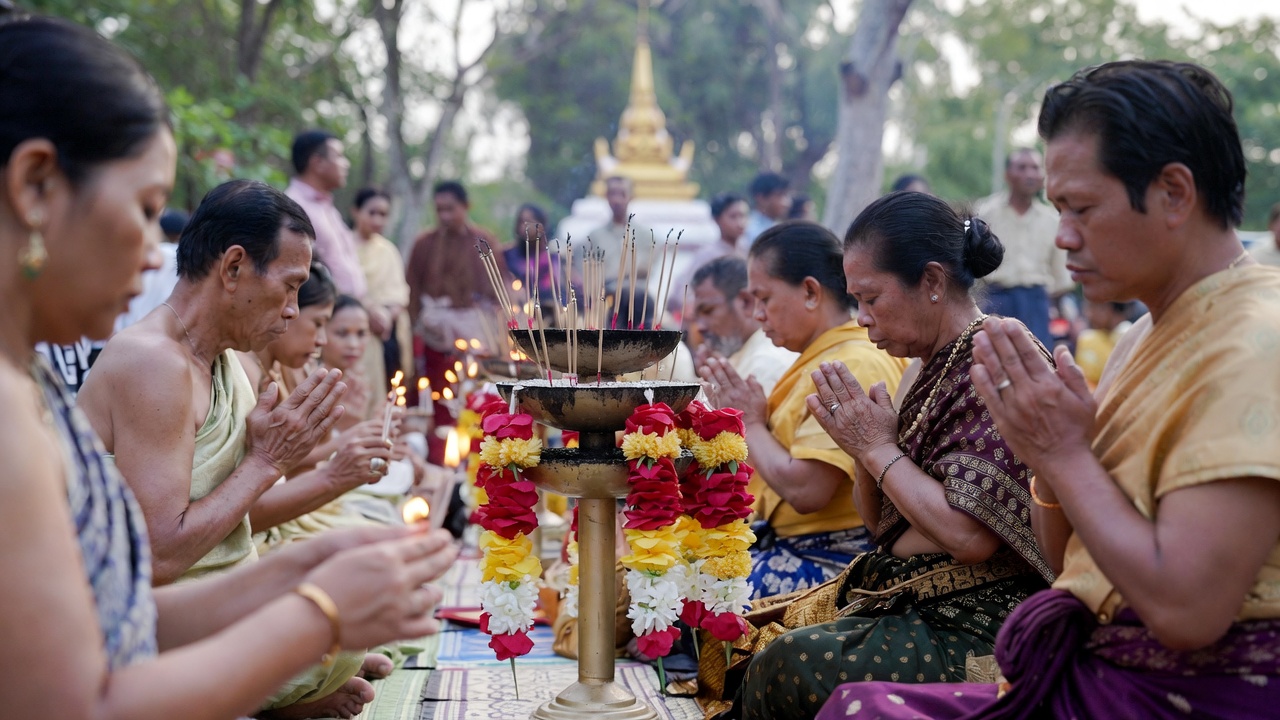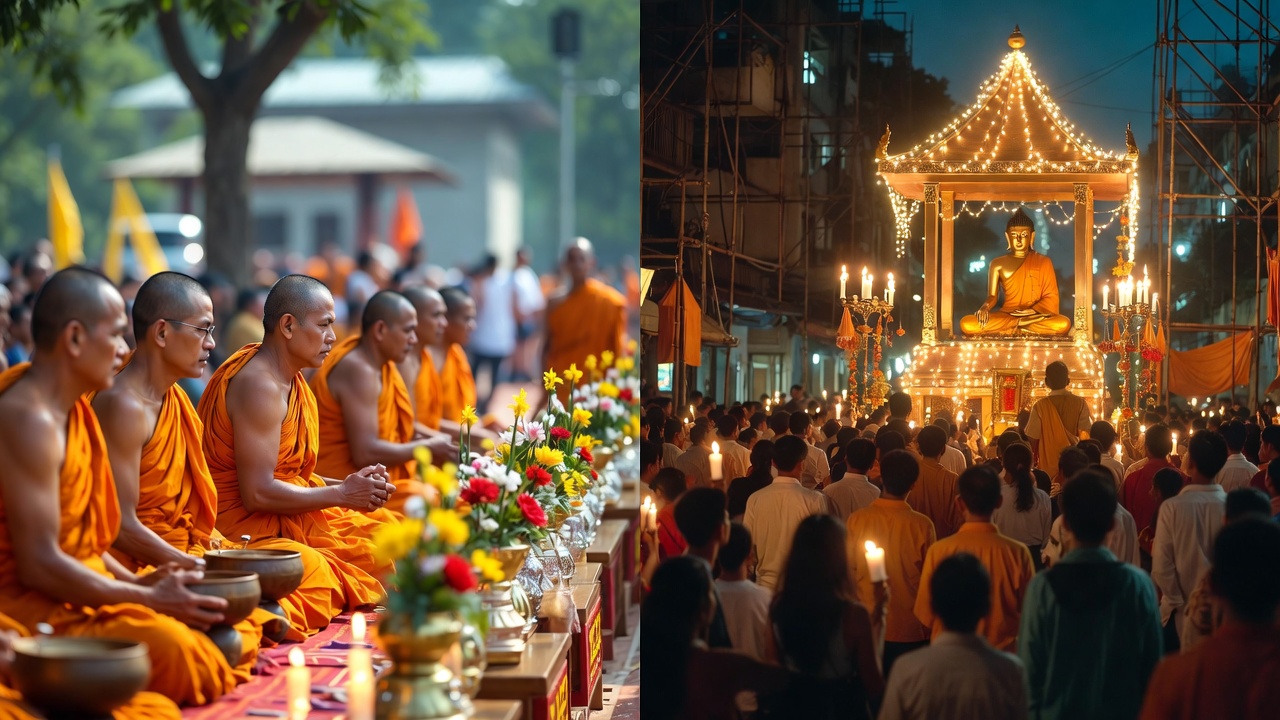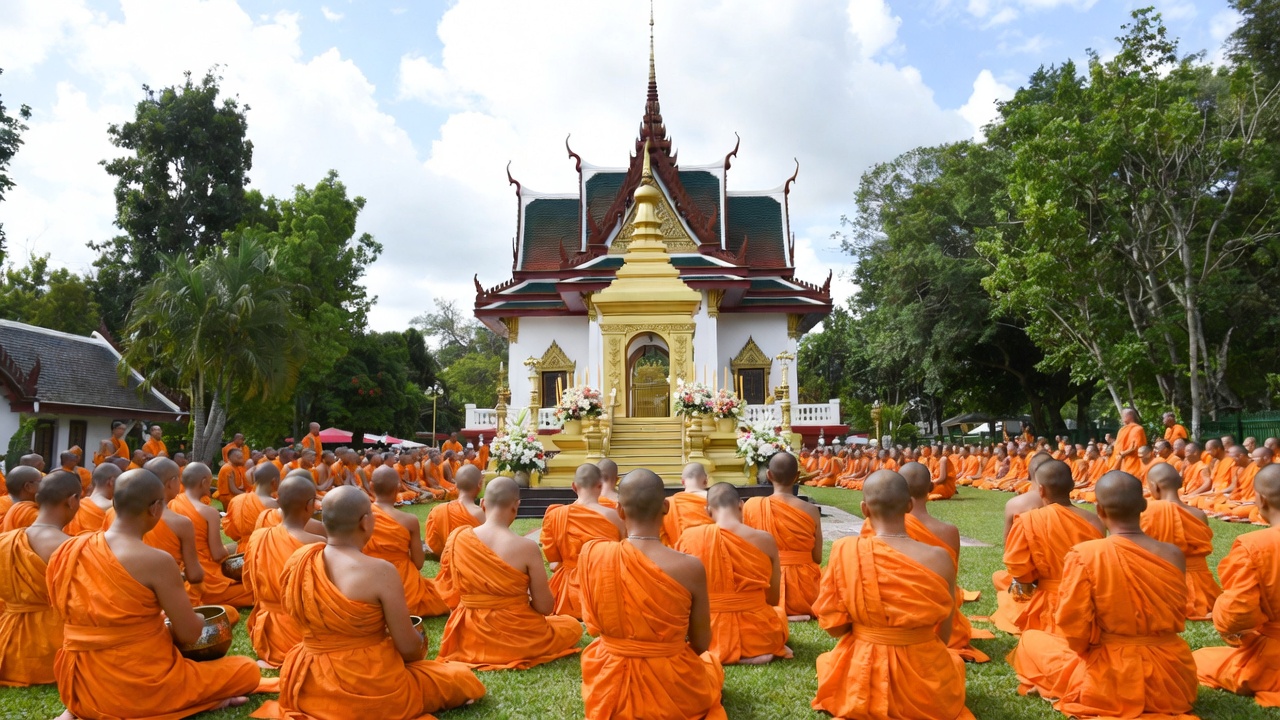
There is a moment each year when the full moon hangs low and heavy over the spires of Thai temples, and an entire nation seems to hold its breath. Candles flicker in the hands of millions. Incense smoke drifts skyward. Monks chant in unison. This is Makha Bucha Day — one of the most sacred Buddhist holidays in Thailand, and one of the most moving spiritual experiences a traveler can witness anywhere on earth.
In 2026, Makha Bucha Day falls on Tuesday, March 3. If you plan to be in Thailand around that date, this guide will help you understand the holiday, join the celebrations with respect, and make the most of a truly rare cultural experience.
What Is Makha Bucha Day and Why Is It Important in Thailand?
Makha Bucha Day, also spelled Magha Puja, is the second most important Buddhist holiday in Thailand after Visakha Bucha Day. The name comes from two Pali words. “Makha” (or Magha) refers to the third month of the traditional Indian lunar calendar. “Bucha” means to honor or venerate. Together, the phrase means “to pay respect on the full moon of the third lunar month.”
The holiday celebrates a remarkable event in Buddhist history known as the Fourfold Assembly, or Chaturangasannibat in Pali. According to Theravada Buddhist tradition, this gathering took place at the Veluwan Temple (Bamboo Grove) in present-day Rajgir, India. It happened nine months after the Buddha first attained enlightenment.
What made this gathering so extraordinary was the convergence of four miraculous conditions:
| Condition | Significance |
|---|---|
| 1,250 disciples gathered spontaneously | No prior invitation or appointment was given |
| All were Arahants | Every disciple had already achieved full enlightenment |
| All were ordained by the Buddha himself | Each was a direct spiritual descendant of the Buddha |
| It occurred on a full moon day | The full moon of the third lunar month, considered deeply auspicious |
During this assembly, the Buddha delivered the Ovadhapatimokha — a set of core teachings that form the spiritual backbone of Theravada Buddhism. These teachings can be distilled into three principles: cease from all evil, do only good, and purify the mind. These three tenets remain the guiding moral framework for millions of Thai Buddhists today.
Thailand is home to the largest Buddhist population in the world, with approximately 68 million Buddhists making up 94% of the country’s population. Makha Bucha is not just a religious observance here. It is a defining moment in the national calendar, a day when families come together, when everyday life slows to a reverent hush, and when the entire country turns inward toward spiritual reflection.
When Is Makha Bucha Day 2026 in Thailand?
Makha Bucha Day 2026 falls on Tuesday, March 3. The date changes each year because it follows the Buddhist lunar calendar. The holiday always lands on the full moon day of the third lunar month, which usually falls in February or March on the Gregorian calendar. In a leap year on the lunar calendar, the celebration shifts to the full moon of the fourth lunar month.
Here is a reference table of recent and upcoming Makha Bucha dates:
| Year | Date |
|---|---|
| 2024 | Saturday, February 24 |
| 2025 | Wednesday, February 12 |
| 2026 | Tuesday, March 3 |
| 2027 | Sunday, February 21 |
Makha Bucha is a national public holiday in Thailand. Government offices, banks, and most schools close for the day. Many private businesses also shut their doors or operate on reduced hours. However, shopping malls, convenience stores, and most tourist attractions remain open.
One key detail travelers need to know: the year 2026 in the Gregorian calendar corresponds to the year 2569 in the Buddhist Era (B.E.), which is the official calendar used in Thailand. You may see this year printed on official documents, temple announcements, and festival banners.
The History of Makha Bucha Day: From Ancient India to Modern Thailand
Understanding the history of Makha Bucha Day deepens the experience of witnessing the celebrations. The story begins roughly 2,600 years ago in ancient India and winds its way through centuries of Southeast Asian Buddhist tradition before arriving at the Thailand we know today.
The Original Gathering at Veluwan Temple
The event that Makha Bucha commemorates took place during the early years of the Buddha’s ministry. The Buddha had been teaching for about nine months since his enlightenment under the Bodhi tree at Bodh Gaya. On the full moon day of the third lunar month, he was staying at the Veluwan Mahavihara, or the Bamboo Grove Monastery, near the city of Rajagaha (modern Rajgir, Bihar, India).
Without any summons or appointment, 1,250 of his ordained disciples converged on the grove. Every single one was an Arahant — a person who had attained the highest stage of spiritual enlightenment in Theravada Buddhism. This spontaneous gathering was considered a miracle, and it was here that the Buddha recited the Ovadhapatimokha for the first and only time.
The Ovadhapatimokha served as a compact code of conduct for the Buddhist monastic community, or Sangha. For 20 years afterward, the Buddha reportedly continued to teach these principles on every full moon of the third lunar month. This is why Makha Bucha is also known as Sangha Day — a celebration of the Buddhist community itself.
King Rama IV and the Modern Revival
While some historical evidence suggests that communities in Lan Na (northern Thailand) and Lan Xang (Laos) observed forms of Makha Bucha before the modern era, the holiday as it is celebrated today traces directly to King Mongkut, or Rama IV, who ruled Siam from 1851 to 1868.
Before becoming king, Mongkut spent 27 years as a Buddhist monk. During that time, he studied the Pali Canon closely and became troubled by discrepancies between scriptural rules and actual monastic practice. He founded the Dhammayuttika Nikaya reform movement to bring Thai Buddhism closer to its canonical roots.
As recorded by historians, Rama IV first held a formal Makha Bucha ceremony in 1851 at the Temple of the Emerald Buddha (Wat Phra Kaew) inside the Grand Palace in Bangkok. The ceremony was initially limited to the royal palace, but it soon grew in scope. His successor, King Rama V, expanded the practice into a national celebration and officially established it as a public holiday in 1913.
By 1937, the celebration was widely observed across the country. However, observance declined during the mid-20th century. The holiday was revived in 1957, thanks in large part to the efforts of Supreme Patriarch-to-be Plod Kittisobhano. Since then, Makha Bucha has grown into one of Thailand’s most cherished and widely observed religious occasions.
The Connection to Valentine’s Day
In 2006, the Thai government formally titled Makha Bucha as the “Day of Pure Love and Gratitude.” The campaign was, in part, a cultural effort to offer Thai youth a more spiritually grounded alternative to Valentine’s Day, which falls in the same month and had been gaining commercial popularity. While many young Thais still celebrate Valentine’s Day, the government’s initiative has reinforced Makha Bucha’s role as a day of sincere, selfless love — love rooted in the Buddha’s compassion for all beings.
How Thai Buddhists Celebrate Makha Bucha Day: Rituals and Traditions
Makha Bucha Day is not a loud, street-festival kind of holiday. It is quiet, contemplative, and deeply personal. The celebrations take place primarily at temples (called wat in Thai) and in the homes of Buddhist families. Here is what a typical Makha Bucha Day looks like from morning to night.
Morning: Giving Alms to Monks (Tak Bat)
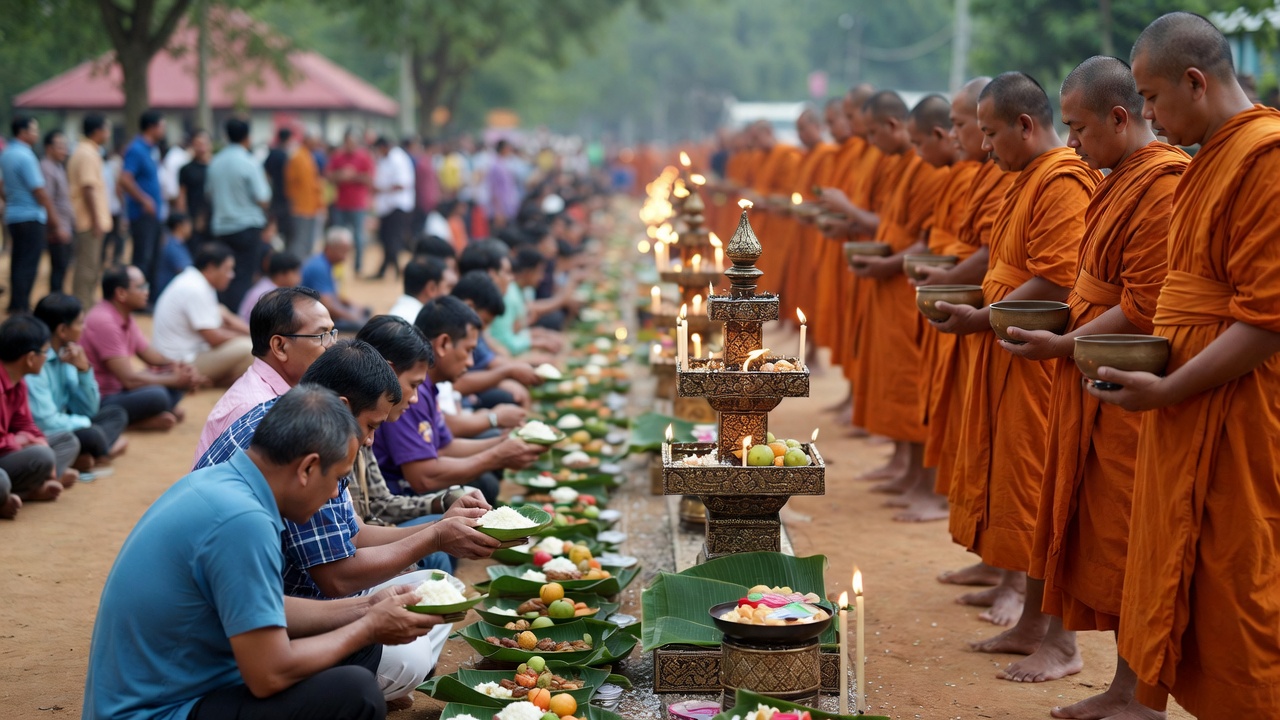
The day begins at dawn. Across Thailand, Buddhist families wake early and prepare food offerings for monks. This practice is called tak bat (ตักบาตร). Monks walk barefoot through their local communities carrying large round alms bowls, and laypeople place food — usually rice, curries, fruit, and sweets — directly into the bowls.
On Makha Bucha, this morning ritual carries special weight. While tak bat is a daily practice for many Thai Buddhists, the holiday version often involves larger offerings and greater numbers of participants. In some communities, devotees line the roads in long rows, creating striking visual scenes of spiritual devotion against the backdrop of a rising sun.
Practical tip for travelers: You are welcome to observe tak bat, but please keep a respectful distance. Do not obstruct the monks’ path. If you wish to offer food, buy a prepared offering kit from a nearby vendor the evening before.
Afternoon: Temple Activities, Sermons, and Merit-Making
After the morning alms round, many Thai Buddhists head to their local temple for a range of spiritual activities. These include:
- Listening to Dhamma talks (sermons): Monks give teachings about the Ovadhapatimokha and the significance of Makha Bucha. These talks emphasize compassion, moral discipline, and mental purification.
- Meditation sessions: Many temples organize group meditation, open to both Thai and foreign participants.
- Making donations: Devotees contribute food, robes, money, and other essential supplies to the temple and its monastic community. This is called tham bun (ทำบุญ), or merit-making.
- Releasing captive animals: Some Buddhists purchase caged birds or fish from vendors near the temple and release them as a symbolic act of compassion. This practice reflects the precept of not taking life.
The afternoon is also a time for families to gather. Many Thai families treat Makha Bucha as a multi-generational event. Grandparents, parents, and children visit the temple together, share a meal, and spend the afternoon in quiet reflection.
Evening: The Wian Tian Candlelight Procession
The most visually stunning and emotionally powerful moment of Makha Bucha Day arrives at nightfall. This is the wian tian (เวียนเทียน), or candlelight circumambulation ceremony.
Wian means “to circle around.” Tian means “candle.” During the wian tian, participants walk slowly around the main ordination hall (called the ubosot or bot) or the main chedi (stupa) of the temple. Each person holds three items:
- A lit candle — representing the light of the Buddha, or enlightenment
- Three sticks of incense — representing the Buddha, the Dhamma (his teachings), and the Sangha (the monastic community)
- A lotus flower or other fresh bloom — representing purity and the beauty of spiritual practice
The procession circles the hall three times in a clockwise direction. Each lap symbolizes one of the Three Jewels of Buddhism (the Triratna): the Buddha, the Dhamma, and the Sangha.
The atmosphere during wian tian is extraordinary. Hundreds — sometimes thousands — of people move together in near-silence, their faces lit by candlelight. Monks chant in the background. The full moon hangs overhead. The scent of incense fills the warm night air. For many visitors, this is the single most memorable experience they have in Thailand.
Practical tip: Arrive at the temple by 6:00 PM to find a good spot. The procession usually begins around 7:00 or 8:00 PM, after a period of group chanting and meditation. Most temples provide candles and incense to participants free of charge, though a small donation is always appreciated.
Observing the Five Precepts on Makha Bucha Day in Thailand
A central part of Makha Bucha observance is the renewed commitment to the Five Precepts (Sila Ha or ศีลห้า). These are the foundational moral guidelines for all Buddhist laypeople. On Makha Bucha, devotees make a special effort to follow these precepts strictly throughout the day. This practice is called “Lab Sin” (รับศีล), meaning to receive or undertake the precepts.
The Five Precepts are:
| Precept | Meaning |
|---|---|
| 1. Refrain from taking life | Do not kill or harm any living being |
| 2. Refrain from stealing | Do not take what is not given |
| 3. Refrain from sexual misconduct | Remain faithful and respectful in relationships |
| 4. Refrain from false speech | Do not lie, gossip, or use harsh words |
| 5. Refrain from intoxicants | Avoid alcohol and drugs that cloud the mind |
Some deeply devout Buddhists go further and observe the Eight Precepts on Makha Bucha. These include additional restraints such as not eating after noon, not sitting on high or luxurious seats, and not wearing perfume or jewelry. Monks and nuns follow the complete monastic code, which includes 227 rules for fully ordained monks.
The fifth precept — abstaining from intoxicants — has a direct legal consequence for everyone in Thailand on Makha Bucha Day, including tourists. This brings us to one of the most important practical details for travelers.
Makha Bucha Day Alcohol Ban in Thailand: What Travelers Need to Know
This section matters greatly if you are planning a trip to Thailand around Makha Bucha. The sale of alcohol is banned nationwide for 24 hours on Makha Bucha Day. The ban runs from midnight to midnight.
This is not just a custom. It is Thai law. Businesses that violate the ban face serious penalties, including fines of up to 10,000 baht and up to six months of imprisonment.
What the Alcohol Ban Means in Practice
The alcohol ban applies to five major Buddhist holidays each year: Makha Bucha Day, Visakha Bucha Day, Asarnha Bucha Day, Buddhist Lent Day (Khao Phansa), and the End of Buddhist Lent (Ok Phansa). On these days:
- Convenience stores (7-Eleven, FamilyMart) will not sell alcohol.
- Bars and nightclubs are either closed entirely or operate without serving drinks.
- Restaurants remove alcoholic beverages from their menus.
- Supermarkets tape off or lock their alcohol sections.
Exceptions to the Alcohol Ban (Updated for 2025–2026)
Thailand’s alcohol laws underwent significant changes in late 2025. The Alcoholic Beverage Control Act (No. 2) 2025, which took effect on November 8, 2025, introduced several new exemptions. According to reporting by The Nation Thailand, the following venues may now serve alcohol even on Buddhist holidays:
- International airport terminals (duty-free shops and restaurants)
- Licensed entertainment venues registered under entertainment place laws
- Hotels registered under the Hotel Act
- Entertainment venues in designated tourist areas, as approved by the Public Health Minister
- Venues hosting major national or international events, as designated by the Tourism and Sports Minister
However, the general ban still applies to regular shops, convenience stores, stand-alone restaurants, and street vendors. For most travelers staying outside of hotel bars or designated entertainment zones, the ban is very much in effect.
Tips for Travelers During the Alcohol Ban
- Buy in advance. Drinking alcohol is not illegal on Makha Bucha Day — only selling it is. You are free to drink from your own supply in your hotel room.
- Do not argue with staff. Store clerks and bartenders face severe penalties if they sell to you. Be polite and understanding.
- Respect the cultural context. The ban exists to honor a deeply sacred day for the Thai people. Treating it with respect is the simplest and most meaningful gesture you can make as a visitor.
Best Temples to Visit for Makha Bucha Day Celebrations in Thailand
Makha Bucha is celebrated at virtually every temple across the country. But some locations offer especially memorable experiences. Here are the top places to witness the celebrations, organized by region.
Bangkok: Where Grand Ceremonies Meet Urban Energy
Bangkok is home to more than 400 Buddhist temples. Several stand out for their Makha Bucha Day observances.
Wat Phra Kaew (Temple of the Emerald Buddha) — Located within the Grand Palace, this is the most revered temple in Thailand. Makha Bucha celebrations here carry a strong historical resonance, as King Rama IV held the first modern Makha Bucha ceremony on this very site in 1851. Expect large crowds and a deeply formal atmosphere.
Wat Saket (The Golden Mount) — One of Bangkok’s most iconic landmarks, the Golden Mount features a hilltop chedi that provides a dramatic setting for the evening candlelight procession. Monks lead participants up the spiraling staircase to the summit, where the wian tian takes place with sweeping views of the city below.
Wat Benchamabophit (The Marble Temple) — Known for its stunning Italian Carrara marble exterior, this temple is a favorite among both locals and visitors. The candlelight procession here is particularly photogenic, with candle flames reflecting off polished marble surfaces.
Wat Hua Lamphong — Tucked beside the Sam Yan MRT station in the Silom district, this smaller temple offers a more intimate, community-centered celebration. It is a great choice for travelers who prefer a quieter, less tourist-heavy experience.
Phutthamonthon (Buddhist Park) — Located in Nakhon Pathom province, just west of Bangkok, this park features a massive standing Buddha statue over 15 meters tall. Makha Bucha ceremonies here attract large crowds and include food stalls, fair activities, and an especially grand wian tian procession.
Chiang Mai: Northern Charm and Ancient Temples
Chiang Mai, the cultural capital of northern Thailand, offers a more intimate and historically rich setting for Makha Bucha celebrations. The old city alone contains dozens of active temples within its medieval moat walls.
Wat Phra Singh — Home to the city’s most revered Buddha image, the Phra Phuttha Sihing, this temple hosts one of Chiang Mai’s largest and most well-attended Makha Bucha ceremonies.
Wat Chedi Luang — The ancient heart of Chiang Mai. The temple’s massive, partially ruined chedi once housed the Emerald Buddha (now in Bangkok’s Wat Phra Kaew). The Makha Bucha evening procession around this enormous stupa is a deeply atmospheric experience, with hundreds of candles casting flickering light across the centuries-old brickwork.
Wat Umong — A forest temple on the western edge of the city, famous for its underground tunnels and tranquil grounds. Wat Umong offers meditation retreats and a quieter, more contemplative Makha Bucha experience.
Wat Ched Yot (Wat Jed Yod) — An 800-year-old temple with seven spires modeled after the Mahabodhi Temple in Bodh Gaya, India. The wian tian here feels especially meaningful given the temple’s direct architectural link to the birthplace of Buddhism.
Beyond Bangkok and Chiang Mai: Regional Celebrations Worth the Journey
Some of the most unique Makha Bucha celebrations take place in Thailand’s smaller provinces, away from the main tourist circuits.
Phayao — Wien Tien on Water — At Wat Tilok Aram, located on an island in the center of Phayao Lake, the candlelight procession takes place on the water. This is believed to be the only place in the world where devotees perform wian tian on boats. The ceremony is held three times a year — on Makha Bucha, Visakha Bucha, and Asarnha Bucha days.
Nakhon Si Thammarat — Hae Pha Kuen That Festival — At Wat Phra Mahathat, southern Thailand’s most important temple, Makha Bucha is celebrated with a striking ritual. Devotees carry a long piece of sacred yellow cloth and wrap it around the base of the temple’s main stupa. Additional activities include merit-making rituals, cultural performances, and the traditional preparation of yacoo (rice milk).
Kalasin — Celebrations at Phrathat Yakhu — In the Isan (northeastern) province of Kalasin, Makha Bucha is marked with elaborate multi-day festivities at the ancient Phrathat Yakhu chedi, the largest in the historic city of Fa Daet Song Yong. The celebrations blend Buddhist ceremony with lively regional folk traditions.
Prachin Buri — Thailand’s Oldest Bodhi Tree — The Sa Morakot Archaeological Site in Si Mahosot District hosts an annual Makha Bucha fair. Activities take place around what is said to be Thailand’s oldest and largest bodhi tree, believed to have grown from a branch brought from Bodh Gaya, India, roughly 2,000 years ago. The fair includes lantern releases, exhibitions, and cultural processions.
Yasothon — Traditional Garland Procession — In Ban Fa Yat village, Makha Bucha is celebrated with a colorful procession of garlands made from popped rice and flowers. These garlands are strung together and paraded through the village the day before Makha Bucha as offerings to the Buddha.
What to Wear When Visiting Thai Temples on Makha Bucha Day
Dressing appropriately is essential when visiting any Thai temple, and it becomes especially important on a sacred holiday like Makha Bucha. Thai temples are places of deep spiritual significance. Your clothing communicates respect — or a lack of it.
Here are the dress code guidelines for temple visits:
For both men and women:
- Cover your shoulders completely. No tank tops, sleeveless shirts, or spaghetti straps.
- Cover your knees. Wear long pants, a long skirt, or a sarong that falls below the knee.
- Remove your shoes before entering any temple building. Most temple grounds have outdoor areas where shoes are fine, but always remove them before stepping into an ordination hall, prayer room, or any building housing a Buddha image.
- Avoid sheer or very tight clothing. Even if it technically covers everything, clothing that is see-through or skin-tight is considered inappropriate.
Additional notes for women:
- Do not touch monks. Women should never make physical contact with a Buddhist monk. If you need to hand something to a monk, place it on a cloth or a table for him to pick up.
- Do not sit higher than monks. If monks are seated on the floor, sit on the floor as well.
Preferred colors: Many Thai Buddhists wear white to the temple on Makha Bucha Day. White symbolizes purity and the observance of precepts. Wearing white is not required for tourists, but if you have a white shirt, wearing it is a thoughtful gesture.
Is Makha Bucha Day a Good Time to Visit Thailand as a Tourist?
This is a question many travelers ask. The answer depends on what you are looking for.
Reasons to Visit Thailand During Makha Bucha
- Witness a rare spiritual experience. The wian tian candlelight procession is one of the most beautiful religious ceremonies in the world. It is impossible to replicate outside of a Buddhist country during a genuine observance.
- Experience authentic Thai culture. Makha Bucha strips away the tourist veneer. You see Thailand at its most sincere and spiritually grounded.
- Enjoy a peaceful atmosphere. The alcohol ban and general tone of reflection make the country quieter and calmer than usual.
- Good weather. In 2026, Makha Bucha falls on March 3, which is during the dry season in most of Thailand. Expect warm, sunny days with low humidity.
Potential Drawbacks to Consider
- The alcohol ban. If your trip centers on nightlife and drinking, Makha Bucha Day will put a pause on those activities for 24 hours.
- Some closures. A few restaurants and shops may close, though most tourist-oriented businesses remain open.
- Domestic travel spikes. Thai families often travel to their home provinces for the holiday, so buses, trains, and domestic flights can be more crowded than usual in the days before and after Makha Bucha.
Overall verdict: Makha Bucha is an excellent time to visit Thailand, especially for travelers interested in culture, spirituality, and authentic local experiences. Plan ahead, dress respectfully, and embrace the slower pace of the day.
How to Participate in Makha Bucha Day as a Foreigner in Thailand
One of the most beautiful things about Thai Buddhism is its openness. Visitors of all faiths and backgrounds are genuinely welcomed at temple celebrations. You do not need to be Buddhist to attend a wian tian procession, listen to a Dhamma talk, or observe the morning alms round.
Here are some ways you can respectfully participate:
Join the Wian Tian Procession
Most temples distribute candles, incense, and flowers to anyone who wishes to join the evening procession. Simply arrive early, accept the items, and follow the crowd as they walk around the ordination hall or stupa three times. Walk slowly and quietly. You may notice people chanting softly or praying silently as they walk. You do not need to chant — simply walking with a mindful, respectful attitude is enough.
Offer Alms to Monks
If you wish to participate in the morning alms round, visit a local market the evening before and purchase a prepared offering kit. These usually include rice, a small curry or side dish, fruit, and a bottle of water. Stand quietly at the side of the road with the other devotees, and place your offering into the monk’s bowl as he passes. Remove your shoes if you are standing on a mat or prepared area.
Make a Donation at the Temple
Many temples have donation boxes for cash contributions. Some also accept donations of practical items such as soap, toothpaste, candles, and bottled water. If the temple is hosting a food preparation event, you may be invited to help.
Attend a Meditation Session
Some temples offer structured meditation sessions on Makha Bucha Day, sometimes with English-language instruction. Wat Umong in Chiang Mai and Wat Mahathat in Bangkok are well known for offering meditation programs accessible to foreigners.
Simply Observe
There is no shame in simply watching. Find a quiet spot at a temple, sit on the ground, and observe the ceremonies. The sights, sounds, and smells of Makha Bucha will stay with you long after you leave Thailand.
Common Mistakes Tourists Make on Makha Bucha Day in Thailand
Even well-meaning travelers can accidentally cause offense on a sacred day. Here are the most common mistakes to avoid:
Pointing your feet at a Buddha image. In Thai culture, the feet are considered the lowest and most impure part of the body. When sitting in a temple, tuck your feet behind you or to the side. Never point your feet toward a Buddha statue, a monk, or another person.
Taking selfies during ceremonies. Photography is generally allowed at temples, but taking selfies during a prayer session, a Dhamma talk, or the wian tian procession is considered disrespectful. If you must take photos, do so quietly and from a distance, without using flash.
Displaying public affection at temples. Thai temples are sacred spaces. Hugging, kissing, or other romantic displays are inappropriate on temple grounds.
Touching someone’s head. The head is considered the most sacred part of the body in Thai culture. Do not touch anyone’s head, including children, even playfully.
Being loud. Makha Bucha is a day of quiet reflection. Keep your voice low and your behavior calm, especially within temple grounds.
Stepping on money. Thai banknotes and coins carry the image of the King. Stepping on money — even to stop a rolling coin — is a criminal offense in Thailand. This applies every day, but cultural sensitivity is heightened on religious holidays.
Makha Bucha Day Travel Tips: Practical Information for Your Trip
Here is a quick-reference section covering the practical details you need for a smooth Makha Bucha trip.
Transportation
- BTS Skytrain and MRT Subway in Bangkok operate on normal or slightly reduced schedules on public holidays. Check the BTS and MRT websites for holiday timetables.
- Taxis and ride-hailing apps (Grab, Bolt) operate as usual.
- Intercity buses and trains may be crowded, especially the day before and after the holiday. Book tickets early.
- Domestic flights are available but may see higher demand. Airlines typically do not add extra flights for Buddhist holidays.
Food and Dining
- Most restaurants remain open, especially in tourist areas.
- Street food stalls operate normally.
- Temple fairs and food stalls near major temples offer inexpensive local dishes — a great opportunity to try authentic Thai food.
- Some strict Buddhist restaurants may offer only vegetarian food on Makha Bucha Day.
Currency and Banking
- Banks are closed on Makha Bucha Day.
- ATMs function normally.
- Credit and debit cards are widely accepted in Bangkok, Chiang Mai, and major tourist areas.
- Smaller temples and market stalls may only accept cash. Carry small bills (20 and 100 baht notes) for donations and purchases.
Health and Safety
- Temples can be hot, especially in March. Bring water, sunscreen, and a hat for daytime visits.
- Candle wax is a hazard during the evening procession. Wear long sleeves and be careful with the flame, especially around children.
- Mosquitoes are active after dark. Apply insect repellent before attending the evening procession.
A Brief Timeline of Makha Bucha Day Activities
For travelers who want to plan their day, here is a general schedule of events. Times may vary by temple and region.
| Time | Activity |
|---|---|
| 5:00 – 7:00 AM | Tak bat — Morning alms round. Monks walk through communities to receive food offerings. |
| 8:00 – 11:00 AM | Temple visits. Devotees offer food, flowers, and donations to the temple. |
| 11:00 AM – 1:00 PM | Midday meal. Monks eat their final meal of the day before noon (per monastic rules). Laypeople share food at the temple. |
| 1:00 – 5:00 PM | Dhamma talks, meditation sessions, and merit-making activities at temples. |
| 6:00 – 7:00 PM | Arrival and gathering at the temple for the evening ceremony. Group chanting and prayer. |
| 7:00 – 9:00 PM | Wian tian — The candlelight procession around the ordination hall or stupa. The highlight of the day. |
| 9:00 PM onward | Quiet reflection. Some devotees continue meditating or chanting at the temple late into the night. |
How Makha Bucha Day Connects to Thailand’s Broader Buddhist Calendar
Makha Bucha does not exist in isolation. It is part of a rich cycle of Buddhist holidays that structure the Thai spiritual year. Understanding the broader calendar helps you see how Makha Bucha fits into the larger rhythm of Thai religious life.
Makha Bucha (February/March) — Celebrates the Fourfold Assembly and the Ovadhapatimokha teachings. Focuses on the Sangha (Buddhist community).
Visakha Bucha (May) — The most important Buddhist holiday. Commemorates the birth, enlightenment, and passing (parinibbana) of the Buddha — all said to have occurred on the same day of the calendar in different years.
Asarnha Bucha (July) — Marks the Buddha’s first sermon, delivered in Deer Park at Sarnath, India. This sermon, known as the Dhammacakkappavattana Sutta, set the “Wheel of Dharma” in motion.
Khao Phansa / Buddhist Lent (July) — The beginning of the three-month Rains Retreat, during which monks remain at their home temple and intensify their practice. Laypeople often make extra merit during this period.
Ok Phansa / End of Buddhist Lent (October) — Marks the conclusion of the Rains Retreat. Celebrations include the Tak Bat Devo ceremony, where monks receive large-scale alms offerings.
All five of these holidays carry a 24-hour alcohol sales ban. They also follow the lunar calendar, so their dates shift each year.
Makha Bucha Day and the Meaning of Merit-Making in Thai Culture
To truly appreciate Makha Bucha, it helps to understand the concept of merit (bun in Thai, or puñña in Pali). Merit-making is the engine of spiritual life in Thai Buddhism. It is the belief that good actions generate positive spiritual energy that influences your current life and future rebirths.
On Makha Bucha Day, Thai Buddhists focus intensely on accumulating merit through a variety of actions:
- Giving — food, money, robes, or supplies to monks and temples
- Morality — strictly observing the Five Precepts (or Eight Precepts for advanced practitioners)
- Meditation — cultivating mindfulness, concentration, and insight
Thai Buddhism holds that merit can be shared with others, including deceased relatives. This is why you may see families at the temple dedicating their merit to ancestors and loved ones who have passed away. The concept of shared merit reinforces the communal, family-centered nature of Makha Bucha.
For travelers, understanding merit helps decode many of the behaviors you will observe at the temple. When a grandmother places food in a monk’s bowl, she is making merit. When a businessman donates money to build a new meditation hall, he is making merit. When a teenager releases a caged bird, she is making merit. These acts are not casual charitable gestures. They are deliberate spiritual practices rooted in one of the world’s oldest ethical systems.
Frequently Asked Questions About Makha Bucha Day in Thailand
Can non-Buddhists attend Makha Bucha celebrations? Yes. Thai temples warmly welcome visitors of all faiths. You are free to observe or participate in the ceremonies. Simply dress modestly, behave respectfully, and follow the lead of those around you.
Is Makha Bucha Day celebrated only in Thailand? No. Makha Bucha (or Magha Puja) is also observed in Cambodia, Laos, Myanmar, and Sri Lanka, as well as in Buddhist communities worldwide. However, Thailand’s celebrations are among the most visible and well-organized.
Are shops and malls open on Makha Bucha Day? Most shopping malls and large retail stores remain open, though individual shops may adjust their hours. Banks and government offices are closed.
Can I buy alcohol at my hotel on Makha Bucha Day? Under the 2025 updates to Thailand’s alcohol laws, hotels registered under the Hotel Act are now exempt from the religious holiday alcohol ban. Check with your hotel to confirm.
What if Makha Bucha falls on a weekend? If the holiday falls on a Saturday or Sunday, the following Monday is typically designated as a substitute holiday, giving workers a day off.
Is it safe to travel to remote temple celebrations? Generally, yes. Thai temple events are family-oriented and peaceful. Exercise normal travel precautions, especially when driving in rural areas at night.
Final Thoughts: Why Makha Bucha Day Deserves a Place on Your Travel Calendar
In a world full of loud, commercialized festivals, Makha Bucha Day stands apart. There are no fireworks. No parades. No corporate sponsors. There is only candlelight, incense, the soft chanting of monks, and the quiet sincerity of millions of people renewing their commitment to a way of life that has endured for over two and a half millennia.
If you find yourself in Thailand on March 3, 2026, make your way to a temple as the sun goes down. Accept a candle. Join the procession. Walk slowly. Breathe. Listen.
You do not need to be Buddhist to feel the power of this moment. You only need to be present.
Sawasdee ka, and may your journey be filled with peace and good merit.
Disclaimer: This article is intended as a cultural and travel guide. All dates, laws, and cultural information have been verified as of February 2026. Alcohol laws and holiday exemptions are subject to change. Always check local regulations before your trip.