A Complete Guide to Transforming Your Space for Vietnamese Lunar New Year
There is a particular kind of magic that descends upon Vietnam as the old year draws to a close. The air grows thick with anticipation. Markets overflow with flowers. Children run through streets decorated in crimson and gold. Families gather, clean their homes from top to bottom, and begin the sacred ritual of preparing for Tết Nguyên Đán—the most important celebration in Vietnamese culture.
For the Vietnamese, Tết is not merely a holiday. It is a homecoming. A spiritual renewal. A time when the veil between the living and ancestors grows thin, when every chrysanthemum petal and kumquat fruit carries meaning that stretches back centuries. And at the heart of this celebration lies the home—transformed, beautified, and made ready to welcome good fortune, prosperity, and the spirits of those who came before.
Whether you are Vietnamese preparing for your first Tết away from family, a cultural enthusiast eager to honor this beautiful tradition, or someone who has married into a Vietnamese family and wants to participate authentically, this guide will walk you through every element of traditional Tết home decoration. From the delicate pink of northern peach blossoms to the brilliant yellow of southern apricot flowers, from the symbolism hidden in a simple tangerine tree to the careful arrangement of the ancestral altar—we will explore it all.
Chúc Mừng Năm Mới. Let us begin.
What Is Tết and Why Do Vietnamese Families Decorate Their Homes?
Before we discuss specific decorations, understanding the cultural significance of Tết provides essential context. Tết Nguyên Đán (literally “Feast of the First Morning”) marks the beginning of the Vietnamese Lunar New Year. It typically falls between late January and mid-February on the Gregorian calendar, coinciding with the Chinese New Year but carrying distinctly Vietnamese characteristics.
Tết represents several profound concepts simultaneously:
- Renewal and fresh beginnings — The old year’s debts, grudges, and misfortunes are cleared away
- Family reunion — Perhaps the most sacred aspect, as millions of Vietnamese travel home regardless of distance
- Ancestor veneration — The spirits of deceased family members are believed to return during Tết
- Welcoming prosperity — Decorations and rituals are designed to attract good luck for the coming year
Home decoration for Tết serves a dual purpose. On one hand, it creates a beautiful, festive atmosphere for family gatherings. On the other, it carries deep spiritual significance—each element symbolizing wishes for health, wealth, happiness, and longevity. A poorly decorated home might be seen as inhospitable to both living guests and returning ancestors.
The Vietnamese have a saying: “Đói cho sạch, rách cho thơm” — roughly translated as “even in poverty, maintain cleanliness and dignity.” This philosophy extends to Tết preparations. Regardless of economic circumstances, Vietnamese families invest considerable effort in making their homes beautiful for the new year.
When Should You Start Decorating Your Home for Vietnamese New Year?
Timing matters in Tết preparations. Vietnamese tradition follows a careful calendar leading up to the new year.
| Timeframe | Traditional Activities |
|---|---|
| 2-3 weeks before Tết | Deep cleaning begins; shopping for decorations starts |
| 1 week before Tết | Major decorations go up; flower markets peak |
| 23rd of the 12th lunar month | Ông Táo (Kitchen God) ceremony; altar preparations intensify |
| New Year’s Eve (Giao Thừa) | Final touches; fresh flowers placed; altar completed |
| Tết days 1-3 | Decorations remain; no sweeping to avoid sweeping away luck |
| 7th day of Tết | Traditional end of celebrations; some decorations removed |
The 23rd day of the 12th lunar month holds particular importance. This is when Ông Táo, the Kitchen God, ascends to heaven to report on the family’s conduct throughout the year. Many families release live carp into rivers on this day (carp being the Kitchen God’s vehicle to heaven) and begin their most intensive preparations.
Most Vietnamese families have their homes fully decorated by New Year’s Eve (Đêm Giao Thừa). This is when the first guest of the new year will arrive—a practice called xông đất or xông nhà—and the home must be ready to receive them, as this first visitor is believed to influence the family’s fortune for the entire year.
Traditional Tết Color Schemes: Red and Gold Vietnamese New Year Decorations
Walk through any Vietnamese neighborhood during Tết and you will be immersed in two dominant colors: red and gold (or yellow). These are not arbitrary aesthetic choices.
The Meaning of Red in Vietnamese Culture
Red symbolizes:
- Luck and good fortune
- Happiness and celebration
- Protection against evil spirits
- Vitality and life force
In Vietnamese folklore, red has the power to ward off evil. The legend of the monster Nian (common across East Asian cultures) tells of a beast that feared the color red, loud noises, and fire—which is why firecrackers and red decorations became integral to new year celebrations.
The Significance of Gold and Yellow
Gold and yellow represent:
- Prosperity and wealth
- Royalty and nobility (yellow was historically reserved for emperors)
- Earth element in the Five Elements philosophy
- Warmth and energy
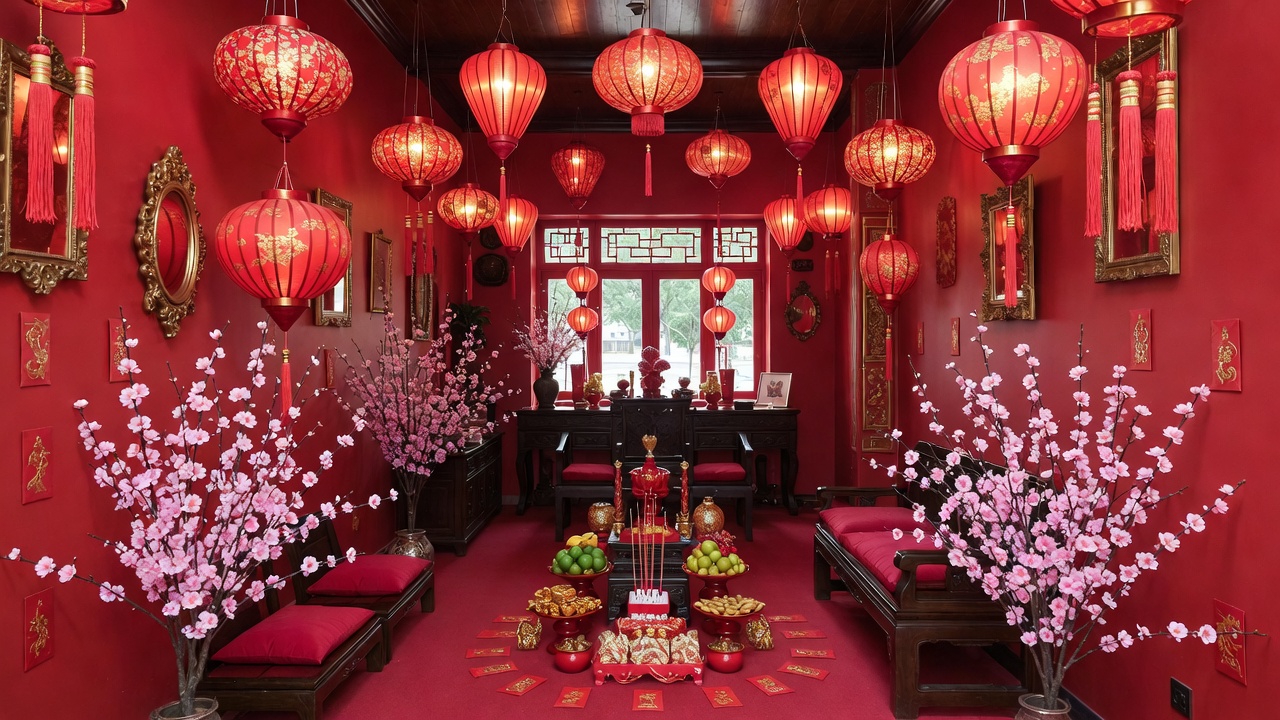
How to Incorporate Red and Gold Tết Decorations
For walls and doorways:
- Hang red banners with gold calligraphy (câu đối)
- Display red paper cutouts (traditionally featuring the character “福” for fortune)
- Attach red tassels to door handles and furniture
For tables and surfaces:
- Use red tablecloths or runners
- Display gold-rimmed serving dishes
- Arrange red lì xì (lucky money) envelopes decoratively
For lighting:
- Hang red paper lanterns
- Use warm-toned fairy lights
- Place gold or red candles on altars
A word of caution: While red and gold dominate, avoid making your space feel overwhelming or gaudy. Vietnamese aesthetic sensibility values balance and harmony. Allow natural elements—flowers, fruits, plants—to provide visual relief from the intense colors.
Hoa Đào: The Complete Guide to Peach Blossom Decorations for Tết
If there is one image that defines Tết in northern Vietnam, it is the hoa đào—the peach blossom. These delicate pink flowers, blooming in the cold of late winter, have been inseparable from Vietnamese new year celebrations for centuries.
Why Peach Blossoms Are Essential for Northern Vietnamese New Year
The peach blossom carries profound symbolism in Vietnamese culture:
- Renewal and rebirth — Blooming in the coldest months, they represent life’s triumph over adversity
- Protection — Ancient belief holds that peach wood wards off evil spirits
- Longevity — In Taoist tradition, the peach is the fruit of immortality
- Romance and femininity — Pink blossoms evoke tenderness and love
- Northern identity — Hoa đào grows primarily in the cooler northern climate, making it a symbol of regional pride
The tradition of decorating with peach blossoms dates back centuries in Vietnam. According to folklore, placing a peach branch at the entrance of one’s home would prevent malevolent spirits from entering. Today, this protective symbolism merges with pure aesthetic appreciation.
How to Choose the Perfect Peach Blossom Branch for Your Home
Selecting a peach blossom branch is both an art and a science. Here is what to look for:
Branch structure:
- Seek branches with graceful, natural curves rather than straight lines
- Multiple branching points create visual interest
- The silhouette should be pleasing even without flowers
Bud and bloom ratio:
- A good branch should have 70% buds and 30% open flowers when purchased
- This ensures blooms will last throughout the Tết period
- Avoid branches where most flowers have already opened
Flower characteristics:
- Petals should be vibrant pink, not faded or browning
- Buds should be firm, not soft or blackened
- The overall appearance should be fresh and vigorous
Size considerations:
- Floor branches: 1.5 to 2.5 meters tall for dramatic impact
- Table arrangements: 50-80 centimeters for smaller spaces
- Consider your ceiling height and room proportions
Where to Buy Authentic Peach Blossoms in Vietnam
The most famous peach blossom growing region is Nhật Tân in Hanoi’s Tây Hồ District. Generations of families have cultivated hoa đào here, developing varieties prized throughout the country.
Other notable sources include:
- Mê Linh District — Known for high-quality branches
- Flower markets throughout Hanoi — Quảng Bá and Hàng Lược are particularly renowned
- Local nurseries — Often offer better prices than central markets
For those outside Vietnam, some Asian grocery stores in communities with significant Vietnamese populations stock imported branches during the Tết season. Alternatively, Japanese cherry blossom or Chinese plum blossom can serve as substitutes, though purists would note the difference.
How to Care for Peach Blossoms to Make Them Last Through Tết
Proper care ensures your branches remain beautiful throughout the celebration:
- Upon arriving home, immediately place branches in water
- Cut the stem at a 45-degree angle to maximize water absorption
- Use lukewarm water, not cold, and change it every 2-3 days
- Add flower preservative or a teaspoon of sugar to the water
- Keep away from direct sunlight and heating sources
- Mist the branches daily to maintain humidity
- Remove wilted flowers to encourage remaining buds to open
Temperature tip: If flowers are opening too quickly, move the branches to a cooler location. If buds are slow to open, place them somewhere slightly warmer.
Creative Ways to Display Peach Blossoms in Modern Vietnamese Homes
While traditional display involves a large branch in a ceramic vase, contemporary Vietnamese families have developed various arrangements:
| Display Style | Description | Best For |
|---|---|---|
| Single dramatic branch | One large branch in a tall floor vase | Spacious living rooms |
| Multiple small branches | Several shorter branches in various vessels | Smaller apartments |
| Hanging arrangement | Branches suspended from ceiling | Modern, artistic spaces |
| Table centerpiece | Short branch with accessories | Dining tables |
| Outdoor display | Potted peach tree on balcony | Homes with terraces |
Hoa Mai: Southern Vietnam’s Golden Apricot Blossom Decorating Guide
Travel south of the Hải Vân Pass and the color of Tết changes. In southern Vietnam, the dominant flower is not pink but brilliant yellow: the hoa mai, or yellow apricot blossom.
Why Southern Vietnamese Prefer Yellow Apricot Blossoms
The distinction between northern peach and southern apricot reflects both climate and culture.
Climatic factors:
- Hoa mai thrives in the warmer southern climate
- Peach blossoms struggle in the heat of Ho Chi Minh City
- The apricot’s natural blooming cycle aligns with southern Tết timing
Cultural symbolism:
- Yellow represents prosperity — The golden color evokes wealth and abundance
- Five petals symbolize five blessings — Longevity, wealth, health, virtue, and peaceful death
- Southern regional identity — Just as hoa đào defines the north, hoa mai defines the south
Selecting the Ideal Hoa Mai for Your Tết Celebrations
Choosing a quality hoa mai requires attention to several factors:
For branches:
- Look for twisted, gnarled shapes with character
- Bark should appear healthy, not diseased or damaged
- Multiple branching creates visual complexity
For buds:
- Golden-yellow buds indicate healthy flowers to come
- Avoid branches with many fallen or blackened buds
- A mix of tight buds and slightly opening flowers is ideal
For potted trees:
- Check root health by gently examining the soil
- Leaves should be absent or minimal (they drop before blooming)
- The trunk should be sturdy with interesting shape
The Art of Forcing Hoa Mai to Bloom for Tết
Experienced gardeners in southern Vietnam practice techniques to ensure their hoa mai blooms precisely during Tết:
- Defoliation — Removing leaves 20-25 days before the desired bloom date
- Water management — Reducing water before defoliation, then increasing after
- Fertilization — Applying phosphorus-rich fertilizer to encourage blooms
- Temperature monitoring — Adjusting placement based on weather conditions
This practice, called tuốt lá mai, requires skill developed over years. Many families have cultivated the same hoa mai trees for generations, becoming intimately familiar with each plant’s rhythms.
Hoa Mai Display Ideas for Contemporary Homes
Traditional approach: A potted hoa mai tree placed in the most prominent location of the home, often near the ancestral altar or in the center of the living room.
Modern variations:
- Bonsai hoa mai — Miniaturized trees for apartments
- Cut branch arrangements — Similar to northern peach displays
- Garden installations — Multiple trees creating a golden landscape
- Mixed arrangements — Hoa mai combined with other Tết flowers
Cây Quất: How to Choose and Display Kumquat Trees for Vietnamese New Year
No Tết would be complete without the cây quất—the kumquat or tangerine tree. These small citrus trees, heavy with golden fruit, are beloved throughout Vietnam regardless of region.
The Deep Symbolism of Kumquat Trees in Vietnamese Culture
The kumquat tree is perhaps the most symbolically loaded of all Tết decorations:
- The round golden fruits represent coins and wealth
- Abundant fruit symbolizes prosperity and fertility
- The evergreen leaves represent longevity and vitality
- The complete tree (roots, trunk, branches, leaves, flowers, fruit) represents wholeness and completeness
In Vietnamese, the word for kumquat (quất) sounds similar to words meaning “luck” and “fortune,” adding linguistic symbolism to the visual.
Selecting the Perfect Kumquat Tree: A Step-by-Step Guide
Choosing a quality cây quất requires careful evaluation:
Step 1: Assess overall shape
- The tree should have a balanced, symmetrical appearance
- Branches should spread evenly in all directions
- Height should be proportional to width
Step 2: Examine the fruit
- Color matters: Look for fruits transitioning from green to golden
- Distribution matters: Fruit should be spread evenly, not clustered
- Size consistency: Relatively uniform fruit size indicates good health
Step 3: Check fruit attachment
- Gently touch several fruits
- They should be firmly attached, not loose
- Loose fruit will fall during transport and throughout Tết
Step 4: Inspect leaves
- Leaves should be deep green and glossy
- No yellowing, browning, or spots
- Leaves should be abundant but not overcrowded
Step 5: Look for flowers and buds
- Ideally, the tree has some white flowers still present
- Flowers add fragrance and visual interest
- Buds suggest continued vitality
Kumquat Tree Size Guide for Different Home Spaces
| Home Space | Recommended Height | Fruit Count | Notes |
|---|---|---|---|
| Small apartment | 50-80 cm | 30-50 fruits | Can be placed on elevated stand |
| Medium apartment | 1-1.5 m | 50-100 fruits | Floor placement |
| Large home | 1.5-2 m | 100+ fruits | Makes dramatic statement |
| Villa/large garden | 2+ m | 150+ fruits | Outdoor or indoor placement |
Caring for Your Kumquat Tree During and After Tết
During Tết:
- Water regularly but do not oversaturate
- Keep in bright, indirect light
- Avoid moving the tree once positioned (constant movement stresses the plant)
- Maintain moderate humidity
After Tết:
- Many families replant their kumquat trees in gardens
- With proper care, the same tree can be used for multiple years
- Prune after fruiting to encourage new growth
- Fertilize in spring and summer
The Emerging Trend of Kumquat Bonsai for Urban Vietnamese Homes
As urban living spaces shrink, kumquat bonsai has become increasingly popular. These miniaturized trees offer the same symbolism in a fraction of the space. Some bonsai artists create elaborate designs with twisted trunks and carefully positioned fruits, commanding prices in the millions of Vietnamese đồng.
Mâm Ngũ Quả: Creating the Perfect Five-Fruit Tray for Tết
The Mâm Ngũ Quả (five-fruit tray) is a quintessential element of Vietnamese Tết decoration, placed on the ancestral altar as an offering. Despite its simple name, this arrangement carries complex symbolism and regional variation.
Understanding the Philosophy Behind the Five-Fruit Tray
The number five is significant in Vietnamese cosmology, relating to:
- The Five Elements: Wood, Fire, Earth, Metal, Water
- The Five Directions: East, West, South, North, Center
- The Five Colors: Green, Red, Yellow, White, Black
- The Five Blessings: As mentioned with hoa mai
The five fruits together represent the wish for completeness and balance in the coming year. However, the concept of “five” is symbolic rather than literal—many families include more or fewer fruits based on regional traditions and personal preference.
Northern Vietnam Five-Fruit Tray Traditions
In northern Vietnam, the Mâm Ngũ Quả typically includes:
- Chuối (Banana) — A hand of green bananas forms the base, symbolizing protection
- Bưởi or Phật thủ (Pomelo or Buddha’s hand) — Large citrus for prosperity
- Đào (Peach) — When available, for longevity
- Hồng (Persimmon) — Orange-red color for luck
- Quất (Kumquat) — Small golden fruits for wealth
Northern arrangements tend to be structured and symmetrical, with the banana hand forming a curved base upon which other fruits are arranged.
Southern Vietnam Five-Fruit Tray: A Different Approach
Southern Vietnamese families follow different conventions, heavily influenced by linguistic symbolism. The traditional southern arrangement includes fruits whose names, when spoken together, form a wish for the new year:
- Mãng cầu (Custard apple) — “Cầu” sounds like “to pray/wish”
- Dừa (Coconut) — “Dừa” sounds like “vừa” (enough/sufficient)
- Đu đủ (Papaya) — “Đủ” means “enough”
- Xoài (Mango) — “Xoài” sounds like “tiêu xài” (spending money)
- Sung (Fig) — “Sung” means abundance
Together, these can be read as: “Cầu vừa đủ xài sung” — “Pray for enough to spend abundantly.”
Important note: Southern families traditionally avoid certain fruits:
- Chuối (Banana) — “Chuối” sounds like “chúi” (to stumble/fail)
- Lê (Pear) — Sounds like “lê lết” (to drag/struggle)
- Cam (Orange) — Despite its auspicious color, “cam” sounds like “cam chịu” (to endure suffering)
Step-by-Step Guide to Arranging a Beautiful Mâm Ngũ Quả
Materials needed:
- A large, sturdy tray or plate (traditionally red or gold)
- Selected fruits, washed and dried
- Decorative leaves (optional)
Arrangement process:
- Clean and dry all fruits thoroughly
- Place the largest fruit as the central anchor
- Build outward with progressively smaller fruits
- Create height variation for visual interest
- Fill gaps with smaller fruits like kumquats
- Add green leaves around the edges if desired
- Position on the altar at an appropriate height
Aesthetic principles:
- Aim for pyramid or dome shape
- Ensure stability — fruits should not roll
- Create color balance — distribute colors evenly
- Maintain freshness — replace any spoiling fruit immediately
Câu Đối and Liễn: Traditional Vietnamese New Year Couplets and Banners
The câu đối (parallel couplets) and liễn (banners) are among the most traditional Tết decorations, combining visual art with literary expression.
The Literary Tradition of Vietnamese Tết Couplets
Câu đối originated from Chinese traditions but developed distinctly Vietnamese characteristics over centuries. These paired phrases follow strict rules:
- Equal length — Both lines have the same number of characters
- Parallel structure — Grammatical patterns mirror each other
- Complementary meaning — The two lines relate thematically
- Tonal balance — In Vietnamese, tones should alternate appropriately
Traditional câu đối were composed by scholars and written by calligraphers, making them marks of education and refinement. Today, they remain important symbols of Vietnamese literary heritage.
Popular Tết Couplet Phrases and Their Meanings
Some commonly seen câu đối include:
| Vietnamese | Meaning |
|---|---|
| An khang thịnh vượng | Peace and prosperity |
| Vạn sự như ý | May ten thousand things go as you wish |
| Tân niên hạnh phúc | New year happiness |
| Phúc lộc thọ | Fortune, prosperity, longevity |
| Năm mới phát tài | New year, make fortune |
How to Display Câu Đối in Your Home
Traditional placement:
- Doorframe — One banner on each side of the main entrance
- Above doorways — A horizontal banner (hoành phi) across the top
- Altar area — Flanking the ancestral altar
Modern adaptations:
- Wall hangings in living rooms
- Framed pieces as artwork
- Smaller versions for apartment doors
- Decorative stickers for rental properties where hanging is difficult
Material options:
- Traditional: Red paper with black or gold ink
- Formal: Red fabric with embroidered characters
- Contemporary: Printed banners, acrylic pieces, LED-illuminated versions
The Ancestral Altar: Heart of Vietnamese Tết Home Decoration
No discussion of Tết decoration would be complete without addressing the bàn thờ tổ tiên (ancestral altar). This sacred space forms the spiritual center of Vietnamese homes and receives special attention during Tết.
Understanding the Significance of the Ancestral Altar
Vietnamese ancestor veneration reflects core cultural values:
- Filial piety — Honoring parents and ancestors is a fundamental virtue
- Continuity — The altar connects past, present, and future generations
- Spiritual presence — Ancestors are believed to remain connected to living family members
- Guidance seeking — Families pray for ancestral blessings and wisdom
During Tết, ancestors are believed to return home to celebrate with their descendants. The altar must therefore be especially beautiful and welcoming.
Essential Elements of the Tết Ancestral Altar
A properly prepared Tết altar includes:
Photographs and tablets:
- Ancestor photographs cleaned and polished
- Name tablets (bài vị) dusted and straightened
- Arrangement typically hierarchical, with oldest ancestors highest
Offerings:
- Mâm Ngũ Quả as discussed above
- Bánh chưng or bánh tét (traditional rice cakes)
- Incense and candles
- Fresh flowers
- Rice wine
- Betel and areca (traditional offerings)
- Special foods favored by deceased family members
Decorative elements:
- Fresh flowers — particularly chrysanthemums, marigolds, or local blooms
- Red candles — lit during ceremonies
- Incense holder with fresh incense
- Offerings of money (ritual paper money)
How to Prepare and Decorate the Ancestral Altar for Tết
Step 1: Deep cleaning (1-2 weeks before Tết)
- Remove all items from the altar
- Clean every surface thoroughly
- Polish metal objects
- Wash or replace altar cloths
Step 2: Arrangement (few days before Tết)
- Replace photographs in clean frames
- Arrange items symmetrically
- Ensure nothing blocks ancestor photos
Step 3: Offerings (New Year’s Eve)
- Place fresh Mâm Ngũ Quả
- Add bánh chưng/bánh tét
- Arrange flowers in fresh water
- Set out rice wine and other offerings
Step 4: Ceremony (New Year’s Eve and throughout Tết)
- Light incense at appropriate times
- Burn ritual paper offerings
- Make prayers and wishes
- Invite ancestors to join the celebration
Regional and Family Variations in Altar Decoration
Altar traditions vary significantly based on:
- Region — Northern, Central, and Southern practices differ
- Religion — Buddhist families may include Buddha images; Catholic families incorporate different elements
- Family customs — Each lineage has unique traditions
- Economic means — Altars range from simple to elaborate
Respect for family tradition is paramount. When decorating an ancestral altar, always defer to family elders’ guidance about proper practices.
Traditional Vietnamese Flowers for Tết Beyond Peach and Apricot Blossoms
While hoa đào and hoa mai receive the most attention, numerous other flowers play important roles in Tết decoration.
Hoa Cúc: Chrysanthemums for Longevity and Nobility
Chrysanthemums (hoa cúc) are revered throughout East Asia and hold special significance in Vietnam:
- Yellow chrysanthemums symbolize longevity and nobility
- White chrysanthemums are sometimes used in ancestor worship
- Various colors add diversity to arrangements
Chrysanthemums are commonly placed on ancestral altars and used in general home decoration. Their long-lasting blooms make them practical choices for the extended Tết celebration.
Hoa Vạn Thọ: Marigolds for Ten Thousand Years of Life
The marigold (hoa vạn thọ) is named for its meaning: “ten thousand years of life.” This brilliant orange-yellow flower is:
- Popular in both North and South
- Associated with longevity wishes
- Used in altar offerings
- Affordable and abundant
Marigolds are particularly common in outdoor decorations and market stalls throughout Vietnam during Tết.
Hoa Lay Ơn: Gladiolus for Progress and Advancement
Gladiolus (hoa lay ơn) has become increasingly popular for Tết, especially in urban areas:
- Tall spikes create dramatic vertical interest
- Available in red, pink, yellow, and orange
- Symbolizes progress and moving forward
- Long vase life makes them economical
Hoa Thược Dược: Dahlias for Elegance
Dahlias (hoa thược dược) offer:
- Lush, full blooms in various sizes
- Multiple color options including lucky red
- Sophisticated appearance for formal settings
Creating Mixed Flower Arrangements for Tết
Contemporary Vietnamese homes often feature arrangements combining multiple flower types:
Suggested combination 1: Traditional
- Peach/apricot blossoms (main feature)
- Yellow chrysanthemums (accent)
- Marigolds (filler)
Suggested combination 2: Modern elegance
- Gladiolus (height)
- Dahlias (focal point)
- Chrysanthemums (body)
- Kumquat branches (accent)
Suggested combination 3: Budget-friendly
- Marigolds (main flower)
- Chrysanthemums (variety)
- Greenery and foliage
Bánh Chưng and Bánh Tét: Displaying Traditional Rice Cakes as Decorations
The iconic rice cakes of Tết—bánh chưng (square, northern) and bánh tét (cylindrical, southern)—serve as both food and decoration.
The Legend and Symbolism of Bánh Chưng
According to Vietnamese legend, bánh chưng was invented by Prince Lang Liêu during the Hùng King period. The square cake represents:
- Earth — The square shape symbolizes the earth in Vietnamese cosmology
- Gratitude to ancestors — The ingredients (rice, pork, mung bean) represent agricultural bounty
- Family unity — Making bánh chưng is traditionally a family activity
Displaying Bánh Chưng and Bánh Tét in Your Home
On the ancestral altar:
- Stack 2-4 cakes neatly
- Leave the traditional banana leaf wrapping intact
- Position near the center of offerings
As table centerpieces:
- Arrange with fruits and flowers
- Use decorative plates or trays
- Can be stacked in pyramids
Modern display ideas:
- Place on elevated cake stands
- Surround with kumquats and flowers
- Use as anchor points for larger arrangements
The Communal Tradition of Making Bánh Chưng
For many Vietnamese families, the process of making bánh chưng together is as important as the final product. Families gather days before Tết to:
- Prepare ingredients
- Wrap the cakes together
- Boil them overnight (traditionally over wood fire)
- Share stories and strengthen bonds
This tradition is increasingly rare in urban areas, where families purchase pre-made bánh chưng. However, the decoration tradition continues regardless of whether cakes are homemade or store-bought.
Modern Vietnamese New Year Decoration Ideas for Apartments and Small Spaces
Urban Vietnam has undergone rapid transformation, and many families now live in apartments rather than traditional houses. This requires adapting Tết decoration practices.
Challenges of Decorating Small Spaces for Tết
Urban dwellers face several constraints:
- Limited floor space for large trees and arrangements
- No outdoor areas for traditional garden displays
- Rental restrictions on hanging or mounting decorations
- Storage limitations for decoration materials
- Budget constraints in high cost-of-living cities
Space-Saving Tết Decoration Solutions
For flowers and trees:
- Choose miniature or bonsai versions of traditional plants
- Use wall-mounted planters for branches
- Select compact kumquat trees (under 1 meter)
- Opt for single branches rather than full arrangements
For the ancestral altar:
- Consider wall-mounted altars designed for apartments
- Use elevated shelving to create altar space
- Scale offerings proportionally to available space
For general decoration:
- Focus on vertical space with hanging decorations
- Use removable adhesive hooks for banners
- Choose multipurpose items (decorative objects that can be stored easily)
- Embrace minimalist aesthetics while maintaining symbolism
Budget-Friendly Tết Decoration Tips
Celebrating Tết beautifully need not be expensive:
- Shop early — Prices increase dramatically as Tết approaches
- Visit wholesale markets — Flower markets like Quảng Bá offer better prices
- Choose long-lasting plants — Invest in a quality kumquat tree you can keep for years
- DIY decorations — Make your own paper lanterns and banners
- Reuse and repurpose — Store quality decorations for future years
- Focus on essentials — A beautiful small arrangement beats a cheap large one
Minimalist Tết: Maintaining Tradition with Modern Aesthetics
A growing movement among young Vietnamese embraces minimalist Tết decoration:
- Single statement piece — One beautiful peach branch rather than multiple decorations
- Quality over quantity — Fewer but more carefully chosen items
- Natural materials — Emphasizing the organic beauty of flowers and plants
- Clean backgrounds — Allowing decorations to stand out against simple walls
- Sustainable choices — Opting for living plants over cut flowers when possible
This approach can actually feel more traditional than overcrowded arrangements, recalling simpler times when a single perfect branch might be a family’s prized decoration.
Regional Differences in Vietnamese Tết Home Decorations
Vietnam’s geography spans over 1,650 kilometers from north to south, encompassing diverse climates, cultures, and traditions. Tết decorations reflect this diversity.
Northern Vietnam (Miền Bắc) Tết Decorating Traditions
Key characteristics:
- Hoa đào (peach blossom) as the signature flower
- Formal altar arrangements with structured symmetry
- Emphasis on traditional couplets (strong literary heritage in Hanoi)
- Deeper color palettes — darker reds, burgundies
Notable regional specialties:
- Nhật Tân peach blossoms (Hanoi)
- Traditional Đông Hồ folk paintings
- Hand-embroidered altar cloths
Central Vietnam (Miền Trung) Tết Decorating Traditions
Key characteristics:
- Transitional styles — mixing northern and southern elements
- Hoa mai and hoa đào both found, depending on local climate
- Strong Huế influence — former imperial capital aesthetic
- Purple and gold appearing alongside red (Huế’s royal colors)
Notable regional specialties:
- Elaborate altar arrangements (Huế tradition)
- Royal-style decorations in areas near the old imperial city
- Integration of French colonial architectural elements in some homes
Southern Vietnam (Miền Nam) Tết Decorating Traditions
Key characteristics:
- Hoa mai (yellow apricot) as the signature flower
- Brighter, warmer color palettes
- More relaxed arrangements — less rigid formality
- Fruit-focused decorations (abundant tropical fruit availability)
Notable regional specialties:
- Mekong Delta flower villages
- Distinctive southern Mâm Ngũ Quả arrangements
- Influence of Chinese and Khmer communities in certain areas
Sustainable and Eco-Friendly Tết Decoration Practices
As environmental awareness grows in Vietnam, many families are reconsidering traditional practices that may harm the environment.
Environmental Concerns with Traditional Tết Decorations
Some traditional practices raise environmental questions:
- Wild-harvested branches contributing to deforestation
- Single-use decorations creating waste
- Plastic flowers and decorations polluting landfills
- Excessive consumption during the holiday period
Sustainable Alternatives for Eco-Conscious Celebrations
For flowers and plants:
- Choose potted plants that can be replanted
- Buy from sustainable nurseries
- Avoid wild-harvested or illegally logged materials
- Consider native species that support local ecosystems
For decorations:
- Invest in quality reusable items
- Choose natural materials (paper, fabric, wood) over plastic
- Support artisans creating traditional handicrafts
- Upcycle old decorations creatively
For offerings:
- Reduce burning of paper money and goods (air pollution concern)
- Consider symbolic rather than excessive offerings
- Choose locally sourced fruits and foods
- Minimize food waste by preparing appropriate quantities
The Movement Toward Conscious Celebration
Young Vietnamese are increasingly embracing what some call “Tết xanh” (Green Tết):
- Quality over quantity in decorations
- Experiences over things in gift-giving
- Local and artisanal products over mass-produced items
- Digital red envelopes instead of paper (though this remains controversial)
This movement attempts to honor traditional values—family, gratitude, renewal—while adapting practices for environmental responsibility.
Common Mistakes to Avoid When Decorating for Vietnamese New Year
Even well-intentioned decorators can make missteps. Here are errors to avoid:
Symbolic Missteps
Using inappropriate colors:
- White flowers (associated with death and mourning) as primary decorations
- Black dominant color schemes (inauspicious for Tết)
- Blue (associated with mourning in some contexts)
Choosing wrong fruits:
- Southern families avoiding fruits mentioned earlier (banana, pear, orange)
- Including spoiled or damaged fruits in Mâm Ngũ Quả
- Using artificial fruits on ancestral altar (considered disrespectful)
Improper numbers:
- Four items together (four sounds like “death” in Sino-Vietnamese)
- Odd numbers for some items traditionally require even numbers
Practical Errors
Poor timing:
- Decorating too early (before proper cleaning is complete)
- Decorating too late (rushing on New Year’s Eve)
- Removing decorations too quickly (traditionally maintained through at least the 3rd day)
Maintenance failures:
- Letting flowers wilt without replacement
- Allowing fruit to rot on the altar
- Letting incense burn out during important times
Placement mistakes:
- Blocking altar access with decorations
- Placing back to door positions for trees
- Creating tripping hazards with floor arrangements
Cultural Sensitivity Issues
For non-Vietnamese celebrating:
- Research thoroughly before attempting traditional arrangements
- Ask Vietnamese friends or family for guidance
- Approach with respect rather than treating as mere aesthetic
- Acknowledge the culture’s origins when sharing photos or discussing
Where to Buy Authentic Tết Decorations: A Shopping Guide
Whether in Vietnam or abroad, finding quality decorations requires knowing where to look.
Shopping in Vietnam
Hanoi:
- Quảng Bá Flower Market — Best selection, wholesale prices (go early morning)
- Hàng Lược Street — Traditional Tết market, concentrated shopping
- Nhật Tân — Source directly from peach blossom growers
- Đồng Xuân Market — General decorations and supplies
Ho Chi Minh City:
- Hồ Thị Kỷ Flower Market — Largest in the city
- Bình Điền Market — Wholesale prices
- Chợ Bến Thành (Ben Thanh Market) — Tourist-friendly but higher prices
- Gò Vấp District — Known for hoa mai cultivation
Other regions:
- Local wet markets throughout Vietnam stock Tết decorations
- Province-specific flower villages (Mê Linh, Sa Đéc, Đà Lạt)
Shopping Outside Vietnam
For Vietnamese communities abroad:
United States:
- Little Saigon (Orange County, CA) — Extensive Tết markets
- Houston — Large Vietnamese community with seasonal markets
- San Jose — Active Tết celebration infrastructure
- Asian supermarkets (99 Ranch, H Mart) often stock basics
Australia:
- Cabramatta (Sydney) — Vietnamese hub with Tết markets
- Footscray (Melbourne) — Similar community resources
- Vietnamese community organizations often coordinate group orders
Europe:
- Paris 13th arrondissement — Significant Vietnamese community
- Berlin — Growing Vietnamese population
- Asian specialty stores in major cities
Online options:
- Vietnamese online marketplaces (Shopee, Lazada) ship internationally
- Etsy sellers offer handmade decorations
- Specialty importers in Vietnamese communities abroad
Creating a Comprehensive Tết Decoration Timeline and Checklist
Planning ensures a smooth, stress-free preparation. Here is a suggested timeline:
4 Weeks Before Tết
- [ ] Begin deep cleaning the home
- [ ] Inventory existing decorations
- [ ] Research and plan major purchases
- [ ] Order any items from abroad that require shipping time
- [ ] Clean and prepare storage areas for post-Tết
2-3 Weeks Before Tết
- [ ] Purchase non-perishable decorations (banners, lanterns, candles)
- [ ] Prepare and clean the ancestral altar
- [ ] Visit nurseries to reserve kumquat trees or hoa mai
- [ ] Arrange bánh chưng orders or prepare to make your own
1 Week Before Tết
- [ ] Complete home cleaning
- [ ] Put up banners and hanging decorations
- [ ] Purchase longer-lasting flowers (chrysanthemums, gladiolus)
- [ ] Pick up reserved kumquat tree
- [ ] Begin arranging main decorations
3-4 Days Before Tết
- [ ] Purchase peach or apricot branches
- [ ] Buy fresh fruit for Mâm Ngũ Quả
- [ ] Arrange flowers in vases
- [ ] Finalize altar setup
New Year’s Eve (Giao Thừa)
- [ ] Place fresh offerings on altar
- [ ] Complete Mâm Ngũ Quả arrangement
- [ ] Light candles and incense
- [ ] Make final adjustments to all decorations
- [ ] Prepare for first visitor (xông đất)
Conclusion: Bringing It All Together for a Beautiful Tết Celebration
Decorating for Tết is ultimately an act of love—love for family, for ancestors, for tradition, and for the hope that the coming year will bring good things. Whether your home features a single perfect peach branch or an elaborate display of flowers, fruits, and heirlooms, the spirit behind the decoration matters most.
As you prepare your home for Tết, remember these guiding principles:
Honor tradition while embracing your circumstances. A modest apartment decorated with care holds as much meaning as a grand villa filled with expensive flowers.
Involve family in the process. The memories created while shopping at flower markets, arranging Mâm Ngũ Quả together, and cleaning side by side are as valuable as the decorations themselves.
Maintain the spiritual dimension. Beautiful decorations mean little if the altar is neglected or ancestors forgotten. The aesthetic serves the spiritual, not the reverse.
Be flexible and forgiving. If your peach blossoms wilt early or your kumquat tree drops its fruit, adjust gracefully. Tết celebrates renewal and new beginnings—imperfections are part of life’s beauty.
Share the traditions. Whether teaching children about symbolic meanings or introducing non-Vietnamese friends to your customs, passing on these traditions ensures they survive for future generations.
The Vietnamese have celebrated Tết for millennia, and the traditions continue to evolve while maintaining their essential meaning. Your decorations this year add to that unbroken chain, connecting your home to countless generations who have welcomed the new year with flowers, fruits, and hope.
May your Tết preparations go smoothly, your home shine with beauty and meaning, and your new year overflow with happiness, prosperity, and peace.
Chúc Mừng Năm Mới! Happy New Year!