February in Pyongyang carries a biting cold that cuts through the city’s wide, empty boulevards. But in 2026, the chill in the air has done nothing to cool the political heat rising from Kim Il Sung Square. Korean People’s Army Foundation Day — observed on February 8 — falls this year against a backdrop of extraordinary political intensity. The country is preparing to convene its Ninth Workers’ Party Congress, a once-every-five-years political event that sets the entire nation’s course. Satellite images show soldiers drilling at the Mirim Parade Training Ground. Intelligence agencies in Seoul and Washington are watching closely. And the world is asking a single, pointed question: Will North Korea hold a military parade in 2026?
This article explores everything you need to know about this important North Korean national holiday. We will trace its complex history, analyze the latest intelligence on parade preparations, examine the weapons North Korea might showcase, and place the celebration within the broader context of Pyongyang’s rapidly evolving alliances with Russia and China. Whether you are a student of Korean Peninsula geopolitics, a cultural observer, or a curious traveler, this guide offers a thorough and grounded look at one of the world’s most secretive military commemorations.
What Is Korean People’s Army Foundation Day and Why Does It Matter?
Korean People’s Army (KPA) Foundation Day is one of North Korea’s most significant national holidays. It commemorates the formal establishment of the country’s armed forces — an institution so central to the regime’s identity that it shapes virtually every aspect of life in the Democratic People’s Republic of Korea (DPRK).
The holiday goes by several names. In Korean, it is called 조선인민군 창건일 (Chosŏn Inmin’gun Ch’angkŏnil). English-language sources refer to it as Military Foundation Day, Army Day, or Chosun People’s Army Foundation Day. Regardless of the name, the purpose is the same: to honor the men and women who serve in what is, by proportion, the most militarized force on earth.
According to estimates from the U.S. Defense Intelligence Agency, North Korea maintains more than 1 million active-duty personnel and over 7 million reserve and paramilitary members. That means roughly 29.9% of the country’s entire population is actively serving, in reserve, or in a paramilitary role. No other nation on earth comes close to that proportion. For a country of approximately 26 million people, the military is not just an institution — it is the backbone of national identity.
KPA Foundation Day is a public holiday. Schools close. Workers get the day off. State television broadcasts commemorative programming. Pyongyang’s streets fill with coordinated celebrations — concerts, rallies, and, in landmark years, massive military parades through Kim Il Sung Square.
The Complicated History of North Korea’s Military Foundation Day
Few holidays anywhere in the world have had their dates changed as many times as North Korea’s Military Foundation Day. Understanding these shifts reveals a great deal about how the Kim dynasty rewrites history to serve its political needs.
The Original Date: February 8, 1948
The Korean People’s Army was formally established on February 8, 1948 — seven months before the DPRK itself was officially proclaimed on September 9 of that year. On that February day, Premier Kim Il Sung presided over the first military parade at Pyongyang Station. Roughly 20,000 soldiers stood at attention before Soviet generals from the 25th Army and the Soviet Civil Administration. February 8 became the official Military Foundation Day and remained so for three decades.
The Switch to April 25: Rewriting the Origin Story
In 1978, the regime changed the date to April 25. The reason was ideological. According to North Korean historiography, Kim Il Sung founded the Korean People’s Revolutionary Army (KPRA) — an anti-Japanese guerrilla unit — on April 25, 1932, during Japan’s colonial rule of Korea. By moving the holiday to this earlier date, the regime extended the military’s lineage by 16 years. More importantly, it linked the army’s founding directly to Kim Il Sung’s personal revolutionary struggle rather than to Soviet-backed state-building.
This was not just a calendar adjustment. It was a deliberate act of historical engineering. By anchoring the army’s birth to 1932, the regime cemented the narrative that the Kim family — not the Soviet Union — was the true architect of North Korea’s military power.
The Return to February 8: Kim Jong Un’s Revision
In 2018, the date was switched back to February 8. The change coincided with a delicate period of diplomacy. The 2018 Winter Olympics were underway in Pyeongchang, South Korea. North and South Korean athletes marched together in the opening ceremony. Analysts speculated that holding a military parade on February 8 — the day of the Olympics opening ceremony — was a deliberate counterprogramming move by Pyongyang.
Today, North Korea observes both dates in different ways. February 8 is the formal Korean People’s Army Foundation Day and a national public holiday. April 25 is celebrated as the Chosun People’s Army Foundation Day, marking the 1932 guerrilla founding. In May 2020, a decree officially instituted April 25 as an additional national holiday.
| Date | Holiday Name | Commemorates | Status |
|---|---|---|---|
| February 8 | Korean People’s Army Foundation Day | Formal establishment of the KPA in 1948 | National public holiday |
| April 25 | Chosun People’s Army Foundation Day | Kim Il Sung’s guerrilla army, 1932 | National holiday since 2020 |
This dual-date system means that in 2026, the DPRK has two separate opportunities for major military commemorations — a fact that significantly increases the chances of at least one large-scale parade this year.
How North Korea Celebrates Army Day: Traditions, Parades, and Pageantry
For visitors and outside observers, the most striking feature of any North Korean holiday is the sheer scale of the celebrations. KPA Foundation Day is no exception.
Commemorative Assemblies and Speeches
The celebrations typically begin with formal assemblies in Pyongyang. Senior military officials and party leaders deliver speeches praising the KPA’s role in defending the nation. Kim Jong Un — as Supreme Commander of the Armed Forces, Chairman of the Central Military Commission, and General Secretary of the Workers’ Party — is always the central figure. His speeches on Army Day set the military tone for the year ahead.
Cultural Performances and Mass Events
State-organized concerts, art performances, and mass dances involving thousands of university students are a hallmark of major North Korean holidays. These synchronized events, often held in venues like the May Day Stadium (the largest stadium in the world by capacity), combine music, choreography, and ideological messaging into a single spectacle. The performances are not mere entertainment. They are political acts, designed to demonstrate national unity and loyalty to the Supreme Leader.
Military Parades Through Kim Il Sung Square
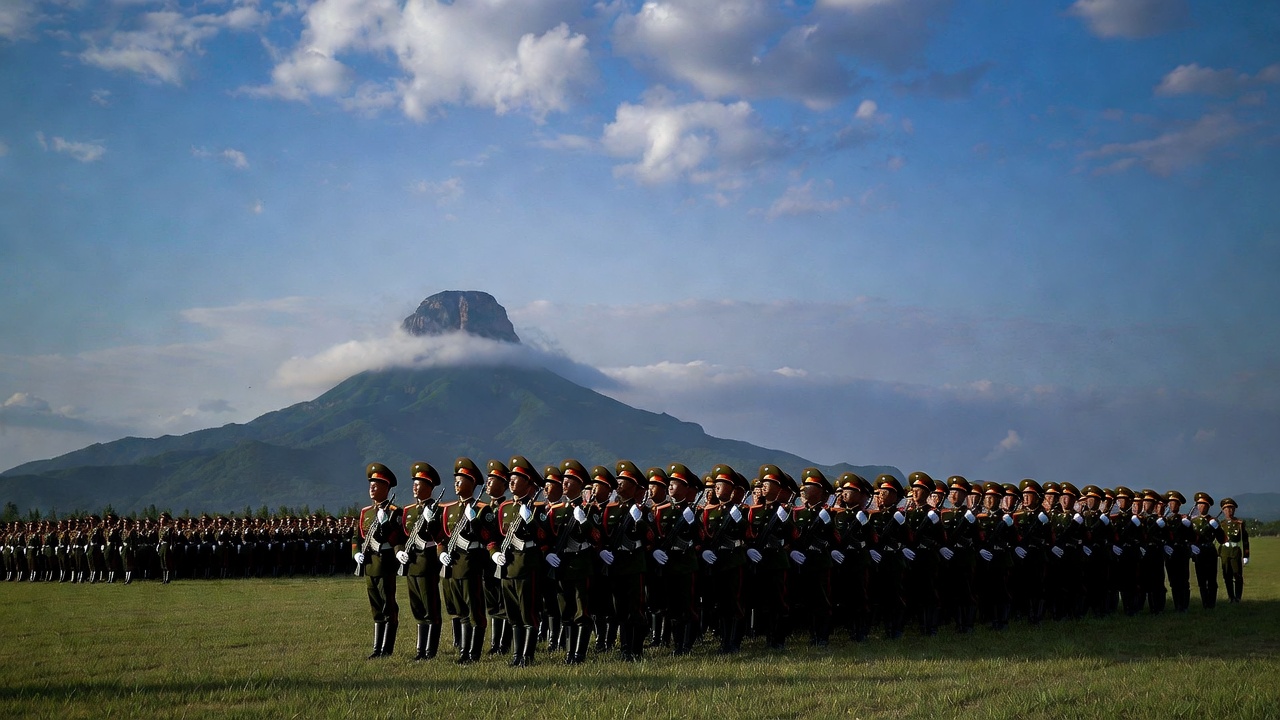
The centerpiece of any major Army Day celebration is the military parade. These parades are broadcast live on Korean Central Television (KCTV) and are watched by analysts around the world. They serve multiple purposes at once: they project military strength to external rivals, they reinforce regime legitimacy at home, and they provide intelligence agencies with rare glimpses of North Korea’s latest weapons systems.
According to Wikipedia’s comprehensive list of North Korean military parades, these events typically feature troops from the Korean People’s Army and the paramilitary Worker-Peasant Red Guards. Parades are generally held on quinquennial (every 5 years) or decennial (every 10 years) anniversaries. Participants often receive commemorative medals and special treatment at their barracks.
Will North Korea Hold a Military Parade in February 2026?
This is the question that has dominated headlines on the Korean Peninsula in recent weeks. The answer, based on the latest available evidence, is: almost certainly yes — though its exact nature remains unclear.
Satellite Evidence: Soldiers Drilling at Mirim Parade Training Ground
On February 2, 2026, commercial satellite imagery analyzed by 38 North — a leading North Korea monitoring project based at the Stimson Center — revealed hundreds of soldiers practicing marching formations at the Mirim Parade Training Ground in eastern Pyongyang. The imagery showed troops arranged in the shape of the hammer, sickle, and calligraphy brush — the emblem of the Workers’ Party of Korea (WPK).
38 North assessed that these preparations are “likely in preparation for a parade to mark the upcoming Ninth Party Congress.”
South Korea’s Military Confirms Preparations
South Korea’s Joint Chiefs of Staff (JCS) confirmed on February 4 that it has detected signs of parade preparations at both the Mirim Airfield and Kim Il Sung Square. JCS spokesman Colonel Lee Sung-jun stated in a press briefing:
“It’s not yet clear whether a military parade will take place. As I understand, preparations are currently being made as a civilian event.”
This careful wording suggests that Pyongyang may stage a paramilitary parade involving reserve forces rather than active military personnel — or that the final decision on the parade’s scope has not yet been made.
The Ninth Party Congress: The Biggest Political Event of 2026
The Ninth Congress of the Workers’ Party of Korea is the single most important political event in North Korea in 2026. The Party Congress, held once every five years, is the regime’s highest decision-making body. It is where Kim Jong Un will unveil a new five-year plan covering the country’s political, economic, military, and diplomatic priorities through 2031.
The Eighth Party Congress was held in January 2021. During the WPK’s June 2025 plenary meeting, the party decided to convene the Ninth Congress without specifying a date. South Korean intelligence and the National Intelligence Service (NIS) have predicted that the congress will likely take place in early to mid-February 2026.
Based on past precedent, experts estimate the congress could open between February 6 and February 10, potentially concluding before February 16 — the birthday of former leader Kim Jong Il, known as the Day of the Shining Star, when major commemorative events are traditionally held.
A military or paramilitary parade tied to the Party Congress would serve a clear purpose: to project regime strength and unity at the very moment Kim Jong Un lays out the nation’s future direction.
What Weapons Could North Korea Showcase at a 2026 Military Parade?
If North Korea does hold a full military parade in 2026, it would offer the world a rare window into Pyongyang’s latest weapons development. Based on what was shown at the October 2025 parade marking the WPK’s 80th anniversary, several systems are likely candidates.
The Hwasong-20 Intercontinental Ballistic Missile
The Hwasong-20 was the star of the October 2025 parade. State media called it North Korea’s “most powerful nuclear strategic weapons system.” The solid-fuel ICBM is designed to threaten the continental United States. Its solid-fuel propulsion system means it can be moved more easily and launched more quickly than liquid-fueled missiles — making it harder for adversaries to detect and intercept.
The Hwasong-11Ma Hypersonic Glide Vehicle
Also featured in October 2025, the Hwasong-11Ma is a short-range ballistic missile equipped with a hypersonic glide vehicle — a warhead that can maneuver erratically during flight, making it extremely difficult for missile defense systems to intercept. The Hwasong-11 series is based on Russia’s Iskander missiles, which have been used extensively in Moscow’s strikes across Ukraine.
The Cheonma-20 Main Battle Tank
The October 2025 parade also debuted the Cheonma-20, an upgraded main battle tank. State media boasted of its “tremendous striking capability” and “reliable protection system.” The tanks represent a rare conventional upgrade for a military that still relies heavily on aging Soviet-era hardware.
Potential New Reveals: AI-Powered Systems and Drones
Analysts like Hong Min, a senior research fellow at the Korea Institute for National Unification, have suggested that North Korea may unveil AI-powered systems and unmanned vehicles at future parades. Given the rapid evolution of drone warfare in the Russia-Ukraine conflict — a war in which North Korean troops are now participating — Pyongyang has strong incentives to display its own advances in this domain.
| Weapon System | Type | First Displayed | Key Feature |
|---|---|---|---|
| Hwasong-20 | ICBM | October 2025 | Solid-fuel, US mainland range |
| Hwasong-11Ma | SRBM with HGV | October 2025 | Hypersonic, Iskander-based |
| Cheonma-20 | Main battle tank | October 2025 | Upgraded armor and firepower |
| Unknown AI/drone systems | Various | Possibly 2026 | Autonomous targeting |
North Korea’s Military Alliance with Russia and Its Impact on the KPA
Any discussion of the KPA in 2026 is incomplete without addressing the dramatic transformation of the North Korea–Russia military relationship. What was once a diplomatic partnership defined by trade in basic commodities has evolved into a full-fledged wartime alliance.
North Korean Troops on the Battlefield in Ukraine
In October 2024, multiple intelligence sources confirmed that North Korea had deployed approximately 10,000 to 12,000 soldiers to Russia’s Kursk region to fight alongside Russian forces against Ukraine. The troops, many from the elite Storm Corps, were transported by Russian ships to Vladivostok, given Russian uniforms and fake identities, and trained at Russian military facilities.
In April 2025, North Korea officially confirmed it had sent troops to Russia — a rare public acknowledgment of what had long been an open secret. State media reported that Kim Jong Un personally honored the returning 528th Regiment of Engineers, which had served approximately 120 days in Kursk. He posthumously recognized nine soldiers killed during the deployment.
By late 2025, estimates from South Korean intelligence suggested that roughly 600 North Korean soldiers had been killed and thousands more wounded in the fighting. Despite these losses, Pyongyang pledged to triple its military contribution, potentially sending an additional 25,000 to 30,000 troops to the front lines.
What Russia Gives North Korea in Return
The alliance is not one-directional. In exchange for manpower, ammunition, and artillery shells, Russia is transferring military technology to North Korea that Pyongyang could not develop on its own. This includes:
- Missile technology: North Korea tested a supersonic cruise missile in 2025 that experts say resembles a nuclear-capable Russian model.
- Naval capabilities: Kim Jong Un launched the country’s largest naval destroyer in April 2025.
- Rocket engine advances: A new high-thrust rocket engine passed final testing in 2025.
- Economic relief: Trade between the two countries has increased significantly.
The Comprehensive Strategic Partnership Treaty, signed during Putin’s 2024 visit to Pyongyang, includes a mutual defense clause — effectively making it a military alliance in all but name. In September 2025, Putin publicly thanked Kim Jong Un for the troops fighting against Ukraine. In December 2025, Kursk Oblast announced plans to build a memorial to North Korean soldiers who fought in the region.
Combat Veterans at the Parade
At the October 2025 parade, North Korean troops who fought in Kursk marched through Kim Il Sung Square. State media described them as “the invincible overseas operations unit that fully demonstrated the spirit of the Korean people.” Former Russian President Dmitry Medvedev attended the parade as a guest of honor.
If a parade takes place in February 2026, these battle-hardened veterans will almost certainly feature prominently — a powerful visual statement linking the KPA’s founding mythology to its first overseas combat deployment in decades.
Kim Jong Un’s Daughter at Military Events: Succession and Symbolism
One of the most closely watched figures at recent North Korean military events is not a general or a diplomat. She is a teenager. Kim Ju Ae, believed to be 12 or 13 years old, is the daughter of Kim Jong Un and his wife Ri Sol Ju. Her increasingly frequent appearances at high-profile state events have fueled intense speculation about whether she is being groomed as the fourth generation of the Kim dynasty to rule North Korea.
From First Appearance to International Debut
Kim Ju Ae first appeared in state media in November 2022, when she accompanied her father at a missile launch inspection. Since then, she has attended dozens of official events — military parades, weapons tests, diplomatic receptions, and national celebrations.
Key milestones in her public visibility include:
- September 2023: Appeared at the 75th anniversary parade of the DPRK’s founding.
- May 2025: Made her diplomatic debut at the Russian Embassy in Pyongyang for Victory Day.
- September 2025: Accompanied Kim Jong Un to Beijing for China’s massive Victory Day military parade.
- January 1, 2026: Visited the Kumsusan Palace of the Sun — the sacred mausoleum where the embalmed bodies of Kim Il Sung and Kim Jong Il are displayed — in what experts called a politically orchestrated move ahead of the Party Congress.
State media has progressively elevated the language used to describe her. Originally called Kim Jong Un’s “beloved” or “precious” daughter, she is now referred to as “respected” — a term traditionally reserved for the regime’s most honored figures. Kim Jong Un himself has reportedly called her the “Morning Star General,” a title carrying deep political symbolism in North Korean rhetoric.
Will She Appear at the 2026 Parade?
If a parade or major celebration takes place around the Party Congress, Kim Ju Ae is likely to attend. Her presence would reinforce the regime’s message of dynastic continuity — a visual promise that the Kim family’s grip on power will extend into the next generation.
North Korea’s “Two Hostile States” Doctrine and What It Means for Army Day 2026
In December 2023, Kim Jong Un formally declared that the relationship between North and South Korea is one between “two hostile states.” This was not merely rhetorical. It represented a fundamental shift in Pyongyang’s official policy — a formal abandonment of the goal of Korean reunification that had been a cornerstone of the regime’s ideology since 1948.
The doctrine was further codified in 2024 amendments to the North Korean Constitution, which reportedly designate South Korea as a hostile state. Throughout 2025, the regime dismantled symbolic remnants of inter-Korean cooperation: the Arch of Reunification in Pyongyang was reportedly demolished, cross-border communication lines were severed, and propaganda shifted from speaking of “one nation” to speaking of “the enemy.”
This doctrine carries direct implications for how Army Day is celebrated. The KPA is no longer framed as the defender of a divided nation awaiting reunification. Instead, it is positioned as the shield of a sovereign state locked in permanent confrontation with an existential enemy. Military parades under this framework are not aspirational — they are confrontational. Every missile on display, every rank of goose-stepping soldiers, carries an implicit message to Seoul: we are prepared for war.
The Ninth Party Congress is expected to institutionalize the “two hostile states” framework as a core element of national policy through 2031. This means that KPA Foundation Day celebrations in 2026 and beyond will increasingly carry a harder, more adversarial edge.
How Past Korean People’s Army Foundation Day Military Parades Have Shaped History
To understand what might happen in 2026, it helps to look at what has happened before. North Korean military parades are not routine events. Each one is a carefully calibrated political statement.
1948: The First Parade
The very first KPA parade took place on February 8, 1948, at Pyongyang Station. Approximately 20,000 soldiers stood at attention as Kim Il Sung presided. Soviet generals attended as honored guests. This parade established the template that has been followed for nearly eight decades.
1992: Kim Jong Il Speaks
At the 1992 parade marking the KPA’s diamond jubilee (60th anniversary), Kim Jong Il made his first and only public speech at a military parade, declaring: “Glory to the officers and soldiers of the heroic Korean People’s Army!” Over 20,000 troops and 1,200 pieces of weaponry participated. It was the last parade to feature the Soviet-style goose step.
2018: The Platinum Jubilee and Olympic Counter-Programming
The February 8, 2018 parade marked the 70th anniversary of the KPA’s formal establishment. Approximately 13,000 soldiers participated. The timing was notable — it coincided with the 2018 Winter Olympics opening ceremony in Pyeongchang, South Korea. Analysts widely interpreted this as deliberate counter-programming by Pyongyang.
2023: Kim Ju Ae’s Debut and the Family Banquet
During the February 2023 celebrations, Kim Jong Un participated in a banquet with his wife Ri Sol Ju and his daughter Kim Ju Ae — one of the young girl’s earliest public appearances. The location was later identified as the Yanggakdo Hotel.
October 2025: The Weapons Showcase
The most recent major parade, in October 2025, celebrated the WPK’s 80th anniversary. It featured the Hwasong-20 ICBM, Hwasong-11Ma hypersonic weapons, Cheonma-20 tanks, and North Korean combat veterans from Russia’s Kursk front. Chinese Premier Li Qiang, former Russian President Dmitry Medvedev, and Vietnamese Communist Party leader To Lam attended as guests of honor — the highest-level foreign delegation at a North Korean event in years.
Understanding the Korean People’s Army: Size, Structure, and Capability in 2026
The KPA is not just large — it is staggeringly so. Understanding its structure helps explain why Army Day is treated with such gravity in the DPRK.
The Five Branches of the KPA
The Korean People’s Army consists of five branches:
- Ground Force — The largest branch, with an estimated 1 million personnel. Possesses over 4,300 tanks, 2,500 armored vehicles, and 8,600 artillery guns.
- Naval Force — Approximately 60,000 personnel with roughly 470 surface vessels and 70 submarines.
- Air Force — About 110,000 personnel operating over 400 fighter aircraft, though many date from the Soviet era.
- Strategic Force — Operates ballistic missiles, including those capable of carrying nuclear warheads.
- Special Operations Forces — An estimated 180,000–200,000 troops trained for infiltration and unconventional warfare.
Nuclear Arsenal
North Korea is estimated to possess between 40 and 50 nuclear warheads, with enough fissile material to build up to 90 weapons, according to assessments cited by the Foundation for Defense of Democracies. The country has conducted six nuclear tests and has developed delivery systems ranging from short-range tactical missiles to intercontinental ballistic missiles theoretically capable of reaching the continental United States.
Military Spending and Conscription
In 2024, 16% of all North Korean state spending went to defense — one of the highest ratios in the world. All men between the ages of 17 and 30 are required to serve in the military, with terms ranging from 3 to 12 years. This universal conscription system ensures that the military permeates every level of North Korean society.
The Ninth Party Congress and the Five-Year Plan: What North Korea’s Military Future Looks Like
The Ninth Workers’ Party Congress is not just a political formality. It is the event where Kim Jong Un will lay out the blueprint for North Korean governance through 2031. Based on reporting from Korea Herald and 38 North, the congress is expected to address three core areas:
First: Nuclear and conventional military development. The new five-year plan will likely outline continued expansion of North Korea’s nuclear arsenal, development of advanced delivery systems (including solid-fuel ICBMs and hypersonic weapons), and deepening military cooperation with Russia.
Second: Institutionalizing the “two hostile states” framework. The congress is expected to formally codify the doctrine that South Korea is a permanent enemy rather than a partner for reunification. This will have cascading effects on military doctrine, diplomatic posture, and domestic propaganda.
Third: Consolidating Kim Jong Un’s governing ideology. The congress will reinforce Kim’s personal authority and potentially advance the succession narrative around Kim Ju Ae.
In late January 2026, Kim oversaw the test-firing of an upgraded large-caliber multiple rocket launcher system and stated that plans to further strengthen the country’s nuclear deterrent would be detailed at the congress. This signals that the military dimension of the five-year plan will be robust and aggressive.
Can Tourists Visit North Korea for Army Day Celebrations?
For those curious about the cultural dimensions of this holiday, the question of tourism is natural — if complex.
North Korea’s borders were almost entirely sealed from early 2020 through late 2023 due to COVID-19 restrictions. Even before the pandemic, access was tightly controlled, with all foreign tourists required to travel through state-approved tour operators and remain under constant supervision.
As of early 2026, limited tourism has resumed — primarily through Chinese operators offering group tours from border cities. However, these arrangements remain fragile. In early 2025, Chinese travel agencies launched group tour products for North Korea, but the resumption was aborted just before departure, according to reporting on DPRK-China tourism normalization.
For KPA Foundation Day specifically, witnessing a military parade as a foreign tourist has historically been possible but rare. Tour operators like Young Pioneer Tours have offered itineraries timed to coincide with major parades. As the company notes on its website: “When it comes to North Korean military parades, they will take place regardless of whether tourists are there to watch them.”
Any traveler considering such a trip should be aware of the significant risks and ethical considerations involved. Many governments, including the United States, restrict or ban travel to North Korea entirely.
February 2026 Timeline: Key Dates to Watch on the Korean Peninsula
For analysts and observers tracking developments, here are the critical dates in February 2026:
| Date | Event | Significance |
|---|---|---|
| Early February | Ninth Party Congress expected to open | Sets five-year national agenda |
| February 8 | Korean People’s Army Foundation Day | Formal KPA anniversary; potential parade |
| February 16 | Kim Jong Il’s Birthday (Day of the Shining Star) | Major commemorative holiday |
| February 17 | Seollal (Lunar New Year) | Traditional Korean holiday |
| Late February | Possible continuation of congress-related events | Follow-up celebrations and policy announcements |
The clustering of the Party Congress, Army Day, Kim Jong Il’s birthday, and Lunar New Year in a single month creates an unusually dense period of political and cultural activity. This concentration makes some form of major public celebration — whether a full military parade, a paramilitary march, or a civilian pageant — virtually certain.
What a 2026 North Korean Military Parade Would Mean for Regional Security
A military parade in early 2026 would not just be a domestic celebration. It would send messages to multiple audiences simultaneously.
To the United States and South Korea, it would signal that North Korea’s nuclear and missile programs are advancing despite international sanctions. The display of systems like the Hwasong-20 ICBM would reinforce Pyongyang’s claim that it can strike the American homeland.
To Russia, it would demonstrate continued solidarity. The likely inclusion of troops who fought in Kursk would underscore the depth of the military partnership and signal readiness for further deployments.
To China, it would reaffirm North Korea’s value as a strategic buffer state while subtly asserting Pyongyang’s growing independence within the Beijing-Moscow-Pyongyang triangle.
To the North Korean people, it would project an image of strength, progress, and regime stability — particularly important as the new five-year plan is unveiled.
The U.S. Indo-Pacific Command and South Korea’s Joint Chiefs of Staff will be monitoring events closely. Any parade featuring new weapons systems could trigger heightened alert levels across the region.
Final Thoughts: The Korean People’s Army Foundation Day in a Changing World
The Korean People’s Army Foundation Day in 2026 arrives at a moment of genuine transformation for North Korea. The country is no longer the isolated hermit kingdom of popular imagination. Through its military alliance with Russia, its growing nuclear arsenal, and its increasingly assertive diplomacy with China, Pyongyang has positioned itself as a significant player in a rapidly shifting global order.
The February 8 holiday will be observed with the usual rituals — speeches, concerts, commemorations of fallen soldiers. But the stakes are higher than they have been in years. A military parade tied to the Ninth Party Congress would serve as the regime’s most important public statement about where it is heading.
Satellite imagery, intelligence assessments, and the sheer political weight of the Party Congress all point toward some form of parade. Whether it features active-duty troops and advanced weapons or takes the form of a more restrained civilian-paramilitary event remains to be seen. But one thing is clear: the world will be watching.
As Kim Jong Un sets the course for the next five years, the soldiers marching through Kim Il Sung Square will embody the central message of his rule — that in North Korea, the party, the people, and the army are inseparable. For better or for worse, that message has never been delivered with more conviction than it will be in February 2026.
Frequently Asked Questions About Korean People’s Army Foundation Day
When is Korean People’s Army Foundation Day in 2026? KPA Foundation Day falls on Sunday, February 8, 2026. It is a public holiday in North Korea. Schools, offices, and most businesses close for the day.
Is there a difference between February 8 and April 25 military holidays? Yes. February 8 marks the formal establishment of the Korean People’s Army in 1948. April 25 commemorates the founding of Kim Il Sung’s guerrilla army in 1932. Both are public holidays, but they honor different chapters of the military’s history.
How often does North Korea hold military parades? Major military parades are typically held on quinquennial (every 5 years) or decennial (every 10 years) anniversaries of key national holidays. However, in recent years under Kim Jong Un, the frequency has increased. Parades have been used to mark Party anniversaries, National Day celebrations, and other significant political events even outside traditional milestone years.
What is the Ninth Workers’ Party Congress? The Party Congress is the highest decision-making body in North Korea’s political system. It convenes once every five years. The Ninth Congress, expected in early to mid-February 2026, will set the country’s political, economic, and military priorities through 2031. It is the most consequential political event in the DPRK this year.
Has North Korea confirmed a military parade for 2026? As of February 4, 2026, North Korea has not officially announced a military parade. However, satellite imagery shows soldiers practicing marching formations at the Mirim Parade Training Ground, and South Korea’s Joint Chiefs of Staff have confirmed detecting preparations at multiple sites in Pyongyang. The evidence strongly suggests that some form of parade or large-scale public march will take place.
How large is North Korea’s military? The Korean People’s Army has an estimated 1.2 to 1.3 million active-duty personnel, making it one of the largest standing armies in the world. Including reserves and paramilitary forces, the total armed strength exceeds 7 million — nearly 30% of the country’s population.
Are North Korean soldiers currently fighting in Ukraine? Yes. North Korea has confirmed deploying troops to Russia’s Kursk region, where they have fought alongside Russian forces against Ukraine. In December 2025, Kim Jong Un publicly honored returning combat units and acknowledged casualties. Estimates suggest that up to 12,000 troops were deployed in the initial wave, with plans for additional deployments announced throughout 2025.
Who is Kim Ju Ae and why does she attend military events? Kim Ju Ae is the daughter of Kim Jong Un and Ri Sol Ju, believed to be around 12–13 years old. She has appeared alongside her father at major military events since 2022. Some analysts believe she is being groomed as a potential successor — the fourth generation of the Kim dynasty. Others caution that her presence may be more about reinforcing family symbolism than about a formal succession plan.