Every year on February 5, the tiny Republic of San Marino pauses to honor two deeply intertwined events. One is political. The other is sacred. Together, they form one of Europe’s most distinctive national holidays — a day when patriotism and faith walk hand in hand through cobblestone streets, under medieval towers, and across the misty ridgeline of Monte Titano.
The official name of this holiday is a mouthful: the Anniversary of the Liberation of the Republic from the Alberonian Occupation (1740) and the Feast of Saint Agatha, Patron Saint, along with San Marino. Locals simply call it la festa. But behind that casual shorthand lies a story of defiance, devotion, and a remarkable coincidence of timing that has shaped Sammarinese identity for nearly three centuries.
In 2026, this celebration falls on a Thursday, February 5 — a welcome midweek respite that draws both Sammarinese citizens and visitors into the heart of the world’s oldest surviving republic. If you are planning a winter trip to central Italy and want to experience something truly authentic, this is the day to circle on your calendar.
What Is Liberation Day in San Marino and Why Is It Celebrated on February 5?
Liberation Day in San Marino commemorates the restoration of the republic’s independence on February 5, 1740. On that date, Pope Clement XII formally recognized San Marino’s sovereignty. He ended a brief but humiliating occupation that had begun just months earlier.
The story begins in October 1739. Cardinal Giulio Alberoni, the Papal Governor of Ravenna, marched troops into San Marino’s territory. His motives were political. He wanted to expand the influence of the Papal States in the region. Alberoni exploited internal tensions among Sammarinese ruling families to justify his intervention. He dismissed the sitting Captains Regent — the republic’s two co-heads of state — and replaced them with figures loyal to the Church.
For a nation that had maintained some form of self-governance since 301 AD, this was an outrage. The Sammarinese responded not with arms, but with civil disobedience. Citizens wrote secret letters to the Pope in Rome. They appealed to other European leaders. They refused to accept the new political order quietly.
Their persistence paid off. Pope Clement XII investigated the matter. He found that Alberoni had likely overstepped his authority. The Pope dispatched Monsignor Enrico Enriquez to restore order. On February 5, 1740, San Marino’s rights were officially reinstated. Independence was restored. The occupation had lasted roughly three and a half months.
That date — February 5 — happened to be the feast day of Saint Agatha on the Catholic calendar. The Sammarinese saw this as more than coincidence. They regarded it as a sign of divine favor. From that moment forward, Saint Agatha was proclaimed the republic’s co-patron saint, alongside Saint Marinus, the 4th-century stonemason who is credited with founding the state.
Who Was Saint Agatha of Sicily and Why Is She the Patron Saint of San Marino?
To understand the spiritual dimension of this holiday, you need to know who Saint Agatha was. Her story is one of the most revered in the early Christian tradition.
Agatha was born around 231 AD in Catania, Sicily. She came from a wealthy, noble family. At a young age, she dedicated her life to God and took a vow of virginity. Her beauty and her family’s status attracted the attention of Quintianus, the Roman prefect of Sicily. He desired both Agatha herself and her family’s wealth.
When the Emperor Decius issued a decree in 250 AD requiring all citizens to offer sacrifices to Roman gods, Quintianus saw his opportunity. He had Agatha arrested. He sent her to a brothel, hoping to break her will. She refused to yield. He ordered her tortured. According to hagiographic tradition, she endured imprisonment, burning, and mutilation with extraordinary resolve.
Agatha died in prison around 251 AD. The year after her death, an eruption of Mount Etna threatened Catania. Citizens carried her veil to the advancing lava, and the flow reportedly stopped. This event cemented her reputation as a protector against fire and natural disaster.
Today, Saint Agatha is the patron saint of Catania, Malta, and the Republic of San Marino. She is also recognized as the patron saint of breast cancer patients, rape survivors, nurses, and bellfounders. Her feast day has been observed on February 5 since medieval times — long before the events of 1740 tied her even more closely to Sammarinese identity.
In San Marino, the link between saint and state is not merely symbolic. It is structural. The fact that independence was restored on her feast day gave the Sammarinese a narrative of divine protection. That narrative has been reinforced through nearly 286 years of uninterrupted celebrations.
The History of San Marino: How the World’s Oldest Republic Survived Centuries of Invasion
To fully appreciate Liberation Day, it helps to understand just how remarkable San Marino’s survival has been.
San Marino claims to have been founded in 301 AD by a Christian stonemason named Marinus. Fleeing religious persecution under Emperor Diocletian, Marinus reportedly settled on the rocky peak of Monte Titano in what is now northeastern Italy. He established a small monastic community there. Over the centuries, that community grew into a self-governing republic.
The first written record of San Marino as an independent political entity dates to 885 AD. By the 13th century, the republic had developed the governmental system that survives in modified form today — including the unique tradition of two Captains Regent who serve as joint heads of state for six-month terms.
Here is a timeline of the key moments in San Marino’s long fight for independence:
| Year | Event |
|---|---|
| 301 AD | Saint Marinus founds a community on Monte Titano |
| 1243 | The Captains Regent system is established |
| 1263 | The earliest known statutes of San Marino are codified |
| 1291 | The Holy See formally recognizes San Marino’s independence |
| 1463 | Territory expands after alliance against Sigismondo Malatesta |
| 1503 | Cesare Borgia (“Valentino”) briefly occupies San Marino |
| 1631 | Pope Urban VIII reconfirms independence |
| 1739 | Cardinal Alberoni occupies San Marino |
| 1740 | Pope Clement XII restores independence on February 5 |
| 1797 | Napoleon recognizes San Marino’s sovereignty |
| 1815 | The Congress of Vienna ratifies independence |
| 1862 | The Kingdom of Italy signs a friendship treaty |
| 2008 | UNESCO designates the historic center and Monte Titano as a World Heritage Site |
What stands out is the pattern. San Marino has been threatened many times. It has been occupied only twice — by Cesare Borgia in 1503 and by Cardinal Alberoni in 1739. Both times, the occupation was short-lived. Both times, Sammarinese resilience won out.
With a land area of just 61 square kilometers and a population of approximately 34,000 people, San Marino is the fifth-smallest country in the world. Yet it claims to be the oldest surviving sovereign state and the oldest constitutional republic on Earth. Its statutes from 1600 remain at the core of its constitutional framework, making them the oldest written governing documents still in effect.
How Do the Sammarinese Celebrate Liberation Day and Saint Agatha’s Feast in 2026?
The celebrations on February 5 blend civic ceremony, religious ritual, and community spirit in a way that feels both solemn and joyful. Here is what you can expect if you visit San Marino on this day in 2026.
The Institutional Procession from Palazzo Pubblico
The day’s formal events begin at the Palazzo Pubblico — San Marino’s town hall and seat of government, located on Piazza della Libertà. The Captains Regent lead a formal procession through the streets of the historic center. Government officials, council members, and dignitaries follow in ceremonial dress.
This procession follows a strict and solemn protocol. It is one of the few times each year when the full pageantry of Sammarinese statehood is on display. The route passes key landmarks in the old town before proceeding toward the Basilica di San Marino.
The Procession from Borgo Maggiore to the Capital
The most visible and beloved tradition is the public procession from Borgo Maggiore — the town at the base of Monte Titano — up to the capital city of San Marino at the summit. This walk follows the ancient path that connects the two communities. It is both a symbolic reenactment of the journey toward freedom and a communal act of devotion.
Participants carry flags and banners. Music fills the narrow streets. The atmosphere is festive but respectful. For visitors, walking alongside the Sammarinese during this procession is one of the most memorable experiences the republic offers.
The Feast of the Militia and Military Ceremony
February 5 is also the Feast of the Militia. A military ceremony takes place in Piazza della Libertà, where the republic’s Military Militias assemble in formation before the Palazzo Pubblico. The scene is striking. Soldiers wear dress uniforms. The Guard of the Council — known locally as the Guard of Nobles — appears in its distinctive blue, white, and gold uniform, one of the most photographed sights in San Marino.
During the ceremony:
- The High Commander reviews the Military Militias in front of the Ara dei Volontari
- A laurel wreath is laid at the base of the monument to honor Sammarinese who died in all wars
- Arms are presented to the Captains Regent
- New recruits take their oath of service
- Medals are awarded to distinguished service members
This military observance is not about projecting power. San Marino has no standing army in the conventional sense. Rather, it is about honoring the principle of civic duty that has sustained the republic for over 1,700 years.
Religious Services at the Basilica
The religious dimension of the day centers on the Basilica di San Marino, the neoclassical church that sits on Piazzale Domus Plebis. A solemn Mass is celebrated in honor of Saint Agatha. The basilica, which also houses the relics of Saint Marinus, provides a powerful setting where sacred and national histories converge.
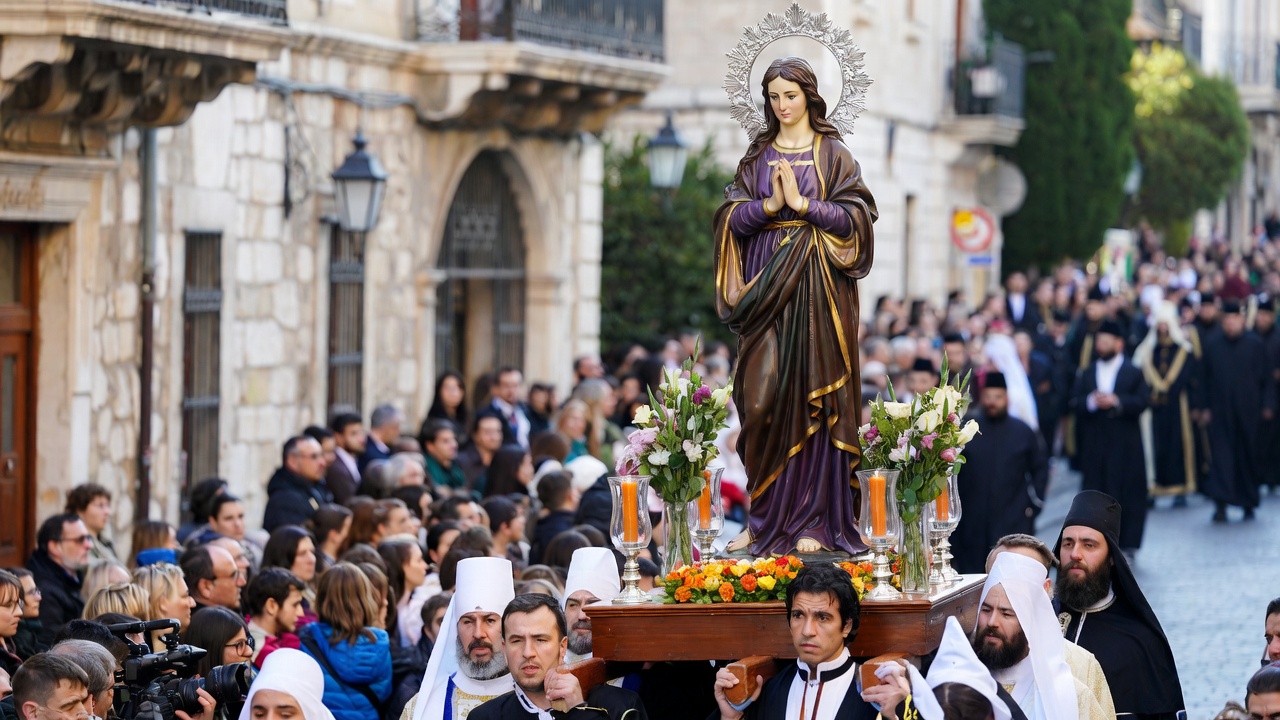
In addition to the main Mass, smaller devotional services are held throughout the day. The blessing of Agatha loaves — bread loaves that are consecrated but not meant to be eaten, serving instead as a form of spiritual intercession — is a tradition observed in some households and parishes.
Traditional Sammarinese Food to Try During the February 5 Celebrations
No Sammarinese celebration is complete without food. The cuisine of San Marino shares deep roots with the neighboring Italian regions of Emilia-Romagna and Marche. But several dishes are distinctly Sammarinese, and the February holiday is an ideal time to try them.
Savory Dishes of San Marino
| Dish | Description |
|---|---|
| Fagioli con le cotiche | A hearty bean and bacon rind soup, traditionally served at Christmas but also enjoyed during winter celebrations |
| Pasta e ceci | A chickpea and noodle soup flavored with garlic and rosemary — simple, warming, and deeply satisfying |
| Nidi di rondine | “Swallows’ nests” — rolled pasta filled with smoked ham, beef, and cheese, baked in tomato and béchamel sauce |
| Coniglio con finocchio | Roast rabbit with fennel, often served with polenta |
| Piada | A flatbread with various fillings, similar to the piadina of Emilia-Romagna, especially popular in Borgo Maggiore |
| Passatelli | Pasta made from breadcrumbs, Parmesan, and eggs, served in chicken broth |
| Erbazzone | A savory spinach pie with cheese and onions |
Sweets and Desserts
The Sammarinese take particular pride in desserts that reference their national symbols:
- Torta Tre Monti — A layered wafer cake covered in chocolate, inspired by the Three Towers of San Marino. This is arguably the republic’s most famous sweet export.
- Torta Titano — A layered dessert made with biscuit, hazelnuts, chocolate, cream, and coffee, named after Monte Titano.
- Verretta — A chocolate wafer cake with hazelnut and cocoa cream, named after the arrows used by crossbowmen in San Marino’s historical tournaments.
- Bustrengo — A rustic cake made with raisins, a traditional Sammarinese recipe.
- Cacciatello — A custard dessert similar to crème caramel.
Local Wines and Spirits
San Marino produces several notable wines. Look for Brugneto and Tessano (cask-aged reds) or Biancale and Roncale (still whites). Among local spirits, Mistrà (anise-flavored) is a common after-dinner choice. The truffle-flavored Tilus and herbal Tamir Shachar are more distinctive options.
During the February 5 festivities, local restaurants in both the old town and Borgo Maggiore serve seasonal menus that feature many of these dishes. Booking a table in advance is a good idea, as the holiday draws both locals and visitors.
Visiting San Marino in February: A Complete Travel Guide for Liberation Day
Planning a trip to San Marino for the February 5 holiday requires a bit of preparation. The republic is small, and infrastructure is designed more for day visitors than for large crowds. Here is what you need to know.
How to Get to San Marino from Rimini and Other Italian Cities
San Marino has no airport and no train station. The nearest major transport hub is Rimini, a coastal city about 24 kilometers to the northeast. From Rimini, getting to San Marino is straightforward.
By bus: The most popular option. Coaches operated by Bonelli Bus and Fratelli Benedettini depart from near Rimini’s main train station several times daily. The journey takes about 50 to 55 minutes and costs approximately €7 one way. Tickets can be purchased online, from the driver, or at kiosks near the station.
By car: The drive from Rimini takes about 30 minutes via the SS72 highway. From Bologna, expect about 90 minutes. Parking in San Marino is available in several paid lots near the historic center. Lots P6 and P7 are closest to the old town. Lot P9 offers covered parking with panoramic elevator access to the historic center.
Distances from major cities:
| City | Distance to San Marino |
|---|---|
| Rimini | 24 km |
| Ancona | 130 km |
| Bologna | 135 km |
| Florence | 240 km |
| Milan | 330 km |
| Rome | 350 km |
The San Marino Cable Car: A Scenic Way to Reach the Historic Center
One of the highlights of arriving in San Marino is the Funivia di San Marino — the cable car that connects Borgo Maggiore with the old town at the summit of Monte Titano. The ride takes just two minutes and offers panoramic views that stretch to the Adriatic Sea on clear days.
In February, the cable car operates from 7:45 AM to 6:30 PM, with departures every 15 minutes. A round-trip ticket costs approximately €5, and a single ride is €3. If you arrive by bus from Rimini, the bus stops right near the cable car station in Borgo Maggiore, making it a natural next step.
Note: The cable car sometimes closes for annual inspections in February or March. Check the official Visit San Marino website for the latest schedule before your trip.
What to Wear and Expect in February
February in San Marino is cold and windy, especially at the summit of Monte Titano (739 meters above sea level). Temperatures typically hover between 0°C and 8°C (32°F to 46°F). Bring a warm coat, layers, and sturdy shoes. The cobblestone streets can be slippery, and some paths between the towers are steep.
The old town is largely pedestrianized. Most attractions are within walking distance of each other. But the terrain is hilly, so comfortable footwear is essential.
Exploring the Three Towers of San Marino: A UNESCO World Heritage Site
No visit to San Marino is complete without exploring the Three Towers — the iconic fortifications perched on the three peaks of Monte Titano. Along with the historic center and Borgo Maggiore, they were designated a UNESCO World Heritage Site in 2008.
Guaita: The First Tower
Guaita (also called Rocca Guaita or La Rocca) is the oldest and largest of the three towers. Built in the 11th century, it has served as a fortress, a prison, and a symbol of Sammarinese independence. Inside, visitors can explore the bell tower, a small chapel dedicated to Santa Barbara, and the former prison cells — some of which still bear graffiti from inmates held there as recently as 1970.
The views from the battlements are spectacular. On clear days, you can see across the Adriatic plains, the rolling hills of Emilia-Romagna, and even the distant sea.
Cesta: The Second Tower
Cesta (also called La Fratta or the Second Tower) sits at the highest point of Monte Titano — approximately 756 meters above sea level. Built in the 13th century on the ruins of a Roman fort, it now houses the Museum of Ancient Arms, with a collection of over 1,500 weapons spanning several centuries.
The walk from Guaita to Cesta follows a dramatic pathway known as the Passo delle Streghe — the “Witches’ Path.” Legend holds that witches once gathered along this windswept ridge to brew potions and cast spells. Whether or not you believe the stories, the views along this trail are among the most dramatic in Europe.
Montale: The Third Tower
Montale is the smallest of the three towers. Built in the 14th century, it sits on the lowest of Monte Titano’s three peaks. Unlike the other two towers, Montale is not open to the public. However, it is worth the short walk from Cesta for the views and the sense of completeness.
A combined ticket for the first and second towers, along with access to several state museums, costs approximately €8 to €11.
The Significance of the Captains Regent System in San Marino’s Political Identity
One of the most distinctive features of San Marino’s governance is the Captains Regent system. Since 1243, two Captains Regent have jointly served as heads of state for six-month terms. New Captains are installed on April 1 and October 1 each year in formal investiture ceremonies.
This system is relevant to Liberation Day because it was the Captains Regent whom Cardinal Alberoni deposed in 1739. His dismissal of the legitimate rulers was seen as an attack not just on individual leaders, but on the constitutional order itself. The restoration of the Captains Regent in 1740 was therefore a restoration of the republic’s entire system of self-governance.
During the February 5 celebrations, the current Captains Regent play a central role. They lead the institutional procession. They receive the salute of the Military Militias. Their presence at the ceremony is a living reminder that the system Alberoni tried to destroy has endured for nearly eight centuries.
The Captains Regent are elected from the Grand and General Council, San Marino’s 60-member unicameral parliament. Members of the Council are elected by the public every five years through proportional representation. The two Captains have equal power and serve as a check on each other — a form of shared executive authority that is virtually unique in the modern world.
Saint Agatha Celebrations Beyond San Marino: Connections to Catania, Sicily
While San Marino’s observance of Saint Agatha’s feast is rooted in 18th-century history, the cult of Saint Agatha has far deeper origins in Catania, Sicily — the city of her birth and martyrdom.
Every year from February 3 to 5, Catania hosts one of the largest religious festivals in Europe. Up to one million people participate, including pilgrims, tourists, and local devotees. The celebration involves elaborate processions, fireworks, historical parades, and the carrying of a massive silver reliquary — the fercolo — through the city streets. Devotees wear the traditional white tunic called ‘u saccu, recalling the night dress citizens wore when they rushed into the streets in 1126 to welcome the return of Saint Agatha’s relics from Constantinople.
In Catania, the culinary traditions of the feast are also distinctive. Revelers eat olivette di Sant’Agata (small green almond pastries) and minnuzzi or cassateddi di Sant’Aita — small cakes shaped to recall the saint’s martyrdom.
The connection between Catania’s spectacular street festival and San Marino’s more intimate civic ceremony highlights a shared Mediterranean Catholic culture. Both communities honor the same saint. But each does so through the lens of its own history. In Catania, the emphasis is on Agatha’s personal sacrifice and miraculous protection. In San Marino, she symbolizes national liberation.
Why Liberation Day Matters: San Marino’s Enduring Commitment to Freedom and Sovereignty
The word “Libertas” — Latin for freedom — appears on San Marino’s coat of arms. It is the nation’s motto. And it is not merely decorative.
San Marino’s survival is extraordinary by any measure. The republic has maintained sovereignty for over 1,700 years while being entirely surrounded by a single neighboring country. It navigated the fall of the Roman Empire, medieval Italian power struggles, Napoleon’s conquests, Italian unification, two World Wars, and Mussolini’s fascist regime — all without losing its independence permanently.
Abraham Lincoln, upon being granted honorary citizenship by San Marino, wrote that the republic proved that “government founded on republican principles is capable of being so administered as to be secure and enduring.” Napoleon, impressed by the tiny state’s commitment to liberty, offered to expand its territory. San Marino politely declined, fearing that a larger territory would invite future claims on its sovereignty.
Liberation Day is the annual moment when the Sammarinese reaffirm this commitment. It is not a celebration of military victory. San Marino did not fight its way free from Alberoni’s occupation. It wrote letters. It appealed to justice. It practiced nonviolent resistance. And it won.
In 2026, this message resonates broadly. At a time when questions of sovereignty, autonomy, and self-governance shape political debates around the world, San Marino offers a quiet but powerful example. Freedom, the Sammarinese seem to say, is not about the size of your army. It is about the strength of your institutions and the determination of your citizens.
Practical Tips for Attending San Marino’s February 5 Celebrations in 2026
If you are planning to attend the 2026 celebrations, here are some practical tips to help you make the most of the experience.
Before You Go
- Check border requirements. San Marino is not in the European Union, but it is surrounded entirely by Italy. There are no border checks. Entry into Italy covers your access to San Marino. However, bring your passport if you plan to stay overnight — hotels may request it.
- Book accommodation early. San Marino has limited hotel options. The Hotel Titano and other properties in the historic center fill up quickly around national holidays. Alternatively, consider staying in Rimini and visiting San Marino as a day trip.
- Get a tourist card. The Tutto San Marino Card offers discounted entry to state museums (approximately €8 for seven museums instead of €11), reduced cable car fares, and discounts at participating restaurants and shops.
During the Day
- Arrive early. The procession from Borgo Maggiore usually begins in the morning. Getting to San Marino by 9:00 or 10:00 AM gives you time to settle in before the formal events begin.
- Respect the ceremony. This is a real national holiday, not a tourist show. The military ceremony and religious services are important to the Sammarinese. Watch respectfully. Ask before taking photos during the Mass or military events.
- Dress warmly. February at 739 meters altitude is cold and breezy. Layers are essential.
- Try the local cuisine. Many restaurants offer special holiday menus. Look for nidi di rondine, pasta e ceci, and of course Torta Tre Monti for dessert.
Getting Around
- The historic center is entirely walkable but steep in places.
- The cable car from Borgo Maggiore is the most scenic way up. In February, it closes at 6:30 PM.
- The last bus back to Rimini typically departs in the early evening. Check the Bonelli Bus schedule for exact times.
- If driving, parking lots P6 (Cava Antica) and P9 (covered, with elevator access) are most convenient for the old town.
Other Must-See Attractions in San Marino Beyond Liberation Day
While Liberation Day is a compelling reason to visit, San Marino offers plenty to explore on any day of the year. Here are highlights you should not miss.
The Palazzo Pubblico
San Marino’s town hall and seat of government sits on Piazza della Libertà. Designed in the late 19th century with stone quarried from Monte Titano, the building echoes the style of Florence’s Palazzo Vecchio. Above the entrance, statues of Saint Agatha, Saint Marinus, and Saint Leo watch over the square. Visitors can tour the interior, including the Grand and General Council chamber.
The Basilica di San Marino
This neoclassical church houses the relics of Saint Marinus beneath the main altar. The Basilica’s façade, with its Corinthian columns, is one of the most recognizable landmarks in the old town. It is here that the solemn Mass for Saint Agatha’s feast is celebrated.
The State Museum (Musei di Stato)
Located on Piazza del Titano, the State Museum displays archaeological finds, art, and artifacts tracing San Marino’s history from prehistoric times through the modern era. The collection includes coins, stamps, and relics of the republic’s centuries-long diplomatic relationships.
The Stamp and Coin Museum
San Marino’s postage stamps and coins are famous collectibles worldwide. The republic has issued its own stamps since 1877 and mints its own euro coins. The museum offers a fascinating look at these tiny ambassadors of Sammarinese culture.
The Witches’ Path (Passo delle Streghe)
The trail between the First and Second Towers is one of the most photographed walks in Europe. Narrow, exposed, and windswept, it earns its enchanting name honestly. Whether the witches were real or metaphorical, the path’s dramatic position along the ridgeline of Monte Titano is unforgettable.
The Cammino del Titano
For more serious hikers, the Cammino del Titano is a 44-kilometer loop trail that circles the entire republic. It connects all of San Marino’s main hiking paths and offers a comprehensive overview of the country’s landscapes — from medieval fortifications to forested slopes to views of the Adriatic.
San Marino’s National Holidays: A Calendar for Travelers in 2026
Liberation Day and the Feast of Saint Agatha is just one of several important public holidays in San Marino. Here is a calendar of the major observances:
| Date | Holiday |
|---|---|
| January 1 | New Year’s Day |
| January 6 | Epiphany |
| February 5 | Liberation Day and Feast of Saint Agatha |
| March 25 | Anniversary of the Arengo (first democratic elections, 1906) |
| April 1 | Investiture of the Captains Regent (first term) |
| April 5 | Easter Sunday |
| April 6 | Easter Monday |
| May 1 | Labour Day |
| July 28 | Anniversary of the Fall of Fascism |
| September 3 | Feast of Saint Marinus and National Day |
| October 1 | Investiture of the Captains Regent (second term) |
| November 1 | All Saints’ Day |
| November 2 | All Souls’ Day |
| December 8 | Immaculate Conception |
| December 25 | Christmas Day |
| December 26 | Saint Stephen’s Day |
Among these, the Feast of Saint Marinus on September 3 is the other major national celebration. It marks the republic’s traditional founding date and features historical parades with flag throwers, crossbowmen, and re-enactors in medieval costume.
Frequently Asked Questions About Liberation Day and Saint Agatha’s Feast in San Marino
Is February 5 a public holiday in San Marino? Yes. Liberation Day and the Feast of Saint Agatha is an official public holiday. Schools, government offices, and most businesses are closed. Restaurants and tourist-facing shops generally remain open.
Can tourists attend the Liberation Day ceremonies? Absolutely. The processions and outdoor ceremonies are open to the public. The military ceremony in Piazza della Libertà can be watched from the edges of the square. Religious services at the Basilica are also open, though visitors should be respectful of the sacred setting.
Is San Marino crowded on February 5? The republic attracts more visitors than usual on this day, but February is generally a quieter season for tourism. You will not encounter the massive summer crowds. The atmosphere is more local and authentic.
Do I need a visa to visit San Marino? San Marino does not issue its own visas. If you can legally enter Italy, you can visit San Marino. There are no border checkpoints.
Can I get a passport stamp in San Marino? Yes. Although there is no formal border control, the tourist office in the historic center offers a souvenir passport stamp for a small fee. This is a popular memento for visitors.
What language is spoken in San Marino? The official language is Italian. Many Sammarinese also speak the regional dialect of Romagnolo. English is spoken in tourist areas but is not widely used outside them.
Final Thoughts: Why San Marino’s February 5 Celebration Deserves a Spot on Your Travel Bucket List
There is something quietly powerful about standing in Piazza della Libertà on February 5, watching the Captains Regent receive the salute of the Military Militias, while the towers of Monte Titano rise against the winter sky. No fireworks. No blockbuster parade floats. Just a small nation reaffirming the values — freedom, faith, and civic responsibility — that have kept it alive for over seventeen centuries.
San Marino does not shout. It endures. And that, perhaps, is the most compelling reason to visit during Liberation Day.
The 2026 celebration marks 286 years since Pope Clement XII restored the republic’s independence. It marks nearly 1,775 years of Agatha’s feast being observed on this date. And it offers travelers a rare chance to experience a national holiday that is not packaged for foreign consumption. It is real. It is lived. It is deeply, unapologetically Sammarinese.
If you find yourself in central Italy in early February, take the bus from Rimini. Ride the cable car through the morning mist. Walk the Witches’ Path. Eat a plate of nidi di rondine. Stand in the square. And let the oldest republic in the world remind you what it looks like when a small community chooses, again and again, to be free.
Have you visited San Marino during Liberation Day? Share your experience in the comments below. For more festival guides and cultural deep dives, explore our other posts on global celebrations and travel traditions.