Every February 5, the world’s oldest republic rises to honor its hard-won freedom. In a solemn procession winding from Borgo Maggiore to the hilltop capital, the Sammarinese carry a sacred painting on their shoulders — rain, snow, or shine. This is Liberation Day in San Marino, a celebration where faith and freedom walk hand in hand.
San Marino is a country most travelers have never heard of. Perched atop Monte Titano in the heart of the Italian peninsula, this tiny republic covers just 61 square kilometers. Its population hovers around 34,000 people. Yet within those modest borders lies a story of independence stretching back over 1,700 years — the longest continuous sovereignty of any nation on Earth.
Every year on February 5, the Sammarinese celebrate Liberation Day (Anniversario della Liberazione dalla Occupazione Alberoniana). This public holiday marks the anniversary of the republic’s liberation from Cardinal Giulio Alberoni’s occupation in 1740. It also coincides with the Feast of Saint Agatha, the nation’s beloved co-patron saint. Together, these twin observances create one of San Marino’s most meaningful national holidays — a day when civic pride and spiritual devotion merge into something deeply personal for every citizen of the republic.
If you are planning a winter trip to the Emilia-Romagna region of Italy, timing your visit around Liberation Day offers a rare window into the authentic cultural soul of this remarkable microstate.
What Is Liberation Day in San Marino and Why Is It Celebrated?
Liberation Day in San Marino is a national public holiday observed on February 5 each year. Its full official title is the “Anniversary of the Liberation of the Republic from Alberonian Occupation (1740) and the Feast of Saint Agatha, Patron Saint, along with San Marino.”
That lengthy name tells you something important. This holiday carries two layers of meaning. The first is political: it commemorates the date when Pope Clement XII formally restored San Marino’s independence after months of foreign occupation. The second is spiritual: it honors Saint Agatha of Sicily, the Christian martyr whose feast day falls on the same date.
For the Sammarinese, these two threads are inseparable. The liberation happened on Saint Agatha’s feast day. The people of San Marino interpreted this timing as a sign of divine protection. In gratitude, they proclaimed Saint Agatha the co-patron saint of the republic, joining the nation’s founder, Saint Marinus (San Marino), who has held that honor since the country’s legendary founding in 301 AD.
Liberation Day is therefore much more than a history lesson. It is an annual reaffirmation of San Marino’s core identity: a free people who owe their survival to both courage and faith.
The History Behind San Marino Liberation Day: Cardinal Alberoni’s Occupation
To understand why Liberation Day matters so deeply, you need to travel back to the turbulent 18th century.
A Republic Under Pressure
By the 1730s, San Marino had already maintained its independence for over a thousand years. Its strategic position on the heights of Monte Titano made it difficult to conquer. Its alliances with the papacy and neighboring Italian powers provided a measure of diplomatic protection. In 1631, Pope Urban VIII had formally confirmed San Marino’s independence through a treaty of protection signed in 1602.
But the republic was not without internal problems. By 1739, power on Monte Titano was controlled by an oligarchy of wealthy families. The territory was divided among a small number of landowners. Some excluded citizens wanted reform. They wanted the Arengo — San Marino’s ancient assembly of family heads — restored to its proper role.
The Cardinal’s Invasion
Cardinal Giulio Alberoni saw an opportunity. Alberoni was the Papal Legate of Ravenna, a powerful figure with a colorful past. Born in Fiorenzuola d’Arda near Piacenza in 1664, Alberoni had risen from humble origins — his father was a gardener — to become one of Europe’s most ambitious statesmen. He had served as Prime Minister of Spain under Philip V before being expelled and eventually returning to Italy in service of the papacy.
On the morning of October 17, 1739, the 75-year-old cardinal crossed the borders of San Marino with three coaches and a military escort. Claiming he was intervening to restore social order, Alberoni used a papal brief as his justification. He dismissed the sitting Captains Regent — San Marino’s twin heads of state — and replaced them with his own appointees. He imposed a new constitution and attempted to force the Sammarinese to submit to the authority of the Papal States.
Civil Disobedience and Secret Letters
The people of San Marino did not take kindly to occupation. What followed was a remarkable campaign of nonviolent resistance — one of the earliest documented examples of organized civil disobedience in European history.
Alberoni had expected a smooth takeover. He had his reasons for confidence. The internal divisions among the Sammarinese oligarchs seemed to provide a ready-made excuse for intervention. He had a papal brief in hand, giving his actions a veneer of legitimacy. And San Marino, with its tiny population and no standing army, appeared defenseless.
But Alberoni misjudged the Sammarinese spirit. The citizens refused to comply with his orders. They did not take up arms — they had none to speak of. Instead, they practiced quiet, stubborn defiance. They ignored his new constitution. They refused to recognize his appointed officials. They carried on governing themselves according to their own ancient laws and customs.
More importantly, they began sending clandestine letters to Pope Clement XII in Rome. These secret messages had to be smuggled out of San Marino past Alberoni’s watch, carried by trusted couriers along hidden mountain routes. The letters laid out the case for San Marino’s sovereignty with careful legal reasoning. They documented Alberoni’s abuses of power. They begged the Pope for justice.
The citizens also appealed to other European heads of state, making San Marino’s case on the international stage. This was a remarkably sophisticated diplomatic strategy for a tiny mountain community in the 18th century.
The strategy worked. Clement XII reviewed the evidence and sided with the Sammarinese. He recognized that Alberoni had overstepped his authority and acted contrary to the interests of the Holy See. The Pope replaced Alberoni with Monsignor Enriquez, who was dispatched to restore autonomy and freedom to the republic.
February 5, 1740: Freedom Restored
On February 5, 1740, the Pope formally confirmed San Marino’s independence once again. The occupation had lasted roughly four months. It was the last time any foreign power successfully occupied San Marino.
The fact that liberation fell on the feast day of Saint Agatha was not lost on the Sammarinese. They saw it as a miracle — a sign that their patron saint had interceded on their behalf. From that day forward, the twin celebration of Liberation Day and the Feast of Saint Agatha became one of the republic’s most treasured traditions.
The Feast of Saint Agatha: Patron Saint of San Marino
The story of Saint Agatha is one of the most powerful martyrdom narratives in the Christian tradition.
Who Was Saint Agatha of Sicily?
Saint Agatha (Sant’Agata in Italian) was born around 231 AD in Catania, Sicily. According to tradition, she came from a noble or wealthy family. She consecrated her virginity to God at a young age.
During the persecutions of Roman Emperor Decius (reigning 249–251 AD), Agatha was arrested and brought before Quintianus, the Roman praetor of Catania. Quintianus demanded that she renounce her Christian faith. When she refused, he ordered her tortured and imprisoned. The accounts of her suffering are graphic and deeply moving. She ultimately died in prison, likely in 251 AD.
Agatha became one of the most venerated virgin martyrs in all of Christendom. Her name was inscribed in the Roman Canon of the Mass by Pope Gregory the Great. She is recognized as the patron saint of breast cancer patients, nurses, bakers, bell-founders, and those who seek protection from fire and earthquakes.
Why Is Saint Agatha the Patron Saint of San Marino?
The connection between Saint Agatha and San Marino dates to the medieval period, when her feast day on February 5 was already observed in the republic. But the decisive moment came in 1740, when the restoration of San Marino’s independence coincided with her celebration.
The Sammarinese believed that Saint Agatha’s intercession had saved their republic. In gratitude, they elevated her to co-patron saint, placing her alongside the nation’s legendary founder, Saint Marinus. Her image now stands on the façade of the Palazzo Pubblico — San Marino’s government palace — between the figures of Saint Leo and Saint Marinus.
The Equestrian Order of Saint Agatha, one of San Marino’s highest state honors, was established in 1923 and named in her honor. It is awarded to foreign nationals who have made outstanding contributions to the republic.
How Is Liberation Day Celebrated in San Marino? Events, Processions, and Ceremonies
Liberation Day in San Marino follows a strict and solemn ceremonial protocol. The celebrations blend civic pride with deep religious devotion in a way that feels completely natural to the Sammarinese.
The Grand Procession from Borgo Maggiore to the Capital
The highlight of Liberation Day is the great procession that winds from the town of Borgo Maggiore, at the foot of Monte Titano, up to the Basilica di San Marino in the historic center of the capital.
During this procession, the Sammarinese carry a sacred painting of Saint Agatha on their shoulders. The journey follows the ancient path up the mountain — the same route that the cable car now travels for tourists during the rest of the year.
A beloved local legend holds that the procession takes place in all weather, no matter how harsh. According to tradition, one year the snowfall was so heavy that the procession was canceled. The following morning, the townspeople found footprints in the snow along the processional route — as though the saint herself had walked it. Since then, the procession has never been canceled again, regardless of conditions.
The Institutional Ceremony at the Palazzo Pubblico
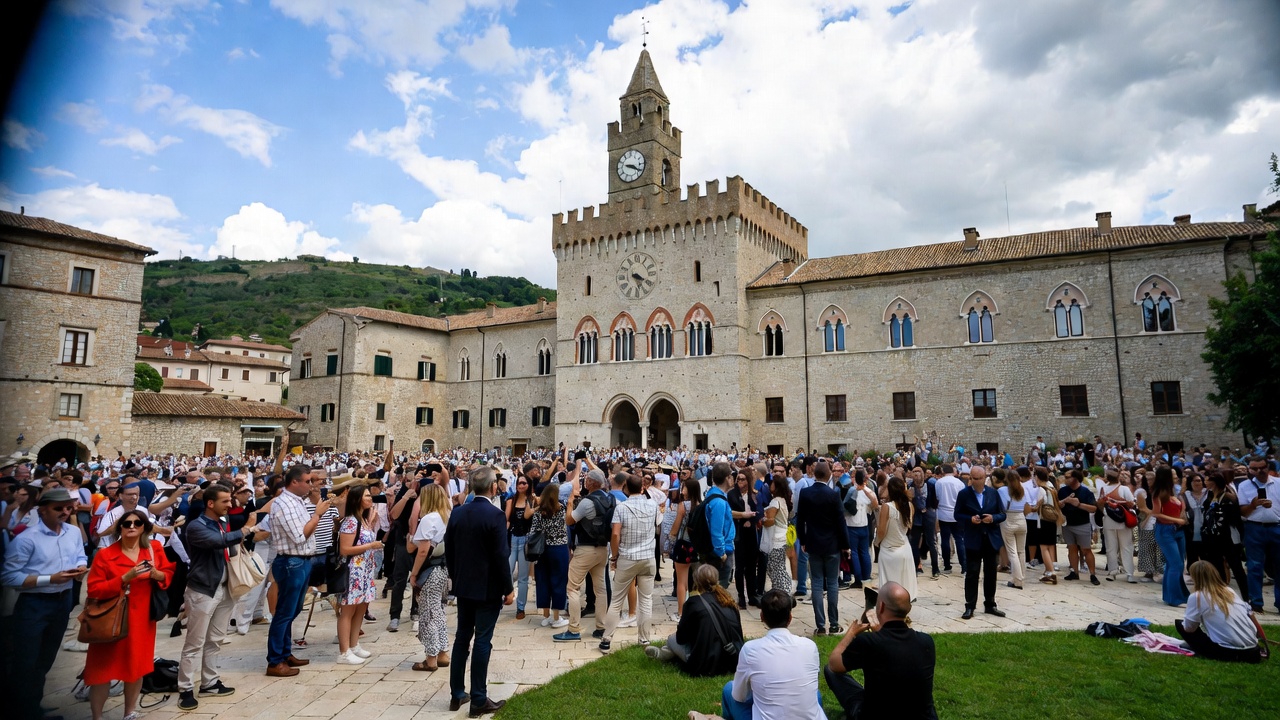
Following the procession, an institutional ceremony takes place at the Palazzo Pubblico in Piazza della Libertà — San Marino’s central square. The Palazzo Pubblico is a striking neoclassical building completed in the late 19th century, built using stone quarried from Monte Titano itself. Its design echoes the famous Palazzo Vecchio in Florence, though on a more intimate scale. The building serves as both the seat of government and a powerful symbol of Sammarinese sovereignty.
The ceremony is led by the Captains Regent (Capitani Reggenti), the republic’s two co-heads of state. San Marino’s system of dual leadership is one of the oldest continuous government structures in the world. Two Captains Regent serve simultaneously, each holding equal power. They are elected from the ranks of the Grand and General Council — the 60-member parliament — and hold office for just six months before new Captains are invested in a ceremony held every April 1 and October 1.
The Liberation Day ceremony includes:
- Official speeches reflecting on the meaning of freedom and independence
- Symbolic presentations honoring the republic’s heritage
- Religious observances connecting the civic and spiritual dimensions of the holiday
- Military elements, with the republic’s ceremonial guard participating in formation
The Captains Regent preside in their traditional ceremonial dress. The honor guards who accompany them wear distinctive black uniforms with gold trim, including a gold stripe down their trousers and high, plumed hats with blue and white feathers. This ceremonial dress is a proud tradition and a reminder that even a tiny republic can carry itself with dignity and grandeur.
The dual leadership system has operated continuously since 1243 — over 780 years of unbroken democratic governance. No other country in the world can match this record.
Religious Services at the Basilica
On Liberation Day, solemn religious services are held at the Basilica del Santo (Basilica of Saint Marinus), the principal church of San Marino. These services honor Saint Agatha and give thanks for the republic’s continued independence.
In addition to the formal Mass, many Sammarinese observe the tradition of baking and blessing Agatha loaves — a custom shared with other communities around the Mediterranean that honor Saint Agatha. These blessed breads were historically kept in homes as a form of spiritual protection, particularly against fire.
Traditional Sammarinese Food to Enjoy During Liberation Day Festivities
No Sammarinese celebration is complete without food. The cuisine of San Marino draws heavily from the culinary traditions of the surrounding Emilia-Romagna and Marche regions of Italy, but it has its own distinctive character.
If you visit San Marino during the Liberation Day period, here are the traditional dishes you should seek out:
| Dish | Description |
|---|---|
| Fagioli con le Cotiche | A hearty bean and bacon rind soup, traditionally eaten during the winter holiday season |
| Pasta e Ceci | A warming chickpea and noodle soup flavored with garlic and rosemary |
| Nidi di Rondine | Baked pasta rolls stuffed with smoked ham, beef, and cheese, topped with tomato and béchamel sauce — the name means “swallow’s nests” |
| Coniglio con Finocchio | Roast rabbit with fennel, a classic Sammarinese main course |
| Passatelli in Brodo | Pasta made from breadcrumbs, nutmeg, eggs, and Parmesan cheese, served in warm chicken broth |
| Erbazzone | A savory spinach pie with cheese and onions |
| Piada | A thin flatbread filled with various toppings, similar to the piadina of Emilia-Romagna — especially popular in Borgo Maggiore |
| Torta Tre Monti | A layered wafer cake covered in chocolate, inspired by the Three Towers of San Marino |
| Torta Titano | A layered dessert of biscuit, hazelnuts, chocolate, cream, and coffee — named after Monte Titano |
| Bustrengo | A traditional cake made with raisins, a rustic winter dessert |
For drinks, look for local wines such as Brugneto and Tessano (cask-aged reds) or Biancale and Roncale (still whites). The anise-flavored liqueur Mistrà is another Sammarinese specialty worth sampling.
San Marino’s Remarkable History of Independence: The Oldest Republic in the World
To fully appreciate Liberation Day, it helps to understand the broader arc of San Marino’s extraordinary survival.
The Founding Legend: Saint Marinus and Monte Titano
According to tradition, San Marino was founded in 301 AD by a Christian stonemason named Marinus. He had emigrated from the Dalmatian island of Rab (in present-day Croatia) to work on the reconstruction of the city walls of Rimini. Seeking a place to practice his faith in peace, Marinus retreated to the heights of Monte Titano and established a small monastic community.
The legendary words attributed to Saint Marinus have become the republic’s unofficial motto: “Relinquo vos liberos ab utroque homine” — “I leave you free from both men” (meaning free from both the Pope and the Emperor). Whether historically accurate or not, these words capture the spirit of independence that has defined San Marino for over seventeen centuries.
Key Moments in San Marino’s Struggle for Freedom
San Marino’s survival is all the more remarkable given its location in one of the most politically turbulent regions of Europe. Here is a timeline of the key moments:
| Year | Event |
|---|---|
| 301 AD | Saint Marinus founds the community on Monte Titano |
| 1243 | The first two Captains Regent are elected — a system still in use today |
| 1503 | Cesare Borgia (“Valentino”) occupies San Marino; his death in 1507 ends the occupation |
| 1543 | Fabiano di Monte San Savino attempts an invasion but fails — his troops get lost in fog |
| 1602 | A treaty of protection is signed with Pope Clement VIII |
| 1631 | Pope Urban VIII confirms San Marino’s independence |
| 1739 | Cardinal Alberoni occupies San Marino on October 17 |
| 1740 | Pope Clement XII restores San Marino’s independence on February 5 |
| 1862 | The Kingdom of Italy signs a treaty guaranteeing San Marino’s independence |
| 1906 | The Arengo is reformed, ending oligarchic rule and establishing democratic elections |
| 1944 | Allied forces briefly occupy San Marino during World War II; the republic shelters over 100,000 refugees |
| 2008 | San Marino’s historic center and Monte Titano are inscribed as a UNESCO World Heritage Site |
The failed invasion of 1543 deserves a special mention. When Fabiano di Monte San Savino attempted to conquer the republic with 500 infantry and cavalry, his forces became hopelessly lost in dense mountain fog. The Sammarinese attributed their deliverance to Saint Quirinus, whose feast day it was, and have celebrated it annually ever since.
Abraham Lincoln and San Marino
One charming footnote to San Marino’s history involves Abraham Lincoln. In 1861, the American president wrote a letter to the Captains Regent of San Marino expressing his admiration for the tiny republic. Lincoln saw in San Marino a kindred spirit — a nation founded on the principles of freedom and self-governance. The letter remains one of the republic’s most treasured diplomatic artifacts.
The Three Towers of San Marino: Symbols of Freedom on Monte Titano
No article about San Marino is complete without discussing the Three Towers (Tre Torri) that crown Monte Titano. These medieval fortifications are the defining symbol of the republic. They appear on San Marino’s coat of arms, its flag, and even its euro coins.
Guaita (First Tower)
Guaita is the oldest and most famous tower. Built in the 11th century, it served as a prison for several centuries and was rebuilt multiple times, reaching its current form in the 15th century. Today, visitors can climb to the top for panoramic views stretching from the Adriatic coast to the Apennine Mountains.
Cesta (Second Tower)
Cesta, also known as De La Fratta, sits on the highest peak of Monte Titano. Built in the 13th century atop the ruins of a Roman fort, it now houses the Museum of Ancient Arms, displaying over 1,500 weapons from the medieval period to the modern era.
The two towers are connected by the Passo delle Streghe — the “Witches’ Path” — a dramatic walkway along the ridge. Local legend says that witches once gathered here at night to brew potions and cast spells.
Montale (Third Tower)
Montale, the smallest tower, was built in the 14th century and served primarily as a watchtower. It is not open to the public but is well worth visiting for the views.
Together with San Marino’s historic center, the Three Towers were designated a UNESCO World Heritage Site in 2008. The inscription recognized San Marino as a testimony to the continuity of a free republic since the Middle Ages. The World Heritage area covers 55 hectares and includes not only the towers but also the fortification walls, gates, bastions, the neoclassical basilica, 14th- and 16th-century convents, the Palazzo Pubblico, and the 18th-century Teatro Titano (Titano Theatre).
The conservation of these structures is overseen by San Marino’s government with support from UNESCO. Restoration work uses traditional materials and techniques that respect the original medieval architecture, maintaining the authenticity that earned the site its World Heritage designation.
Things to Do in San Marino During the Liberation Day Holiday Weekend
If you time your visit for Liberation Day on February 5, you will find plenty to do beyond the official ceremonies. San Marino’s compact size makes it easy to explore on foot, and the winter season gives the hilltop setting an atmospheric quality that summer visitors never experience.
Walk the Passo delle Streghe (Witches’ Path)
The stone walkway connecting the First Tower to the Second Tower is one of San Marino’s most dramatic experiences. The path follows the narrow ridge of Monte Titano, with steep drops on either side. In winter, mist and low clouds can envelop the ridge, creating an eerie atmosphere that perfectly suits the path’s name. The views on a clear day stretch all the way to the Adriatic Sea, roughly 10 kilometers to the east.
Visit the State Museums
San Marino has seven state museums, all accessible with a combined ticket for around €8. Highlights include the Museum of Ancient Arms inside Cesta Tower, the State Museum with archaeological and art collections, and the Stamp and Coin Museum — particularly relevant for collectors, since San Marino’s postage stamps and euro coins are sought-after worldwide.
Explore Borgo Maggiore
The town of Borgo Maggiore, at the foot of Monte Titano, is where the Liberation Day procession begins. It has a more everyday, local feel compared to the tourist-oriented historic center above. The weekly market, held in the main square, has been operating since 1244. Borgo Maggiore is also the lower station for the funicolare (cable car), a scenic two-minute ride up to the capital.
Get a Passport Stamp
San Marino is one of the few countries in the world where you can request a souvenir passport stamp. Head to the tourist information office or the central post office in the historic center. The stamp costs a small fee and makes a wonderful keepsake. You can also purchase San Marino’s collectible stamps and coins at the post office — they make excellent gifts.
Enjoy Shopping in a Tax-Free Microstate
San Marino has its own tax system, separate from Italy’s. This means certain goods can be purchased at lower prices. The historic center has many shops selling everything from perfumes and electronics to local crafts and souvenirs. For luxury brand shopping, the San Marino Outlet Experience is located near the border with Italy, between Rimini and Borgo Maggiore.
How to Visit San Marino for Liberation Day: A Practical Travel Guide
San Marino is one of the least visited countries in Europe, which means fewer crowds and a more authentic experience. Here is everything you need to know about planning a Liberation Day trip.
How to Get to San Marino from Italy
San Marino has no airport and no railway station. The only ways to reach it are by car or bus from Italy. The gateway city is Rimini, located about 20 kilometers away on the Adriatic coast.
By bus from Rimini: The Bonelli Bus shuttle operates between Rimini’s train station and San Marino. The journey takes about 40–50 minutes and costs around €6 one way or €12 round trip. Buses depart approximately every 75 minutes. You can buy tickets from a small tobacco shop (tabaccheria) across the street from Rimini station or online.
By car from Rimini: The drive takes about 25–30 minutes. There are no border controls — you drive from Italy into San Marino without even stopping. Parking is available at the base of Monte Titano, and a cable car connects Borgo Maggiore to the historic center in just two minutes (around €3 one way).
From major Italian cities:
| Origin | How to Get There |
|---|---|
| Bologna | Train to Rimini (1–1.5 hours), then bus to San Marino |
| Florence | Train to Rimini (2.5–3 hours), then bus to San Marino |
| Rome | High-speed train to Rimini (3.5–4 hours), then bus to San Marino |
| Venice | Train to Rimini (2.5–3 hours), then bus to San Marino |
Weather in San Marino in February
February is winter in San Marino. Expect cold temperatures between 0°C and 8°C (32–46°F). Snow is possible, especially on the heights of Monte Titano. Bring warm layers, a waterproof jacket, and sturdy walking shoes — the cobblestone streets are steep and can be slippery.
The upside of visiting in winter is that you will have the country almost entirely to yourself. Summer sees the heaviest tourist traffic. Winter visitors enjoy a quiet, intimate atmosphere perfect for experiencing the local culture.
Where to Stay in San Marino
San Marino has a small but comfortable selection of hotels, mostly concentrated in the historic center and Borgo Maggiore. Staying overnight is highly recommended during Liberation Day, as the festivities span the full day.
If you check into a local hotel, ask for the Tutto San Marino card — it offers discounts on museums, the cable car, restaurants, and shops.
Do You Need a Passport to Visit San Marino?
No passport is required to enter San Marino if you are already legally present in Italy. There are no border checkpoints. However, you can request a souvenir passport stamp at the tourist information office or central post office — a fun keepsake for your collection.
San Marino’s Other Major Public Holidays and Festivals Worth Visiting
While Liberation Day is one of San Marino’s most important celebrations, the republic has a rich calendar of holidays throughout the year:
| Date | Holiday | Significance |
|---|---|---|
| February 5 | Liberation Day and Feast of Saint Agatha | Commemorates 1740 liberation and honors the co-patron saint |
| March 25 | Arengo Anniversary and Feast of the Militia | Celebrates the 1906 democratic reform |
| April 1 | Investiture of the Captains Regent | New heads of state take office in a ceremony dating to 1243 |
| July 28 | Liberation from Fascism Day | Marks the fall of San Marino’s fascist government |
| September 3 | Feast of Saint Marinus (Republic Day) | San Marino’s most important holiday — the founding of the republic in 301 AD |
| October 1 | Second Investiture of the Captains Regent | Autumn transition of government leadership |
The Feast of Saint Marinus on September 3 features the most elaborate celebrations, including medieval costume parades, flag throwers, crossbow tournaments, and historical reenactments. If you cannot visit for Liberation Day, this is the next best option.
Why Liberation Day Matters: Lessons from the World’s Oldest Republic
In a world where empires have risen and fallen, where borders have been redrawn countless times, and where the very concept of national sovereignty has been tested by wars, revolutions, and alliances, San Marino endures. It has done so for over 1,700 years.
Liberation Day is the republic’s annual reminder of a simple but profound truth: freedom is not given; it is protected. The Sammarinese did not defeat Alberoni’s forces through military might. They had no army to speak of. Instead, they used civil disobedience, diplomatic cunning, and moral authority to reclaim their independence.
The events of 1739–1740 offer a powerful example of how a small community can resist a powerful aggressor through nonviolent means. The clandestine letters to the Pope were, in their own way, an 18th-century version of grassroots activism — citizens bypassing an illegitimate authority to appeal directly to a higher power.
Today, San Marino stands as the only surviving Italian city-state and the oldest existing republic in the world. Its constitution, rooted in statutes dating to 1600, is among the oldest still in use. Its dual-headed system of government — with two Captains Regent serving six-month terms and elected from the 60-member Grand and General Council — has operated continuously since 1243.
For travelers and students of history alike, Liberation Day offers a chance to witness how a nation of just 34,000 people keeps the flame of its founding ideals alive. In the procession from Borgo Maggiore to the basilica, in the speeches at the Palazzo Pubblico, and in the quiet reverence of the Mass, the Sammarinese are not merely remembering the past. They are recommitting to the future.
Frequently Asked Questions About Liberation Day in San Marino
When is Liberation Day in San Marino in 2026? Liberation Day falls on Thursday, February 5, 2026. It is the same date every year.
Is Liberation Day a public holiday in San Marino? Yes. All government offices, banks, and most businesses are closed. Museums and restaurants in the historic center generally remain open.
Can tourists attend the Liberation Day procession? Absolutely. The procession and public ceremonies are open to everyone. Visitors are welcome to watch and participate respectfully.
What is the connection between Liberation Day and Saint Agatha? The restoration of San Marino’s independence on February 5, 1740, coincided with the feast day of Saint Agatha. The Sammarinese interpreted this as divine protection and proclaimed her the republic’s co-patron saint.
Is San Marino worth visiting in February? Yes. While the weather is cold, the winter atmosphere is magical. The hilltop setting of the historic center takes on a dramatic beauty in the low winter light, and you will experience the country without the summer tourist crowds.
How much time should I spend in San Marino? Most travelers spend half a day to a full day. However, if you want to experience Liberation Day properly and explore the Three Towers, museums, and restaurants at a relaxed pace, plan for an overnight stay.
What language is spoken in San Marino? The official language is Italian. Many residents also speak Romagnol, the regional dialect of the surrounding area. English is spoken at most tourist-oriented businesses.
What currency does San Marino use? San Marino uses the euro (€), despite not being a member of the European Union. San Marino also mints its own euro coins, which are prized by collectors.
Final Thoughts: Experiencing the Spirit of Liberation Day in San Marino
There is something deeply moving about standing in Piazza della Libertà on a cold February morning, watching the Captains Regent emerge from the Palazzo Pubblico in their ceremonial regalia. The square is small. The country is tiny. But the meaning of the moment is immense.
Liberation Day in San Marino is not a spectacle designed for tourists. It is a living tradition, performed by and for the Sammarinese themselves. That is precisely what makes it so powerful. When you witness the procession from Borgo Maggiore, you are watching a community affirm the values that have sustained it for nearly two millennia: independence, resilience, faith, and the unshakable belief that even the smallest nation deserves to be free.
In 2026, that procession will mark 286 years since Pope Clement XII restored the republic’s sovereignty. It will also mark over 1,725 years since Saint Marinus first climbed Monte Titano in search of freedom. The snow may fall. The wind may howl along the Witches’ Path. But the Sammarinese will walk, as they always have, carrying the image of their patron saint toward the light.
If you are anywhere near the Adriatic coast of Italy this February, make the journey. Ride the bus from Rimini. Climb the cobblestone streets. Stand in the square and listen to the bells. You will be witnessing one of Europe’s most extraordinary traditions — and one of its most enduring triumphs of the human spirit.
Planning your trip to San Marino? Visit the official tourism website at www.visitsanmarino.com for up-to-date information on events, accommodations, and museum hours. For bus schedules from Rimini, check the Bonelli Bus service online.