Every year, when the full moon rises over the gilded spires of Thailand’s temples, millions of Buddhists across Southeast Asia pause. They light candles. They fold their hands in prayer. They walk in slow, meditative circles around ancient ordination halls. This is Makha Bucha Day — one of the most sacred and deeply felt occasions on the Buddhist calendar.
In 2026, Makha Bucha Day falls on Tuesday, March 3. It is a national public holiday in Thailand and a day of observance in Cambodia, Laos, Myanmar, and Sri Lanka. Yet for many travelers and even some residents, the deeper meaning of this day remains a mystery. What exactly happened over 2,500 years ago to make this full moon night so special? Why do Thai people wake before dawn to offer food to monks? And what should visitors know before they arrive in Thailand during this period?
This guide answers all of these questions. Whether you are a devoted Buddhist, a curious traveler, or someone planning a trip to Thailand in March 2026, this article will walk you through the history, spiritual meaning, traditions, and practical travel advice surrounding Makha Bucha Day.
When Is Makha Bucha Day in 2026? Exact Date and Calendar Details
Makha Bucha Day 2026 falls on Tuesday, March 3. The date is determined by the traditional Buddhist lunar calendar. The holiday always lands on the full moon day of the third lunar month, known as “Makha” in the Pali language. Because of the lunar cycle, the date shifts each year on the Gregorian calendar, typically landing somewhere between mid-February and early March.
Here is a quick reference table for Makha Bucha Day dates in recent and upcoming years:
| Year | Makha Bucha Date | Day of the Week |
|---|---|---|
| 2024 | February 24 | Saturday |
| 2025 | February 12 | Wednesday |
| 2026 | March 3 | Tuesday |
| 2027 | February 21 | Sunday |
Important note for travelers: Because Makha Bucha Day is a national public holiday in Thailand, government offices, schools, and some businesses will be closed on March 3, 2026. Banks may also close or operate with reduced hours. However, most shopping malls, restaurants, and tourist attractions remain open throughout the day.
In the Thai Buddhist calendar, the year 2026 corresponds to Buddhist Era (B.E.) 2569. This numbering system, which counts forward from the year of the Buddha’s passing into Nirvana, is still widely used in official Thai documents.
What Is Makha Bucha Day? The Meaning Behind the Name
To understand Makha Bucha, it helps to break the name into its two parts.
“Makha” comes from the Pali word Māgha, which is the name of the third month in the traditional Buddhist lunar calendar. “Bucha” derives from the Pali word Pūjā, meaning “to venerate” or “to honor.” Put together, Makha Bucha roughly translates to “paying honor on the full moon of the third lunar month.”
The holiday is also known by several other names around the world:
- Māgha Pūjā — the formal Pali term used across Theravada Buddhist countries
- Saṅgha Day — because it celebrates the Buddhist community (the Sangha)
- Fourfold Assembly Day — referring to the four miraculous conditions of the original gathering
- Buddhist All Saints Day — a name sometimes used by Western writers
In Thailand, the Pali term Māgha-pūraṇamī is occasionally used in formal religious contexts. It translates to “to honor on the full moon of the third lunar month.” Regardless of the name, the essence remains the same: this is a day to reflect on the core principles of Buddhism and to honor the Buddha, his teachings (Dharma), and the monastic community (Sangha).
The History of Makha Bucha Day: How It All Began Over 2,500 Years Ago
The story behind Makha Bucha Day stretches back roughly 2,500 years to the early days of Buddhism in ancient India. According to Buddhist tradition, the event took place at a bamboo grove called Veluvana Vihara (also known as the Bamboo Grove Monastery) near the city of Rajagaha in present-day Bihar, India.
The Gathering at Veluvana: A Once-in-a-Lifetime Event
Nine months after Siddhartha Gautama attained enlightenment and became the Buddha, something remarkable occurred. Without any prior arrangement or summons, 1,250 of the Buddha’s disciples arrived at Veluvana on the same day. Every single one of them came of their own will. None had been invited.
This was extraordinary for several reasons. Travel in ancient India was slow and difficult. There were no postal systems, no messengers sent ahead. Yet 1,250 monks independently decided to seek out the Buddha on the same full moon night.
The Four Miraculous Factors: Why This Day Is Called the Fourfold Assembly
Buddhist scholars highlight four remarkable conditions that made this gathering unique. These four factors are the reason Makha Bucha Day is sometimes called Chaturangasannibat (จาตุรงคสันนิบาต) in Thai, which translates to “Fourfold Assembly.” They are:
- It was the full moon day of the third lunar month (Makha). Full moons hold deep significance in Buddhist practice, as the Buddha is believed to have been born, attained enlightenment, and passed away on full moon days.
- All 1,250 disciples came without being summoned. The gathering was entirely spontaneous — a fact that Buddhists view as a sign of the profound spiritual connection between the Buddha and his followers.
- Every one of the 1,250 monks was an Arahant. In Theravada Buddhism, an Arahant is someone who has attained full enlightenment and broken free from the cycle of rebirth. Having 1,250 Arahants in one place at one time was considered extraordinary.
- All had been ordained directly by the Buddha himself. These were not monks ordained by other teachers or in later traditions. Each one had received ordination through the Ehi Bhikkhu method — a direct invitation from the Buddha to join the monastic order.
These four conditions occurring simultaneously have never been repeated in Buddhist history. This is why the event holds such special reverence.
The Ovadhapatimokha: The Heart of Buddhist Teaching
To this remarkable assembly, the Buddha delivered one of his most important sermons. This teaching is called the Ovadhapatimokha (โอวาทปาติโมกข์), sometimes written as Ovāda Pātimokkha. It is considered by many scholars and practitioners to be the “Heart of Buddhism” — a concise summary of the religion’s core moral principles.
The Ovadhapatimokha can be distilled into three essential teachings:
- Cease from all evil (Sabbapāpassa akaraṇaṃ) — Refrain from any actions that cause harm to oneself or others.
- Do what is good (Kusalassūpasampadā) — Actively pursue wholesome, compassionate, and virtuous behavior.
- Purify the mind (Sacittapariyodapanaṃ) — Cleanse the mind of greed, hatred, and delusion through meditation and mindful living.
These three principles remain the foundation of Buddhist ethics today. They guide the daily practice of monks and laypeople alike across Thailand, Cambodia, Laos, Myanmar, Sri Lanka, and Buddhist communities worldwide.
The Buddha continued to teach the Ovadhapatimokha for the next two decades. Over time, it evolved into the 227 rules of the monastic discipline code (Vinaya) observed by fully ordained Theravada monks to this day.
The Second Event: Buddha’s Announcement of His Passing
The significance of Makha Bucha Day does not end with the Fourfold Assembly. Buddhist tradition holds that 44 years after that original gathering, on the same full moon day of the third lunar month, the Buddha made a momentous announcement. He told his followers that within three months, he would pass into Parinirvana — the final release from the cycle of death and rebirth.
This announcement added another layer of poignancy to the day. Makha Bucha thus marks both a beginning — the founding principles of the Buddhist monastic community — and a farewell, as the Buddha prepared his followers for his departure from the world.
His actual passing occurred three months later, on the full moon of the sixth lunar month. That day is now observed as Visakha Bucha Day (Vesak), which is the most important Buddhist holiday, commemorating the Buddha’s birth, enlightenment, and death.
How Makha Bucha Became a National Holiday in Thailand
Although the events of Makha Bucha took place in ancient India, the holiday as it is celebrated today in Thailand has a relatively modern origin story.
King Rama IV and the Royal Beginnings
Makha Bucha was not widely observed in Thailand until the mid-19th century. It was King Mongkut (Rama IV), who reigned from 1851 to 1868, who first established a formal Makha Bucha ceremony. King Mongkut was a former Buddhist monk himself. He had spent 27 years in the monastic order before ascending to the throne. His deep knowledge of Buddhist scripture led him to recognize the importance of this day.
Initially, the Makha Bucha ceremony was held exclusively within the royal court at the Temple of the Emerald Buddha (Wat Phra Kaew) in Bangkok. Only those connected to the palace were permitted to attend.
Expanding to the People Under King Rama V
King Mongkut’s son, King Chulalongkorn (Rama V), continued his father’s work in promoting Buddhism across the kingdom. Under his reign, the celebration of Makha Bucha was expanded beyond the palace walls. Temples across the country began organizing their own ceremonies, and ordinary Thai citizens could participate for the first time.
Official Public Holiday Status
Makha Bucha eventually became an official public holiday in Thailand. The holiday was formally recognized by the Thai government, and by the mid-20th century, it had become deeply embedded in the nation’s cultural calendar. Today, it is one of the most widely observed religious holidays in the country.
Although Thailand does not have an official state religion, Theravada Buddhism is practiced by roughly 93% of the population, according to government census data. This makes Buddhist holidays like Makha Bucha central to national life.
How Thai People Celebrate Makha Bucha Day: Traditions and Rituals
Makha Bucha Day is not a holiday of fireworks, street parties, or parades. It is quieter than that. It is a day of reflection, merit-making, and spiritual renewal. The traditions observed on this day are deeply personal, rooted in centuries of Buddhist practice.
Morning: Giving Alms to Monks (Tak Bat)
The day begins early. Before sunrise, many Thai Buddhists prepare food offerings and head to their local temple or wait along roadsides for monks making their morning alms rounds. This practice is called Tak Bat (ตักบาตร).
Monks walk barefoot in single file through neighborhoods, carrying their alms bowls. Devotees kneel and place rice, curries, fruit, and sweets into the bowls. This is not charity in the Western sense. In Buddhist thought, the monks are providing the laypeople with an opportunity to earn spiritual merit (บุญ, bun) — a concept central to Thai Buddhist life.
On Makha Bucha Day, the act of giving alms carries extra weight. Many families prepare more elaborate offerings than usual, believing that merit earned on holy days is especially powerful.
Afternoon: Temple Visits and Dhamma Talks
Throughout the afternoon, temples across Thailand host Dhamma talks (sermons on Buddhist teachings). Monks deliver lectures on the significance of the Ovadhapatimokha, the story of the Fourfold Assembly, and the practical application of Buddhist ethics in daily life.
Devotees also spend time in meditation, sitting quietly in temple halls or under the shade of Bodhi trees in temple grounds. Some practitioners choose to observe the Eight Precepts — a stricter set of moral guidelines that includes abstaining from eating after noon, sleeping on luxurious beds, and using entertainment or cosmetics.
The Five Precepts, which are the everyday moral guidelines for Buddhist laypeople, are also reaffirmed on this day:
- Do not kill or harm living beings.
- Do not steal.
- Do not engage in sexual misconduct.
- Do not lie.
- Do not consume intoxicants.
Evening: The Wien Tien Candlelight Procession
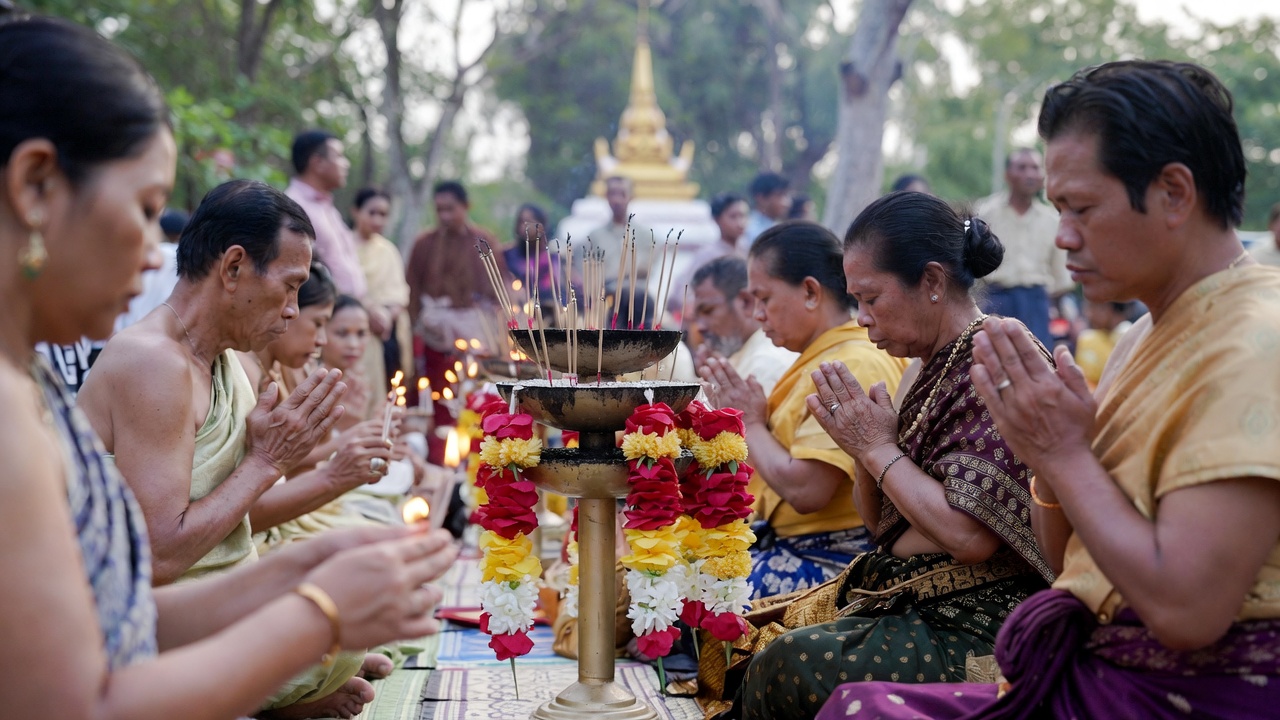
The most visually striking tradition of Makha Bucha Day takes place after dark. As twilight settles over Thailand’s temples, devotees gather for the Wien Tien (เวียนเทียน) — a candlelight procession that is the spiritual heart of the celebration.
The word Wien means “to circle” and Tien means “candle.” During the Wien Tien, devotees walk three times clockwise around the temple’s main ordination hall (the ubosot). Each person carries three items: a lit candle, three sticks of incense, and a lotus flower.
Each of the three circuits holds deep symbolic meaning. The three laps represent the Three Jewels of Buddhism (Triratna):
- First circuit: In honor of the Buddha — the Enlightened One and founder of the faith.
- Second circuit: In honor of the Dharma — the teachings of the Buddha and the nature of reality.
- Third circuit: In honor of the Sangha — the community of monks, nuns, and Buddhist practitioners.
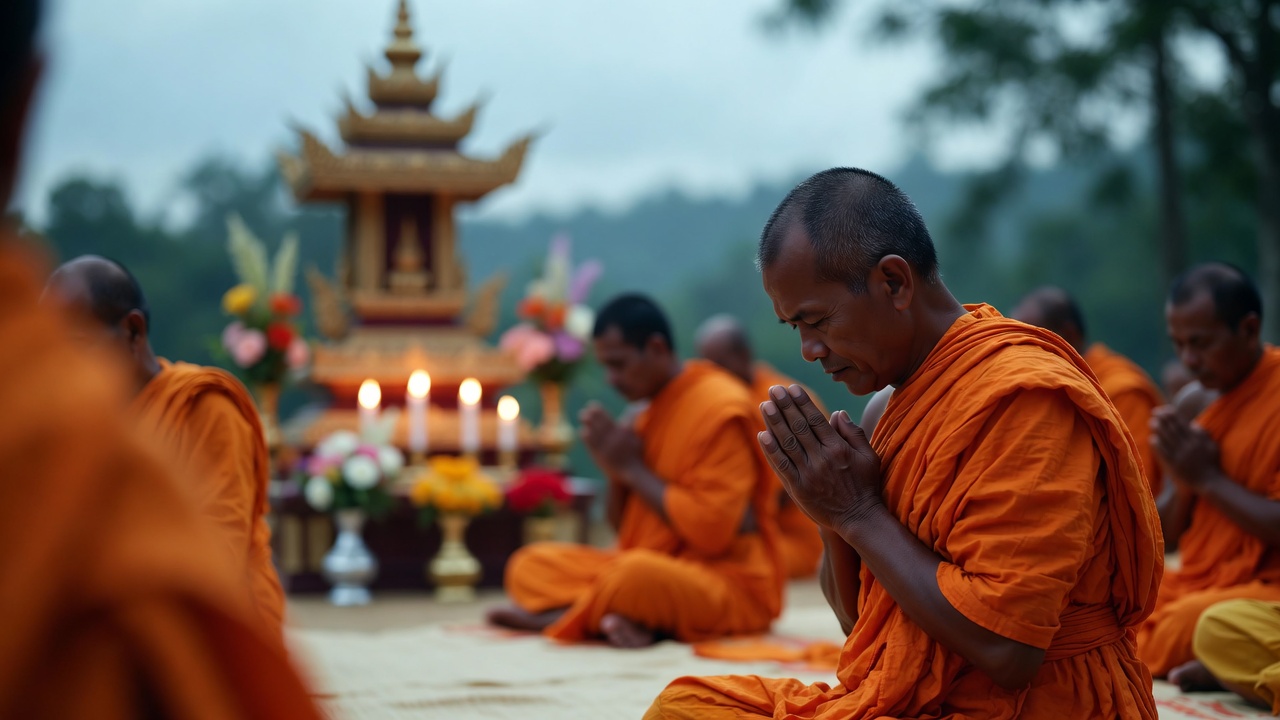
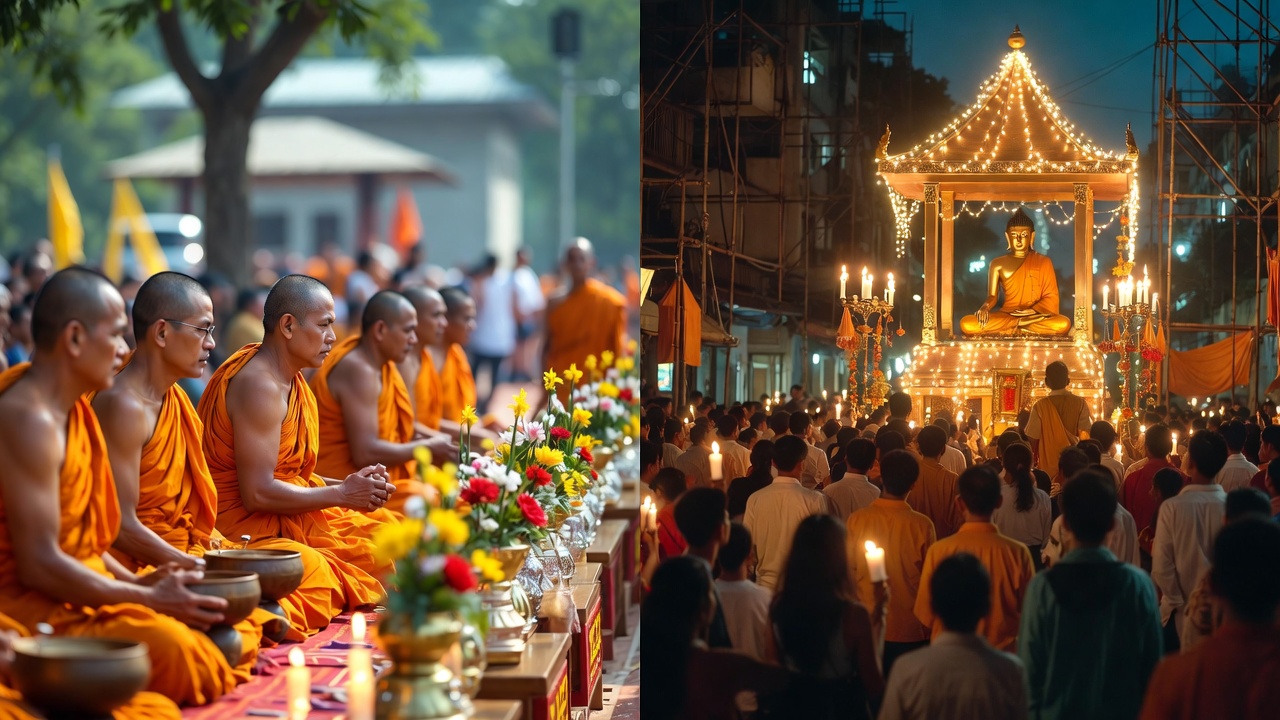
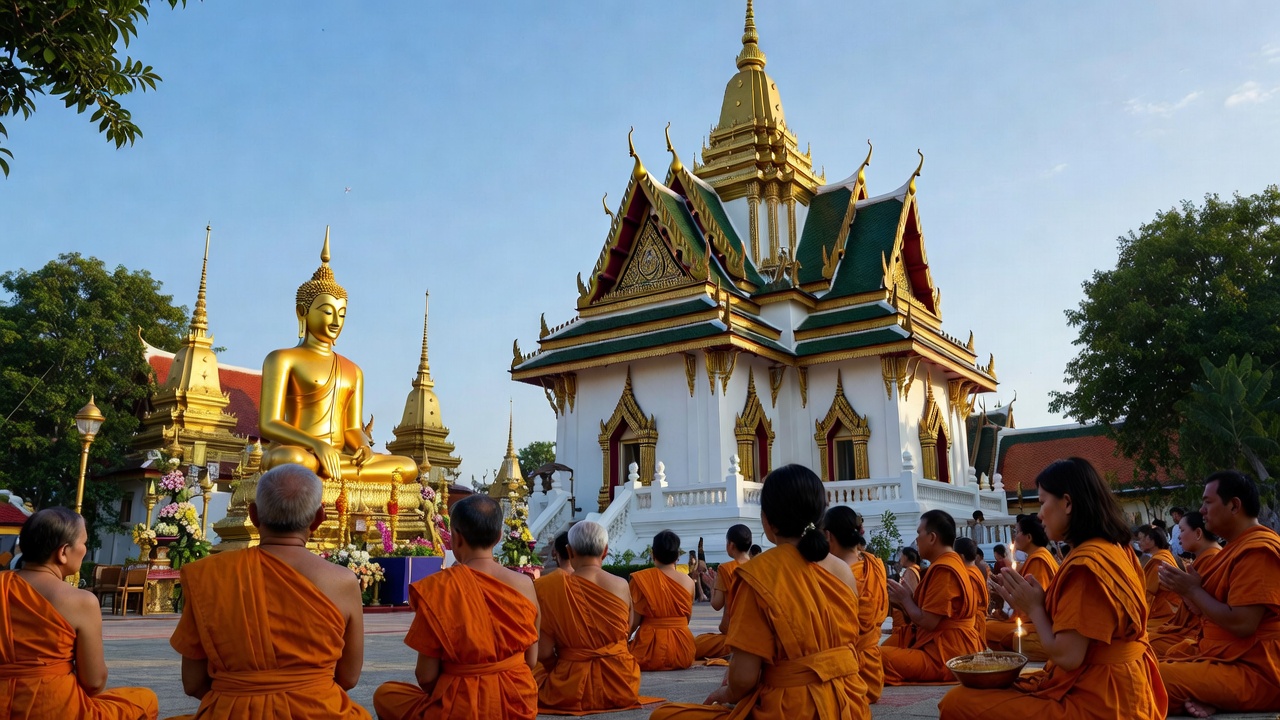
The atmosphere during the Wien Tien is profoundly moving. Hundreds, sometimes thousands, of people walk in near-silence, the warm glow of candles flickering against the gold leaf of temple walls. The scent of incense fills the night air. Children walk alongside grandparents. Monks lead the way, their saffron robes luminous in the candlelight.
This is not performance or spectacle. It is genuine devotion. For many Thai people, the Wien Tien on Makha Bucha night is one of the most spiritually meaningful experiences of the year.
A Unique Wien Tien: The Water Procession at Phayao Lake
One of the most remarkable Makha Bucha traditions in Thailand takes place not on land, but on water. At Wat Tilok Aram, a temple built on an island in the middle of Phayao Lake in northern Thailand, the Wien Tien is performed on boats. Devotees hold their candles and circle the temple across the lake’s surface, creating an ethereal scene of floating lights reflected on dark water. According to the Tourism Authority of Thailand (TAT), this is believed to be the only Wien Tien ceremony on water in the world.
Makha Bucha Day Alcohol Ban in Thailand: What Travelers Need to Know
One of the most important practical considerations for travelers visiting Thailand during Makha Bucha Day is the nationwide alcohol ban.
Since 2015, the sale of alcohol has been strictly prohibited on Makha Bucha Day. This ban runs from midnight to midnight on the day of the holiday. It applies to:
- Convenience stores (such as 7-Eleven and Family Mart)
- Supermarkets and department stores
- Restaurants and street food stalls
- Bars, pubs, and nightclubs
Many bars and entertainment venues choose to close entirely on Makha Bucha Day. Those that remain open are still prohibited from selling alcohol. Violation of the alcohol ban can result in imprisonment of up to six months and a fine of up to 10,000 Thai Baht (approximately $280 USD).
There is one partial exception: hotel bars and minibars in rooms booked by foreign guests may still serve alcohol in some cases, depending on the establishment’s policy. However, this is not guaranteed, and travelers should not rely on it.
Practical tip: If you plan to enjoy alcoholic beverages during your trip, stock up the day before Makha Bucha. Purchase what you need on March 2, 2026, before the ban begins at midnight.
| What’s Closed on Makha Bucha Day | What Stays Open |
|---|---|
| Bars and pubs | Shopping malls |
| Nightclubs | Tourist attractions |
| Alcohol sales everywhere | Restaurants (food only) |
| Government offices | Most hotels |
| Schools | Public transport |
How Makha Bucha Is Celebrated in Other Buddhist Countries
While Thailand is the country most closely associated with Makha Bucha, the holiday is observed across Southeast Asia. The traditions vary from country to country, but the spiritual core remains the same.
Cambodia: Meak Bochea
In Cambodia, the holiday is known as Meak Bochea (មាឃបូជា). It was traditionally a public holiday, though in 2019, the Cambodian government removed it from the official list of national holidays to reduce the total number of public holidays and boost economic productivity.
Despite this change, Cambodian Buddhists continue to observe the day. Devotees visit pagodas, cook meals for elderly family members, clean their homes, and make offerings. In recent years, Cambodia’s Ministry of Cults and Religion has promoted Meak Bochea activities and education for young people. The day has gained renewed popularity among Cambodian youth since the late 2010s, with more pagodas organizing ceremonies.
Myanmar: Tabaung Full Moon Day
In Myanmar (Burma), the holiday coincides with the full moon of Tabaung, the final month of the Burmese calendar. The day is closely tied to the Shwedagon Pagoda Festival in Yangon, one of the most famous Buddhist sites in the world.
According to Burmese tradition, the Shwedagon Pagoda was completed on this very day, and relics of the Buddha — including strands of his hair — were enshrined there. The festival begins 15 days before the full moon and features continuous recitation of Buddhist scriptures, offerings to the 28 Buddhas (from Taṇhaṅkara to Gautama), and the chanting of the Pathana — texts describing the interdependence of all things in the world.
Laos: Boun Makha Boussa
In Laos, the holiday is called Boun Makha Boussa. Laos is a predominantly Theravada Buddhist country, and the celebrations mirror many of the Thai traditions. Devotees give alms, visit temples, listen to Dhamma talks, and participate in candlelight processions. Makha Bucha is recognized as a public holiday in Laos.
Sri Lanka: Navam Poya
In Sri Lanka, the corresponding observance falls on Navam Poya, the full moon day of the month of Navam (February). Sri Lankan Buddhists commemorate the same historic gathering of 1,250 Arahants. The largest celebrations take place at the Gangaramaya Temple in Colombo, where a grand procession called the Navam Perahera features decorated elephants, traditional dancers, drummers, and fire performers.
The Spiritual Significance of Makha Bucha for Modern Buddhists
In a world that moves faster than ever, Makha Bucha Day offers something countercultural: a chance to slow down. The holiday is not about buying gifts or gathering around a feast table. It is about turning inward.
A Day for Self-Reflection and Moral Renewal
The three principles of the Ovadhapatimokha — cease from evil, do good, purify the mind — are simple to state but difficult to practice. Makha Bucha Day serves as an annual reminder to measure oneself against these ideals. Thai Buddhists often use the day to examine their behavior over the past year. Where have they fallen short? What habits need correction? How can they live more compassionately?
This spirit of self-examination is not limited to deeply religious practitioners. Many younger Thai people, even those who do not visit temples regularly, use Makha Bucha as a moment for personal reflection. It is a cultural touchstone, a shared pause in the national rhythm.
“National Gratitude Day”: A Modern Rebranding
In 2006, the Thai government gave Makha Bucha Day an additional designation: “National Day of Pure Love and Gratitude.” This was part of a cultural campaign to encourage Thai youth to focus on expressing gratitude and love for family and community. The campaign was also, in part, a response to the growing influence of Western Valentine’s Day, which falls close to Makha Bucha on the calendar. Officials hoped that by associating Makha Bucha with themes of love and gratitude, young people would engage more deeply with their own cultural traditions rather than adopting imported holidays.
The Relevance of Buddhist Ethics in 2026
The teachings delivered over 2,500 years ago at Veluvana remain strikingly relevant. In a time of political division, environmental crisis, and the accelerating pace of digital life, the Ovadhapatimokha’s call to refrain from harm, actively pursue good, and cultivate a clear mind resonates across cultural boundaries.
Mindfulness meditation, which has its roots in the very practices the Buddha taught, has become a global phenomenon. Millions of people worldwide — many of whom do not identify as Buddhist — practice mindfulness techniques for stress relief, mental health, and personal growth. Makha Bucha Day is a reminder that these practices are not modern self-help trends. They are ancient wisdom, tested across millennia.
Best Temples to Visit on Makha Bucha Day 2026 in Thailand
If you are in Thailand on March 3, 2026, attending a Wien Tien ceremony at a temple is one of the most meaningful cultural experiences available. Here are some of the best temples to visit:
Bangkok
- Wat Phra Kaew (Temple of the Emerald Buddha): Located within the Grand Palace, this is the most sacred temple in Thailand. It is where King Rama IV first held the modern Makha Bucha ceremony. Grand Buddhist rituals are held here on the day.
- Wat Pho (Temple of the Reclining Buddha): Home to the famous 46-meter reclining Buddha statue, Wat Pho hosts chanting sessions and beautiful candlelight processions.
- Wat Saket (The Golden Mount): One of the best places in Bangkok to experience the Wien Tien. Monks lead a procession up the hilltop pagoda, with candles lighting the way up the winding path.
- Wat Benchamabophit (The Marble Temple): This elegant temple is known for its Italian Carrara marble construction and hosts a serene, well-organized Wien Tien ceremony.
Chiang Mai
Northern Thailand’s cultural capital offers a more intimate temple experience. Key temples include:
- Wat Phra Singh — home to one of Chiang Mai’s most revered Buddha images
- Wat Chedi Luang — a partially ruined temple with a powerful atmosphere
- Wat Umong — a forest temple with tunnels and meditation gardens
- Wat Ched Yot — a quieter temple with distinctive seven-spired architecture
Nakhon Pathom
Phutthamonthon (Buddhist Monthon Park) in Nakhon Pathom province, just west of Bangkok, is one of the largest Makha Bucha gathering sites in the country. A 15-meter bronze walking Buddha statue stands at the center of the park. Because of its royal recognition, this is one of the most venerated Buddhist sites in Thailand. The procession here draws enormous crowds.
Phayao (Northern Thailand)
As mentioned earlier, Wat Tilok Aram on Phayao Lake offers the only Wien Tien on water in the world. If you can make the journey to this northern province, the experience is unforgettable.
Practical Travel Tips for Visiting Thailand During Makha Bucha 2026
Planning a trip to Thailand around Makha Bucha Day requires a few extra considerations. Here are the key things you need to know.
Dress Code for Temple Visits
Thai temples have strict dress codes that apply year-round but are especially important on holy days. Both men and women should:
- Cover shoulders completely (no tank tops or sleeveless shirts)
- Wear long pants or skirts that cover the knees
- Remove shoes before entering any temple building
- Avoid clothing with Buddhist imagery or tattoos of the Buddha on display (this is considered deeply disrespectful in Thailand)
Behavior and Etiquette at Temples
- Keep your voice low during ceremonies and processions.
- Do not point your feet at Buddha statues or monks. The feet are considered the lowest part of the body in Thai culture.
- Women should never touch a monk or hand anything directly to a monk. Place items on a cloth or tray for the monk to receive.
- Do not take selfies during prayer sessions or Wien Tien processions. Quiet, respectful photography from a distance is usually acceptable.
- Stand when monks pass by as a sign of respect.
Transportation and Logistics
- Makha Bucha Day is a national holiday, so expect increased domestic travel. Buses and trains between cities may be crowded. Book transportation in advance if possible.
- Airports remain open and flights operate on normal schedules.
- Taxis and ride-hailing apps (like Grab) operate as usual.
- Traffic near major temples will be heavy in the evening, especially in Bangkok. Plan extra time for travel.
Can Tourists Join the Wien Tien?
Yes. Visitors of all faiths and nationalities are welcome to observe or participate in the Wien Tien candlelight procession. Temples are open to everyone. You do not need to be Buddhist. Simply dress appropriately, behave respectfully, and follow the lead of other participants. Candles and incense are typically available at the temple for a small donation.
Makha Bucha Day and Visakha Bucha Day: Understanding the Difference
Because Thailand has several important Buddhist holidays, visitors sometimes confuse them. Here is a quick comparison of the two most significant:
| Feature | Makha Bucha Day | Visakha Bucha Day (Vesak) |
|---|---|---|
| 2026 Date | March 3 | May 1 |
| Lunar Month | Third (Makha) | Sixth (Visakha) |
| Commemorates | The Fourfold Assembly and the Ovadhapatimokha teaching | The Buddha’s birth, enlightenment, and death |
| Ranking | Second most important Buddhist holiday | Most important Buddhist holiday |
| UNESCO Recognition | No | Yes (recognized as a World Heritage Day in 1999) |
| Alcohol Ban | Yes | Yes |
| Wien Tien | Yes | Yes |
Both holidays share many of the same traditions — alms giving, temple visits, Dhamma talks, and candlelight processions. The key difference is in what they commemorate. Makha Bucha celebrates the formation of the Buddhist community and its founding teachings. Visakha Bucha marks the three pivotal events in the Buddha’s life: his birth, his attainment of enlightenment, and his passing into Nirvana.
Frequently Asked Questions About Makha Bucha Day 2026
Q: Is Makha Bucha Day a public holiday in Thailand? A: Yes. It is a national public holiday. Government offices, schools, and banks are closed. Most tourist-oriented businesses remain open.
Q: Can I buy alcohol on Makha Bucha Day? A: No. The sale of alcohol is banned nationwide from midnight to midnight on Makha Bucha Day. Some hotel bars may serve alcohol to guests, but this varies by establishment.
Q: Are bars and nightclubs open on Makha Bucha Day? A: Most bars and nightclubs close for the day. Those that remain open cannot sell alcohol.
Q: Can non-Buddhists attend temple ceremonies? A: Absolutely. Thai temples are open to visitors of all backgrounds. Just dress modestly and behave respectfully.
Q: Is Makha Bucha Day observed outside of Thailand? A: Yes. It is observed in Cambodia, Laos, Myanmar, and Sri Lanka, among other countries with significant Buddhist populations.
Q: What is the Buddhist year in 2026? A: The year 2026 in the Gregorian calendar corresponds to B.E. 2569 (Buddhist Era).
Q: Do I need to cancel my Thailand trip because of Makha Bucha? A: Not at all. In fact, being in Thailand during Makha Bucha is a rare cultural opportunity. Just be aware of the alcohol ban and plan accordingly.
How to Make the Most of Makha Bucha Day as a Visitor in Thailand
If you happen to be in Thailand on March 3, 2026, here are some ways to make the experience meaningful and respectful:
Wake early and observe the morning alms round. Head to a temple or a quiet neighborhood before 7 AM and watch as monks walk their rounds. You can participate by purchasing a prepared alms set from vendors near the temple.
Spend the afternoon at a temple. Listen to a Dhamma talk, even if you do not understand Thai. The atmosphere of devotion and calm is deeply affecting regardless of language.
Join the Wien Tien at dusk. Arrive at your chosen temple by 6 PM to find a good spot. The procession typically begins around 7 or 8 PM, after a period of chanting.
Reflect on the Ovadhapatimokha. Even if you are not Buddhist, the three principles — cease from evil, do good, purify the mind — are universal ethical guidelines worth considering.
Respect the solemn nature of the day. This is not a festival in the celebratory sense. Keep noise levels down, avoid rowdy behavior, and be mindful of the spiritual atmosphere.
Understanding the Five Precepts and Eight Precepts Observed on Makha Bucha
On Makha Bucha Day, many Thai Buddhists commit to observing a stricter moral code than they follow in everyday life. Understanding these precepts helps visitors appreciate the depth of the day’s spiritual practice.
The Five Precepts (Panca Sila)
These are the basic moral guidelines that all Buddhist laypeople are encouraged to follow every day, but they receive special emphasis on Makha Bucha:
- Refrain from taking life — This extends to all living beings, not just humans. Many devotees avoid eating meat on Makha Bucha Day.
- Refrain from stealing — Taking what is not freely given.
- Refrain from sexual misconduct — Behaving with integrity in relationships.
- Refrain from false speech — This includes lying, gossip, and harsh language.
- Refrain from intoxicants — Alcohol and drugs that cloud the mind. This precept is the basis for the national alcohol ban.
The Eight Precepts (Attha Sila)
More devout practitioners — particularly older Thais and those staying overnight at temples — observe three additional precepts on top of the basic five:
- Refrain from eating after noon — Only morning meals are consumed.
- Refrain from entertainment, cosmetics, and adornments — No music, dancing, perfume, or jewelry.
- Refrain from sleeping on high or luxurious beds — Some practitioners sleep on thin mats on the floor.
Observing the Eight Precepts is a way of temporarily living closer to the monastic life. It is seen as an act of deep devotion and an opportunity to accumulate significant spiritual merit. Many Thais who take the Eight Precepts on Makha Bucha Day will dress entirely in white clothing — symbolizing purity and the renunciation of worldly attachments. Visitors to temples on this day will notice many white-clad devotees, particularly women, seated in prayer halls from dawn until well past nightfall.
Why Makha Bucha Day Matters Beyond Thailand
Makha Bucha Day is more than a Thai holiday. It is a living connection to one of the oldest and most influential philosophical traditions in human history. The gathering of 1,250 enlightened monks at Veluvana was, in Buddhist understanding, a moment when the ideal spiritual community was made manifest on earth. The teachings delivered that night — do no harm, do good, purify your mind — have shaped the moral landscape of hundreds of millions of lives across Asia and beyond.
In 2026, as the full moon rises over Thailand on the evening of March 3, the same scene will unfold as it has for generations. Candles will be lit. Incense will burn. Feet will move slowly around sacred halls. In the quiet glow of a thousand flames, people will remember that more than two millennia ago, a teacher sat before his students in a bamboo grove and said something timeless: the path to a good life begins with doing no harm and ends with a purified mind.
That message has not aged. It may, in fact, be more needed now than ever.
Have you experienced Makha Bucha Day in Thailand or another Buddhist country? Share your experience in the comments below. If you are planning a trip to Thailand in March 2026, bookmark this page for the most up-to-date information on dates, traditions, and travel advice.