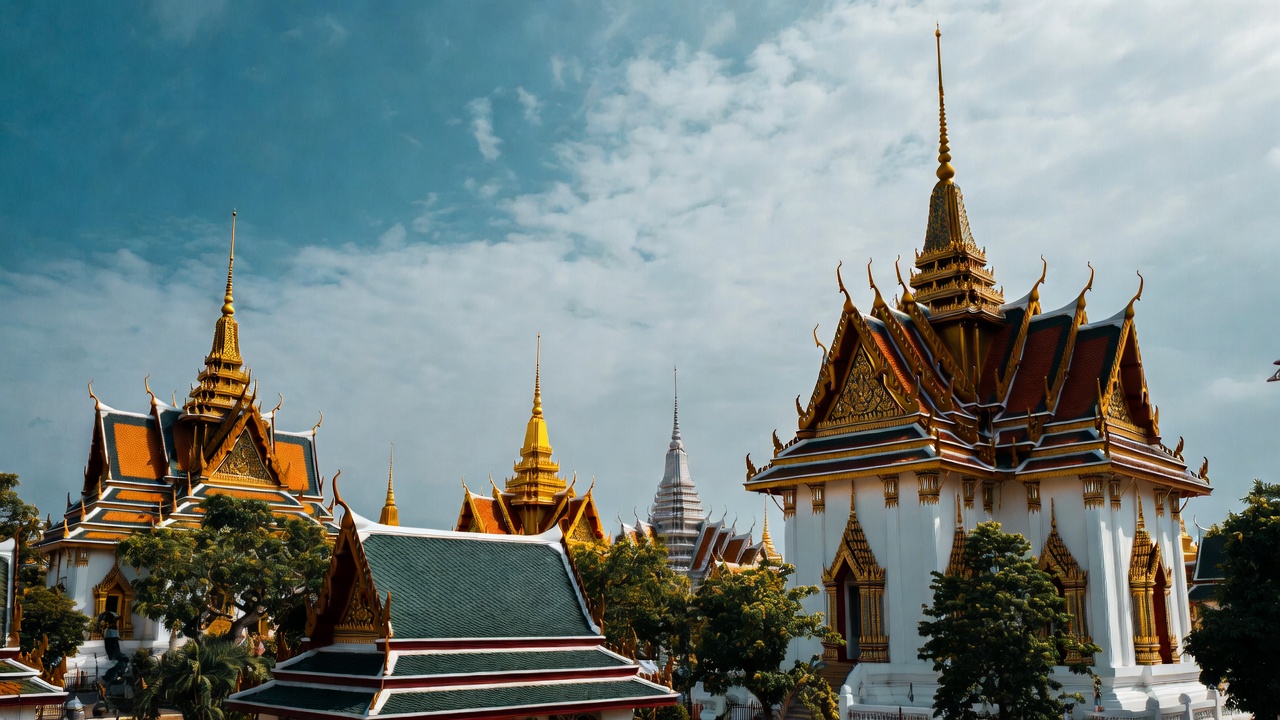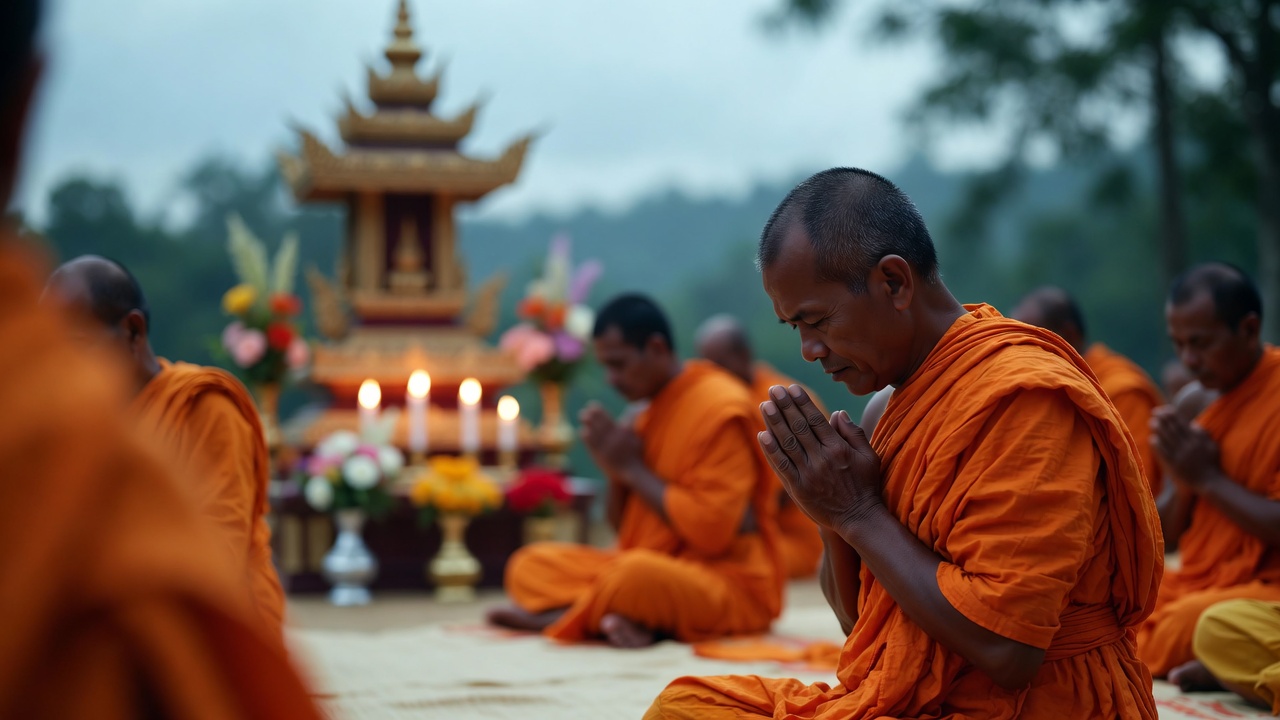
There is a moment each year when the full moon rises over Thailand and something extraordinary happens. Temples across the country glow with the soft flicker of thousands of candles. Families walk in quiet procession. Monks chant ancient Pali verses under the open sky. The air carries the scent of jasmine, lotus, and burning incense. This is Makha Bucha Day — one of the most sacred dates on the Buddhist calendar.
In 2026, Makha Bucha Day falls on Tuesday, March 3 (corresponding to the year 2569 in the Buddhist Era). Whether you are a practicing Buddhist, a curious traveler, or someone simply drawn to the power of spiritual traditions, this guide will walk you through everything you need to know about making merit on Makha Bucha Day. From ancient history to practical tips, from Bangkok’s grandest temples to the quiet candlelit procession at a countryside wat, you will find it all here.
Let’s begin.
What Is Makha Bucha Day and Why Is It Important in Buddhism?
Makha Bucha Day, also known as Māgha Pūjā or Magha Puja, is the second most important Buddhist holiday after Visakha Bucha (Vesak). The name comes from two Pali words. “Makha” (Māgha) refers to the third lunar month in the traditional Buddhist calendar. “Bucha” (Pūjā) means “to venerate” or “to honor.” Together, they describe a day of paying reverence on the full moon of the third lunar month.
The holiday marks a remarkable event that took place over 2,500 years ago at a bamboo grove called Veḷuvana, near the ancient city of Rājagaha (present-day Rajgir) in northern India. According to Buddhist scripture, this event had four extraordinary characteristics — known in Thai as จาตุรงคสันนิบาต (Cāturaṅgasannipāta), or the Fourfold Assembly.
Here is what made that gathering so special:
| Characteristic | Description |
|---|---|
| 1,250 monks gathered | All came without any prior appointment or summons |
| All were Arahants | Each monk had already achieved enlightenment |
| All were ordained by the Buddha | The Buddha himself had ordained every one of them |
| It was a full moon day | The gathering fell on the full moon of the third lunar month |
On that evening, the Buddha delivered a teaching called the Ovādapātimokkha, which laid out the core principles of Buddhism in three simple directives: cease from evil, do good, and purify the mind. These became the foundation of Buddhist moral conduct and monastic discipline.
Some 44 years later, on the same full moon of the third lunar month, the Buddha is said to have announced that he would pass into final nirvana within three months. That passing eventually occurred on Visakha Bucha Day. Because both of these landmark events share the same calendar date, Makha Bucha carries a double weight of historical and spiritual significance.
In Thailand, King Rama IV (King Mongkut) introduced the modern celebration of Makha Bucha in the mid-19th century, initially holding ceremonies within the royal palace. His successor, King Rama V, expanded the observance to the national level and officially established it as a public holiday in 1913. By the mid-20th century, it had become a widely observed day across the country. Today, Makha Bucha is celebrated not only in Thailand but also in Cambodia, Laos, Myanmar, and Sri Lanka.
When Is Makha Bucha Day 2026 and How Is the Date Decided?
Because Makha Bucha follows the lunar calendar, its date shifts each year on the Gregorian calendar. It always falls on the full moon day of the third lunar month, which typically lands in February or March. In a Buddhist leap year, the celebration may shift to the fourth lunar month.
Here are the recent and upcoming dates for reference:
| Year | Makha Bucha Day | Day of Week |
|---|---|---|
| 2024 | February 24 | Saturday |
| 2025 | February 12 | Wednesday |
| 2026 | March 3 | Tuesday |
| 2027 | February 21 | Sunday |
In 2026, the holiday falls on Tuesday, March 3. This is a national public holiday throughout Thailand. Government offices, banks, and most schools close. Many private businesses also shut their doors for the day. For travelers, this means certain services may be limited — but it also means the temples will be alive with activity.
One practical note: the full moon itself is stunning on this night. If you are in Thailand, step outside after the temple ceremonies and look up. The Makha Bucha moon has a luminous quality that seems to justify every ounce of reverence the day inspires.
How Thai Buddhists Make Merit on Makha Bucha Day
The Thai concept of ทำบุญ (tham bun) — making merit — sits at the heart of everyday Buddhist practice. But on Makha Bucha Day, merit-making takes on a heightened sense of purpose. Devout Buddhists see this day as a powerful opportunity to purify the mind, strengthen their moral commitments, and accumulate positive karma.
Making merit is not a single act. It is a collection of practices woven together throughout the day. Here is how a typical Makha Bucha Day unfolds for Thai Buddhists:
Early Morning: Giving Alms to Monks (Tak Bat)
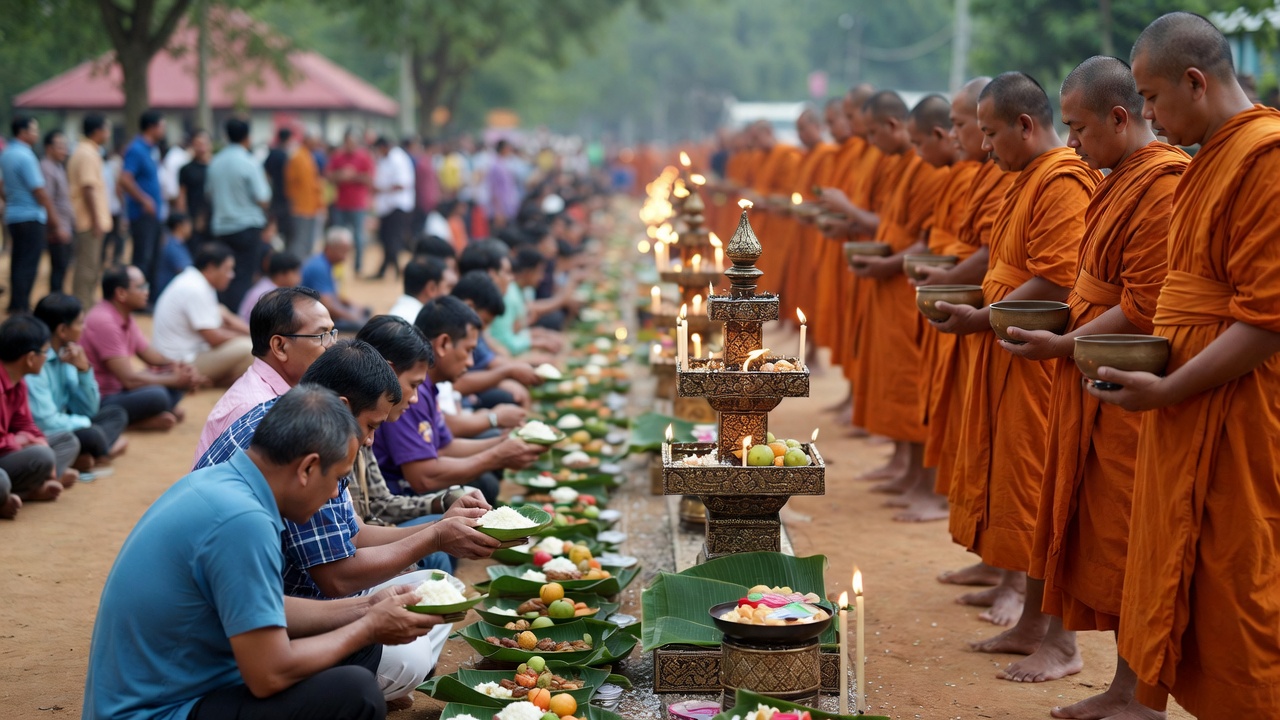
The day often starts before sunrise. Across Thailand, Buddhists prepare food offerings — steamed rice, curries, fruit, sweets, and other dishes — and wait by the roadside or near temples for monks on their morning alms round. This practice is called ตักบาตร (tak bat).
When monks approach, devotees place food directly into the monks’ alms bowls. They do so barefoot and with a respectful posture. Monks do not say “thank you” in the conventional sense. Instead, they chant a brief blessing. The exchange is quiet, dignified, and deeply personal.
For Thai Buddhists, giving alms is one of the most direct and meaningful ways to earn merit. The act reflects dāna (generosity), one of the foundational virtues of Buddhism.
Mid-Morning to Afternoon: Temple Activities and Dhamma Teachings
After alms, many Buddhists head to their local temple — or wat — to participate in religious activities. These may include:
- Listening to Dhamma sermons given by senior monks
- Meditating in the temple’s main hall or meditation center
- Donating money, robes, food, or other supplies to the temple and its monks
- Applying gold leaf to Buddha statues as a devotional act
- Reciting Buddhist scriptures together with the monastic community
- Freeing captive animals — particularly birds and fish — as a symbolic act of compassion
Many temples set up stalls where devotees can purchase lotus flowers, incense, candles, and small offerings. Some temples also offer areas for seated meditation and quiet contemplation.
Evening: The Wien Tien Candlelight Procession
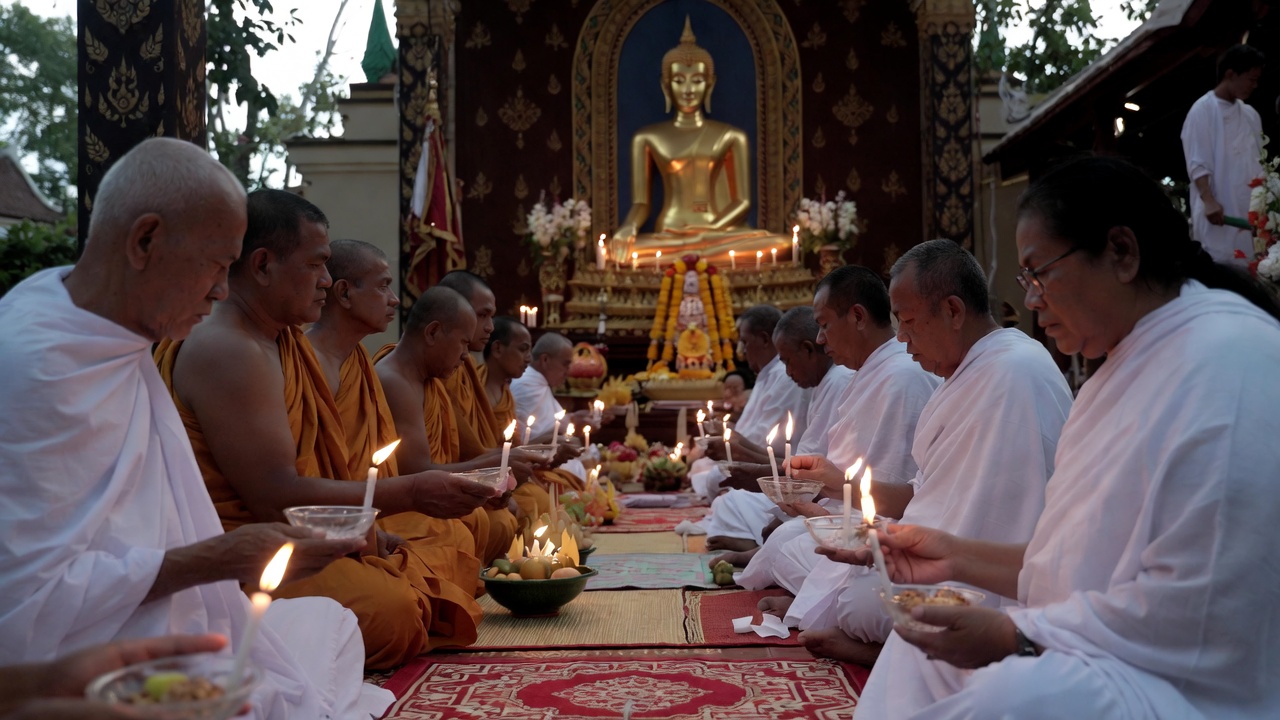
The highlight of Makha Bucha Day arrives in the evening with the เวียนเทียน (Wien Tien) — a mesmerizing candlelight procession around the temple’s main ordination hall, known as the อุโบสถ (Ubosot).
Here is how Wien Tien works:
- Each participant carries three items: a lit candle, three sticks of incense, and a lotus flower or other fresh flowers.
- The procession moves clockwise around the Ubosot three times.
- Each circuit represents one of the Three Jewels of Buddhism: the Buddha (the Teacher), the Dhamma (the Teaching), and the Sangha (the Monastic Community).
- Monks lead the procession, followed by lay devotees.
- After three rounds, participants place their candles, incense, and flowers at designated spots near Buddha statues or the base of the Ubosot.
The sight of hundreds — sometimes thousands — of people walking in silent procession under the full moon, their candles casting a warm glow against ancient temple walls, is one of the most visually powerful experiences in Southeast Asian religious life. It is the kind of moment that stays with you long after you return home.
Five Precepts and Eight Precepts: Moral Commitments on Makha Bucha
An essential part of making merit on Makha Bucha Day involves observing the Buddhist precepts — moral guidelines that shape daily conduct. Most Thai Buddhists pledge to follow the Five Precepts (ศีลห้า) for the day:
| Precept | Commitment |
|---|---|
| 1st Precept | Abstain from harming living beings |
| 2nd Precept | Abstain from stealing |
| 3rd Precept | Abstain from sexual misconduct |
| 4th Precept | Abstain from lying, gossip, and harsh speech |
| 5th Precept | Abstain from all intoxicants |
Some especially devout Buddhists go further and observe the Eight Precepts (ศีลแปด), which add three more commitments:
- Abstain from eating after midday
- Abstain from entertainment, perfume, and personal adornment
- Abstain from using luxurious beds or seats
Those observing the Eight Precepts typically wear white clothing and may stay overnight at the temple. They spend their time in meditation, chanting, and quiet reflection. This practice is called รับศีล (rap sin) — literally, “receiving the precepts.”
For travelers witnessing this, you may notice groups of people dressed entirely in white sitting in temple courtyards or prayer halls. They are undertaking a profound personal commitment, and it is best to observe them with quiet respect.
Alcohol Ban on Makha Bucha Day in Thailand: What Tourists Need to Know
This is a detail that catches many visitors off guard. On Makha Bucha Day, the sale of alcohol is banned nationwide for a full 24 hours. This ban has been strictly enforced since 2015. It applies to bars, restaurants, convenience stores, supermarkets, hotels, and all other retail outlets.
Here is what you need to know:
- The ban typically runs from midnight to midnight on Makha Bucha Day itself.
- Bars and nightclubs are required to close or at least stop serving alcohol.
- Restaurants will not serve beer, wine, or spirits with your meal.
- Convenience stores like 7-Eleven and FamilyMart will cover or lock their alcohol shelves.
- Hotels may restrict minibar access or alcohol room service.
Violating the alcohol ban can result in up to six months of imprisonment and a fine of up to 10,000 Thai Baht. While enforcement varies — upscale hotel bars and some tourist-heavy areas may be more lenient — the rule is taken seriously across the country.
Practical tip: If you want to enjoy a drink on the evening of March 2, stock up before midnight. Many seasoned expats and tourists simply buy their beer or wine the day before and enjoy it privately in their rooms. But please be discreet and respectful. This is a sacred day for millions of people around you.
Best Temples to Visit on Makha Bucha Day in Thailand
Thailand has over 34,000 Buddhist temples spread across every province. On Makha Bucha Day, nearly all of them hold some form of ceremony. But certain temples offer especially memorable experiences.
Top Temples for Makha Bucha Celebrations in Bangkok
Wat Saket (The Golden Mount) — Located in Bangkok’s old town, this hilltop temple offers a dramatic Wien Tien experience. Monks lead a candlelight procession up the winding stairway to the golden chedi at the summit. The view of Bangkok at night, combined with the flickering candles, creates an unforgettable atmosphere.
Wat Benjamabophit (The Marble Temple) — Built during the reign of King Rama V, this temple is known for its striking Italian marble architecture. The Makha Bucha ceremonies here draw large crowds, and the setting — one of the most photographed temples in Bangkok — adds grandeur to the occasion.
Wat Pho (Temple of the Reclining Buddha) — As the oldest temple in Bangkok, dating back to the 7th century and rebuilt by King Rama I in 1801, Wat Pho provides a deeply historic backdrop for Makha Bucha merit-making.
Wat Phra Dhammakaya — Located in Pathum Thani province, just north of Bangkok, this modern temple is famous for its massive, futuristic dome and its spectacular Makha Bucha celebration. In recent years, the temple has hosted ceremonies involving thousands of monks and tens of thousands of devotees, all holding lanterns in a vast, coordinated display that has been described as one of the most visually striking religious celebrations anywhere in the world. Drone footage of the event regularly goes viral, showing an ocean of light surrounding the enormous dome under the full moon.
Top Temples for Makha Bucha in Chiang Mai
Wat Phra Singh — One of Chiang Mai’s most revered temples, featuring beautiful Lanna-style architecture. The Wien Tien ceremony here is intimate and deeply atmospheric.
Wat Chedi Luang — Home to a massive, partially ruined chedi that dates to the 15th century. The evening procession at the base of this ancient structure is hauntingly beautiful.
Wat Phan Tao — A smaller, wooden temple next to Wat Chedi Luang that offers one of Chiang Mai’s most photogenic Makha Bucha experiences. Candles line the grounds and reflect in the water features, creating a scene straight out of a storybook.
Wat Umong — A forest temple on the edge of Chiang Mai, known for its tunnels and peaceful atmosphere. Ideal for those who prefer a quieter, more contemplative Makha Bucha experience.
A Unique Experience: Wien Tien on Water at Phayao Lake
In Phayao province in northern Thailand, Wat Tilok Aram sits on an island in the center of Phayao Lake. The Wien Tien ceremony here is said to be the only candlelight procession on water in the world. Devotees travel by boat to the island temple, then walk the procession around it while the lake reflects the candlelight. It is a rare and breathtaking sight.
Regional Celebrations Worth Discovering
Prachin Buri Province — The local government organizes an annual Makha Bucha fair that includes religious ceremonies, lantern releases, Buddhist exhibitions, cultural processions, and market stalls. The event takes place at an important archaeological site related to early Buddhism in Thailand.
Yasothon Province (Ban Fa Yat Village) — In Thailand’s northeast, this village celebrates Makha Bucha with a distinctive Garland Procession featuring garlands made from popped rice and flowers. The procession takes place the day before Makha Bucha and includes traditional dances.
How to Make Merit on Makha Bucha Day as a Foreign Visitor
One of the most common questions from tourists is: Can I participate in Makha Bucha if I am not Buddhist? The answer is a warm and definite yes. Thai temples welcome visitors of all faiths and backgrounds. You do not need to be Buddhist to observe or even join in the ceremonies.
Here is a step-by-step guide to participating respectfully:
Step 1: Dress Appropriately for the Temple
Temple dress codes in Thailand are strict, and they become even more important on sacred holidays. Follow these guidelines:
- Cover your shoulders completely. No tank tops, sleeveless shirts, or spaghetti straps.
- Cover your knees. Wear long pants, a long skirt, or a dress that falls below the knee.
- Avoid tight or revealing clothing. Loose-fitting, breathable fabrics work best in the tropical heat.
- Remove shoes and hats before entering any temple building.
- Avoid flashy jewelry or accessories. Modesty is the guiding principle.
If you arrive at a temple in unsuitable clothing, some larger temples offer wraps or sarongs you can borrow or rent for a small fee. But planning ahead saves time and shows respect from the very start.
Pro tip: Pack a lightweight scarf or sarong in your daypack. It weighs almost nothing and can cover shoulders or wrap around the waist if needed.
Step 2: Arrive Early for Alms Giving
If you want to participate in the morning alms round, prepare food or purchase pre-made alms sets from vendors near the temple. Arrive at dawn — typically between 6:00 and 7:00 AM — and wait respectfully by the roadside or temple entrance.
When placing food into a monk’s bowl, kneel or stand with a respectful posture. Women should be especially mindful not to touch the monk directly, as monks are not permitted to have physical contact with women. Place offerings on the cloth or tray that the monk extends.
Step 3: Join the Wien Tien Procession in the Evening
Most temples begin their Wien Tien procession after sunset — usually around 7:00 to 8:00 PM. Arrive a bit early to buy your candle, incense, and flowers from the vendors on the temple grounds.
Follow the lead of the local devotees. Walk slowly and mindfully in a clockwise direction. Keep your voice low. Focus on the act of walking, the flame of your candle, and the intention behind it.
After completing three rounds, place your offerings at the designated area. Then take a moment to sit quietly and absorb the atmosphere. Many devotees linger at the temple, meditating or simply enjoying the shared sense of peace.
Step 4: Observe Proper Etiquette Throughout
Beyond dress codes, there are important behavioral guidelines to keep in mind:
- Never point your feet toward a Buddha statue or monk. Feet are considered the lowest part of the body in Thai culture. When sitting, tuck your feet underneath you or to the side.
- Do not touch Buddha statues unless the temple specifically invites interaction (such as applying gold leaf).
- Do not touch monks. If you wish to hand something to a monk, either give it to a male companion to pass along, or place it within the monk’s reach.
- Keep noise to a minimum. Temples are places of worship and contemplation.
- Ask permission before photographing people, especially monks and devotees in prayer. Never use flash photography inside temple buildings.
- Step over thresholds at temple entrances rather than stepping on them.
Traditional Merit-Making Activities on Makha Bucha Day: A Complete List
Making merit on Makha Bucha Day can take many forms. Here is a complete list of traditional activities, with their Thai names:
| Activity | Thai Name | Description |
|---|---|---|
| Giving alms to monks | ตักบาตร (Tak Bat) | Offering food to monks on their morning round |
| Attending Wien Tien | เวียนเทียน (Wien Tien) | Walking the candlelight procession around the Ubosot |
| Making temple donations | ทำบุญ (Tham Bun) | Donating money, food, robes, or supplies to the temple |
| Keeping the Five Precepts | รับศีลห้า (Rap Sin Ha) | Pledging to observe the five moral guidelines |
| Keeping the Eight Precepts | รับศีลแปด (Rap Sin Paet) | Observing the stricter eight moral guidelines in white clothes |
| Listening to Dhamma | ฟังเทศน์ (Fang Thet) | Attending sermons and teachings by monks |
| Meditating | นั่งสมาธิ (Nang Samaathi) | Practicing seated meditation at the temple |
| Freeing captive animals | ปล่อยนก ปล่อยปลา (Ploi Nok Ploi Pla) | Releasing birds or fish as acts of compassion |
| Applying gold leaf to statues | ปิดทอง (Pit Thong) | Pressing gold leaf onto Buddha statues |
| Reciting Buddhist scriptures | สวดมนต์ (Suat Mon) | Chanting Pali texts with the monastic community |
Each of these activities carries a specific spiritual purpose. Giving alms cultivates generosity. Meditation purifies the mind. Observing precepts strengthens moral discipline. Together, they form a complete practice that mirrors the Buddha’s own teaching from 2,500 years ago: cease from evil, do good, purify the mind.
Makha Bucha Day Celebrations in Other Buddhist Countries
While Thailand is the most well-known destination for Makha Bucha celebrations, other countries in the Theravada Buddhist world mark the day with their own distinctive traditions.
Cambodia (Meak Bochea)
In Cambodia, Makha Bucha is known as Meak Bochea. Ceremonies are held at major Buddhist sites, with the most notable gatherings taking place at Preah Reach Trop Mountain and Oudong Hill. Devotees make merit, cook meals for elderly family members, and clean their homes as acts of spiritual purification. In recent years, the day has grown increasingly popular among younger Cambodians, with more pagodas organizing educational events.
Myanmar (Full Moon of Tabaung)
In Myanmar, the celebration falls on the full moon of Tabaung, the final month of the Burmese calendar. This period coincides with several major pagoda festivals. The Shwedagon Pagoda in Yangon holds a 15-day festival leading up to the full moon, featuring offerings, continuous recitals of Buddhist texts, and massive candlelit gatherings. At the Kyaiktiyo Pagoda (the famous Golden Rock), thousands of candles are lit around the boulder. In Mandalay and northern Myanmar, devotees build sand pagodas in honor of the Buddha.
Sri Lanka (Navam Full Moon Poya)
In Sri Lanka, the celebration is marked by the Gangarama Navam Perahera, a grand procession held on the Navam full moon day. The procession includes approximately 5,000 participants and dozens of decorated elephants marching through the streets of Colombo. It is one of the largest Buddhist processions in the world.
Laos
In Laos, Makha Bucha is observed more quietly, with devotees visiting temples, offering alms, and attending evening candlelight processions. The celebrations are similar in structure to those in Thailand but tend to be smaller in scale.
What to Eat on Makha Bucha Day: Vegetarian Food and Temple Offerings
Many Thai Buddhists choose to eat vegetarian food (เจ, jay) on Makha Bucha Day as a way of observing the first precept — abstaining from harming living beings. While vegetarianism is not strictly required, it is a common choice, especially among those observing the Eight Precepts.
At temple fairs and markets, you will find a wide array of vegetarian and traditional Thai dishes. Some popular offerings include:
- Khao tom (rice porridge) — often served in the morning after alms giving
- Pad pak ruam (stir-fried mixed vegetables)
- Som tam (papaya salad) — request it without dried shrimp or fish sauce for a vegetarian version
- Kanom jeen (rice noodles with curry) — some vendors offer vegetable curry versions
- Fresh tropical fruits — mangoes, pineapple, dragon fruit, and rambutan
- Thai sweets and desserts — many are naturally vegetarian, made with coconut milk, rice, and palm sugar
Temples often provide communal meals for devotees and visitors. These meals are typically free and are funded by donations. Eating together at a temple is itself a form of community building and shared merit.
Makha Bucha Day and Valentine’s Day: A Cultural Intersection in Thailand
Makha Bucha Day sometimes falls in the same week as Valentine’s Day (February 14). This proximity created an unexpected cultural conversation in Thailand. In 2006, the Thai government designated Makha Bucha as the “Day of Pure Love and Gratitude” — a cultural campaign aimed at promoting a Buddhist alternative to the commercialism of Valentine’s Day.
The idea was to encourage young Thais to channel their energy toward spiritual love, gratitude, and acts of kindness rather than commercial gifts. The campaign had mixed success, but it reflects a genuine tension between traditional values and global consumer culture that many countries face.
In 2026, with Makha Bucha falling on March 3, the two holidays are well separated on the calendar. But the underlying message remains relevant: Makha Bucha offers a form of love that is not romantic or commercial. It is the love of wisdom, the love of compassion, and the love of a community that has sustained its traditions for over two and a half millennia.
Practical Travel Tips for Visiting Thailand on Makha Bucha Day 2026
Planning a trip to Thailand around Makha Bucha? Here are some practical considerations:
Transportation and Logistics
- Domestic travel increases around public holidays. Buses and trains between Bangkok and popular destinations like Chiang Mai, Phuket, and Isan may sell out. Book ahead.
- Banks and government offices are closed. If you need to exchange currency or handle official business, do so the day before.
- Most shopping malls, convenience stores, and restaurants remain open, but alcohol sales are suspended.
- Temples can be crowded, especially popular ones in Bangkok and Chiang Mai. Arrive early for a better experience.
Accommodation
- Hotels remain open and are typically not affected by the holiday, though some may limit minibar access.
- Consider staying near a temple you wish to visit, especially if you plan to participate in the early morning alms round and the evening Wien Tien procession.
Photography
- The Wien Tien procession is extremely photogenic. Bring a camera capable of low-light photography. A tripod is useful but may not always be practical in crowded spaces.
- Be discreet and respectful. The procession is a religious ceremony, not a photo op. Capture images quietly and without intruding on devotees’ personal space.
- Avoid using flash photography inside temple buildings.
Weather
- Early March in Thailand is part of the hot season. Expect daytime temperatures of 30–35°C (86–95°F) in Bangkok and central Thailand. Chiang Mai may be slightly cooler but still warm.
- Stay hydrated. Bring water, a fan, and sun protection if you plan to spend the day at a temple.
- The evening hours are more comfortable, and the full moon adds a pleasant coolness to the night air.
Language
- A few simple Thai phrases go a long way on Makha Bucha Day:
- สวัสดี (Sawasdee) — Hello
- ขอบคุณ (Khob khun) — Thank you
- ทำบุญ (Tham bun) — Make merit
- เวียนเทียน (Wien Tien) — Candlelight procession
- วันมาฆบูชา (Wan Makha Bucha) — Makha Bucha Day
The Spiritual Meaning of Making Merit: Why Tham Bun Matters in Thai Culture
To truly understand Makha Bucha Day, it helps to understand the broader concept of merit-making (tham bun) in Thai Buddhist culture. Merit is not an abstract idea. It is a practical, lived reality that shapes decisions large and small.
Thai Buddhists believe that the merit you accumulate through good actions — generosity, moral conduct, meditation, and acts of kindness — directly affects your well-being in this life and future lives. Merit is transferable: you can dedicate the merit you earn to deceased relatives, to the sick, or to anyone you wish to help.
On Makha Bucha Day, the spiritual “return” on merit-making is believed to be especially high. The alignment of the full moon, the sacred history of the day, and the collective energy of millions of practitioners all combine to create what Buddhists consider an auspicious opportunity for spiritual growth.
This is not a superstitious or transactional belief. At its best, it is a framework for living with intention. When a Thai grandmother wakes before dawn to prepare food for monks, she is not just performing a ritual. She is affirming her commitment to generosity. When a family walks the Wien Tien procession together, they are not just circling a building. They are reaffirming their connection to a tradition that has given their lives meaning for generations.
For visitors who approach the day with openness and respect, this depth of meaning becomes palpable. You do not need to be a Buddhist to feel the sincerity of the devotion around you. You just need to be present.
Common Questions About Makha Bucha Day for First-Time Visitors
Can non-Buddhists attend Wien Tien? Yes. All are welcome. Simply dress appropriately, buy a candle and incense at the temple, and follow the procession quietly.
Is it offensive to take photos during Makha Bucha ceremonies? Photography is generally allowed outside temple buildings. Be discreet, avoid flash, and always ask before photographing individuals, especially monks.
Can I buy alcohol anywhere on Makha Bucha Day? The national ban applies to all retail and hospitality outlets. Some hotels may be more lenient in practice, but technically the ban is enforced everywhere. Plan ahead if this matters to you.
What if Makha Bucha Day falls on a weekend? If it falls on a Sunday, the following Monday is typically declared a substitute holiday (วันหยุดชดเชย). In 2026, Makha Bucha falls on a Tuesday, so no substitute day is needed.
Do I need to make a donation at the temple? Donations are not required, but they are appreciated. Even a small amount — 20 to 100 Baht — contributes to the upkeep of the temple and the monastic community. If you have enjoyed the experience or taken photographs, a small donation is a thoughtful gesture.
Are children involved in Makha Bucha celebrations? Absolutely. Families bring children of all ages. You will see toddlers clutching tiny candles, school-age children helping prepare alms, and teenagers walking the procession. It is a family affair.
How Makha Bucha Day Has Evolved in Modern Thailand
Like many traditional festivals, Makha Bucha Day has adapted to the realities of modern life. In large cities, some younger Thais treat the day as a welcome public holiday rather than a strictly religious observance. Yet the core practices remain strong.
A 2019 poll by Suan Dusit University, surveying 5,335 respondents across age groups, found that temple visits, merit-making, and Wien Tien attendance remained the most popular activities during Makha Bucha week. At the same time, the poll revealed that many respondents also used the holiday for rest, family time, and leisure.
The Dhammakaya Temple has become a symbol of how tradition can meet spectacle. Its annual Makha Bucha celebration draws global media attention. In 2024, the temple reported using approximately one million lanterns during its ceremony, with around 5,000 monks and 35,000 devotees in attendance. The event is choreographed with precision and broadcast widely, making it one of the most-viewed Buddhist ceremonies in the world.
Social media has also played a role. Younger Thais now share photos and reflections from their Makha Bucha experiences on platforms like Instagram, TikTok, and X (formerly Twitter), bringing renewed visibility to the holiday. Temples have responded by extending their hours and offering more engaging programs for younger visitors.
Yet beneath the Instagram posts and the drone footage, the heart of Makha Bucha remains unchanged. It is still about a person sitting quietly in a temple, watching a candle flame, and reflecting on how to live a better life.
A Closing Reflection: What Makha Bucha Day Teaches Us All
Makha Bucha Day is not just a Buddhist holiday. It is a reminder — for people of any faith or none — of what happens when human beings gather with a shared intention to be good.
Over 2,500 years ago, 1,250 people came together without being summoned. They came because they felt called. They came because they believed that wisdom was worth walking toward. And on the evening of their arrival, they received a teaching so simple that a child could understand it: do not do evil, do what is good, and keep your mind clean.
That teaching has crossed oceans and centuries. It has been carried in the alms bowls of monks, whispered in the glow of candles, and written into the laws of nations. On March 3, 2026, it will be carried again — by millions of people who still believe that these three simple principles are enough to build a life on.
If you find yourself in Thailand on that day, step into a temple. Watch the candles. Listen to the chanting. And if you feel moved to walk the procession, walk it. You do not need to be Buddhist. You just need to be willing to take three slow, quiet steps in the direction of something good.
That is what making merit means. That is what Makha Bucha is.
Planning your trip? Makha Bucha Day 2026 falls on Tuesday, March 3. Temples across Thailand welcome visitors of all backgrounds. Remember to dress modestly, respect the alcohol ban, and arrive early for the best experience. Safe travels and may your merit be plentiful.