Most countries celebrate their armed forces with a single national holiday. North Korea is not most countries. The Democratic People’s Republic of Korea (DPRK) reserves two separate public holidays for its military — one on February 8 and another on April 25. These dates honor two different chapters in the founding story of the Korean People’s Army (KPA), and both are deeply tied to the Kim family’s grip on national identity.
For outsiders, these overlapping celebrations can be confusing. Why would a single nation need two army birthdays? The answer lies in decades of shifting political narratives, ideological power plays, and the outsized role the military holds in North Korean society. This guide unpacks the history, meaning, and modern-day observance of both holidays — from the guerrilla camps of 1930s Manchuria to the missile-laden parades of 2020s Pyongyang.
What Is Military Foundation Day in North Korea and When Is It Celebrated?
Military Foundation Day (조선인민군 창건일, Chosŏn Inmin’gun Ch’anggŏnil) is an annual public holiday in North Korea that now falls on February 8. It marks the date in 1948 when Kim Il Sung formally established the Korean People’s Army as a regular, standing military force.
The holiday carries enormous weight. In a country where the armed forces number over 1.2 million active-duty personnel — making the KPA one of the largest standing armies on Earth — this is not a minor observance. It is a day when soldiers and civilians alike are given time off from work, and when the state mobilizes its full propaganda apparatus to celebrate the military’s role in national life.
The core narrative is straightforward. On February 8, 1948, just seven months before the DPRK was officially proclaimed as a state on September 9 of that year, Kim Il Sung reorganized scattered armed units into a conventional army. The Soviet Union, which occupied the northern half of the Korean peninsula after World War II, recognized and equipped this new force. A parade of roughly 20,000 soldiers marched past Pyongyang Station that day, with Soviet generals looking on from the reviewing stand.
For the first three decades of North Korean history, February 8 was the date for celebrating the army. That changed in the late 1970s — and the story of why is the key to understanding North Korea’s second army holiday.
What Is KPRA Day and Why Does North Korea Celebrate April 25?
The second military holiday falls on April 25. This date commemorates the founding of the Korean People’s Revolutionary Army (KPRA) — or, in Korean, 조선인민혁명군 (Chosŏn Inmin Hyŏngmyŏng’gun). According to DPRK state historiography, Kim Il Sung established this anti-Japanese guerrilla force on April 25, 1932, deep in the forests of Japanese-occupied Manchuria.
The KPRA is treated as the direct predecessor of today’s KPA. In the North Korean telling, the army did not spring into existence in 1948. It was born in armed struggle against imperial Japan in 1932, and everything that followed — the 1948 reorganization, the Korean War, the nuclear weapons program — is a continuation of that original revolutionary act.
April 25 became an official public holiday in 1996, though it had been observed in various forms since 1962. It is sometimes called “Army Day,” “KPRA Day,” or “Chosun People’s Army Foundation Day,” depending on the source. The date is significant enough that it gives its name to many North Korean institutions. The Korean People’s Army itself is sometimes nicknamed “the April 25th Army” in domestic propaganda.
Historians outside North Korea have questioned the KPRA narrative. Independent scholars note that no organized force called the “Korean People’s Revolutionary Army” existed in 1932 in the way that Pyongyang describes. Kim Il Sung was active in Korean guerrilla units within the Chinese-led Northeast Anti-Japanese United Army during the 1930s, but the formal, structured military organization described by DPRK sources is widely considered to be a later embellishment designed to extend the Kim family’s military legacy further back in time.
The History Behind North Korea’s Two Army Birthdays Explained
Understanding these two holidays requires walking through their tangled political history. The dates did not always coexist peacefully. For decades, one would rise in prominence while the other faded, depending on the ideological needs of whoever held power.
The 1948–1977 Period: February 8 Reigns Supreme
When the KPA was first established, February 8 was the undisputed army birthday. The very first military parade in North Korean history took place on that date in 1948. For the next three decades, this was the day soldiers were honored, promotions were announced, and the state reaffirmed its commitment to national defense.
The 1978 Shift: April 25 Takes Over
In 1978, North Korea’s leadership made a dramatic change. The February 8 celebration was quietly phased out, and April 25 was elevated as the true founding date of the army. The logic, articulated in a Rodong Sinmun editorial from February 8, 1978, went roughly as follows: the KPA is the direct heir of the KPRA, which Kim Il Sung founded on April 25, 1932. Therefore, the army’s real birthday is 1932, not 1948. The February 8 date merely marks the day the guerrilla army was “strengthened and developed into a regular armed force.”
This was not just a calendar adjustment. It was an ideological statement. By pushing the army’s origin back to 1932, the regime could claim that the KPA predated both the Soviet occupation and the formal founding of the North Korean state. The army became older than the country itself — a powerful narrative for a government built on the principle that the military is the backbone of the revolution.
The 1992 Diamond Jubilee: Kim Jong Il Speaks
The April 25 celebrations reached a high point in 1992, the 60th anniversary of the KPRA’s supposed founding. A massive parade was held, featuring over 20,000 troops and 1,200 pieces of weaponry. Four days before the celebration, on April 21, Kim Jong Il was given the title of wonsu (marshal). And during the parade itself, he did something unprecedented: he spoke publicly.
His words — “Bring glory to the heroic people’s military” — were broadcast to the nation. This was the first and only known public recording of Kim Jong Il’s voice during his entire time in power. It remains one of the most famous moments in North Korean military history.
The 2015 Revival: Kim Jong Un Brings Back February 8
When Kim Jong Un consolidated power after his father’s death in 2011, he began putting his own stamp on the national calendar. In 2015, he officially restored February 8 as a celebrated army holiday, marking its 67th anniversary. The decision was made through a formal resolution of the Politburo of the Central Committee of the Workers’ Party of Korea.
This move was widely interpreted as Kim Jong Un distancing himself from certain aspects of his father’s legacy while simultaneously establishing new traditions under his own authority. Rather than choosing between the two dates, he kept both — giving North Korea the unusual distinction of celebrating two army birthdays every year.
Key Differences Between February 8 Military Foundation Day and April 25 KPRA Day
The two holidays may both celebrate the army, but they differ in their historical claims, symbolic emphasis, and the way they are observed. The table below summarizes the key distinctions.
| Feature | February 8 — Military Foundation Day | April 25 — KPRA Day |
|---|---|---|
| What it commemorates | Formal establishment of the KPA as a regular army (1948) | Founding of the anti-Japanese guerrilla KPRA (1932) |
| Historical era | Post-WWII Soviet occupation | Japanese colonial period |
| Key figure | Kim Il Sung (as head of state) | Kim Il Sung (as young guerrilla leader) |
| Official holiday since | 1948 (lapsed 1978; restored 2015) | 1996 (observed informally since 1962) |
| Associated narrative | Building a modern socialist army | Revolutionary armed struggle against imperialism |
| Typical celebrations | Military parades, banquets, concerts | Military parades, commemorative assemblies, demonstrations |
| Major milestone parades | 70th anniversary (2018) | 60th anniversary (1992), 90th anniversary (2022) |
| Season | Winter (February) | Spring (April) |
| Restored by | Kim Jong Un (2015) | Kim Jong Il–era consolidation |
The symbolic distinction matters. February 8 ties the army to state-building — the practical work of organizing, equipping, and training a conventional military. April 25 ties it to revolution — the romantic, ideologically charged story of guerrilla fighters in the Manchurian wilderness taking up arms against a colonial empire.
Both narratives serve the regime. The February 8 story says: our army is a professional, modern force. The April 25 story says: our army was born in blood and sacrifice, and its spirit is eternal.
How North Korea Celebrates Army Day: Parades, Banquets, and Propaganda
North Korean military holidays are not quiet affairs. They are among the most visually spectacular events in a country that has elevated pageantry to a political art form.
Military Parades in Kim Il Sung Square
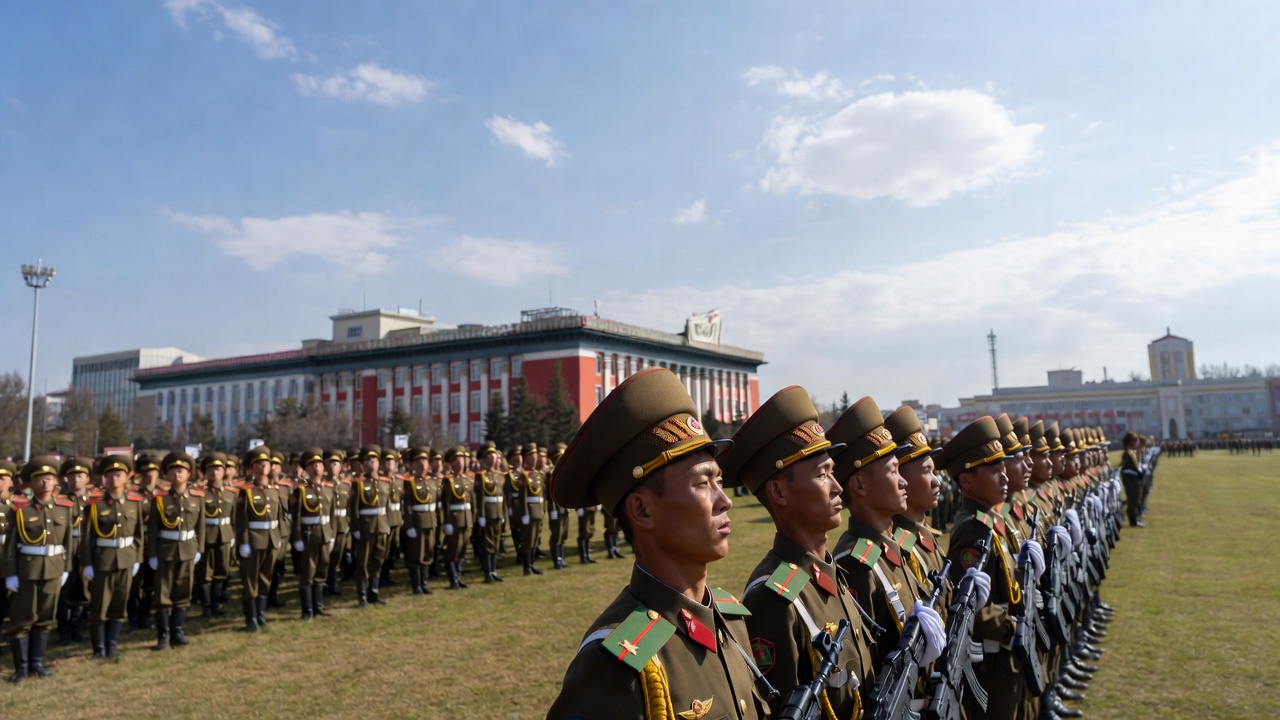
The centerpiece of both holidays is the military parade. These take place in Kim Il Sung Square in central Pyongyang and can involve tens of thousands of soldiers marching in formation, alongside columns of tanks, artillery, rocket launchers, and — in recent years — intercontinental ballistic missiles (ICBMs).
Parades do not happen every year. North Korea generally follows a pattern borrowed from Chinese and Soviet practice: major parades are held on fifth and tenth anniversaries of key holidays. Smaller commemorative events — concerts, rallies, banquets, and speeches — fill in the other years.
The 2018 February 8 parade was particularly notable. It marked the 70th anniversary of the KPA’s formal founding and was the first full-scale parade held on the February 8 date since the holiday’s revival. Some 13,000 troops participated. International observers noted that the timing seemed deliberate — the parade fell just one day before the opening ceremony of the 2018 Winter Olympics in Pyeongchang, South Korea, where North and South Korean athletes marched together in the parade of nations. The contrast was striking: solidarity on the Olympic stage, a show of force back in Pyongyang.
The 2022 April 25 celebration marked the 90th anniversary of the KPRA. A nighttime military parade was held, a format North Korea has increasingly favored since 2020. Nighttime parades allow for dramatic lighting effects and are believed to make it harder for foreign satellites to photograph the weapons on display.
Banquets, Concerts, and Visits to Military Sites
Beyond the parades, both holidays feature:
- State banquets attended by senior military and party officials. During the 2023 February 8 celebrations, Kim Jong Un hosted a banquet at the Yanggakdo Hotel with his wife Ri Sol Ju and their daughter Kim Ju Ae.
- Concerts and artistic performances organized by military cultural troupes and civilian arts groups.
- Visits to symbolic sites, such as the Kumsusan Palace of the Sun, where the preserved bodies of Kim Il Sung and Kim Jong Il lie in state.
- Commemorative assemblies in Pyongyang and in provincial cities, where officials give speeches honoring the army.
- Special food distributions to soldiers and, in some years, to the civilian population, reinforcing the idea that the state provides for its people through the strength of its military.
The Role of State Media
North Korean state media — primarily the Korean Central News Agency (KCNA) and Rodong Sinmun, the Workers’ Party newspaper — play an outsized role during both holidays. Coverage typically includes lengthy editorials praising the army, biographies of Kim family members emphasizing their military credentials, and extensive photo spreads of the Supreme Leader inspecting troops, shaking hands with commanders, or watching weapons tests.
Why the Korean People’s Army Is Central to North Korean National Identity
To understand why two army holidays exist at all, you must understand how deeply the military is woven into the fabric of North Korean life. This is not a country that merely has an army. In many ways, the country is an army.
The Songun Doctrine: Military-First Politics
From the mid-1990s until around 2019, North Korea’s governing ideology was built around Songun (선군), meaning “military first.” Introduced by Kim Jong Il after the death of his father in 1994, Songun placed the Korean People’s Army at the center of political, economic, and social life. The Brookings Institution has described Songun as replacing the proletariat and the vanguard Communist Party with the army as the driving force in society.
Under Songun, the army was not just a defense force. It was the model for all civic behavior. Soldiers built roads, harvested crops, and staffed construction projects. Military units ran factories and farms. The National Defence Commission — a military body — functioned as the supreme organ of state power, outranking the cabinet and the legislature.
Songun was formally removed from the DPRK Constitution in 2019, as Kim Jong Un shifted toward a “people-first” framing of governance. He began steering the country toward a Party-first model, reinforcing the Workers’ Party’s control over all aspects of governance. In June 2013, North Korea had revised the Ten Principles for the Establishment of the Party’s Monolithic Ideological System, emphasizing the Party’s absolute leadership over military and civilian affairs alike.
However, the military’s privileged position in society has not fundamentally changed. Following the collapse of the 2019 Hanoi Summit with the United States, North Korea reaffirmed its commitment to defense spending and weapons development. By 2022, the regime had recommitted to the Songun line with a new emphasis — the development of advanced, high-precision weaponry rather than sheer troop strength. The two army holidays remain central to the national calendar, and both continue to serve as annual affirmations that the army occupies a sacred place in North Korean life.
The practical impact of this military-centric culture is visible in everyday statistics. Military service in North Korea lasts approximately ten years for most conscripts — far longer than in any other country. Roughly 29.9 percent of the North Korean population is either actively serving, in reserve, or enrolled in paramilitary organizations. The KPA’s five branches — Ground Force, Naval Force, Air Force, Strategic Force, and Special Operations Forces — together consume a disproportionate share of the national budget, estimated at approximately $6 billion annually according to international assessments, though the true figure is difficult to verify.
Juche and the Legacy of Armed Struggle
Underlying everything is Juche (주체), the ideology of national self-reliance created by Kim Il Sung. Juche holds that a nation must achieve political, economic, and military independence to prosper. The military pillar of Juche is inseparable from the other two. Without a strong army, the state argues, there can be no independence and no socialism.
The April 25 KPRA Day, in particular, reinforces the Juche narrative by anchoring the army’s birth in an act of national liberation — the guerrilla war against Japan. This is not just military history. It is the origin story of the North Korean state itself.
North Korea’s Military Holidays in the Context of the Korean Peninsula in 2026
As of early 2026, North Korea’s military celebrations take on added significance against the backdrop of escalating geopolitical tensions.
North Korean Troops Fighting Alongside Russia in Ukraine
The most dramatic development in recent years has been the deployment of North Korean soldiers to Russia’s Kursk region to fight alongside Russian forces in the war against Ukraine. The first wave of approximately 10,000–12,000 troops arrived in late 2024. By mid-2025, reports indicated that North Korea was preparing to send an additional 25,000–30,000 soldiers.
The deployment has been costly. South Korean intelligence estimated that roughly 4,000 North Korean soldiers were killed or wounded in the initial wave of fighting. In late 2025, Kim Jong Un publicly honored returning troops from the 528th Regiment of Engineers, who had served a four-month combat rotation in Kursk. He posthumously awarded state honors to nine soldiers killed during the mission — a rare, explicit acknowledgment of combat losses.
This overseas combat experience is likely to feature prominently in future Military Foundation Day and KPRA Day celebrations. At the October 2025 Workers’ Party anniversary parade, North Korea already showcased units it described as “the invincible overseas operations unit” — widely understood to refer to soldiers who had fought in Russia.
The Expanding Nuclear and Missile Arsenal
North Korea’s army holidays have increasingly become platforms for weapons unveiling. The October 2025 parade debuted the Hwasong-20, described by state media as the country’s “most powerful” intercontinental ballistic missile. Previous parades have introduced submarine-launched ballistic missiles, hypersonic warheads, and various drone systems.
For the Kim regime, the parades serve a dual purpose: they rally domestic pride while sending a deterrence signal to the United States, South Korea, and Japan. As the Council on Foreign Relations has noted, Russia’s provision of military technology to North Korea — likely in exchange for troops and ammunition — has accelerated Pyongyang’s weapons development in ways that could shift the military balance on the Korean Peninsula.
Relations with South Korea at a Low Point
Cross-border relations have deteriorated sharply. North Korea has declared that reunification is no longer a goal and has dismantled several inter-Korean liaison mechanisms. The DPRK has also sent thousands of trash-filled balloons across the border and severed communication hotlines.
In this climate, both army holidays serve as reminders of the state of hostility that still officially exists between the two Koreas. The armistice that ended the Korean War in 1953 was never replaced by a peace treaty. Technically, the two countries remain at war — a fact that gives North Korea’s military celebrations an edge of real-world urgency that few other nations’ army days carry.
How to Tell North Korea’s February 8 and April 25 Army Holidays Apart
For researchers, journalists, and anyone following North Korean affairs, keeping the two dates straight is essential. Here is a quick reference guide.
February 8 — Military Foundation Day (Army Day)
- Marks the 1948 founding of the KPA as a formal military
- Emphasizes modern military capability and state-building
- Revived by Kim Jong Un in 2015
- Winter holiday; soldiers parade in cold-weather gear
- In 2026, this marks the 78th anniversary of the KPA
April 25 — KPRA Day (Military Foundation Day / Army Day)
- Marks the 1932 founding of the anti-Japanese guerrilla KPRA
- Emphasizes revolutionary heritage and armed struggle
- Official holiday since 1996
- Spring holiday; often features nighttime parades
- In 2026, this marks the 94th anniversary of the KPRA
The naming conventions can be confusing because both holidays are sometimes called “Military Foundation Day” or “Army Day” in English-language media. When reading news reports, always check the date. February 8 = KPA founding (1948). April 25 = KPRA founding (1932).
The Role of Military Parades in North Korean Holiday Celebrations
Military parades are the most visible element of both holidays and deserve special attention. They are not merely celebrations — they are strategic communications tools designed for both domestic and international audiences.
A Brief History of North Korean Military Parades
The first military parade in North Korean history took place on February 8, 1948, at Pyongyang Station. Roughly 20,000 soldiers stood at attention while Kim Il Sung presided as commander in chief, with Soviet generals observing.
Since 1958, major parades have been held in Kim Il Sung Square, following a pattern of quinquennial (every five years) or decennial (every ten years) observances. Some landmark parades include:
- 1992 (April 25): The 60th anniversary parade, featuring over 20,000 troops and 1,200 weapons systems. Kim Jong Il’s only public speech.
- 2018 (February 8): The 70th anniversary of the KPA, with 13,000 soldiers. Coincided with the eve of the Pyeongchang Winter Olympics.
- 2022 (April 25): The 90th anniversary of the KPRA. First parade to feature agents from the Ministry of State Security and women traffic police officers.
- 2023 (February 8): The 75th anniversary of the KPA. Kim Jong Un attended with his wife and daughter.
- 2025 (October 10): The 80th anniversary of the Workers’ Party of Korea. Featured the Hwasong-20 ICBM and hosted Chinese, Russian, and Vietnamese dignitaries.
The Shift to Nighttime Parades
Since 2020, North Korea has increasingly staged its parades at night. This trend began with the October 10, 2020, parade marking the 75th anniversary of the Workers’ Party. Nighttime parades offer several advantages: dramatic lighting creates powerful visual propaganda for state media, the darkness makes it harder for foreign intelligence satellites to photograph new weapons in detail, and the spectacle of illuminated missiles rolling through Pyongyang at midnight creates images that dominate global news cycles.
What the Parades Reveal About North Korean Military Capability
Analysts at organizations like 38 North and the Center for Strategic and International Studies (CSIS) closely study parade footage and satellite imagery to assess North Korea’s military progress. New missile types, changes in troop uniforms, the size of vehicle columns, and even the behavior of individual soldiers can yield intelligence about the state of the KPA.
The parades are also watched for what they reveal about political dynamics. Who stands next to Kim Jong Un on the reviewing stand? Which generals are promoted? Which weapons receive the most screen time in KCNA broadcasts? These details often signal shifts in policy priorities.
How North Korea’s Army Holidays Compare to Military Days in Other Countries
North Korea is not the only country that celebrates its armed forces with a national holiday. But the way it does so is distinctive. A comparison helps illustrate why.
| Country | Military Holiday | Date | Character |
|---|---|---|---|
| North Korea | Military Foundation Day / KPRA Day | Feb 8 / Apr 25 | Two holidays; massive parades; weapons reveals |
| South Korea | Armed Forces Day | October 1 | Single holiday; parades and ceremonies |
| China | Army Day (PLA Day) | August 1 | Marks founding of People’s Liberation Army (1927) |
| Russia | Defender of the Fatherland Day | February 23 | Broad celebration of military service |
| United States | Armed Forces Day | Third Saturday in May | Civilian-organized; no military parades |
| France | Bastille Day (includes military parade) | July 14 | Combined national/military celebration |
What sets North Korea apart is the political function of its army holidays. In most countries, military days honor service members. In North Korea, they honor the regime’s foundational mythology. The army and the state are inseparable, and the holidays exist to remind citizens of that fact.
Understanding the Kim Family’s Connection to North Korea’s Military Holidays
Each of North Korea’s three ruling Kims has left a distinct imprint on the army holidays.
Kim Il Sung (1912–1994): The Founder
Kim Il Sung is credited with founding both the KPRA in 1932 and the KPA in 1948. He is the central figure of both holidays. North Korean propaganda portrays him as a military genius who personally led the guerrilla struggle against Japan, liberated Korea, and then built a modern army capable of fighting the United States to a standstill in the Korean War.
The reality is more complex — Soviet support was critical at every stage — but within North Korea, the narrative is absolute. Kim Il Sung’s military credentials are the bedrock on which the entire system rests.
Kim Jong Il (1941–2011): The Marshal Who Spoke Once
Kim Jong Il’s relationship with the military was formalized through the Songun doctrine. He elevated the army to the pinnacle of state life and made the April 25 KPRA Day the dominant military holiday. His most memorable contribution to the holiday’s history was his single public utterance at the 1992 parade — a moment that remains iconic in North Korean culture.
Kim Jong Il received the title of marshal on April 21, 1992, just before that historic parade. He later became Chairman of the National Defence Commission, the most powerful position in the country, reflecting the military’s centrality to his rule.
Kim Jong Un (2011–Present): The Modernizer
Kim Jong Un has reshaped the military holidays to reflect his own priorities. By restoring February 8 as a holiday in 2015, he created a new tradition associated with his leadership. He has also used both holidays as platforms for displaying increasingly advanced weapons — ICBMs, submarine-launched ballistic missiles, hypersonic weapons, and drones — signaling his commitment to making North Korea a recognized nuclear power.
His decision to bring his wife and daughter to the 2023 celebrations was interpreted by many analysts as a signal about succession planning, suggesting that the Kim dynasty intends to continue into a fourth generation.
What Visitors and Researchers Should Know About North Korea’s Army Holidays
For the small number of foreign visitors who have attended celebrations in Pyongyang — primarily through specialized tour operators — the army holidays offer a rare window into North Korean public life.
Practical Considerations for Travel During Military Holidays
Tourism to North Korea has been largely suspended since the COVID-19 pandemic, and access remains extremely restricted as of early 2026. When tours do operate, however, visits timed around February 8 or April 25 are among the most sought-after experiences. Tour operators such as Young Pioneer Tours and Koryo Tours have historically offered special itineraries around major anniversary years.
Visitors who have attended parades describe the experience as surreal and overwhelming — the synchronized marching of thousands of soldiers, the thunderous music, the sheer scale of the missile displays, and the tightly controlled environment in which foreign observers are confined to specific viewing areas.
Important Cultural Etiquette for Observers
Anyone studying or writing about North Korea’s army holidays should be mindful of the cultural sensitivities involved. Within North Korea, the military is not merely respected — it is revered as a near-sacred institution. The founding dates of the army are treated with a solemnity that outsiders may find difficult to fully appreciate.
Criticism of the KPA or the Kim family’s military legacy is, of course, absolutely prohibited within the DPRK. But even outside observers should approach the subject with analytical rigor rather than mockery. The millions of North Korean soldiers and civilians who observe these holidays do so within a tightly controlled information environment. Their lived experience of the celebrations — the pride, the community, the sense of shared national purpose — is genuine, even as the broader political context is authoritarian.
Understanding the holidays on their own terms, without condescension, is essential for anyone who wants to produce meaningful analysis of North Korean society.
Academic and Intelligence Value
For researchers and intelligence analysts, the army holidays produce a burst of data. State media releases photographs, video footage, and written accounts of the celebrations. Satellite imagery companies capture preparations and parade formations from orbit. Defector testimony provides context about what ordinary soldiers experience during the holidays.
Every five years, the major anniversary parades become particularly important intelligence events. The 2028 February 8 celebration will mark the 80th anniversary of the KPA, and the 2032 April 25 celebration will mark the centenary of the KPRA. Both dates are expected to feature extraordinary displays.
The Future of North Korea’s Military Celebrations in an Era of Global Tension
As the DPRK enters an era of deepened military cooperation with Russia, an expanding nuclear arsenal, and intensifying confrontation with the United States and South Korea, its army holidays are likely to grow in both scale and geopolitical significance.
Overseas Combat Veterans as a New Propaganda Element
The deployment of North Korean troops to Russia has created something the regime has not had since the Korean War: recent combat veterans. The December 2025 ceremony honoring soldiers from the 528th Regiment who served in Kursk suggests that these veterans will become central figures in future military holiday celebrations. They provide the state with fresh stories of heroism and sacrifice — powerful material for propaganda in a country that has relied on Korean War narratives for over seven decades.
Weapons Development as Holiday Spectacle
Each major parade now doubles as a weapons expo. The Hwasong-20 ICBM, unveiled in October 2025, will almost certainly appear again at future February 8 or April 25 celebrations. As North Korea continues to develop new delivery systems — potentially with Russian technological assistance — the parades will remain a key venue for signaling capability to the outside world.
The Question of Succession
Kim Jong Un’s decision to bring his daughter, Kim Ju Ae, to military events since 2022 has fueled intense speculation about the future of the dynasty. If succession planning continues along current lines, future army holidays may serve as the stage on which a fourth-generation Kim is gradually introduced to the military establishment and the public.
Frequently Asked Questions About North Korea’s Army Holidays
Q: Does North Korea celebrate two army holidays? Yes. February 8 marks the founding of the Korean People’s Army (KPA) in 1948. April 25 marks the founding of the Korean People’s Revolutionary Army (KPRA) in 1932. Both are public holidays.
Q: Which army holiday is more important in North Korea? Both are significant, but major parades tend to follow a rotating schedule based on milestone anniversaries. In practice, the scale of celebrations varies from year to year.
Q: Are military parades held every year in North Korea? No. Major parades typically occur on fifth or tenth anniversaries of key holidays. Smaller commemorative events are held in other years.
Q: Can foreigners attend North Korean military parades? In the past, some foreign tour groups were in Pyongyang during parade days, though they were not always granted direct access to viewing areas. Tourism has been largely suspended since 2020.
Q: What is Songun? Songun (선군) is the “military-first” ideology that dominated North Korean governance from the mid-1990s until 2019. It placed the Korean People’s Army at the center of political and economic life.
Q: Why did North Korea change its army’s founding date? In 1978, the regime shifted the official founding date from February 8 (1948) to April 25 (1932) to emphasize the army’s revolutionary origins in the anti-Japanese guerrilla struggle. Kim Jong Un restored February 8 as a holiday in 2015 while keeping April 25.
Final Thoughts: Why North Korea’s Two Army Holidays Matter Beyond Its Borders
North Korea’s dual army holidays are not just domestic celebrations. They are windows into how the regime thinks about itself, its history, and its future. The February 8 holiday speaks to the practical reality of maintaining one of the world’s largest armies. The April 25 holiday speaks to the mythology that sustains the Kim family’s claim to power.
For the international community, these holidays offer tangible intelligence — new weapons, political alignments, leadership signals. For students of history and culture, they offer a case study in how states use commemorative dates to shape national identity. And for anyone trying to understand the Korean Peninsula in 2026, they offer a reminder that North Korea’s military identity is not a relic of the Cold War. It is a living, evolving, and increasingly consequential force in global affairs.
The next time you see satellite images of formations assembling at Pyongyang’s Mirim Parade Training Ground, or headlines about a nighttime missile display in Kim Il Sung Square, check the date. If it is February 8, you are watching the anniversary of a formal army’s birth. If it is April 25, you are watching the anniversary of a revolution’s beginning. Both tell you something essential about the country that celebrates them — and about the world that must reckon with what they represent.