If you have ever dreamed of joining tens of thousands of people in a single, thundering dance under the subtropical skies of western Yunnan, the Munao Zongge Festival is the event you cannot afford to miss. This is not a choreographed stage show. It is not a museum exhibit. It is a living, breathing tradition in which an entire people — the Jingpo — pour their history, spirituality, and joy into a mass dance so powerful that the ground shakes beneath your feet.
In 2026, the festival falls during the first week of March, right when the dry season makes Dehong Prefecture’s border country at its golden, sun-drenched best. Whether you are a cultural traveler, a photographer, or simply someone who believes the world is best understood through its celebrations, this guide will walk you through everything you need to plan your trip.
What Is the Munao Zongge Festival and Why Is It Important to the Jingpo People?
The name Munao Zongge (目瑙纵歌) translates roughly as “everyone dance together” in the Jingpo language. Some scholars also render it as “dance in paradise” or “mass revelry dance.” But no translation quite captures the scale or emotion of the event. Imagine an open square the size of several football fields, packed with dancers in black, red, and silver costumes, all stepping to the same deep-chested drum beat for hours — sometimes days — on end.
The Jingpo are one of China’s 56 officially recognized ethnic groups. Most of the roughly 150,000 Jingpo people in China live in the mountainous western reaches of Yunnan Province, concentrated in the Dehong Dai and Jingpo Autonomous Prefecture. Across the border in Myanmar, the same people are known as the Kachin, and they share deep cultural and linguistic ties with their Chinese relatives. During Munao Zongge, Kachin visitors from Myanmar frequently cross the border to dance alongside their kin — a testament to the transnational nature of Jingpo identity.
Historically, the Jingpo held Munao Zongge dances before going to war, after returning in victory, and to celebrate abundant harvests. The festival is rooted in an ancient legend. According to oral tradition, only the children of the Sun were once permitted to dance the Munao dance in the Sun Palace. When birds attended a divine carnival in the sky and brought the dance steps back to Earth, the Jingpo people learned the dance and made it their own. Over the centuries, the festival absorbed layers of meaning — religious sacrifice, community bonding, prayers for prosperity, and pure collective joy.
In 2006, the Chinese State Council added Munao Zongge to the national list of intangible cultural heritage, recognizing its extraordinary cultural value. Today, it stands as the single most important annual event for the Jingpo people and one of the most spectacular ethnic festivals anywhere in China.
When Is the Munao Zongge Festival in 2026? Exact Dates and Lunar Calendar
The Munao Zongge Festival is held around the 15th day of the first month on the Chinese lunar calendar each year. This date coincides with the Chinese Lantern Festival (元宵节), the traditional closing celebration of the Spring Festival season.
In 2026, the Chinese New Year (Spring Festival) falls on February 17. Counting forward to the 15th day of the first lunar month, we arrive at March 3, 2026 — the date the main Munao Zongge celebrations begin.
| Detail | Information |
|---|---|
| Festival Name | Munao Zongge (目瑙纵歌) |
| 2026 Start Date | Tuesday, March 3, 2026 |
| Duration | Typically 3 to 7 days (varies by village) |
| Lunar Calendar Date | 15th day of the 1st lunar month |
| Main Location | Longchuan County, Dehong Prefecture, Yunnan Province |
| Chinese Zodiac Year | Year of the Horse (丙午年) |
The festival usually lasts between three and seven days, though the main dancing and ceremonies are most intense on the first two or three days. Individual Jingpo villages throughout Dehong Prefecture hold their own Munao Zongge celebrations, so even if you arrive slightly before or after March 3, you may still catch festivities in nearby communities.
Pro tip: Arrive at least one day early — ideally by March 2 — to witness the preparation rituals and to secure a good position near the dance square.
Where Does the Munao Zongge Festival Take Place in Yunnan Province?
Longchuan County: The Heartland of Jingpo Culture
The primary venue for the Munao Zongge Festival is Longchuan County (陇川县), located in the southern part of Dehong Prefecture. Longchuan is widely considered the heartland of Jingpo culture in China. According to CGTN reporting on the festival, the county is home to roughly 10,000 Jingpo people — about one-third of the ethnic group’s total population in the country. This concentration of Jingpo residents means Longchuan preserves the most complete and standardized traditions of the Munao Zongge dance.
The main celebration takes place at a dedicated Munao dance square in Jinghan Township (景罕镇), where the grand Munao poles stand at the center. In recent years, the event held here has been called the Pengsheng Tongken Munao Zongge Festival, a title that carries ancestral significance in Jingpo oral history.
Other Festival Sites Across Dehong Prefecture
While Longchuan hosts the largest celebration, virtually every Jingpo village in Dehong marks the occasion. You can also find Munao Zongge activities in:
- Mangshi (芒市) — the capital of Dehong Prefecture and a convenient base for travelers
- Yingjiang County (盈江县) — near the Yunyan Pagoda, where both Jingpo and Dai festivals are held
- Ruili (瑞丽) — a lively border town with strong cross-border cultural exchange
Each location adds its own local flavor, but Longchuan remains the essential destination for the most authentic and grand experience.
How to Experience the Munao Zongge Dance: What Happens During the Festival
The Sacred Munao Poles and Their Hidden Symbolism
At the center of every Munao Zongge dance ground stand four tall wooden pillars known as Munao Shidong (目瑙示栋). These are not mere decorations. They are sacred objects that serve two purposes: to honor the sun god and to guide the dance formation. Each pole is painted with elaborate symbolic patterns:
- Ferns — Fern sprouts look like clenched fists. Their leaves fan out like arrows pointing upward. They represent unity and progress.
- Swords — The sword motif honors Jingpo traditions of bravery and martial heritage.
- Mountains (representing the Himalayas) — According to Jingpo oral tradition, their ancestors migrated from the high mountains. The mountain symbol honors this origin.
- Crops and livestock — These images express the people’s wish for a prosperous harvest and material well-being.
- Gongs and drums — Musical instrument motifs signal good fortune and celebration.
The patterns on the poles are not random art. They are essentially a visual map of the Jingpo migration story, coded in symbols that every Jingpo person can read. Spend some time studying the poles before the dance begins — they will deepen your understanding of everything that follows.
The Naoshuang: Sacred Dance Leaders of the Munao Zongge
The mass dance is not a free-for-all. It is led by four designated leaders called Naoshuang (瑙双). These are respected spiritual figures — traditionally ritual specialists or village elders — who have earned the honor of guiding the community dance.
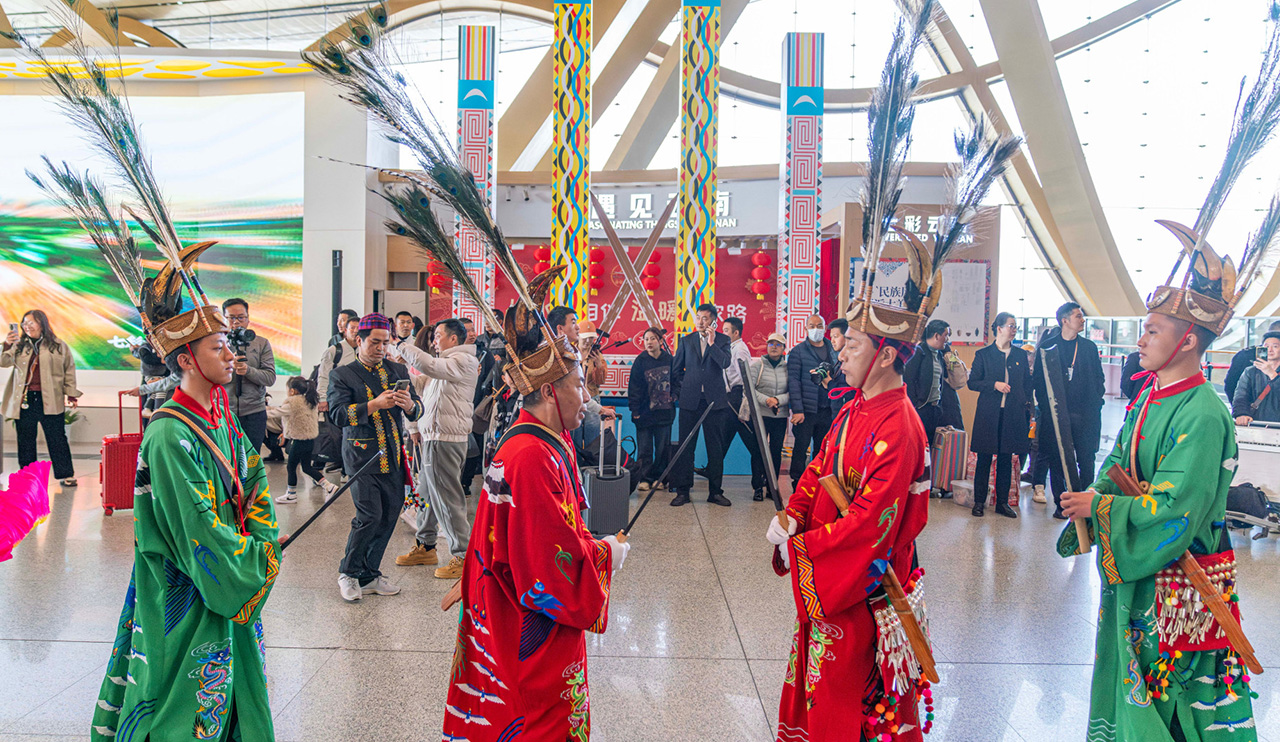
The Naoshuang dress distinctively. They wear crested caps, robes of red and green silk, and silver-colored cloaks. Each one holds a long ceremonial knife. They arrange themselves in two columns at the head of the dance line. The two in front are called the “military pair” and the two at the rear are the “civil pair” — reflecting the Jingpo tradition of balancing martial and civic virtues.
Once the Naoshuang begin to move, the entire crowd falls into step behind them. The dance pattern follows the symbolic routes painted on the Munao poles, tracing the ancestral migration path of the Jingpo people through rhythm and movement. It is a deeply spiritual act disguised as a joyful party.
Joining the Dance: Can Tourists Participate?
Yes — and you are warmly encouraged to. One of the most beautiful aspects of Munao Zongge is its inclusiveness. There is no audience and no stage. Everyone present is a dancer. You simply fall into the moving column, follow the person in front of you, and let the drumbeat carry your feet.
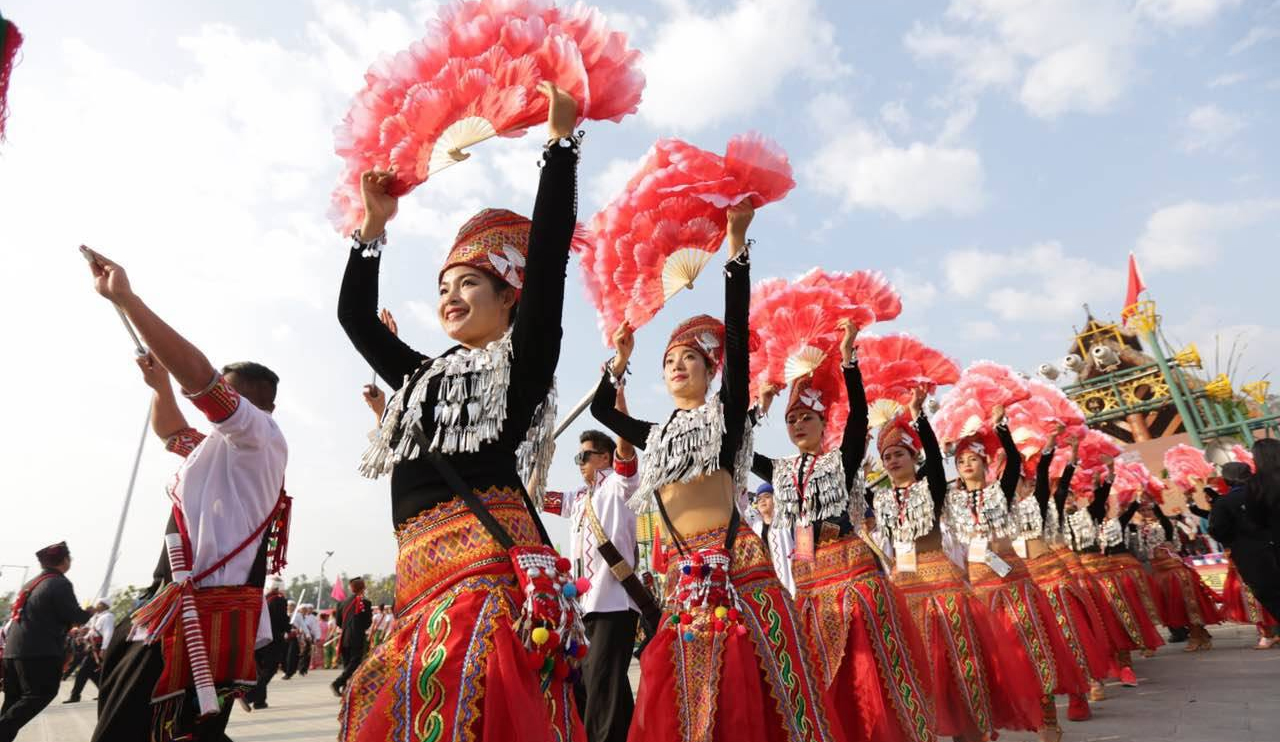
The basic step is not difficult. You move in a shuffling, rhythmic walk, swaying your body and keeping time with the drums. Women around you will be waving fans or handkerchiefs. Men will hold long knives or simply swing their arms. No one judges your technique. What matters is your presence and your willingness to share in the collective joy.
As provincial inheritor of the tradition Shang Deguang has noted, the festival once was celebrated only by Jingpo people, but in recent years it has attracted visitors from around the world to join the dancing. During the 2023 festival, local authorities reported that over 200,000 tourists visited Longchuan County, with approximately 60,000 people directly participating in the festivities.
Traditional Jingpo Costumes Worn During the Munao Zongge Festival
The visual spectacle of Munao Zongge owes much to the extraordinary traditional costumes of the Jingpo people. These are not tourist-shop replicas. Many Jingpo women spend months weaving and embroidering their festival outfits by hand. Brocade and embroidery skills are considered essential accomplishments for Jingpo women, and their garments reflect genuine artistry.
Women’s Festival Attire
Jingpo women’s festival costumes typically include:
- A collarless black blouse with intricate embroidery along the edges
- A colorful woven skirt (often in deep reds, blacks, and purples with geometric patterns)
- An abundance of silver ornaments — necklaces, bracelets, waist chains, and hair accessories
- Handwoven shoulder bags with bright beaded decorations
- Ornamental earrings and headpieces that catch the sunlight and flash during movement
When hundreds of women dance together, the combined effect of all that silver moving in unison is dazzling. The sound of their ornaments creates a secondary rhythm layered over the drums.
Men’s Festival Attire
Jingpo men dress in a more understated but equally symbolic fashion:
- A white or blue-purple cloth turban wrapped around the head
- A round-collared dark shirt and short black trousers
- A woven shoulder bag (called a tongpa)
- A long sword or knife carried at the waist — an essential part of Jingpo male identity
During the dance, men brandish their swords in sweeping movements that recall the Jingpo tradition of guerrilla warfare and hunting. The sword dance (dao wu) is one of the most popular and photogenic elements of the festival.
What to Eat at the Munao Zongge Festival: A Guide to Jingpo Ethnic Cuisine
The Jingpo people’s food culture is as distinctive as their dance. If Dai cuisine is known for its sour, fresh flavors, Jingpo food hits you with bold, spicy intensity. During the festival, food stalls and communal feasts give you the chance to taste dishes you will find nowhere else in the world.
Must-Try Jingpo Dishes During the Festival
Pestled Dishes (舂菜, Chong Cai) — This is the signature culinary technique of the Jingpo people. Fresh ingredients — dried beef, fish, herbs, chili — are placed in a large wooden mortar and pounded with a pestle until they form a coarse, aromatic paste. As the Jingpo saying goes: “If the pestle doesn’t pound, the meal isn’t right.” Almost every Jingpo household owns a wooden mortar, and pestled dishes appear at virtually every meal. Try pestled dried beef (舂干巴) for the most iconic version.
The Green Leaf Banquet (绿叶宴) — This is the traditional Jingpo feast for welcoming guests. Forget plates and bowls. All dishes are served on fresh banana leaves spread across a table or the ground. The spread typically includes seven to nine items: grilled fish, glutinous rice, houttuynia (fish mint), fried eggs, pancakes, grilled meats, and fresh herbs. Bamboo joints serve as drinking cups. Rice is steamed inside bamboo tubes. The Green Leaf Banquet is not just a meal — it is a philosophy of eating in harmony with nature.
Ghost Chicken (鬼鸡, Gui Ji) — Despite the eerie name, this cold chicken dish is absolutely delicious. The chicken is boiled, cooled, torn into shreds, and mixed with minced ginger, garlic, cilantro, lemon leaf, salt, and soy. The name comes from the Jingpo tradition of offering chicken to spirits during rituals. Once the ceremony is complete, the chicken is prepared for the living to enjoy.
Bamboo Tube Rice (竹筒饭) — Sticky rice is stuffed into sections of fresh green bamboo and roasted over an open fire. The bamboo imparts a subtle, earthy, slightly sweet flavor to the rice that you cannot replicate with any pot or oven.
Sour Bamboo Shoot Soup — A tangy, warming broth made with fermented bamboo shoots, chili, and seasonal vegetables. It is a staple of Jingpo home cooking, especially during the cooler dry-season months when the festival takes place.
| Dish | Description | Flavor Profile |
|---|---|---|
| Pestled Dried Beef | Dried beef pounded with herbs and chili | Spicy, savory, smoky |
| Green Leaf Banquet | Multi-dish feast served on banana leaves | Varied — herbal, grilled, fresh |
| Ghost Chicken | Cold shredded chicken with lemon and herbs | Tangy, garlicky, refreshing |
| Bamboo Tube Rice | Sticky rice roasted in bamboo | Sweet, earthy, subtle |
| Sour Bamboo Shoot Soup | Fermented bamboo in spicy broth | Sour, spicy, warming |
How to Get to the Munao Zongge Festival in Dehong Prefecture, Yunnan
Getting to Dehong takes a bit of planning, but the journey itself is part of the adventure. The prefecture sits in the far western corner of Yunnan Province, sharing a 503.8-kilometer border with Myanmar’s Kachin State. This is genuine frontier country — subtropical, lush, and culturally rich.
Flying to Dehong: Mangshi Airport
The fastest route is to fly into Dehong Mangshi Airport (芒市机场, IATA code: LUM). The airport receives flights from several major Chinese cities, including Kunming, Beijing, Shanghai, Shenzhen, Chengdu, Chongqing, Xi’an, and Changsha. The most frequent connection is from Kunming Changshui International Airport, with multiple daily flights taking roughly one hour.
From Mangshi Airport to the city center is about 12 kilometers, a 20-minute taxi ride. Taxi meters start at approximately ¥8. Airport shuttle buses also operate on a regular schedule.
Getting from Mangshi to Longchuan County
From Mangshi, you will need to travel south to Longchuan County, where the main festival takes place. The distance is roughly 100 kilometers, and the drive takes about 1.5 to 2 hours by road.
- Shared minibuses depart from Mangshi’s central bus station throughout the day. Expect to pay approximately ¥30–50 per person.
- Private car hire or taxi is the most comfortable option and typically costs ¥200–300 for the one-way trip.
- Ride-hailing apps (Didi is widely used in China) work in Mangshi and can arrange inter-city rides.
Driving from Kunming to Dehong
If you prefer a road trip, the drive from Kunming to Mangshi covers about 530 kilometers along the G56 Hangzhou–Ruili Expressway. The road conditions are good, with modern tunnels and bridges along the way, including the spectacular Longjiang Bridge — one of the highest suspension bridges in Asia. Budget about 7–8 hours for the drive.
Rail Access (Limited in 2026)
As of early 2026, there is no operational railway station in Mangshi. The Baoshan-to-Ruili railway line is under construction and expected to open in the coming years. Until then, flights and highway travel remain the primary options.
Best Hotels and Accommodation Near the Munao Zongge Festival 2026
Accommodation options in Dehong range from comfortable business hotels to simple guesthouses. During the festival period, rooms in Longchuan fill up quickly, so booking well in advance is essential.
Where to Stay in Longchuan County
Longchuan is a small county town, and its hotel options are modest compared to a major city. You will find several two- and three-star hotels along the main roads, plus an increasing number of guesthouses and Airbnb-style homestays. Prices during the festival typically range from ¥150 to ¥400 per night for a clean double room.
Where to Stay in Mangshi (More Options)
If you prefer a wider selection of hotels, stay in Mangshi and make the day trip to Longchuan for the festival. Mangshi offers a broader range of accommodation including modern business hotels, boutique guesthouses, and a few international-standard properties. Room rates in Mangshi typically range from ¥200 to ¥600 per night during the festival season.
Where to Stay in Ruili (Combine Festival with Border Town Culture)
Ruili, the famous border town about 90 minutes south of Longchuan, is another excellent base. It offers the most cosmopolitan atmosphere in the prefecture, with jade markets, cross-border trade zones, and Burmese-influenced cuisine. Hotels here range from ¥150 to ¥500 per night.
| Location | Distance to Festival | Hotel Price Range | Best For |
|---|---|---|---|
| Longchuan County | Walking distance | ¥150–400/night | Being at the heart of the action |
| Mangshi (Capital) | ~100 km / 1.5–2 hrs | ¥200–600/night | Better hotel selection, city amenities |
| Ruili (Border Town) | ~90 km / 1.5 hrs | ¥150–500/night | Combining festival with border culture |
Weather in Dehong During the Munao Zongge Festival: What to Pack for March
Dehong Prefecture enjoys a south subtropical monsoon climate — warm and pleasant year-round, with distinct dry and wet seasons. March falls squarely in the dry season, which is ideal for festival travel.
Typical March weather in Dehong:
- Daytime temperatures: 22°C to 28°C (72°F to 82°F)
- Nighttime temperatures: 10°C to 15°C (50°F to 59°F)
- Rainfall: Very low. March is one of the driest months.
- Sunshine: Abundant. Expect bright, clear days with strong UV.
Packing Essentials for the Festival
- Layered clothing — Warm days, cool evenings. A light jacket or fleece for the morning and night, comfortable t-shirts for the day.
- Comfortable walking shoes — You will be on your feet for hours, potentially dancing. Avoid heels or stiff shoes.
- Sun protection — Hat, sunglasses, and strong sunscreen. The subtropical sun at altitude is intense.
- A small daypack — For water, snacks, camera, and sun gear.
- Respectful, modest clothing — While there is no strict dress code for visitors, avoid overly revealing outfits. You are a guest at a sacred cultural event.
- Camera with a good zoom lens — The costumes and crowd scenes offer extraordinary photographic opportunities.
- Cash (Chinese yuan) — Smaller towns and food stalls may not accept mobile payment from foreign accounts. Carry enough cash for meals, transport, and souvenirs.
Visa Requirements for Visiting China During the Munao Zongge Festival in 2026
Good news for international travelers: China’s visa policies have become significantly more accessible in recent years.
China’s 30-Day Visa-Free Entry Policy (Extended Through 2026)
China has extended its unilateral 30-day visa-free entry policy for citizens of 46 countries through December 31, 2026. Eligible travelers can enter China without a visa for tourism, business, family visits, or transit for up to 30 days. The eligible countries include most EU member states, Australia, New Zealand, Japan, South Korea, and several Latin American and Gulf Cooperation Council nations.
Sweden was added to the list in November 2025, and as of January 2026, there are reports that Canada may soon be included as well.
Countries Requiring a Standard Visa
Citizens of the United States, United Kingdom, and Canada (pending the announced expansion) are not currently included in the 30-day visa-free scheme. However, travelers from these countries can take advantage of China’s 240-hour (10-day) visa-free transit policy, which allows entry through designated ports for travelers continuing to a third country or region.
For stays longer than the permitted visa-free period, or for travelers from non-eligible countries, a standard L (tourist) visa is required. Apply through your nearest Chinese embassy or consulate well in advance of your travel date.
| Nationality | Visa Requirement for 2026 |
|---|---|
| EU citizens (most), Australia, NZ, Japan, South Korea | Visa-free for up to 30 days |
| United States, United Kingdom | Standard visa required (or 240-hour transit waiver) |
| Russia | Visa-free until September 14, 2026 |
| ASEAN nations | Various group and individual arrangements |
| Canada | Standard visa (expansion expected in 2026) |
Important: Always verify the latest visa requirements through official channels before booking your trip. Policies can change.
Top Things to Do Near the Munao Zongge Festival: Side Trips and Attractions in Dehong
The Munao Zongge Festival is reason enough to visit Dehong, but the surrounding region offers a wealth of additional experiences. Plan a few extra days to explore.
Ruili: China’s Jade Capital and Border Town Experience
Ruili (瑞丽) is the most dynamic border town in Dehong. It sits directly across the Ruili River from Myanmar and buzzes with cross-border trade, jade markets, and a fascinating blend of Chinese, Burmese, Dai, and Jingpo cultures.
Must-see spots in Ruili include:
- Jiegao Border Trade Zone — Walk the streets where Chinese and Burmese merchants trade jade, amber, rosewood, and tropical goods. The zone has over 15 trading streets. The largest is Zhongmian Street.
- One Village, Two Countries (一寨两国) — A unique attraction where a single Dai village straddles the China-Myanmar border. A swing set near the border marker lets you literally swing between two countries.
- Jiele Great Golden Pagoda — A stunning Theravada Buddhist pagoda that reflects the Dai community’s deep spiritual traditions.
- Moli Tropical Rainforest and Waterfall — A lush nature reserve with a 60-meter waterfall, tropical flora, and walking trails through the jungle canopy.
Mangshi: Golden Pagodas and Peacock Lakes
As the capital of Dehong, Mangshi (芒市) is a pleasant, walkable city with several notable sites:
- Menghuan Grand Golden Pagoda — Perched on Leiyarang Mountain overlooking Peacock Lake, this enormous golden Buddhist stupa is the most photographed landmark in Dehong.
- Menghuan Silver Pagoda — On the same mountain, offering excellent photo opportunities, especially at sunset.
- Tree-Wrapped Pagoda — An ancient brick pagoda that has been gradually enveloped by the roots of a massive banyan tree. It is believed to be one of the earliest Buddhist pagodas built by the Dai people.
- Five Clouds Temple — A hilltop Buddhist temple with panoramic views of the surrounding valley.
Longchuan: Beyond the Festival
Even outside of festival time, Longchuan offers insights into Jingpo daily life:
- Jingpo Park — A cultural park in Longchuan where you can see Jingpo architecture, watch sword dance demonstrations, and learn about Jingpo history.
- Husa Achang Village — The home of the famous Husa knife, a national intangible cultural heritage. The Achang people here have been forging exquisite swords and knives since the Ming Dynasty. Watch the artisans at work and purchase an authentic handmade blade as a souvenir.
Cultural Etiquette: How to Respect Jingpo Traditions as a Festival Visitor
The Jingpo people are warm, generous hosts who welcome visitors with open arms. To show your respect and make the most of your experience, keep these cultural guidelines in mind.
Ask before photographing individuals. While the festival is a public celebration and wide-angle crowd shots are perfectly fine, close-up portraits of individuals — especially elders and Naoshuang dancers — should be taken only with permission. A smile, a gesture toward your camera, and a nod of acknowledgment go a long way.
Accept food and drink graciously. If a Jingpo family invites you to eat or offers you rice wine, accept with both hands. Refusing food or drink can be seen as impolite. You do not have to consume everything, but the gesture of acceptance matters.
Do not touch the Munao poles. The tall wooden poles at the center of the dance square are sacred objects. They are not playground equipment or selfie props. Admire them from a respectful distance.
Dress modestly and practically. The festival is a cultural and spiritual event, not a beach party. Dress in comfortable, respectful clothing. Earthy tones and darker colors help you blend in. Bright red and green are traditional Jingpo festive colors — wearing them shows cultural sensitivity.
Learn a few Jingpo phrases. Even a simple greeting will delight your hosts:
| English | Jingpo | Usage |
|---|---|---|
| Hello | Kaba nai | General greeting |
| Thank you | Chyeju kaba | Expressing gratitude |
| Cheers! (toasting) | Shadu! | During rice wine toasts |
Be patient and present. The festival operates on its own timetable. Ceremonies may start later than announced. The dancing may continue long after you expected it to end. Embrace the rhythm of Jingpo time. Put your phone down occasionally. Listen to the drums. Watch the silver flash on the dancers’ costumes. Let the experience wash over you.
Munao Zongge Festival Photography Tips: Capturing the Dance of Paradise
For photographers, Munao Zongge is a dream assignment. The combination of vivid costumes, dramatic movement, massive crowds, and strong subtropical light creates images of extraordinary power.
Best times to shoot:
- Early morning (7:00–9:00 AM): The sacrificial ceremony and Naoshuang crowning ritual happen before the main dance. The light is soft and golden. The crowd is still gathering, making it easier to isolate individual subjects.
- Mid-morning to early afternoon (9:00 AM–2:00 PM): The main mass dance reaches its peak. This is when you get the epic wide-angle crowd shots. The overhead sun is harsh but creates dramatic shadows on the costumes.
- Late afternoon (4:00–6:00 PM): As the light turns warm and horizontal, the silver ornaments on the dancers’ costumes become incandescent. This is the magic hour for portraiture.
Technical tips:
- Use a wide-angle lens (16–35mm) for crowd and atmosphere shots.
- Use a telephoto lens (70–200mm) for isolating individual dancers and details of costume and expression.
- Shoot at a fast shutter speed (1/500 or faster) to freeze the movement of the dancers and their swinging ornaments.
- Consider a monopod for stability in dense crowds where a tripod would be impractical.
- Bring extra memory cards and batteries. You will shoot far more than you expect.
The Deeper Meaning of Munao Zongge: Why This Festival Matters in 2026
It would be easy to describe Munao Zongge as a colorful ethnic festival — a photogenic spectacle for tourists. But to leave it at that would be to miss the point entirely.
The Jingpo people number only about 150,000 in China. They are a small community in a vast country. Their language, their dances, their cuisine, their spiritual practices — all of these are under pressure from the forces of modernization, urbanization, and cultural homogenization. The Munao Zongge Festival is not just a celebration. It is an act of cultural survival.
When a 70-year-old Naoshuang leads the dance and a 7-year-old child follows behind in her grandmother’s silver necklace, a living chain of tradition stretches across generations. When Kachin visitors cross from Myanmar to dance with their Chinese cousins, the arbitrary lines of national borders dissolve in the rhythm of shared ancestry. When a tourist from Europe or America joins the dance line and feels the drumbeat in their chest, they become — for a few hours — part of something much larger than themselves.
As Xu Liehong, a young Jingpo man, expressed to reporters: he hopes that Jingpo culture and traditions can be preserved and passed down. The Munao Zongge Festival is one of the most powerful tools for that preservation.
By traveling to Dehong in March 2026, you are not just watching a festival. You are participating in the survival of a culture. You are adding your footsteps to a dance that has been going on for centuries. And you are helping to ensure that it continues for centuries to come.
Complete Planning Checklist: Your Munao Zongge Festival 2026 Trip at a Glance
| Planning Item | Details |
|---|---|
| Festival dates | Starting March 3, 2026 (3–7 days) |
| Main location | Longchuan County, Dehong Prefecture, Yunnan |
| Nearest airport | Dehong Mangshi Airport (LUM) |
| Best flight connection | Kunming → Mangshi (1 hour, multiple daily flights) |
| Mangshi to Longchuan | ~100 km, 1.5–2 hours by road |
| Visa (46 countries) | Visa-free for up to 30 days through Dec 31, 2026 |
| Visa (US/UK) | Standard visa or 240-hour transit waiver |
| March weather | 22–28°C days, 10–15°C nights, dry and sunny |
| Budget (mid-range, per day) | ~¥400–800 (accommodation, food, local transport) |
| Language | Mandarin Chinese widely spoken; Jingpo and Dai in villages |
| Mobile payment | WeChat Pay and Alipay dominant; carry cash as backup |
| Must-try food | Pestled dried beef, Green Leaf Banquet, Ghost Chicken |
| Must-see nearby | Ruili border town, Menghuan Golden Pagoda, Moli Waterfall |
| Key cultural rule | Do not touch the Munao poles; ask before photographing individuals |
Frequently Asked Questions About the Munao Zongge Festival 2026
Is the Munao Zongge Festival safe for solo travelers?
Yes. Dehong Prefecture is generally very safe for travelers, including solo visitors. The festival itself has a warm, communal atmosphere. Petty theft can occur in any large crowd, so keep valuables secure, but violent crime is extremely rare. Local people are typically friendly and helpful toward foreign visitors.
Do I need to speak Chinese to attend the festival?
Mandarin Chinese is widely spoken in Mangshi and Longchuan. English is rarely spoken outside of upscale hotels and travel agencies. Having a translation app on your phone (such as Google Translate or Baidu Translate) is highly recommended. Learning a few basic Mandarin phrases — nǐ hǎo (hello), xièxie (thank you), duōshao qián (how much?) — will make your trip smoother.
Can I buy Jingpo handicrafts and souvenirs at the festival?
Absolutely. During the festival, vendors sell a wide range of Jingpo handicrafts including woven shoulder bags (tongpa), silver jewelry, embroidered textiles, and handmade knives. The Achang Husa knives from nearby Longchuan are particularly prized — they have been recognized as a national intangible cultural heritage. Jade and amber from the Dehong-Myanmar border region also make excellent souvenirs.
Is Dehong Prefecture accessible for travelers with mobility challenges?
The main festival square in Longchuan is an open, relatively flat area that is accessible for wheelchair users, though the ground may be uneven or dusty. Hotels in Mangshi generally have elevator access. The rural roads and villages in the area, however, are not consistently accessible. If you have specific mobility needs, contact a local travel agent in advance to arrange appropriate transportation and accommodation.
What other festivals happen in Dehong around the same time?
Since Munao Zongge coincides with the Lantern Festival period, you may also encounter Dai cultural celebrations in the lowland areas. Later in April, the famous Water-Splashing Festival (Songkran) of the Dai people takes place throughout Dehong — a completely different but equally spectacular celebration if your travel dates are flexible.
Final Thoughts: Why the Munao Zongge Festival Should Be on Your 2026 Travel List
Southwest China’s ethnic minority festivals remain among the world’s most underappreciated cultural treasures. While millions of travelers flock to Thailand’s Songkran or India’s Holi, far fewer know about the Munao Zongge Festival — and that is precisely what makes it special. There are no velvet ropes. There are no VIP sections. There is just the drum, the dance, the dust rising from ten thousand feet, and the ancient silver catching the Yunnan sun.
Dehong Prefecture is not the easiest place in China to reach. But the best things in travel rarely are. When you stand in that vast square in Longchuan County on the morning of March 3, 2026, and the first drum beat splits the air, you will understand why you came. And when the Jingpo people welcome you into their dance line with a smile and a nod, you will understand something else, too: that the deepest human experiences are always shared.
See you on the dance ground.
Have you attended the Munao Zongge Festival or are you planning to go in 2026? Share your experiences and questions in the comments below. For more guides on ethnic minority festivals across Asia, follow this blog.
Disclaimer: All travel information in this post is accurate as of February 2026. Visa policies, flight schedules, and local conditions may change. Always verify details with official sources before finalizing your travel plans.