Deep in the misty mountains of western Yunnan, where subtropical forests meet terraced rice paddies and the border with Myanmar lies just beyond the next ridge, the thunderous beat of drums shakes the earth. Tens of thousands of people — dressed in silver and silk, wielding swords and feathered fans — move as one body across a vast square. This is the Munao Zongge Festival, the greatest gathering of the Jingpo people, and one of the most spectacular ethnic celebrations in all of China.
What Is the Munao Zongge Festival and Why Is It Famous?
The Munao Zongge Festival (目瑙纵歌节) is the most important traditional celebration of the Jingpo ethnic group. The name comes from the Jingpo and Zaiwa languages. It translates roughly to “everyone dancing together” or “mass dance.” And mass dance is exactly what you get — a festival where thousands upon thousands of participants move in spiraling, rhythmic formation to the pounding of wooden drums, bronze gongs, and powerful folk music.
This is not a quaint village gathering. It is an ethnic carnival of western China, often called the “Dance of Paradise” and the “Dance of Ten Thousand People.” During the festival, the entire Jingpo community comes alive. Villages empty as families travel to the main celebration grounds. Visitors from neighboring ethnic groups, tourists from across China, and even Kachin people from across the Myanmar border all join the celebration.
In 2006, the Chinese State Council officially added the Munao Zongge Festival to the National Intangible Cultural Heritage List, recognizing it as a living treasure of Chinese ethnic culture. Today, the festival stands as both a proud symbol of Jingpo identity and a bridge connecting communities across national borders.
When Is the Munao Zongge Festival Celebrated in 2026?
The Munao Zongge Festival traditionally takes place around the 15th day of the first month on the Chinese lunar calendar. This date typically falls in February, coinciding roughly with the Chinese Lantern Festival. The celebration lasts between three and seven days, depending on the location and the scale of the event.
For 2026, the 15th day of the first lunar month falls on March 3rd. Travelers planning a trip should expect the main festivities in Longchuan County, Dehong Prefecture to begin on or around this date, with the full celebration running for approximately four days.
| Detail | Information |
|---|---|
| Festival Name | Munao Zongge (目瑙纵歌) |
| Ethnic Group | Jingpo (景颇族) |
| 2026 Expected Date | Early March (around March 3) |
| Duration | 3–7 days |
| Main Location | Longchuan County, Dehong Prefecture, Yunnan |
| Other Celebration Sites | Yingjiang, Ruili, Mangshi (Luxi) |
| Heritage Status | National Intangible Cultural Heritage (2006) |
Every Jingpo village across Dehong Prefecture holds its own celebration, but Longchuan County is considered the heart of the festival. This county has the largest concentration of Jingpo people in China and maintains the most complete and traditional form of the Munao Zongge ceremony.
Who Are the Jingpo People of Yunnan Province?
To understand the Munao Zongge, you must first understand the people who created it. The Jingpo are one of China’s 56 officially recognized ethnic groups. They are a mountain-dwelling people whose ancestors migrated south over many centuries from the Qinghai-Tibet Plateau.
A People Born of Migration
Historical records trace the Jingpo’s origins to the ancient Qiang and Di peoples, who once inhabited the highlands near the sources of the Irrawaddy, Mekong, Yangtze, and Salween Rivers. Beginning roughly 1,500 years ago, these ancestors started a slow, centuries-long migration southward along the great river valleys of western China.
By the Yuan Dynasty (1271–1368), Jingpo groups had settled in the Xunchuan area of Yunnan. During the Ming Dynasty (1368–1644), the imperial court appointed Jingpo nobles as local administrators. From the 16th century onward, large numbers of Jingpo people moved into the Dehong area, where most of them live today.
Population and Geography
The Jingpo people number approximately 150,000 in China, according to census data. The vast majority live in the Dehong Dai and Jingpo Autonomous Prefecture, established in 1953. This autonomous prefecture sits in the extreme west of Yunnan Province, sharing a 500-kilometer border with Myanmar.
The Jingpo primarily inhabit mountainous terrain at elevations between 1,000 and 2,000 meters above sea level. Their villages are typically built on slopes facing river valleys, hidden among dense subtropical forests and bamboo groves. The warm climate and plentiful rainfall support the cultivation of rice, corn, rubber, tea, coffee, and various tropical fruits.
Cross-Border Kinship
A remarkable aspect of the Jingpo is that they are a cross-border ethnic group. In Myanmar, the Jingpo are known as the Kachin people. Dehong’s long frontier with Myanmar means that families, customs, and traditions flow freely across the border. During the Munao Zongge Festival, Kachin people from Myanmar regularly cross into Dehong to join the celebration — a vivid demonstration of how culture transcends political boundaries.
The Ancient Origin Story Behind the Munao Zongge Dance
Every great festival has an origin story, and the Munao Zongge’s is rich with myth and meaning. The Jingpo people have passed this legend down through generations of oral storytelling.
The Legend of the Sun Palace
According to the most widely told version of the origin myth, in ancient times, only the children of the Sun God were permitted to perform the Munao dance in the palace of the Sun. One day, the Sun God hosted a magnificent carnival, and all creatures of the earth were invited to attend. The birds of the forest traveled to the Sun Palace, where they learned the beautiful dance. When they returned to earth, they performed it in the mountain forests.
The Jingpo people, watching the birds dance among the trees, were captivated. They learned the steps and movements from the birds and began performing the dance themselves. Over time, the Munao Zongge became the Jingpo’s most sacred celebration — a dance that connects humanity to the heavens, to nature, and to one another.
Historical Evolution
Beyond the myth, the Munao Zongge has deep historical roots in practical community life. In ancient times, the ceremony was held to mark important occasions: before going to battle, after returning in victory, to celebrate a bountiful harvest, to bless a new home, or to honor a wedding or funeral. There are in fact 12 distinct types of Munao Zongge, each with its own purpose:
- Su Munao — celebrating a good harvest
- Ba Dang Munao — celebrating a military victory
- Dingshuan Munao — blessing a newly completed home
- Deru Munao — making vows before war
- Kelong Munao — welcoming honored guests
- Kenran Munao — celebrating a marriage
- Naosai Munao — recreational dancing
- Zhu Munao — performed at funerals and sacrificial rites
Over the centuries, the festival has evolved from a religious and military ritual into a comprehensive cultural celebration. Today, it incorporates elements of music, dance, visual art, cuisine, trade, and spiritual ceremony.
The Sacred Munao Poles: Symbols and Meanings of Jingpo Totem Art
At the center of every Munao Zongge celebration stand the Munao Poles (目瑙柱) — tall, elaborately painted wooden pillars that serve as the spiritual and visual anchor of the entire festival. These poles are not mere decoration. They are sacred objects loaded with symbolic meaning.
The poles are typically arranged in the center of the dance square. They are painted with bold, colorful patterns that tell the story of the Jingpo people. Each design element carries specific meaning:
| Symbol on the Poles | Meaning |
|---|---|
| Ferns | Unity and progress (fern sprouts resemble clenched fists; leaves look like arrows pointing forward) |
| Swords | Bravery and strength |
| Mountains (Himalayas) | The ancestral homeland of the Jingpo people |
| Crops and Livestock | Hope for prosperity and a good life |
| Gongs and Instruments | Good fortune and celebration |
| Spiraling Lines | The migration routes of the Jingpo ancestors |
The poles also serve a practical purpose: they guide the dance formations. The spiraling and zigzag patterns painted on the poles indicate the paths the dancers should follow. In this way, the poles are both a map of Jingpo history and a choreographic blueprint for the celebration.
The Munao Poles can be thought of as the Jingpo equivalent of a totem pole — a vertical narrative of identity, faith, and collective memory, standing tall at the heart of the community’s most important gathering.
How Tens of Thousands of People Dance Together at Munao Zongge
The dance is the soul of the Munao Zongge. It is what gives the festival its name, its energy, and its emotional power. And it is genuinely massive in scale.
The Naoshuang: Sacred Dance Leaders
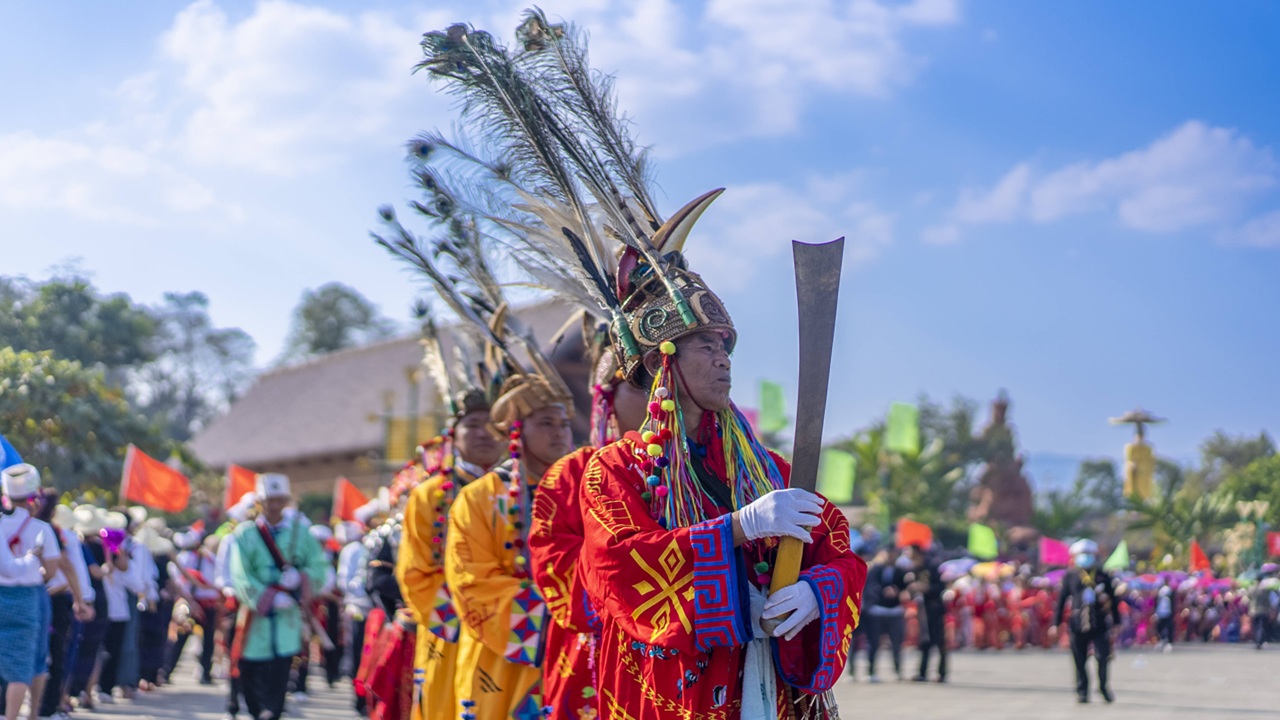
The dance is led by four ceremonial leaders called Naoshuang (瑙双). These leaders are not ordinary dancers — they are traditionally ritual specialists or community elders of high standing. The Naoshuang wear distinctive ceremonial regalia: crest-like feathered headdresses, long robes made of red and green silk, silver-colored cloaks, and they each hold a long traditional sword.
The four Naoshuang are arranged in two pairs. The front pair is called the “military pair,” and the rear pair is called the “civil pair.” Together, they lead the massive procession in spiraling, serpentine patterns that trace the designs painted on the Munao Poles.
The Dancers
Behind the Naoshuang, thousands of dancers fall into formation. The men carry long swords, spears, or bows and arrows, performing movements that demonstrate courage and physical skill. The women hold fans or handkerchiefs, dancing with graceful, flowing movements that make their elaborate silver ornaments jingle and flash in the sunlight.
There is no strict limit on who can join. Anyone — Jingpo or not — is welcome to enter the dance at any time while it is ongoing. This open spirit is one of the things that makes the Munao Zongge so beloved among visitors. You do not need an invitation or special skill. You simply step into the line, follow the beat of the drums, and become part of something much larger than yourself.
The Music
The musical accompaniment is powerful and primal. Wooden drums (木鼓) provide the deep, pounding heartbeat of the dance. Bronze gongs crash at intervals. Bamboo flutes and traditional pipe instruments weave melody through the percussive foundation. The rhythm is steady, insistent, and almost hypnotic — it pulls you in and carries you forward.
At the height of the celebration, with tens of thousands of people moving in synchronized patterns across the vast dance square, the visual and auditory effect is overwhelming. As one observer noted, it may well be the most spectacular mass dance in the world.
Traditional Jingpo Costumes: Silver Ornaments and Handwoven Textiles
One of the most visually striking aspects of the Munao Zongge Festival is the traditional dress worn by the Jingpo people. The costumes are elaborate, colorful, and loaded with cultural significance — especially the women’s attire.
Women’s Festival Dress
Jingpo women typically wear black blouses with a vertical front placket, paired with barrel-shaped skirts in deep red and black that fall to the shin. But during the festival, the outfit is elevated to spectacular heights with the addition of silver ornaments.
For grand occasions like the Munao Zongge, a Jingpo woman’s costume may include:
- Silver plates attached to the front, back, and shoulders of her blouse
- Six or seven silver neck rings stacked around the throat
- Long silver earrings that extend well past the earlobe
- Engraved silver bracelets, usually one or two pairs
- A chain of silver bells that jingles with every step and turn
The more silver a woman wears, the more she is considered to be skilled and prosperous. When hundreds of women dance together, the combined effect of the sunlight catching thousands of silver ornaments is genuinely dazzling.
Some women also wear painted rattan rings around the waist — the more rings, the more beautiful the wearer is considered. This is a distinctive Jingpo aesthetic tradition that you will not find among any other ethnic group in China.
Men’s Festival Dress
Jingpo men dress in dark tunics and trousers, often accented with a brightly colored turban or headwrap. They carry traditional long swords (长刀) in decorated scabbards — the sword is both a ceremonial object and a symbol of Jingpo manhood. During the dance, men demonstrate their skill with these blades, performing practiced movements that echo their ancestors’ traditions of hunting and warfare.
The Art of Jingpo Textile Craft
Behind the finished costumes lies a tradition of handweaving and embroidery that is itself recognized as intangible cultural heritage. Jingpo women learn textile skills from childhood. The fabric for traditional garments is typically woven on backstrap looms using cotton threads dyed with natural pigments. Geometric patterns inspired by nature — mountains, rivers, ferns, seeds — are woven directly into the cloth.
The Famous Jingpo Green Leaf Banquet: A Feast Without Plates or Chopsticks
No festival experience is complete without food, and the Munao Zongge features one of the most distinctive and memorable dining traditions in all of China: the Green Leaf Banquet (绿叶宴).
What Is a Green Leaf Banquet?
The Green Leaf Banquet is a traditional Jingpo feast in which all food is served on fresh leaves — with no plates, no bowls, and no chopsticks. Diners wear disposable gloves and eat entirely with their hands. Drinks are served in cups made from freshly cut bamboo.
The concept sounds simple, but the execution is anything but. A full Green Leaf Banquet typically features seven to nine dishes, each individually wrapped in large green leaves — usually banana leaves or palm leaves. The wrapped parcels are then arranged on a larger leaf that serves as a communal platter.
Signature Dishes of Jingpo Cuisine
Jingpo cooking is characterized by bold, spicy flavors with an emphasis on freshness and wild ingredients. Many of the ingredients come directly from the surrounding mountains and forests. Here are some dishes you might encounter at a Green Leaf Banquet:
| Dish | Description |
|---|---|
| Pestled Dish (舂菜) | Fresh ingredients pounded in a wooden mortar — the most iconic Jingpo dish |
| “Ghost Chicken” (鬼鸡) | Shredded chicken marinated with lemon juice, chili, and cardamom |
| Bamboo Tube Rice (竹筒饭) | Glutinous rice steamed inside a fresh bamboo tube |
| Roasted Beef | Beef slow-roasted and then hammered tender with a wooden mallet |
| Grilled Fish | River fish grilled in banana leaf wrapping |
| Wild Mountain Vegetables | Seasonal greens foraged from the surrounding hills |
The pestled dish deserves special mention. The Jingpo have a saying: “If the pestle does not sound, you will not have a good meal.” Almost every Jingpo household owns a wooden mortar and pestle, and almost every meal features some variation of freshly pounded ingredients. The technique of pestling releases flavors and textures that ordinary chopping cannot achieve.
The Cultural Meaning Behind the Green Leaves
The Green Leaf Banquet is more than a quirky dining format. It reflects the Jingpo people’s deep relationship with the natural environment. As one local Jingpo man explained in an interview, the tradition originated from practical necessity: leaf-wrapped food was easy to prepare and convenient to carry for farm work or hunting trips. But it has also become a statement of ecological living — a reminder that the best things in life come directly from the land.
During the Munao Zongge Festival, large-scale Green Leaf Banquets are organized as communal events. Long rows of bamboo tables are set up under the canopy of ancient banyan trees. The ground is covered with fresh pine needles, filling the air with a clean, resinous scent. Hundreds of people sit down together to eat with their hands, laughing and talking over shared food — an experience that creates an immediate sense of community and belonging.
Dehong Prefecture Travel Guide: How to Get to the Munao Zongge Festival
Getting to the Munao Zongge Festival requires some planning, as Dehong is located in one of the most remote corners of Yunnan Province. But the journey itself is part of the adventure — the route passes through some of the most beautiful scenery in southwestern China.
Flying to Dehong
The most convenient option for long-distance travelers is to fly into Dehong Mangshi Airport (IATA: LUM). This regional airport is located approximately 6.5 kilometers from downtown Mangshi, the capital of Dehong Prefecture.
Key flight routes to Dehong Mangshi Airport:
| Departure City | Approximate Flight Time | Major Airlines |
|---|---|---|
| Kunming | ~1 hour 15 minutes | China Eastern, Ruili Airlines, Lucky Air |
| Chengdu | ~2 hours | Sichuan Airlines, China Eastern |
| Beijing | ~3 hours 50 minutes | China Eastern |
| Guangzhou | ~3 hours | China Southern |
| Shanghai | ~3 hours 30 minutes | China Eastern |
Kunming is the most common gateway, with well over 100 weekly flights connecting the two cities. From the airport, a taxi to downtown Mangshi takes about 15–20 minutes and costs roughly 30–50 yuan.
Getting from Mangshi to Longchuan
From Mangshi, the main festival venue in Longchuan County is approximately 100 kilometers to the southwest. You have several options:
- Intercity bus: Regular buses depart from Mangshi’s central bus station to Longchuan. The journey takes approximately 1.5–2 hours and costs around 30–50 yuan.
- Private car or taxi: A hired car offers more flexibility, especially during the festival when bus schedules may be crowded.
- Self-driving: The roads between Mangshi and Longchuan are well-maintained. The route passes through lush tropical countryside with scenic stops along the way.
Longchuan County also has its own small airport, Guangsong Airport (IATA: LCS), which operates limited flights to Mangshi and Tengchong on small turboprop aircraft. However, most travelers will find it easier to fly into Mangshi and drive from there.
Driving from Kunming
For travelers who enjoy road trips, the drive from Kunming to Mangshi covers approximately 530 kilometers along the G56 Hangrui Expressway. The journey takes 8–9 hours and passes through dramatic mountain scenery. This route is well-suited for travelers who plan to explore multiple destinations in western Yunnan.
Best Things to Do During the Munao Zongge Festival in Dehong
The Munao Zongge Festival is not just about the grand dance. The multi-day celebration is packed with activities that offer visitors a deep and varied experience of Jingpo culture and the broader Dehong region.
1. Join the Grand Dance
This is the main event. Head to the central Munao square in Longchuan and join the dancing. Remember: everyone is welcome. Follow the beat of the drums, fall into the spiraling line behind the Naoshuang leaders, and let the rhythm carry you. You do not need to know the steps in advance — the person in front of you is your teacher.
2. Attend the Opening Sacrificial Ceremony
Before the dancing begins, a traditional sacrificial ceremony is held to honor the spirits and pray for a prosperous year. This ritual includes offerings, chanting by Jingpo priests (called Dumsa), and the ceremonial crowning of the Naoshuang dance leaders. The ceremony offers a rare glimpse into the spiritual traditions of the Jingpo people.
3. Experience the Green Leaf Banquet
As described above, the communal Green Leaf Banquet is a highlight. Arrive hungry and open-minded. Eating with your hands while sitting under banyan trees alongside hundreds of Jingpo families is one of those travel experiences you will never forget.
4. Watch Traditional Performances
Throughout the festival, stages are set up for performances of traditional music, sword dances, and the Yinpao Dance, a graceful women’s dance that showcases the beauty of Jingpo silver costumes. You can also hear traditional songs that express the Jingpo people’s respect for mountains, rivers, and the natural world.
5. Visit the Jingpo Ethnic Park
The Jingpo Ethnic Park in Guangshan Village, near Zhangfeng Town in Longchuan County, is a large cultural tourism park covering 228.5 hectares. Here you can explore traditional Jingpo-style wooden houses and bamboo stilt dwellings. Watch artisans craft embroidery, silver jewelry, and intricate wood carvings. The park is an excellent complement to the festival experience.
6. Explore the Border Town of Ruili
About 100 kilometers from Longchuan, the bustling border city of Ruili is well worth a day trip. Ruili is famous for its jade and gemstone markets, its unique “One Village, Two Countries” border park, and its blend of Chinese and Burmese culture. The Jiele Grand Golden Pagoda and Menghuan Golden Pagoda are two of the most striking Buddhist monuments in all of Yunnan.
7. Try the Local Specialties
Beyond the Green Leaf Banquet, Dehong’s food scene is rich and varied. Sample Dai-style sour and fresh dishes, try the local Paoluda dessert drink (a Burmese-influenced cold drink with milk, bread, shaved coconut, and jelly), or taste the region’s excellent Zhefang rice, a premium grain once served as tribute to the imperial court.
Cultural Etiquette: How to Respectfully Experience the Munao Zongge Festival
Attending an ethnic minority festival comes with a responsibility to be a respectful and thoughtful guest. The Jingpo people are known for their warmth and hospitality, and a little cultural awareness on your part will make the experience richer for everyone.
Do’s
- Accept invitations to dance. Refusing an invitation to join the Munao dance may be seen as unfriendly. Even if you feel awkward, step in and try.
- Accept food and drink graciously. If a Jingpo family offers you rice wine (米酒) or food, it is polite to accept. The traditional rice wine is a fermented beverage that is a staple of Jingpo hospitality.
- Ask before photographing individuals. Most people are happy to be photographed during the festival, but it is always respectful to ask first — especially when photographing elders, priests, or ritual ceremonies.
- Dress modestly and comfortably. You do not need to wear traditional Jingpo clothing, but modest, practical clothing shows respect.
Don’ts
- Do not touch or climb on the Munao Poles. These are sacred objects. Treat them with the same reverence you would give to a church altar or temple shrine.
- Do not mock or parody the dance or costumes. The Munao Zongge is a living cultural practice, not a performance staged for tourists. Participate sincerely.
- Do not litter. The Jingpo have a deep connection to their natural environment. Keep the festival grounds clean.
The Role of Munao Zongge in Preserving Jingpo Intangible Cultural Heritage
The Munao Zongge Festival is far more than entertainment. It is a living archive of Jingpo history, values, and identity. In an era of rapid modernization, the festival plays a critical role in cultural preservation.
A National Heritage Treasure
The festival’s designation as a National Intangible Cultural Heritage in 2006 was a landmark moment. It brought government support for documentation, education, and promotion. Local governments in Dehong have invested in building dedicated Munao celebration grounds and in training young Jingpo people in the traditional dance forms, music, and ritual practices.
Named inheritors of the Munao Zongge tradition, such as Shang Deguang (a provincial-level inheritor), play a vital role in keeping the knowledge alive. These cultural custodians serve as living links between the past and the future, teaching young people the 12 types of Munao Zongge and the meaning behind every symbol on the sacred poles.
A Bridge Across Borders
The festival also serves as a bridge between the Jingpo people of China and the Kachin people of Myanmar. Because Dehong shares such a long border with Myanmar, the Munao Zongge has become an occasion for cross-border cultural exchange. Kachin singers, dancers, and families from Myanmar regularly participate, strengthening kinship ties that predate modern national borders.
Challenges and Hope
Like many indigenous traditions around the world, the Munao Zongge faces challenges. Young Jingpo people are increasingly drawn to cities for education and employment. The detailed knowledge required to lead a Munao ceremony — the 12 dance types, the pole symbolism, the sacrificial rituals — takes years to master and is at risk of being lost.
But there is also reason for optimism. The growing popularity of the festival with domestic and international tourists brings economic incentives to preserve the tradition. Social media allows young Jingpo people to share their culture with a global audience. And the pride that the Jingpo community takes in the Munao Zongge remains a powerful force for continuity.
As Xu Liehong, a young Jingpo man, told CGTN: he hopes their culture and traditions can be preserved and passed on to future generations.
Other Nearby Attractions to Explore During Your Trip to Dehong
If you are traveling to Dehong for the Munao Zongge Festival, consider extending your stay to explore more of this fascinating region. Dehong is one of the most culturally rich and scenically beautiful prefectures in Yunnan.
Ruili: The Jade Capital of China’s Southwest
The border city of Ruili is famous for its jade and gemstone trade. Dehong sits at the intersection of two major gem belts and has centuries of history in the jewelry trade with Myanmar. The streets of Ruili are lined with jade shops, and the Jiegao Border Trade Zone is a fascinating place to browse for gems, handicrafts, and Burmese goods.
Yunyan Buddhist Pagoda
Located on Yunyan Mountain near Yingjiang County, this pagoda complex is built in the Burmese style and consists of a main pagoda and 40 smaller ones. It is a national historical site and a beautiful example of the fusion of Buddhist culture and Dai architecture.
Menghuan Grand Golden Pagoda
Perched atop Leiyarang Mountain beside Kongque (Peacock) Lake, the Menghuan Grand Golden Pagoda is one of the most photographed landmarks in Dehong. The golden spire rises above lush tropical forest, creating a scene of peaceful grandeur.
“One Village, Two Countries” Border Park
In the Ruili area, the famous “One Village, Two Countries” scenic spot straddles the China-Myanmar border. Here, Chinese and Burmese families live side by side, sharing a well, a road, and daily life. You can even sit on a swing that arcs from China into Myanmar and back.
Dadenghan Dai Village
For a deeper experience of Dai culture — the other major ethnic group of Dehong — visit Dadenghan, a traditional Dai village with well-preserved stilted wooden houses, Buddhist temples, and a tranquil rural atmosphere.
Practical Tips for Visiting the Munao Zongge Festival in 2026
Here are some essential tips to help you plan a smooth and enjoyable trip to the Munao Zongge Festival.
When to Go
Aim to arrive in Longchuan 1–2 days before the festival officially begins. This gives you time to settle in, explore the town, and attend the preparatory ceremonies. The main dance events typically run for three to four days.
Where to Stay
Accommodation options in Longchuan County are limited compared to larger cities. Book early — rooms fill up fast during the festival. Mangshi, the prefecture capital, offers a wider range of hotels and guesthouses and is a reasonable base from which to make day trips to the festival.
What to Pack
| Item | Why You Need It |
|---|---|
| Comfortable walking shoes | You will be on your feet all day |
| Sunscreen and hat | The Dehong sun is strong, even in February/March |
| Light rain jacket | Subtropical weather can produce sudden showers |
| Camera with extra battery | You will take thousands of photos |
| Cash (Chinese yuan) | Small vendors and rural areas may not accept mobile payment |
| Open mind and appetite | For the Green Leaf Banquet |
Weather
Dehong has a subtropical monsoon climate. During the festival period (February–March), daytime temperatures typically range from 20°C to 25°C (68°F to 77°F), with cooler evenings. Rain is possible but not frequent at this time of year. The weather is generally comfortable and pleasant for outdoor activities.
Language
Mandarin Chinese is widely spoken throughout Dehong. The Jingpo people speak their own language (part of the Tibetan-Myanmese language family), but most Jingpo people in urban areas and tourist-facing roles also speak Mandarin. English is rarely spoken outside of hotel front desks, so a translation app on your phone is highly recommended.
Why the Munao Zongge Festival Should Be on Every Traveler’s Bucket List
In a world increasingly dominated by homogenized tourist experiences, the Munao Zongge Festival stands apart. It is authentic. It is massive in scale. And it is deeply meaningful to the people who celebrate it.
This is not a festival that has been manufactured for tourism. The Jingpo people have been dancing the Munao for centuries — long before any tourist ever set foot in Dehong. When you join the spiraling lines of dancers, you are participating in a living tradition that connects the present to a mythical past when birds first brought the dance from the palace of the Sun.
You will eat food wrapped in leaves, with your bare hands. You will hear drums that make your chest vibrate. You will see silver costumes that blind you with reflected sunlight. And you will be welcomed into the celebration by a people who are genuinely glad you came.
The Munao Zongge Festival is proof that the world still has secrets worth discovering — places where ancient traditions are not just preserved but truly alive, where culture is not a museum exhibit but a beating heart. For any traveler who cares about authentic cultural experiences, Dehong’s greatest festival deserves a place at the very top of the list.
Frequently Asked Questions About the Munao Zongge Festival
Is the Munao Zongge Festival open to foreign tourists? Yes. The festival is open to all visitors, both domestic and international. There is no entry fee for the main dance event, though some organized Green Leaf Banquets and cultural performances may require tickets.
Do I need a visa to visit Dehong, Yunnan? International visitors need a valid Chinese visa to enter Yunnan Province. There is no special permit required for Dehong Prefecture itself, unlike some other border regions in China. Check current visa policies before traveling.
Can I participate in the dance even if I am not Jingpo? Absolutely. One of the most beautiful aspects of the Munao Zongge is its openness. People from all ethnic backgrounds and nationalities are warmly invited to join the dance at any time.
What is the best way to combine this festival with a larger Yunnan trip? Many travelers combine a trip to Dehong with visits to Tengchong (famous for hot springs and volcanoes), Ruili (jade markets and border culture), and Baoshan (ancient Silk Road history). For a broader Yunnan itinerary, you can connect through Kunming to destinations like Dali, Lijiang, and Shangri-La.
Is Dehong safe for solo travelers? Yes. Dehong is generally safe and welcoming. The border region has its own unique character, but crime rates are low and the local people are known for their hospitality. Use common sense as you would anywhere, and you will have a wonderful time.
The Munao Zongge Festival is a reminder that the most powerful human experiences are often the simplest: moving together, eating together, celebrating together. In the mountains of Dehong, where the Jingpo people have danced for centuries, that simple truth echoes louder than any drum.