If you have ever stood in the middle of a public square in western Yunnan while tens of thousands of people moved in unison to the thunder of cowhide drums, you already know there is nothing else on Earth quite like the Munao Zongge Festival. If you have not, consider this your invitation.
Munao Zongge — literally “dancing together” in the Jingpo language — is the grandest annual celebration of the Jingpo ethnic group, one of China’s 56 officially recognized nationalities. Every year around the fifteenth day of the first lunar month, villages across Dehong Dai and Jingpo Autonomous Prefecture in southwest China’s Yunnan Province erupt in color, rhythm, and communal joy. The 2026 celebration falls on March 3–4, aligning closely with the Chinese Lantern Festival season.
But this festival is far more than a dance party. It is a living archive — a vibrant mechanism through which the Jingpo people pass on their migration stories, spiritual beliefs, musical traditions, textile arts, and culinary heritage to the next generation. Since 2006, when China’s State Council inscribed it on the National Intangible Cultural Heritage list, Munao Zongge has gained recognition as one of the most culturally significant ethnic festivals in all of China.
This article explores every aspect of the Munao Zongge Festival, from its legendary origins to its role in heritage preservation, its dances and rituals, its food and fashion, and practical advice for travelers who want to witness it firsthand.
What Is the Munao Zongge Festival and Why Is It Important for the Jingpo People?
The Munao Zongge Festival is the most sacred and largest traditional gathering of the Jingpo people. The name comes from the Jingpo and Zaiwa languages. “Munao” refers to a large-scale group event, and “Zongge” means singing and dancing. Together, the phrase is often translated as “mass dance” or “everyone dances together.”
In older times, Jingpo communities held Munao Zongge gatherings before marching into battle, upon returning victorious, and during bumper harvests. The event served as a spiritual petition — a way of asking the sun god, ancestor spirits, and nature deities for protection, prosperity, and good weather. Over the centuries, the festival grew into a comprehensive showcase of Jingpo identity, weaving together elements of:
- Ritual dance and music — the core of the festival
- Oral storytelling — through song lyrics and chants
- Religious ceremony — animal sacrifice and spirit worship
- Costume and textile art — silver jewelry, brocade weaving, and tubular skirts
- Food culture — the famous green-leaf banquet and rice wine
- Social bonding — courtship, reconciliation, and inter-village fellowship
The Jingpo people number roughly 147,828 in China according to the 2020 Chinese census. Most live in Dehong Prefecture. They are a relatively small ethnic group, which makes active cultural preservation all the more urgent.
The Ancient Origin Story Behind Munao Zongge: How a Mythical Hero Inspired the Dance
Every great festival carries a founding story. The origin myth of Munao Zongge is rooted in Jingpo animist belief and the people’s deep reverence for the sun god.
According to legend, a terrible demon once terrorized Jingpo villages, devouring children and destroying crops. A courageous leader named Leipan stepped forward to rally his people. He led them away from danger and, with the blessing and guidance of the sun god, ultimately defeated the demon. In celebration of this deliverance, the Jingpo people held a great gathering of singing and dancing — the first Munao Zongge.
But there is a second, equally beloved story. In this version, the birds of the sky were the first to perform the Munao dance. They had discovered a bountiful land and celebrated their good fortune with a spectacular display of synchronized movement. Their commotion drew the attention of nearby humans. Watching from behind the trees, the Jingpo ancestors learned the steps. From that day forward, they replicated the birds’ dance in their own celebrations.
Both myths share a common theme: collective triumph over adversity, expressed through movement and music. The dance is not entertainment alone. It is a reenactment of survival, gratitude, and unity.
Where Does the Jingpo Munao Zongge Festival Take Place? Key Locations in Dehong Prefecture
The Munao Zongge Festival unfolds across the entire Dehong Dai and Jingpo Autonomous Prefecture, but certain locations host the largest and most well-known celebrations.
Dehong Prefecture at a Glance
| Detail | Information |
|---|---|
| Province | Yunnan, southwest China |
| Prefecture capital | Mangshi (芒市) |
| Location | Westernmost prefecture of Yunnan, bordering Myanmar |
| Border length with Myanmar | Approximately 500 km |
| Elevation | 800–2,000 m above sea level |
| Primary ethnic groups | Dai, Jingpo, Achang, Lisu, De’ang |
| Climate | Subtropical monsoon; warm and humid |
Top Festival Venues
1. Longchuan County (陇川县)
Longchuan County is considered the most representative and complete area for Munao Zongge celebrations. It has the largest Jingpo population in Dehong and the most standardized inheritance of the dance tradition. The county’s main Munao square features towering ceremonial poles, spacious dance grounds, and facilities that accommodate tens of thousands of participants.
2. Mangshi (芒市)
As the prefectural capital, Mangshi stages a grand, government-supported version of the festival that typically runs for four to five days. The celebrations here draw tourists from across China and abroad. Events include machete competitions, sporting events, trade fairs, and cultural performances alongside the traditional mass dance.
3. Ruili (瑞丽)
Located directly on the China–Myanmar border, Ruili’s celebrations are distinctive because they attract Jingpo people from Myanmar — known there as Kachin — who cross the border to join. This cross-border participation underscores the transnational character of the Jingpo/Kachin people.
4. Yingjiang County (盈江县)
Smaller but deeply authentic, Yingjiang’s festival activities offer a more intimate experience for travelers seeking a less commercialized atmosphere.
How the Munao Zongge Dance Works: Understanding the Sacred Choreography and Rituals
The heart of the Munao Zongge Festival is its mass dance. Often called the “Dance of Ten Thousand People” (万人舞) by Chinese media, the largest performances can involve anywhere from several thousand to over ten thousand dancers at once.
The Munao Poles: Sacred Pillars That Guide the Dance
At the center of every Munao Zongge dance ground stand four tall wooden poles called Munao Shidong (目瑙示栋). These are not simple decorations. They are sacred objects that serve two purposes: they symbolize the cosmology of the Jingpo world, and they instruct the winding dance line.
Each pole is painted with symbolic patterns. These patterns carry deep cultural meaning:
| Symbol | Meaning |
|---|---|
| Fern sprouts | Unity and progress (sprouts look like fists; leaves resemble arrows) |
| Swords | Bravery and fortitude |
| The Himalayas | The ancestral homeland of the Jingpo people |
| Crops and livestock | Hope for a bright future and prosperity |
| Gongs and instruments | Good fortune and blessings |
The spiral and zigzag patterns painted on the poles map out the path of the dance — a visual language that experienced dancers can “read” to navigate the formation correctly.
The Naoshuang: Leading Dancers Who Set the Path
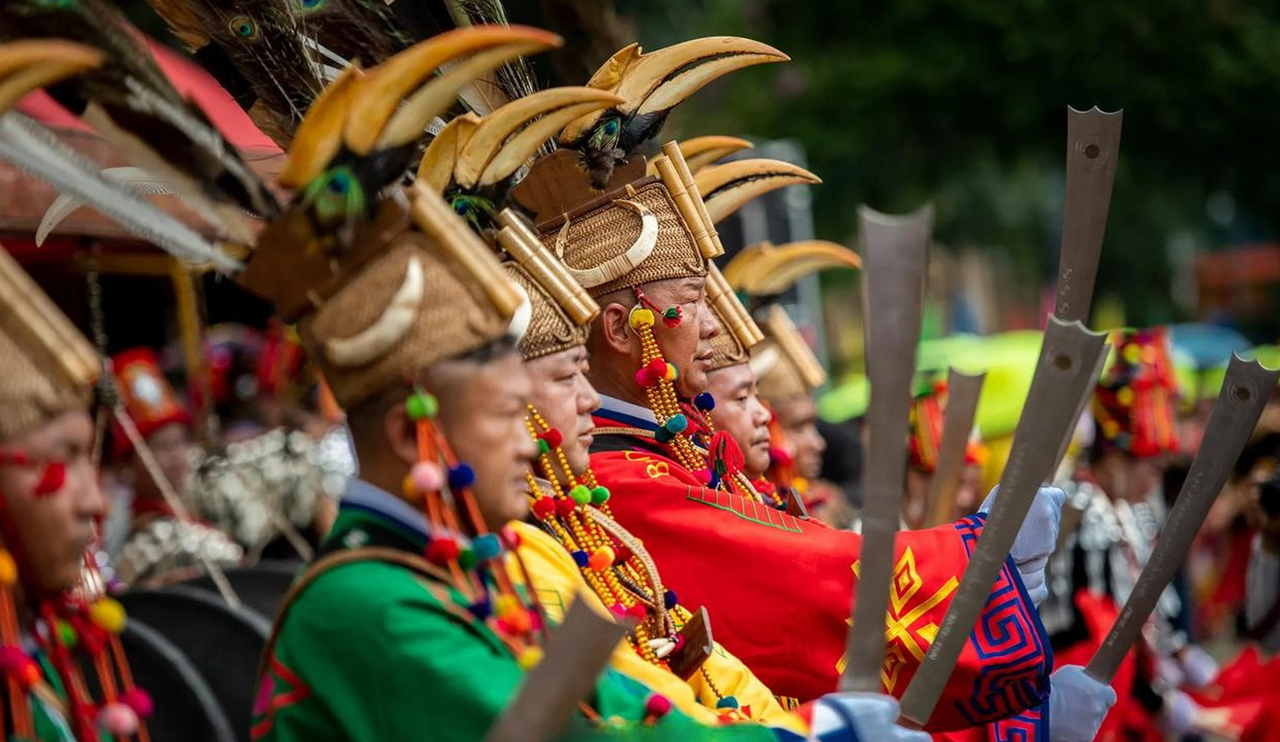
The dance is led by four ceremonial lead dancers called naoshuang (瑙双). These individuals are ritual specialists — traditionally shamans or priests — chosen for their deep knowledge of Jingpo tradition. Their attire is extraordinary:
- Crest-shaped feathered caps rising above the head
- Red and green silk robes resembling imperial garments
- Silver-colored cloaks that shimmer in the sunlight
- Long ceremonial swords held aloft as they lead the procession
The four naoshuang divide into two pairs. The two at the front of the dance column are called the “military pair”. The two at the rear are the “civil pair.” Together, they guide the snaking column of dancers around and around the Munao poles, tracing the symbolic migration route of the Jingpo people.
The Dance Formation
Behind the naoshuang, dancers form two winding columns. Men carry long knives, spears, or bows and arrows, executing movements that demonstrate physical strength and hunting skill. Women hold fans or handkerchiefs, their silver ornaments jingling with every step. The columns wind around the four poles in a pattern said to represent the Jingpo people’s ancient migration — their long journey from the Tibetan Plateau southward into the mountains of western Yunnan.
The dance is accompanied by large cowhide drums (often beaten by several drummers simultaneously) and traditional wind instruments. The rhythm is steady, powerful, and insistent. Once the dance begins, anyone — regardless of ethnicity, age, or nationality — can join the column at any point. This openness is one of the most beautiful aspects of the festival.
Twelve Types of Munao Zongge
Few outsiders realize that there are actually twelve distinct types of Munao Zongge, each performed for a different occasion. Here are the most notable:
| Type | Jingpo Name | Occasion |
|---|---|---|
| Harvest Celebration | Su Munao (苏目瑙) | Celebrating a good harvest |
| Victory Celebration | Ba Dang Munao (巴当木脑) | Returning from a successful battle |
| New Home Celebration | Dingshuan Munao (定栓目瑙) | Completing a new residence |
| War Vows | Deru Munao (德如目瑙) | Before going to war |
| Welcoming Guests | Kelong Munao (克龙目瑙) | Honoring important visitors |
| Marriage Celebration | Kenran Munao (肯然目瑙) | Wedding festivities |
| Friendship | Tingran Munao (亭然目瑙) | Making new friends |
| Recreation | Naosai Munao (瑙赛目瑙) | Leisure and entertainment |
| Funeral Rites | Zhu Munao (朱目瑙) | Memorial and sacrificial dance |
The version performed during the annual festival is typically the Su Munao or a general celebratory form that incorporates elements from several types.
What Do Jingpo People Wear During the Munao Zongge Festival? Traditional Costume and Silver Jewelry
One of the most visually striking aspects of the Munao Zongge Festival is the traditional Jingpo costume. The clothing is not merely decorative. It encodes history, identity, social status, and artistic achievement.
Women’s Festival Costume
Jingpo women’s festival attire is a masterpiece of textile and metalwork:
- Black velvet blouse with a vertical front opening, adorned with dozens of large silver bubbles (银泡) stitched to the chest, back, and shoulders
- Colorful woolen tubular skirt (筒裙), typically in striking combinations of red, black, and geometric patterns woven on a backstrap loom — a skill called Jingpo brocade weaving
- Seven silver neck rings, layered in graduated sizes
- A chain of silver bells or a heavy silver necklace
- Long silver earrings that extend past the jawline
- Carved silver bracelets, usually one or two pairs
- A red jacquard headscarf made of wool
According to Yunnan Provincial Museum’s documentation, the more silver accessories a Jingpo woman wears on a grand occasion, the more capable and prosperous she is considered. Some women also wear painted rattan circles around their waists — the more circles, the more beautiful the wearer is deemed to be.
When thousands of women dance together in this attire, the sound of jingling silver creates its own layer of percussive music, blending with the drums and flutes.
Men’s Festival Costume
Jingpo men dress in a more restrained but no less meaningful style:
- Black or white turban (white for younger men, black for elders)
- Black or dark blue high-collared jacket
- Short black trousers
- A tongpa — a woven shoulder bag
- A long ceremonial knife (长刀) carried at the waist or in hand
The knife is not a weapon in the festival context. It is a cultural symbol reflecting the Jingpo people’s highland heritage and their historical dependence on the forest. During the dance, men brandish their knives and perform machete dances that display dexterity and courage.
How the Munao Zongge Festival Preserves Jingpo Intangible Cultural Heritage
The Munao Zongge Festival is not a museum exhibit. It is a living, breathing cultural ecosystem that transmits knowledge from one generation to the next through direct participation. Here is how the festival preserves specific categories of intangible heritage.
1. Oral History and the Munao Zaiwa Epic
The Jingpo people possess a magnificent creation epic called Munao Zaiwa (目瑙斋瓦). This narrative poem, passed down orally through generations, tells the story of the origin of the world, the birth of the Jingpo people, and their long migration from the highlands of the Tibetan Plateau. It has been inscribed as a separate National Intangible Cultural Heritage item by China’s government.
During the Munao Zongge Festival, excerpts from the Munao Zaiwa are recited and sung by ritual specialists. Younger community members hear these stories in their original Jingpo language, reinforcing linguistic and narrative traditions that might otherwise fade in an era of smartphones and Mandarin-language education.
2. Traditional Music and Instrument Skills
The festival keeps alive a range of Jingpo musical traditions:
- Cowhide drum playing — the backbone of the Munao rhythm
- Bamboo flute performance — including the cucurbit flute (hulusi), shared with other Dehong ethnic groups
- Call-and-response singing — a traditional vocal style used during the dance
- Gong and cymbal techniques — essential to the ceremonial soundscape
These instruments and techniques are learned through apprenticeship, and the festival provides the primary public occasion for their display and practice.
3. Dance Knowledge and Choreographic Memory
With twelve distinct types of Munao Zongge, the dance tradition represents a vast choreographic archive. Each type requires different steps, different formation patterns, and different symbolic meanings. The naoshuang leaders must commit this knowledge to memory. The festival ensures that these choreographic patterns are practiced publicly at least once a year, preventing the loss of movement vocabulary.
4. Textile Arts and Brocade Weaving
The preparation of festival costumes — especially the Jingpo brocade tubular skirt — requires months of skilled handiwork. Patterns woven into the fabric encode clan identity, marital status, and regional origin. The festival creates market demand for these traditional textiles. Without the festival, the economic incentive to maintain brocade weaving skills would diminish significantly.
Shi Mading, recognized as a representative inheritor of Jingpo textile craft in Longchuan County, is one of several artisans working to ensure these weaving skills survive.
5. Ritual and Spiritual Knowledge
The sacrificial ceremonies that open the festival — involving animal offerings, spirit invocations, and the consecration of the Munao poles — preserve the Jingpo people’s animist belief system. While many Jingpo today also practice Christianity or Buddhism, the festival’s ritual dimension keeps the older spiritual traditions visible and respected.
6. The Inheritor System
China’s intangible heritage framework includes a formal inheritor system (传承人制度) that designates individuals as official bearers of specific cultural traditions. For the Munao Zongge Festival, several key inheritors have been recognized:
- He Weimin — representative inheritor for the Munao Zongge Festival project in Luxi City, Dehong
- Yue Matong — representative inheritor in Longchuan County
- Le Paidang — priest of Jingpo sacrificial activities in Longchuan County
These inheritors receive government support and are tasked with training younger practitioners, documenting traditional knowledge, and organizing authentic festival activities.
Jingpo Green-Leaf Banquet: The Traditional Feast That Defines Munao Zongge Food Culture
No discussion of the Munao Zongge Festival is complete without its food. The green-leaf banquet (绿叶宴) is one of the most distinctive and ancient culinary traditions of the Jingpo people, and it takes center stage during the festival.
What Is the Green-Leaf Banquet?
The green-leaf banquet is exactly what it sounds like: a feast served entirely on fresh green leaves. Banana leaves, palm leaves, and other broad local foliage serve as both plates and tablecloths. Leaves are even folded into small cups and spoons for soup. No chopsticks. No ceramic bowls. You eat with your hands.
Historical records from the Yuan and Ming dynasties (roughly 1271–1644) describe the Jingpo dietary custom of eating without utensils, using banana leaves to wrap food. This practice has survived continuously into the present day.
Signature Dishes of the Jingpo Green-Leaf Banquet
| Dish | Description |
|---|---|
| Bamboo-tube rice (竹筒饭) | Fresh rice stuffed into a green bamboo tube and roasted over charcoal until the tube turns golden brown. The rice absorbs a sweet, smoky bamboo fragrance. |
| Jingpo ghost chicken (鬼鸡) | Despite its ominous name, this is a refreshing cold dish: shredded chicken mixed with lemon juice, chilies, cardamom, and fresh herbs. |
| Wrapped and roasted beef | Beef seasoned with local spices, wrapped tightly in banana leaves, and slow-cooked over charcoal. The leaves impart a subtle aroma. |
| Bamboo-tube pounded dish (舂菜) | Roasted meat, bamboo shoots, and wild herbs are pounded together in a bamboo mortar — fragrant but slightly bitter. |
| Fermented fish and sour pickles | Preserved condiments that showcase the Jingpo talent for fermentation and pickling. |
| Jingpo rice wine | A mild, slightly sweet fermented rice beverage, indispensable at any gathering. |
The “Peacock Banquet” (孔雀宴) is a more modern, tourism-oriented presentation of Dehong’s multi-ethnic cuisine. Dishes from the Dai, Jingpo, Achang, and De’ang traditions are arranged on banana leaves in the shape of a peacock’s fanned tail. It has become a popular draw for visitors.
Food as Heritage
The green-leaf banquet is more than a meal. It is a living demonstration of Jingpo ecological knowledge — which wild plants are edible, which have medicinal properties, which leaves make the best wrappers. As younger Jingpo move to cities, the festival is often the primary occasion when they learn or re-engage with these food traditions.
The Jingpo People: A Transnational Ethnic Group Spanning China, Myanmar, and India
Understanding the Munao Zongge Festival requires understanding the Jingpo people themselves — a group whose cultural identity spans three countries.
Origins and Migration
The Jingpo trace their ancestry to the ancient Di and Qiang peoples of the Qinghai-Tibet Plateau. Over many centuries, they migrated southward through the mountains of what is now western Yunnan. By the start of the sixteenth century, they had settled in the area around present-day Dehong Prefecture. From there, branches of the group continued south into northern Myanmar.
A People of Many Names
| Country | Name Used | Estimated Population |
|---|---|---|
| China | Jingpo (景颇族) | ~147,828 (2020 census) |
| Myanmar | Kachin | ~630,000+ |
| India (Assam) | Singpho | Several thousand |
The Jingpo in China are divided into five subgroups: Jingpo, Zaiwa (the largest subgroup by population), Leqi, Lang’e, and Bola. Each speaks a distinct dialect, though Jingpo serves as a shared lingua franca.
Cross-Border Cultural Exchange at Munao Zongge
One of the most moving aspects of the festival is the participation of Kachin people from Myanmar. Dehong Prefecture shares a border with Myanmar stretching some 500 kilometers. During the festival, Kachin singers, dancers, and ordinary families cross the border to join.
As Myanmar-based singer Jet San Htun told CGTN during a recent festival: he had come to participate in Dehong for the third time and hoped to return again. This cross-border participation reinforces the cultural continuity of the Jingpo/Kachin people across national boundaries.
In recent years, ethnic groups from Taiwan, including the Amis people, have also been invited to join the festival as part of cultural exchange programs.
How China’s Intangible Heritage Policies Protect the Munao Zongge Festival
China has developed one of the world’s most extensive systems for identifying and protecting intangible cultural heritage. The Munao Zongge Festival sits within this framework at multiple levels.
National Intangible Cultural Heritage Listing (2006)
The festival was added to China’s first batch of National Intangible Cultural Heritage in 2006. This designation carries tangible consequences:
- Government funding for annual festival organization and infrastructure
- Official inheritor designations for key practitioners
- Documentation projects — audio, video, and textual records
- Integration into local education — schools in Dehong incorporate Jingpo cultural content
Provincial and Prefectural Protections
Yunnan Province has its own layered system of intangible heritage protection. The Dehong Dai and Jingpo Autonomous Prefecture government actively promotes the festival as both a cultural preservation mechanism and an economic development tool through tourism.
The Inheritor Hierarchy
| Level | Description |
|---|---|
| National inheritors | Designated by the State Council; receive highest level of support |
| Provincial inheritors | Designated by the Yunnan Provincial Government |
| Prefectural inheritors | Designated by the Dehong Prefecture government |
Each inheritor is expected to teach apprentices, participate in public events, and contribute to documentation efforts.
Challenges Ahead
Despite strong institutional support, the Jingpo face challenges common to many small ethnic groups:
- Youth migration to cities, where Mandarin dominates daily life
- Language shift — younger Jingpo increasingly speak Mandarin as their primary language
- Commercialization pressures — balancing tourism appeal with ritual authenticity
- Small population — at under 150,000 in China, the group has a thin margin for cultural continuity
A 2024 study published in npj Heritage Science found that among ethnic minorities in southwest China, the Jingpo ethnic group has comparatively fewer cultural heritage resources than larger groups like the Yi and Tibetan. This makes the Munao Zongge Festival even more vital — it represents one of the Jingpo people’s primary platforms for cultural visibility.
How to Travel to the Munao Zongge Festival in 2026: A Practical Guide for Visitors
Planning a trip to experience the Munao Zongge Festival requires some preparation, since Dehong Prefecture is remote by Chinese standards. Here is what you need to know.
Festival Dates for 2026
According to YunnanExplorer, the 2026 Munao Zongge Festival in Dehong falls on approximately March 3–4, 2026, around the fifteenth day of the first lunar month. Some locations, especially Mangshi, extend celebrations to four or five days.
Getting There
By Air: Dehong Mangshi Airport (LUM) receives flights from Kunming, the capital of Yunnan Province. The flight takes about one hour.
By Road from Kunming: Approximately 700 km by expressway. The drive takes 8–10 hours and passes through stunning highland scenery.
From Ruili or Longchuan: Once in Dehong, the main festival sites are well connected by local roads. Taxis, buses, and hired drivers are available.
Where to Stay
Mangshi has the widest range of hotels, from budget guesthouses to mid-range business hotels. During the festival, book well in advance — rooms fill up quickly. Longchuan has fewer but more atmospheric options closer to the authentic festival action.
What to Expect
- Crowds: Tens of thousands of people attend. Be prepared for noise, congestion, and excitement.
- Participation: You are welcome to join the dance. No invitation needed. Step into the column and follow the rhythm.
- Photography: Festival-goers are generally happy to be photographed, but ask permission for close-up portraits.
- Food: Street stalls and temporary restaurants offer Jingpo dishes, Dai cuisine, and the green-leaf banquet. Adventurous eaters will be in paradise.
- Weather: Early March in Dehong is warm and dry. Daytime temperatures average 20–28°C (68–82°F). Bring sun protection.
Respectful Behavior
- Do not touch the Munao poles — they are sacred objects.
- Respect the naoshuang — they are religious figures, not performers. Do not block their path.
- Dress modestly if visiting villages or attending sacrificial ceremonies.
- Ask before entering private homes or ritual spaces.
- Purchase local crafts directly from artisans when possible — this supports the community.
The Role of Tourism in Sustaining Jingpo Cultural Heritage in Dehong
Tourism is a double-edged sword for cultural preservation. In the case of the Munao Zongge Festival, it has been largely positive — though vigilance is needed.
Economic Benefits
Local and prefectural governments have positioned the festival as a cornerstone of Dehong’s ethnic tourism strategy. Revenue from visitors supports:
- Festival infrastructure and logistics
- Artisan livelihoods (silver workers, weavers, food vendors)
- Hospitality jobs in hotels, restaurants, and transportation
- Cultural centers and museums
The Dehong Dai and Jingpo Autonomous Prefecture government has invested in a comprehensive cultural industry encompassing jewelry, rosewood crafts, folk entertainment, and food tourism, all of which benefit from the festival’s annual spotlight.
Risks of Over-Commercialization
Some observers worry that the festival could become overly polished for tourist consumption, losing its rougher, more authentic edges. The challenge is to welcome outsiders without turning a living ritual into a staged performance.
So far, the balance has been largely maintained — partly because the Jingpo themselves insist on the ritual’s integrity, and partly because the sheer scale of the mass dance resists easy commodification. When you are in a column of ten thousand people, all stepping to the same drumbeat, it is clear that this is not a show put on for your benefit. You are a guest in something much larger.
Comparing the Munao Zongge Festival to Other Major Ethnic Festivals in Yunnan Province
Yunnan Province is home to 25 of China’s 56 ethnic groups, and its festival calendar is one of the richest in the country. Here is how the Munao Zongge Festival compares to other prominent celebrations.
| Festival | Ethnic Group | Time of Year | Key Activities | Heritage Status |
|---|---|---|---|---|
| Munao Zongge | Jingpo | Lunar New Year (Feb/Mar) | Mass dance, sacrificial rites, green-leaf banquet | National Intangible Cultural Heritage (2006) |
| Water-Splashing Festival | Dai | Mid-April (Dai New Year) | Water splashing, dragon boat races, peacock dance | National Intangible Cultural Heritage |
| Torch Festival | Yi | Lunar June 24 (Jul/Aug) | Bonfires, bullfights, wrestling, folk singing | National Intangible Cultural Heritage |
| March Fair (Sanyuejie) | Bai | Lunar March 15 (Apr/May) | Trade fair, horse racing, singing, opera | Provincial heritage item |
| Kuoshi Festival | Lisu | December/January | Crossbow shooting, singing, bonfire dancing | Provincial heritage item |
Each of these festivals plays a similar role within its community — serving as a primary vehicle for heritage transmission. What makes Munao Zongge unique is its scale of participatory dance, its deep cosmological symbolism (the Munao poles as cosmic maps), and its cross-border dimension with Myanmar’s Kachin people.
The Munao Zaiwa Creation Epic: The Narrative Backbone of Jingpo Cultural Identity
No exploration of Jingpo intangible heritage is complete without discussing the Munao Zaiwa (目瑙斋瓦), the creation epic of the Jingpo people. This monumental oral poem is recognized as a National Intangible Cultural Heritage item in its own right, separate from the festival itself.
The Munao Zaiwa narrates:
- The creation of the world — the origin of sky, earth, water, and fire
- The emergence of humankind — the birth of the Jingpo ancestors
- The great migration — the journey from the Tibetan Plateau to western Yunnan
- The social order — the establishment of clans, chiefs, and marriage rules
- The relationship with nature — how humans learned to farm, hunt, and build
Traditionally, the Munao Zaiwa was recited by priests (dumsa) during significant rituals, including Munao Zongge ceremonies. A complete recitation could take days. Today, fragments of the epic are performed at the festival, keeping the narrative alive in public memory.
The epic is particularly important because the Jingpo did not have a written script until the late nineteenth century, when missionaries developed a Latin-based alphabet. Before that, all historical and cultural knowledge was transmitted orally. The Munao Zaiwa is the longest and most comprehensive of these oral archives.
The Future of Munao Zongge: Challenges and Hopes for Jingpo Heritage Preservation
As we move through the mid-2020s, the Munao Zongge Festival faces a set of challenges that are common to indigenous cultural traditions worldwide — but also some unique opportunities.
Challenges
Language loss is perhaps the most pressing concern. As younger Jingpo grow up speaking Mandarin in school and consuming Chinese-language media, fluency in the Jingpo language — the language of the songs, chants, and epic recitations performed at the festival — is declining.
Urban migration is pulling young people away from the villages where festival traditions are strongest. A young Jingpo woman working in Kunming or Guangzhou may return for the festival once a year, but she is unlikely to learn the brocade weaving skills or the intricacies of the naoshuang choreography.
Population size creates a narrow base for cultural continuity. With under 150,000 people in China, the Jingpo have fewer resources and fewer cultural practitioners than larger ethnic groups.
Opportunities
Government support for intangible heritage remains strong. China’s national framework provides funding, recognition, and institutional backing that many indigenous communities worldwide lack entirely.
Digital documentation is creating permanent records of the festival’s dances, music, costumes, and rituals. Video archives, oral history recordings, and academic publications are expanding the knowledge base.
Tourism revenue provides economic incentives for cultural maintenance. Young Jingpo who might otherwise abandon traditional skills can earn income as tour guides, artisan vendors, or cultural performers.
Cross-border cultural exchange with Myanmar’s Kachin community adds depth and resilience to the tradition. The Jingpo/Kachin cultural world is larger than any single nation’s borders.
Growing domestic interest in ethnic tourism across China is bringing new audiences and new appreciation. Social media platforms like Douyin (the Chinese TikTok) have introduced the Munao Zongge’s stunning visuals to millions of viewers who might never have heard of Dehong.
Frequently Asked Questions About the Munao Zongge Festival
Q: When is the Munao Zongge Festival held? A: It takes place around the fifteenth day of the first lunar month, which typically falls in February or March. In 2026, the main celebrations are expected around March 3–4.
Q: Can foreigners attend the festival? A: Yes. The festival is open to everyone. Both domestic and international tourists are welcome. There is no entrance fee for the public dance areas.
Q: Do I need to speak Jingpo or Chinese to enjoy the festival? A: Knowledge of Mandarin Chinese is helpful for navigating logistics (transport, food, accommodation). The dance itself transcends language — you follow the rhythm and the person in front of you.
Q: Is the festival safe for solo travelers? A: Generally, yes. Dehong is a safe region. Exercise normal travel precautions: watch your belongings in crowds, and be mindful of your health in the warm climate.
Q: What is the best way to support Jingpo cultural heritage as a visitor? A: Buy directly from local artisans. Stay in locally owned accommodation. Eat at local restaurants. Be respectful of sacred objects and rituals. Share your experience responsibly on social media, crediting the Jingpo people and their culture.
Final Thoughts: Why the Munao Zongge Festival Matters for All of Us
In a world where cultural homogeneity accelerates every year, the Munao Zongge Festival stands as a powerful counterstatement. It declares that rhythm, movement, costume, food, and story can hold a people together across borders and centuries. It insists that the small and the local have value — that a group of 147,000 people carries a heritage worth fighting for.
If you ever find yourself in Dehong Prefecture in late winter, when the subtropical air is warm and the drumbeats begin to echo across the valley — step into the column. Follow the naoshuang. Let the silver bells of the women ahead of you become your metronome. You will not understand every symbol or every song. But you will feel, in your feet and in your chest, something very old and very alive.
That is the gift of Munao Zongge. That is why it must endure.
Have you attended the Munao Zongge Festival or do you plan to visit in 2026? Share your thoughts and questions in the comments below. For more travel guides to Yunnan’s ethnic festivals and intangible heritage sites, explore our archives.