Baseball is a shared language between the United States and Japan. Both nations love the crack of the bat, the rhythm of nine innings, and the drama of a pennant race. But anyone who has attended games in both countries knows the truth: Japanese baseball and American baseball are remarkably different experiences. The rules are not quite the same. The balls are not quite the same size. The stadiums do not sound the same. And the philosophies that drive each league could hardly be more different.
Nippon Professional Baseball (NPB) has been Japan’s premier professional baseball league since 1950. Major League Baseball (MLB) has existed in the United States since 1876. Together, they represent the two highest levels of professional baseball on Earth. Yet for all their shared DNA, these leagues have evolved in ways that reflect the cultures that shaped them.
Whether you are a diehard fan planning your first trip to a Japanese ballpark, a fantasy baseball manager trying to evaluate incoming NPB talent, or simply someone curious about how the same sport can feel so different on opposite sides of the Pacific, this guide is for you. Let’s walk through every major difference — from the size of the baseball to the sound of the crowd.
What Is Nippon Professional Baseball and How Does It Compare to MLB?
Before diving into specific differences, it helps to understand what NPB actually is. NPB is Japan’s top professional baseball league. Locally, fans simply call it Puro Yakyū (プロ野球), which means “professional baseball.” The league traces its roots to 1934, when media mogul Matsutarō Shōriki founded the first professional team that would later become the Yomiuri Giants. A formal professional league launched in 1936 and reorganized into the current NPB structure in 1950.
Today, NPB consists of 12 teams split evenly into two leagues: the Central League and the Pacific League. Each league has six clubs. This structure has remained largely stable since 1957. The most recent changes came in 2005, when the Osaka Kintetsu Buffaloes merged with the Orix BlueWave (forming the Orix Buffaloes), and the Rakuten Golden Eagles joined as an expansion team.
MLB, by contrast, fields 30 teams across two leagues — the American League and the National League. MLB’s larger footprint means more games, more roster spots, more minor league affiliates, and a deeper talent pool.
One important cultural difference is right there in the team names. NPB teams are named after their corporate owners, not their cities. You root for the Yomiuri Giants or the Fukuoka SoftBank Hawks — the corporation comes first. In MLB, teams carry the names of their cities or regions. This naming convention reflects a broader truth about Japanese baseball: corporate sponsorship and identity are woven into the fabric of the sport in ways that go far beyond a logo on a jersey.
How Many Games Do NPB and MLB Teams Play Each Season?
The most obvious structural difference is the length of the regular season.
| Feature | NPB | MLB |
|---|---|---|
| Regular season games | 143 | 162 |
| Leagues | 2 (Central & Pacific) | 2 (American & National) |
| Teams per league | 6 | 15 |
| Total teams | 12 | 30 |
| Season months | Late March – October | Late March – October |
| Off days per week | Typically 1–2 | Varies (fewer) |
NPB teams play 143 regular season games, while MLB teams play 162. That 19-game difference adds up. NPB teams also receive more scheduled off days each week, which has a significant impact on pitching strategy (more on that below). The shorter schedule means every game carries slightly more weight in the standings.
Both leagues begin their seasons in late March and wrap up in October with their respective championship series. NPB’s championship is the Japan Series, a best-of-seven format similar to MLB’s World Series. But there is an important twist: NPB games can end in ties, and that rule applies even in the Japan Series. If no winner emerges after extra innings, the game is declared a draw and does not count as a win or loss. This means the Japan Series can, in theory, extend beyond seven games. It happened once, in the 1986 Japan Series between the Hiroshima Toyo Carp and Seibu Lions, when a tied game forced a Game 8.
Can NPB Baseball Games End in a Tie? Understanding the 12-Inning Rule
This is one of the most surprising differences for American fans. In NPB, if no team has won after 12 innings, the game is declared a tie. The result goes into the standings as neither a win nor a loss.
In MLB, games continue until one team wins. There is no inning limit. Extra-inning games can stretch deep into the night — or even into the next morning, as happened in several famous marathon games throughout MLB history. (MLB did experiment with a “runner on second” rule starting in 2020 to speed up extra innings, and that rule remains in place as of 2026.)
The NPB tie rule has real strategic consequences. Managers may play for a tie late in a game if their bullpen is exhausted. Fans learn to accept ties as part of the rhythm of a season. And the standings reflect this reality: NPB uses a winning percentage that excludes ties from the denominator.
In the Climax Series (NPB’s version of the playoffs), ties actually benefit the higher-seeded team. If the top seed earns enough wins or ties to make it mathematically impossible for their opponent to win the required number of games, the higher seed advances. This rule adds a layer of strategy that simply does not exist in MLB’s postseason.
What Is the Difference Between NPB and MLB Baseballs?
The ball itself is different. This might seem like a small detail, but pitchers who have crossed the Pacific in both directions will tell you it matters enormously.
The NPB baseball is slightly smaller than the MLB baseball. According to the official specifications, the NPB ball measures between 22.54 and 23.18 centimeters in circumference. The MLB ball measures between 22.9 and 23.5 centimeters. The difference is modest — about a quarter of an inch at most — but it affects grip, spin, and movement.
| Specification | NPB Ball (Mizuno) | MLB Ball (Rawlings) |
|---|---|---|
| Circumference | 22.54–23.18 cm | 22.9–23.5 cm |
| Manufacturer | Mizuno (since 2009) | Rawlings (since 1977) |
| Seams | Lower profile, tighter | Higher profile, wider |
| Grip/Tackiness | Stickier leather | Less tacky (rubbed with mud) |
The more significant difference lies in the seams. NPB balls have lower-profile, tighter seams. This gives pitchers a better grip and allows them to generate more spin and movement on breaking pitches. MLB balls have raised, wider seams and are rubbed with a special mud before games to reduce the slipperiness of the new leather.
Japanese pitchers moving to MLB often struggle with the larger, less grippy American ball. This adjustment period is well documented. When the Chicago Cubs signed Shōta Imanaga ahead of the 2024 season, Bleed Cubbie Blue published a detailed comparison of NPB and MLB baseballs, noting that the seam difference is arguably more significant than the size difference. Pitchers who rely on sharp breaking balls in Japan may find that those same pitches don’t bite quite as hard with an MLB ball in hand.
Why Do NPB Teams Use a Six-Man Pitching Rotation Instead of Five?
Pitching strategy is where the two leagues diverge most dramatically.
Most NPB teams use a six-man starting pitching rotation. MLB teams overwhelmingly use a five-man rotation. This single difference cascades through every aspect of roster construction, bullpen management, and player development.
In a six-man rotation, each starting pitcher gets an extra day of rest between starts. Combined with NPB’s more frequent off days, a Japanese starter typically pitches once per week. An MLB starter pitches every five days — and sometimes on short rest in the postseason.
This difference reflects a broader Japanese philosophy about pitching: protect the arm, invest in longevity, and prioritize consistency over raw workload. NPB starters are expected to go deep into games. Complete games, while declining in both leagues, remain more common in NPB. Pitchers are managed with a long-term view, and teams are reluctant to push young arms too hard.
The six-man rotation also means NPB teams carry pitching staffs built differently from their MLB counterparts. With one fewer start per week for each pitcher, there is less strain on the bullpen on a per-game basis. But the smaller roster (more on that below) means less depth overall.
For pitchers making the jump from NPB to MLB, the transition to a five-man rotation can be challenging. Throwing every fifth day instead of every sixth means roughly five or six additional starts per season. Over a career, that adds up. Teams signing Japanese pitchers often discuss workload management carefully during contract negotiations.
How Do NPB and MLB Roster Rules and Foreign Player Limits Differ?
Roster construction is another area of significant difference.
NPB teams carry a 70-man organizational roster, from which up to 31 players can be registered for the active first-team squad (expanded from 29 under COVID-era rules that have been maintained). Of those, 26 can be placed on the game-day bench. MLB teams have a 26-man active roster drawn from a larger 40-man roster.
The most distinctive NPB roster rule is the foreign player restriction. Each NPB team can register up to four non-Japanese players on its active roster at any time. Of those four, no more than three can be pitchers, and no more than three can be position players. So a team might carry three foreign pitchers and one foreign position player, or two of each, but never four pitchers or four position players.
This rule, known informally as the gaijin waku (foreign player quota), has shaped NPB’s identity for decades. It ensures that the league remains primarily a showcase for Japanese talent while still allowing teams to supplement their rosters with international players. Many American players who fall short of sustained MLB careers find productive homes in NPB, where the competition is strong and the pay can be quite good.
Players who achieve free agency in NPB after sufficient service time no longer count against the foreign player limit. This is rare — only a handful of non-Japanese players in NPB history have earned this classification, including the legendary slugger Tuffy Rhodes, who hit 474 home runs across 13 NPB seasons.
How Does the NPB Draft System Create More Competitive Balance Than MLB?
One of the most fascinating structural differences is the draft system, and it has a direct impact on competitive balance.
The NPB draft uses a simultaneous selection format. In the first round, every team announces its top pick at the same time. If multiple teams select the same player, a lottery determines which team gets the rights to negotiate with that player. This process repeats until every team has made a first-round pick. Subsequent rounds follow a more traditional format.
MLB’s draft, by contrast, is a sequential system where the team with the worst record picks first, the second-worst picks second, and so on. This format creates a well-known incentive problem: “tanking.” Bad teams sometimes embrace losing because a higher draft pick can yield a franchise-changing prospect. MLB has introduced a draft lottery system to combat this, but the incentive structure still rewards poor performance to some degree.
In NPB, there is no reward for finishing last. Any team can draft any player — the lottery is the great equalizer. This removes the motivation to tank and contributes to the tighter competitive balance that researchers have observed in NPB standings. A quantitative study from Dartmouth College found that NPB teams cluster more closely around the .500 mark than MLB teams do. Dominant 100-win seasons and catastrophic 100-loss seasons are both far rarer in Japan.
The playoff structure reinforces this balance. The top three teams in each NPB league qualify for the Climax Series, meaning half of all 12 teams make the postseason. In MLB, 12 of 30 teams reach the playoffs — a smaller proportion. In NPB, contention is almost always realistic, which keeps fans engaged and stadiums full deep into the season.
What Makes NPB Fan Culture and the Ōendan Cheering Experience So Unique?
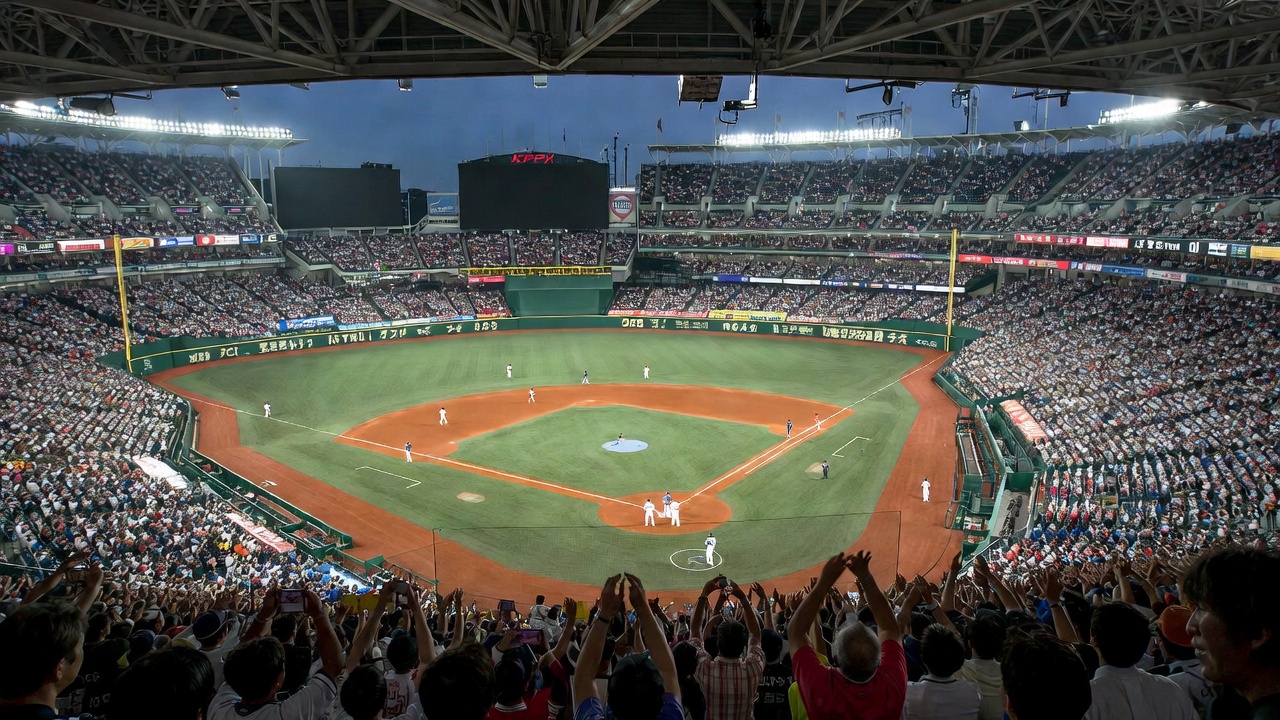
If there is one thing that blows the mind of every first-time visitor to a Japanese ballpark, it is the fan experience. NPB games are not just sporting events. They are organized, coordinated, relentless celebrations of team loyalty.
The heart of this experience is the ōendan (応援団), or cheering squad. These are organized groups of fans who lead the crowd in synchronized chants, songs, and cheers throughout the game. They use taiko drums, trumpets, horns, megaphones, and plastic thunder sticks to create a wall of sound that never stops. Every player has his own personal cheer. Every situation has its own chant. The ōendan sets the rhythm, and the entire stadium follows.
“The fact that you can create a sense of unity and oneness in the ballpark is my favorite part,” Kentaro Kawai, chairman of the Kanto Swallow Army and a member of the Samurai Japan ōendan, told MLB.com through an interpreter.
The contrast with MLB could not be starker. In American ballparks, crowd noise is organic and unstructured. Fans cheer when something exciting happens and fall quiet during lulls. Heckling is common. Booing is expected. In NPB stadiums, heckling is essentially nonexistent. Fans focus entirely on supporting their own team with positive energy. The fans of the fielding team sit quietly while the opposing team’s supporters cheer. Then they trade off.
Here is what a typical NPB game atmosphere looks like:
- Home fans sit along the first-base side. Away fans sit along the third-base side.
- Each team’s ōendan occupies a dedicated cheering section, usually in the outfield bleachers.
- Fans wear team jerseys, wave towels, and blow up jet balloons (fūsen) during the seventh-inning stretch, releasing them simultaneously in a spectacular burst of color.
- Beer vendors — often young women carrying kegs on their backs — walk through the stands serving draft beer throughout the game.
- Food options include bento boxes, yakitori (grilled chicken skewers), edamame, takoyaki (octopus balls), and other Japanese stadium staples.
This atmosphere has roots in Japan’s university baseball tradition. When Waseda University traveled to play Stanford in 1905, the players were inspired by the American marching band culture they encountered. They brought the concept of organized cheering back to Japan, where it took root first in college baseball before spreading to the professional game.
How Do NPB and MLB Player Salaries and Contract Structures Compare?
The financial gap between the two leagues is enormous — but the comparison is more nuanced than it first appears.
The average MLB salary in 2025 was projected at approximately $5 million per year, with a league minimum of around $760,000. The highest-paid players earn upward of $40 million annually. MLB operates without a hard salary cap, relying instead on a luxury tax system. In 2024, the New York Mets carried a payroll of $316 million, while the Oakland Athletics spent just $62 million — a difference of more than $250 million.
NPB salaries are considerably lower. The average NPB salary in 2023 was approximately ¥44.7 million (roughly $300,000 to $400,000 depending on exchange rates). The highest-paid NPB players earn in the range of ¥600 million to ¥900 million (approximately $4 million to $6 million). The Fukuoka SoftBank Hawks had the highest average player salary in the 2024 season at approximately ¥68.1 million.
| Salary Comparison | NPB | MLB |
|---|---|---|
| Average salary | ~¥44.7M (~$300K–$400K) | ~$5M |
| Minimum salary (active roster) | ¥16M (~$110K–$140K) | ~$760K |
| Top player salary | ~¥600M–¥900M (~$4M–$6M) | $40M+ |
| Salary cap | No hard cap | No hard cap (luxury tax) |
NPB has no collective bargaining agreement in the American sense. Instead, it operates under a charter (Pro Yakyu Kyoyaku) approved by the 12 teams. Player salary negotiations are conducted individually, and salaries are not publicly disclosed with full transparency. The figures reported in the media come from what teams or players tell reporters, and these numbers may not always reflect the full picture, as jballallen.com has reported in its analysis of NPB’s pay system.
This salary gap is a major reason why top Japanese players aspire to play in MLB. The financial incentive is overwhelming. When Yoshinobu Yamamoto signed a 12-year, $325 million contract with the Los Angeles Dodgers after the 2023 NPB season, it was the largest contract ever given to a pitcher at the time. That single deal was worth more than the entire payroll of most NPB teams.
How Does the NPB Posting System Work for Players Moving to MLB?
The pipeline from NPB to MLB is governed by a posting system — a formal transfer mechanism that has been revised several times since its introduction in 1998.
Here is how it works: When an NPB player wants to pursue an MLB career but is still under contract with his Japanese team (i.e., has not yet reached NPB free agency), his team can “post” him. The NPB team notifies the MLB Commissioner’s Office. The player then has 30 days to negotiate with any interested MLB team. If a deal is reached, the NPB team receives a posting fee calculated as a percentage of the player’s MLB contract value.
For minor league contracts, the posting fee is a flat 25% of the contract value. For major league contracts, the fee is based on the total value of the deal. If no agreement is reached within 30 days, the player returns to his NPB team.
NPB players are not eligible for unrestricted free agency until they have completed nine seasons of service time. This means most star players who want to move to MLB in their prime must go through the posting system, because waiting for free agency would mean staying in Japan until their late 20s or early 30s.
The 2025–26 offseason provided a vivid illustration of this system in action. Three prominent NPB players were posted: slugger Munetaka Murakami (who signed with the Chicago White Sox), pitcher Tatsuya Imai (who signed with the Houston Astros), and infielder Kazuma Okamoto (who signed with the Toronto Blue Jays). As CBS Sports reported, all three received contracts shorter and cheaper than many analysts had predicted, reflecting the uncertainty that always accompanies players transitioning between leagues.
Which Japanese Baseball Players Have Succeeded in MLB After Playing in NPB?
The history of NPB players succeeding in MLB is rich and growing richer every year. These crossover stars have done more than any statistic or comparison chart to bridge the two baseball cultures.
Ichiro Suzuki is the towering figure. After nine seasons with the Orix BlueWave, Ichiro was posted to MLB in 2001 and claimed by the Seattle Mariners. He won both the American League Rookie of the Year and MVP awards in his first season. He set the MLB single-season hit record with 262 in 2004. He collected over 3,000 MLB hits and, combined with his NPB hits, holds the record for the most top-level professional hits in baseball history. In January 2025, Ichiro was elected to the Baseball Hall of Fame in his first year of eligibility.
Shohei Ohtani redefined what was possible. The two-way star played for the Hokkaido Nippon-Ham Fighters before coming to MLB in 2018. He has since become perhaps the most remarkable player the sport has ever seen — an elite hitter and an elite pitcher rolled into one. His $700 million contract with the Los Angeles Dodgers, signed before the 2024 season, is the largest in professional sports history.
Other notable NPB-to-MLB success stories include:
- Hideo Nomo — pioneered the path from NPB to MLB in 1995, winning NL Rookie of the Year with the Dodgers
- Hideki Matsui — became a World Series MVP with the Yankees in 2009
- Yu Darvish — one of the premier pitchers in MLB for over a decade
- Masahiro Tanaka — signed a seven-year, $155 million deal with the Yankees in 2014
- Yoshinobu Yamamoto — won back-to-back World Series titles with the Dodgers in 2024 and 2025, earning World Series MVP honors in 2025
- Seiya Suzuki — has steadily improved with the Chicago Cubs, adapting to MLB’s higher velocity over multiple seasons
- Shōta Imanaga — impressed immediately as a rookie pitcher for the Cubs in 2024
The latest wave of NPB players arriving for the 2026 MLB season — Murakami, Imai, and Okamoto — continues this tradition. As ESPN’s analysis noted, this may be one of the strongest single classes of Japanese talent ever to cross the Pacific at the same time.
What Are the Key Differences Between NPB and MLB Playing Fields and Stadiums?
The physical environment of the game differs in subtle but important ways.
Several NPB ballparks are smaller than MLB standards would allow. The American Official Baseball Rules specify minimum dimensions for parks built or renovated after 1958: 325 feet down each foul line and 400 feet to center field. Five NPB stadiums violate these minimums. That said, MLB itself does not always enforce this rule strictly — Yankee Stadium, built in 2009, has a right-field line of just 314 feet.
NPB also uses a slightly smaller strike zone than MLB, with the zone being narrower on the inside part of the plate relative to the batter. This subtle difference affects pitch sequencing and how hitters approach the inside part of the plate.
Some of Japan’s most iconic stadiums carry a cultural weight that goes beyond baseball:
- Koshien Stadium (Nishinomiya, Hyogo) — home of the Hanshin Tigers and host of the beloved National High School Baseball Championship. Koshien is sacred ground in Japanese sports culture. The high school tournament draws over 50,000 spectators and is the most-watched sporting event in the country.
- Tokyo Dome — home of the Yomiuri Giants. Known as “The Big Egg,” this domed stadium in central Tokyo has hosted countless historic games and is a pilgrimage site for Giants fans.
- ES CON Field Hokkaido — opened in 2023 as the new home of the Hokkaido Nippon-Ham Fighters. This state-of-the-art facility represents the cutting edge of Japanese stadium design.
MLB stadiums, while often larger, vary enormously in character — from the ivy-covered walls of Wrigley Field to the retractable roof of T-Mobile Park in Seattle. Both leagues have embraced modern stadium design, but the emotional relationship between Japanese fans and their ballparks runs particularly deep.
How Do Training Philosophies Differ Between Japanese and American Baseball?
If you want to understand the deepest cultural difference between NPB and MLB, look at how they practice.
Japanese baseball training is legendary for its intensity and duration. NPB spring training camps, held primarily in Okinawa and Miyazaki during February, are grueling affairs. Players practice for hours each day, with sessions that can last from morning until evening. Repetition is king. Fielding drills, batting practice, and pitching sessions are conducted with a discipline and rigor that goes far beyond what most MLB camps require.
American author Robert Whiting, in his influential book The Chrysanthemum and the Bat, described the Japanese approach as rooted in cultural values of group identity, cooperation, hard work, and respect for seniority. These values permeate every aspect of the Japanese baseball experience, from the way rookies carry equipment to the way veterans are addressed.
MLB spring training, held in Florida’s Grapefruit League and Arizona’s Cactus League, is certainly serious. But the pace is generally more relaxed. Players have more autonomy over their preparation. Individual workout plans are common. The emphasis is on getting ready for the season without wearing anyone out before it starts.
This philosophical gap also affects how young players are developed. NPB teams do not have the extensive minor league systems that MLB teams do. Each NPB team has essentially one affiliated minor league squad (playing in the Eastern or Western League). MLB teams have multiple minor league levels — from Rookie ball to Single-A, Double-A, and Triple-A — creating a development ladder with hundreds of affiliated players.
The Japanese approach favors polishing skills through repetition and team-oriented practice. The American approach favors developing talent through competitive game experience at progressively higher levels. Neither is inherently superior. Both have produced generations of world-class baseball players.
What Role Does “Small Ball” Play in NPB Compared to MLB Power Hitting?
For years, a common narrative held that Japanese baseball was a “small ball” league — emphasizing contact hitting, sacrifice bunts, and advancing runners — while American baseball was about power and home runs. Like most stereotypes, this one contains a grain of truth but misses the full picture.
The sacrifice bunt is alive and well in NPB. Japanese managers use it more frequently and in more situations than their American counterparts. Advancing a runner from first to second with a bunt is considered sound strategy in NPB, even in situations where an MLB manager would never consider it.
But the characterization of NPB as purely a contact-oriented league has been challenged. FanGraphs analyst Eno Sarris noted in 2017 that contact rates in MLB are actually comparable to those in NPB. Japanese hitters can hit for power too. Munetaka Murakami hit 56 home runs in 2022, breaking the NPB record for home runs by a Japanese-born player. Sadaharu Oh hit 868 career home runs — still the world record for professional baseball.
The difference is more about approach than ability. Japanese baseball culture values situational hitting — putting the ball in play to move runners, hitting behind the runner, and manufacturing runs through smart baserunning. American baseball has increasingly embraced analytics-driven approaches that prioritize launch angle, exit velocity, and the three true outcomes (home runs, walks, and strikeouts).
In recent years, NPB has experienced what analysts describe as a “dead-ball era.” Run-scoring has declined, and pitching dominance has increased. The league-average ERA in NPB’s Pacific League has dropped well below 3.00 in some recent seasons. This makes it challenging to evaluate NPB hitters and pitchers using raw statistics alone, because the run-scoring environment is so different from MLB’s.
How Does the Designated Hitter Rule Differ Between NPB’s Two Leagues?
For decades, one of the quirky similarities between MLB and NPB was that each sport had one league that used the designated hitter (DH) and one that did not.
In NPB, the Pacific League adopted the DH in 1975. The Central League did not use it. This mirrored MLB, where the American League used the DH (since 1973) and the National League required pitchers to bat.
That parallel ended in 2022, when MLB adopted the universal DH, eliminating pitcher batting from the National League. As of 2026, all MLB teams use the designated hitter.
NPB has not followed suit. The Central League still does not use the DH in its regular season games. This means Central League pitchers must bat for themselves, which affects roster construction, late-game strategy, and how managers approach the bottom of their lineups. When Central League and Pacific League teams meet in interleague play or the Japan Series, the rules of the home team apply.
This split gives NPB a strategic dimension that MLB no longer has. Central League managers must decide when to pinch-hit for their pitcher, how to construct their batting order around a weak-hitting ninth spot, and whether to sacrifice at-bats for defensive ability. It is a throwback to an earlier era of baseball strategy that many purists appreciate.
How Do the NPB and MLB Postseason Formats Compare?
Both leagues use a multi-round postseason, but the structures differ significantly.
NPB’s postseason is called the Climax Series, introduced in 2007. It works as follows:
- First Stage: The second and third-place teams in each league play a best-of-three series. The second-place team holds home-field advantage and an extra edge: ties benefit the higher seed.
- Final Stage: The first-place team hosts the First Stage winner in a best-of-six series. The first-place team starts with a one-game advantage, meaning the challenger must win four games while the first-place team needs only three.
- Japan Series: The Climax Series winners from each league meet in a best-of-seven championship. Ties are possible, and if the series is still undecided after seven games, additional games are played.
MLB’s postseason, as of 2026, features a Wild Card Series (best of three), a Division Series (best of five), a League Championship Series (best of seven), and the World Series (best of seven). There are no ties, no automatic advantages for higher seeds beyond home-field advantage, and games continue until a winner is determined.
The NPB format has been controversial. Giving the first-place team a built-in one-game advantage in the Final Stage is intended to reward regular-season dominance. But critics argue that it can feel anticlimactic when a first-place team advances with just two actual wins. The system also means that a third-place team with a mediocre record can theoretically upset the league’s best team — which has happened.
What Happens When NPB Stars Move to MLB? The Adjustment Challenges for Japanese Players
The transition from NPB to MLB is never seamless. Even the most talented Japanese players face significant adjustment challenges.
For pitchers, the biggest hurdle is the baseball itself. The MLB ball is slightly larger and less tacky, which can reduce the movement on breaking pitches. Pitchers must also adapt to a five-man rotation (from six), meaning more starts and more innings over the course of a season. They face lineups with more consistent power and higher average velocity from opposing pitchers, which quickens the overall pace of the game.
For hitters, the challenge is velocity. As Baseball Prospectus detailed in a 2025 analysis, NPB hitters see far fewer pitches above 95 mph than their MLB counterparts. In some NPB seasons, a typical starting position player might face only 20 to 30 pitches per year above 97 mph — and those often come from a single pitcher. In MLB, high-velocity fastballs are everywhere. Relievers regularly touch 100 mph. Starting pitchers average speeds that would rank among the top arms in NPB.
Seiya Suzuki’s career arc with the Chicago Cubs illustrates the adjustment curve. In his first MLB season, Suzuki performed reasonably well against high-velocity pitching given his limited prior exposure to it. But with each successive year, he has steadily improved his exit velocity and reduced his swing-and-miss rate against hard throwers. The lesson: the adjustment is real, but talented hitters can overcome it with time.
For the 2026 class, the concerns are specific. Munetaka Murakami’s strikeout rate has been climbing in NPB, reaching nearly 30% in recent seasons — a troubling number given that he was doing it against pitching that is, on average, less powerful than what he will face in MLB. Tatsuya Imai’s history of wildness (though improving) raised questions about his command against more disciplined MLB lineups. And Kazuma Okamoto, while consistent, is already 29 and may have less upside than younger imports.
The 2026 World Baseball Classic and the Growing Bridge Between NPB and MLB
The 2026 World Baseball Classic (WBC), set to begin in March 2026 with first-round games at the Tokyo Dome, represents the latest chapter in the growing connection between Japanese and American baseball.
Team Japan’s 2026 WBC roster features a record eight MLB players, including Shohei Ohtani, Yoshinobu Yamamoto, Seiya Suzuki, and newly arrived MLB players Munetaka Murakami and Kazuma Okamoto. This roster reflects the unprecedented flow of talent from NPB to MLB in recent years.
The WBC has been enormously important for Japanese baseball. Japan’s victory in the 2023 tournament — clinched with a dramatic final-out strikeout from Ohtani against Mike Trout — became one of the most celebrated moments in Japanese sports history. The tournament gives NPB players a global stage and often accelerates their path to MLB, as scouts and fans alike get their first close look at Japanese talent.
For NPB, the WBC is both a point of pride and a source of anxiety. Every star who shines in the tournament becomes more likely to leave for MLB, creating a talent drain that has long been a concern for Japanese teams. The posting system provides financial compensation, but losing a franchise player is never easy — no matter how large the posting fee.
NPB vs MLB Quick Comparison: A Complete Side-by-Side Reference Guide
For easy reference, here is a comprehensive comparison table covering the major differences:
| Category | NPB | MLB |
|---|---|---|
| Founded | 1950 (roots to 1936) | 1876 |
| Number of teams | 12 | 30 |
| Regular season games | 143 | 162 |
| Starting rotation | 6-man | 5-man |
| Extra innings | 12-inning limit; ties allowed | No limit; no ties |
| Baseball size | Slightly smaller (Mizuno) | Slightly larger (Rawlings) |
| DH rule | Pacific League only | Universal |
| Foreign player limit | 4 per active roster | None |
| Draft format | Simultaneous first round with lottery | Sequential (worst-to-first with lottery) |
| Postseason teams | 6 of 12 (50%) | 12 of 30 (40%) |
| Championship | Japan Series | World Series |
| Team naming | Corporate sponsors | City/region names |
| Fan culture | Organized ōendan cheering | Organic, unstructured |
| Average salary | ~$300K–$400K | ~$5M |
| Minor league system | 1 affiliate per team | Multiple levels (Rookie to AAA) |
| Spring training location | Okinawa, Miyazaki | Florida, Arizona |
Should You Watch NPB or MLB? Why Both Leagues Deserve Your Attention
The question of whether NPB or MLB is “better” misses the point entirely. These are two distinct expressions of the same beautiful game, shaped by different cultures, histories, and values.
Watch MLB if you want the deepest talent pool on Earth, the longest season, the highest velocity, and the biggest contracts. MLB is where the absolute best players in the world compete at the highest level. It is a spectacle of raw athleticism and financial ambition.
Watch NPB if you want a more intimate, strategic, and culturally rich baseball experience. NPB stadiums are louder, more participatory, and more joyful than most MLB parks. The games are tighter. The competitive balance is better. The fan culture is unlike anything else in professional sports.
And if you have the chance to visit Japan during baseball season, do not miss it. Attending an NPB game is one of the great sporting experiences on Earth. Buy a ticket to the ōendan section. Learn the chants. Eat the yakitori. Release a jet balloon during the seventh-inning stretch. You will leave the stadium grinning, hoarse, and deeply in love with a version of baseball you never knew existed.
Frequently Asked Questions About NPB vs MLB Differences
Is NPB the same level as MLB? No. MLB is widely considered the higher level of competition due to its larger talent pool, higher salaries that attract the world’s best players, and deeper farm systems. However, NPB is the second-best professional baseball league in the world, and many of its top players are fully capable of succeeding in MLB.
Can NPB games end in a tie? Yes. If no team leads after 12 innings, the game is declared a tie. This rule applies during the regular season and can even occur during the Japan Series.
How many foreign players can an NPB team have? Each team can register up to four non-Japanese players on its active roster. Of those, no more than three can be pitchers and no more than three can be position players.
Who is the most famous player to go from NPB to MLB? Ichiro Suzuki and Shohei Ohtani are the two most famous. Ichiro was a 10-time All-Star and first-ballot Hall of Famer. Ohtani is widely considered the most talented baseball player ever, excelling as both a pitcher and hitter.
When does the NPB season start? The NPB season typically begins in late March, around the same time as MLB’s Opening Day. Spring training camps begin in early February, primarily in Okinawa and Miyazaki.
Is the baseball different in Japan? Yes. The NPB ball (made by Mizuno) is slightly smaller than the MLB ball (made by Rawlings) and has lower-profile seams that give pitchers a better grip. This allows for more movement on breaking pitches.
The beauty of baseball is that it belongs to everyone who loves it. Whether you follow the Yomiuri Giants or the New York Yankees, whether you cheer with a taiko drum or a foam finger, whether you eat a bento box or a hot dog — you are part of the same family. The game connects us. The differences make it richer.
See you at the ballpark.