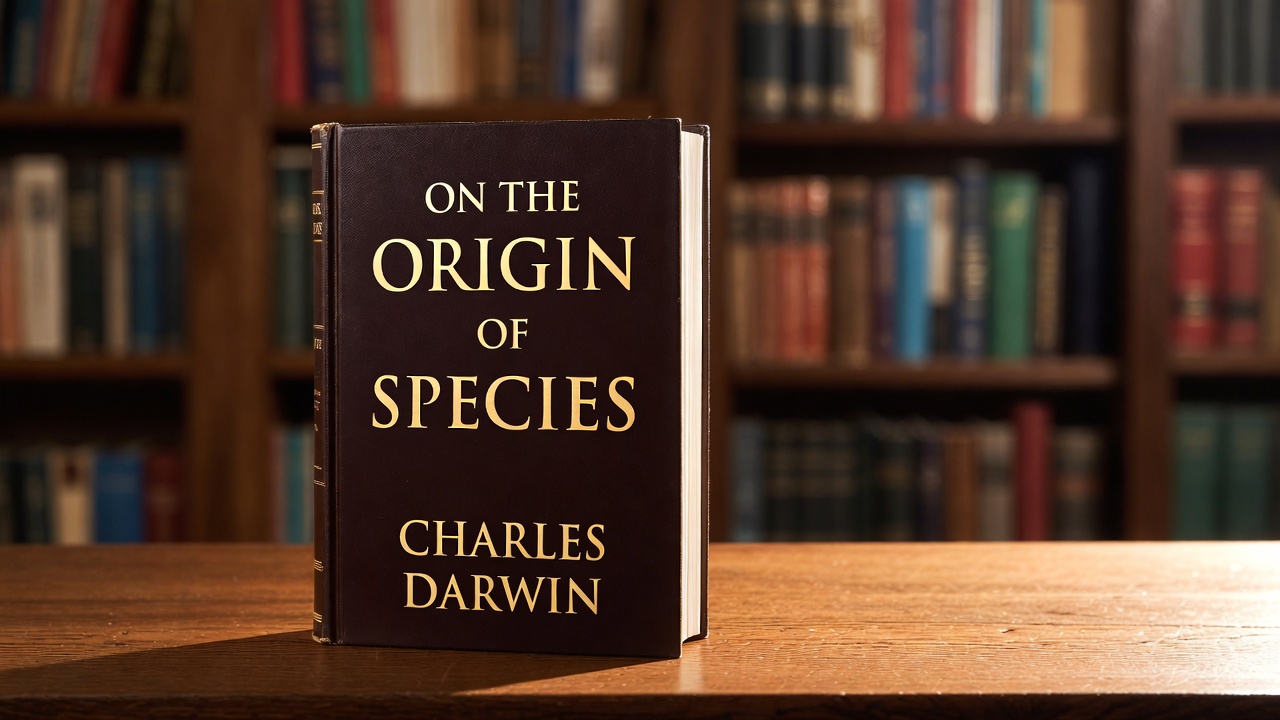
Charles Darwin’s On the Origin of Species is not just a book. It is a turning point. Published on November 24, 1859, this single work reshaped biology, philosophy, and the way humans understand their own place in the natural world. More than 166 years later, Darwin’s core ideas remain the backbone of modern life sciences. They guide everything from cancer research to climate adaptation strategies.
But how did a seaside-loving English naturalist, born into a comfortable family in Shrewsbury, come to write a book that rewrote the rules of science? What drove him to wait more than twenty years before publishing his findings? And why does On the Origin of Species matter more in 2026 than at any previous time in history?
This is the full story — from the volcanic shores of the Galápagos Islands to the cutting-edge CRISPR laboratories of today.
Who Was Charles Darwin and Why Did He Matter to Science?
Charles Robert Darwin was born on February 12, 1809, in Shrewsbury, England. He was the fifth of six children in a wealthy and well-connected family. His father, Robert Darwin, was a successful physician. His grandfather, Erasmus Darwin, was a renowned naturalist and poet who had already written about the idea that life changes over time.
Young Charles showed little interest in medicine. He enrolled at the University of Edinburgh in 1825 to follow his father’s footsteps. He quickly grew bored of lectures and surgery. He dropped out. His father, frustrated, sent him to Christ’s College, Cambridge, to study divinity. The hope was that Charles would become a country clergyman.
At Cambridge, Darwin found his true calling. He attended lectures by the botanist John Stevens Henslow, who became his mentor and friend. He read Alexander von Humboldt’s travel narratives about South America. He devoured John Herschel’s A Preliminary Discourse on the Study of Natural Philosophy (1830), which taught him to seek “true causes” of natural events. These readings planted the seeds of scientific curiosity that would bloom aboard the HMS Beagle.
Darwin was not a rebel. He was not trying to overthrow religion or challenge the social order. He was simply a careful observer who asked questions that others did not.
The Voyage of the HMS Beagle That Changed History
How a Five-Year Journey Shaped Darwin’s Theory of Evolution
On December 27, 1831, a 22-year-old Darwin set sail from Plymouth, England, aboard HMS Beagle. The ship’s primary mission was to survey the coastline and harbors of South America for the British government. Darwin’s role was unofficial. Captain Robert FitzRoy wanted a gentleman companion of similar social standing — someone educated enough to hold a conversation during the long months at sea.
The voyage was supposed to last two years. It lasted nearly five. The Beagle returned to Falmouth, England, on October 2, 1836. During those years, Darwin spent roughly two-thirds of his time on land. He trekked through Brazilian rainforests, crossed the Argentine pampas, climbed the Andes, and weathered earthquakes in Chile.
He filled notebooks with observations. He collected hundreds of specimens — fossils, birds, insects, plants, and marine creatures. He studied geological formations and coral reefs. Every stop offered new puzzles.
Here is a simplified timeline of the most significant moments during the voyage:
| Date | Location | Key Observation |
|---|---|---|
| January 1832 | Brazil | First encounter with tropical rainforests |
| September 1832 | Argentina | Discovery of giant fossil bones (megafauna) |
| February 1835 | Chile | Witnessed an earthquake; saw the coast rise several feet |
| March 1835 | Andes | Found petrified trees at high altitude |
| September–October 1835 | Galápagos Islands | Observed unique finches, tortoises, and mockingbirds |
| January 1836 | Australia | Noted the completely different set of mammals (marsupials) |
Each of these observations chipped away at the dominant belief of the time: that all species were fixed and unchanging, created separately by God.
Darwin’s Galápagos Islands Experience and Finch Discovery
The Galápagos Islands deserve special attention. Darwin arrived there on September 16, 1835, when the Beagle anchored off San Cristóbal Island. The ship spent approximately five weeks in the archipelago.
At the time, Darwin did not realize the full importance of what he was seeing. He collected birds, reptiles, and plants with his servant Syms Covington. He noticed that mockingbirds on different islands looked different from one another. He observed tortoises whose shell shapes varied by island. He collected small, dull-colored birds — finches — from several islands, but he did not label all of them carefully by location.
It was only after the voyage, back in London, that the picture became clear. In January 1837, Darwin presented his bird specimens to the Zoological Society of London. The ornithologist John Gould examined them and delivered a stunning conclusion. The birds Darwin had thought belonged to several different families — blackbirds, gross-beaks, and finches — were actually all closely related finch species. Each had evolved a beak shape suited to a different food source on a different island.
This was the breakthrough. Darwin realized that these finches must have descended from a single common ancestor that colonized the islands. Over time, they had adapted to different ecological conditions. Different beak shapes let them eat different foods: seeds, insects, cactus fruit, or even bird blood.
The finches were not the only clue. The mockingbirds, the tortoises, and even the plants all told the same story. Species were not fixed. They changed. They adapted. They diverged.
“Seeing this gradation and diversity of structure in one small, intimately related group of birds, one might really fancy that from an original paucity of birds in this archipelago, one species had been taken and modified for different ends.” — Charles Darwin, Journal of Researches (2nd ed., 1845)
How Darwin Developed the Theory of Natural Selection Step by Step
The idea did not come to Darwin in a flash of inspiration. It grew slowly, over years of reading, thinking, experimenting, and corresponding with other scientists.
The Influence of Thomas Malthus on Darwin’s Thinking
In September 1838, Darwin read Thomas Malthus’s An Essay on the Principle of Population (6th edition, 1826). Malthus argued that human populations grow faster than food supplies. This creates a constant “struggle for existence.” Only some individuals survive.
Darwin saw the connection immediately. If all organisms produce more offspring than the environment can support, and if those offspring vary in their traits, then the individuals with the most useful traits will survive longer and reproduce more. They will pass their traits to the next generation. Over many generations, this process — which Darwin called natural selection — could transform a species entirely.
This was the mechanism Darwin had been searching for.
Why Darwin Waited Twenty Years to Publish His Findings
Darwin did not rush to publish. He knew his ideas would cause a firestorm. England in the 1830s and 1840s was a turbulent place. The Church of England held enormous power over the universities. Science and theology were deeply intertwined. The idea that species could change — that they were not individually created by God — was considered dangerous and even seditious.
Darwin also wanted overwhelming evidence. He spent years studying barnacles. He bred pigeons. He exchanged thousands of letters with naturalists, breeders, and botanists across the world. He wrote a 230-page essay in 1844 outlining his theory, but he kept it in a drawer.
By the mid-1850s, England was changing. The rising professional class of scientists, led by figures like Thomas Henry Huxley, was pushing back against religious control of the universities. The cultural atmosphere was becoming safer for new ideas.
Then came the crisis that forced Darwin’s hand. In June 1858, he received a letter from Alfred Russel Wallace, a young naturalist working in the Malay Archipelago. Wallace had independently arrived at the same theory of natural selection. Panicked, Darwin consulted his friends Charles Lyell and Joseph Hooker. They arranged for a joint presentation of papers by both Darwin and Wallace at the Linnean Society of London on July 1, 1858.
That joint presentation received almost no public attention. But it lit a fire under Darwin. He threw himself into writing what he called an “abstract” of his larger work. That abstract became On the Origin of Species.
What Is On the Origin of Species About: A Complete Summary
The full title of the book is On the Origin of Species by Means of Natural Selection, or the Preservation of Favoured Races in the Struggle for Life. It was published by John Murray in London on November 24, 1859. The entire first print run of 1,250 copies sold out on the first day.
The book contains fourteen chapters. Here is a breakdown of the core arguments:
| Chapter(s) | Topic | Key Argument |
|---|---|---|
| 1 | Variation Under Domestication | Animal and plant breeders create new varieties by selecting desired traits. This proves that species are not fixed. |
| 2 | Variation Under Nature | Wild species also show wide variation among individuals. |
| 3 | Struggle for Existence | All organisms produce more offspring than can survive. Resources are limited. Competition is fierce. |
| 4 | Natural Selection | Individuals with advantageous traits survive and reproduce more. Over generations, populations change. |
| 5 | Laws of Variation | Variation arises from many causes, some understood and some unknown. |
| 6–8 | Difficulties, Instinct, Hybridism | Darwin addresses objections to his theory head-on. He discusses complex organs like the eye, social instincts, and the sterility of hybrids. |
| 9–10 | Geological Record | The fossil record is incomplete, but it supports gradual change over deep time. |
| 11–12 | Geographical Distribution | The distribution of species across the globe makes sense only through common descent. |
| 13 | Mutual Affinities, Morphology, Embryology | Similarities in body structure and development across species point to shared ancestry. |
| 14 | Recapitulation and Conclusion | Darwin summarizes his argument and envisions a new approach to the study of life. |
Darwin’s argument was built on analogy. He started with something his Victorian readers already accepted — artificial selection by breeders — and then extended it to nature. If a pigeon breeder could transform the shape of a bird in just a few generations, imagine what nature could do over millions of years.
The book did not discuss human evolution directly. Darwin deliberately avoided the topic. He wrote only one cautious sentence: “Light will be thrown on the origin of man and his history.” That single line was enough to ignite public fury.
How On the Origin of Species Changed Biology and Modern Science
The Scientific Revolution That Darwin Started
The impact was immediate. Within two decades of publication, the scientific community broadly accepted that species evolved through common descent. Darwin’s friend Thomas Henry Huxley — nicknamed “Darwin’s Bulldog” — championed the theory in public debates, lectures, and reviews. Huxley published his own book, Evidence as to Man’s Place in Nature (1863), extending Darwin’s ideas to human evolution.
But acceptance of natural selection as the primary mechanism of evolution was slower. During the period that historians call “the eclipse of Darwinism” — roughly from the 1880s to the 1930s — many scientists favored alternative explanations. Some supported Lamarckism (the idea that organisms inherit traits acquired during their lifetimes). Others backed orthogenesis (the idea that evolution follows a predetermined direction). Still others supported mutation theory (the idea that evolution happens through sudden, large-scale jumps rather than gradual change).
It was not until the Modern Evolutionary Synthesis of the 1930s and 1940s that natural selection regained its central role. Scientists like Ronald Fisher, J.B.S. Haldane, and Sewall Wright combined Darwin’s theory with Mendelian genetics. They showed mathematically that natural selection acting on small genetic variations could account for all observed evolutionary change.
The Modern Synthesis united several fields:
- Genetics (Mendel’s laws of inheritance)
- Paleontology (the fossil record)
- Systematics (classification of species)
- Biogeography (distribution of species)
- Population genetics (mathematical modeling of gene frequency changes)
This unified framework remains the foundation of evolutionary biology today.
Darwin’s Impact on Medicine, Agriculture, and Genetics
Darwin’s ideas did not stay confined to biology textbooks. They transformed practical science in ways that affect billions of people every day.
In medicine, evolutionary thinking helps researchers understand why bacteria develop antibiotic resistance. When a patient takes antibiotics, most bacteria die. But a few with random genetic mutations may survive. These survivors reproduce, and the next generation is resistant. This is natural selection in action — on a timescale of days, not millennia. The World Health Organization has described antimicrobial resistance as one of the top ten global public health threats.
In agriculture, the principle of artificial selection — the very concept Darwin used to open On the Origin of Species — underpins modern crop and livestock breeding. Nearly every food crop consumed today has been shaped by centuries of selective breeding, and modern genomics has accelerated this process dramatically.
In genetics, Darwin’s work laid the groundwork for the discovery of DNA and the genetic code. Darwin did not know about genes. He proposed a flawed model of inheritance called “pangenesis.” But his core insight — that variation exists, that it is heritable, and that nature selects for it — was exactly right. Once Gregor Mendel’s work on inheritance was rediscovered in 1900, the two streams of thought merged into the powerful current of modern genetics.
Darwin and Genetics: What He Got Right Without Knowing DNA
One of the most remarkable things about Darwin is how much he got right without understanding the mechanism of inheritance. He did not know about chromosomes, genes, or DNA. He proposed “pangenesis,” a model in which tiny particles called “gemmules” were shed by every cell in the body and collected in the reproductive organs. This model allowed for the inheritance of acquired characteristics — a Lamarckian idea that turned out to be wrong.
Yet Darwin correctly identified the three essential ingredients for evolution by natural selection:
- Variation — Individuals within a species differ from one another.
- Inheritance — Offspring tend to resemble their parents.
- Selection — Individuals with certain traits survive and reproduce more than others.
As Brian Charlesworth and Deborah Charlesworth noted in a landmark paper published in the journal Genetics, Darwin’s theory was “logically incomplete” without a model of inheritance, but his identification of the core mechanism was precise (Charlesworth and Charlesworth, 2009). Once the particulate basis of genetics was understood — thanks to Mendel, and later to Watson, Crick, Franklin, and Wilkins — everything clicked into place.
Today, Darwinian principles play a greater role in biology than ever before. DNA sequencing technology allows researchers to observe natural selection at the molecular level. Scientists can track exactly which genes are under selection, how quickly they change, and what environmental pressures are driving that change.
Why On the Origin of Species Was So Controversial When Published
Darwin’s book provoked fierce debate. The controversy was not only scientific. It was deeply cultural, religious, and political.
The Famous Oxford Debate of 1860 Between Huxley and Wilberforce
The most famous confrontation occurred on June 30, 1860, at a meeting of the British Association for the Advancement of Science in Oxford. Bishop Samuel Wilberforce — a skilled orator nicknamed “Soapy Sam” — spoke against Darwin’s theory. He reportedly asked Huxley whether it was through his grandmother’s or grandfather’s side that he claimed descent from an ape.
Huxley’s response, though not precisely recorded, was devastating. He reportedly said he would rather be descended from an ape than from a man who used his gifts to obscure the truth. The audience erupted. The Oxford debate became a symbol of the clash between science and religious authority.
But the reality was more nuanced than the legend. Many religious thinkers accepted evolution. Asa Gray, Darwin’s strongest ally in America, was a devout Christian who saw no conflict between natural selection and belief in God. Darwin himself was careful not to attack religion directly. He had once studied for the clergy, and many of his closest friends were clergymen.
The controversy was not really about God. It was about authority. Who had the right to explain the natural world — scientists or theologians? Darwin’s work shifted that authority decisively toward science.
Why Some People Still Disagree With Evolution Today
Despite overwhelming scientific evidence, a significant portion of the global population remains skeptical of evolution. Surveys consistently show that acceptance of evolution varies widely by country, education level, and religious affiliation.
The most common objections rest on misunderstandings of what evolution actually claims. Here are some of the most frequent myths and the facts that correct them:
| Common Myth | Scientific Reality |
|---|---|
| “Evolution is just a theory.” | In science, a theory is the highest level of explanation. Gravity is also “just a theory.” A scientific theory is supported by vast evidence and has survived rigorous testing. |
| “Humans descended from monkeys.” | Humans and modern apes share a common ancestor that lived roughly 6–8 million years ago. We did not evolve from any living primate species. |
| “Survival of the fittest means the strongest survive.” | “Fitness” in evolutionary terms means reproductive success — not physical strength. The most cooperative, best camouflaged, or most energy-efficient organisms often thrive. |
| “Evolution cannot produce complex organs like the eye.” | Darwin himself addressed this. Complex organs evolved through many small, incremental steps. Each intermediate stage provided a survival advantage. |
| “There are no transitional fossils.” | The fossil record contains thousands of transitional forms — from fish to amphibians, dinosaurs to birds, and land mammals to whales. |
Understanding these distinctions matters. In 2026, as gene-editing technologies become more powerful and climate change reshapes ecosystems, scientific literacy about evolution is more important than ever.
How Darwin’s Natural Selection Theory Applies to Climate Change in 2026
Climate change is the defining environmental challenge of our era. It is also, in a very real sense, a massive evolutionary experiment. Rising temperatures, shifting rainfall patterns, and extreme weather events are creating new selection pressures on every living species.
Darwin wrote about the “struggle for existence” in 1859. In 2026, that struggle is intensifying at a pace he could never have imagined.
Species Are Evolving Faster Than at Any Time in Recent History
Multiple studies have documented rapid evolutionary responses to climate change. Species are shifting their geographic ranges toward the poles and to higher elevations. Breeding seasons are moving earlier. Body sizes are changing. Some organisms are developing new heat-tolerance mechanisms.
A 2025 study published in Proceedings of the National Academy of Sciences by researchers at Stockholm University tracked the evolution of thermal performance in eight species of yeast over 600 generations. The researchers found that adaptive responses to warming were highly species-specific. Some species expanded their temperature range, while others improved their peak performance at higher temperatures. The study underscored that genetic diversity is a key factor in determining whether a species can adapt to a warming world (Molinet and Stelkens, 2025).
In early 2026, research from the University of East Anglia revealed that polar bears in southeast Greenland are showing genetic changes linked to heat stress, fat metabolism, and diet. These bears appear to be slowly adapting to warmer conditions and shifting from fatty seal-based diets toward other food sources. But whether these adaptations can keep pace with the rate of warming remains unclear.
This is Darwin’s natural selection playing out in real time — but under unprecedented pressure.
The Uncomfortable Truth: Many Species Cannot Adapt Fast Enough
Not all species will survive. Darwin’s theory also explains extinction. When the environment changes faster than a population can adapt, that population declines. If it declines far enough, it disappears.
Coral reefs are a stark example. Rising ocean temperatures cause coral bleaching — the breakdown of the symbiotic relationship between corals and the algae that give them color and nutrition. Some coral populations show signs of thermal adaptation, but the rate of ocean warming is outstripping the pace of evolutionary change for most reef-building species.
Amphibians face similar challenges. They are among the most climate-sensitive vertebrates due to their permeable skin and dependence on moist habitats. The International Union for Conservation of Nature (IUCN) lists more than 40% of amphibian species as threatened with extinction.
Arctic species — from polar bears to Arctic foxes to narwhals — are losing habitat as sea ice retreats. Some are hybridizing with southern relatives. Grizzly-polar bear hybrids, sometimes called “grolar bears” or “pizzly bears,” have been documented in the wild. This hybridization is a form of evolutionary response, but it also raises questions about the loss of distinct species.
Darwin’s framework helps scientists understand these dynamics. It helps them predict which species are most vulnerable and which may have the evolutionary potential to survive. This is why evolutionary biology has become central to modern conservation planning.
CRISPR Gene Editing and Directed Evolution: Darwin’s Ideas in the Laboratory
Perhaps the most dramatic modern application of Darwinian thinking is in the field of gene editing and directed evolution. Scientists are now using tools like CRISPR-Cas9 to perform in the laboratory what nature does over millennia — select for useful traits and eliminate harmful ones.
How CRISPR Technology Uses Darwinian Principles of Selection
CRISPR (Clustered Regularly Interspaced Short Palindromic Repeats) is a gene-editing technology that allows scientists to cut, delete, or insert specific DNA sequences with extraordinary precision. It was adapted from a natural immune system found in bacteria. The discovery earned Jennifer Doudna and Emmanuelle Charpentier the 2020 Nobel Prize in Chemistry.
What connects CRISPR to Darwin? The answer is selection. In many CRISPR applications, researchers create a large library of genetic variants — thousands or millions of slightly different DNA sequences. They then apply a selection pressure (for example, exposure to a drug or a high temperature). Only the cells with the most advantageous variants survive and reproduce. The researchers collect the survivors and repeat the process.
This is artificial natural selection — exactly the analogy Darwin used in Chapter 1 of On the Origin of Species. The difference is that modern scientists can do it with molecular precision, at astonishing speed.
In May 2025, a team led by researchers at Harvard University published a breakthrough in the journal Science. They developed a new genome-editing tool that could insert entire genes into human DNA — something earlier CRISPR systems struggled to achieve. The tool was created through “directed evolution” in the laboratory, meaning that researchers evolved the editing molecules themselves to be more efficient and precise (Witte et al., 2025).
In August 2025, scientists at the University of Sydney unveiled PROTEUS (PROTein Evolution Using Selection), a platform that can evolve proteins and antibodies inside living mammalian cells. Previous directed evolution systems mostly worked in bacterial cells. PROTEUS brings the process into human-relevant biology, potentially accelerating the development of new medical treatments. The system fast-forwards evolution by years and even decades (Genetic Literacy Project, 2025).
Gene Drives: Engineering Evolution in the Wild
Perhaps the most audacious application of Darwinian logic is the gene drive. A gene drive is a genetic engineering technology that ensures a particular gene is inherited by nearly 100% of offspring, rather than the normal 50%. This allows a desired trait to spread rapidly through a wild population.
The technology was pioneered by Kevin Esvelt at the Massachusetts Institute of Technology. Esvelt has proposed using gene drives to combat Lyme disease by genetically engineering white-footed mice to be resistant to the Borrelia bacteria that cause the illness. Ticks acquire the bacteria from mice, so resistant mice could break the transmission cycle.
Other researchers are developing gene drives to make mosquitoes unable to transmit malaria. If successful, this could save hundreds of thousands of lives every year.
But the ethical questions are profound. As Esvelt himself has warned: “With this technology, one person can decide to edit a lab organism that — if released — will change the entire species.” This is Darwin’s natural selection, hijacked by human intention. It raises questions about unintended consequences, ecological disruption, and the very definition of what is “natural.”
The Six Editions of On the Origin of Species and How Darwin Revised His Work
Darwin did not write On the Origin of Species once and walk away. He revised it extensively over the next thirteen years, producing six editions between 1859 and 1872. Each edition responded to criticisms, incorporated new evidence, and refined his arguments.
| Edition | Year | Key Changes |
|---|---|---|
| 1st | 1859 | Original publication. 1,250 copies printed. |
| 2nd | 1860 | Minor corrections. 3,000 copies printed. |
| 3rd | 1861 | Added a historical sketch of earlier evolutionary thinkers. Responded to reviews. |
| 4th | 1866 | Significant revisions. Added the phrase “survival of the fittest,” borrowed from Herbert Spencer. |
| 5th | 1869 | Further revisions in response to criticisms about the age of the Earth. |
| 6th | 1872 | Major revision. Added a new chapter (Chapter VII) responding to objections by St. George Jackson Mivart. First edition to use the word “evolution.” |
The phrase “survival of the fittest” did not appear in the original 1859 edition. Darwin adopted it from the philosopher Herbert Spencer beginning with the fourth edition in 1866. He used it alongside “natural selection,” though he later expressed some regret. The phrase was widely misunderstood. It sounded like evolution favored the strong and ruthless, when in fact it favored whatever traits happened to improve reproductive success in a given environment.
The sixth edition (1872) is the most commonly reprinted, but many scholars consider the first edition (1859) the best and clearest expression of Darwin’s ideas. The later editions are longer and sometimes less coherent, as Darwin tried to accommodate too many objections.
Alfred Russel Wallace and the Co-Discovery of Natural Selection
No honest account of Darwin’s achievement can ignore Alfred Russel Wallace (1823–1913). Wallace was a brilliant naturalist from a working-class background who traveled extensively in South America and Southeast Asia. He arrived at the theory of natural selection independently of Darwin, while suffering from a fever on the island of Ternate in the Malay Archipelago in early 1858.
Wallace sent his paper to Darwin, who was horrified. He had been working on the same idea for twenty years. Their friends Lyell and Hooker arranged for a joint presentation at the Linnean Society on July 1, 1858. Both men are credited as co-discoverers.
But their versions of the theory differed in subtle ways. Wallace placed more emphasis on environmental pressures driving group-level adaptation. Darwin focused more on competition between individuals. Wallace also believed that the human mind could not be explained by natural selection alone — he invoked a spiritual force. Darwin disagreed strongly.
Wallace was gracious about sharing credit. He even titled one of his own books Darwinism (1889). But history has not treated him equally. Darwin’s name is synonymous with evolution. Wallace’s is a footnote. This is partly because Darwin published the fuller, more detailed work. It is partly because Darwin had better social connections and institutional support. And it is partly the randomness of historical memory.
In 2026, Wallace deserves to be remembered. His story is a reminder that great ideas often arrive independently when the time is right — and that scientific credit is never distributed fairly.
Darwin’s Other Major Works: From The Descent of Man to The Expression of Emotions
On the Origin of Species was not Darwin’s only book. He was a prolific author who published numerous works over his lifetime. Each expanded and applied the theory of natural selection to new areas.
Key works include:
- The Voyage of the Beagle (1839) — Darwin’s travel narrative from the HMS Beagle journey. A bestseller that established his reputation as a naturalist and writer.
- On the Various Contrivances by Which British and Foreign Orchids Are Fertilised by Insects (1862) — A detailed study of orchid pollination that demonstrated how natural selection shapes the most intricate structures.
- The Variation of Animals and Plants Under Domestication (1868) — A two-volume work examining artificial selection in domestic species. This is where Darwin proposed his flawed “pangenesis” theory of inheritance.
- The Descent of Man, and Selection in Relation to Sex (1871) — Darwin finally addressed human evolution directly. He argued that humans descended from earlier primates and introduced the concept of sexual selection — the idea that competition for mates drives the evolution of many traits (such as the peacock’s tail).
- The Expression of the Emotions in Man and Animals (1872) — A pioneering work in what we now call evolutionary psychology. Darwin argued that emotional expressions (smiling, frowning, crying) are shared across human cultures and even across species, because they evolved from common ancestors.
- The Formation of Vegetable Mould Through the Action of Worms (1881) — Darwin’s final book, published the year before his death. It documented how earthworms transform soil — a humble topic that illustrated ecological processes long before the science of ecology had a name.
Darwin died on April 19, 1882, at his home, Down House, in Kent. He was buried in Westminster Abbey, near Isaac Newton — a fitting tribute to the man who transformed biology as completely as Newton transformed physics.
How Modern Evolutionary Synthesis Built on Darwin’s Original Theory
Darwin provided the idea. The Modern Evolutionary Synthesis provided the math.
In the early twentieth century, genetics and evolutionary biology were in tension. Some geneticists believed that evolution occurred through sudden, large mutations. Some naturalists argued that evolution was gradual, as Darwin had claimed. These camps seemed irreconcilable.
The synthesis brought them together. Between the 1930s and 1950s, a group of brilliant scientists demonstrated that Mendelian genetics and Darwinian natural selection were not only compatible — they were inseparable.
The key figures included:
- Ronald Fisher (1890–1962) — A statistician and geneticist who showed mathematically how natural selection could change gene frequencies in populations. His 1930 book, The Genetical Theory of Natural Selection, is a founding text of population genetics.
- J.B.S. Haldane (1892–1964) — A polymath who independently developed similar mathematical models of selection and published a series of landmark papers in the 1920s and 1930s.
- Sewall Wright (1889–1988) — An American geneticist who introduced the concept of genetic drift — random changes in gene frequencies that are especially important in small populations.
- Theodosius Dobzhansky (1900–1975) — A Ukrainian-American geneticist whose 1937 book, Genetics and the Origin of Species, bridged the gap between laboratory genetics and field naturalism.
- Ernst Mayr (1904–2005) — A German-American ornithologist who clarified the concept of species and the mechanisms of speciation.
- George Gaylord Simpson (1902–1984) — A paleontologist who reconciled the fossil record with genetics and showed that evolution occurs at varying rates.
Together, these scientists built the framework that Theodosius Dobzhansky famously summarized in 1973: “Nothing in biology makes sense except in the light of evolution.”
That statement remains true in 2026. Whether a researcher is studying cancer genetics, antibiotic resistance, or the biodiversity crisis, evolutionary theory provides the essential lens.
Darwin’s Theory of Evolution and Its Relevance to Biodiversity Conservation
In 2026, the planet is in the midst of what scientists call the sixth mass extinction. Species are disappearing at a rate estimated to be 100 to 1,000 times higher than the natural background rate of extinction. The primary drivers are habitat destruction, climate change, pollution, overexploitation, and invasive species.
Darwin’s theory is central to conservation biology. It explains why biodiversity matters. Genetic diversity within a species is the raw material for adaptation. When a population loses diversity — through habitat loss, inbreeding, or bottleneck events — it loses its ability to evolve in response to new challenges. That population becomes more vulnerable to disease, environmental change, and eventual extinction.
Conservation genetics, a field that did not exist in Darwin’s time, uses his principles every day. Researchers monitor the genetic health of endangered populations. They design breeding programs to maintain diversity. They use DNA analysis to track illegal wildlife trade. They identify “evolutionarily significant units” — populations within a species that are genetically distinct and should be conserved separately.
The Galápagos Islands themselves remain a powerful conservation story. The archipelago is a UNESCO World Heritage Site, and its wildlife is protected by Ecuadorian law. Yet the islands face growing threats from invasive species, tourism pressure, and climate change. Conservationists work to protect the very finches, tortoises, and iguanas that inspired Darwin nearly two centuries ago.
Visiting Darwin’s World: Key Locations for History of Science Enthusiasts
For those who want to walk in Darwin’s footsteps, several locations around the world offer a direct connection to his life and work.
Down House, Kent, England
Darwin’s family home from 1842 until his death in 1882. Now managed by English Heritage, it is open to the public. Visitors can see the study where Darwin wrote On the Origin of Species, the greenhouse where he experimented with plants, and the “Sandwalk” — the gravel path in the garden where he took his daily thinking walks.
The Natural History Museum, London
Home to many of the specimens collected during the Beagle voyage, including finch specimens and fossils. The museum holds the largest single collection of Darwin’s Beagle birds — nearly 200 specimens. An ongoing digitization project is making these collections available to researchers worldwide.
The Galápagos Islands, Ecuador
The archipelago that changed everything. The Charles Darwin Research Station on Santa Cruz Island continues important conservation and research work. Visitors can see giant tortoises, marine iguanas, blue-footed boobies, and — of course — Darwin’s finches in their natural habitat. Tourism is carefully managed to protect the fragile ecosystems.
The Fitzwilliam Museum and Sedgwick Museum, Cambridge, England
Cambridge is where Darwin studied and where he developed his love of natural history under the mentorship of Henslow. The Sedgwick Museum of Earth Sciences holds geological specimens relevant to Darwin’s early career.
Shrewsbury, England
Darwin’s birthplace. The house where he was born is now home to a collection of his personal belongings and family artifacts. The town celebrates its most famous son with a Darwin Festival held periodically.
Frequently Asked Questions About Darwin’s On the Origin of Species
When was On the Origin of Species first published? The book was first published on November 24, 1859, by John Murray in London.
How many copies were in the first print run? The first edition consisted of 1,250 copies, and they sold out on the first day of release.
Did Darwin invent the phrase “survival of the fittest”? No. The phrase was coined by the philosopher Herbert Spencer after reading Darwin’s work. Darwin adopted it in the fourth edition (1866) of On the Origin of Species.
Did Darwin say humans descended from monkeys? Darwin did not say this in On the Origin of Species. He addressed human evolution later in The Descent of Man (1871). He argued that humans and apes share a common ancestor — not that we descended from any modern ape or monkey species.
How many editions of On the Origin of Species did Darwin publish? Darwin published six editions between 1859 and 1872, each with revisions responding to criticisms and new evidence.
What is the difference between evolution and natural selection? Evolution is the observed process by which species change over time. Natural selection is the primary mechanism that drives that change — the process by which individuals with advantageous traits survive and reproduce more.
Is evolution still happening today? Yes. Evolution is happening constantly, in every living population. Antibiotic-resistant bacteria, Darwin’s finches responding to drought, and polar bears adapting to warmer climates are all examples of ongoing evolution.
The Legacy of On the Origin of Species in 2026 and Beyond
In 2026, Darwin’s legacy is not a relic of the past. It is a living framework that shapes our response to the most pressing challenges of the present.
Climate change is forcing species to adapt, migrate, or die — precisely the dynamic Darwin described in 1859. CRISPR gene editing and directed evolution are putting Darwinian selection under human control, with consequences we are only beginning to understand. Genomic medicine uses evolutionary principles to develop vaccines, fight cancer, and understand genetic disease. Conservation biology depends on Darwinian theory to protect the world’s remaining biodiversity.
The book that a seasick, anxious Englishman published in 1859 has proven to be one of the most durable intellectual achievements in human history. It has survived every challenge — scientific, religious, and philosophical. It has grown stronger with each new discovery. And it remains, as Ernst Mayr once wrote, the single most important idea in the history of biology.
Darwin closed On the Origin of Species with some of the most beautiful sentences in scientific writing:
“There is grandeur in this view of life, with its several powers, having been originally breathed into a few forms or into one; and that, whilst this planet has gone cycling on according to the fixed law of gravity, from so simple a beginning endless forms most beautiful and most wonderful have been, and are being, evolved.”
Those words are as true in 2026 as they were in 1859. The forms are still being evolved. The story is still being written. And the science Darwin started is still leading the way.
Did you enjoy this deep dive into Darwin and the science of evolution? Share this article with fellow science and travel enthusiasts, and follow us for more explorations of the history, culture, and natural wonders that shape our world.