Every February 11, millions of faithful around the world turn their hearts toward a small town in the French Pyrenees. Lourdes, France, becomes the spiritual epicenter of the Catholic world on this date, when two powerful observances converge: the Feast of Our Lady of Lourdes and the World Day of the Sick. In 2026, this convergence carries special weight. Pope Leo XIV has chosen a deeply moving theme for the occasion. The Sanctuary has announced a brand-new three-year spiritual journey. And two miraculous healings — the 71st and 72nd officially recognized miracles — were confirmed in the past year alone.
Whether you are planning a pilgrimage, supporting a loved one who is ill, or simply drawn to one of the most extraordinary places on Earth, this guide will help you prepare. I have visited Lourdes across every season, walked the torchlight processions, and stood in the silence of the Grotto at dawn. This is the guide I wish I had before my first trip.
What Is the Feast of Our Lady of Lourdes and Why Is It Celebrated on February 11?
The Feast of Our Lady of Lourdes marks the anniversary of the first Marian apparition at the Grotto of Massabielle. On February 11, 1858, a fourteen-year-old girl named Bernadette Soubirous was gathering firewood along the banks of the Gave de Pau river with her sister and a friend. As she paused to remove her stockings near a cave, she heard a rushing wind. She looked up and saw a woman dressed in white with a blue sash, a yellow rose on each foot, and a rosary with white beads.
Bernadette would go on to witness 18 apparitions between February 11 and July 16 of that year. During one encounter, the Lady instructed Bernadette to dig in the dirt inside the grotto. A spring of water emerged — a spring that still flows today, producing roughly 32,000 gallons (120,000 liters) of water per week. In a later apparition, the Lady identified herself with the words: “I am the Immaculate Conception.”
The local bishop, Bertrand-Sévère Laurence of Tarbes, officially endorsed the veneration of the Blessed Virgin Mary in Lourdes on January 18, 1862. Pope Pius X formally introduced the feast into the liturgical calendar in 1907. Bernadette herself was canonized by Pope Pius XI on December 8, 1933. Her feast day falls on April 16.
In the Roman Catholic liturgical calendar for 2026, the Feast of Our Lady of Lourdes falls on Wednesday, February 11, and is classified as an Optional Memorial. Despite this modest liturgical ranking, the feast carries immense emotional and spiritual significance for the estimated five million pilgrims who visit Lourdes each year, according to the Sanctuary of Our Lady of Lourdes.
World Day of the Sick 2026: Theme, Meaning, and Global Celebrations
How the World Day of the Sick Began
In 1992, Pope John Paul II established February 11 as the World Day of the Sick. The choice of date was deliberate. By linking this observance to the Feast of Our Lady of Lourdes, the Pope tied the Church’s care for the suffering to the very place most associated with miraculous healing. Every year since, the Catholic Church has used this day to pray for those who are ill, to honor healthcare workers, and to reflect on the meaning of compassion.
Every three years, the celebration takes a solemn form at a designated Marian shrine. In 2026, the 34th World Day of the Sick receives its solemn celebration at the Shrine of Nuestra Señora de la Paz in the diocese of Chiclayo, Peru — a location of personal significance to Pope Leo XIV from his earlier episcopal ministry in the region, according to the Dicastery for Promoting Integral Human Development.
The 2026 Theme: “The Compassion of the Samaritan”
Pope Leo XIV selected the theme “The compassion of the Samaritan: loving by bearing another’s pain” for this year’s observance. The theme draws from the Gospel of Saint Luke (10:25–37), where Jesus tells the parable of the Good Samaritan — a man who stops to care for a stranger beaten by robbers, while a priest and a Levite pass by.
In his message, signed January 13, 2026, and released through the Vatican, the Pope wrote that he chose to reflect on this passage through the lens of the late Pope Francis’ 2020 encyclical Fratelli Tutti on human fraternity. He emphasized that compassion is not merely a feeling but must translate into concrete gestures and shared responsibility. The Pope invited the faithful to recognize that caring for the sick is not just an “important part” of the Church’s mission — it is an authentic “ecclesial action.”
Cardinal Michael Czerny, S.J., prefect of the Dicastery for Promoting Integral Human Development, has been appointed as the Pope’s special envoy to the solemn celebration in Chiclayo. He told Catholic News Service that the good Samaritan shows “we are all in a position to respond” to those in need, and that “by responding, in a sense, your own suffering is also addressed.”
How to Travel to Lourdes France for the February 11 Feast Day
Getting to Lourdes by Plane, Train, and Car
Lourdes sits at the foot of the Pyrenees Mountains in southwestern France, in the Hautes-Pyrénées department of the Occitanie region. It is roughly 28 miles (45 km) southeast of Pau and about a 6-hour drive south of Toulouse. Despite its small size — the town has only about 16,000 permanent residents — Lourdes is remarkably well connected for travelers.
By Air: The nearest airport is Tarbes-Lourdes-Pyrénées International Airport (LDE), just 14 km (9 miles) to the north. It receives seasonal flights from cities including London Stansted, Dublin, Bergamo, and several French domestic hubs like Paris Orly, Lyon, Marseille, and Nice. For larger international arrivals, Toulouse-Blagnac Airport (TLS) is about 2 hours away by road, and Pau Pyrénées Airport (PUF) is roughly 45 km distant.
By Train: The French national rail service (SNCF) connects Lourdes to major cities. TGV high-speed trains run from Paris Montparnasse, though the journey takes roughly 6 hours with a transfer in Tarbes or Toulouse. Direct intercity trains connect Lourdes with Bayonne, Biarritz, Pau, and Toulouse. The Gare de Lourdes train station sits only a few hundred meters from the town center, with clear signage pointing toward the Sanctuary. Notably, Lourdes station offers strong accessibility features due to the large number of pilgrims with disabilities who visit each year.
By Car: Lourdes is accessible via the A64 motorway (La Pyrénéenne), which connects Toulouse and Bayonne. Highways also link to Pau, Tarbes, and roads crossing into Spain. Parking in town is available, though streets near the Sanctuary can become very congested during feast days and weekends.
By Bus: The MonCitybus network provides local public transport within Lourdes. Regional bus services connect the town to the airport and surrounding areas. The TLP Mobilités website provides schedules and route information.
| Transport | Origin | Duration | Notes |
|---|---|---|---|
| Flight | London Stansted → LDE | ~2 hours | Seasonal; check availability |
| Flight | Paris Orly → LDE | ~1.5 hours | Domestic connection |
| TGV Train | Paris Montparnasse → Lourdes | ~6 hours | Transfer at Tarbes or Toulouse |
| Intercity Train | Toulouse → Lourdes | ~2 hours | Direct service |
| Car | Toulouse → Lourdes (A64) | ~2 hours | Well-maintained motorway |
| Airport Transfer | Toulouse Airport → Lourdes Hotel | ~2 hours | Private transfers from ~€269/person |
Best Hotels and Accommodation Near the Sanctuary of Our Lady of Lourdes
Lourdes has a staggering concentration of hotels — over 270 properties, making it second only to Paris for hotels per square kilometer in France. This legacy exists because of the town’s pilgrimage tradition. Rooms range from spartan budget options to comfortable four- and five-star properties.
Where to Stay for the Feast of Our Lady of Lourdes
The ideal neighborhood for pilgrims lies south of the Sanctuary, bordered by the Gave de Pau river. Hotels here place you within walking distance of the Grotto, the basilicas, and the main religious processional routes. Some recommended areas and tips:
- Near the Sanctuary (Boulevard de la Grotte area): This is the most popular zone for pilgrims. Hotels here tend to book up quickly for feast days. Book at least 2–3 months in advance for a February 11 visit.
- Near the Train Station (Avenue de la Gare): A convenient option if you arrive by train. Hotels tend to be slightly less expensive while still only a 10–15 minute walk from the Sanctuary.
- Outskirts and Lac de Lourdes area: For those with a car, staying outside the center offers lower prices and the chance to enjoy the surrounding Pyrenees scenery.
Accommodation Price Guide for February
February falls in the low season for Lourdes, which means better availability and lower prices compared to the peak pilgrimage months of April through October. Many smaller hotels and shops close during winter, but enough properties remain open to serve the February 11 crowds.
| Accommodation Type | Approximate Nightly Rate (Feb 2026) |
|---|---|
| Budget hotel / hostel | €35–€60 |
| Mid-range 3-star hotel | €60–€120 |
| 4-star hotel with breakfast | €120–€200 |
| Self-catering apartment (Airbnb) | €40–€90 |
| Campsite cabin (limited in winter) | €25–€45 |
Pro tip: Several hotels near the Sanctuary have been specifically designed for guests with mobility challenges. Wheelchair-accessible rooms, wide corridors, and ground-floor access are more common in Lourdes than in most French towns of comparable size. If you or a companion have mobility needs, mention this when booking — hotel staff are accustomed to accommodating pilgrims of all abilities.
February 11 Schedule of Events: Feast Day Programme at the Lourdes Sanctuary
The Sanctuary of Our Lady of Lourdes organizes a full day of events for the feast. While the exact 2026 program may receive minor updates closer to the date, the general structure follows a well-established tradition. Based on previous years’ programming published by the Sanctuary, here is the typical schedule:
| Time | Event | Location |
|---|---|---|
| 10:00 AM | International Mass | Basilica of Saint Pius X |
| 12:00 PM | Angelus & Account of the Apparition | The Grotto |
| 3:00 PM | Rosary & Account of the Apparition | The Grotto |
| 4:15 PM | Spiritual Talk / Conference | Various |
| 5:00 PM | Adoration & Blessing of the Blessed Sacrament | Basilica of Saint Pius X |
| 8:30 PM | Torchlight Procession | Esplanade of the Sanctuary |
The International Mass
The morning International Mass, typically presided over by the Bishop of Tarbes and Lourdes (currently Mgr. Jean-Marc Micas), is the centerpiece of the feast. It is held in the Basilica of Saint Pius X, an underground church completed in 1958 that can accommodate up to 25,000 worshippers. The basilica is shaped like the hull of an overturned boat — a striking architectural feature. Mass is celebrated in multiple languages to accommodate the international character of the pilgrimage.
The Torchlight Procession
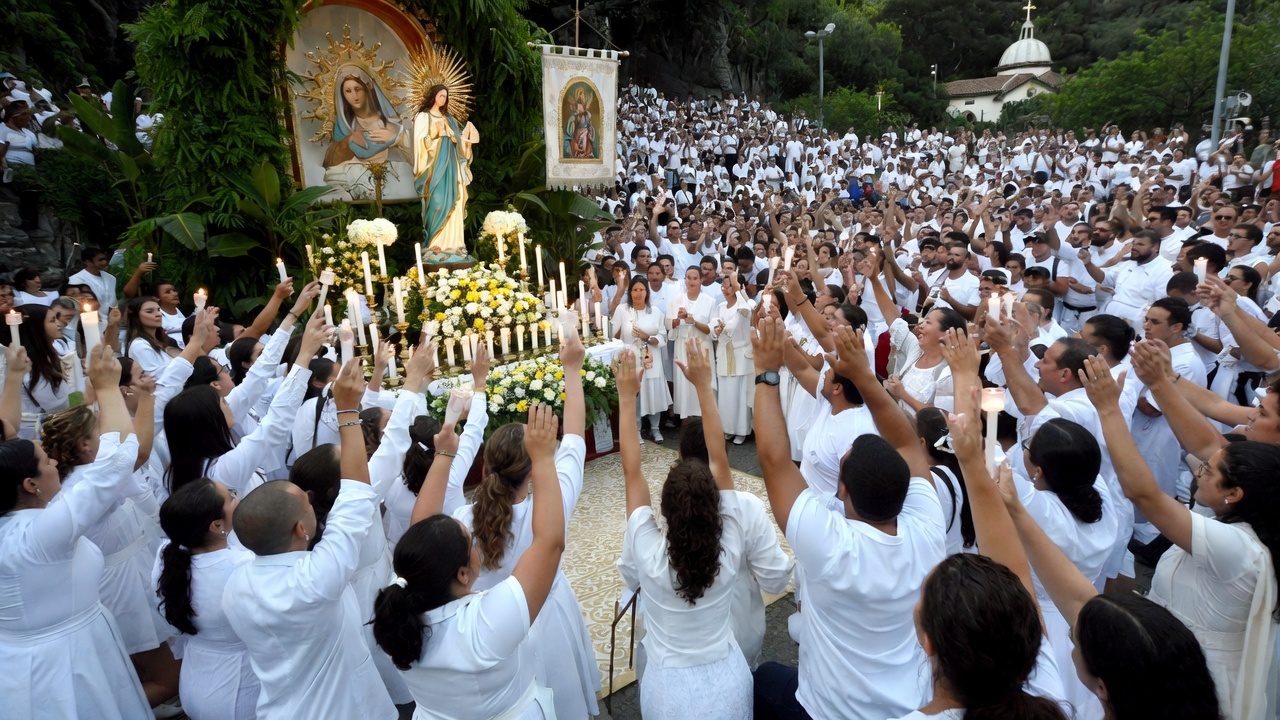
The evening torchlight procession (procession aux flambeaux) is one of the most moving experiences in all of Christendom. Thousands of pilgrims walk through the Sanctuary grounds carrying lit candles while singing hymns, including the beloved Ave Maria de Lourdes. In February, the winter darkness descends early, intensifying the atmosphere. The flickering of thousands of candle flames against the cold Pyrenean night is something I have never been able to adequately describe to those who have not experienced it.
The World Day of Prayer to Our Lady of Lourdes
The Sanctuary also hosts its annual World Day of Prayer on February 11, inviting Catholics worldwide to unite in prayer with pilgrims present at the site or joining from their homes. Remote participants can access livestreamed events through the Sanctuary’s website and social media channels.
What to See at the Sanctuary of Our Lady of Lourdes: A Complete Visitor’s Guide
The Sanctuary domain (le Domaine) covers a vast area along the south bank of the Gave de Pau. It is open year-round, and admission is free. Here are the essential sites within the Sanctuary:
The Grotto of Massabielle
This is the heart of Lourdes — the very cave where Bernadette saw the apparitions. A marble statue of the Virgin Mary stands in the niche where the Lady appeared. Pilgrims file past in a continuous, quiet line. Many touch or kiss the rock wall. The spring that Bernadette uncovered still flows from within the grotto, channeled into taps and fountains nearby. You are welcome to fill bottles with Lourdes water at no charge.
Practical note: During the feast day, expect significant crowds at the Grotto. If you prefer a contemplative visit, come very early in the morning — before 7:00 AM — or late in the evening after the torchlight procession.
The Three Basilicas
Lourdes is unique in having three basilicas stacked above and around the Grotto:
- The Basilica of the Immaculate Conception (Upper Basilica): Consecrated in 1876, this is the oldest church in the Sanctuary. It is 51 meters long and 21 meters wide, with stunning stained glass windows depicting the apparitions and the dogma of the Immaculate Conception. Several side chapels are dedicated to saints including St. Peter, St. Joseph, and St. Francis of Assisi.
- The Basilica of Our Lady of the Rosary (Rosary Basilica): Built in Roman-Byzantine style below the Upper Basilica, it covers 2,000 square meters and features magnificent Venetian mosaics depicting the fifteen mysteries of the Rosary. It was completed in 1899 and serves as the visual anchor of the Sanctuary’s façade.
- The Basilica of Saint Pius X (Underground Basilica): This massive subterranean church was completed in 1958 for the centenary of the apparitions. Holding up to 25,000 people, it is one of the largest churches in the world by capacity. Its oval shape and concrete pillars give it a modern, almost arena-like feel. Major International Masses and feast day celebrations are held here.
The Baths (Les Piscines)
The Lourdes baths are where pilgrims can fully immerse themselves in water from the miraculous spring. The experience is deeply personal and profoundly moving. Volunteer helpers called hospitaliers assist bathers, especially those who are sick or have disabilities. The water is cold — typically around 12°C (54°F) year-round — and the immersion is brief. There is no obligation to undress fully; the volunteers provide wraps for modesty.
Important 2026 update: The baths fully reopened after COVID-19 pandemic restrictions in August 2024, according to reporting by OSV News. All pilgrims, including those with disabilities, can once again fully immerse in the spring waters.
The Stations of the Cross
The Chemin de Croix (Way of the Cross) winds up the hillside behind the basilicas. Life-sized bronze statues by the sculptor Raffl depict the fourteen traditional stations. The path is steep in places and takes about 45 minutes to one hour to complete. In February, sections of the path may be slippery if conditions are wet or icy — wear sturdy shoes.
The Bureau of Medical Observations
For those interested in the intersection of faith and science, the Bureau des Constatations Médicales is a fascinating stop. Created in 1883, this office has documented over 7,000 case files of reported healings. It is currently led by Dr. Alessandro de Franciscis. An exhibition at the Bureau explains the rigorous, multi-step medical and canonical process by which a cure is investigated and potentially recognized as miraculous.
The 72nd Miracle of Lourdes: Antonia Raco’s Story and What It Means for Pilgrims
The year 2025 brought extraordinary news to Lourdes. On April 16, 2025, the Bishop of Tursi-Lagonegro in southern Italy officially proclaimed the 72nd recognized miracle of Lourdes — the healing of Antonia Raco, a 67-year-old Italian woman who had suffered from primary lateral sclerosis (PLS), an incurable neurodegenerative disease.
Raco first experienced symptoms in 2004: severe headaches, cramps, and difficulty walking. By 2006, she had been diagnosed by specialists at the University of Turin. Her condition worsened steadily, eventually confining her to a wheelchair. In the summer of 2009, she traveled to Lourdes with the Italian pilgrimage organization UNITALSI and was brought to the baths by volunteer caregivers.
During the immersion, she later recounted at a press conference in Lourdes on July 25, 2025, she heard a voice say three times: “Don’t be afraid!” She felt a sharp pain in her legs. She returned home still in a wheelchair — but soon after, in her living room, she stood and walked. The symptoms of her disease had completely vanished.
The investigation took 16 years. In November 2024, a secret vote among 21 members of the International Medical Committee of Lourdes (CMIL) produced 17 votes in favor, declaring the cure “unexpected, complete, lasting, and unexplained according to medical knowledge.” The required two-thirds majority was met.
This miracle arrived only months after the confirmation of the 71st miracle — the healing of John Traynor, a British soldier wounded during World War I, who was cured after immersion in the baths in 1923. His miracle was formally recognized on December 8, 2024, by the Archbishop of Liverpool, making it one of the longest intervals between a healing event and formal recognition in Church history.
For pilgrims visiting Lourdes in February 2026, these recent recognitions serve as a powerful reminder that the spring still flows, the baths still welcome the sick, and the tradition of healing — whether physical, spiritual, or both — continues unbroken since 1858.
Lourdes Weather in February: What to Expect and How to Pack
February is a winter month in Lourdes, and the town’s location at the foot of the Pyrenees means you should prepare for cold, damp conditions. The beauty of visiting during this season is the lack of crowds and the deeply intimate atmosphere — but the weather demands respect.
February Climate Data for Lourdes
| Metric | Average Value |
|---|---|
| Average high temperature | 10–12°C (50–53°F) |
| Average low temperature | 0–2°C (32–35°F) |
| Rainfall days per month | ~13 days |
| Average monthly rainfall | 62–85 mm |
| Snowfall days | ~4 days |
| Average daily sunshine | ~6 hours |
| Humidity | ~82% |
| Daylight hours | ~10.5 hours |
Packing Essentials for a February Lourdes Pilgrimage
The key to comfort in Lourdes in February is layering. Mornings can be near freezing, afternoons may warm to a pleasant 12°C in sunshine, and evenings drop quickly after sunset.
- Thermal base layer — merino wool or synthetic — worn under regular clothing makes an enormous difference.
- Warm fleece or wool sweater as a mid-layer.
- Waterproof and windproof outer jacket — rain is frequent and often arrives without warning.
- Waterproof walking shoes or boots — the Stations of the Cross path and some cobblestone streets can be slippery when wet.
- Scarf, hat, and gloves — essential for the evening torchlight procession.
- Umbrella — compact and easy to carry.
- Comfortable walking shoes — you will walk a great deal within the Sanctuary domain and through town.
If you plan to use the baths: The water is cold year-round, and in February, the air is cold as well. Volunteers will provide you with a lightweight wrap. Bring a towel and a change of warm clothing to put on immediately after immersion.
Beyond the Sanctuary: Top Things to Do in Lourdes for Pilgrims and Tourists
Lourdes is much more than its Sanctuary. The town and its surroundings offer rich historical, cultural, and natural attractions that reward even the most spiritually focused visitor with moments of discovery and wonder.
Château Fort de Lourdes (Lourdes Castle)
Perched on a rocky hill overlooking the town, this medieval fortress predates the apparitions by centuries. Its origins trace to the Roman era, though the current structure largely dates from the Middle Ages. During the Hundred Years’ War, Lourdes belonged to England for 45 years. Today, the château houses the Musée Pyrénéen, which displays artifacts and exhibits about the culture and traditions of the Pyrenees region. The views from the battlements are spectacular — on clear days, you can see snowcapped peaks stretching to the horizon.
The Birthplace of Bernadette Soubirous
Two sites are connected to Bernadette’s early life:
- The Boly Mill (Moulin de Boly): Bernadette’s birthplace. It has been preserved and is open for visits.
- The Cachot: A former prison cell where Bernadette’s impoverished family lived at the time of the apparitions. Seeing this tiny, dark room puts her story into stark and humbling context.
The Lourdes Covered Market (Les Halles)
For a taste of local Pyrenean culture, visit the covered market where vendors sell regional cheeses, honeys, jams, wines, and charcuterie. The market is a grounding, everyday counterpoint to the spiritual intensity of the Sanctuary.
The Pic du Midi de Bigorre
If you have an extra day and clear weather, the Pic du Midi — an astronomical observatory perched at 2,877 meters (9,439 feet) above sea level — is one of the most dramatic day trips from Lourdes. A cable car carries visitors to the summit, where panoramic terraces offer breathtaking views of the Pyrenees chain. In February, the mountain is covered in snow, and the observatory often sits above the clouds.
The Pyrenees National Park
Lourdes is a gateway to the Parc National des Pyrénées, one of France’s most beautiful protected natural areas. While deep-winter snow limits some hiking trails, the Pont d’Espagne and the Cirque de Gavarnie (a UNESCO World Heritage Site) are accessible on clear days and offer stunning winter landscapes. Both are within an hour’s drive of Lourdes.
Lourdes New Spiritual Journey 2026: What Pilgrims Need to Know
Starting in 2026, the Sanctuary of Lourdes has announced a new three-year spiritual journey based on the Gospel according to Saint Luke. This multi-year program is designed to provide a fresh framework for pilgrimages and reflection, as announced on the Sanctuary’s official website.
The choice of Luke’s Gospel is fitting. It is Luke who records the parable of the Good Samaritan — the very passage at the center of the 2026 World Day of the Sick. Luke’s Gospel is also known as the “Gospel of mercy” for its emphasis on compassion, healing, and God’s care for the marginalized.
For pilgrims traveling to Lourdes in 2026, this new spiritual journey means that homilies, catechetical materials, prayer guides, and Sanctuary programming will be shaped by Lukan themes throughout the year. It offers a deeper dimension to any visit — an invitation to not simply pass through the Sanctuary, but to enter into a sustained engagement with the scriptural foundations of what Lourdes represents.
Practical Travel Tips for Visiting Lourdes During the February Feast
Accessibility and Mobility
Lourdes is one of the most accessible pilgrimage destinations in the world. The Sanctuary grounds are largely flat and paved, with ramps and wide pathways designed for wheelchair users. The baths have dedicated assistance for those with limited mobility. Volunteer helpers (hospitaliers) are stationed throughout the domain.
However, the town itself has some steep hills and narrow streets. Local buses run regularly if walking is difficult. A small tourist train operates during peak season (it may not run in February — check locally). If you need a wheelchair, you can bring your own collapsible model or request one through your pilgrimage organizer or hotel.
Language
French is the primary language in Lourdes, but the town is deeply international. Hotel staff, restaurant servers, and Sanctuary volunteers often speak English, Italian, Spanish, and other languages. Masses at the Sanctuary are offered in multiple languages, and the February 11 International Mass typically includes readings and prayers in several tongues.
Currency and Payments
France uses the euro (€). Credit and debit cards are widely accepted at hotels, restaurants, and larger shops. However, some local bus services and small vendors may prefer cash — it is wise to carry some euros, particularly if you have an international card that may not always work with local terminals.
Electrical Adapters
France uses Type C and Type E electrical outlets (two-pin, round). If you are traveling from the UK, the US, or most non-European countries, you will need an adapter. Voltage is 230V / 50Hz.
Food and Dining
Lourdes offers a range of dining options, from small cafés to hotel restaurants that welcome non-guests. In February, some establishments close for the winter low season, but those near the Sanctuary and town center generally remain open. Pyrenean cuisine is hearty and ideal for cold weather — look for garbure (a thick cabbage and meat soup), local cheeses like Ossau-Iraty, mountain ham, and duck dishes. Several supermarkets (including E.Leclerc, Carrefour, and Lidl) are available for self-catering guests.
Religious Etiquette and Cultural Sensitivity
Lourdes is, above all, a place of prayer. While the town welcomes tourists of all backgrounds, visitors should observe basic respect within the Sanctuary:
- Dress modestly — cover shoulders and knees when entering the basilicas.
- Maintain silence in the Grotto area and during processions.
- Do not photograph during Mass or other liturgical celebrations unless you see a clear indication that it is permitted.
- Approach the baths with reverence — this is a deeply sacred experience for many pilgrims, especially the sick.
- Be patient in queues — lines at the Grotto and the baths can be long, but the atmosphere is one of gentle solidarity.
How to Plan a Lourdes Pilgrimage for Someone Who Is Sick or Has a Disability
The World Day of the Sick exists because Lourdes has always placed the ill at the center of its mission. Planning a pilgrimage for someone with a serious illness or disability requires some extra preparation, but Lourdes is uniquely equipped to welcome such visitors.
Medical Facilities
The Sanctuary has its own Accueil Notre-Dame, a hospitality center with medical staff that provides care and rest for sick pilgrims. The town also has a local hospital and pharmacies. If you or a companion have specific medical needs, coordinate with your pilgrimage organizer or contact the Sanctuary information center (telephone: +33 (0)5 62 42 20 08).
Organized Pilgrimage Groups
Many pilgrims, particularly those who are ill, travel to Lourdes through organized groups. These are run by dioceses, religious orders, and dedicated organizations such as:
- UNITALSI (Italy) — the organization that brought Antonia Raco on the pilgrimage during which she was healed.
- The Order of Malta — active worldwide, including in the US, where it organizes a bilingual Mass and Anointing of the Sick in observance of the World Day of the Sick.
- Various diocesan pilgrimage offices — check with your local diocese for organized trips to Lourdes.
Wheelchair and Mobility Equipment
If you cannot bring your own wheelchair, options are available:
- Request a wheelchair through your pilgrimage organizer or hotel.
- Consider a folding mobility scooter — these are increasingly common among Lourdes pilgrims.
- Airport wheelchair assistance is routinely available at both Tarbes-Lourdes and Toulouse airports.
A travel companion is essential if you require physical assistance. Pilgrimage guides and priests cannot serve as personal caregivers, but the network of volunteer hospitaliers within the Sanctuary is extraordinary.
Lourdes February Travel Budget: How Much Does a Pilgrimage Cost in 2026?
One of the most frequently asked questions about visiting Lourdes is cost. The good news: February is one of the most affordable months to visit. Here is a rough budget guide for a three-night stay around the feast day:
| Expense | Budget Traveler | Mid-Range Traveler | Comfortable Traveler |
|---|---|---|---|
| Accommodation (3 nights) | €105–€180 | €180–€360 | €360–€600 |
| Meals (3 days) | €60–€90 | €90–€150 | €150–€250 |
| Transport (from Toulouse) | €30–€60 (train) | €60–€100 (rental car) | €100–€270 (private transfer) |
| Sanctuary entry | Free | Free | Free |
| Lourdes water | Free | Free | Free |
| Candles, religious items | €10–€30 | €20–€50 | €50–€100 |
| Day trip (Pic du Midi, etc.) | €30–€50 | €50–€80 | €80–€120 |
| Estimated total | €235–€410 | €400–€740 | €740–€1,340 |
The Sanctuary itself charges nothing for admission, nothing for Lourdes water, and nothing for participation in any of its liturgical events or processions. This is a deeply important principle of Lourdes: the core spiritual experience is free and open to all.
Understanding the Recognized Miracles of Lourdes: A Brief History
Since 1858, the Catholic Church has officially recognized 72 miraculous healings at Lourdes. This number is deliberately conservative. The Bureau of Medical Observations has documented over 7,000 case files of reported cures. The process of recognition is among the most rigorous in any religious or scientific context.
How a Miracle Is Recognized at Lourdes
The path from reported cure to recognized miracle follows multiple stages:
- Initial Report: The healed person reports their cure to the Bureau of Medical Observations in Lourdes, ideally returning in person for examination.
- Medical Investigation: The Bureau and then the International Medical Committee of Lourdes (CMIL) — composed of independent physicians and specialists from around the world — evaluate the case. They must determine that the cure is “unexpected, complete, lasting, and unexplained” by current medical knowledge.
- Vote: The CMIL votes in secret session. A two-thirds majority is required to advance the case.
- Episcopal Declaration: The file is forwarded to the bishop of the healed person’s home diocese, who appoints a theological and medical commission. If the bishop is satisfied, he formally declares the healing to be miraculous.
The most recent recognitions — the 71st miracle (John Traynor, December 2024) and the 72nd miracle (Antonia Raco, April 2025) — illustrate both the thoroughness of this process and the reality that miracles continue to be recognized in our own time.
Celebrating the Feast of Our Lady of Lourdes Outside of France
Not everyone can travel to Lourdes on February 11. But the feast and the World Day of the Sick are observed worldwide. Here are some ways to participate from wherever you are:
Parish Celebrations
Many Catholic parishes hold special Masses, anointing of the sick services, or prayer vigils on or near February 11. In the United States, for example, the Order of Malta has organized a bilingual (English/Spanish) Mass and Anointing of the Sick at the Cathedral of Our Lady of the Angels in Los Angeles on Saturday, February 7, 2026, according to the Archdiocese of Los Angeles.
Novena to Our Lady of Lourdes
The nine-day Novena to Our Lady of Lourdes runs from February 3 to February 11, 2026. Various Catholic organizations offer daily prayers and reflections, including the Missionary Oblates of Mary Immaculate, who also offer to light votive candles at the National Shrine of Our Lady of the Snows in Belleville, Illinois, for those who submit their intentions.
Livestream from Lourdes
The Sanctuary offers livestreamed coverage of major feast day events, including the International Mass, the Angelus at the Grotto, and the torchlight procession. Visit the Sanctuary’s official website at www.lourdes-france.com for broadcast links and schedules.
Lourdes Water at Home
Many Catholic families keep a small bottle of Lourdes water in their homes. If you have visited Lourdes before (or know someone who has), February 11 is a traditional day to bless your home or anoint a sick family member with the water. The water is provided free of charge at the Sanctuary and can be legally brought through customs in most countries.
Frequently Asked Questions About Visiting Lourdes for the Feast Day
Is the Sanctuary open in February? Yes. The Sanctuary of Our Lady of Lourdes is open year-round. Some hotels and shops in town close during the winter low season, but the Sanctuary, the Grotto, and the basilicas are always accessible.
Do I need to be Catholic to visit Lourdes? No. Lourdes welcomes visitors of all faiths and none. The Sanctuary is a public space. You can walk the grounds, visit the Grotto, fill a bottle with spring water, and attend the torchlight procession regardless of your religious beliefs. The baths are also open to all.
Can I drink the Lourdes water? Yes. The spring water has been analyzed and found to be potable. It contains no curative properties identifiable by science. The Catholic Church permits its use but takes no official position on its healing properties. You may drink it, bathe in it, or take it home in bottles.
Is travel insurance recommended? Yes, especially if you or a companion have health concerns. Standard European travel insurance is advisable. If you are traveling from outside the EU, ensure your policy covers medical care in France.
What if I cannot walk long distances? Lourdes is highly accessible. Wheelchairs are available, the Sanctuary is flat and paved, and volunteer helpers assist pilgrims throughout. Local buses serve the town for those who cannot walk steep streets.
Is February 11 a public holiday in France? No. The Feast of Our Lady of Lourdes is a Catholic liturgical observance, not a French public holiday. Normal business operations continue, though Lourdes itself is clearly focused on the feast.
Final Thoughts: Why Lourdes in February Stays With You
There is a quality to Lourdes in February that the summer months cannot replicate. The town is quieter. The Pyrenees are dusted with snow. The cold air sharpens your senses. And the reason you have come — whether to mark the feast, to pray for a sick loved one, to seek your own healing, or simply to stand where Bernadette stood — feels more present and more personal without the summer crowds.
The convergence of the Feast of Our Lady of Lourdes and the World Day of the Sick is not accidental. It is a statement that faith and suffering are not opposites. That a cave in the foothills of the Pyrenees, where a poor fourteen-year-old girl once heard the wind, can still be a place where the impossible is gently, stubbornly held open.
In 2026, with a new Pope carrying forward the tradition, with the 72nd miracle freshly proclaimed, and with a new three-year spiritual journey beginning, Lourdes enters its next chapter. The spring still flows. The candles still burn. And on February 11, the world still turns toward this small, remarkable town.
Bonne route, and may Our Lady of Lourdes watch over your journey.
Disclaimer: This article is for informational and cultural purposes. It does not constitute medical advice. If you or a loved one are experiencing a health condition, please consult a qualified healthcare professional. Travel information is current as of early February 2026 and may be subject to change.