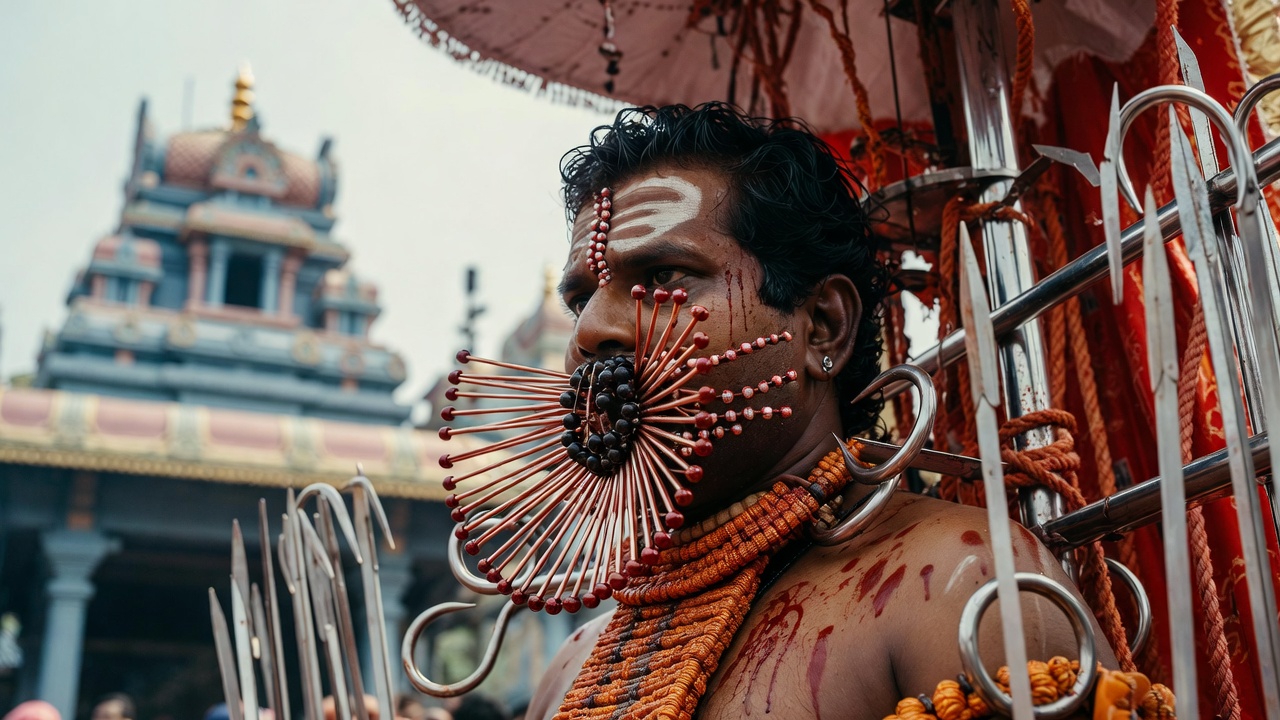
The morning air is thick with incense. Drums pound in hypnotic rhythms. A man stands motionless as a priest pushes a silver skewer through his cheek. There is no blood. There is no scream. Only a serene expression of absolute devotion.
This is Thaipusam—one of the most visually stunning and spiritually profound religious festivals on Earth.
For travelers seeking authentic cultural experiences, witnessing the Thaipusam body piercing rituals challenges everything we think we know about human endurance, faith, and the mysterious connection between mind and body.
In this comprehensive guide, we’ll explore the ancient origins of Thaipusam, the spiritual significance behind the piercing rituals, the science of trance states, and everything you need to know to experience this remarkable festival firsthand.
What is Thaipusam and Why Do Devotees Pierce Their Bodies?
Thaipusam (Tamil: தைப்பூசம்) is a Tamil Hindu festival celebrated on the first full moon day of the Tamil month of Thai, which typically falls in January or February. The name itself reveals its astronomical significance: “Thai” refers to the tenth month of the Tamil calendar, while “Pusam” refers to the star that shines brightest during the festival.
This sacred celebration commemorates the day when Goddess Parvati bestowed a divine spear called the Vel upon her son, Lord Murugan, enabling him to vanquish the demon Surapadman. The victory represents the eternal triumph of good over evil.
But Thaipusam is far more than a historical commemoration.
The piercings serve multiple spiritual purposes:
- Debt bondage to the divine — Devotees believe they owe a spiritual debt to Lord Murugan for prayers answered
- Purification through sacrifice — Physical pain cleanses the soul of accumulated sins
- Surrender of ego — The ritual helps devotees overcome anger, lust, greed, and hatred
- Demonstration of absolute faith — Enduring pain proves unwavering devotion
According to Hinduism Today, the power and presence of Lord Murugan can be felt throughout the three-day event, with thousands of devotees experiencing a divine trance state called “arul vaku” (trance of grace).
The History and Origins of Thaipusam Body Piercing Rituals
Ancient Roots in Tamil Nadu, India
The origins of Thaipusam stretch back centuries to Tamil Nadu in southern India. Lord Murugan, also known as Skanda, Kartikeya, or Subrahmanya, holds a special place in Tamil Hindu worship as the patron deity of the Tamil people.
According to the Kanda Puranam (the sacred text describing Murugan’s exploits), the demon Surapadman had received boons from Lord Shiva that made him nearly invincible. He terrorized the three worlds until the gods sought help.
The divine solution came through Murugan:
- Murugan was born from the sparks emanating from Lord Shiva’s third eye
- Goddess Parvati granted him the Vel (divine spear) to defeat evil
- He waged war against Surapadman and his demon armies
- Using the Vel, Murugan split Surapadman into two halves
- The halves transformed into a peacock (now Murugan’s mount) and a rooster (his battle flag)
This victory is celebrated annually during Thaipusam.
How the Festival Came to Malaysia and Southeast Asia
While Thaipusam has ancient roots in India, the most spectacular celebrations today occur in Malaysia and Singapore. This migration of tradition followed the movement of Tamil workers during British colonial rule in the 19th century.
The pivotal moment came in 1891 when K. Thambasamy, a leader of the Kuala Lumpur Hindu community, noticed that the entrance to the Batu Caves resembled the shape of Lord Murugan’s Vel. He established a shrine within the main chamber, and the first Thaipusam celebration at Batu Caves took place in 1892.
Interestingly, the festival in Malaysia has become more elaborate than in India itself. As noted by Travel Begins at 40, many Indians consider the Malaysian version to be “purer and more religious” than celebrations in India, where public self-mortification is prohibited by law.
Understanding Kavadi: The Sacred Burden of Thaipusam Devotees
What is a Kavadi and What Does It Symbolize?
The word Kavadi comes from the Tamil words “kaavu” (pole) and “tadi” (stick), literally meaning “a pole used for carrying things.” But the Kavadi is far more than a simple carrying device—it represents the physical manifestation of spiritual burden.
The symbolism is profound:
- The weight represents life’s challenges and hardships
- Carrying the Kavadi demonstrates willingness to bear burdens for the divine
- The journey itself symbolizes the pilgrim’s path toward spiritual liberation
- The piercings that secure the Kavadi create a direct physical connection to the offering
According to legend, a devotee of Lord Murugan named Idumban once carried two sacred hills on his shoulders using a pole. Lord Murugan declared that anyone who carries a similar burden with devotion would receive his blessings. This forms the spiritual foundation of the Kavadi tradition.
Types of Kavadi Used in Thaipusam Celebrations
| Kavadi Type | Description | Weight | Piercings Required |
|---|---|---|---|
| Paal Kavadi | Simple pot of milk carried on the head | 2-5 kg | None or minimal |
| Pushpa Kavadi | Flower-decorated frame on shoulders | 5-15 kg | Tongue and cheek piercings |
| Alangara Kavadi | Ornate structure with peacock motifs | 15-30 kg | Multiple body piercings |
| Vel Kavadi | Elaborate altar up to 4 meters tall | 30-100 kg | Extensive hooks and skewers |
| Alagu Kavadi | Chariot pulled by hooks in the back | Variable | Heavy hook piercings |
| Karumbu Toddi | Parents carry child with sugarcane | Light | Usually none |
The most extreme form is the Vel Kavadi, which according to Wikipedia can reach up to 2 metres (6 ft 7 in) tall and weigh up to 30 kg (66 lb), decorated with peacock feathers and attached to the devotee’s body through multiple skewers and metal hooks.
The 48-Day Preparation Period Before Thaipusam Piercings
The piercing rituals are not spontaneous acts. They require 48 days of rigorous spiritual preparation—a period known as one “mandala” in Hindu tradition.
Physical and Spiritual Disciplines Required
Dietary restrictions:
- Strict vegetarian diet (sattvic foods only)
- Often limited to one simple meal per day
- Complete avoidance of alcohol and stimulants
- Some devotees consume only fruits and milk
Behavioral observances:
- Celibacy throughout the 48-day period
- Regular prayers morning and evening
- Chanting of mantras and hymns
- Sleeping on hard floors (for some devotees)
- Maintaining cleanliness through regular purificatory baths
Mental preparation:
- Constant remembrance of Lord Murugan
- Reading of sacred texts (Sastras)
- Maintaining a peaceful state of mind
- Avoiding anger, conflict, and negative emotions
As explained by Malaysia Fact, this period of abstinence fundamentally alters the body’s biochemistry. By the time Thaipusam arrives, the devotee is in a state of high mental focus and metabolic purity.
The Final 24 Hours: Complete Fasting and Silence
The intensity increases dramatically in the final day before the ritual:
- Complete fasting from all food
- Some observe a vow of silence
- Continuous prayer and meditation
- Purificatory bath before beginning the procession
- Donning of sacred attire in yellow or orange (Lord Murugan’s colors)
This preparation is not merely symbolic. It serves as a physiological and psychological primer for the intense physical stress to come. The body, free of toxins, and the mind, honed by discipline, react differently to pain stimuli than an unprepared individual would experience.
The Science Behind Thaipusam Piercings: Why Devotees Don’t Bleed
One of the most astonishing aspects of Thaipusam piercings is the apparent absence of blood and pain. Devotees with dozens of hooks piercing their skin dance through the streets without grimacing. Skewers pass through cheeks leaving minimal blood. How is this possible?
The Role of Trance States in Pain Suppression
Scientific researchers have studied this phenomenon. A landmark study published in the journal Transcultural Psychiatry examined the drum and dance-induced trances of Thaipusam participants in Kuala Lumpur in 1984.
The research explored the hypothesis that endorphins—the body’s natural painkillers—play a crucial role in the analgesia (pain suppression) observed during Thaipusam trances. The study suggested that these trance states represent “a specific mode of functioning of the central nervous system.”
Key findings about trance-induced analgesia:
- The analgesia specifically affects epicritic pain (pain from skin)
- Rhythmic drumming and chanting help induce altered consciousness
- The trance state can be triggered and terminated by specific stimuli
- Different devotees exhibit varying degrees of trance susceptibility
Physiological Changes During the Ritual
Several physiological mechanisms work together:
1. Vasoconstriction According to Malaysia Fact, the devotee’s heightened physiological state causes vasoconstriction (narrowing of blood vessels), which explains why piercing sites remain relatively dry.
2. Fasting-Induced Metabolic Changes The 48-day preparation alters the body’s biochemistry:
- Reduced inflammation response
- Altered pain perception thresholds
- Enhanced natural endorphin production
- Heightened focus and mental clarity
3. Precise Piercing Technique The piercers (who perform a crucial but often overlooked role) are skilled practitioners:
- They know exactly where to place hooks to avoid major blood vessels
- The piercings typically go through superficial skin layers
- Vibhuti (holy ash) is applied to piercing sites, which may have antiseptic properties
The Psychology of Faith and Pain Tolerance
Psychology explains what biology cannot fully account for. The unwavering belief that Lord Murugan is protecting them allows devotees to transcend normal pain thresholds.
As one experienced body piercer named Yashven Raj Vigneswaran explained to the South China Morning Post, “People who get body piercings claim they experience little to no discomfort… We know that they are awake when the pricks are inserted since the majority of them promise to have their bodies pierced before they enter a trance.”
Remarkably, Yashven also noted an unusual phenomenon: “For instance, you will experience back agony if you pierce someone else’s back. It’s true since I’ve experienced it myself.” The piercers often feel the pain that the devotees do not.
Experiencing Thaipusam at Batu Caves Malaysia: A Complete Guide
Why Batu Caves is the World’s Largest Thaipusam Celebration
The Batu Caves temple complex, located about 13 kilometers north of Kuala Lumpur, has become the global epicenter of Thaipusam celebrations. The site features:
- A 140-foot-tall golden statue of Lord Murugan (the world’s tallest, installed in 2006)
- 272 colorful steps leading to the main temple cave
- Multiple shrines within the limestone cave system
- Capacity to accommodate millions of visitors
According to the Star Malaysia, over 2.5 million people are expected to visit Batu Caves for the 2026 Thaipusam celebrations, making it one of the largest religious gatherings in the world outside of India.
Thaipusam 2026 Schedule and Key Events
| Date | Event | Location |
|---|---|---|
| January 29, 2026 | Flag hoisting ceremony (rooster flag) | Batu Caves |
| January 30, 2026 | Silver Chariot procession begins | Sri Mahamariamman Temple, KL |
| January 30-31, 2026 | 15km chariot journey through streets | Kuala Lumpur to Batu Caves |
| February 1, 2026 | Main Thaipusam Day | Batu Caves |
| All days | Kavadi processions and rituals | Throughout the complex |
What to Expect During Your Visit
The Silver Chariot Procession (Day 1-2)
The celebrations begin with the departure of the massive Silver Chariot from Sri Mahamariamman Temple in Kuala Lumpur’s Chinatown. This ornate chariot carries a statue of Lord Murugan on its approximately 15-kilometer journey to Batu Caves. According to Travel Begins at 40, around 50,000 devotees accompany the chariot, breaking coconuts along the way as acts of humility and sacrifice.
The Main Day Rituals
On Thaipusam day itself, the experience is overwhelming to the senses:
- Before sunrise: Priests bathe the deities in rosewater, milk, honey, and ghee
- Early morning: Kavadi bearers begin their preparations, entering trance states
- Throughout the day: A continuous stream of devotees climbs the 272 steps
- All night: Rituals continue under lights, with the cave temple open until late
Sights You Will Witness
- Men with dozens of hooks piercing their backs, pulling chariots
- Devotees with large silver skewers through their cheeks and tongues
- Women carrying paal kudam (milk pots) on their heads
- Children participating in lighter forms of devotion
- Elaborate Kavadi structures adorned with peacock feathers
- Devotees walking on spiked shoes as additional penance
- Families performing pujas (prayers) at makeshift altars
Thaipusam in Singapore: A Different but Equally Powerful Experience
While Malaysia hosts the largest celebrations, Singapore offers a more intimate but equally powerful Thaipusam experience.
The Singapore Kavadi Procession Route
The procession in Singapore follows a 4-kilometer route:
Starting Point: Sri Srinivasa Perumal Temple (Serangoon Road, Little India) Ending Point: Sri Thendayuthapani Temple (Tank Road)
According to Holidify, the most distinct feature of Thaipusam in Singapore is the huge adorned kavadi, which involves extensive skin piercings. Women and children also actively participate by carrying large pots of milk.
Key Differences from Malaysia
| Aspect | Malaysia (Batu Caves) | Singapore |
|---|---|---|
| Scale | 2.5+ million visitors | ~20,000 participants |
| Duration | 3-4 days | Primarily one day |
| Setting | Dramatic cave temple | Urban street procession |
| Atmosphere | Overwhelming, chaotic | More controlled, regulated |
| Accessibility | Requires transport | Central, easily accessible |
| Photography | More challenging | Better opportunities |
2026 Singapore Thaipusam Information
For 2026, the Singapore procession is expected to begin on the evening of January 31 and continue through February 1.
Personal Stories: Why Devotees Choose to Bear the Kavadi
Behind every pierced devotee is a deeply personal story. During my research, I encountered numerous accounts that illuminate the profound motivations behind this practice.
Stories of Healing and Gratitude
The University Student One young man had his body pierced to give thanks for being admitted to study IT at university. His family surrounded him as hooks were inserted into his back, their prayers mixing with the drums.
The New Mother A young woman had her forehead pierced by a small skewer to celebrate the birth of her baby son after years of trying to conceive. Her gratitude to Lord Murugan found expression through physical offering.
The Kidney Transplant Survivor In Penang, three Western friends participated together—one had recently survived a difficult kidney transplant and wished to honor the divine intervention he believed saved his life.
The Businessman Another devotee, whose friends took turns pulling the hooks attached to his back, was participating to praise Lord Murugan for “good business” throughout the year.
The Generational Tradition
According to Hinduism Today, many devotees begin bearing offerings from their teenage years—initially to fulfill specific vows, but over time as an integral part of their spiritual practice. The tradition often passes from parent to child, creating unbroken chains of devotion spanning generations.
Photography and Etiquette: How to Respectfully Experience Thaipusam
Essential Guidelines for Visitors
Dress Code:
- Wear modest, covered clothing
- Yellow and orange are appreciated (Lord Murugan’s colors)
- Remove shoes when entering temple areas
- Women should tie their hair
Behavioral Guidelines:
- Be respectful at all times
- Ask permission before photographing individuals
- Never mock or show disdain for the rituals
- Avoid public displays of affection
- Do not consume alcohol or non-vegetarian food nearby
- Keep noise to appropriate levels
Photography Tips:
- Early morning offers the best light and fewer crowds
- Respect “no photography” zones
- Capture the emotion, not just the spectacle
- Wide-angle lenses help in crowded conditions
- Bring extra batteries—you’ll shoot more than expected
Common Mistakes to Avoid
❌ Treating the festival as mere entertainment ❌ Interfering with devotees in trance states ❌ Littering (last year, nearly three tonnes of discarded shoes became waste) ❌ Wearing inappropriate clothing ❌ Blocking procession routes ❌ Being disrespectful to families in prayer
Medical Considerations and Safety at Thaipusam
Are Thaipusam Piercings Safe?
While devotees typically emerge unharmed, there are medical considerations. According to a case study published in PMC, complications such as bleeding, infection, and granulomatous reactions are rare despite the thousands of piercings performed.
The study documented a case of delayed granulomatous reaction appearing 15 years after a vel piercing during Thaipusam. However, such complications remain exceptional rather than common.
Factors contributing to safety:
- The application of Vibhuti (holy ash) to piercing sites
- The use of sterilized stainless steel implements
- The presence of medical teams at major celebration sites
- The physiological changes induced by fasting and meditation
- The rapid removal of piercings after the ritual completes
Health Precautions for Visitors
If you’re attending Thaipusam as a visitor:
- Stay hydrated: Malaysian heat can be intense
- Wear comfortable shoes: You’ll walk extensively
- Protect against sun: Bring sunscreen and a hat
- Carry water: Vendors may be far away
- Be aware of crowds: Stampede risk exists at peak times
- Know first aid locations: Medical tents are usually present
The Global Reach of Thaipusam Celebrations
Where Else is Thaipusam Celebrated?
| Country | Key Location | Notable Features |
|---|---|---|
| Malaysia | Batu Caves, Kuala Lumpur | Largest celebration globally |
| Malaysia | Penang | Historic chariot procession |
| Singapore | Little India | Urban procession |
| India | Palani Temple, Tamil Nadu | 10-day Brahmotsavam |
| India | Tiruchendur | Where Murugan defeated asuras |
| Sri Lanka | Nallur Kandaswamy Temple | Public holiday |
| Mauritius | Kovil Montagne | Cavadee ritual |
| South Africa | Durban | Large Tamil community |
| Fiji | Nadi | Sri Siva Subrahmanya Temple |
| Indonesia | Medan | 100-year-old chariot tradition |
Why Malaysia’s Thaipusam is Considered the “Purest”
A fascinating cultural reversal has occurred. While Thaipusam originated in India, the Malaysian celebrations have become the global standard for several reasons:
- Legal restrictions in India prohibit public self-mortification
- Strong Tamil diaspora in Malaysia maintained traditions purely
- Religious freedom in Malaysia allows full expression of rituals
- Scale of celebration attracts pilgrims from India itself
- Spectacular venue at Batu Caves enhances spiritual atmosphere
Understanding Lord Murugan: The Deity at the Heart of Thaipusam
Who is Lord Murugan?
Lord Murugan (also known as Kartikeya, Skanda, or Subrahmanya) is one of the most important deities in Hindu tradition, particularly among Tamil communities.
Key attributes:
- God of war and victory — Symbolizes the triumph of good over evil
- God of wisdom — Associated with yogic discipline and spiritual knowledge
- Patron of Tamils — Holds special significance in Tamil culture
- Giver of favors — Devotees appeal to him for help and blessings
- Dispenser of moksha — Believed capable of granting spiritual liberation
Iconography:
- Often depicted with multiple faces (typically six)
- Rides a blue peacock (one half of the transformed demon)
- Carries a Vel (divine spear)
- Battle flag features a rooster (the other transformed half)
- Dressed in yellow and orange robes
The Vel: Sacred Weapon and Spiritual Symbol
The Vel holds central importance in Thaipusam:
- Represents divine power granted by Goddess Parvati
- Symbolizes victory over ignorance and evil
- The silver skewers used in piercings represent the Vel
- Having the Vel pass through one’s cheek prevents speech, forcing internal focus
- Creates silence that channels all attention toward Lord Murugan
Planning Your Thaipusam Trip: Practical Travel Information
Best Accommodations Near Batu Caves
Budget Options:
- Hostels in Kuala Lumpur city center (take the KTM Komuter train)
- Budget hotels along Jalan Raja Laut
Mid-Range Options:
- Hotels in Sentul or Titiwangsa areas
- Airbnb properties near Batu Caves MRT station
Luxury Options:
- Five-star hotels in KLCC area with easy rail access
- Resorts in Genting Highlands (30 minutes away)
Transportation Tips
Getting to Batu Caves:
- KTM Komuter: Direct train from KL Sentral (30 minutes)
- Grab/Taxi: Available but expensive during festival
- Bus: RapidKL buses serve the area
- Private tour: Many operators offer festival packages
Important Notes:
- Arrive very early (before 6 AM) to avoid worst crowds
- Expect road closures around Batu Caves
- Return transport becomes difficult late evening
- Consider staying nearby to avoid traffic
What to Pack for Thaipusam
Essential Items:
- [ ] Comfortable walking shoes (that you can remove easily)
- [ ] Modest, loose clothing
- [ ] Sunscreen and hat
- [ ] Multiple water bottles
- [ ] Camera with extra batteries/memory cards
- [ ] Small bag (nothing valuable)
- [ ] Cash in small denominations
- [ ] Phone with offline maps
- [ ] Light rain jacket (weather unpredictable)
Leave Behind:
- Valuables (pickpocketing risk in crowds)
- Heavy backpacks
- Expensive jewelry
- Food or alcohol
Frequently Asked Questions About Thaipusam Piercings
Do the piercings really not hurt?
Devotees consistently report minimal or no pain during the ritual. This is attributed to:
- Deep trance states induced by drums and chanting
- Endorphin release following extended fasting
- Absolute faith in divine protection
- Altered states of consciousness
However, individual experiences vary. Some devotees feel discomfort during piercing insertion, while others report complete absence of sensation.
Can non-Hindus attend Thaipusam?
Absolutely yes. Thaipusam is open to all visitors regardless of religion. The Tamil community generally welcomes respectful observers. However, only Hindus typically participate in the kavadi rituals themselves.
Is it safe to bring children?
Children can attend, but parents should consider:
- Intense visual imagery of piercings
- Extreme crowds and noise
- Limited facilities for young children
- Heat and sun exposure
- Difficulty maintaining supervision
Many Tamil families bring their children as part of religious education. Western visitors should assess their own children’s readiness.
How long does Thaipusam last?
The main day is the full moon day, but celebrations span 3-4 days at major sites:
- Day 1: Flag hoisting and preparations
- Day 2: Chariot procession
- Day 3 (main day): Kavadi processions and rituals
- Day 4: Conclusion and return ceremonies
Are there medical facilities available?
Yes. At major celebration sites like Batu Caves, medical tents are set up to handle:
- Dehydration and heat exhaustion
- Minor injuries
- Emergency situations
- Support for devotees completing rituals
The Deeper Meaning: What Thaipusam Teaches Us About Faith
Beyond the spectacle of piercings and processions lies a profound spiritual message. Thaipusam challenges visitors to reconsider fundamental questions:
About the nature of pain: Is pain purely physical, or can belief transform our experience of it?
About human potential: What are we capable of when faith removes self-imposed limitations?
About community: How does shared ritual create bonds that transcend individual experience?
About devotion: What does it mean to offer everything—including our bodies—to something greater than ourselves?
For devotees, the answers are clear. The piercings are not about self-harm or spectacle. They represent the ultimate surrender of ego—a physical manifestation of spiritual commitment that words alone cannot express.
As one kavadi bearer explained: “I first thought the body is a blemish. Then I realized that the Supreme Being exists in my body. In my body, the Supreme Being resides in a temple within. And hence I worship and nurture my physical body.”
Conclusion: Why Thaipusam Should Be on Every Traveler’s Bucket List
Thaipusam offers something increasingly rare in our modern world: an unfiltered encounter with profound human faith.
In an age of skepticism and surface-level experiences, witnessing devotees transcend physical pain through spiritual devotion is genuinely transformative. It doesn’t matter whether you share their beliefs. What matters is the authenticity of what you witness—real people, real faith, real transcendence.
The festival reminds us that beneath our cultural differences, humans share universal capacities for devotion, sacrifice, and spiritual connection. Whether you’re drawn by cultural curiosity, spiritual seeking, or simple wonder at human capability, Thaipusam delivers an experience you will never forget.
The key takeaways:
- Thaipusam commemorates Lord Murugan’s victory over evil using the divine Vel
- Kavadi burdens symbolize spiritual debt and devotion
- 48 days of preparation alter body and mind for the ritual
- Batu Caves Malaysia hosts the world’s largest celebration (2.5+ million visitors)
- Piercings occur without blood due to trance states and physiological changes
- All are welcome to witness this remarkable testament to human faith
Whether you attend the massive celebrations at Batu Caves, the urban procession in Singapore, or smaller observances elsewhere, you will encounter something extraordinary—pain transformed into prayer, flesh offered in faith, and the boundaries of human experience stretched in ways that defy explanation.
That is the power of Thaipusam.
Have you witnessed Thaipusam? Share your experiences in the comments below. If you found this guide helpful, please share it with fellow travelers seeking authentic cultural experiences.