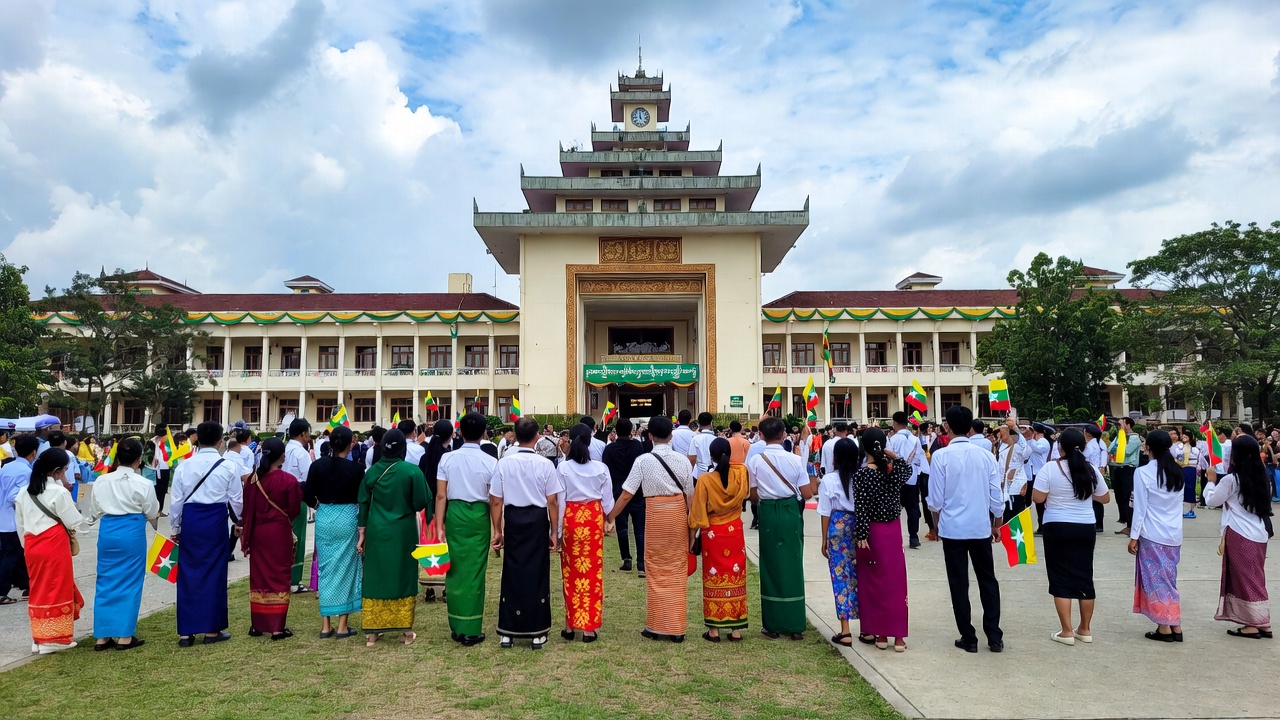
Every February 12, a song plays on radios across Myanmar at seven in the morning. Schoolchildren pause. Office workers look up. For the people of Myanmar, this broadcast means one thing: Union Day is near. The Union Flag will soon travel across the nation, carried from state capital to state capital, through towns large and small, before arriving at the People’s Square for a ceremony that has been held for nearly eight decades.
But behind the parades, the flag relays, and the ethnic dance performances lies a deeper story. It is the story of a single piece of paper, signed in the small hill town of Panglong in Shan State in 1947. That paper—the Panglong Agreement—brought together a divided land. It promised freedom, equality, and unity to a country that had known none of these things under colonial rule.
In 2026, Myanmar marks the 79th anniversary of that historic agreement. The celebration arrives at a difficult time. The country has been gripped by civil conflict since the military coup of February 2021. Over 3.5 million people have been internally displaced, and the military junta controls only a fraction of the nation’s territory. Yet the spirit of Panglong endures. It endures in the memories of grandmothers who tell the story in Shan teahouses. It endures in the poems that schoolchildren write every year. It endures because the promise of unity among Myanmar’s 135 ethnic groups remains the most powerful idea in the nation’s history.
This is the full story behind that promise.
What Is the Panglong Agreement and Why Does It Matter?
The Panglong Agreement is a treaty signed on February 12, 1947, in the town of Panglong in the Southern Shan State of British Burma. It was signed between General Aung San, the head of the interim Burmese government, and representatives from three major ethnic frontier groups: the Shan, the Kachin, and the Chin.
The agreement had one central purpose. It brought the frontier hill areas and the Burmese heartland together under a single political framework, so that the entire country could seek independence from Britain as one nation. Before this agreement, the British had governed central Burma (known as “Ministerial Burma”) and the surrounding ethnic regions (known as the “Frontier Areas”) as two separate entities. The Panglong Agreement ended that division.
In practical terms, the agreement established the following provisions:
- A Counsellor for Frontier Areas would be appointed to the Governor’s Executive Council, giving the ethnic hill peoples a voice in central governance.
- The Counsellor would be selected on the recommendation of the Supreme Council of the United Hill Peoples (SCOUHP).
- The Frontier Areas would receive full autonomy in internal administration.
- Financial arrangements for the Kachin Hills and Chin Hills would be examined to ensure equitable treatment.
- Existing financial autonomy of the Federated Shan States would be preserved.
There were 23 signatories in total: General Aung San representing the interim Burmese government, 14 Shan representatives (including several powerful Saohpas, or hereditary chiefs), 5 Kachin representatives, and 3 Chin representatives. The agreement accepted the principle of “full autonomy in internal administration for Frontier Areas,” a phrase that has echoed through Myanmar’s politics ever since.
The importance of the Panglong Agreement cannot be overstated. As the Online Burma/Myanmar Library notes, it formed the legal and moral basis for the creation of the Union of Burma. Without it, there would have been no unified country to gain independence from Britain. February 12 has been celebrated as Union Day ever since.
How British Colonial Rule Divided Burma Into Two Separate Territories
To understand why the Panglong Agreement was necessary, you must first understand how Britain governed Burma.
Britain completed its conquest of Burma in stages. The First Anglo-Burmese War (1824–1826) resulted in the loss of Assam, Manipur, and the Arakan and Tenasserim coastal strips. The Second Anglo-Burmese War (1852) claimed Lower Burma. The Third Anglo-Burmese War (1885) resulted in the fall of the Burmese monarchy and the full annexation of Upper Burma. By 1886, all of Burma was a province of British India.
But Britain did not rule its new territory as a single unit. Instead, it drew a sharp administrative line between two zones:
| Territory | Administration | Population |
|---|---|---|
| Ministerial Burma (lowlands) | Governed directly by British civil service; later given limited self-governance | Predominantly Bamar (Burman) ethnic majority |
| Frontier Areas (hills and borderlands) | Governed indirectly through local chiefs and traditional leaders | Shan, Kachin, Chin, Karenni, Karen, and other ethnic groups |
This division had profound consequences. The lowland Bamar majority experienced a degree of modern administration, infrastructure development, and eventual political representation. The hill peoples, by contrast, were kept largely separate. Their traditional systems of governance were preserved, but they were also isolated from the political movements sweeping through Ministerial Burma.
The British justified this system as a form of protection for the ethnic minorities. Critics, both then and now, have argued that it was a deliberate policy of “divide and rule”—a strategy to prevent the diverse peoples of Burma from uniting against colonial power.
This separation also created an uneven relationship with the independence movement. When Burmese nationalists began agitating for freedom in the 1920s and 1930s, their movement was largely centered in the Bamar heartland. The frontier peoples had their own concerns, their own leaders, and in many cases, their own wariness of the lowland majority. Bridging this gap would become the central challenge of the Panglong Conference.
Who Was General Aung San: The Father of Modern Myanmar
No account of the Panglong Agreement is complete without understanding the man who made it possible.
Bogyoke Aung San was born on February 13, 1915, in the small town of Natmauk in central Burma. His family had a history of resistance to British rule. His great-uncle, Bo Min Yang, had fought against the British annexation of 1886.
Aung San entered Rangoon University in 1933 and quickly became a student leader. He befriended U Nu, the future first Prime Minister of Burma, and together they led a student strike in 1936. After graduation, he joined the Dobama Asiayone (“We Burmans Association”), a nationalist organization whose members adopted the title “Thakin”—meaning “master” or “lord”—as a deliberate challenge to the British, who were commonly addressed by that title.
His path to the Panglong Agreement was anything but straightforward:
- 1939–1940: Aung San co-founded the Communist Party of Burma and the People’s Revolutionary Party. He fled Burma after the British issued a warrant for his arrest.
- 1941: He was intercepted by Japanese intelligence agents in China. They convinced him to accept military training and support for a Burmese armed uprising against the British.
- 1942: Aung San founded the Burma Independence Army (BIA) in Bangkok with Japanese backing. The BIA marched into Burma alongside the Japanese invasion force.
- 1943: Japan granted Burma nominal independence. Aung San served as Minister of War in the puppet government of Dr. Ba Maw. But he grew deeply disillusioned with the Japanese, whose occupation killed an estimated quarter of a million Burmese civilians.
- March 1945: Aung San switched sides, leading the renamed Burma National Army in revolt against the Japanese occupiers alongside the Allies.
- 1946: He became the de facto head of the interim Burmese government and leader of the Anti-Fascist People’s Freedom League (AFPFL).
By early 1947, Aung San had emerged as the most powerful political figure in Burma. But he knew that independence would mean nothing if the country remained divided. The British had made it clear: the Frontier Areas could not simply be handed over to the Burmese government without the “free consent” of the peoples who lived there. This condition was formalized in the Aung San–Attlee Agreement, signed in London on January 27, 1947.
It was this requirement that brought Aung San to Panglong.
The Road to Panglong: How Ethnic Leaders Negotiated Burma’s Future
The town of Panglong sits in the rolling hills of the southern Shan State, at an elevation of about 4,000 feet above sea level. In the 1940s, it was a quiet market town known for its Shan teashops and its cool mountain air. It would become the birthplace of a nation.
The Panglong Conference was not a single event but a process that unfolded over several years.
The First Panglong Conference (March 1946)
The first gathering at Panglong was organized by Sao Shwe Thaik, the Saopha (hereditary ruler) of Yawnghwe and one of the most respected Shan leaders. Officially billed as a “Shan State handicraft exhibition,” the conference was attended by prominent political figures, including AFPFL Deputy Chairman U Nu. Its purpose was to begin discussions about the future of the frontier peoples in a post-colonial Burma.
The first conference did not produce a formal agreement. But it established something equally important: a channel of communication between the Bamar political leadership and the ethnic chiefs of the hill areas.
The Second Panglong Conference (February 3–12, 1947)
The second conference—the historic one—was organized by the Shan Saohpas and convened on February 3, 1947. The guest list was extraordinary. As the historian Thant Myint-U has documented, those invited included the Governor, more than 30 top Burmese political leaders (among them General Aung San), the Karenni chiefs, Kachin and Chin representatives, and even representatives of the United States, Chinese, and Indian governments.
General Aung San and his delegation arrived in Panglong on February 7, 1947. Accompanying the General were U Aung Zeya, Thakin Tun Oak, Mahn Ba Khine, and Deedok U Ba Cho. The Shan delegation included leaders such as Sao Shwe Thaik, Sao Khun Cho, Sao San Tun, and Sao Khun Pan Sein.
The negotiations were intense. Each ethnic group had specific demands:
- Kachin representatives demanded the creation of a separate Kachin State within the future union.
- Shan representatives insisted on the right to secede from the union after a fixed period if they were dissatisfied with the arrangement.
- Chin representatives sought guarantees of financial support from the central government, since the Chin Hills were among the poorest areas in the country.
The Notable Absences
Perhaps the single biggest weakness of the Panglong Conference was who did not attend.
The Karen leaders chose not to participate. They were still hoping for a better deal from the British—potentially their own separate state or even independence. Their absence left a wound in the Panglong process that has never fully healed.
The Mon and Rakhine (Arakanese) peoples were not invited to negotiate separately, as they fell within Ministerial Burma rather than the Frontier Areas. The Karenni (Kayah) attended only as observers.
These gaps meant that the Panglong Agreement, for all its historic significance, was an incomplete bargain. It united some of Burma’s peoples, but not all of them. This incompleteness would have consequences for decades to come.
What Did the Panglong Agreement Actually Say: Key Terms Explained
The text of the Panglong Agreement is remarkably brief. Preserved in archives such as Hugh Tinker’s Burma: The Struggle for Independence, the full document runs to just nine clauses. Here is a summary of its key provisions:
Clause I: A representative of the Hill Peoples, selected by the Governor on the recommendation of the Supreme Council of the United Hill Peoples, would be appointed as a Counsellor to the Governor to deal with the Frontier Areas.
Clause II: This Counsellor would also be appointed a member of the Governor’s Executive Council, without portfolio, bringing frontier affairs within the scope of the central government.
Clause III: The Counsellor would be assisted by two Deputy Counsellors representing the Kachin Hills and the Chin Hills.
Clauses IV–VII: These dealt with the specific powers and functions of the Counsellor and Deputy Counsellors, and the relationship between frontier administration and the central government.
Clause VIII: The financial autonomy of the Federated Shan States would be preserved.
Clause IX: The financial arrangements for the Kachin Hills and Chin Hills would be examined, with the goal of providing them treatment similar to that given to the Shan States.
The agreement’s preamble stated the foundational principle clearly: the conference members believed that “freedom will be more speedily achieved by the Shans, the Kachins and the Chins by their immediate co-operation with the Interim Burmese Government.”
In other words, the ethnic leaders agreed to join the Burmese independence movement, not because they were forced to, but because they were persuaded that unity was the fastest path to freedom from colonial rule.
Aung San summarized the spirit of the agreement in words that are still quoted across Myanmar today: “We should not emphasize our differences. We should only think about how to live together.”
From Panglong to Independence: The Birth and Tragedy of the Union of Burma
The Panglong Agreement was signed on February 12, 1947. What followed was a chain of events that moved with breathtaking speed—and ended in tragedy.
The Aung San–Attlee Agreement and Its Aftermath
With the Panglong Agreement in hand, Aung San had fulfilled the British condition that the frontier peoples give their “free consent” to joining a unified Burma. The British government agreed to grant full independence. Elections for a Constituent Assembly were held in April 1947, and the AFPFL won 196 of 202 seats in a landslide.
The new assembly began drafting a constitution for the Union of Burma. It incorporated many of the Panglong principles, including the right of the Shan State and Karenni State to secede from the union after ten years (a provision enshrined in Chapter X of the 1947 Constitution).
The Assassination of Aung San
On the morning of July 19, 1947, a group of armed men in military uniforms stormed an Executive Council meeting at the Secretariat building in Rangoon. They opened fire with automatic weapons. Aung San and six of his cabinet ministers were killed. Among the dead was Sao Sarm Htun, the Saopha of Mong Pawng, who had been a signatory of the Panglong Agreement, and Mahn Ba Khaing, a Karen member of the cabinet.
The mastermind was identified as U Saw, a former Prime Minister and political rival. He and his co-conspirators were later tried and executed.
Aung San was only 32 years old at the time of his death. He never lived to see the independence he had fought for.
Independence Day: January 4, 1948
After Aung San’s assassination, U Nu assumed leadership. At 4:20 a.m. on January 4, 1948—a time chosen by astrologers as the most auspicious moment—the Union Jack was lowered for the last time in Rangoon, and the flag of the Union of Burma was raised.
Sao Shwe Thaik, the Shan Saopha who had organized the first Panglong Conference, became the first President of the new republic. U Nu became the first Prime Minister. In a significant decision, the Union of Burma chose not to join the British Commonwealth, marking a complete break from colonial ties.
The nation that the Panglong Agreement had built was now free.
Why the Panglong Promise Was Never Fulfilled: Myanmar’s Ethnic Conflicts Since 1948
The story of Myanmar since independence is, in many ways, the story of the Panglong Agreement’s unfulfilled promises.
The new government under U Nu struggled almost immediately. Ethnic tensions that had been papered over by the excitement of independence began to surface. The Karen National Union launched an armed rebellion in 1949, seeking the independent Karen state they had hoped for since before Panglong. The Communist Party of Burma also took up arms.
The decisive turning point came on March 2, 1962, when General Ne Win overthrew the parliamentary government in a military coup. Ne Win abolished the 1947 Constitution—and with it, the constitutional provisions that had embodied the Panglong promises, including the right to secession.
The consequences were devastating:
- The Kachin Independence Army (KIA) was formed in the early 1960s in direct response to the coup and the new government’s refusal to adopt a federal system.
- The Shan rebellion intensified, fueled in part by Cold War-era CIA operations in the region.
- The Chin launched their own armed resistance in response to economic marginalization.
- The Karen insurgency continued, becoming one of the longest-running civil conflicts in the world.
Since 1948, Myanmar has been embroiled in what is widely recognized as the world’s longest ongoing civil war. The conflict has lasted nearly eight decades. It has displaced millions, killed tens of thousands, and kept large portions of the country in a state of poverty and underdevelopment.
At the root of this conflict lies a single, painful fact: the promises made at Panglong were never honored. The autonomy that was pledged was not delivered. The equality that was envisioned was not realized. The trust that Aung San had built through personal diplomacy died with him on that July morning in 1947.
Myanmar’s 135 Ethnic Groups and the Dream of a Federal Union
Myanmar is one of the most ethnically diverse countries in Southeast Asia. The government officially recognizes 135 distinct ethnic groups, organized into eight “major national ethnic races”: the Bamar, Shan, Karen (Kayin), Rakhine, Mon, Chin, Kachin, and Kayah (Karenni).
These groups are distributed across a country that is divided into seven ethnic minority states and seven regions (formerly called divisions). The seven states are named after the major ethnic minorities:
| State | Primary Ethnic Group | Key Characteristics |
|---|---|---|
| Kachin State | Kachin (Jinghpaw) | Northern highlands; rich in jade and amber |
| Kayah State | Kayah (Karenni) | Smallest state; home to the Padaung “long-neck” women |
| Kayin State | Karen (Kayin) | Eastern borderlands along Thailand; dense forests |
| Chin State | Chin | Western mountains; one of the poorest regions; largely Christian |
| Mon State | Mon | Southern lowlands; the Mon are among Burma’s oldest inhabitants |
| Rakhine State | Rakhine (Arakanese) | Western coast; also home to the persecuted Rohingya minority |
| Shan State | Shan | Largest state; a vast eastern plateau; home to 33 recognized sub-groups |
The Bamar ethnic majority makes up approximately 68% of the population and traditionally inhabits the central Ayeyarwady River valley and the seven regions. The remaining ethnic minorities account for roughly 30–32% of the population but occupy approximately two-thirds of the country’s land area.
More than 100 languages are spoken in Myanmar, drawn from the Sino-Tibetan, Tai-Kadai, Austroasiatic, and Hmong-Mien language families. The dominant religion is Theravada Buddhism (practiced by roughly 89.8% of the population), but significant Christian, Muslim, Hindu, and animist communities exist, particularly among the ethnic minorities.
This extraordinary diversity is what makes the Panglong ideal so important—and so difficult to achieve. The dream of a federal democratic union, where every ethnic group enjoys autonomy and equal representation, has been the aspiration of Myanmar’s peoples since 1947. It remains unfulfilled in 2026.
How Myanmar Celebrates Union Day: Traditions, Flag Relays, and Cultural Performances
Despite the political difficulties Myanmar faces, Union Day remains one of the country’s most anticipated holidays. The celebrations are both solemn and joyful, blending patriotic ceremony with rich cultural expression.
The Union Flag Relay
The most distinctive Union Day tradition is the flag relay. Starting approximately two months before February 12, the Union Flag is carried through the capital cities of each of Myanmar’s seven states and seven regions. This journey covers thousands of miles and passes through dozens of towns.
In each town, the flag’s arrival is greeted with local celebrations. Parades are organized. Traditional music fills the streets. The flag bearers are accompanied by military personnel, police, ethnic representatives, and ordinary citizens.
Five days before Union Day itself, the flag begins its final leg, passing through 45 townships before arriving at the People’s Square on Pyay Road in Yangon (or, in recent years, at Nay Pyi Taw, the capital since 2005), where the main ceremony is held.
Cultural Performances and Ethnic Dance
Union Day is a showcase for Myanmar’s extraordinary cultural diversity. Each ethnic group prepares traditional dance performances months in advance. The Naypyidaw Union Day concert features dancers from all major ethnic groups performing side by side—a visual representation of the unity that Panglong envisioned.
Performances may include:
- Shan sword dances and traditional shan-ni performances
- Kachin Manau dances, a communal celebration involving elaborate headdresses and synchronized movement
- Chin traditional dances with gongs and bamboo instruments
- Karen Frog Drum (Frog Drum) dances, performed to the rhythmic beat of bronze drums
- Mon classical dances, among the oldest performance traditions in Southeast Asia
- Rakhine traditional dances featuring colorful costumes and lively rhythms
Schools, Essays, and Patriotic Poems
For Myanmar’s schoolchildren, Union Day is a time for essay writing contests and poetry competitions. Students are assigned topics related to national unity, the history of the Panglong Agreement, and the importance of ethnic harmony. As one Yangon writer recalls, “I usually participated in the essay writing and earned about the history of Union Day by reading references for the contest. The knowledge about the long and difficult journey that our people had undertaken to achieve Independence has given me a greater sense of love for my Country.”
Visiting the Panglong Monument
For those who can travel to Shan State, the Panglong Monument is a pilgrimage site. Located in the garden where the agreement was signed, the monument features representations of General Aung San and the other independence leaders. A formal ceremony is held at the monument every February 12, drawing family members of the original signatories and political leaders from across the country.
The 21st Century Panglong Peace Process and What It Means for Myanmar
The term “Panglong” has been invoked repeatedly in Myanmar’s modern political history as a symbol of the peace and unity that the country has struggled to achieve.
Aung San Suu Kyi and the “Spirit of Panglong”
Aung San Suu Kyi, the daughter of General Aung San and winner of the 1991 Nobel Peace Prize, made the revival of the Panglong spirit a centerpiece of her political agenda. After her party, the National League for Democracy (NLD), won the 2015 general election, she launched the “21st Century Panglong” peace conferences starting in August 2016.
The conferences aimed to bring together the government, the military (Tatmadaw), and the country’s many ethnic armed organizations to negotiate a new political settlement. The goal was ambitious: to create a federal democratic union that would finally honor the promises made at Panglong in 1947.
Over several rounds of talks, some progress was made. A Nationwide Ceasefire Agreement (NCA) was signed by several armed groups, though many of the most powerful organizations—including the United Wa State Army (UWSA) and the Kachin Independence Army (KIA)—refused to sign.
The 2021 Coup and Its Aftermath
The peace process was shattered by the military coup of February 1, 2021. The Tatmadaw, led by Senior General Min Aung Hlaing, overthrew the elected NLD government. Aung San Suu Kyi was placed under arrest, where she remains as of early 2026.
The coup triggered massive protests across Myanmar, followed by a brutal military crackdown. Thousands of young people fled to territory held by ethnic armed groups, where they formed People’s Defense Forces (PDFs) to fight the military. The NLD’s exile leadership established the National Unity Government (NUG) and declared the 2008 Constitution abolished, calling instead for a federal democratic state in the spirit of Panglong.
The resulting civil war has been devastating. According to the UK House of Commons Library, as of April 2025, over 6,486 civilians have been killed and over 3.5 million have been internally displaced. The UN’s humanitarian appeal for Myanmar in 2025 sought $1.1 billion in funding to support 5.5 million people, while 19.9 million were projected to need assistance.
The military junta held elections in December 2025 and January 2026, but these were widely condemned as illegitimate. As the Council on Foreign Relations has documented, the junta controls only about 21 percent of the country’s territory, while resistance forces and ethnic armies control approximately 42 percent, with the remainder contested.
Union Day 2026: The 79th Anniversary Amid Myanmar’s Ongoing Crisis
The 79th anniversary of Union Day on February 12, 2026, arrives at a moment of profound uncertainty for Myanmar.
The Global New Light of Myanmar, the state media outlet, published an editorial ahead of the anniversary that struck a poignant tone. “We will have a chance to listen to the stories told by an elderly Shan grandmother, feel the song of a young Kachin, and help ease the concerns of a Rakhine person,” it stated. “We must remember that unity is not simply speaking the same words, but understanding one another—a truth our ancestors demonstrated through the Panglong Agreement.”
At the 2025 Union Day celebration, Senior General Min Aung Hlaing stated that “all ethnic peoples must work together in unity to build a strong federal democratic Union.” He stressed that the Panglong Agreement is a “historic gift of unity” and that protecting the integrity of the Union is everyone’s responsibility.
Yet the gap between rhetoric and reality has never been wider. The country is fractured along multiple lines—between the military and the resistance, between ethnic armed groups and the central government, and even among the various opposition forces themselves. Analysts at the International Institute for Strategic Studies note that the opposition forces “are as fragmented as ever,” with relationships between ethnic armed organizations and the People’s Defense Forces deteriorating.
China has intervened heavily, brokering deals and pressuring certain armed groups to cooperate with the junta. The devastating March 2025 earthquake added another layer of humanitarian crisis.
For many Myanmar citizens, Union Day 2026 is both a celebration and a lament. It celebrates the moment when their ancestors chose unity over division. It laments the decades of broken promises that followed.
The Panglong Agreement’s Legacy: Lessons for Peace and Ethnic Harmony
Nearly eight decades after its signing, the Panglong Agreement offers enduring lessons—not only for Myanmar but for any country grappling with ethnic diversity and the legacy of colonialism.
Trust Is Built Through Personal Relationships
General Aung San’s success at Panglong was not simply a matter of political skill. It was a matter of trust. He traveled to the hill areas. He sat with the ethnic leaders. He listened to their concerns. He made personal commitments that went beyond the formal text of the agreement.
The Shan Saohpas, the Kachin Duwas, and the Chin leaders chose to trust Aung San not because of his title, but because of his character. His assassination destroyed not only a political leader but a web of personal relationships that held the union together.
Agreements Must Be Honored
The most painful lesson of Panglong is the simplest: a promise not kept is worse than no promise at all. The autonomy pledged to the ethnic minorities was systematically dismantled after 1962. The right to secede was abolished. The federal structure was replaced by a centralized military dictatorship.
This betrayal fueled decades of armed resistance. It taught a generation of ethnic leaders that the Burmese government could not be trusted. Rebuilding that trust is the single greatest challenge facing anyone who seeks to bring peace to Myanmar.
Inclusion Must Be Complete
The absence of the Karen from the Panglong Agreement was, as one historian noted, “perhaps the single biggest weakness of the conference.” The Karen had the largest population of any ethnic minority, and their exclusion left a gap that the agreement could not fill.
Any future peace process in Myanmar will need to be truly inclusive—not just of the groups that attended Panglong, but of all the communities that make up the Union, including the Mon, the Rakhine, the Rohingya, and the many smaller ethnic groups who have been marginalized for decades.
Unity Does Not Require Uniformity
Perhaps the most beautiful aspect of the Panglong spirit is the idea that different peoples can live together without becoming the same. General Aung San expressed this clearly: “We should not emphasize our differences. We should only think about how to live together.”
This is not a call for assimilation. It is a call for coexistence. The Panglong model envisioned a union where the Shan could be Shan, the Kachin could be Kachin, the Chin could be Chin—and all could be citizens of a shared nation.
How to Visit Panglong and Key Myanmar Union Day Sites
For travelers interested in Myanmar’s history and culture, several sites connected to the Panglong Agreement and Union Day are worth visiting. (Travel conditions in Myanmar remain highly restricted due to the ongoing conflict; always consult current advisories before planning any trip.)
Panglong, Shan State
The town of Panglong itself is located in the southern Shan State, about 25 miles south of Taunggyi, the state capital. The Panglong Monument stands in the garden where the agreement was signed. The monument’s facade features relief carvings of General Aung San and the ethnic leaders who signed the agreement. A formal ceremony is held at the site every February 12.
The Secretariat Building, Yangon
The Secretariat (also known as the Ministers’ Building) in downtown Yangon is where Aung San and his colleagues were assassinated on July 19, 1947. The building has been partially restored and is open to visitors on certain occasions. It is one of the most historically significant structures in Myanmar.
Martyrs’ Mausoleum, Yangon
Located at the foot of the Shwedagon Pagoda, the Martyrs’ Mausoleum was built in 1947 to honor Aung San and the cabinet members killed with him. It is a place of quiet reflection and national remembrance, especially on Martyrs’ Day (July 19) and Union Day.
Shwedagon Pagoda, Yangon
The Shwedagon Pagoda is Myanmar’s most sacred Buddhist site. While not directly linked to the Panglong Agreement, it played a central role in the independence movement. Aung San and other nationalist leaders organized rallies at the pagoda, and the AFPFL held its founding conference at its middle platform. The pagoda is said to house eight strands of the Buddha’s hair and is covered in gold leaf, with over 4,500 diamonds encrusting its upper structure.
Naypyidaw
Myanmar’s capital since 2005, Naypyidaw hosts the main governmental Union Day celebrations, including the flag relay’s concluding ceremony, military parades, and the annual Union Day concert.
Frequently Asked Questions About the Panglong Agreement and Myanmar Union Day
When is Union Day in Myanmar? Union Day is celebrated every year on February 12. In 2026, it falls on a Thursday.
What was the Panglong Agreement? It was a treaty signed on February 12, 1947, between General Aung San and representatives of the Shan, Kachin, and Chin peoples, agreeing to form a unified Union of Burma to seek independence from Britain.
Who signed the Panglong Agreement? There were 23 signatories: General Aung San for the interim Burmese government, 14 Shan representatives, 5 Kachin representatives, and 3 Chin representatives.
Why didn’t the Karen sign the Panglong Agreement? The Karen leaders chose not to attend the conference. They were still hoping for a better deal from the British, potentially including their own separate state.
Is Union Day a public holiday in Myanmar? Yes. Union Day is an official public holiday across the Republic of the Union of Myanmar.
What is the relationship between Union Day and Independence Day? Union Day (February 12) celebrates the signing of the Panglong Agreement in 1947, which unified the country. Independence Day (January 4) celebrates the actual declaration of independence in 1948. They are two separate holidays commemorating two distinct but connected events.
What is the 21st Century Panglong Conference? It was a series of peace conferences launched by Aung San Suu Kyi in 2016, aimed at resolving Myanmar’s ethnic conflicts through a new political settlement inspired by the original Panglong spirit. The process was halted by the 2021 military coup.
How many ethnic groups does Myanmar have? The government officially recognizes 135 ethnic groups, organized into eight major national races. However, the actual number may be different, as the classification system is contested.
The Unfinished Journey: Why the Spirit of Panglong Still Matters in 2026
Myanmar in 2026 is a nation at war with itself. The military junta’s grip has weakened. Resistance forces control vast stretches of territory. Millions of people have been displaced. The economy has been devastated. And yet, across the front lines and ceasefire zones, across the refugee camps and diaspora communities, the idea of Panglong persists.
It persists because it represents something that Myanmar has never fully achieved but has never stopped wanting: a country where all peoples are equal, where all cultures are respected, and where freedom is shared.
The original Panglong Agreement was imperfect. It excluded too many groups. It relied too heavily on the personal trust that Aung San had built—trust that died with him. And the promises it contained were broken within a generation.
But the spirit of Panglong—the willingness to sit down with those who are different from you, to listen to their grievances, to find common ground, to choose unity over division—remains the most powerful political idea in Myanmar.
As the state newspaper editorial put it ahead of the 79th anniversary: “What can we hope for on Union Day 2026? It is not an easy task. However, Father of Independence General Aung San himself demonstrated that it was possible.”
The song plays on the radio every February. The flag travels from state to state. Schoolchildren write their poems. And somewhere in a Shan teahouse, an old woman tells her grandchild about the day the leaders came to Panglong, and the day they chose to be one country.
That story is not over. It may never be. But as long as it is remembered, the spirit of Panglong will endure.