A Complete Guide to Festival Photography, Cultural Etiquette, and Technical Mastery
Thaipusam is one of the most visually spectacular religious festivals in the world. Every year, millions of Hindu devotees gather to honor Lord Murugan, the Hindu god of war, through acts of profound devotion, penance, and celebration. For photographers, this festival presents an extraordinary opportunity to document human spirituality, cultural heritage, and raw emotion in ways few other events can match.
This comprehensive guide will help you capture the most stunning moments of Thaipusam while respecting the sacred nature of this extraordinary celebration. Whether you’re a professional photographer or an enthusiastic traveler with a camera, understanding both the technical and cultural aspects of this festival is essential for creating meaningful images.
What Is Thaipusam and Why Is It a Must-Photograph Festival?
Thaipusam is a Tamil Hindu festival celebrated during the full moon in the Tamil month of Thai (January-February). The name combines “Thai” (the month) and “Pusam” (referring to a star that reaches its highest point during this festival).
The festival commemorates the occasion when Goddess Parvati gave her son Murugan a divine spear (Vel) to vanquish the evil demon Soorapadman. This victory of good over evil is celebrated through:
- Kavadi Attam (burden dance)
- Body piercings with hooks, skewers, and spears
- Milk pot carrying (Paal Kudam)
- Trance states and spiritual devotion
- Colorful processions spanning several kilometers
| Element | Significance | Photography Opportunity |
|---|---|---|
| Kavadi bearers | Physical sacrifice and devotion | Dramatic portraits, motion shots |
| Body piercings | Spiritual transcendence | Close-up details, emotional moments |
| Milk offerings | Purification and gratitude | Still life, ritual documentation |
| Temple processions | Community celebration | Wide-angle crowd shots |
| Trance states | Divine connection | Candid emotional portraits |
For photographers, Thaipusam offers what few festivals can: genuine human emotion, striking visual contrasts, and profound spiritual moments unfolding in real-time.
Best Locations to Photograph Thaipusam Festival Celebrations
Batu Caves Malaysia: The World’s Largest Thaipusam Celebration
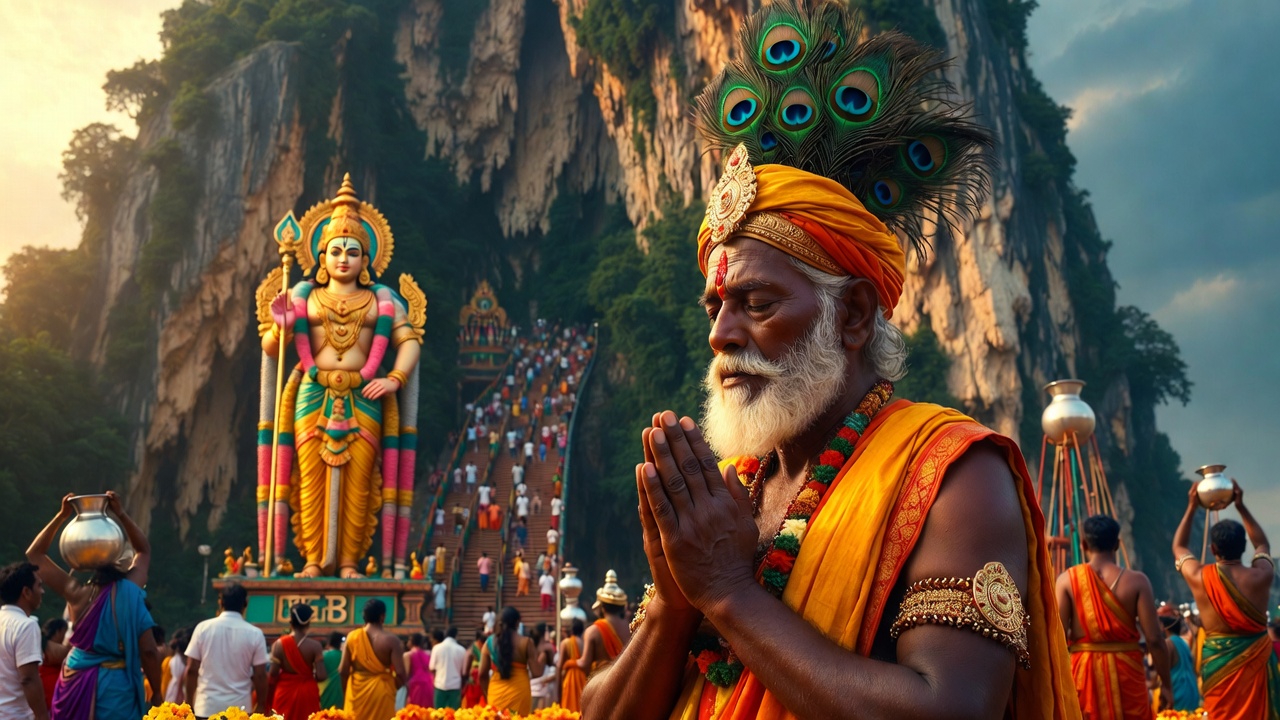
The Batu Caves in Kuala Lumpur, Malaysia hosts the largest Thaipusam celebration outside of India, attracting over 1.5 million devotees and visitors annually. The 272 rainbow-colored steps leading to the limestone caves create an iconic backdrop for festival photography.
Key photography spots at Batu Caves:
- Base of the 272 steps — Capture devotees beginning their ascent with kavadis
- Halfway point — Document the physical struggle and determination
- Cave entrance — Frame subjects against dramatic natural lighting
- Interior temple areas — Low-light photography opportunities
- Surrounding grounds — Preparation rituals and crowd scenes
Pro tip: Arrive by 4:00 AM to secure a position near the main pathway. The most dramatic piercing ceremonies occur between 5:00 AM and 8:00 AM.
Singapore Thaipusam Photography at Sri Thendayuthapani Temple
Singapore’s Thaipusam procession stretches 4.5 kilometers from the Sri Srinivasa Perumal Temple on Serangoon Road to the Sri Thendayuthapani Temple on Tank Road. This route passes through the heart of Little India, offering diverse urban backdrops.
| Location | Best Time | What to Capture |
|---|---|---|
| Sri Srinivasa Perumal Temple | 2:00 AM – 6:00 AM | Preparation rituals, piercing ceremonies |
| Serangoon Road | 4:00 AM – 10:00 AM | Procession against Little India backdrop |
| Dhoby Ghaut area | 6:00 AM – 12:00 PM | Urban contrast shots |
| Sri Thendayuthapani Temple | 8:00 AM – 6:00 PM | Arrival celebrations, kavadi removal |
Other Notable Thaipusam Photography Destinations
- Palani, Tamil Nadu, India — The original and most sacred location
- Penang, Malaysia — Waterfall Temple (Arulmigu Balathandayuthapani Temple)
- Mauritius — Growing celebration with unique cultural blend
- Sri Lanka — Nallur Kandaswamy Temple celebrations
Essential Camera Gear for Thaipusam Festival Photography
Best Camera Equipment for Low-Light Festival Photography
Thaipusam celebrations begin before dawn and continue into the night, making low-light capability essential.
Recommended camera bodies:
| Camera Type | Advantages | Recommended Models |
|---|---|---|
| Full-frame mirrorless | Excellent low-light, fast autofocus | Sony A7 IV, Canon R6 II, Nikon Z6 III |
| APS-C mirrorless | Lighter weight, good performance | Fujifilm X-T5, Sony A6700 |
| Full-frame DSLR | Reliable, extensive lens selection | Canon 5D IV, Nikon D850 |
Lens Selection for Religious Festival Documentation
Your lens choice will dramatically impact your Thaipusam photographs. Consider bringing:
- 24-70mm f/2.8 — Versatile workhorse for processions and environmental portraits
- 70-200mm f/2.8 — Essential for capturing intimate moments from a respectful distance
- 35mm f/1.4 or f/1.8 — Perfect for street photography and available light
- 85mm f/1.4 — Stunning portraits with beautiful background separation
- 16-35mm f/2.8 — Wide-angle shots of crowds and temple architecture
Critical consideration: Fast aperture lenses (f/1.4 to f/2.8) are non-negotiable for pre-dawn ceremonies when artificial lighting is minimal.
Must-Have Photography Accessories for Thaipusam
- Extra batteries (minimum 3-4) — Continuous shooting drains power quickly
- High-capacity memory cards (256GB minimum) — Expect to shoot thousands of frames
- Monopod — Stability without restricting movement in crowds
- Weather-sealed camera bag — Protection from tropical humidity
- Lens cleaning kit — Dust and incense smoke coat glass surfaces
- Comfortable footwear — You’ll walk 10-15 kilometers during the festival
Camera Settings Guide for Thaipusam Night and Day Photography
Optimal Camera Settings for Pre-Dawn Thaipusam Ceremonies
The most powerful photographs often come during the pre-dawn hours when devotees undergo piercing rituals and begin their procession. These low-light conditions require specific settings:
| Setting | Recommended Value | Reasoning |
|---|---|---|
| Aperture | f/1.4 – f/2.8 | Maximum light gathering |
| ISO | 3200 – 12800 | Accept noise for proper exposure |
| Shutter Speed | 1/125 – 1/250 | Freeze subject movement |
| Focus Mode | Continuous AF (AI Servo/AF-C) | Track moving subjects |
| Drive Mode | High-speed continuous | Capture fleeting expressions |
| White Balance | Auto or 3200K (tungsten) | Correct for artificial lighting |
Important technical note: Modern cameras handle high ISO remarkably well. Don’t sacrifice a sharp image for lower noise. A slightly noisy but sharp photograph is always preferable to a clean but blurry one.
Daytime Festival Photography Settings for Vibrant Colors
As the sun rises, switch your approach to capture the vibrant colors of kavadis, flowers, and traditional attire:
- Aperture: f/4 to f/8 for sharper images with sufficient depth of field
- ISO: 100-400 for optimal image quality
- Shutter Speed: 1/500 or faster to freeze movement
- Exposure Compensation: -0.3 to -0.7 EV to preserve color saturation
The harsh tropical sun creates challenging contrast. Consider using fill flash or positioning subjects in open shade when possible.
How to Photograph Kavadi Bearers and Piercing Rituals Respectfully
Understanding the Sacred Nature of Kavadi Attam
Kavadi refers to the physical burden devotees carry as an act of penance and devotion. These range from simple milk pots (Paal Kavadi) to elaborate steel constructions weighing up to 30 kilograms decorated with peacock feathers, flowers, and images of Lord Murugan.
The most dramatic kavadis involve body piercings:
- Vel kavadi — Skewers piercing cheeks and tongue
- Hook kavadis — Multiple hooks attached to back skin
- Alagu kavadi — Entire body pierced with small spears
These rituals are deeply sacred acts of devotion, not performances for photographers. Approach with the same respect you would show at any solemn religious ceremony.
Ethical Photography Guidelines for Religious Ceremonies
Respectful photography is paramount. Follow these essential guidelines:
- Always ask permission when possible, especially for close portraits
- Never use flash directly in a devotee’s face during trance states
- Maintain respectful distance during actual piercing procedures
- Don’t obstruct pathways or interfere with processions
- Dress modestly — Cover shoulders and knees
- Remove footwear when entering temple areas
- Avoid photographing children without parental consent
Many devotees are honored to have their sacrifice documented, but consent varies. A respectful nod or gesture before raising your camera shows cultural awareness.
Capturing Emotional Moments Without Being Intrusive
The most powerful Thaipusam photographs capture genuine emotion — the determination of kavadi bearers, the devotion in their eyes, the support of family members, and the spiritual transcendence achieved through penance.
Techniques for capturing authentic emotion:
- Use longer focal lengths (85mm-200mm) to maintain physical distance
- Anticipate moments rather than chasing them
- Focus on supporters and family for intimate emotional content
- Photograph the quiet moments before and after the main rituals
- Look for hands — supporting, praying, blessing — they tell powerful stories
Best Times to Capture Stunning Thaipusam Photography Moments
Golden Hour and Blue Hour Opportunities During Thaipusam
Light quality transforms photographs from documentation to art. Thaipusam offers multiple opportunities for exceptional natural light:
| Time Period | Light Quality | Best Subjects |
|---|---|---|
| 4:30-5:30 AM | Blue hour — mystical, cool tones | Preparation rituals, temple interiors |
| 6:00-7:00 AM | Sunrise golden hour — warm, directional | Procession beginning, portraits |
| 7:30-10:00 AM | Harsh but workable | Wide scenes, architectural shots |
| 5:00-6:30 PM | Sunset golden hour — dramatic backlighting | Silhouettes, temple finishes |
| 7:00-8:00 PM | Blue hour — neon and artificial light mix | Street scenes, temple illumination |
Key Moments Every Thaipusam Photographer Should Capture
Plan your shooting schedule around these critical festival moments:
Pre-dawn (2:00 AM – 5:00 AM):
- Ritual preparation and body shaving
- Piercing ceremonies beginning
- First kavadi bearers starting processions
Morning (5:00 AM – 9:00 AM):
- Peak of kavadi procession
- Largest crowds and most dramatic kavadis
- Temple steps ascent at Batu Caves
Midday (9:00 AM – 3:00 PM):
- Continuous procession
- Devotees in various states of trance
- Food offerings and charity distribution
Afternoon to evening (3:00 PM – 8:00 PM):
- Kavadi removal ceremonies
- Cleansing rituals
- Temple celebrations and conclusion
Composition Techniques for Powerful Thaipusam Festival Images
Using Leading Lines and Framing in Temple Photography
Batu Caves and other Thaipusam temples offer rich architectural elements for composition:
- The 272 steps create a powerful leading line drawing the eye upward
- Temple archways frame devotees naturally
- Rows of kavadi bearers create repetition and visual rhythm
- Smoke from incense adds atmospheric depth and mystery
Composition strategies:
- Position yourself low to emphasize the height of kavadis
- Use the rule of thirds to place faces at power points
- Include environmental context to tell complete stories
- Look for reflections in pools, wet ground, and temple surfaces
- Frame within frames using doorways, arches, and natural elements
Color Theory and Visual Storytelling at Thaipusam
Thaipusam is a feast of color: saffron yellow, vibrant orange, sacred red, fresh green limes, and pristine white jasmine flowers. Use color deliberately:
| Color | Meaning | Visual Impact |
|---|---|---|
| Yellow/Saffron | Sacred, auspicious | Dominant festival color |
| Red | Power, sacrifice | Emotional intensity |
| Green | Renewal, nature | Balance and calm |
| White | Purity, devotion | Clean visual contrast |
| Gold | Divine presence | Luxury and spirituality |
Color harmony tips:
- Isolate single-color subjects against contrasting backgrounds
- Capture the riot of colors in wide environmental shots
- Use selective focus to emphasize color details
How to Edit Thaipusam Festival Photos for Maximum Impact
Post-Processing Workflow for Religious Festival Photography
Post-processing should enhance, not alter, the authentic emotion you captured. A thoughtful workflow preserves the spirit of the moment:
Step 1: Culling and Selection
- Shoot thousands of frames; select your strongest 50-100
- Prioritize emotion and storytelling over technical perfection
- Look for “decisive moments” that capture peak action
Step 2: Basic Adjustments
- Correct exposure, particularly for high-ISO images
- Adjust white balance to match the actual light conditions
- Recover highlights and shadows carefully
Step 3: Noise Reduction
- Apply luminance noise reduction for high-ISO images
- Preserve essential detail in faces and kavadis
- Consider specialized software like DxO PureRAW or Topaz DeNoise AI
Step 4: Color Grading
- Enhance (don’t oversaturate) the vibrant festival colors
- Maintain accurate skin tones
- Consider a consistent look across your series
Step 5: Local Adjustments
- Dodge and burn to direct attention
- Sharpen eyes and important details
- Vignette subtly to focus the viewer
Software Recommendations for Festival Photo Editing
| Software | Best For | Price Point |
|---|---|---|
| Adobe Lightroom Classic | Overall workflow, cataloging | Subscription |
| Capture One | Color grading, tethering | Subscription or perpetual |
| DxO PhotoLab | Noise reduction, lens corrections | Perpetual license |
| Skylum Luminar Neo | AI-assisted editing | Subscription or perpetual |
| Affinity Photo | Photoshop alternative | One-time purchase |
Cultural Etiquette Every Photographer Must Follow at Thaipusam
Dress Code and Behavior Guidelines for Non-Hindu Photographers
Respect is paramount. As a guest at a sacred religious celebration, follow these essential guidelines:
What to wear:
- Cover shoulders and knees — essential for both men and women
- Remove shoes before entering temples
- Avoid leather items in temple areas
- Choose modest colors — avoid attention-grabbing outfits
- Comfortable, practical clothing for long hours
Behavioral expectations:
- Never touch devotees without explicit permission
- Don’t interrupt prayers or rituals for photographs
- Avoid pointing feet at religious images or people
- Accept offerings graciously if given (vegetarian food, blessed items)
- Maintain silence during sacred moments
Understanding Hindu Photography Taboos and Sensitivities
Some aspects of Hindu worship have specific photography restrictions:
- Inner sanctums (garbhagriha) typically prohibit photography
- Certain deities should not be photographed at specific times
- Priests performing rituals may decline to be photographed
- Deceased persons’ ceremonies are private and off-limits
When in doubt, ask. Temple officials and volunteers are typically happy to explain what is and isn’t appropriate.
Practical Tips for Surviving Long Hours of Thaipusam Photography
What to Bring for a Full Day of Festival Photography
Thaipusam is physically demanding. Prepare properly:
Essential supplies:
- 3-4 liters of water — Tropical heat and crowds cause rapid dehydration
- High-energy snacks — Nuts, energy bars, fruit
- Sunscreen and hat — UV exposure is intense
- Rain jacket — Sudden tropical showers are common
- Small first aid kit — Band-aids, antiseptic, pain relievers
- Cash — Many vendors don’t accept cards
- Portable phone charger — For navigation and communication
Health and Safety Considerations for Festival Photographers
Stay safe while photographing:
- Be aware of your surroundings — Pickpockets operate in dense crowds
- Protect your gear — Use rain covers and secure camera straps
- Stay hydrated — Heat exhaustion is a real risk
- Wear insect repellent — Mosquitoes are active at dawn and dusk
- Know emergency exits — Identify escape routes in crowded areas
- Travel with a companion — Particularly during pre-dawn hours
Medical note: If you’re sensitive to graphic imagery, be prepared for the sight of body piercings and blood. While devotees typically don’t bleed heavily due to their trance state, the visual can be intense for some.
How to Share and Publish Your Thaipusam Photography Ethically
Creating a Respectful Photo Essay About Thaipusam
When publishing your Thaipusam photographs, consider the dignity of your subjects:
- Provide context — Explain the religious significance, not just the spectacle
- Avoid sensationalism — Don’t emphasize pain or shock value
- Use accurate captions — Research proper terminology and meanings
- Credit the community — This is their celebration, not just your portfolio
- Consider giving back — Donate to Hindu charitable organizations
Building Your Festival Photography Portfolio
Thaipusam images can become a powerful portfolio piece when presented thoughtfully:
Portfolio presentation tips:
- Create a cohesive series — Show the full arc of the festival
- Balance close-ups with context — Mix intimate portraits with environmental shots
- Include supporting images — Preparation, crowds, temple architecture
- Write thoughtful artist statements — Explain your approach and respect for the tradition
Frequently Asked Questions About Thaipusam Photography
Can Non-Hindus Photograph Thaipusam Celebrations?
Yes, non-Hindus are welcome to attend and photograph Thaipusam. The festival is celebrated publicly, and the Hindu community generally appreciates respectful documentation. However, always follow etiquette guidelines and respect any restrictions at specific temples.
Do I Need Special Permits for Professional Thaipusam Photography?
For personal photography, no permits are required at most public celebrations. Commercial photography and film crews may need permits, particularly:
- At Batu Caves in Malaysia (contact Batu Caves Temple Committee)
- At temples in Singapore (contact Hindu Endowments Board)
- For drone photography (check local aviation regulations)
What Camera Settings Work Best for Thaipusam Fire Rituals?
Fire and flame photography requires specific adjustments:
- Expose for the flames — They’re brighter than they appear
- Use spot metering on the fire itself
- Faster shutter speeds (1/250+) freeze flame movement
- Lower ISO than you’d expect — flames provide significant light
Is Flash Photography Allowed at Thaipusam?
Flash is generally discouraged, especially:
- During piercing ceremonies
- When devotees are in trance states
- Inside temple sanctuaries
If you must use flash, use bounce flash or diffused light. Never fire a flash directly into a devotee’s face during sacred moments.
Conclusion: Capturing the Spirit of Thaipusam Through Your Lens
Thaipusam offers photographers one of the world’s most visually extraordinary and spiritually profound subjects. The festival is a testament to human devotion, physical endurance, and community faith. When you photograph Thaipusam, you’re documenting a living tradition stretching back centuries.
The most successful Thaipusam photographers approach the festival with equal measures of technical skill and cultural respect. They understand that the best images come not from aggressive pursuit, but from patient observation and genuine connection with the community.
As you prepare for your Thaipusam photography experience, remember:
- Plan thoroughly — Research locations, timing, and cultural context
- Pack appropriately — Bring the right gear and supplies
- Respect always — You’re a guest at a sacred celebration
- Stay safe — Take care of yourself during long festival hours
- Share responsibly — Present your images with dignity and context
Thaipusam is more than a photography opportunity — it’s a window into profound human spirituality. Approach it with an open heart, a curious mind, and a respectful camera, and you’ll return with images that transcend mere documentation to become genuine artistic and cultural preservation.
Have you photographed Thaipusam? Share your experiences and tips in the comments below. For more festival photography guides, explore our comprehensive collection of cultural celebration coverage from around the world.