Every February 8, something remarkable happens in Slovenia. The entire country pauses. Schools close. Offices go dark. Museums swing their doors wide open — free of charge. Across towns and cities, poetry fills the air. Slovenians gather to honor a man who died nearly two centuries ago, yet whose words still define what it means to be Slovene.
This is Prešeren Day — or, in its full official title, Prešeren Day, the Slovene Cultural Holiday (Prešernov dan, slovenski kulturni praznik). It falls on Sunday, February 8, 2026, and it promises to be a stirring celebration of art, identity, and national pride.
But who was France Prešeren? Why does a poet — not a general, not a king — command his own national holiday? And what exactly happens across Slovenia on this day?
Whether you are planning a winter trip to Ljubljana, researching Slovenian traditions, or simply curious about one of Europe’s most poetic public holidays, this guide covers everything you need to know about Prešeren Day 2026.
What Is Prešeren Day and Why Does Slovenia Celebrate It?
Prešeren Day is a national public holiday in Slovenia, observed every year on February 8. It marks the anniversary of the death of Dr. France Prešeren (1800–1849), widely regarded as the greatest poet in Slovenian literary history. But the holiday means far more than a single poet’s memorial. It is Slovenia’s official day of culture — a nationwide tribute to Slovenian artistic achievement, language, and identity.
The holiday serves a dual purpose. First, it honors Prešeren’s extraordinary body of work — poems that elevated the Slovenian language to the level of high European literature. Second, it gives the nation a moment to reflect on the broader sweep of Slovenian cultural life, from visual arts and music to theater and film.
In practical terms, Prešeren Day is a work-free public holiday. Most businesses, government offices, and shops close for the day. It is one of 16 annual public holidays in Slovenia, and Slovenian law requires that the national flag be displayed on official buildings throughout the holiday.
What makes this day truly special, though, is how it is celebrated. This is not a holiday spent lounging at home. Slovenians actively engage with their cultural heritage. They attend poetry readings, visit galleries, take their children to museums, and gather for concerts. The atmosphere is lively, reflective, and proud — a collective affirmation that culture matters.
Who Was France Prešeren? The Life of Slovenia’s National Poet
To understand Prešeren Day, you must first understand the man behind it. France Prešeren was not simply a talented writer. He was a figure whose poetry shaped a nation’s sense of self.
Early Life in Upper Carniola
France Prešeren was born on December 3, 1800, in the village of Vrba, a small settlement in Upper Carniola — then part of the Habsburg monarchy, now in the Gorenjska region of Slovenia. He was the third of eight children and the eldest son in a farming family. His mother, Mina, was ambitious for her children. She taught them to read and write at an early age and sent them to be educated by their uncles, who were Roman Catholic priests.
At the age of eight, young France left Vrba for schools in Grosuplje and Ribnica, both run by the local clergy. By 1812, he had moved to Ljubljana, the provincial capital, to attend the State Gymnasium. There, he studied Latin, Ancient Greek, and German — the language of administration and elite culture across the Slovenian-speaking lands.
University Years in Vienna
In 1821, Prešeren entered the University of Vienna to study philosophy and law. His mother had hoped he would become a priest, but Prešeren had other plans. Vienna opened his mind to the Western literary canon. He read Homer, Dante, Boccaccio, and Goethe. He studied the Romantic poets. Most importantly, he befriended Matija Čop, a brilliant literary scholar who introduced him to the possibilities of Slovenian-language poetry.
Prešeren completed his law degree in 1826, graduating with honors and earning the title of Doctor of Law in March 1827. He had already begun writing poetry during his student years, publishing his first poem — “To the Maidens” (Dekelcam) — in a newspaper called the Illyrisches Blatt in January 1827.
The Poet’s Struggles and Triumphs
Returning to Ljubljana, Prešeren worked as an assistant in a law firm while pouring his creative energy into verse. The 1830s were his most productive decade. He introduced several new poetic forms to Slovenian literature, including the ghazal, the ballad, and the remarkable sonnet wreath (sonetni venec) — a cycle of 14 interconnected sonnets whose first lines, read together, form a fifteenth “master” sonnet.
His personal life, however, was marked by heartbreak. In the spring of 1833, Prešeren encountered Julija Primic, the daughter of a wealthy Ljubljana merchant, in the Trnovo church. He fell deeply in love. She became his muse. He dedicated some of his finest work to her, most notably the 1834 Wreath of Sonnets (Sonetni venec). But Julija did not return his feelings. She married another man — one of Prešeren’s own schoolmates, a wealthy nobleman.
Tragedy struck again in 1835 when Prešeren’s closest friend and mentor, Matija Čop, drowned while swimming in the Sava River. Devastated, Prešeren channeled his grief into one of his masterpieces: “The Baptism on the Savica” (Krst pri Savici), an epic lyric poem published in 1836.
For over a decade, Prešeren’s applications for an independent law practice were rejected by the authorities. They considered him a freethinker and politically suspicious. It was not until 1846 — fourteen years after passing the bar exam — that he was finally allowed to open his own office in the town of Kranj.
Zdravljica and Death in Kranj
In 1844, Prešeren wrote what would become his most consequential poem: “Zdravljica” (A Toast). This patriotic work championed the independence of the Slovenian people and the equality of all nations. It was inspired by the ideals of the French Revolution — liberté, égalité, fraternité. The poem was so politically charged that Habsburg censors refused to let it be published. It did not appear in print until 1848, after the March Revolution temporarily abolished censorship.
Prešeren spent his final years in Kranj, planning new literary projects. But years of heavy drinking had taken a toll on his health. He developed liver disease and died on February 8, 1849, at the age of 48. He was buried in the old Kranj cemetery, a site now known as Prešeren’s Grove (Prešernov gaj).
He died in relative obscurity. It was not until the 1860s that recognition of his significance truly began to take hold. Today, he is acknowledged not only as a towering figure of Slovenian literature but as Slovenia’s sole successful contributor to European Romanticism, as described by Encyclopaedia Britannica.
How Zdravljica Became Slovenia’s National Anthem
The story of how a banned poem became a nation’s anthem is one of the most remarkable chapters in Slovenian cultural history.
“Zdravljica” is a carmen figuratum — a pattern poem in which the visual shape of the stanzas mirrors the shape of a drinking glass, matching the poem’s title (“A Toast”). Prešeren wrote it in 1844, but censors blocked its publication because of its political content. The fourth stanza, which calls for unity (“Edinost, sreča, sprava” — “Unity, happiness, reconciliation”), was interpreted by the censor (ironically, a fellow Slovene named Franz Miklosich) as a dangerous expression of pan-Slavic sentiment.
Prešeren refused to publish a mutilated version. The poem finally appeared in full only after the revolutionary upheavals of 1848 swept across Europe.
Over the following decades, Zdravljica gradually became a symbol of Slovenian national aspiration. During World War II, when Slovenian artists were suppressed under Axis occupation, partisans reprinted the poem as an act of cultural resistance. The poem carried special weight because it spoke not of military conquest but of peaceful coexistence among nations.
In 1989, as Yugoslavia began to fracture and Slovenia moved toward independence, the seventh stanza of Zdravljica was officially adopted as the Slovenian national anthem. That stanza reads, in translation:
“Long live all nations / Who long to see the day / When strife will be dispelled from the world / And all its peoples free — / When all men living will be / Neighbors, and not foes.”
When Slovenia declared independence on June 25, 1991, this verse became the anthem of the new republic. It is notable as one of the few national anthems in the world that does not reference the nation by name. Instead, it speaks to universal ideals of freedom and brotherhood.
In 2020, Zdravljica was awarded the European Heritage Label by the European Commission, recognizing its significance not only for Slovenia but for the broader European tradition of democratic and cultural expression. A quotation from the poem is engraved on a memorial erected in 2008 in front of the Justus Lipsius building of the Council of the European Union in Brussels.
The History Behind February 8: How Prešeren Day Became a National Holiday
The path from a poet’s death date to a national public holiday was a long one, shaped by war, occupation, and the fight for cultural survival.
World War II Origins
The anniversary of Prešeren’s death first gained political significance during World War II. In 1941, the date of February 7 was observed as a day of all-Slavic unity. As Slovenia came under Italian, German, and Hungarian occupation, Slovenian artists and intellectuals were forbidden from expressing themselves freely. The suppression of Slovenian culture made Prešeren’s legacy more urgent than ever.
In January 1945, while the war still raged, a Slovenian cultural worker named Bogomil Gerlanc proposed that February 8 be officially declared the Slovenian Cultural Holiday. He made this proposal in Črnomelj, a town in southeastern Slovenia that served as a base for the Slovenian Liberation Front. The Presidency of the Slovene National Liberation Council approved the decree on January 28, 1945, and it was published in the newspaper Slovenski poročevalec on February 1.
The Yugoslav Era
After the war, Prešeren Day continued as a public holiday within the Socialist Republic of Slovenia, one of the six constituent republics of Yugoslavia. It was celebrated not only in Slovenia proper but also by Slovenian communities in the neighboring regions of Carinthia (Austria) and Friuli Venezia Giulia (Italy).
However, during the Yugoslav period, Prešeren Day was a public holiday in name only. Workers were still expected to show up for their shifts. It had symbolic significance but lacked the practical weight of a genuine day off.
Independence and Full Recognition
That changed in 1991, the year Slovenia declared independence from Yugoslavia. The new republic elevated Prešeren Day to a work-free public holiday — a full day off for the entire nation. This was more than a bureaucratic adjustment. It was a statement: the new Slovenia would place culture at the center of its national identity.
Since then, Prešeren Day has only grown in importance. It now serves as the anchor for an entire season of cultural programming that extends from late January through February.
| Year | Milestone |
|---|---|
| 1849 | France Prešeren dies on February 8 in Kranj |
| 1905 | Prešeren Monument unveiled in Ljubljana |
| 1945 | February 8 officially declared the Slovenian Cultural Holiday |
| 1947 | First Prešeren Awards ceremony held |
| 1989 | Seventh stanza of Zdravljica adopted as national anthem |
| 1991 | Prešeren Day declared a work-free public holiday |
| 2007 | Prešeren’s image placed on the Slovenian two-euro coin |
| 2020 | Zdravljica awarded the European Heritage Label |
The Prešeren Awards: Slovenia’s Highest Cultural Honor Explained
One of the most anticipated traditions associated with Prešeren Day is the presentation of the Prešeren Awards — Slovenia’s highest recognition for artistic achievement.
How the Awards Work
The Prešeren Award system has two tiers:
- The Prešeren Award (Grand Prešeren Award): Given to a maximum of two artists each year for lifetime achievement. This is the highest cultural honor in Slovenia. It can generally be received only once in a lifetime.
- The Prešeren Fund Award (Small Prešeren Award): Given to up to six artists for outstanding work presented to the public within the three preceding years.
Both awards carry financial prizes. The Prešeren Award is valued at three times the amount of the Fund Award. Winners are selected by the Prešeren Fund Management Board, a 15-member panel of artists, critics, historians, and cultural workers nominated by the government and elected by the National Assembly.
The Ceremony
The award ceremony takes place on the eve of Prešeren Day — that is, the evening of February 7 — at a formal state event. It is broadcast on national television and is one of the most watched cultural programs of the year. The ceremony typically takes place at the Cankarjev dom, Ljubljana’s main culture and congress center.
The names of the laureates are announced by the Prešeren Fund Management Board on December 3 each year — the anniversary of Prešeren’s birth — though in recent years, the identities have sometimes been kept secret until the ceremony itself.
The awards have been given every year since 1947, making the 2026 ceremony part of a tradition stretching back nearly eight decades. Past laureates have come from every artistic discipline: literature, theater, film, music, dance, visual arts, and design.
In the most recent cycle (awarded at the February 2025 ceremony), the Prešeren Award for lifetime achievement went to sculptor Dragica Čadež and theater director Dragan Živadinov, the latter a co-founder of the influential art movement Neue Slowenische Kunst. The Prešeren Fund Awards recognized artists in fields ranging from sound design to fiction writing.
How to Celebrate Prešeren Day 2026: Events and Activities Across Slovenia
Prešeren Day is not observed in hushed reverence. It is celebrated with energy, openness, and a genuine love of the arts. Here is what you can expect across the country on February 8, 2026.
Free Museum and Gallery Admission Across the Country
The most visible tradition on Prešeren Day is free admission to public museums and galleries. Nearly every major cultural institution in Slovenia opens its doors without charge. This is by far the most popular way for families and visitors to mark the holiday.
In Ljubljana alone, the following venues typically offer free entry on February 8:
- National Gallery of Slovenia — Home to masterworks of Slovenian art from the 13th to the 20th century, including paintings by the Slovenian Impressionists.
- Museum of Modern Art — Showcasing 20th and 21st century Slovenian visual art.
- Slovene Ethnographic Museum — A treasury of everyday and festive heritage, with hands-on workshops for children.
- City Museum of Ljubljana — Features the city’s rich history and houses the remarkable 5,200-year-old wooden wheel and axle.
- Ljubljana Castle — Offers free guided tours, exhibitions, and family activities throughout the day.
- Cukrarna Gallery — A striking contemporary art venue in a converted sugar refinery on the banks of the Ljubljanica River.
- Museum of Recent and Contemporary History — Often features special exhibitions by emerging artists for the holiday.
Beyond Ljubljana, museums and galleries in Maribor, Celje, Koper, Idrija, Murska Sobota, Pivka, and dozens of smaller towns also participate in the free-entry tradition.
The Prešeren Fair in Kranj: A Step Back to the 19th Century
No celebration of Prešeren Day is complete without mention of the Prešeren Fair (Prešernov smenj) in Kranj — the town where the poet spent his last years and where he is buried.
The Prešeren Fair is one of the largest cultural events in the country, drawing more than 20,000 visitors each year. On this day, the old town of Kranj is transformed into a living scene from the 19th century. Local residents dress in period costumes. Traditional craftsmen and artisans display their products on the cobblestone streets. Horse-drawn carriages clatter through the town center. Street organs play. Choirs sing. Prešeren’s poems are recited aloud in public squares.
The fair runs from 10 AM to 10 PM and includes:
- An arts and crafts market featuring handmade local products
- Prešerna kuhna — a street food festival with traditional Slovenian cuisine
- Guided tours of the Gorenjska Museum, Prešeren’s House, the Town Hall, and Khislstein Castle (all with free admission)
- Poetry recitals and cultural performances throughout the day
- The Gathering of Muses on the Carniolan Parnassus — a closing event where Prešeren Award laureates gather in the poet’s honor
- Pony rides for children and carriage rides for couples
In 2026, Kranj is building on recent momentum. The city was recognized as a European Destination of Excellence in 2023 and holds the Platinum Label of the Slovenian Green Tourism Scheme. Its celebrations now extend over an entire week, with the “Prešeren Festival Every Day” (Vsak dan Prešernovo) running from February 1 to 8, featuring reduced-price guided tours, exhibitions, theater performances, and concerts at cultural venues throughout the town.
Walking the Cultural Heritage Trail in Vrba
For those who want to connect with Prešeren on a deeper level, a visit to his birthplace in Vrba na Gorenjskem is essential. The village, nestled at the foot of Mount Stol in the Julian Alps, is home to the Prešeren Birth House, now a museum.
On Prešeren Day, hundreds of visitors walk the Žirovnica Cultural Heritage Trail — a 10-kilometer path that connects the birth houses of several major Slovenian literary figures, including Prešeren, his friend and mentor Matija Čop, and others. The trail is open year-round, but the February 8 experience is unique. On this day, the path comes alive with guided walks, historical reenactments, and a shared sense of cultural pilgrimage.
LUV Fest and the Season of Love in Ljubljana
Prešeren Day also overlaps with Ljubljana’s annual celebration of love. The city’s LUV Fest runs from February 8 (the Cultural Holiday) through March 12 (St. Gregory’s Day, the traditional Slovenian holiday of love). This festival of love and art features evening illumination walks through the old town, special gallery exhibitions, theatrical performances, and culinary events designed for couples.
The timing is no coincidence. Prešeren’s poetry is saturated with themes of love — mostly unrequited. His longing for Julija Primic is among the most famous love stories in Slovenian culture. The LUV Fest transforms this poetic heartbreak into a citywide celebration of romance, creativity, and connection.
Prešeren’s Cultural Legacy: Why a Poet Defines an Entire Nation
It may seem unusual to outsiders that a poet — not a monarch, not a military hero, not a political leader — serves as the defining symbol of a modern European nation. But Prešeren’s role in Slovenian identity runs far deeper than literary achievement.
The Poet Who Proved a Language Could Soar
In the early 19th century, the Slovenian language was widely dismissed as a peasant dialect, unfit for serious literature. German was the language of education, law, commerce, and culture. Slovenian existed in churches, farmhouses, and folk songs — but not in the salons or universities of the Habsburg Empire.
Prešeren changed that. By writing in Slovenian and mastering the most sophisticated European poetic forms — the sonnet, the ghazal, the epic — he proved that the Slovenian language could achieve anything that Italian, French, or German could. As Professor Henry R. Cooper, Jr. of Indiana University wrote for Britannica, Prešeren was “Slovenia’s national poet and its sole successful contributor to European Romanticism.”
His friend and mentor Matija Čop understood this significance immediately. Together, Prešeren and Čop waged what became known as the “Alphabet War” (abecedna vojna) — a fierce public debate about the proper form of the Slovenian literary language. They were fighting not just over orthography but over whether Slovenian could be a vessel for modern thought and art.
Prešeren won. And in winning, he gave the Slovenian people something no army could provide: proof of their cultural sovereignty.
Prešeren’s Image on the Euro Coin and Banknote
The Slovenian state has honored Prešeren with its most visible symbols. His portrait appeared on the 1,000-tolar banknote in 1992 — the currency of the newly independent republic. When Slovenia adopted the euro in 2007, Prešeren’s likeness was placed on the national side of the Slovenian two-euro coin, alongside a verse from Zdravljica. Every time a Slovenian — or anyone in the eurozone — handles this coin, they encounter a poet.
A Name That Means “Happy”
There is a beautiful linguistic coincidence at the heart of Prešeren’s legacy. The word “prešeren” in Slovenian means “happy” or “cheerful.” This double meaning infuses the holiday — and the poet’s memory — with warmth and affection. When Slovenians celebrate Prešernov dan, they are celebrating not just culture but the spirit of happiness itself.
Where to Visit on Prešeren Day 2026: A Travel Guide to Slovenian Cultural Sites
If you are planning to be in Slovenia on February 8, 2026, here are the key destinations to include in your itinerary.
Prešeren Square in Ljubljana: The Heart of the Capital
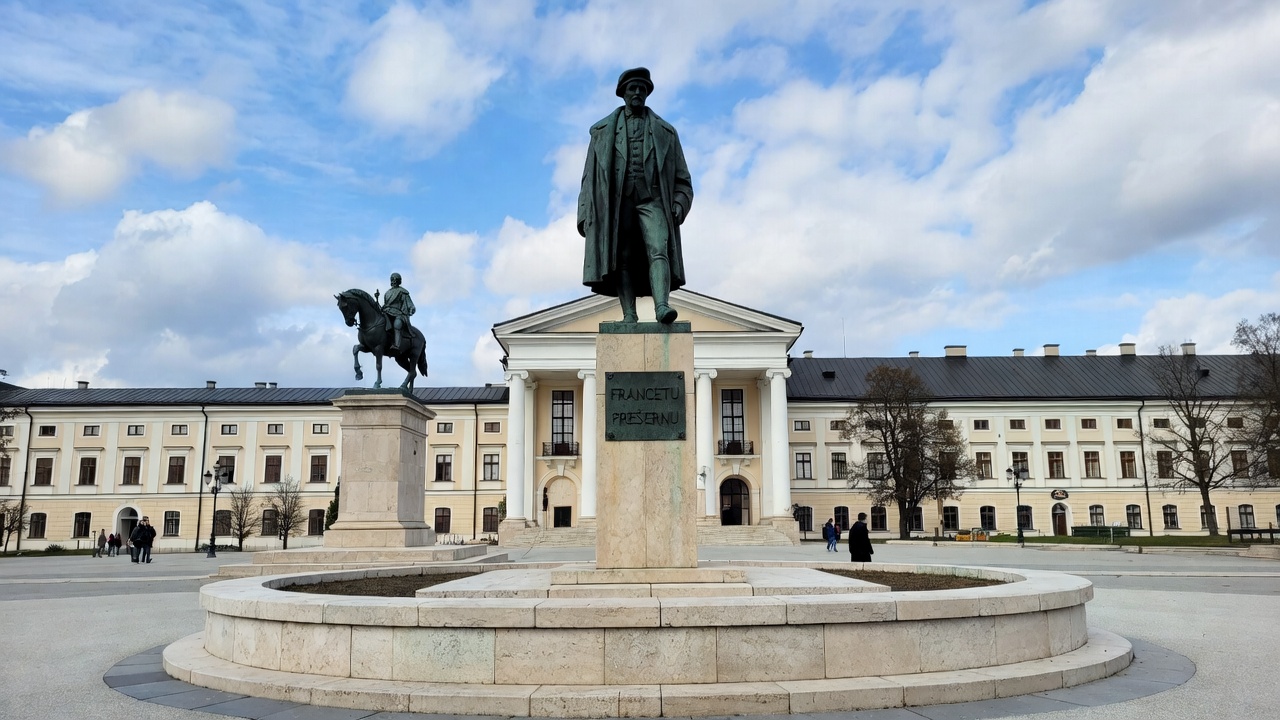
Prešeren Square (Prešernov trg) is the central square of Ljubljana and one of the most recognizable public spaces in Slovenia. It is named after the poet, and his bronze monument — designed by sculptor Ivan Zajec and architect Max Fabiani and unveiled in 1905 — stands at its eastern edge.
The statue depicts Prešeren in formal 19th-century attire, holding a book that symbolizes his collected poems. Above him, a half-nude muse sits on a rock, holding a laurel branch. The poet gazes across the square toward the building where Julija Primic once lived — a small bust of Julija is mounted on the facade, ensuring that the two are locked in an eternal exchange of glances.
Ljubljana is one of the few capital cities in the world where the central square is named after a poet rather than a political or military figure. The square is surrounded by stunning architecture, including the pink Franciscan Church of the Annunciation (built 1646–1660) and the Art Nouveau Urbanc House. It connects to the iconic Triple Bridge (Tromostovje) and is a short walk from Ljubljana Castle.
On Prešeren Day, the square serves as a gathering point. Flowers are often laid at the base of the monument. Street performers recite poetry. And the surrounding streets buzz with the energy of a nation celebrating its cultural identity.
Prešeren’s House and Grave in Kranj
Kranj — often called “the capital of the Slovenian Alps” — is inseparable from Prešeren’s story. He lived and worked here during the final years of his life, and he died in a house on the main street. That house, Prešeren’s House (Prešernova hiša), is now a museum operated by the Gorenjska Museum. It contains the room where the poet passed away, furnished with period items including a bed, a chest of drawers, a standing clock, and a candle-holder.
Nearby, Prešeren’s Grove (Prešernov gaj) — the old Kranj cemetery — is where the poet is buried. The site is a peaceful park, perfect for quiet reflection.
Also in Kranj, the Prešeren Award Winners Gallery is housed in the Pavšlar House, a 16th-century building in the old town. Here you can see portraits and biographical information about every artist who has received Slovenia’s highest cultural honor.
The Birth House in Vrba na Gorenjskem
Prešeren’s Birth House (Prešernova rojstna hiša) in Vrba is a modest farmhouse that has been carefully preserved as a museum. The house sits in one of the most beautiful settings in Slovenia, with the Julian Alps rising dramatically in the background. On Prešeren Day, it is a pilgrimage site for Slovenians who want to honor the poet at the place where his story began.
Other Cultural Destinations Worth Visiting
| Destination | Region | What to See |
|---|---|---|
| National Gallery of Slovenia | Ljubljana | Slovenian art from the 13th–20th centuries |
| Slovene Ethnographic Museum | Ljubljana | Traditional heritage, workshops for children |
| Ljubljana Castle | Ljubljana | Free guided tours and exhibitions on February 8 |
| Idrija Municipal Museum | Idrija | Idrija lace and mercury mining heritage |
| Pomurje Museum | Murska Sobota | Cultural heritage of the Prekmurje region |
| Park of Military History | Pivka | Tanks, submarines, and historic aircraft |
| University of Maribor | Maribor | “Povezija – Poetry Connects” event |
| Media Nox Gallery | Maribor | Guided tours about General Rudolf Maister |
Practical Tips for Visiting Slovenia During the Prešeren Day Holiday
Planning a trip to Slovenia around Prešeren Day? Here is what you need to know.
What Is Open and What Is Closed on February 8?
Because Prešeren Day is a public holiday, many businesses follow holiday hours or close entirely:
- Museums and galleries: Open, and most offer free admission
- Supermarkets and retail shops: Largely closed, though some smaller shops in tourist areas may operate on limited hours
- Restaurants and cafes: Many remain open, especially in city centers
- Public transport: Operates on a Sunday/holiday schedule with reduced frequency
- Banks and government offices: Closed
Pro tip: Stock up on groceries the day before. February 7 is a regular working day, and shops will operate on normal hours.
Weather in Slovenia in Early February
February is one of the coldest months in Slovenia. In Ljubljana, average temperatures hover around 0°C to 5°C (32°F to 41°F). Snow is common at higher elevations but not guaranteed in the capital. Pack warm layers, a waterproof jacket, and sturdy walking shoes — especially if you plan to walk the Cultural Heritage Trail in Vrba or explore Kranj’s old town on foot.
Getting Around
Slovenia is a compact country, and its major cultural sites are easily accessible:
- Ljubljana to Kranj: About 30 minutes by car or 40 minutes by train
- Ljubljana to Vrba: About 50 minutes by car (no direct train service)
- Ljubljana to Maribor: About 1.5 hours by car or 2 hours by train
During the Prešeren Fair in Kranj, city buses run free of charge, and railway tickets are often available at discounted prices. Parking in Kranj’s old town is very limited on February 8 due to the fair, so public transport is strongly recommended.
Accommodation
Early February is not peak tourist season in Slovenia, so hotel availability is generally good. However, if you want to stay in central Ljubljana or in Kranj, booking at least a few weeks in advance is wise — particularly for the weekend of February 8, 2026 (which falls on a Sunday). Expect moderate winter rates, significantly lower than summer prices.
Prešeren Day and Slovenia’s Broader Cultural Calendar in 2026
Prešeren Day does not exist in isolation. It is part of a rich cultural calendar that runs throughout the year, with special emphasis on the winter months.
This Happy Day of Culture: December 3
Slovenians celebrate a second culture-related observance each year on December 3, the anniversary of Prešeren’s birth. Known as “This Happy Day of Culture” (Ta veseli dan kulture), this date is not a public holiday, but many museums and galleries again offer free admission. It serves as a warm-up of sorts for the main celebrations in February.
2026 Literary Anniversaries
The year 2026 is particularly significant for Slovenian literature. As highlighted by the Slovenian Tourist Board, three major literary figures are being commemorated:
- Srečko Kosovel — One of the most important representatives of constructivist and avant-garde poetry in the Slovenian tradition
- Ivan Cankar — A towering figure of Slovenian modernism, known for his plays and prose
- Zofka Kveder — A pioneering feminist thinker and writer
All three shared something with Prešeren: a belief in the revolutionary power of language and art. Their anniversaries ensure that 2026 will be an especially rich year for cultural tourism in Slovenia.
Other Winter Events
Beyond Prešeren Day, Ljubljana’s 9th Winter Festival — organized by the Ljubljana Festival — brings a series of high-profile concerts and performances to the capital from January through March. The highlight in 2026 is the Ljubljana Festival International Competition – Piano, featuring promising pianists from around the world competing for a main prize of €50,000 under the chairmanship of legendary Slovenian pianist Professor Emerita Dubravka Tomšič Srebotnjak.
What Prešeren Day Means for Slovenian Identity in 2026
In a world where national holidays tend to celebrate military victories, political revolutions, or religious events, Slovenia’s choice to dedicate a public holiday to a poet — and by extension, to culture itself — is a powerful statement.
Prešeren Day says something essential about what Slovenia values. It says that a nation is defined not by the size of its army or the strength of its economy, but by the depth of its cultural life. It says that a language is worth fighting for — not with weapons, but with words. It says that a small country of roughly two million people can produce art that stands alongside the greatest achievements of European civilization.
For visitors, Prešeren Day offers something rare: a chance to experience a national holiday that is genuinely about ideas, beauty, and shared humanity. There are no military parades, no political speeches. There are poems, paintings, concerts, and conversations. There is free admission to world-class museums. There is street food in Kranj and illuminated walks through Ljubljana. There is the quiet dignity of a grave in a snow-dusted grove, where a man who changed a nation’s destiny lies beneath the winter sky.
France Prešeren died poor, heartbroken, and largely unrecognized. He could never have imagined that his words would become a national anthem, that his face would appear on the euro, or that millions of people would take a day off work each year to honor his memory. But that is exactly what happens every February 8 in Slovenia.
And in 2026 — 177 years after his death — the celebration continues.
Frequently Asked Questions About Prešeren Day 2026
When is Prešeren Day 2026? Prešeren Day falls on Sunday, February 8, 2026. It is a public holiday and a work-free day in Slovenia.
Is Prešeren Day a public holiday in Slovenia? Yes. Prešeren Day is one of Slovenia’s 16 official public holidays. Most businesses, schools, and government offices close for the day.
Who was France Prešeren? France Prešeren (1800–1849) was Slovenia’s greatest poet. His work elevated the Slovenian language to the level of high European literature. The seventh stanza of his poem Zdravljica serves as the Slovenian national anthem.
What is the Slovenian national anthem? The Slovenian national anthem is the seventh stanza of France Prešeren’s poem “Zdravljica” (A Toast), written in 1844 and adopted as the anthem in 1989.
Are museums free on Prešeren Day? Yes. Most public museums and galleries across Slovenia offer free admission on February 8.
What is the Prešeren Fair in Kranj? The Prešeren Fair is an annual cultural festival held in Kranj on February 8. The town transforms into a 19th-century scene with crafts markets, street food, poetry recitals, horse-drawn carriages, and costumed townspeople. It attracts more than 20,000 visitors each year.
What are the Prešeren Awards? The Prešeren Awards are Slovenia’s highest honors for artistic achievement, presented annually on the eve of Prešeren Day. Up to two Grand Prešeren Awards and six Prešeren Fund Awards are given each year.
Where is Prešeren buried? Prešeren is buried at Prešeren’s Grove (Prešernov gaj) in Kranj, the town where he spent his final years.
Can I visit Prešeren’s birth house? Yes. Prešeren’s Birth House in Vrba na Gorenjskem is a museum open to visitors. On Prešeren Day, the nearby Žirovnica Cultural Heritage Trail offers a special walking experience connecting the homes of several Slovenian literary figures.
Is Prešeren Day celebrated outside Slovenia? Yes. Slovenian communities around the world — particularly in Austria (Carinthia), Italy (Friuli Venezia Giulia), and diaspora communities in North America, South America, and Australia — observe the holiday with their own cultural events.
Whether you are a literature lover, a history enthusiast, or a curious traveler, Prešeren Day is one of Europe’s most meaningful public holidays. Mark February 8, 2026, on your calendar — and let Slovenia show you what happens when a nation puts poetry at the heart of its identity.