Every nation has its founding myths. Some rally around battles. Others point to constitutions or revolutions. Slovenia chose a poem. Each year on February 8, the small Alpine country of just over two million people pauses entirely — shops close, offices go dark, galleries throw open their doors — to honor a man who died penniless and largely unrecognized in 1849. His name was France Prešeren, and his words became the heartbeat of an entire nation.
Prešeren Day (Prešernov dan, slovenski kulturni praznik) is not simply a public holiday. It is Slovenia’s Cultural Holiday — a day that celebrates poetry, artistic expression, and the enduring power of language to shape national identity. In 2026, the holiday falls on Sunday, February 8, and the celebrations stretch across the country from the poet’s humble birthplace in Vrba to the glittering award ceremonies in Ljubljana’s Cankarjev dom.
If you have ever wondered why a two-million-strong nation treats a Romantic poet like a national hero, this guide will answer that question. And if you are planning a winter trip to Slovenia, there is no better time to arrive than the first week of February.
Who Was France Prešeren, Slovenia’s Greatest Romantic Poet?
To understand Prešeren Day, you must first understand the man. France Prešeren (3 December 1800 – 8 February 1849) was born in the village of Vrba na Gorenjskem, a tiny hamlet beneath the Julian Alps in what was then the Habsburg province of Carniola. He was the third of eight children and the first son of a farming family. His mother, Mina, was unusually well-read for her time and insisted on providing her children with a solid education.
Young France showed exceptional promise from the start. He attended elementary schools in Grosuplje and Ribnica before moving to Ljubljana for secondary school, where he mastered Latin, Ancient Greek, and German — the dominant language of education and administration at the time. In 1821, he enrolled at the University of Vienna to study law. It was in Vienna that he devoured the Western literary canon: Homer, Dante, Petrarch, Goethe, and the leading Romantic poets of the era. These influences would shape everything he wrote.
After earning his law degree in 1828, Prešeren returned to Ljubljana. He worked as a legal assistant for years, filing six applications to become an independent lawyer, each one denied by the Austrian authorities. It was not until 1846 — just three years before his death — that he was finally permitted to practice law on his own, in the town of Kranj.
A Life Shaped by Love and Loss
Prešeren’s personal life was marked by heartbreak. On Easter Saturday, 6 April 1833, he caught sight of Julija Primic, the young daughter of a wealthy Ljubljana merchant, at the Church of Trnovo. He fell deeply, hopelessly in love. Julija, however, married someone else — one of Prešeren’s own former schoolmates. The unrequited love for Julija became one of the great engines of his poetry. He dedicated some of his most famous works to her, including the technically dazzling Sonetni venec (A Wreath of Sonnets, 1834), in which the first letters of each line spell out her name in an acrostic.
His closest friend, the literary scholar Matija Čop, drowned in the Sava River in 1835. The loss devastated Prešeren and inspired his epic poem Krst pri Savici (The Baptism on the Savica, 1836), widely considered the high point of his artistic achievement.
Prešeren had three children with Ana Jelovšek, a household servant, but the relationship brought him little stability. He struggled with depression and alcohol. He died on 8 February 1849 in Kranj — alone, sick, and largely unrecognized. He was forty-eight years old.
Why Prešeren Matters: Poetry as Nation-Building
Here is what makes Prešeren exceptional. In the early 19th century, Slovenian was not considered a literary language. The educated classes spoke German. The Austrian administration conducted all business in German. Writing serious poetry in Slovenian was, in itself, an act of cultural defiance.
Prešeren did not simply write in Slovenian. He proved that the Slovenian language could sustain the most demanding poetic forms in Europe — the sonnet, the ghazal, the epic, the ballad. As Britannica notes, he was Slovenia’s sole successful contributor to European Romanticism, and his work placed Slovenian literature on equal footing with the literary traditions of far larger nations.
His fervent, emotionally intense lyrics — never merely sentimental — made him the leading voice of the Romantic movement in his homeland. But recognition came slowly. It was not until 1866, nearly two decades after his death, that literary critic Josip Stritar published an influential essay placing Prešeren’s work in the broader European context. After that, his reputation grew steadily until he became the central figure of Slovenian cultural life.
What Is Prešeren Day and Why Does Slovenia Celebrate It on February 8?
Prešeren Day is observed on February 8 each year — the anniversary of the poet’s death. It is one of Slovenia’s most important public holidays and a work-free day for the entire country.
The idea of marking this date originated during World War II, when Slovenian artists were suppressed under occupation and forbidden from expressing themselves freely. In January 1945, cultural worker Bogomil Gerlanc proposed celebrating 8 February as a Slovenian cultural holiday at a meeting of the Slovene Liberation Front in the town of Črnomelj. The proposal was officially adopted on 28 January 1945 by the Presidency of the Slovene National Liberation Council.
The holiday survived every political transition that followed. It remained a public holiday during the era of the Socialist Republic of Slovenia within Yugoslavia. When Slovenia declared independence in 1991, the holiday was elevated to a work-free day — a move that was not without controversy. Some critics worried that a day off work would dilute the cultural focus of the celebration. In response, 3 December (Prešeren’s birthday) also became a widely observed cultural date, known as “Ta veseli dan kulture” — meaning “This Happy Day of Culture.” The word prešeren itself means happy in Slovenian, making the phrase a lovely linguistic coincidence.
Today, both dates are celebrated with cultural events, though only February 8 holds official status as a national holiday.
How Zdravljica Became Slovenia’s National Anthem: The Story Behind “A Toast”
Perhaps no single work illustrates Prešeren’s lasting impact better than Zdravljica — A Toast. Written around St. Martin’s Day in November 1844, this poem is a carmen figuratum: each of its eight stanzas is shaped on the page to resemble a wine glass. But Zdravljica is far more than a drinking song. It is a manifesto of freedom, equality, and peaceful coexistence among nations.
Censorship and Delayed Publication
Prešeren intended to include Zdravljica in his only published poetry collection, Poezije (1847). However, the Austrian censor — fellow Slovenian Franz Miklosich — saw in the poem’s fourth stanza an expression of pan-Slavic sentiment and refused to allow its publication. Rather than publish a mutilated version, Prešeren withdrew the poem entirely.
Zdravljica was finally published in April 1848, after the March Revolution abolished censorship across the Habsburg Empire. Its message of national unity and freedom struck a powerful chord. Slovenes living under Habsburg rule immediately interpreted the poem as a call for a united Slovenia.
From Partisan Song to National Anthem
The poem resurfaced at every turning point in Slovenian history. During World War II, partisans resisting Nazi-fascist occupation reprinted and recited Zdravljica as an act of resistance. In the 1980s, Slovenian punk rock band Lačni Franz recorded a cover version — and was promptly banned from performing it, because authorities feared it would encourage Slovenia’s breakaway from Yugoslavia.
In September 1989, the Assembly of the Socialist Republic of Slovenia adopted Zdravljica as the regional anthem. When Slovenia declared independence on 25 June 1991, the seventh stanza became the national anthem of the new republic. The music was composed by Stanko Premrl in 1905 for a choral arrangement.
That seventh stanza reads, in English translation:
Long live all the nations / Who long to see the day / When where the sun travels / Strife shall be banished from the world / That every countryman / Will be free / Not an enemy, but a neighbour shall the foreigner be!
As historian Božo Repe has observed, Zdravljica is one of the few non-militant national anthems in the world. It does not celebrate military victory or call citizens to arms. It calls for friendship among nations. This is fitting for a country that has always defined itself more by culture than by conquest.
In 2020, Zdravljica was awarded the European Heritage Label by the European Commission, recognizing its significance as a message of the European Spring of Nations.
The Prešeren Award: Slovenia’s Highest Honor for Artistic Achievement
One of the central rituals of Prešeren Day is the presentation of the Prešeren Award (Prešernova nagrada) — Slovenia’s most prestigious recognition for artistic creation. First bestowed in 1947, the award is given each year to a maximum of two artists for lifetime achievement. In addition, up to six Prešeren Fund Awards (nagrade Prešernovega sklada) are given for outstanding work presented to the public in the preceding three years.
The winners are announced on 3 December (Prešeren’s birthday) and formally presented with their awards at a state ceremony held on the eve of Prešeren Day, February 7, at the Cankarjev dom Culture and Congress Centre in Ljubljana.
2026 Prešeren Award Winners
For 2026, the Prešeren Fund Management Board, chaired by Zdenka Badovinac, announced two laureates for lifetime achievement:
| Award | Recipient | Field |
|---|---|---|
| Prešeren Award (Lifetime) | Mateja Bučar | Choreography and dance |
| Prešeren Award (Lifetime) | Saša J. Mächtig | Industrial design |
Mateja Bučar (born 1957) was recognized for her unique, multimedia approach to choreography, which the board described as placing dance beyond the realm of purely physical art. Her work consistently pushes the boundaries of what choreography can be.
Saša J. Mächtig is celebrated for establishing the foundations of modern Slovenian design identity. He is perhaps best known as the creator of the legendary K67 kiosk, a modular street kiosk that became an icon of Yugoslav-era design and is now held in the permanent collection of the Museum of Modern Art (MoMA) in New York.
The 2026 Prešeren Fund Award recipients are:
| Recipient | Field |
|---|---|
| Petra Seliškar | Film directing |
| Ana Pepelnik | Poetry |
| Jasmina Cibic | Visual art |
| Gregor Božič | Cinematography |
| Petra Strahovnik | Musical composition |
| Tina Vrbnjak | Dramatic acting |
As Badovinac noted in the announcement, the awarded works speak the language of the present day and respond to the urgent questions of our time.
How to Celebrate Prešeren Day in Slovenia: Events, Traditions, and Free Museum Entry
Prešeren Day is a work-free public holiday, which means most shops and businesses are closed. But cultural institutions come alive. Here is what you can expect across the country.
Free Admission to Museums and Galleries Across Slovenia
On February 8, all state and municipal museums and galleries in Slovenia offer free admission. This is one of the most popular traditions of the holiday. In Ljubljana alone, you can visit:
- The National Gallery of Slovenia — home to the country’s most important collection of fine art from the Middle Ages to the 20th century
- The National Museum of Slovenia — which houses the 60,000-year-old Divje Babe Flute, considered the world’s oldest musical instrument
- The Museum of Modern Art — showcasing 20th-century Slovenian artists
- The Slovenian Ethnographic Museum — with workshops and interactive programs for children
- Ljubljana Castle — featuring guided tours, puppet shows, and a special cultural program
- Cukrarna Gallery, Bežigrad Galleries, and the Creative Hub Center Rog
Expect long lines at the most popular venues, especially the National Gallery. Arrive early to make the most of the day.
The Prešeren Fair in Kranj: A Street Festival Honoring Slovenia’s Poet
The city of Kranj, where Prešeren spent his final years, hosts the Prešeren Fair (Prešernov semenj) every February 8. This is an eight-day celebration of culture that culminates on the holiday itself. The old town center fills with market stalls, live performances, poetry readings, and theatrical reenactments. Actors in period costume portray France Prešeren and Julija Primic, walking through the cobblestone streets as if stepping out of the 1840s.
Kranj considers itself the “City of Prešeren.” You will find his name everywhere: the Prešeren Theatre, the Prešeren House memorial museum, the Prešeren Grove, and a gallery of Prešeren Award winners in the Pavšlar House. During the festive season from December through February, verses from Zdravljica are illuminated on the streets and squares of the town.
Walking the Cultural Heritage Trail in Vrba
The village of Vrba na Gorenjskem, Prešeren’s birthplace, draws hundreds of hikers and visitors every February 8. The Žirovnica Cultural Heritage Trail is a 10-kilometer path connecting the birth houses of several major Slovenian cultural figures, including Prešeren and his mentor Matija Čop. The poet’s birth house has been converted into a small museum. Walking this trail on Prešeren Day is a beloved tradition — a quiet, reflective pilgrimage through snow-dusted Alpine countryside.
Poetry Readings at Prešeren Square in Ljubljana
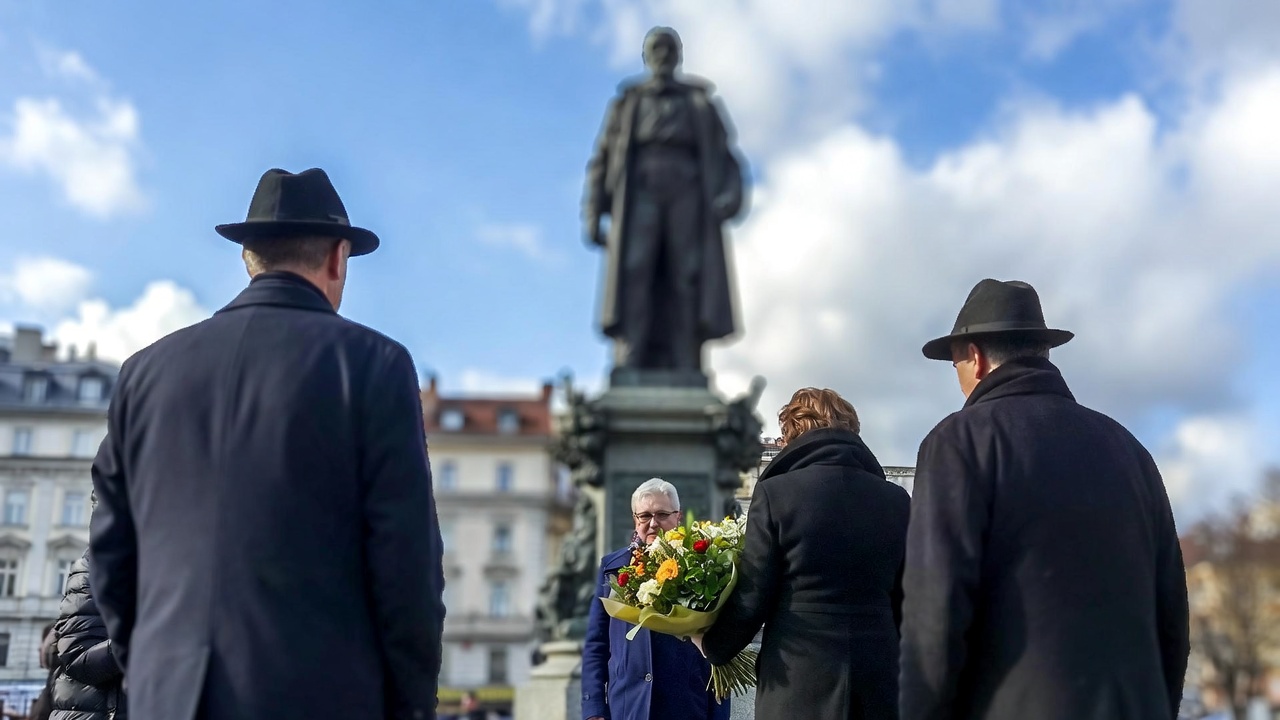
In Ljubljana, members of the Slovenian Association of Dramatic Artists traditionally gather at Prešeren’s monument in Prešeren Square to read his poetry aloud. The square, dominated by a bronze statue of the poet unveiled in 1905, is the symbolic center of the capital. The statue, sculpted by Ivan Zajec on a pedestal designed by architect Max Fabiani, depicts Prešeren gazing across the square — toward a small statue of Julija Primic mounted on a building facade across the way. Even in bronze, the poet’s gaze follows his unrequited love.
Prešeren Square Ljubljana: Why Every Traveler Should Visit Slovenia’s Iconic Landmark
Prešeren Square (Prešernov trg) is more than a meeting point. It is the emotional center of the Slovenian capital. Ljubljana is one of the few European capitals whose central square is named not for a king, a general, or a political leader — but for a poet.
The square sits at the foot of the Triple Bridge (Tromostovje), designed by the legendary Slovenian architect Jože Plečnik, and directly in front of the Franciscan Church of the Annunciation, a Baroque landmark with a distinctive pink facade. Surrounding the square are Art Nouveau and Secessionist buildings erected after the devastating 1895 Ljubljana earthquake, including the elegant Urbanc House and the Hauptmann House.
Since 2007, the square has been closed to motorized traffic, making it a fully pedestrian space. On any given day, you will find street musicians, cafe-goers, and locals socializing. But on Prešeren Day, the square becomes a stage for the entire nation’s cultural pride.
Practical Tips for Visiting Prešeren Square
- Address: Prešernov trg 1, 1000 Ljubljana
- Getting there: A 10-minute walk from Ljubljana railway station, or take any city bus to the center
- Best time to visit: Early morning for photos; late afternoon and evening for atmosphere
- Nearby attractions: Triple Bridge, Ljubljana Castle (accessible by funicular), the Central Market, the Dragon Bridge
The Slovenian National Anthem and Its Connection to Prešeren Day
Few countries can claim that their national anthem is a poem about peace, wine, and friendship. Slovenia can.
The seventh stanza of Zdravljica, set to Stanko Premrl’s 1905 choral composition, embodies values that Slovenians hold dear: tolerance, freedom, and the peaceful coexistence of all nations. A verse from the poem — “Žive naj vsi narodi” (Long live all nations) — is engraved on the Slovenian two-euro coin, alongside Prešeren’s portrait. The same verse is inscribed on a memorial erected in 2008 in front of the Justus Lipsius building of the Council of the European Union in Brussels, placed there during Slovenia’s EU Presidency.
The anthem’s non-militant character sets Slovenia apart. While many European anthems speak of blood and glory, Zdravljica speaks of shared tables and shared toasts. This is a country that defines patriotism not through war, but through the beauty of its language.
France Prešeren’s Most Famous Poems and Their Enduring Legacy
Prešeren’s complete output fits into a single slim volume — his 1847 collection Poezije — yet its impact on Slovenian literature is immense. Here are the works that continue to define Slovenian cultural identity.
Sonetni venec (A Wreath of Sonnets, 1834)
This cycle of fifteen interconnected sonnets is a technical masterpiece. The last line of each sonnet becomes the first line of the next, creating a continuous “garland” of verse. The fifteenth sonnet, the Magistrale (Master Theme), is composed entirely of the first lines of the preceding fourteen. Read downward, the first letters of each line spell out PRIMICOVI JULIJI — “To Julija Primic.” The poem scandalized readers of the day because Prešeren dared to publicly name a young woman of higher social standing.
Krst pri Savici (The Baptism on the Savica, 1836)
Prešeren’s longest and most ambitious work, this epic poem was written as a memorial to his drowned friend Matija Čop. It tells the story of Črtomir, a pagan warrior who fights against the forced Christianization of the Slavs, and his beloved Bogomila. The poem explores themes of cultural conflict, surrender, and transformation. It is set near the Savica Waterfall in the Julian Alps, which remains a popular hiking destination partly because of the poem’s fame.
Povodni mož (The Water Man)
Prešeren’s first and most beloved ballad tells the story of Urška, a beautiful and vain woman who refuses every dance partner at a ball in Ljubljana’s Old Square — until a mysterious stranger appears. They spin faster and faster until both disappear into the whirlpool of the Ljubljanica River. The ballad captures the folk horror tradition with vivid, cinematic energy.
Zdravljica (A Toast, 1844)
Already discussed above, this is the poem that became the national anthem. Its shape — each stanza laid out to resemble a wine glass — makes it a rare example of concrete poetry from the Romantic period.
Visiting Prešeren’s Birth House in Vrba: A Guide to Slovenia’s Literary Pilgrimage
The village of Vrba na Gorenjskem lies at the foot of Mount Stol in the Karavanke mountain range, about 55 kilometers northwest of Ljubljana. Prešeren’s birth house, known locally as “Pr’ Ribč” (At the Fisherman’s), has been preserved as a memorial museum managed by the Gorenjski muzej (Museum of Upper Carniola).
Inside, visitors can see period furniture, documents, and artifacts from Prešeren’s life, including his death veil — an embroidered cloth that covered the poet’s body. The museum traces three key themes: the composition of Zdravljica, the publication of Poezije, and Prešeren’s final move to Kranj.
How to Get to Vrba
- By car: Take the A2 motorway from Ljubljana toward Jesenice. Exit at Žirovnica. Vrba is a short drive from the motorway.
- By train: Take the train from Ljubljana to Lesce-Bled station (approximately 1 hour). From there, Vrba is accessible by local bus or taxi.
- On foot: Many Slovenians walk to Vrba on Prešeren Day as a cultural pilgrimage. The Žirovnica Cultural Heritage Trail connects several important sites.
Admission: Free on Prešeren Day (February 8) and on This Happy Day of Culture (December 3).
Why Prešeren Day Matters: How Slovenia Uses Culture to Define National Identity
Slovenia is a young country. It declared independence only in 1991. But its cultural traditions run centuries deep, stretching back to the Freising Manuscripts of the 9th century — the oldest surviving text in any Slavic language written in the Latin alphabet — and the Protestant Reformation works of Primož Trubar in the 16th century.
In this long arc of cultural history, Prešeren occupies a unique position. He proved that the Slovenian language was capable of the highest literary art. He gave Slovenians a national anthem that preaches peace rather than war. And he provided a model of artistic genius persisting against indifference — a narrative that resonates deeply in a small nation that has always had to fight for recognition.
The decision to make a poet — rather than a soldier or a politician — the central symbol of national identity says something profound about Slovenian values. As the Slovenian government’s official portal states, the Prešeren Awards represent the highest recognition in the Republic of Slovenia for achievements in artistic creation. The arts are not peripheral to Slovenian life. They are at its center.
Prešeren’s image appears on the Slovenian two-euro coin. A square named after him is the heart of the capital city. Streets, schools, theaters, and even a rose variety bear his name. The word prešeren — meaning happy or cheerful — has become synonymous with Slovenian cultural pride.
Planning Your Trip to Slovenia for Prešeren Day 2026: Travel Tips and Practical Information
When Is Prešeren Day 2026?
Sunday, February 8, 2026. Because it falls on a Sunday, some businesses may follow Sunday opening hours. Cultural events and free museum entry will proceed as usual.
What to Expect
| Detail | Information |
|---|---|
| Date | February 8, 2026 (Sunday) |
| Official name | Prešernov dan, slovenski kulturni praznik |
| Type | National public holiday, work-free day |
| Key locations | Ljubljana, Kranj, Vrba na Gorenjskem |
| Free museum entry | Yes — all state and municipal museums and galleries |
| Award ceremony | Evening of February 7 at Cankarjev dom, Ljubljana |
| Weather | Expect winter conditions: average temperatures around 0–5°C in Ljubljana, colder in alpine areas |
Where to Stay
- Ljubljana: The capital offers the widest range of hotels, hostels, and apartments. Stay near the Old Town for easy access to Prešeren Square and major museums.
- Kranj: A smaller, more intimate option. Choose Kranj if you want to attend the Prešeren Fair and experience the holiday in the poet’s final hometown.
- Bled: Just 10 kilometers from Vrba, Lake Bled is one of Slovenia’s most famous destinations. Stay here if you plan to hike the Cultural Heritage Trail.
Getting Around
Ljubljana has an excellent public transport network. The city center is compact and walkable. For trips to Kranj and Vrba, renting a car is the most convenient option, though train and bus connections are available.
What to Eat
February in Slovenia means hearty winter fare. Look for:
- Štruklji — rolled dumplings filled with cottage cheese, walnut, or tarragon
- Jota — a thick stew of beans, sauerkraut, and potatoes, popular in winter
- Potica — a traditional rolled pastry with walnut filling, often served during holidays
- Prešeren’s chocolate balls and Prešeren’s figs — specialty treats available in Ljubljana’s chocolate shops, inspired by the poet’s famous habit of carrying dried figs in his coat pockets to share with poor children
LUV Festival Ljubljana: Celebrating Love and Art from Prešeren Day to St. Gregory’s Day
If you time your visit right, Prešeren Day marks the beginning of one of Ljubljana’s most enchanting seasonal events. The LUV Festival (Ljubljana Unforgettable Valentines) runs from February 8 through March 12, connecting Culture Day with St. Gregory’s Day (Gregorjevo) — the traditional Slovenian holiday of love. Yes, Slovenia has its own Valentine’s Day, and it predates the commercial version by centuries.
During LUV Festival, Ljubljana fills with romantic experiences: candlelit walks along the Ljubljanica River, poetry readings in intimate cafes, wine tastings, chocolate workshops, and special exhibitions. The festival is a bridge between the intellectual love of Prešeren Day and the romantic love of Gregorjevo, creating a month-long celebration of affection in all its forms.
The Prešeren Monument and Julija Primic: A Love Story Frozen in Bronze
Stand in Prešeren Square and look at the poet’s statue. His gaze is fixed on something across the square. Follow it. There, mounted on the facade of a building on Wolfova ulica, you will find a small bust of Julija Primic — the woman he loved and never won.
The main monument, designed by architect Maks Fabiani and sculptor Ivan Zajec, was unveiled in 1905. It depicts Prešeren standing beneath a figure of the Muse of Poetry, who holds a laurel sprig above his head. The Muse is bare-chested — a detail that scandalized the clergy of the neighboring Franciscan Church and the more conservative residents of Ljubljana. The model was reportedly an Italian dancer from Trieste.
In 1991, Prešeren Square and the Prešeren Monument were declared a cultural monument of national significance. The monument was restored in 2005, and the square was fully pedestrianized in 2007. Three birch trees planted behind the monument are said to mark the energy center of Ljubljana — a claim that locals share with a mix of sincerity and amusement.
Slovenian Culture Beyond Prešeren: Exploring the Country’s Artistic Heritage
Prešeren Day is a gateway to understanding the broader landscape of Slovenian culture. While in the country, consider exploring:
Architecture: Jože Plečnik’s Ljubljana
The architect Jože Plečnik (1872–1957) reshaped Ljubljana in the early 20th century. His works include the National and University Library, the Triple Bridge, the Central Market, and the redesigned banks of the Ljubljanica River. In 2021, Plečnik’s works in Ljubljana were inscribed on the UNESCO World Heritage List.
Literature: From the Freising Manuscripts to Contemporary Fiction
Slovenian literary history begins with the Freising Manuscripts (c. 972–1039), the oldest known texts in any Slavic language using the Latin script. The Protestant reformer Primož Trubar published the first two printed books in Slovenian in the 1550s. Contemporary Slovenian literature continues to thrive — 2026 Prešeren Fund Award winner Ana Pepelnik represents the next generation of Slovenian poets.
Music: From Stanko Premrl to Modern Sounds
The composer Stanko Premrl (1880–1965) wrote the choral arrangement of Zdravljica that became the national anthem. Today, Slovenia has a vibrant music scene ranging from classical to electronic. The Ljubljana Festival and the annual Winter Festival bring world-class performers to the capital each year.
Frequently Asked Questions About Prešeren Day in Slovenia
Is Prešeren Day a public holiday? Yes. It is a national public holiday and a work-free day. Most shops, banks, and offices are closed.
Can I visit museums for free on Prešeren Day? Yes. All state and municipal museums and galleries offer free admission on February 8.
Where are the main celebrations held? The largest events take place in Ljubljana (Prešeren Square, Cankarjev dom, museums), Kranj (the Prešeren Fair), and Vrba (the poet’s birthplace).
What is the Prešeren Award? It is Slovenia’s highest honor for artistic achievement, given annually to a maximum of two artists for lifetime work. It has been awarded since 1947.
Is Prešeren Day only celebrated in Slovenia? No. Slovenian communities around the world — including in Italy, Austria, Argentina, the United States, and Canada — also mark the holiday with cultural events.
What is the difference between February 8 and December 3? February 8 (Prešeren Day) marks the anniversary of the poet’s death and is the official national holiday. December 3 (This Happy Day of Culture) marks his birthday and is widely celebrated but is not an official public holiday.
How Prešeren Day Compares to Other European Cultural Holidays
Every European country honors its cultural heritage in some form, but few do so with the singular focus that Slovenia brings to Prešeren Day. It is worth comparing this celebration to similar holidays across the continent to appreciate what makes it distinctive.
Scotland celebrates Burns Night on January 25, honoring the poet Robert Burns with haggis suppers, whisky toasts, and recitations of his verse. The format is more intimate — typically a dinner among friends — and it is not a public holiday. Denmark marks H.C. Andersen Day (April 2) as International Children’s Book Day, but it is not a national holiday either. Ireland’s Bloomsday (June 16) commemorates James Joyce’s Ulysses with readings and pub crawls in Dublin, but again, businesses do not close.
What sets Prešeren Day apart is that it is a full national public holiday — a work-free day enshrined in law. The entire country shuts down for a poet. This level of institutional commitment to literary culture is exceptionally rare in Europe, or anywhere else. It reflects a deeply held Slovenian belief that artistic expression is not a luxury but a necessity — a core element of national survival.
The comparison is also instructive in terms of accessibility. Burns Night requires an invitation. Bloomsday is largely confined to Dublin. But Prešeren Day is open to everyone, everywhere in Slovenia. Free museum admission, public poetry readings, open-air festivals — the celebration is democratic by design.
The Prešeren Day Experience for Families: Kid-Friendly Cultural Activities
Prešeren Day is not just for literary scholars and poetry lovers. Slovenian cultural institutions go out of their way to engage children and families in the celebrations.
In Ljubljana, the City Museum organizes hands-on workshops where children learn historical crafts like sewing, embroidery, and weaving. At Plečnik’s House, young visitors explore architecture through the eyes of a playful dog mascot named Sivko. The School Museum offers calligraphy workshops where children can try writing with a goose quill — the same tool Prešeren used to compose his poems. At Ljubljana Castle, the mascot Friderik greets children before each kids’ guided tour, and the castle screens animated films and hosts fairy-tale walks for visitors aged five and older.
The Slovenian Ethnographic Museum hosts drawing and creative workshops, while the Museum of Recent and Contemporary History often features exhibitions by young artists, exploring themes like happiness and laughter through art.
For families visiting Kranj, the Prešeren Fair offers a lively, carnival-like atmosphere with food stalls, live music, and theatrical performances. Children can participate in craft workshops or watch actors dressed as Prešeren and Julija stroll through the old town streets.
These activities reflect a deliberate educational philosophy: introduce children to their cultural heritage not through dry textbooks, but through lived experience. A child who writes with a goose quill on Prešeren Day may carry that memory — and that connection to Slovenian culture — for a lifetime.
The Slovenian Two-Euro Coin: Prešeren’s Image in Everyday Life
Since 2007, every Slovenian two-euro coin has carried the image of France Prešeren alongside the opening line of Zdravljica’s seventh stanza: “Žive naj vsi narodi” (Long live all nations). This means that Prešeren’s face passes through millions of hands every day, not just in Slovenia but across the entire eurozone.
The coin was designed by Slovenian artist Miljenko Licul in collaboration with Maja Licul. It replaced an earlier depiction of Prešeren that appeared on the 1000-tolar banknote used before Slovenia adopted the euro in 2007.
There is something quietly profound about this. In most countries, currency features monarchs, founding fathers, or architectural landmarks. Slovenia chose a poet and a line of poetry that calls for peace among all nations. Every time a Slovenian pays for a coffee with a two-euro coin, they are — in the most literal sense — circulating their cultural values.
Final Thoughts: Why Prešeren Day Deserves a Place on Every Traveler’s Calendar
I have been to festivals on every continent. I have watched cherry blossoms fall in Kyoto, danced at Carnival in Salvador, and stood silent at Anzac Day dawn services in Gallipoli. But I have rarely encountered a national celebration as quietly powerful as Prešeren Day.
There is something moving about a country that stops everything to honor a poet. Not a conqueror. Not a politician. A man who wrote sonnets in a language that most of the world has never heard — and in doing so, gave that language dignity and permanence.
When you stand in Prešeren Square on February 8, surrounded by Slovenians reciting verses they learned in childhood, you understand something about this country that no guidebook can fully convey. Slovenia does not just celebrate its culture. It lives inside it.
If you can, come in February. Walk the Cultural Heritage Trail in the snow. Stand before the poet’s statue as someone reads Zdravljica aloud. Raise a glass of Slovenian wine and drink to what Prešeren asked us to drink to — the day when all people will be free, and every foreigner will be not an enemy, but a neighbor.
Na zdravje! 🥂