Every February 10, the tiny Mediterranean island of Malta shuts down. Schools close. Offices empty. Fireworks thunder across the Grand Harbour before most of the world has finished its morning coffee. This is the Feast of Saint Paul’s Shipwreck — not just another saint’s day on a crowded Catholic calendar, but the holiday that defines an entire nation’s identity.
Malta is a country built on limestone, seawater, and faith. With over 360 churches packed into an archipelago smaller than most major cities, it holds one of the highest concentrations of sacred architecture anywhere on earth. Over 90% of its population identifies as Roman Catholic, making it one of the most devoutly Catholic nations in all of Europe. The Constitution itself names Roman Catholicism as the state religion.
But among the dozens of saints’ feasts, liturgical celebrations, and holy days that dot the Maltese calendar, one stands above the rest. The Feast of Saint Paul’s Shipwreck (Il-Festa ta’ San Pawl Nawfragu in Maltese) is the holiday that sits at the very heart of what it means to be Maltese. It marks the moment — nearly two thousand years ago — when an Apostle’s misfortune became an island’s salvation.
In 2026, the feast falls on Tuesday, February 10. As always, it is a national public holiday. And as always, it will transform the streets of Valletta into a tapestry of music, devotion, confetti, and fire.
This post is your complete guide to understanding why this day matters so deeply, what happens during the celebrations, and how to experience it for yourself.
The Biblical Story Behind Saint Paul’s Shipwreck in Malta
To understand why Malta celebrates this feast with such intensity, you need to start with the story itself. It is recorded in the New Testament, in the Acts of the Apostles, chapters 27 and 28. The author is Luke, a physician and companion of Paul, who was present on the voyage and wrote as an eyewitness.
Around A.D. 60, Paul of Tarsus — already one of the most important figures in early Christianity — was a prisoner of Rome. He had appealed his case to Caesar and was being transported by ship from Caesarea (in modern-day Israel) to Rome for trial. The vessel was an Alexandrian grain freighter, a massive ship carrying 276 passengers and crew.
The journey did not go as planned.
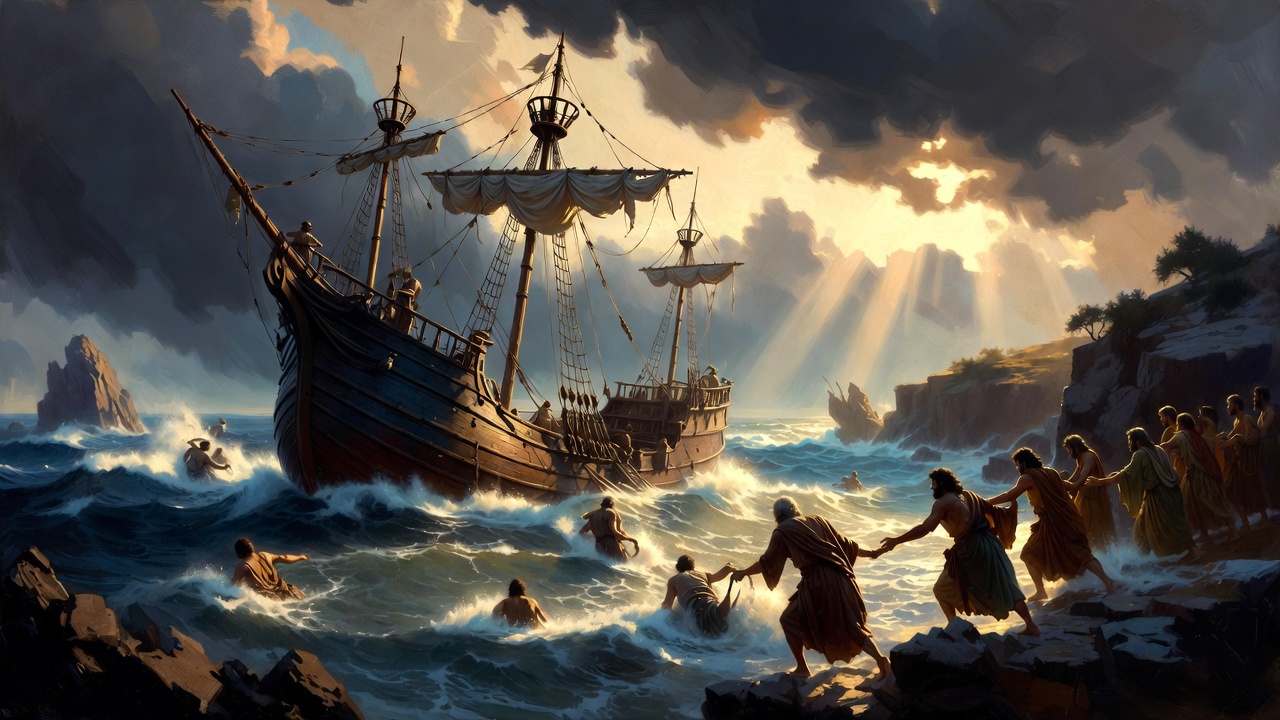
Somewhere in the central Mediterranean, the ship was caught by a violent northeast wind that Luke calls a Euraquilo (sometimes rendered as “Euroclydon”). For fourteen days, the storm drove the vessel westward across open water. The crew threw cargo overboard. They passed ropes under the hull to hold the ship together. They gave up all hope of survival.
Then, on the fourteenth night, the sailors sensed land. They took depth soundings and found the sea floor was rising beneath them. Fearing rocks in the darkness, they dropped four anchors from the stern and waited for dawn. When daylight came, they spotted a bay with a sandy beach. They cut the anchor ropes, raised a foresail, and aimed for shore. The ship struck a sandbar and broke apart.
Every single person on board survived, just as Paul had promised them, citing a vision from God. They swam or floated on wreckage to the island. The locals, Luke writes, showed them “unusual kindness” and built a fire for them in the rain.
The island was called Melita. It was Malta.
How Saint Paul Changed the History of Christianity in Malta
What happened next is the foundation story of Maltese Christianity. And on an island where religion is not merely a private matter but a public identity, that foundation story carries extraordinary weight.
According to Acts 28, Paul was gathering sticks for the fire when a viper, driven out by the heat, fastened itself on his hand. The islanders, seeing the snake hanging from his wrist, assumed he must be a murderer whom divine justice had caught up with at last. They waited for him to swell up and die.
He did not. He shook the snake into the fire and suffered no harm. The locals quickly reversed their judgment. If he was not a criminal, perhaps he was a god.
Paul, of course, was neither. But he was a healer. The father of Publius, the chief official of the island (traditionally understood as the Roman governor), was sick with fever and dysentery. Paul visited him, prayed, and laid his hands on the old man. Publius’ father recovered. Word spread, and soon people from across the island came to Paul for healing.
Paul stayed in Malta for three months — the entire winter season — before departing for Rome on another Alexandrian ship that had wintered in the island’s harbour. During that time, tradition holds, he preached the Gospel and converted many of the islanders to Christianity.
Publius himself became the first Bishop of Malta, according to Maltese tradition. He is one of the island’s three patron saints, alongside Paul and Saint Agatha. The Mdina Cathedral, the historic seat of the Maltese church, is traditionally said to stand on the site of Publius’ own residence.
This makes Malta one of the earliest Christian communities in the entire Roman world. The Maltese did not receive Christianity secondhand through missionaries or conquests centuries later. They received it directly from an Apostle. That distinction is a source of deep national pride.
Where Did the Shipwreck of Saint Paul Actually Happen in Malta?
For centuries, the traditional answer was simple: Saint Paul’s Bay, on the northeast coast of the island, about nine miles northwest of Valletta. The bay has carried Paul’s name since at least the twelfth century. A small uninhabited island just offshore, known as St. Paul’s Island (or Selmunett), features a prominent statue of the Apostle erected in 1844.
The geography seems to fit Luke’s description in some respects. There is a channel between St. Paul’s Island and the main island that could match the biblical description of a place “where two seas meet.” There is a sandy beach. And the location is on the less-trafficked northern coast — which could explain why the professional sailors on board did not recognize where they were.
But in recent decades, alternative theories have emerged.
The St. Thomas Bay Theory
The most publicized alternative comes from Robert Cornuke, a former crime scene investigator turned amateur biblical archaeologist. Cornuke argued that the shipwreck occurred at St. Thomas Bay, on the southeastern coast of Malta, near a submerged reef called the Munxar Reef.
His theory received attention because of a dramatic piece of evidence. In the early 1960s, local divers recovered four large Roman-era lead anchor stocks at a depth of about 90 feet near the Munxar Reef. The Bible specifically states that the crew dropped four anchors from the stern. The anchors were confirmed by experts at the University of Malta to be consistent with first-century Roman maritime equipment.
However, the theory remains controversial. Dr. Gordon Franz, an archaeologist with the Associates for Biblical Research, has pointed out that Roman-era anchors have been found at multiple sites around Malta and do not conclusively link to Paul’s specific ship. Maritime archaeologist Dr. Timmy Gambin of the University of Malta notes that St. Thomas Bay was near at least two known Roman harbours, making it unlikely that experienced sailors would not have recognized the area.
The Salina Bay Theory
A third possibility emerged in 2005 when rescue diver Mark Gatt discovered a massive one-ton lead anchor off Salina Bay, near the Għallis Tower. The anchor bore Egyptian inscriptions — significant because Paul’s ship was an Alexandrian grain freighter from Egypt. The Malta Archaeological Survey had previously confirmed that both St. Paul’s Bay and the Salina area served as harbours in antiquity.
The Mljet (Croatia) Theory
Outside Malta entirely, some scholars have argued that the shipwreck occurred on the island of Mljet (historically called Meleda or Melita) off the coast of Croatia, in the Adriatic Sea. This theory, which dates back to a 1730 dissertation by a Benedictine monk named Ignacio Giorgi, has supporters but remains a minority view. The prevailing wind patterns and the established grain-ship trade routes from Alexandria to Rome make Malta the far more likely candidate.
| Proposed Location | Key Evidence | Main Weakness |
|---|---|---|
| St. Paul’s Bay (traditional) | Centuries of tradition; geographic match to “two seas meet” | No archaeological artifacts directly linked to the wreck |
| St. Thomas Bay | Four Roman-era anchors found at biblical depth | Near known Roman ports — sailors would have recognized it |
| Salina Bay | Large anchor with Egyptian inscriptions | Single find; not conclusive |
| Mljet, Croatia | Also called “Melita” historically | Wind patterns and trade routes favour Malta |
The honest answer, as Dr. Gambin has put it, is that the exact location remains “shrouded in mystery.” But for the Maltese people, the debate over specific coordinates misses the larger point. Paul came to Malta. That is what matters.
Why Saint Paul Is the Patron Saint of Malta and Its National Symbol
Saint Paul is not merely a religious figure in Malta. He is a national symbol, woven into the island’s identity as deeply as the Maltese cross or the limestone that forms its bedrock.
Malta has three patron saints: Paul, Publius, and Agatha. But Paul occupies a special place. He is the one who brought the faith. He is the one whose story is told and retold in churches, schools, and family homes across the archipelago. His image appears on churches, street corners, public buildings, and even the national euro coins.
The depth of devotion becomes clearer when you consider the sheer number of sites connected to Paul across the tiny island:
- St. Paul’s Shipwreck Church in Valletta — the centre of the February 10 feast
- St. Paul’s Grotto in Rabat — the cave where Paul is said to have sheltered during his three-month stay
- The Mdina Cathedral — built on the traditional site of Publius’ residence
- San Pawl Milqi Chapel — where tradition says Paul met and converted Publius
- St. Paul’s Island — the offshore islet with its iconic statue
- San Pawl tal-Wied — a small church marking a place where Paul is said to have preached
- Multiple parish churches dedicated to Paul’s conversion or shipwreck in Safi, Munxar, Bormla, Marsalforn, and elsewhere
For a nation of roughly 530,000 people living on an archipelago only 27 kilometres long and 15 kilometres wide, the saturation of Pauline devotion is remarkable. It reflects something deeper than religious observance. It reflects a people’s understanding of who they are and where they come from.
The Maltese language itself provides a striking example. Malta is the only predominantly Christian country in Europe where the word for God is “Alla” — a legacy of Arab rule from 870 to 1091 A.D. Yet despite centuries of Islamic influence, Maltese Christianity survived and eventually re-emerged. The Maltese see Paul’s visit as the moment that planted an indestructible seed of faith in their soil.
The Church of Saint Paul’s Shipwreck in Valletta: A Complete Guide
The Collegiate Parish Church of St Paul’s Shipwreck (Knisja Parrokkjali Kolleġġjata ta’ San Pawl Nawfragu) stands on a narrow, steep side street — Triq San Pawl (St. Paul’s Street) — in the heart of Valletta. It is easy to miss if you are not looking for it. The entrance is modest. The street is tight. But step inside, and you enter one of the most important sacred spaces in the Maltese Islands.
History of the Church
The church was designed by Girolamo Cassar, the same Maltese architect responsible for St. John’s Co-Cathedral and many of Valletta’s most important buildings. Construction was completed in 1582, making it one of the oldest churches in the capital.
The Cathedral Chapter of Mdina had purchased the land and commissioned the church shortly after Grand Master Jean de Valette began building the new capital following the Great Siege of 1565. The church was dedicated to Paul’s shipwreck — the defining event of Maltese Christianity — and was intended from the start to be a building of exceptional quality.
In the mid-seventeenth century, the church was handed over to the Jesuits and rebuilt. It became a collegiate church in the early eighteenth century. The current facade dates from 1885, redesigned by architect Nicholas Zammit. The building is listed on the National Inventory of the Cultural Property of the Maltese Islands.
Artistic Treasures Inside the Church
The interior is far more lavish than the exterior suggests. Visitors often compare it favourably to the more famous St. John’s Co-Cathedral down the street. Key highlights include:
- The Titular Altarpiece by Matteo Perez d’Aleccio (1547–1616), a follower of Michelangelo, depicting Paul’s shipwreck
- The Statue of Saint Paul, carved in Rome by Melchiorre Gafà (1635–1667), one of the finest Baroque sculptors of the era. This gilded wooden statue shows Paul in the act of preaching and set the template for all subsequent depictions of the Apostle in Maltese art
- Ceiling frescoes by Italian artist Attilio Palombi, depicting episodes from Paul’s life
- Paintings by Maltese artists Giuseppe Calì and Giuseppe d’Arena, and twentieth-century works by Emvin Cremona
- Coloured marble columns, gilded woodcarvings, and an abundance of silver, gold, and precious-stone objects donated over the centuries by Grand Masters and Bishops
Sacred Relics of Saint Paul
The church holds two relics of extraordinary significance:
- A fragment of Saint Paul’s right wrist bone, encased in an ornate golden reliquary. This relic was donated to the church in 1823 by Vincenzo Aloisio Bonavia.
- A piece of the marble column on which Paul was beheaded in Rome at the church of San Paolo alle Tre Fontane. This relic was donated by Pope Pius VII in 1818, in recognition of the service rendered by the collegiate chapter during a devastating plague outbreak in 1813.
These relics draw Christian pilgrims from around the world. They are displayed in the church and can be viewed by visitors, though photography restrictions apply.
Visiting Information
| Detail | Information |
|---|---|
| Location | Triq San Pawl (St. Paul’s Street), Valletta |
| Entrance from | Triq Santa Luċija (St. Lucia’s Street) |
| Admission | Free (donations welcome) |
| Dress code | Shoulders must be covered; no shorts. Shawls are provided at the entrance |
| Opening hours | Typically open in the late afternoon (after 17:30); check locally for current times |
| Feast day | February 10 (national public holiday) |
What Happens During the Feast of Saint Paul’s Shipwreck on February 10
The Feast of Saint Paul’s Shipwreck is the first major outdoor religious feast of the Maltese calendar year. While most of Malta’s approximately 94 festas take place during the warmer months between May and September, Paul’s feast arrives in the chill of February. That it still draws enormous crowds despite the cold is itself a measure of its importance.
The celebrations are centred on Valletta but felt across the entire island. Here is what you can expect.
Morning: Mass and Fireworks Over the Grand Harbour
The feast day begins early with a Solemn Mass at 8:00 a.m. at the Church of St. Paul’s Shipwreck. The church is packed. The liturgy is formal and reverent, conducted in Maltese with Latin elements, as is traditional for major Maltese feast days.
Immediately after the morning Mass, fireworks erupt over the Grand Harbour. This is not a quiet, evening-sky affair. Maltese fireworks during feasts are deliberately thunderous — designed to be heard and felt as much as seen. The booms echo off the limestone bastions and roll across the harbour waters. For anyone watching from the Upper Barrakka Gardens or the Valletta waterfront, it is an unforgettable spectacle.
Malta has a long and proud tradition of pyrotechnics. Local fireworks factories, often family-run operations passed down through generations, produce the displays. The craft is taken extremely seriously, and there is fierce but friendly rivalry between different teams and villages over who produces the best show.
The Grand Procession Through the Streets of Valletta
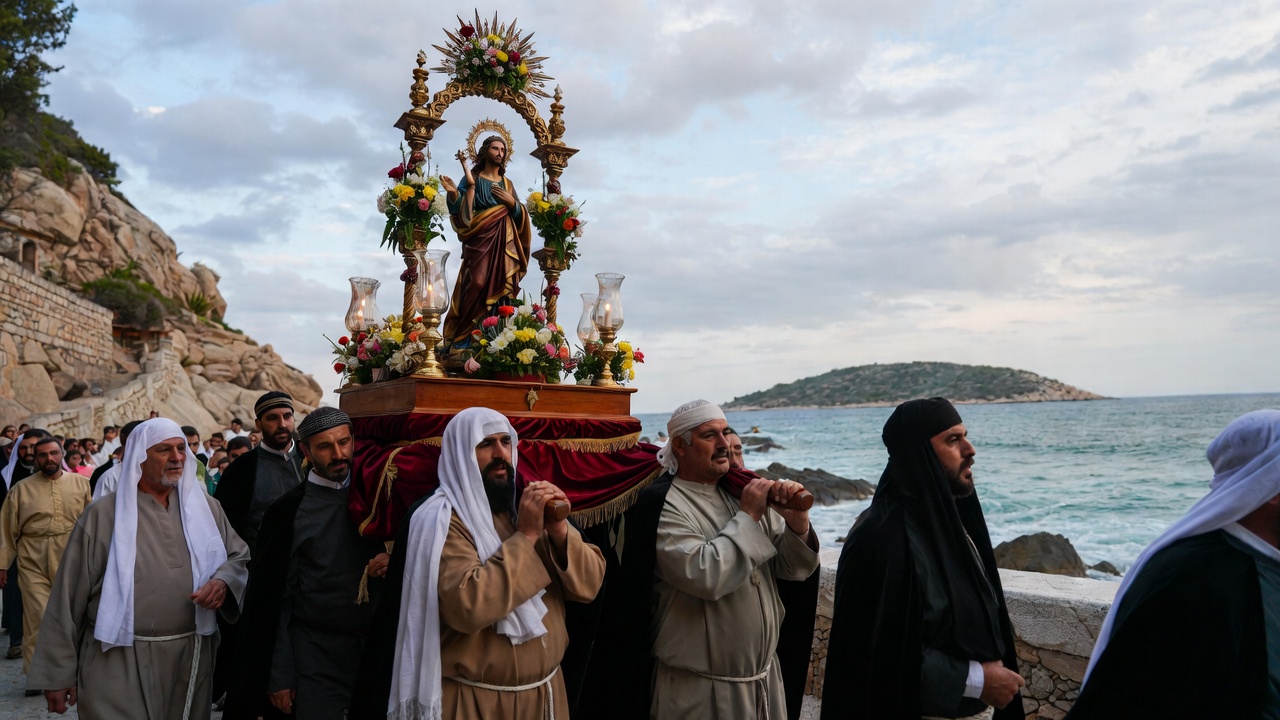
The centrepiece of the feast is the procession of the statue of Saint Paul through the streets of the capital. This is the moment that draws the largest crowds and generates the most emotion.
The statue — Melchiorre Gafà’s magnificent Baroque masterpiece, carved in Rome in the 1650s — is carried out of the church and through the streets of Valletta on the shoulders of the city’s strongest men. The bearers are chosen as a mark of honour, and the privilege is taken very seriously.
The procession is accompanied by:
- Brass bands in traditional uniforms, playing festive marches
- Costumed participants adding colour and historical pageantry
- Crowds of devoted followers who applaud, cheer, and chant as the statue passes
- Elderly women on balconies who shower the procession with confetti from above — a deeply Maltese tradition that adds a touch of beauty and tenderness to the spectacle
The streets along the procession route are decorated with banners, lights, and elaborate baroque-style hangings. The atmosphere is a unique blend of solemn devotion and exuberant celebration. It is loud, colourful, emotional, and deeply communal.
The Solemn Mass and Evening Celebrations
The feast day concludes with a second Solemn Mass at the Church of St. Paul’s Shipwreck. This evening service tends to be even more elaborate than the morning one, with full choral accompaniment and a sermon focused on Paul’s legacy and meaning for Malta.
After the Mass, the celebrations continue informally. Families gather for meals. Friends meet in the streets and in the kazini (band clubs). Food stalls offer traditional Maltese treats. The evening often ends with another round of fireworks.
Traditional Maltese Feast Day Food You Must Try on February 10
No Maltese feast is complete without food. The street stalls that appear during festas are an essential part of the experience, transforming Valletta’s narrow streets into an open-air market of aromas and flavours.
Here are the traditional foods to look for during the Feast of Saint Paul’s Shipwreck:
Pastizzi — Perhaps the most iconic Maltese street food. These are flaky, diamond-shaped pastries filled with either ricotta cheese (tal-irkotta) or mushy peas (tal-piżelli). Crispy, savoury, and deeply satisfying, they cost very little and can be found at every festa.
Imqaret — Deep-fried date pastries, sweet and rich, often served with a drizzle of honey or a dusting of powdered sugar. These are a traditional Maltese dessert that appears at every major celebration.
Qubbajt (Nougat) — Sold from traditional dark wooden stalls with antique brass weighing scales, nougat is one of the most visually and culturally distinctive elements of any Maltese feast. The white, chewy confection is studded with almonds and comes in thick slabs cut to order. The nougat sellers and their stalls have become an iconic image of the Maltese festa.
Mqaret tal-Tewm — Garlic bread, Maltese-style, often served with kunserva (tomato paste) or bigilla (a broad bean dip with garlic and parsley).
Ħobż biż-żejt — The classic Maltese bread dish: crusty ftira bread rubbed with ripe tomatoes, drizzled with olive oil, and topped with capers, olives, onions, and sometimes tuna or anchovies. This is comfort food in its purest form.
For drinks, look for local Maltese beer (such as Cisk lager), local wine, and kinnie — a bittersweet soft drink made from bitter oranges and aromatic herbs that is distinctly Maltese.
How the Maltese Village Festa Became a UNESCO World Heritage Tradition
In November 2023, a historic milestone was reached. The Maltese Village Festa was officially inscribed by UNESCO on the Representative List of the Intangible Cultural Heritage of Humanity. The decision was made during the 18th Session of the Intergovernmental Committee for the Safeguarding of Intangible Cultural Heritage, held in Kasane, Botswana.
The application had been submitted by the Malta Band Clubs Association, with support from the Maltese Curia and local feast communities. It was overseen by the Office for Intangible Cultural Heritage within the Culture Directorate, led by Professor Jean Paul Baldacchino of the University of Malta. UNESCO’s technical committee specifically praised the quality of the application and the accompanying audio-visual documentation.
The festa now joins two other Maltese traditions on the UNESCO intangible heritage list:
- Il-Ftira — the traditional Maltese flattened sourdough bread, inscribed in 2020
- L-Għana — the traditional Maltese folk song, inscribed in 2021
The UNESCO recognition is significant for several reasons. It affirms that the Maltese festa is not simply a local custom but a cultural practice of universal value. It also provides a framework for safeguarding the tradition against the pressures of modernisation and secularisation.
While the UNESCO listing covers the broader category of Maltese village festas — which number approximately 94 across 85 parishes throughout Malta and Gozo — the Feast of Saint Paul’s Shipwreck holds a special position within this tradition. It is the first major outdoor feast of the year, opening the festa season in February rather than waiting for the summer months when most village feasts take place. And its national significance — commemorating the event that brought Christianity to the islands — gives it a weight that no other single festa can match.
The Role of Maltese Band Clubs in the Saint Paul’s Shipwreck Feast Day
You cannot understand a Maltese feast without understanding the band clubs (każin tal-banda). These are not mere musical groups. They are community institutions — the social, cultural, and often political centres of village life in Malta.
The tradition of band clubs dates back to the mid-nineteenth century. Before that, religious processions were accompanied by smaller musical ensembles. But around the 1850s and 1860s, formal band clubs began to be established in towns and villages across Malta. These clubs transformed the feasts from primarily religious events into the elaborate, multi-day celebrations they are today.
Each band club operates as a free music school for the community. Young people learn brass, woodwind, and percussion instruments from older members. The training is rigorous and year-round, even though the big performances happen only during the festa season. Many of Malta’s professional musicians got their start in a village band club.
During the Feast of Saint Paul’s Shipwreck, band members dress in traditional uniforms and march through the streets of Valletta playing festive compositions. These marches — known collectively as the marċ — build in energy and volume as the procession progresses. The crowds join in, waving flags and singing along. The experience is infectious and deeply emotional.
The rivalry between band clubs, even within the same parish, is legendary. Clubs compete to produce the most impressive decorations, the best musical performances, and the most spectacular fireworks. This rivalry can become intense — occasional heated disagreements between competing clubs are part of the folklore — but it also drives the extraordinary quality of the celebrations.
Saint Paul’s Grotto in Rabat: The Cave Where Paul Sheltered in Malta
While Valletta is the centre of the February 10 celebrations, the story of Paul’s stay in Malta extends beyond the capital. One of the most important Pauline sites on the island is Saint Paul’s Grotto (Il-Grotta ta’ San Pawl) in the town of Rabat, just outside the old walled city of Mdina.
According to tradition, Paul spent part of his three-month winter sojourn in this natural cave. While held as a Roman prisoner, he would have needed shelter, and the grotto — a limestone cave typical of Malta’s geological landscape — provided it. The cave is also associated with the beginnings of Paul’s preaching to the Maltese people.
The grotto has been a place of pilgrimage for centuries. Visitors descend a flight of stone steps into the cool, dimly lit cave. A statue of Paul stands within. The atmosphere is quiet, contemplative, and profoundly different from the exuberant street celebrations of the Valletta feast.
Adjacent to the grotto is the Wignacourt College Museum, opened in 1980 to preserve the artistic and historical objects associated with St. Paul’s Church, the Grotto, and the wider Rabat area. Nearby are the St. Paul’s Catacombs, ancient underground burial sites that — while not directly linked to Paul — bear his name due to their proximity to the grotto.
The Mdina Cathedral (the Metropolitan Cathedral of St. Paul) is a short walk away, in the silent, honey-coloured streets of the old fortified city. The cathedral’s titular painting, The Conversion of St. Paul by the Calabrian Knight Mattia Preti (1613–1699), is one of the finest works of art on the island. Above it, Preti also painted a fresco of Paul’s shipwreck.
For visitors who want to understand the full story of Paul in Malta — not just the feast day, but the deeper historical and spiritual narrative — a visit to Rabat and Mdina is essential.
How to Experience the Feast of Saint Paul’s Shipwreck as a Tourist in 2026
The feast falls on Tuesday, February 10, 2026. Here is practical advice for visitors planning to attend.
Getting to Malta in February
Malta is well connected by air to major European cities. KM Malta Airlines operates direct flights from many European hubs. Low-cost carriers including Ryanair and Wizz Air also serve Malta International Airport (MLA) in Luqa. Flight times from London are about three hours; from Rome, about an hour and a half.
February is low season in Malta. This is actually an advantage for visitors. Hotel prices are lower, crowds at major tourist sites are thinner, and the island has a quieter, more authentic feel than during the busy summer months. Temperatures in February typically range from 10°C to 16°C (50°F to 61°F). Rain is possible. Bring a light jacket and layers.
Where to Stay for the Feast
Valletta is the best base for experiencing the feast. The procession, Masses, and main celebrations all happen within the city walls. Boutique hotels and guesthouses have proliferated in Valletta in recent years, many of them occupying converted historic townhouses. Booking early is advisable, as the feast is a national holiday and accommodation fills up.
Alternatives include Sliema and St. Julian’s, both a short ferry or bus ride from Valletta. Rabat is a good choice for those who want to combine the feast with visits to St. Paul’s Grotto and Mdina.
A Suggested Itinerary for February 10
| Time | Activity |
|---|---|
| 7:30 a.m. | Arrive at St. Paul’s Shipwreck Church for the 8:00 a.m. Solemn Mass |
| 8:30–9:00 a.m. | Watch the fireworks over the Grand Harbour from the Upper Barrakka Gardens |
| 9:30 a.m. | Walk through decorated streets; enjoy pastizzi and coffee at a local café |
| 10:30 a.m. | Visit St. John’s Co-Cathedral (nearby; one of Europe’s great Baroque churches) |
| 12:30 p.m. | Lunch at a Valletta restaurant — try fenek (rabbit stew), Malta’s national dish |
| 2:00 p.m. | Explore the Grand Master’s Palace or the National Museum of Archaeology |
| 4:00 p.m. | Return to the feast area; browse nougat stalls and food vendors |
| 5:00 p.m. | Watch the grand procession through the streets of Valletta |
| 7:00 p.m. | Attend the evening Solemn Mass, or watch from outside the church |
| 8:00 p.m. | Evening fireworks and informal street celebrations |
Cultural Etiquette for Visitors
Malta is a welcoming country, but visitors should be mindful of a few cultural norms during religious feasts:
- Dress modestly when entering churches. Shoulders must be covered. Shorts and sleeveless tops are not acceptable. Shawls are usually available at church entrances.
- Be respectful during processions. The statue of Saint Paul is a sacred object, not a tourist spectacle. Applause and cheering are welcome — they are part of the tradition — but maintain a respectful attitude.
- Ask before photographing inside the church. Flash photography is often prohibited. The relics area may have specific restrictions.
- Embrace the noise. Maltese fireworks are loud. Very loud. This is intentional and traditional. If you are sensitive to loud sounds, carry earplugs — but know that the thunderous booms are an integral part of the experience.
Why the Feast of Saint Paul’s Shipwreck Matters Beyond Religion
The significance of the Feast of Saint Paul’s Shipwreck extends well beyond the boundaries of religious observance. For Malta, this day operates on multiple levels simultaneously.
A National Identity Marker
Malta has been ruled by Phoenicians, Romans, Arabs, Normans, the Knights of St. John, Napoleon’s French, and the British Empire. Independence came only in 1964. The Republic was declared in 1974. For a small island nation with a long history of foreign domination, the story of Paul’s shipwreck provides something precious: an origin story that belongs entirely to Malta.
No foreign power gave Malta its Christianity. An Apostle was shipwrecked on its shores by divine providence. The Maltese took him in, received his healing and his teaching, and built a faith that has endured for nearly two millennia. This narrative is deeply empowering for a people who spent most of their history under someone else’s flag.
A Community Bonding Ritual
In a world of increasing digital isolation and social fragmentation, the Maltese festa — and Saint Paul’s feast in particular — serves as a powerful force for community cohesion. The preparations take months. Volunteers decorate streets, organize logistics, rehearse music, and coordinate pyrotechnics. Families gather. Neighbours reconnect. The elderly are honoured. Children are initiated into traditions they will carry forward.
The UNESCO recognition in 2023 specifically highlighted this community dimension. The inscription noted that the festa “strengthens communal partnerships and intergenerational bonds” and remains vital to Maltese cultural identity despite increasing secularisation.
A Living Bridge Between Past and Present
The feast is not a museum piece. It is not a reenactment. It is a living tradition that has been continuously celebrated for centuries and continues to evolve. The brass bands of the nineteenth century transformed the feast’s character. Twentieth-century pyrotechnic advances made the fireworks more spectacular. Modern social media has expanded the audience. But the core — the Mass, the procession, the statue, the community gathering around a shared story — remains unchanged.
In this sense, the Feast of Saint Paul’s Shipwreck is a reminder that tradition and modernity are not enemies. They can coexist. They can strengthen each other. Malta proves it every February 10.
Other Important Saint Paul Sites to Visit in Malta and Gozo
If the Feast of Saint Paul’s Shipwreck inspires you to explore Malta’s Pauline heritage more deeply, there are numerous sites across the islands to discover.
In Malta:
- St. Paul’s Bay — The traditional site of the shipwreck. Visit the waterfront and look out toward St. Paul’s Island with its statue. The nearby Wignacourt Tower (built in 1610) is the oldest surviving watchtower in Malta.
- San Pawl Milqi Chapel — A tiny chapel on a hill near St. Paul’s Bay. Tradition holds that this is where Paul met Publius and healed his father.
- St. Paul’s Catacombs, Rabat — Ancient underground burial chambers, part of a larger network of early Christian catacombs.
- San Pawl tal-Wied Church — Built in 1538, marking a spot where Paul is said to have stopped to preach.
- The Conversion of St. Paul Parish Church, Safi — One of several parish churches across Malta dedicated to Paul’s story.
In Gozo:
- St. Paul’s Shipwreck Parish Church, Munxar — A small rural village church with an altarpiece depicting the shipwreck by Robert Caruana Dingli.
- St. Paul’s Shipwreck Church, Marsalforn — A seaside chapel near what legend calls the port from which Paul departed Malta after his three-month stay.
Frequently Asked Questions About the Feast of Saint Paul’s Shipwreck
When is the Feast of Saint Paul’s Shipwreck in 2026? The feast is on Tuesday, February 10, 2026. It falls on the same date every year.
Is the Feast of Saint Paul’s Shipwreck a public holiday in Malta? Yes. It is one of Malta’s 14 official public holidays. Schools, government offices, and most businesses are closed. It is a paid day off for all employees.
Where do the main celebrations take place? The main celebrations are centred on the Collegiate Parish Church of St. Paul’s Shipwreck in Valletta and the surrounding streets. The fireworks are best viewed from the Grand Harbour area.
Is the feast only for Catholics? No. While the feast has religious origins and centres on Mass and procession, the street celebrations, music, food, and fireworks are open to everyone. Visitors of all backgrounds are warmly welcome.
How long do the celebrations last? The main celebrations take place on February 10 itself, though preparatory events and decorations may appear in the days before. The procession and street activities typically run from mid-morning through the evening.
What is the weather like in Malta in February? Expect mild Mediterranean winter weather. Temperatures range from about 10°C to 16°C (50°F to 61°F). Rain is possible but not guaranteed. Dress in layers and bring a waterproof jacket.
Can I enter the Church of St. Paul’s Shipwreck on the feast day? Yes, but the church will be very crowded, especially during the Solemn Masses. Arrive early for the best experience. Modest dress is required.
Planning Your Trip to Malta for Saint Paul’s Shipwreck Feast Day 2026
Malta in February is a different experience from Malta in August. The summer crowds are gone. The light is softer. The pace is slower. And on February 10, the island reveals something that no beach holiday can offer: the beating heart of a culture that has been alive for nearly two thousand years.
The Feast of Saint Paul’s Shipwreck is not just Malta’s most important holiday. It is the holiday that explains Malta. It tells you why there are 360 churches on a 27-kilometre island. It tells you why faith is written into the Constitution. It tells you why a nation of half a million people can look at one of the greatest empires in history — Rome — and say, “An Apostle came to us first.”
If you visit Malta on February 10, you will hear the fireworks. You will see the gilded statue of Paul swaying above the heads of the crowd. You will smell the nougat and the pastizzi. You will feel the bass notes of the brass bands vibrating in your chest.
And you will understand, in a way that no guidebook can fully convey, why this small island in the middle of the Mediterranean has held on to its story — and its faith — for nearly two thousand years.
Il-Festa t-Tajba. Happy feast.