
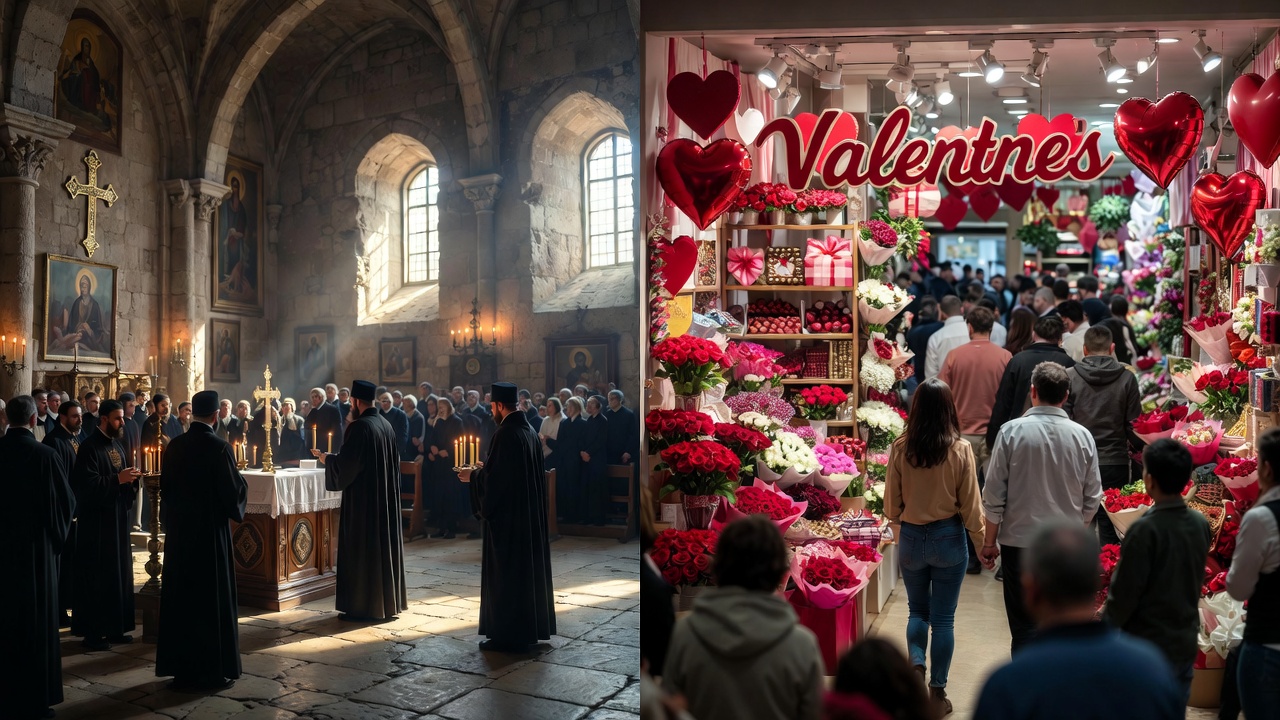
Every February, millions of people around the world reach for red roses, heart-shaped cards, and boxes of chocolate. Valentine’s Day on February 14 is the holiday most people think of when they think of romance. But deep in the highlands of the South Caucasus — and across Armenian communities worldwide — a different love holiday has been celebrated for over 1,600 years.
Saint Sarkis Day, known in Armenian as Sourp Sarkis (Սուրբ Սարգիս), falls on January 31 in 2026.
This guide will walk you through everything you need to know about both holidays. We will explore their origins, traditions, food, symbolism, and cultural meaning. We will point out where they overlap and where they differ. Whether you are planning a trip to Yerevan in late January, looking for unique winter festival traditions, or simply curious about how different cultures celebrate love, this post is for you.
What Is Saint Sarkis Day? The Armenian Patron Saint of Love and Youth Explained
Saint Sarkis Day is a feast day on the Armenian Apostolic Church calendar. It honors Saint Sarkis the Warrior (Sourp Sarkis Zoravar), a 4th-century military commander who became one of the most beloved saints in the Armenian Christian tradition.
The holiday is a moveable feast. This means it does not fall on the same date every year. Instead, it always lands on a Saturday, exactly 63 days before Easter. Because the Armenian Apostolic Church mainly follows the Gregorian calendar for calculating Easter, the date of Saint Sarkis Day shifts from year to year. It can fall anywhere between January 11 and February 15.
In 2026, Armenian Easter falls on April 5. Counting back 63 days places Saint Sarkis Day on Saturday, January 31, 2026.
Here is a quick look at recent and upcoming dates:
| Year | Saint Sarkis Day | Armenian Easter |
|---|---|---|
| 2024 | February 3 | March 31 |
| 2025 | February 15 | April 20 |
| 2026 | January 31 | April 5 |
What makes Saint Sarkis Day special is its dual identity. In church tradition, it is a solemn commemoration of a Christian martyr. In folk tradition, it is the Armenian holiday of romantic love. By order of His Holiness Karekin II, Supreme Patriarch and Catholicos of All Armenians, the feast of Saint Sarkis has been officially proclaimed a day of blessing the youth. At the end of the Divine Liturgy on this day, young people are invited to approach the altar for a special blessing service.
Many Armenians call Saint Sarkis Day the “Armenian Valentine’s Day.” But as we will see, that label — while convenient — does not tell the whole story.
Who Was Saint Sarkis the Warrior? The True Story Behind the Armenian Love Holiday
To understand Saint Sarkis Day, you need to know the man behind it.
Sarkis (also spelled Sargis) was a Cappadocian Greek who lived during the 4th century. The name “Sarkis” is the Armenian form of the Latin name “Sergius.” He was not Armenian by birth. He was a soldier in the Roman Empire who rose through the ranks under Emperor Constantine the Great (r. 306–337 AD). Constantine appointed Sarkis as General in Chief of Cappadocia, the region bordering Armenia.
Sarkis was a devout Christian. He used his military authority to spread the Gospel, tear down pagan idols, and build churches. His piety, courage, and honesty made him popular among both soldiers and civilians.
Everything changed when Emperor Julian the Apostate came to power in 361 AD. Julian reversed Constantine’s pro-Christian policies and launched a campaign of persecution against Christians across the empire. Churches were destroyed. Believers were tortured and killed.
According to Armenian hagiographic tradition recorded in the medieval Haysmavurk (a book of saints’ lives), Sarkis received a divine vision telling him to leave his homeland. He abandoned his military title and fled with his only son, Martiros (meaning “martyr” in Armenian), to the Kingdom of Armenia. There, King Tiran — a grandson of Tiridates the Great — welcomed them.
As Julian’s armies advanced eastward, King Tiran urged Sarkis and Martiros to seek safety in the Sassanid Persian Empire. The Persian emperor Shapur II, hearing of Sarkis’s military reputation, appointed him commander of a Persian military regiment. Sarkis continued to preach Christianity among the soldiers, and many were baptized.
This did not sit well with Shapur II, a Zoroastrian. He ordered Sarkis to renounce his Christian faith, worship fire, and make sacrifices in a Zoroastrian temple. Sarkis refused. According to the account maintained by the Armenian Church, Sarkis declared that he would only worship the one true God — the Holy Trinity — and that fire and idols were not gods. In an act of defiance, he destroyed items within the temple.
The enraged crowd attacked Sarkis and his companions. Martiros was killed before his father’s eyes. Sarkis was thrown into prison. Even in captivity, his faith did not waver. Shapur ordered his execution. Sarkis was beheaded around 362–363 AD.
His loyal soldiers retrieved his body and wrapped it in clean linen. When Shapur heard of this act of reverence, he ordered those soldiers killed as well — 14 companions in total were martyred alongside Sarkis.
Centuries later, in the 5th century, the great Armenian scholar Mesrop Mashtots — the inventor of the Armenian alphabet — brought Sarkis’s relics to the village of Karbi in the Ashtarak region of Armenia. A church was built over the relics. To this day, the Church of Saint Sarkis in Karbi remains an important pilgrimage site.
The History of Valentine’s Day: From Roman Martyrdom to Global Celebration
Now let us turn to the more famous holiday.
Valentine’s Day, celebrated every February 14, takes its name from one or more early Christian saints named Valentine (or Valentinus in Latin). The word “Valentine” derives from the Latin valens, meaning “worthy” or “strong.”
The Catholic Encyclopedia mentions at least three different saints named Valentine, all of whom were martyred. The most commonly cited figure is Saint Valentine of Rome, a priest who lived during the 3rd century under the reign of Emperor Claudius II Gothicus (r. 268–270 AD).
The most popular legend holds that Claudius II banned marriages for young soldiers, believing that unmarried men made better warriors. Valentine considered this decree unjust. He secretly performed marriage ceremonies for Christian soldiers and their partners. When he was discovered, Claudius ordered his arrest.
While imprisoned, Valentine reportedly befriended the blind daughter of his jailer. According to tradition, he restored her sight through his faith. Before his execution on February 14, around 269–270 AD, he sent her a letter signed “From your Valentine” — a phrase still used today.
Pope Gelasius I declared February 14 as Saint Valentine’s Day around 496 AD. However, the holiday did not acquire its strong romantic associations until much later.
The key turning point came in the 14th century when the English poet Geoffrey Chaucer wrote about Valentine’s Day in his poem Parlement of Foules. Chaucer linked the day to courtly love and the belief that February 14 was the beginning of bird mating season in England and France. This literary connection transformed the feast from a purely religious commemoration into a celebration of romance.
By the 1500s, written valentines began to appear. The first known Valentine’s letter was penned in 1415 by Charles, Duke of Orléans, who wrote a poem to his wife while imprisoned in the Tower of London after the Battle of Agincourt.
Commercial Valentine’s cards appeared in the late 1700s. The first mass-produced commercial valentines in the United States were printed in the mid-1800s by Esther Howland of Massachusetts, who is sometimes called the “Mother of the American Valentine.” In 1913, Hallmark Cards of Kansas City began mass-producing valentines, turning the holiday into the commercial giant it is today.
Saint Sarkis Day vs Valentine’s Day: Key Differences You Should Know
Now that we understand the history of both holidays, let us examine how they differ. The contrasts run deeper than you might expect.
1. Religious Roots and Church Status
Saint Sarkis Day remains a fully integrated feast of the Armenian Apostolic Church. It appears on the official liturgical calendar each year. Special divine liturgies are held in every Armenian church. A relic of the saint is carried in procession from Mother See Holy Etchmiadzin Cathedral to Saint Sarkis Church in Yerevan. The Catholicos himself has declared it a day for blessing the youth.
Valentine’s Day, by contrast, has largely lost its religious foundation. In 1969, during the reforms of the Second Vatican Council under Pope Paul VI, Saint Valentine was removed from the General Roman Calendar. His feast day is no longer universally observed in the Catholic Church, though local celebrations are still permitted. Today, most people celebrate Valentine’s Day as a secular, commercial holiday.
2. Fixed Date vs Moveable Feast
Valentine’s Day always falls on February 14. It never changes.
Saint Sarkis Day is a moveable feast tied to the date of Easter. It always falls on a Saturday, 63 days before Easter. The date can range from January 11 to February 15 in any given year. This means Saint Sarkis Day sometimes occurs before, sometimes after, and sometimes very close to Valentine’s Day.
3. Cultural Scope
Valentine’s Day is a global holiday. It is celebrated across North America, Europe, Latin America, East Asia, the Middle East, and beyond. In Finland, the day is called ystävänpäivä (“Friend’s Day”) and emphasizes friendship rather than romance. In Japan, women traditionally give chocolate to men on February 14, and men reciprocate on March 14 (“White Day”).
Saint Sarkis Day is celebrated almost exclusively within Armenian communities — both in the Republic of Armenia and across the Armenian diaspora in Lebanon, Syria, Iran, the United States, France, Russia, and elsewhere. It is deeply tied to Armenian national identity, language, and church life.
4. Commercialization
Valentine’s Day is a massive commercial event. According to the National Retail Federation’s 2026 survey, Americans are expected to spend a record $29.1 billion on Valentine’s Day gifts in 2026 — up from $27.5 billion in 2025. The average shopper plans to spend $199.78. Candy, jewelry, flowers, greeting cards, and dining out dominate the market. A record 35% of consumers even plan to buy gifts for their pets, totaling $2.1 billion.
Saint Sarkis Day, by contrast, has minimal commercialization. There are no mass-produced Saint Sarkis greeting cards or chocolates. The gifts exchanged are typically homemade sweets, flowers, and small tokens. The holiday economy revolves around local bakeries making traditional halva and families baking aghablit cookies at home.
Here is a side-by-side comparison:
| Feature | Saint Sarkis Day | Valentine’s Day |
|---|---|---|
| Date in 2026 | January 31 (Saturday) | February 14 (Saturday) |
| Date type | Moveable feast | Fixed date |
| Named after | Saint Sarkis the Warrior (4th c.) | Saint Valentine of Rome (3rd c.) |
| Saint’s role | Military commander, preacher | Priest, secret marriage officiant |
| Cause of martyrdom | Refused to worship fire/idols | Refused to renounce Christianity |
| Church status (2026) | Active feast on Armenian calendar | Removed from Catholic general calendar (1969) |
| Primary audience | Armenian communities worldwide | Global |
| Spending (approx.) | Minimal; locally driven | ~$29.1 billion in the U.S. alone |
| Signature food | Halva, aghablit (salty cookies) | Chocolate, candy hearts |
| Key symbols | Horse hoofprint, flour, snowstorms | Hearts, roses, Cupid |
| Romantic tradition | Dream divination, salty cookie ritual | Cards, flowers, dining out |
What Are the Similarities Between Saint Sarkis Day and Valentine’s Day?
Despite their differences, the two holidays share a remarkable amount of common ground. These similarities suggest that the human desire to celebrate love through ritual is universal.
Both Honor a Christian Martyr Who Died for His Faith
Saint Sarkis was beheaded by the Sassanid Persian emperor Shapur II for refusing to renounce Christianity. Saint Valentine was executed by the Roman emperor Claudius II for the same reason. Both men chose death over betrayal of their beliefs. Both were subsequently elevated to sainthood by their respective churches.
This parallel is not a coincidence. Early Christianity produced thousands of martyrs across the Roman and Persian empires. That two of them became associated with love — centuries apart, in different cultural contexts — speaks to the deep connection between sacrifice and devotion in the Christian tradition.
Both Became Patron Saints of Lovers and Young People
Saint Sarkis is officially recognized by the Armenian Apostolic Church as the patron saint of love and youth. Saint Valentine became associated with romantic love through centuries of literary and folk tradition, starting with Chaucer in the 14th century. Both saints serve as spiritual symbols for couples, young lovers, and anyone seeking a romantic partner.
Both Holidays Feature Gift-Giving Between Lovers
On Valentine’s Day, partners exchange cards, flowers, jewelry, and chocolates. On Saint Sarkis Day, young Armenians exchange gifts, sweets, and flowers after the church ceremony. In both cases, the act of giving is meant to express affection and commitment.
Both Have Roots in Pre-Christian or Folk Traditions
Valentine’s Day has been linked — though the evidence is debated among historians — to the ancient Roman festival of Lupercalia, a fertility celebration held from February 13 to 15. Saint Sarkis Day likewise absorbed layers of Armenian folk tradition that may predate Christianity, including dream divination rituals and weather-related folklore about storms and snowfall.
Both Fall in the Late Winter Season
Both holidays occur during the cold, dark months of late January and February in the Northern Hemisphere. This is not coincidental. Winter was historically a time when communities drew together for warmth and companionship. Love celebrations during this period served both practical and emotional purposes — brightening the darkest part of the year and encouraging new marriages before the spring planting season.
Traditional Armenian Saint Sarkis Day Customs and Rituals That Make It Unique
While the similarities are striking, what truly sets Saint Sarkis Day apart are its unique folk traditions. These customs are unlike anything you will find on Valentine’s Day. They reflect centuries of Armenian belief, superstition, and community life.
The Aghablit Tradition: Eating Salty Cookies to Dream of Your Future Spouse
The most famous Saint Sarkis Day custom is the aghablit ritual (Աdescribalit in Armenian). On the eve of the feast, unmarried young men and women bake and eat an extremely salty cookie or wafer called aghablit (aghi blit, literally “salty bread”).
The recipe is simple. According to recipes shared by the Armenian Mirror-Spectator and traditional Armenian bakers, you mix about 1¼ cups of flour with several tablespoons of salt and enough water to form a dough. Roll it out, cut it into shapes, and bake at 350°F (180°C) until golden — about 20 to 30 minutes.
The result? An almost inedible, teeth-grittingly salty wafer. But that is the point.
After eating the aghablit, the young person must not drink any water before going to bed. They go to sleep thirsty, praying to Saint Sarkis. The belief is that during the night, they will dream of a person who offers them water or leads them to a water source. That person — the one who quenches their thirst in the dream — is destined to become their future spouse.
If no such dream comes, tradition holds that marriage prospects look dim for the year. In the morning, young people gather and share their dreams with friends and family. It is a time of laughter, teasing, and gentle speculation.
This ritual is deeply rooted in Armenian family values. As researchers at the USC Digital Folklore Archives have noted, the aghablit tradition emphasizes the importance of marriage, family building, and community. It is practiced by both men and women, reflecting the expectation that young people of both genders will prioritize starting a family.
Leaving Flour on the Rooftop for Saint Sarkis’s Horse
Another beloved tradition involves placing a tray of flour (or sometimes porridge) outside the front door or on the rooftop the night before Saint Sarkis Day. According to folk belief, Saint Sarkis rides through the skies on a white horse during the night. If the family finds a hoofprint pressed into the flour the next morning, it is taken as a sign that Saint Sarkis has blessed them — and their prayers for love will be answered.
This tradition connects to the broader Armenian folk image of Saint Sarkis as a warrior on horseback who commands storms and snowfall. In Armenian folklore, the entire world trembles from the clatter of his horse’s hooves, and snowstorms arise when he twirls his spear. A blizzard on or near Saint Sarkis Day is considered a good omen.
Feeding Birds and Watching Their Flight
A lesser-known custom involves throwing breadcrumbs to birds on the morning of the feast. The direction in which the birds fly is believed to indicate where the young person’s future partner will come from. If the birds fly east, for example, the spouse will arrive from the east.
The Wedding Rush Before Great Lent
Saint Sarkis Day also plays a practical role in the Armenian marriage calendar. The two weeks between the feast and the start of Great Lent (Mets Pahk) are traditionally a peak time for weddings in Armenia. Once Great Lent begins — in 2026, on February 15 — the curtains of church altars are closed and no wedding ceremonies take place for 48 days. Couples who want to marry must do so before Lent or wait until after Easter. This creates a concentrated “wedding season” around Saint Sarkis Day.
How to Celebrate Saint Sarkis Day in Armenia: A Traveler’s Guide for 2026
If you are planning a trip to Armenia and want to experience Saint Sarkis Day firsthand, here is what to expect in 2026.
Attend the Divine Liturgy at Saint Sarkis Church in Yerevan
The main celebration takes place at Saint Sarkis Church (Sourp Sarkis Yekeghetsi) in central Yerevan. A special liturgy is held, and a relic of the saint is carried in procession from the Mother See of Holy Etchmiadzin to the church. The Catholicos or a senior bishop leads the blessing of the youth at the end of the service.
Arrive early. The church will be crowded with young Armenians, families, and couples.
Visit the Saint Sarkis Monastery in Ushi Village
For a more intimate pilgrimage experience, travel to the village of Ushi in Aragatsotn Province. The Saint Sarkis Monastery there was built upon the relics of the saint. On the feast day, local pilgrims gather to pray and celebrate.
Try Traditional Saint Sarkis Halva
After the church service, seek out Saint Sarkis Halva — the sweet counterpart to the salty aghablit. This is a chewy, sesame-coated confection traditionally made by whipping the reduced liquid from boiled soapwort root (saponaria) with sugar syrup. Many modern recipes use marshmallow fluff as a shortcut.
The halva is rolled in toasted sesame seeds and often filled with walnuts or pistachios. It is sold in Armenian bakeries and pastry shops during the week surrounding the feast. In diaspora communities, look for it at Armenian grocery stores and church bazaars.
Other traditional foods include Kumba cake (a dense, spiced, dairy-free cake from the Musa Dagh region), Khashil Don (a wheat pudding), and Klontrak (another type of halva made from toasted ground wheat, butter, and mulberry syrup).
Experience the Cultural Programs
For more than a decade, the celebration of Saint Sarkis Day in Yerevan has included cultural activities beyond the church service. Expect exhibitions, concerts, folk dance performances, and other public events organized around the feast day.
How Valentine’s Day Is Celebrated Around the World in 2026
Valentine’s Day needs less introduction, but its global diversity is worth noting — especially for travelers who want to experience different expressions of love.
United States: The $29 Billion Holiday
Valentine’s Day in the United States is the world’s largest Valentine’s celebration by spending. According to the National Retail Federation, total spending in 2026 is projected at $29.1 billion. The average consumer plans to spend $199.78 — a new record.
Candy remains the most popular gift, with 56% of consumers planning to buy sweets. Flowers and greeting cards are each purchased by 41% of shoppers. Jewelry, while purchased by only 25% of shoppers, accounts for the single largest spending category at $7 billion.
An interesting 2026 trend: a record 35% of consumers plan to buy Valentine’s Day gifts for their pets, totaling $2.1 billion. Dogs, cats, and even rabbits are getting treats and toys on February 14.
Japan: Chocolate, Gender Roles, and White Day
In Japan, Valentine’s Day has a unique twist. Women give chocolate to men — not the other way around. There are two types: honmei-choco (true-feeling chocolate) for romantic partners, and giri-choco (obligation chocolate) for male coworkers, friends, and acquaintances. Men reciprocate exactly one month later, on March 14 (“White Day”), with gifts of white chocolate, cookies, or jewelry.
Finland and Estonia: Friend’s Day
In Finland, February 14 is called ystävänpäivä — literally, “Friend’s Day.” The focus is on celebrating friendship rather than romantic love. People send cards and small gifts to their close friends. Estonia adopted a similar approach, calling it sõbrapäev.
France: The Birthplace of the Valentine
France has deep connections to the origin of the valentine. The first known Valentine’s letter was written by a Frenchman — Charles, Duke of Orléans — in 1415. Today, the holiday is known as “Saint Valentin” and is celebrated much the same as in other Western countries. The town of Roquemaure in southern France holds a special “Fête des Amoureux” celebration near Valentine’s Day, as it houses relics of Saint Valentine of Terni.
South Korea: Monthly Love Days
South Korea takes the love holiday concept to an extreme. Beyond Valentine’s Day (February 14) and White Day (March 14), South Korea celebrates “Black Day” on April 14, when single people gather to eat black bean noodles (jajangmyeon) and commiserate. There is even a love-related celebration on the 14th of every single month throughout the year.
Why Armenians Celebrate Saint Sarkis Day Instead of — or Alongside — Valentine’s Day
A common question from travelers and cultural observers is: Do Armenians celebrate Valentine’s Day, or only Saint Sarkis Day?
The answer is nuanced.
In modern Armenia — especially in Yerevan and other urban centers — many young people celebrate both holidays. Valentine’s Day arrived in Armenia after the country’s independence in 1991, carried by Western media, globalization, and the internet. Today, you will find red hearts and Valentine’s decorations in Yerevan shops and restaurants every February 14.
However, Saint Sarkis Day remains the primary love holiday for culturally and religiously observant Armenians. It is the day blessed by the church. It is the day connected to ancestral traditions like aghablit and the flour-on-the-rooftop ritual. It is the day that Armenian grandmothers remember from their own youth.
For many Armenians, celebrating Saint Sarkis Day is also an act of cultural preservation. In a globalized world where Western holidays increasingly overshadow local traditions, maintaining Saint Sarkis Day keeps a living thread to Armenian identity, language, and faith.
As one Armenian community website noted, the holiday gives Armenians “a chance to love and be loved by our lovely ones and give some Armenian-owned gifts and sweets to each other and help Armenian small businesses at the same time.”
In the diaspora — among Armenian communities in Los Angeles, Beirut, Paris, Moscow, and Sydney — Saint Sarkis Day serves as a cultural anchor. It brings families together. It fills church halls. It fills kitchens with the smell of halva and spiced kumba cake. And it reminds the younger generation of who they are.
Saint Sarkis Day Food vs Valentine’s Day Food: A Delicious Cultural Comparison
Food is one of the clearest windows into cultural difference. The foods associated with these two holidays could not be more different — and each tells a story about the values of the culture that created it.
Valentine’s Day Foods: Chocolate, Candy Hearts, and Fine Dining
Valentine’s Day food in the West is built around sweetness, luxury, and indulgence. The top food gifts include:
- Chocolate: Americans buy an estimated 58 million pounds of chocolate for Valentine’s Day each year. Brands like Godiva, Lindt, and See’s Candies release special Valentine’s collections.
- Candy conversation hearts: The small pastel hearts stamped with messages like “Be Mine” and “Love You” have been a Valentine’s staple since 1866.
- Strawberries dipped in chocolate: A classic romantic dessert.
- Fine dining: Restaurants see massive demand on February 14. Americans are projected to spend $6.3 billion on dining out for Valentine’s Day 2026.
The emphasis is on purchasing something beautiful and delicious for your partner. The food is a medium for expressing love through spending.
Saint Sarkis Day Foods: Halva, Salty Wafers, and Ancestral Recipes
Saint Sarkis Day food is built around tradition, ritual, and community. The key foods include:
- Aghablit (salty wafers): The deliberately unpleasant salty cookie is not meant to be enjoyed. It is a ritual object — eaten to trigger thirst and dreams. It represents the willing acceptance of discomfort in pursuit of love.
- Saint Sarkis Halva: The sweet, sesame-rolled confection is the reward that comes after the aghablit ordeal. Traditionally made from soapwort root, it is a labor-intensive treat that requires skill and patience to prepare.
- Kumba Cake: A dense, spiced cake from the Musa Dagh region, made without dairy or eggs (making it suitable for the Lenten period that follows). It contains mahlab (cherry kernel spice), cinnamon, and cloves.
- Khashil Don: A wheat pudding served with yogurt and melted butter, representing comfort and sustenance.
The emphasis is on making something by hand — often using recipes passed down through generations. The food is not a commodity but a carrier of memory and heritage.
| Aspect | Valentine’s Day Food | Saint Sarkis Day Food |
|---|---|---|
| Primary sweet | Chocolate | Saint Sarkis Halva |
| Ritual food | None | Aghablit (salty wafer) |
| Purpose of food | Express love through luxury | Ritual divination and community bonding |
| Typical preparation | Store-bought | Homemade |
| Dietary notes | No restrictions | Often Lenten-friendly (no dairy, no eggs) |
| Cultural origin | Western commercial tradition | Armenian folk and church tradition |
The Symbolism of Love in Armenian Culture vs Western Valentine’s Culture
The way a culture symbolizes love reveals its deepest values. The symbols of Saint Sarkis Day and Valentine’s Day draw from very different wells.
Valentine’s Day Symbols
- Red hearts: The heart shape became associated with Valentine’s Day because the heart was traditionally considered the seat of emotion in European culture.
- Red roses: The red rose has symbolized romantic love since the time of the ancient Greeks and the goddess Aphrodite.
- Cupid: The Roman god of desire, depicted as a winged child with a bow and arrow, became the mascot of Valentine’s Day during the Renaissance.
- Doves and lovebirds: Connected to the medieval belief that birds begin their mating season around February 14.
- The color red: Passion, desire, and romantic intensity.
Saint Sarkis Day Symbols
- The white horse: Saint Sarkis rides through the night sky on his white horse, leaving hoofprints in the flour. The horse represents divine intervention, protection, and answered prayers.
- Snowstorms and blizzards: A storm on Saint Sarkis Day is a good omen. It signals the saint’s powerful presence. This is unique — no other love holiday treats bad weather as a blessing.
- Flour on the rooftop: Represents openness to divine signs and willingness to trust in God’s plan for one’s romantic future.
- The salty cookie: Represents the willingness to endure hardship for the chance at true love. Love is not simply sweet — it begins with sacrifice and thirst.
- Water in dreams: Represents the relief and fulfillment that comes when the right partner is found. It is an act of kindness — someone offering you water when you are parched.
The contrast is revealing. Valentine’s Day symbolism emphasizes desire, passion, and beauty — the external expressions of love. Saint Sarkis Day symbolism emphasizes sacrifice, endurance, divine blessing, and fate — the deeper, more internal dimensions of love.
Neither approach is better. Together, they form a richer picture of what love means to human beings.
Is Saint Sarkis Day Older Than Valentine’s Day? A Timeline Comparison
This question comes up frequently. The answer depends on what you are comparing — the historical figure, the church feast, or the romantic tradition.
The Saints Themselves
Saint Valentine was martyred around 269–270 AD under the Roman Emperor Claudius II.
Saint Sarkis was martyred around 362–363 AD under the Sassanid Emperor Shapur II.
Valentine lived roughly a century before Sarkis.
The Church Feast Days
Saint Valentine’s Day was established as a feast day around 496 AD by Pope Gelasius I.
Saint Sarkis Day has been celebrated by the Armenian Apostolic Church since at least the 5th century, when Mesrop Mashtots brought the saint’s relics to Armenia and a church was built over them.
The two feast days were established around the same general period — the 5th century.
The Romantic Associations
Valentine’s Day did not become a holiday about romantic love until the 14th century, when Chaucer wrote his poetry connecting the feast day to courtship and bird mating.
Saint Sarkis Day has folk traditions related to love and marriage that are difficult to date precisely but are believed to be very old — possibly originating in the medieval period or earlier. The aghablit and flour traditions are documented in Armenian folk literature going back centuries.
So while Valentine lived earlier, the romantic dimension of both holidays emerged during the medieval period. The two traditions developed independently, without direct influence on each other, in very different cultural contexts.
How the Armenian Diaspora Keeps Saint Sarkis Day Alive Worldwide
The Armenian diaspora — estimated at 7 to 10 million people living outside Armenia — plays a vital role in preserving Saint Sarkis Day traditions.
Los Angeles, California
Greater Los Angeles is home to one of the largest Armenian communities outside Armenia, with an estimated 200,000 to 500,000 Armenian Americans in the region. Armenian bakeries in Glendale, Pasadena, and Hollywood produce Saint Sarkis Halva in the days before the feast. Armenian churches across Southern California hold special liturgies and youth blessings. Sarkis Pastry in Pasadena is one of the best-known sources for traditional halva.
Beirut, Lebanon
Lebanon’s Armenian community, centered in the Bourj Hammoud neighborhood of Beirut, has maintained Saint Sarkis Day traditions for over a century. The Lebanese-Armenian community has its own variations of kumba cake and halva recipes that reflect the blending of Armenian and Middle Eastern culinary traditions.
Paris, France
France’s Armenian community — one of the oldest in Western Europe — celebrates Saint Sarkis Day through church services at the Armenian Apostolic Church of Paris and community gatherings that feature traditional food, music, and the aghablit ritual.
Yerevan and Beyond
In Armenia itself, the celebration has grown more elaborate in recent decades. For over 11 years, the feast has included organized cultural events such as exhibitions, concerts, and folk programs alongside the religious observance.
Should You Celebrate Both? Embracing Two Love Holidays in February
There is no rule that says you must choose one holiday over the other. In fact, celebrating both can enrich your understanding of love, culture, and human connection.
Here are some ideas for embracing both traditions in 2026:
For Saint Sarkis Day (January 31, 2026):
- Bake aghablit with your partner or friends. See who has the most interesting dream.
- Visit an Armenian bakery and try Saint Sarkis Halva.
- Learn about Armenian history and culture.
- If you are in Armenia, attend the Divine Liturgy and observe the youth blessing.
For Valentine’s Day (February 14, 2026):
- Exchange cards, flowers, or chocolates with your loved ones.
- Cook a special meal together at home — the NRF data shows this is increasingly popular.
- Write a heartfelt letter. The tradition goes back over 600 years.
- Celebrate your friends and family, not just your romantic partner. The Finnish model of “Friend’s Day” is worth adopting.
For both:
- Reflect on what love means in different cultures.
- Support small businesses — Armenian bakeries for Saint Sarkis, local florists and chocolatiers for Valentine’s Day.
- Share the stories of both saints with your children. The themes of courage, faith, and sacrifice transcend cultural boundaries.
Frequently Asked Questions About Saint Sarkis Day and Valentine’s Day
Q: Is Saint Sarkis Day the same as Valentine’s Day? A: No. They are two separate holidays with different origins, different saints, different traditions, and different cultural contexts. However, they share the theme of romantic love and are sometimes compared because both fall in the late January–February period.
Q: When is Saint Sarkis Day in 2026? A: Saturday, January 31, 2026. It falls 63 days before Armenian Easter (April 5, 2026).
Q: When is Valentine’s Day in 2026? A: Saturday, February 14, 2026. It is always on February 14.
Q: Do Armenians celebrate Valentine’s Day? A: Many modern Armenians — especially younger, urban residents — celebrate both Saint Sarkis Day and Valentine’s Day. However, Saint Sarkis Day is the traditional Armenian love holiday and holds deeper cultural and religious meaning.
Q: What is aghablit? A: Aghablit is a very salty cookie or wafer eaten on the eve of Saint Sarkis Day. Unmarried young people eat it before bed without drinking water. They hope to dream of their future spouse offering them water.
Q: What is Saint Sarkis Halva? A: A traditional Armenian sweet made from sugar syrup (traditionally with soapwort root extract or marshmallow), rolled in toasted sesame seeds and filled with nuts. It is eaten on the feast day itself.
Q: How much do Americans spend on Valentine’s Day? A: In 2026, Americans are expected to spend a record $29.1 billion on Valentine’s Day, with an average per-person expenditure of $199.78, according to the National Retail Federation.
Q: Was Saint Valentine a real person? A: The Catholic Church recognizes multiple saints named Valentine. The most widely referenced is a 3rd-century Roman priest martyred under Emperor Claudius II. However, the historical details are debated, and some scholars believe the legends are later inventions.
Q: Was Saint Sarkis Armenian? A: No. He was a Cappadocian Greek by birth. However, he found refuge in Armenia and is venerated as one of the most beloved saints of the Armenian Apostolic Church. His relics are housed in Armenia.
Final Thoughts: What Two Love Holidays Teach Us About the Human Heart
Saint Sarkis Day and Valentine’s Day are separated by geography, language, theology, and centuries of distinct cultural development. One is rooted in the mountainous heartland of the South Caucasus. The other has spread from Rome and medieval England to become a worldwide phenomenon.
Yet both holidays spring from the same fundamental human impulse: the desire to celebrate love, to honor those who sacrificed for their beliefs, and to mark the late winter season with warmth, sweetness, and hope for the future.
Saint Sarkis Day reminds us that love begins with sacrifice and endurance — with eating the salty bread before tasting the halva. Valentine’s Day reminds us that love is also about beauty, generosity, and the simple act of telling someone you care.
Both lessons are true. Both are needed.
So this February — whether you eat aghablit or chocolate, leave flour on the rooftop or roses on the table, attend a Divine Liturgy in Yerevan or a candlelit dinner in Paris — take a moment to appreciate the magnificent diversity of the ways human beings say “I love you.”
The salty and the sweet. The ancient and the modern. The Armenian and the universal.
That is what makes the world of festivals so endlessly fascinating.
Did you enjoy this guide? Share it with someone who loves learning about global festivals and traditions. And if you have celebrated either Saint Sarkis Day or Valentine’s Day in a memorable way, we would love to hear your story in the comments below.