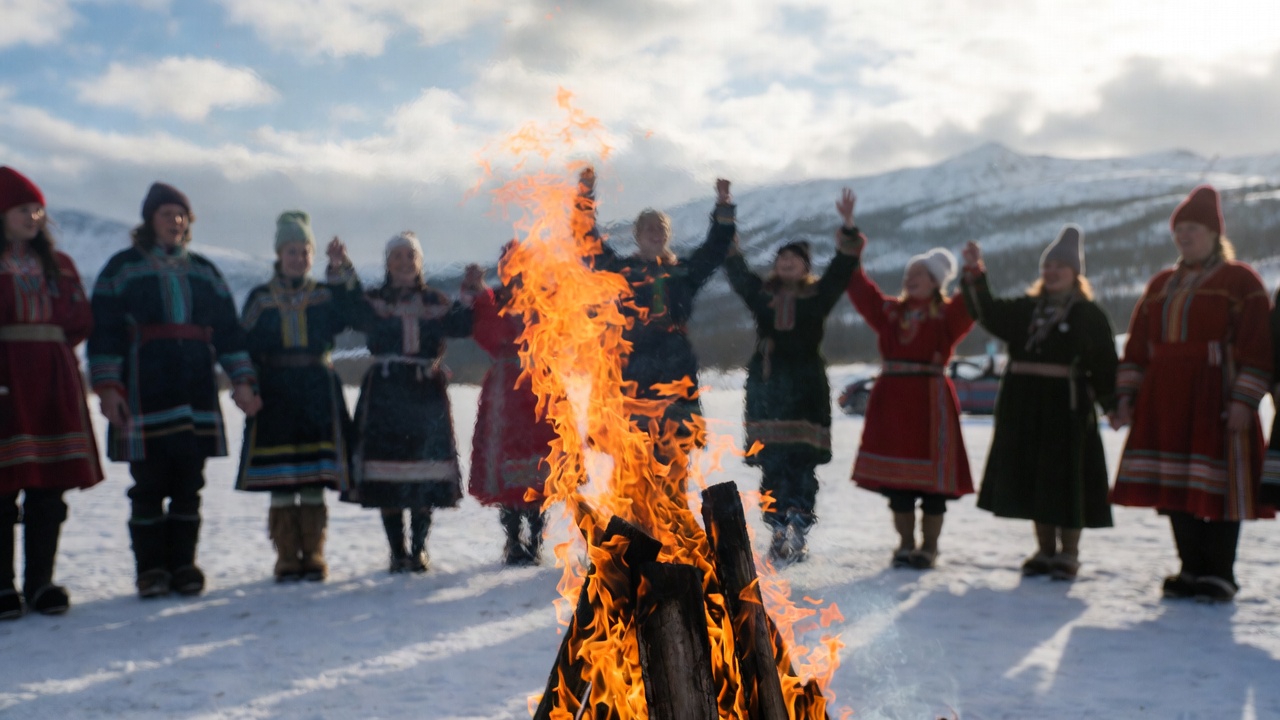
Lihkku beivviin! On February 6, 2026, communities across the Arctic will raise the Sámi flag, sing the ancient anthem Sámi soga lávlla, and gather to honor the oldest living culture in Northern Europe. Sámi National Day — known as Sámi álbmotbeaivi in Northern Sámi — is not just a date on a calendar. It is a heartbeat. A statement of survival. A celebration that crosses four national borders and speaks in nine distinct languages.
This year, the date falls on a Friday, which means celebrations across Norway, Sweden, and Finland will stretch deep into the weekend. Markets will glow under polar twilight. Joik melodies will echo off snow-laden rooftops. Reindeer will thunder down city streets. And for travelers seeking something far beyond the usual European itinerary, there may be no better time to step into the world of Sápmi.
I have spent years tracing the threads of Indigenous celebrations around the globe, and I keep returning to the Arctic north. The Sámi people — Europe’s only recognized Indigenous group within the European Union — have built a culture that is simultaneously ancient and urgently modern. Their story is one of resilience against forced assimilation, of language revival in the face of erasure, and of a profound relationship with a landscape that most of us can barely imagine.
This guide is built on that admiration. It is meant to help you experience Sámi National Day 2026 with respect, curiosity, and a genuine desire to listen. Because that is what this day asks of visitors above all else: come, and listen.
What Is Sámi National Day and Why Is February 6 Important for Sápmi Culture?
Sámi National Day commemorates February 6, 1917 — the date of the very first Sámi congress, held in the Norwegian city of Trondheim (known as Tråante in Southern Sámi). That gathering was historic. For the first time, Sámi people from both Norway and Sweden crossed national borders to sit together and discuss shared challenges: land rights, cultural survival, and political recognition.
The day was not formally established as a pan-Sámi celebration until 1992, when delegates at the 15th Sámi Conference in Helsinki passed a resolution declaring February 6 as a day for all Sámi, regardless of which country they live in. The resolution stated that the Sámi flag should fly and the Sámi anthem should be sung in the local Sámi language on this day, every year.
The first official celebration took place on February 6, 1993, coinciding with the United Nations International Year of Indigenous People. That opening ceremony was held in Jokkmokk, Sweden — a town that remains one of the most important cultural gathering places in all of Sápmi.
Today, the holiday is observed across four countries: Norway, Sweden, Finland, and Russia. In Norway, it is an official flag-flying day, meaning municipal buildings are required to raise the Norwegian flag. Many choose to raise the Sámi flag alongside it. In the capital city of Oslo, the bells of the City Hall tower play the Sámi national anthem as the flags go up — a small but deeply symbolic gesture.
Key facts about the Sámi people:
| Category | Detail |
|---|---|
| Total population | Approximately 80,000 |
| Norway | ~50,000 |
| Sweden | ~20,000 |
| Finland | ~8,000 |
| Russia (Kola Peninsula) | ~2,000 |
| Languages | 9 distinct Sámi languages |
| Traditional homeland | Sápmi (northern Scandinavia and Kola Peninsula) |
| Primary livelihoods | Reindeer herding, fishing, hunting, duodji (handicrafts) |
| Political representation | Sámi Parliaments in Norway, Sweden, and Finland |
Understanding these numbers matters. The Sámi are not a monolithic group. They are coastal fishers along the Norwegian fjords, mountain reindeer herders in the Swedish highlands, Skolt Sámi communities in Finland’s Inari region, and small populations clinging to their heritage on the Kola Peninsula. Each group has its own dialect, its own version of the gákti (traditional clothing), and its own relationship with the land.
How to Celebrate Sámi National Day 2026: Traditions, Symbols, and Cultural Etiquette
Before diving into specific destinations, it helps to understand what Sámi National Day actually looks and feels like on the ground. This is not a commercialized holiday. There are no mass-produced decorations or greeting cards. The celebrations are rooted in community, storytelling, music, and food.
The Sámi Flag and Its Meaning
The Sámi flag was officially approved in 1986 at the 13th Nordic Sámi Conference. Its design features bold blocks of red, blue, green, and yellow, with a circle at the center. The red half of the circle represents the sun. The blue half represents the moon. The imagery draws inspiration from a Sámi poem that describes the Sámi as the sons and daughters of the sun.
On February 6, the flag is raised on municipal buildings, schools, and private homes across Sápmi. In Norway, Sweden, and Finland, national authorities recommend public flagging on this day.
Joik: The Sound of a People
If there is one cultural element that defines Sámi identity, it is joik (juoigan in Northern Sámi). Joik is not quite singing. It is not quite chanting. It is something older and more personal — a vocal tradition that is one of the oldest song forms in Europe. A joik is not sung about someone or something. It is sung to them. A joik for your mother is not a song describing her. It is her, in sound.
For centuries, joik was suppressed. Norwegian authorities deemed it sinful. In the 1950s, it was banned in Sámi schools. That dark chapter makes today’s revival all the more remarkable. Modern Sámi artists now blend joik with jazz, electronic music, metal, and hip-hop, and the form has gained growing international recognition.
During Sámi National Day celebrations, you will hear joik everywhere — in concert halls, around campfires inside lavvu tents, and on the streets. If you are attending a public performance, simply listen with respect. Do not record without permission. And never attempt to joik yourself unless invited to do so by a Sámi host.
The Gákti: Wearing Identity
The gákti is the traditional garment of the Sámi people. It is not a costume. It is a statement of identity, origin, and family connection. The colors, patterns, and embroidery of a gákti reveal where its wearer comes from, their marital status, and their community. If you see someone wearing a gákti on February 6, you may greet them with a congratulation:
- Northern Sámi: Lihkku beivviin!
- Southern Sámi: Læhkoeh biejjine!
- Lule Sámi: Vuorbbe biejvijn!
As a visitor, you should not wear a gákti unless you are Sámi or have been specifically invited to do so by a Sámi family member or host. This garment carries deep cultural meaning. Treating it as a tourist costume is disrespectful.
Traditional Sámi Food: Bidos, Reindeer, and Campfire Coffee
Food is central to Sámi celebrations. The most iconic dish is bidos — a thick, slow-cooked reindeer stew made with potatoes and carrots. At Sámi weddings and large gatherings, bidos is served in multiple sittings to accommodate hundreds of guests. On Sámi National Day, it is common to find bidos served in lavvu tents set up in town squares.
Other foods you may encounter include smoked reindeer meat, dried fish, gáhkku (a traditional Sámi bread), and lefse (soft potato flatbread, especially from Sea Sámi communities). Campfire coffee, brewed strong and smoky over an open flame, is the drink of choice.
Tromsø Sámi Week 2026: Reindeer Racing and Arctic Culture in Northern Norway
Dates: February 1–8, 2026 Location: Tromsø, Norway Best for: First-time visitors, families, urban accessibility
If you want the most accessible and action-packed Sámi National Day experience, Tromsø is your destination. This city of 78,000 — the largest in Northern Norway — transforms every February into a week-long celebration of Sámi culture, sport, and community.
Sámi Week in Tromsø has been organized annually by the Midnight Sun Marathon Foundation since 2004. It is an important gathering place for Sámi organizations, cultural professionals, and sports competitors from across the region. The week features lectures, debates, exhibitions, concerts, workshops, Sámi language courses for beginners, and children’s events.
But the true showstopper is reindeer racing.
Norwegian Championships in Reindeer Racing
On the final Sunday of Sámi Week, barriers go up along both sides of Storgata, Tromsø’s main street. At the northern end, reindeer are loaded into starting stalls. When the signal fires, they burst out at full gallop, pulling their drivers on skis behind them. The crowd roars. The finishing line lies at the southern end of the street.
This is the Norwegian Championship in Reindeer Racing, and it draws thousands of spectators. According to Visit Northern Norway, the event is technically a Nordic championship, with the 12 fastest reindeer from Norway and Finland on the starting line. There is no distinction between male and female drivers. Only the fastest reindeer matters. Junior races are also held, with six young competitors racing outside the championship class.
What Else to Do During Sámi Week in Tromsø
- Lasso-throwing competition: The National Championship in Lasso Throwing takes place at the market square. In reindeer herding, the lasso is a critical tool for catching individual animals from a moving herd. Registration for the competition closes on February 1.
- Lavvu tents on Storgata: All week long, traditional Sámi tents line the main street. Everyone is welcome to step inside, warm up by the campfire, and enjoy a cup of campfire-brewed coffee or a bowl of bidos.
- Concerts and exhibitions: Sámi musicians perform throughout the week, blending traditional joik with contemporary genres. Art exhibitions showcase both historical and modern Sámi works.
- Official Sámi National Day ceremony: February 6 is honored at Tromsø City Hall with an official celebration, speeches, and flag raising.
- The Arctic University Museum of Norway: This museum has two permanent exhibitions on Sámi culture and history. It is an essential stop for anyone wanting deeper context before attending the festivities.
Getting there: Tromsø has a well-connected airport with direct flights from Oslo, Stockholm, and several other European cities. The city is compact enough to explore on foot, and most Sámi Week events are concentrated in the center.
Jokkmokk Winter Market 2026: A 421-Year-Old Sámi Gathering in Swedish Lapland
Dates: February 5–7, 2026 Location: Jokkmokk, Sweden Best for: Cultural immersion, handicraft shopping, historical significance
If Tromsø offers spectacle, then Jokkmokk offers soul. This small town in Swedish Lapland — home to around 2,800 people — has been a gathering place for the Sámi since the early 1600s. In 1605, the Swedish crown established permanent marketplaces near Sámi winter settlements throughout the Lappish territories. Jokkmokk’s was one of them. The purpose was partly administrative — collecting taxes, holding court, spreading Christianity — but the Sámi adapted the market into something of their own.
The 2026 Jokkmokk Winter Market will be the 421st edition of this remarkable gathering. It runs from Thursday, February 5, to Saturday, February 7, overlapping perfectly with Sámi National Day.
Why Jokkmokk Matters for Sámi Culture
Jokkmokk is not just a market. It is the most important annual event for cultural and creative industries in the Nordkalotten — the northernmost region where Norway, Sweden, and Finland meet. For centuries, Sámi families have traveled from across the region to trade furs, silver, reindeer products, and handmade crafts. That tradition continues today, though the offerings now include contemporary Sámi art alongside traditional duodji (handicrafts).
Walking the market streets, you will find handmade knives with birch and reindeer antler handles, tin-thread embroidery, silver jewelry, leather goods, wooden carvings, and warm reindeer-hide products. You will also find plenty of food: smoked reindeer meat, dried fish, candy, and hot drinks served around open fires in tipi-style tents.
What to See and Do at the 421st Jokkmokk Winter Market
- Ajtte — Swedish Mountain and Sámi Museum: This museum, located in Jokkmokk, hosts special films, lectures, exhibitions, and performances during market week. It is the primary museum for documenting Sámi and mountain culture in Sweden.
- Joik concerts and performances: Live music fills the town all week. Expect traditional joik alongside contemporary Sámi artists exploring new sounds.
- Reindeer caravan and sled races: A reindeer caravan parades through the market area, and sled races provide fast-paced thrills.
- Art and handicraft exhibitions: Jokkmokk is home to a growing community of Sámi artists. Galleries and pop-up exhibitions showcase painting, sculpture, textile art, and photography.
- Northern lights: Early February is prime season for aurora viewing in Swedish Lapland. Several tour operators in Jokkmokk offer guided northern lights excursions by snowmobile during market week.
Practical Information for Jokkmokk Market
The market draws significant crowds. Record attendance was noted in 2025, and the 2026 edition is expected to be equally busy. Book accommodation well in advance. Options include hotels in Jokkmokk, cabins outside town, and accommodation in nearby Luleå (approximately 170 km south, about 2.5 hours by car).
Several tour operators offer complete holiday packages that combine market access with dog sledding, snowmobile tours, reindeer farm visits, wildlife watching, and northern lights excursions. Jokkmokkguiderna offers a six-day package running from February 3–8, 2026.
Getting there: The nearest airport is Arvidsjaur. Luleå Airport, which receives flights from Stockholm, is another option. From Luleå, it is about 2.5 hours by bus or car to Jokkmokk.
Inari, Finland: The Heart of Finnish Sámi Culture and the Siida Museum
Best for: Museum lovers, Sámi Parliament visits, year-round cultural immersion Key sites: Siida Museum, Sajos Cultural Centre, Lake Inari
The village of Inari (population ~500) sits on the banks of the Juutuanjoki River in Finnish Lapland, at the edge of the vast Lake Inari — the third-largest lake in Finland. Despite its small size, Inari is the administrative and cultural capital of the Finnish Sámi. It is home to three major Sámi languages: Northern Sámi, Inari Sámi, and Skolt Sámi.
For travelers seeking a deep, contemplative engagement with Sámi culture — rather than the festival energy of Tromsø or Jokkmokk — Inari delivers something quieter but no less powerful.
Siida: The Sámi Museum and Nature Centre
The Sámi Museum Siida is the most comprehensive museum dedicated to Sámi culture in Finland. It opened as an outdoor museum in 1963 — the first independent Sámi museum anywhere in the Nordic countries. The modern indoor facility features interactive displays, audio-visual presentations, and artifacts reclaimed from museum collections in Finland and abroad.
Siida achieved a historic milestone in 2024, attracting over 82,000 visitors — more than 20 percent higher than its previous record. The museum’s permanent exhibition covers Sámi cultural heritage, traditional livelihoods, languages, spirituality, and the ongoing challenges of cultural preservation.
In 2026, Siida will take part in an especially significant cultural event. A major joint exhibition titled We Who Remain — organized together with Kiasma, Helsinki’s museum of contemporary art — will open at Kiasma on March 27, 2026, before traveling to Siida in October 2026. Curated by Sámi rights advocate Petra Laiti, the exhibition features more than 20 artists and presents contemporary art by and about the Sámi community across Finland, Sweden, and Norway. It will be the first major exhibition of Sámi contemporary art and duodji ever held in Helsinki.
The outdoor museum, open during the summer season, showcases traditional Sámi buildings, architectural heritage, and livelihoods in a forest setting beside the river.
Winter hours (October 1 – May 31, 2025–2026): Monday to Saturday, 10:00 AM to 5:00 PM. Closed Sundays.
Sajos: The Sámi Cultural Centre and Parliament
A five-minute walk from Siida, the Sámi Cultural Centre Sajos is a striking modern building on the shores of Lake Inari. Opened in January 2012, Sajos houses the Sámi Parliament of Finland, the Sámi Education Institute, the Sámi Library, the Sámi Archive, a handicraft shop (Sámi Duodji), and the café-restaurant Čaiju.
Visitors can join guided tours on weekdays at noon. The tour lasts about 45 minutes and covers the Finnish Sámi Parliament, Sámi self-governance, and contemporary Sámi life. It concludes with a short film, Sápmi – The Way of Being. The tour costs €8 per person.
The building itself is architecturally notable. Its cross-shaped floor plan was carefully designed to avoid disturbing old trees on the site, and its forms draw on traditional Sámi handicraft motifs. It has won international architectural recognition.
Skábmagovat: The Indigenous Peoples’ Film Festival
If your visit to Inari extends beyond Sámi National Day, check the schedule for Skábmagovat, an Indigenous peoples’ film festival that takes place annually in Inari. What makes it unique? Some screenings are held in an outdoor cinema carved from ice and snow, under the Arctic sky. The festival connects Indigenous filmmakers from around the world and is an extraordinary cultural experience.
Getting there: The nearest airport is Ivalo (IVL), about 40 minutes south of Inari by car. Direct flights connect Ivalo to Helsinki (1.5 hours). Inari is also reachable by bus from Rovaniemi.
Kautokeino and Karasjok: The Sámi Heartland in Finnmark, Norway
Best for: Deep cultural immersion, Easter Festival, Sámi Parliament Key sites: Sámi Parliament (Karasjok), Juhls Silver Gallery, Sámi National Theater Beaivváš
If you want to experience the places where Sámi culture is not a spectacle but simply everyday life, you travel inland. Kautokeino (Guovdageaidnu in Northern Sámi) and Karasjok (Kárášjohka) are the twin hearts of Sámi Finnmark, Norway’s northernmost county.
Karasjok: The Unofficial Sámi Capital
Karasjok, with just over 2,500 inhabitants, is sometimes called the unofficial capital of Sápmi. It is home to the Sámi Parliament of Norway, which was established on October 9, 1989, when King Olav V signed its founding document on a reindeer hide. The Parliament building, completed in 2001, has won the Building Design Award and is architecturally distinctive both inside and out.
The town is also home to the Sámi National Museum (Sámiid Vuorká-Dávvirat), which preserves and exhibits Sámi cultural artifacts, textiles, tools, and art. Here, there are more reindeer than people — a fact the locals are proud of.
Kautokeino: Living Sámi Language and Culture
Kautokeino is Norway’s largest municipality by area and home to about 1,500 inhabitants. It is one of the few places in the world where Northern Sámi is the dominant everyday language. The town is officially bilingual, and Sámi culture is woven into every facet of community life, from schools to shops to churches.
For architecture enthusiasts, the building Čoarvemátta is a must-see. Designed by the renowned Norwegian firm Snøhetta (the same team behind the Oslo Opera House) in cooperation with 70°N arkitektur and Sámi artist Joar Nango, it houses both the Sámi National Theater Beaivváš and the Sámi Upper Secondary School and Reindeer Herding School. Its form is inspired by the innermost joint of a reindeer antler and the shape of a lavvu tent.
Also in Kautokeino: Juhls Silver Gallery, a fairytale-like complex where traditional Sámi design meets contemporary silverwork. It has been described as an oasis on the Finnmark plateau.
The Sámi Easter Festival in Kautokeino
While the Easter Festival falls after Sámi National Day (in late March or April, depending on the year — Easter 2026 falls on April 5), it is worth mentioning because it is the single largest cultural gathering in Sámi Finnmark.
The Sámi Easter Festival in Kautokeino is built around a centuries-old tradition. At Easter, the sun has returned to the Arctic. The daytime temperatures are pleasant. Reindeer herders return to the villages before the spring migration begins. This has always been the season for weddings, christenings, and confirmations. Sámi weddings can involve up to a thousand guests, with bidos served in multiple sittings.
The modern festival adds concerts, art exhibitions, theater performances, the Sámi Grand Prix (a music competition featuring joik and contemporary Sámi song, running since 1990), World Championships in Reindeer Racing, snowmobile cross competitions, and a duodji market.
A 2026 study tour organized by Vesterheim (a Norwegian-American museum) runs from March 27 to April 8, combining visits to Tromsø, the Sámi Parliament in Karasjok, and the Easter Festival in Kautokeino.
Getting there: The nearest airport is Alta Airport (about 130 km from Kautokeino). The drive from Alta to Kautokeino crosses some of the most dramatic plateau landscapes in Scandinavia. Winter temperatures can drop to minus 30–40°C, so pack serious cold-weather gear.
Stockholm and Oslo: Celebrating Sámi National Day in the Nordic Capitals
Not everyone can travel to the Arctic in February. The good news is that Sámi National Day is also celebrated in the Nordic capital cities, where growing Sámi communities and cultural institutions ensure the day receives the attention it deserves.
Sámi National Day at Skansen, Stockholm
Skansen, the world-famous open-air museum in Stockholm, hosts a Sámi National Day celebration from February 6–8, 2026. Organized in collaboration with the Stockholm Sámi Association (Sameföreningen i Stockholm), the event features food, handicrafts, history presentations, joik performances, and educational activities.
Skansen’s involvement highlights an important truth: Sámi culture is not confined to the Arctic. Many Sámi people live and work in Sweden’s cities. Celebrating at Skansen brings Sámi heritage to a wider audience while raising awareness about the ongoing importance of cultural preservation.
Sámi National Day in Oslo
Oslo has a vibrant Sámi community. On February 6, the city marks the day with several events. The highlight is the moment when the bells in the highest tower of Oslo City Hall play the Sámi national anthem as the flags are raised. It is a quiet, powerful gesture that sends the melody across the city center.
Throughout February, Oslo hosts Sámi-focused events including museum exhibitions, concerts, film screenings, and food events. The Norwegian Museum of Cultural History (Norsk Folkemuseum) on the Bygdøy peninsula has permanent Sámi exhibitions. And several Oslo restaurants feature reindeer dishes — a way to connect with Sámi food culture even in the capital.
Traditional Sámi Food to Try During Your Visit to Sápmi
Food is one of the most immediate and respectful ways to engage with a culture. Sámi cuisine is shaped by the Arctic landscape: reindeer, fish, berries, and wild plants. Here are the essential dishes to seek out.
| Dish | Description |
|---|---|
| Bidos | Thick reindeer stew with potatoes and carrots. The centerpiece of Sámi celebrations. |
| Suovas | Smoked, salted reindeer meat. Often thinly sliced and served on bread. |
| Gáhkku | A traditional Sámi flatbread, sometimes enriched with reindeer fat. |
| Gurpi | Dried and smoked reindeer meat, stored for long periods. |
| Lefse | Soft potato flatbread, especially common among Sea Sámi communities. |
| Smoked Arctic char | Fresh fish from northern rivers and lakes, slowly smoked over birch wood. |
| Campfire coffee | Strong, dark coffee brewed over an open flame — the quintessential Sámi drink. |
| Cloudberries | Golden Arctic berries, often served as jam or fresh with cream. |
When trying traditional Sámi food, ask your host or server about the origin of the ingredients. Many Sámi food producers take great pride in sourcing from their own herds and local waters. Supporting these producers directly is one of the most meaningful things a visitor can do.
How to Travel Responsibly to Sápmi: Ethical Tourism and Cultural Respect
Traveling to Sámi communities comes with a responsibility. The Sámi have endured centuries of colonization, forced assimilation, language suppression, and land dispossession. Tourism can be a positive force — or it can replicate harmful dynamics. Here is how to get it right.
Choose Sámi-Owned and Sámi-Led Experiences
The single most important thing you can do is book with Sámi-owned businesses. When a Sámi guide tells you about reindeer herding, you are hearing a lived experience, not a script written by an outside marketing team. Companies like Visit Natives, which specializes in sustainable, Indigenous-led experiences in Norway, can help you find authentic encounters.
In Inari, the Sámi Museum Siida and the Sajos Cultural Centre are both Sámi-run institutions. In Jokkmokk, look for the Sámi duodji mark on handicraft products — this label certifies that the item was made by a Sámi artisan using traditional methods.
Ask Before Photographing
This cannot be overstated. Do not photograph Sámi people in gákti without their permission. Do not record joik performances unless explicitly told it is acceptable. Do not take photos inside lavvu tents without asking. The gákti is not a costume for your social media feed. It is someone’s family identity.
Learn Before You Go
Read about Sámi history before your trip. The Norwegian government’s Norwegianization policies, Sweden’s racial biology programs, and Finland’s forced relocations of Skolt Sámi communities are essential context for understanding why cultural preservation matters so deeply. The Siida Museum and the Sámi Parliament visitor experiences provide excellent introductions.
Respect the Land
The Arctic environment is fragile. Stay on marked trails. Do not disturb reindeer. Follow the Nordic principle of allemannsretten (right to roam), but do so responsibly. If you are visiting a reindeer farm or herding area, follow your guide’s instructions carefully. Reindeer herding is not a performance. It is a livelihood.
Best Time to Visit Sápmi for Sámi Cultural Experiences Beyond February 6
Sámi National Day on February 6 is the obvious anchor date. But Sámi culture is alive year-round. Here are other key times to plan a visit.
| Event | Location | Approximate Dates | Highlights |
|---|---|---|---|
| Jokkmokk Winter Market | Jokkmokk, Sweden | First Thursday of February (Feb 5–7, 2026) | 421st annual market; handicrafts, joik, reindeer racing |
| Sámi Week Tromsø | Tromsø, Norway | Feb 1–8, 2026 | Reindeer racing, lasso competitions, concerts |
| Sámi Easter Festival | Kautokeino, Norway | Easter week (late March–early April) | Sámi Grand Prix, reindeer racing world championships, weddings |
| Isogaisa Shamanic Festival | Tennevoll, Norway | August (exact dates vary) | Only shamanic festival in northern Scandinavia |
| Skábmagovat Film Festival | Inari, Finland | Late January/early February | Indigenous film in an ice-and-snow cinema |
| We Who Remain Exhibition | Helsinki (Mar–Sep 2026), then Inari (from Oct 2026) | 2026 | Major Sámi contemporary art exhibition at Kiasma and Siida |
| Riddu Riđđu Festival | Manndalen, Norway | July | International Indigenous arts and music festival |
The Arctic seasons offer radically different experiences. Winter brings polar nights, northern lights, and reindeer sledding. Spring (Easter) brings the return of the sun and the most festive period in Sámi Finnmark. Summer brings midnight sun and fishing. Autumn brings the stunning ruska — fall foliage across the Lapland fells.
Planning Your Sámi National Day 2026 Trip: Practical Travel Tips
Flights and Transportation
- Norway: Fly to Tromsø (TOS) for Sámi Week. Fly to Alta (ALF) for access to Kautokeino and Karasjok. Oslo (OSL) has celebrations in the capital.
- Sweden: Fly to Luleå (LLA) or Arvidsjaur (AJR) for Jokkmokk. Stockholm (ARN) has celebrations at Skansen.
- Finland: Fly to Ivalo (IVL) for Inari. Helsinki (HEL) for the Kiasma exhibition from March 2026.
Accommodation
Book early. Accommodation in small Arctic towns fills up fast during festival season. Jokkmokk in particular sells out months in advance. Consider staying in nearby towns (such as Luleå for Jokkmokk, or Ivalo for Inari) and making day trips.
Weather and Clothing
February in the Arctic means cold. Expect temperatures ranging from -10°C to -30°C in inland areas. Coastal Tromsø tends to be slightly milder. Layer up with thermal base layers, a good insulated jacket, warm boots, a hat, and gloves. Many tour operators provide additional cold-weather gear (thermal overalls, boots, helmets) for outdoor activities.
Budget
Northern Scandinavia is not a budget destination. Hotel rooms, meals, and activities can be expensive by global standards. A modest hotel in Tromsø during Sámi Week might cost €150–250 per night. Activity packages (dog sledding, snowmobile tours, northern lights excursions) typically range from €100–300 per person. Museum entry fees are generally modest (€8–15).
Frequently Asked Questions About Sámi National Day 2026
Is Sámi National Day a public holiday? No. Sámi National Day is not a public holiday in Norway, Sweden, or Finland. However, it is an official flag-flying day in all three countries. Schools across the Nordic region often dedicate the surrounding week to lessons about Sámi culture and history.
Can non-Sámi people attend Sámi National Day celebrations? Yes. Public events during Sámi Week in Tromsø, the Jokkmokk Winter Market, and celebrations in Oslo and Stockholm are open to everyone. Visitors are welcome to observe, listen, and participate in public activities. The most respectful approach is to attend with curiosity and humility — this is a day for the Sámi to celebrate their identity, and your role as a visitor is to honor that.
What language should I use to greet Sámi people on February 6? If you would like to offer congratulations in Northern Sámi, say “Lihkku beivviin!” In Norwegian, the equivalent greeting is “Gratulerer med dagen.” A warm smile and genuine interest mean more than perfect pronunciation.
Do I need to book activities in advance? For Tromsø and Jokkmokk, advance booking is strongly recommended, particularly for accommodation and organized activities like dog sledding, northern lights tours, and guided cultural experiences. Festival events in public spaces (markets, street performances, flag ceremonies) are typically free and do not require tickets.
Is it appropriate to buy Sámi handicrafts as souvenirs? Absolutely — in fact, purchasing authentic duodji (Sámi handicrafts) directly from Sámi artisans is one of the best ways to support the community. Look for the official Sámi Duodji certification mark, which guarantees the item was made by a Sámi craftsperson using traditional techniques. Be cautious of mass-produced imitations sold in generic tourist shops.
Why Sámi National Day Matters More Than Ever in 2026
The Sámi have survived for thousands of years in one of the harshest environments on Earth. They have survived colonization, forced assimilation, the banning of their languages, and the theft of their lands. They have survived being classified as racially inferior by state-sponsored eugenics programs. And they have survived the erasure of their very existence from mainstream Nordic narratives.
Today, the Sámi are not merely surviving. They are reclaiming. Young Sámi artists are redefining contemporary art and music. Sámi filmmakers are telling their own stories. Language revitalization programs — including “language nests” that connect Sámi children across Finland via the internet — are breathing new life into endangered tongues. The Sámi Parliaments in Norway, Sweden, and Finland are increasingly assertive in defending land rights and cultural autonomy.
The landmark We Who Remain exhibition coming to Helsinki and Inari in 2026 is a perfect example of this cultural resurgence. Its curator, Petra Laiti, chose a title inspired by Johan Turi’s 1910 book Muitalus sámiid birra (An Account of the Sámi), which describes a time when the Sámi did not even know that other peoples existed beyond their homeland.
Sámi National Day is an invitation. It says: We are here. We have always been here. Come see.
The question for travelers is simple. Will you accept that invitation? Will you make the journey north — not just for the northern lights, not just for the snow — but to listen to the oldest story in Northern Europe, told by the people who have lived it?
Lihkku sámi álbmotbeivviin. Happy Sámi National Day.