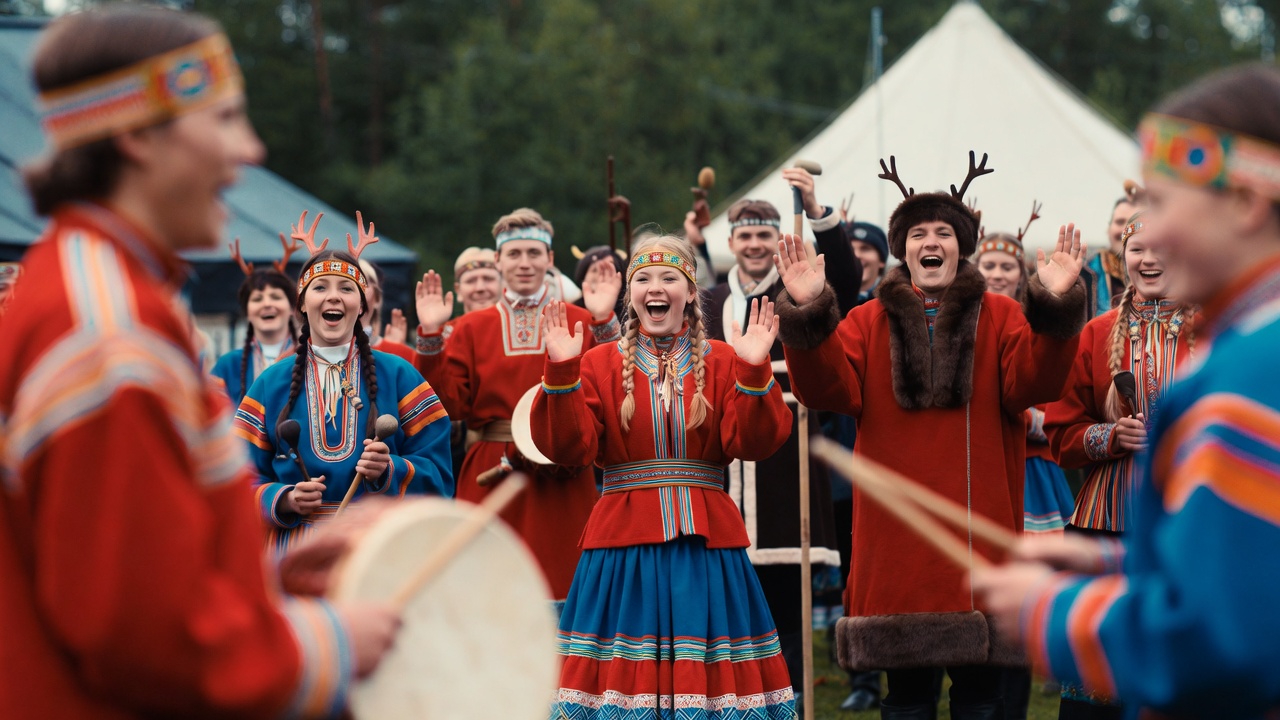
Every February 6, a wave of red, blue, green, and yellow sweeps across the Arctic. Flags rise over government buildings from Tromsø to Helsinki. Drums pulse in the cold air. Voices rise in ancient melodies that predate written history. This is Sámi National Day — a celebration of Europe’s only recognized Indigenous people and one of the most striking cultural events on the Nordic calendar.
In 2026, the day falls on a Friday. Schools across Norway, Sweden, and Finland spend the surrounding week exploring Sámi heritage. Families gather around tables set with steaming bowls of bidos (reindeer stew). Communities don the brilliant colors of traditional dress and fill public squares with joik, the oldest continuous vocal tradition on the continent. For visitors and culture enthusiasts, Sámi National Day opens a window into a world that stretches back thousands of years — yet remains vibrantly alive today.
This guide walks through the traditions at the heart of the celebration. It covers the history behind the day, the meaning woven into every stitch of the gákti, the spiritual power of joik, and the deep bond between the Sámi people and their reindeer. Whether you are planning a trip to Sápmi or simply want to understand one of the world’s most enduring Indigenous cultures, read on.
What Is Sámi National Day and Why Is It Celebrated on February 6?
Sámi National Day — known as Sámi álbmotbeaivi in Northern Sámi — commemorates a turning point in the history of the Sámi people. On February 6, 1917, Norwegian and Swedish Sámi gathered in Trondheim, Norway, for their first joint congress. It was the first time Sámi from different countries met across national borders to address shared problems. That meeting planted the seeds for a movement that would grow over the next century.
The day did not become official until much later. In 1992, at the 15th Sámi Conference in Helsinki, Finland, delegates passed a resolution declaring February 6 as the national day for all Sámi people, regardless of which country they call home. The first celebration took place the following year, in 1993. That same year, the United Nations proclaimed the International Year of Indigenous People and opened the ceremonies in Jokkmokk, Sweden — a powerful statement of global recognition.
Since then, the holiday has grown steadily. In Norway, it is an official flag day. Municipal buildings are required to fly the Norwegian flag, and many choose to raise the Sámi flag alongside it. In Oslo, the bells in the highest tower of City Hall play the Sámi national anthem as flags go up. In Sweden, Skansen — the famous open-air museum in Stockholm — hosts annual events with food, handicraft demonstrations, and joik performances. In Finland, the Sámi Parliament in Inari organizes cultural programs in partnership with local schools and museums.
The Sámi population is estimated at approximately 80,000 people spread across four countries: around 50,000 in Norway, 20,000 in Sweden, 8,000 in Finland, and 2,000 in Russia. Despite these numbers, the impact of the day extends far beyond the Sámi community. It serves as a reminder — for the Nordic nations and the wider world — that one of Europe’s oldest living cultures continues to thrive in the Arctic.
Key Facts About Sámi National Day
| Detail | Information |
|---|---|
| Date | February 6 (every year) |
| First celebrated | 1993 |
| Named after | First Sámi congress, Trondheim, 1917 |
| Northern Sámi name | Sámi álbmotbeaivi |
| Countries | Norway, Sweden, Finland, Russia |
| Official status | Flag day in Norway |
| 2026 day of the week | Friday |
Who Are the Sámi People? History of Europe’s Only Recognized Indigenous Group
To understand the traditions of Sámi National Day, it helps to understand the people behind them. The Sámi are the Indigenous inhabitants of a vast region known as Sápmi, which stretches across the northern reaches of Norway, Sweden, Finland, and the Kola Peninsula of Russia. Their roots in this landscape run deep. Ancestors of today’s Sámi can be traced back to the end of the last Ice Age — roughly 10,000 years ago.
The Sámi are not a single, uniform group. They speak at least nine distinct Sámi languages, all part of the Uralic language family. Their traditional livelihoods have varied by region. Coastal Sámi historically relied on fishing and farming. Mountain and inland Sámi centered their lives around reindeer herding — a practice that remains legally protected as an exclusive Sámi livelihood in Norway and Sweden.
The Sámi have their own flag, designed by artist Astrid Båhl from Skibotn, Norway, and adopted by the Saami Council in 1986. Its four colors — red, blue, green, and yellow — represent the essentials of life. Red stands for fire and the warmth of the sun. Blue represents water and the sky. Green symbolizes the plants that sustain life. Yellow evokes the sun at its peak. A circle divided into red and blue halves sits at the flag’s center, representing the sun and the moon. These same colors appear throughout Sámi traditional dress, tying the flag directly to centuries of cultural expression.
The Sámi also have their own political institutions. The Sámi Parliament of Norway (Sámediggi), established in 1989 and located in Karasjok, was a milestone in Indigenous political representation. Sweden and Finland each have their own Sámi Parliaments as well. These bodies advocate for Sámi rights on issues ranging from land use and language preservation to education and cultural funding.
A Dark Chapter: Forced Assimilation and Cultural Suppression
The celebration of Sámi National Day cannot be separated from the darker chapters of Sámi history. From the mid-1800s through much of the 20th century, the governments of Norway, Sweden, and Finland pursued aggressive assimilation policies. In Norway, this period is known as Norwegianization (fornorsking). Sámi children were taken from their families and sent to boarding schools where they were forbidden to speak their own languages. Joiking was condemned as sinful. Traditional spiritual practices were outlawed. The message was clear: the Sámi were expected to abandon their culture and become part of the majority population.
These policies left deep scars. Entire communities lost their languages. Families hid their Sámi identity for generations. But the culture survived — in whispered joiks, in gáktis sewn in secret, in the persistent rhythm of reindeer hooves across the tundra. The establishment of Sámi National Day in 1993 was itself an act of reclamation. Today, every raised flag and every sung joik on February 6 carries the weight of that history.
Traditional Sámi Clothing: What Is the Gákti and What Does It Mean?
If you attend any Sámi National Day celebration, the first thing you will notice is the clothing. Brilliant splashes of red, blue, green, and yellow stand out against the snow and the gray Nordic winter. This is the gákti — the traditional dress of the Sámi people. It is not a costume. It is not regalia. It is a living garment, worn for daily life, for ceremonies, and for everything in between.
The word gákti comes from Northern Sámi. Other Sámi languages have their own terms: gáppte, gapta, gåptoe, kofte (in Norwegian), and kolt (in Swedish). Whatever the name, the garment carries the same deep cultural significance. As the Pacific Sámi Searvi describes it, the gákti is “an important marker of Sámi identity and community, and reserved for those living the culture.”
How the Gákti Works as a Cultural Code
The gákti is far more than beautiful clothing. It is a visual language. The colors, patterns, and decorative details tell a knowledgeable observer exactly where the wearer is from, which family they belong to, and whether they are married or single. A Sámi person familiar with these codes can identify someone’s home region at a glance simply by looking at their gákti.
Some of the key signals include:
- Belt buttons: In many regions, particularly around Kautokeino, square buttons on the belt indicate the wearer is married. Round buttons mean the person is single.
- Regional colors: Northern Sámi gáktis often feature red and blue as dominant colors. Skolt Sámi designs may incorporate more green and yellow.
- Collar height and decoration: High collars with pewter embroidery or tin threadwork are common in certain areas and reflect local traditions of ornamentation.
- Hem length: Men’s gáktis are generally shorter, hanging around mid-thigh. Women’s gáktis are longer, reaching the knee or mid-calf. Southern Sápmi gáktis tend to be longer than those from the north.
Materials: From Reindeer Hide to Modern Fabrics
Traditionally, every part of the gákti came from what the land provided. The primary material was reindeer skin, with sinew used as thread. Reindeer leather boots with curled toes — a practical design that hooked into ski bindings — completed the outfit. Families lined these boots with dried sedge grass for insulation in the harsh Arctic cold.
Over time, the materials evolved. Wool, cotton, and silk replaced reindeer hide for many garments, though leather and fur remain important for winter items. Today, some modern designers use velvet, denim, and synthetic blends. The structure and symbolism of the gákti, however, remain rooted in tradition.
A full gákti outfit typically includes:
- A tunic or dress (the gákti itself)
- A woven or leather belt with decorative buttons
- Headwear — hats are especially significant, indicating region, gender, and sometimes marital status
- Footwear — traditional curved-toe shoes called nutukas or skaller, made from reindeer leather or fur
- Accessories — silver brooches, silk shawls, gloves, and pewter jewelry
The Gákti in the Modern World: Identity, Fashion, and Resistance
The gákti was once everyday wear. It was the practical clothing of people working in Arctic conditions. But during the decades of forced assimilation, wearing it became an act of quiet defiance. Many Sámi stopped wearing their gáktis in public, fearing discrimination.
Today, the gákti has re-emerged as a powerful symbol of pride. Young Sámi designers are blending traditional patterns with contemporary fashion, bringing the garment to runways and international stages. The gákti appears at political gatherings, including sessions of the Sámi Parliaments, where it serves as a visible statement of cultural identity. During the 2023 Fosen wind farm protests, demonstrators wore their gáktis outside the Norwegian Prime Minister’s office, wearing their heritage as an act of resistance.
If you see someone wearing a gákti, remember that you are looking at a garment that encodes family history, regional identity, and centuries of resilience in every stitch. It is polite to admire, but photographing someone in gákti should always be done with their consent. And if you wish to own a Sámi garment yourself, the appropriate option is the luhkka — a functional poncho-style outer layer — rather than a gákti, which is reserved for those within the culture.
Joik: The Ancient Sámi Singing Tradition That Captures the Soul
If the gákti is the visual heartbeat of Sámi National Day, the joik is its voice. On February 6, the sound of joik fills community halls, school auditoriums, and town squares across Sápmi. It echoes from Oslo to Inari, from the winter market in Jokkmokk to the concert stages of Tromsø. No other sound so immediately evokes the spirit of the Sámi people.
What Is Joik and How Is It Different from Western Singing?
Joik (also spelled yoik, and known as luohti in Northern Sámi, vuolle in Southern Sámi, or leu’dd among the Eastern Sámi) is a form of vocal expression that music researchers consider one of the oldest continuous musical traditions in Europe. According to Sámi oral tradition, joiks were a gift from the fairies and elves of the Arctic lands — a story documented by ethnographer Just Qvigstad in the 19th century.
But joik is not a “song” in the Western sense. It does not follow the patterns familiar to most European or American listeners. There is no fixed meter, no standard beginning or end. It does not rhyme. Joik can have words, or it can be pure sound — syllables, breath, guttural tones, and soaring melodies woven together.
The most important distinction is this: you do not joik about something. You joik something. A joik dedicated to a person does not describe them. It attempts to capture their essence — to conjure their presence through sound alone. As South Sámi joiker Marja Mortensson has explained: “Joik is like a whole philosophy. It’s about your connection with nature and the people around you. When I joik, my head is filled with images, and I feel that I am travelling.”
How Joik Functions in Sámi Daily Life
In traditional Sámi life, joik was woven into every aspect of existence:
- Personal joiks: In Northern Sámi areas, many people receive their own joik at birth. This personal melody functions almost like a second name — a sonic portrait that captures who they are.
- Animal joiks: Reindeer herders developed joiks for specific animals, landscapes, and seasonal events. These functioned as memory aids and emotional connections to the land.
- Spiritual joiks: Before Christianization, joik was closely linked to the practices of the noaidi (Sámi shamans), who used it in ceremonies alongside the sacred drum.
- Social joiks: Joiking someone is a form of appreciation. Rather than paying a verbal compliment, a Sámi person might simply joik the person they admire.
The Suppression and Survival of Joik Across Centuries
Joik has survived despite centuries of deliberate suppression. When Christian missionaries arrived in Sámi territories, they condemned joiking as sinful, linking it to pre-Christian shamanism and what they called “magic spells.” Most of the sacred Sámi drums — the traditional accompaniment to joik — were confiscated and burned. During the period of forced assimilation, joiking was banned in Sámi-area schools as late as the 1950s. In some communities, the stigma persisted even longer. As recently as 2014, a parish council in Kautokeino debated whether to impose a total ban on music other than hymns in local churches.
Despite all this, joik endured. Families continued to practice it privately. The melodies were passed from generation to generation, often in secret. As Norwegian singer Elle Márjá Eira, a reindeer herder from Kautokeino, has said: “Joik is in my blood. I have been practicing it in all situations and phases of life.”
The Joik Renaissance: How Young Sámi Artists Are Transforming an Ancient Tradition
The revival of joik began in earnest in the late 1960s. Nils-Aslak Valkeapää (known as Áillohaš), a Finnish-born Norwegian Sámi musician and poet, released the first commercial joik recording in 1968 — his album Joijuka. His work blended traditional joik with ambient sounds and instrumentation, introducing the form to audiences far beyond Sápmi.
In the 1980s, Mari Boine took joik further onto the world stage. Raised on the Finland-Norway border, Boine combined joik with rock, jazz, and electronic elements, creating a minimalist folk-rock sound rooted in Sámi tradition. She became an icon of Indigenous music worldwide.
Today, a new generation continues this evolution. Key figures include:
| Artist | Style | Notable Achievement |
|---|---|---|
| Ella Marie Hætta Isaksen | Joik meets modern pop | Won Stjernekamp (Norwegian TV music competition), 2018 |
| Elle Márjá Eira | Electronic-joik, Arctic music | Collaborated with Led Zeppelin’s John Paul Jones in Snoweye |
| Marja Mortensson | South Sámi joik revival | Won Spellemannprisen (Norwegian Grammy) for Folk/Traditional Music |
| Jon Henrik Fjällgren | Pop-joik fusion | Second place in Sweden’s Melodifestivalen, 2015 |
| KEiiNO | Pop trio with joik elements | Won the Eurovision 2019 audience vote with Fred Buljo’s joik |
The Sámi Grand Prix, an annual music competition modeled after Eurovision, has become a vital platform for both traditional and contemporary joik. In its traditional joik category, contestants perform a cappella in gákti. In the song category, artists blend joik with pop, creating a sound that bridges centuries of tradition and the beat of the modern world.
Why Reindeer Are Central to Sámi Culture and National Day Celebrations
Walk into any Sámi National Day event and you will encounter reindeer — in the food, in the clothing, in the crafts, in the conversation, and sometimes standing right outside the door. Reindeer are not just animals to the Sámi. They are the foundation of a culture, a spiritual symbol, and a living connection to the land.
The History of Sámi Reindeer Herding: A Tradition Spanning Millennia
The relationship between the Sámi and the reindeer stretches back roughly 2,000 years. It evolved gradually, from hunting wild reindeer to domesticated herding. This transition allowed the Sámi to develop a semi-nomadic lifestyle, moving with their herds between seasonal grazing grounds — highlands in summer, sheltered lowlands in winter.
Historically, the reindeer provided nearly everything the Sámi needed:
- Food: Meat, blood, marrow, tongue, and organs
- Clothing: Hides for gáktis, boots, gloves, and outer garments
- Shelter: Reindeer skins covered the lavvu (the traditional Sámi tent)
- Tools: Antlers and bones were carved into knives, buttons, needles, and drum frames
- Thread: Sinew was used for sewing
- Transportation: Reindeer pulled sleds across the snow
The philosophy of using every part of the animal is a cornerstone of Sámi culture. Nothing was wasted. As one Sámi saying puts it: the reindeer provides from hoof to antler.
Reindeer Herding Today: Between Tradition and Modern Challenges
Reindeer herding remains a legally protected Sámi livelihood in Norway and Sweden. In Norway, the herding area covers approximately 140,000 square kilometers — about 40% of the country’s surface. In Sweden, roughly 5,000 Sámi are registered as reindeer owners. In Finland, reindeer herding is recognized as a core element of Sámi culture under the Finnish Constitution.
Modern herders use tools their ancestors never imagined. GPS tracking helps monitor herd movements. Snowmobiles and helicopters have replaced some of the labor once done on foot or by ski. But the underlying knowledge — reading the weather, understanding the land, knowing each animal — remains rooted in oral tradition passed from generation to generation.
The challenges, however, are significant:
- Climate change: Warming temperatures are altering snow conditions and disrupting traditional migration routes. Thaw-freeze cycles create ice layers that prevent reindeer from reaching the lichen they depend on for winter food.
- Land encroachment: Mining, forestry, road construction, and wind energy projects continue to fragment reindeer grazing land.
- Political conflicts: The landmark Fosen wind farm case in Norway brought these tensions into sharp focus. In October 2021, Norway’s Supreme Court ruled unanimously that Europe’s largest onshore wind farm — 151 turbines on the Fosen peninsula — violated the rights of Sámi reindeer herders under the UN International Covenant on Civil and Political Rights. Despite the ruling, the turbines continued operating for over 500 days before the government formally acknowledged the human rights violation. An agreement was finally reached in March 2024, granting the herders new winter grazing land and a veto right over any extension of the wind farm’s license beyond 2045.
The Spiritual Bond Between the Sámi and Their Reindeer
Beyond economics, the reindeer holds spiritual significance in Sámi culture. Traditional Sámi cosmology places humans and animals in an integrated relationship with the natural world. Herders often speak of their bond with their reindeer in deeply personal terms. As one herder told the organization Survival International: “The reindeer is not just an animal to us, but an entire way of life.”
Joik and reindeer herding are closely linked. Herders compose joiks for their animals. Joiks are used to communicate with and about the reindeer, embedding the animals even deeper into the cultural fabric. Reindeer antlers and hides are used to craft duodji (traditional handicrafts), including ceremonial items. And on Sámi National Day, reindeer meat takes center stage at the table.
Traditional Sámi Food Served on National Day: Bidos, Suovas, and Arctic Flavors
No Sámi celebration is complete without food rooted in the land. On Sámi National Day, families and communities gather to share dishes that have sustained them through Arctic winters for centuries. The philosophy is simple: cook with what the land gives you, and waste nothing.
Bidos: The Signature Reindeer Stew of Sámi National Day
The most iconic dish of Sámi National Day is bidos — a thick, slow-cooked reindeer stew. The recipe is straightforward: reindeer meat (often with bone), potatoes, carrots, onions, and salt, simmered in water until the broth develops a rich, deep flavor. Seasoning is minimal. The taste of the reindeer itself — shaped by its natural diet of lichen, herbs, and berries — is the star.
As the Norwegian Cookbook by Visit Norway notes, bidos never tastes exactly the same twice. Its character depends on the cook, the day, and the quality of the meat. It is served at weddings, community gatherings, and national celebrations — the Sámi equivalent of a holiday feast.
Other Traditional Sámi Dishes to Know
| Dish | Description |
|---|---|
| Suovas | Dry-salted, cold-smoked reindeer meat; a preservation staple |
| Gurpi | Reindeer mince sausage wrapped in tripe and cold-smoked |
| Blood pancakes | Pancakes made with reindeer blood and flour, served with lingonberries |
| Gáhkko | Traditional Sámi flatbread, sometimes flavored with anise |
| Dried reindeer meat (goikebiergu) | Air-dried meat carried on long herding journeys |
| Cloudberries | The most prized wild berry of Sápmi, used in desserts and sauces |
The Sámi approach to food reflects their broader worldview. The reindeer provides meat, blood for sausages and pancakes, marrow for soups, sinew for thread, and hide for clothing. Fish — salmon, char, whitefish, and cod — supplements the diet, especially in coastal areas. Wild berries, particularly lingonberries and cloudberries, provide essential vitamins during the long winter months.
Sámi Handicrafts and Duodji: The Art of Making by Hand
Walk through any Sámi National Day market and you will find tables laden with beautifully crafted objects — carved birch cups, reindeer-antler knife handles, woven belts in vivid colors, and silver jewelry set with pewter thread. This is duodji, the traditional Sámi handicraft tradition, and it is far more than decoration.
What Is Duodji and Why Does It Matter?
Duodji is the Northern Sámi word for handicraft. It encompasses a vast range of skills: woodcarving, leatherwork, bone carving, weaving, sewing, metalwork, and more. The guiding principle of duodji is that every object should first serve a purpose. Beauty follows function, not the other way around.
Traditionally, duodji was divided along gender lines. Men worked with wood, antler, and bone, creating knives, cups, drums, and tools. Women worked with leather, roots, and textiles, making clothing, shoes, bags, and needle kits. This knowledge was passed down within families, learned through daily practice rather than formal instruction.
Materials come directly from the surrounding landscape. Birch wood and bark, reindeer antler and bone, reindeer hide and sinew, pewter and tin thread — all sourced from nature. The Sámi traditional practice of using every part of the reindeer extends directly into duodji. The curled toe of a traditional Sámi boot, for example, is not merely decorative. It was designed to hook into ski bindings during long winter journeys.
The Sámi Duodji Trademark
To protect the integrity of authentic Sámi craftsmanship, the Saami Council established the Sámi Duodji trademark in 1982. This label certifies that a product was made by a Sámi artisan using traditional materials and techniques. It is used across all Nordic countries and serves as the most reliable guarantee of authenticity.
This matters because the market for “Sámi-inspired” products has grown rapidly with tourism. Mass-produced imitations — made outside Sápmi, often by non-Sámi producers — are common in tourist shops across Lapland. The Sámi Duodji trademark helps visitors identify genuine work and support actual Indigenous artisans.
How to Experience Sámi National Day in 2026: Events, Festivals, and Travel Tips
Sámi National Day celebrations take place across the whole of Sápmi. Here are some of the best ways to experience the day in 2026:
Top Sámi National Day Celebrations and Cultural Events
- Tromsø Sámi Week (Norway): A full week of concerts, lectures, reindeer racing, lasso-throwing championships, and generous servings of bidos, centered around February 6.
- Oslo Sámi National Day (Norway): The bells of Oslo City Hall play the Sámi national anthem as the flag is raised. Cultural events are organized at the Sámi House (Samisk Hus) in the capital.
- Jokkmokk Winter Market (Sweden): Held every February since 1605, this 400-year-old market in Swedish Sápmi is a vibrant celebration of Sámi culture, featuring duodji, food stalls, joik concerts, and cultural lectures.
- Skansen, Stockholm (Sweden): The open-air museum hosts a collaborative event with the Stockholm Sámi Association, offering gáhkko, joik performances, speeches, and craft workshops.
- Inari and Sajos (Finland): The Sajos Sámi Cultural Centre in Inari serves as a hub for events, exhibitions, and workshops throughout Sámi week.
- Sámi Easter Festival, Kautokeino (Norway): While not on February 6 itself, this major annual event (held at Easter) features reindeer racing, snocross, concerts, and exhibitions. It is one of the largest Sámi cultural gatherings of the year.
Tips for Respectful Participation
Visitors are generally welcome to observe and participate in public Sámi National Day events. Here are a few guidelines for respectful engagement:
- Listen and learn. The day belongs to the Sámi people. Approach celebrations with curiosity and humility.
- Ask before photographing. Especially if someone is wearing a gákti. The garment carries personal and family significance.
- Support authentic artisans. Look for the Sámi Duodji trademark when purchasing crafts. Buy directly from Sámi-owned businesses when possible.
- Try the food. Bidos, suovas, and gáhkko are delicious and central to the experience. Many events offer tastings.
- Do not wear a gákti unless you are Sámi or have been specifically invited to do so. The luhkka (a poncho-style outer garment) is a more appropriate option for non-Sámi visitors.
- Learn a few words. Saying “Lihkku beivviin” (Happy Day) or “Giitu” (Thank you) in Northern Sámi goes a long way.
The Sámi Flag and National Anthem: Symbols of Unity Across Borders
The symbols of Sámi National Day carry deep meaning. The Sámi flag, designed by Astrid Båhl and adopted in 1986, uses the four traditional Sámi colors found in the gákti. The circle at its center represents the sun (red half) and the moon (blue half), reflecting the Sámi connection to celestial rhythms and the cycles of Arctic light and darkness.
The Sámi national anthem, “Sámi soga lávlla” (Song of the Sámi Family), was originally a poem written by Isak Saba in 1906. It was set to music and adopted as the anthem in 1986, the same year as the flag. On Sámi National Day, the anthem is sung in whichever local Sámi language is spoken — a tradition that reflects and honors the linguistic diversity within the Sámi community.
Together, these symbols bind Sámi people across four countries into a single cultural nation, transcending the borders that divide Sápmi.
Sámi Rights and Land Struggles: Why National Day Is Also a Day of Advocacy
Sámi National Day is a celebration, but it is also a moment of political reflection. The Sámi have fought — and continue to fight — for recognition of their rights as an Indigenous people.
The Fosen Case: A Landmark in Indigenous Rights
The most significant recent event in Sámi rights was the Fosen wind farm dispute. In October 2021, Norway’s Supreme Court ruled unanimously that the licenses for the Storheia and Roan wind farms on the Fosen peninsula were invalid. The court found that the construction of 151 turbines on traditional reindeer grazing land violated the Sámi’s right to practice their culture under Article 27 of the UN International Covenant on Civil and Political Rights.
The Storheia site alone accounted for over 40% of the available winter grazing land for the local herding community. Despite the ruling, the turbines continued to operate. More than 500 days passed before the Norwegian government acknowledged the ongoing human rights violation.
In February 2023, Sámi activists and climate protesters — including Greta Thunberg — occupied the square outside the Norwegian Prime Minister’s office. Their message was clear: the green energy transition must not come at the cost of Indigenous rights. One of the protest slogans was “Respect existence or expect resistance.”
A final agreement was reached in March 2024. Under the terms, the wind farm will continue to operate, but the herders received new winter grazing land, compensation payments, and a veto right over any extension of the operating license beyond 2045.
Ongoing Challenges
The Fosen case is just one example. Across Sápmi, Sámi communities face pressure from mining operations, forestry expansion, and infrastructure development. Climate change adds another layer of urgency, as warming temperatures disrupt the delicate balance that reindeer herding depends on. Language preservation remains a concern — several Sámi languages are classified as endangered.
Sámi National Day keeps these issues visible. It is a day to celebrate, yes — but also a day to remember what has been lost, to defend what remains, and to build toward a future where Sámi culture can thrive.
How Sámi Culture Influences Modern Nordic Life and Global Awareness
Sámi culture does not exist in isolation. Its influence ripples outward, touching Nordic art, music, fashion, environmental policy, and even popular culture.
Sámi Influence in Music and Film
The success of artists like Mari Boine, KEiiNO, and Ella Marie Hætta Isaksen has brought joik to millions of listeners worldwide. At the 2019 Eurovision Song Contest, KEiiNO’s performance of “Spirit in the Sky” — featuring Fred Buljo’s joik — won the pan-European audience vote, introducing the Sámi vocal tradition to a truly global stage.
In film, the Sámi-language movie Sámi Blood (2016) and other productions have brought Sámi stories to international audiences. Disney’s Frozen 2 (2019) drew visual and musical inspiration from Sámi culture, a fact that generated both appreciation and important conversations about cultural representation and consultation.
Sámi Environmental Knowledge
The Sámi worldview — rooted in a deep, practical understanding of Arctic ecosystems — has gained new relevance in the era of climate change. Traditional Sámi knowledge about snow conditions, animal behavior, and seasonal patterns offers insights that modern science is only beginning to document systematically. Reindeer herders have been observing and adapting to environmental shifts for centuries. Their expertise is increasingly recognized as a valuable complement to scientific climate research.
Sámi National Day Around the World: How the Diaspora Celebrates
You do not need to be in Sápmi to mark February 6. Sámi diaspora communities around the world organize events, from North America to Australia. The Pacific Sámi Searvi, based on the west coast of the United States and Canada, hosts cultural gatherings and educational events. Sámi associations in European capitals like London, Berlin, and Brussels organize flag-raisings, film screenings, and lectures.
Social media has amplified the day’s reach. The hashtags #SámiNationalDay and #SámiálbmotBeaivi trend every February 6, filling feeds with images of gáktis, recordings of joik, and messages of solidarity.
Frequently Asked Questions About Sámi National Day Traditions
Is Sámi National Day a public holiday? It is not a public holiday in any country, but it is an official flag day in Norway. Schools and cultural institutions across the Nordic countries typically organize events during the surrounding week.
Can non-Sámi people attend celebrations? Yes. Public events are open to all. The key is to approach with respect, listen, and learn.
What is the difference between “Sámi” and “Lapp”? “Lapp” is an outdated and often considered offensive term. “Sámi” is the preferred and respectful name used by the Sámi people themselves.
Where can I hear joik? Live performances happen at national day events, the Sámi Grand Prix, the Riddu Riđđu Festival (held each July in Kåfjord, Norway), and the Sámi Easter Festival in Kautokeino. Recordings by artists like Mari Boine, Marja Mortensson, and Jon Henrik Fjällgren are widely available on streaming platforms.
What food should I try on Sámi National Day? Start with bidos (reindeer stew). If available, try suovas (smoked reindeer meat) and gáhkko (Sámi flatbread). Lingonberries and cloudberries are essential accompaniments.
Conclusion: Why Sámi National Day Matters More Than Ever in 2026
In 2026, as the 33rd annual celebration of Sámi National Day approaches, the day carries more weight than ever. Climate change threatens the Arctic landscapes that sustain Sámi life. Land rights disputes continue. Languages face the risk of disappearing. Yet the Sámi community meets these challenges with the same resilience that has defined them for millennia.
Every gákti worn on February 6 is a statement of identity. Every joik sung is a bridge between the present and the deep past. Every bowl of bidos shared is a reminder that culture lives through daily practice, not just in museums.
As Aslak Holmberg, President of the Saami Council, said of the day: “Sámi álbmotbeaivi is a representation of the strength and solidarity of the Sámi people. It is a day to honour our rich history, culture, and customs and to gather strength for our dedication to safeguarding and advancing the Sámi society.”
Whether you are in Tromsø or Tokyo, Kautokeino or California, February 6 is an invitation to pay attention to one of the world’s great living cultures. Listen to a joik. Learn a Sámi word. Read about the Fosen case. Support a Sámi artisan. The traditions are thousands of years old — and they are asking to be seen.
Lihkku sámi álbmotbeivviin — Happy Sámi National Day.