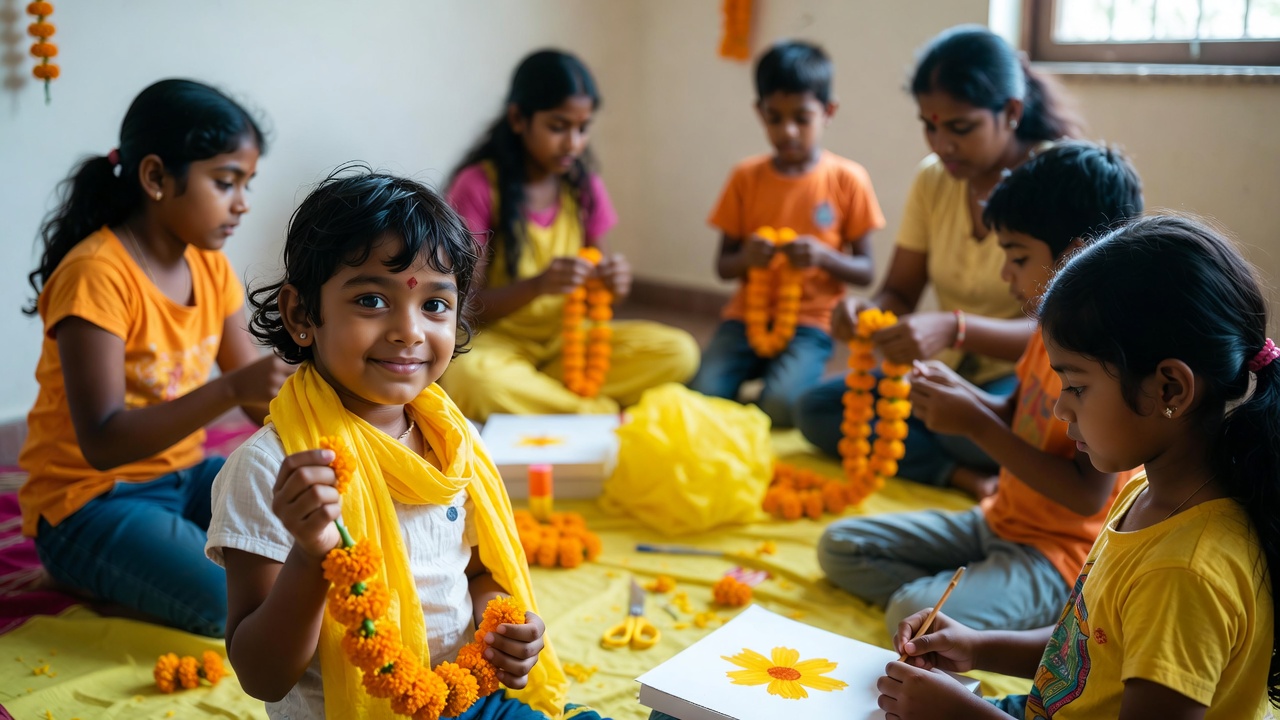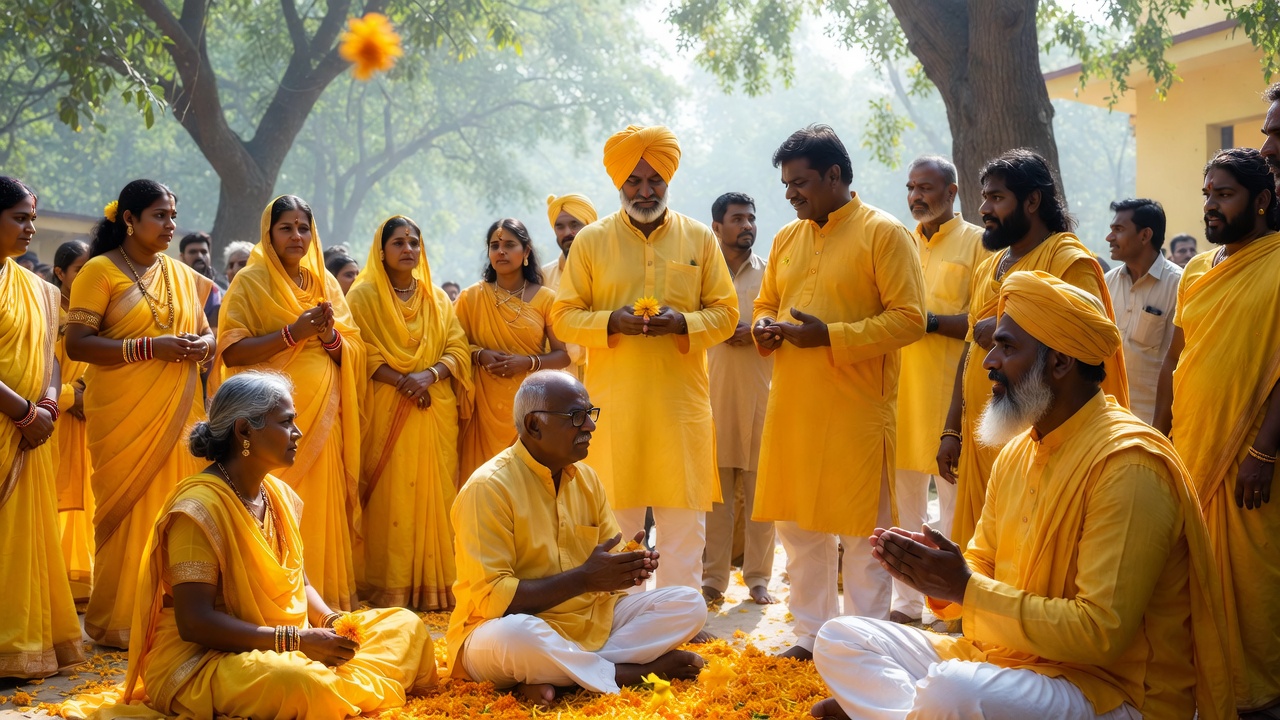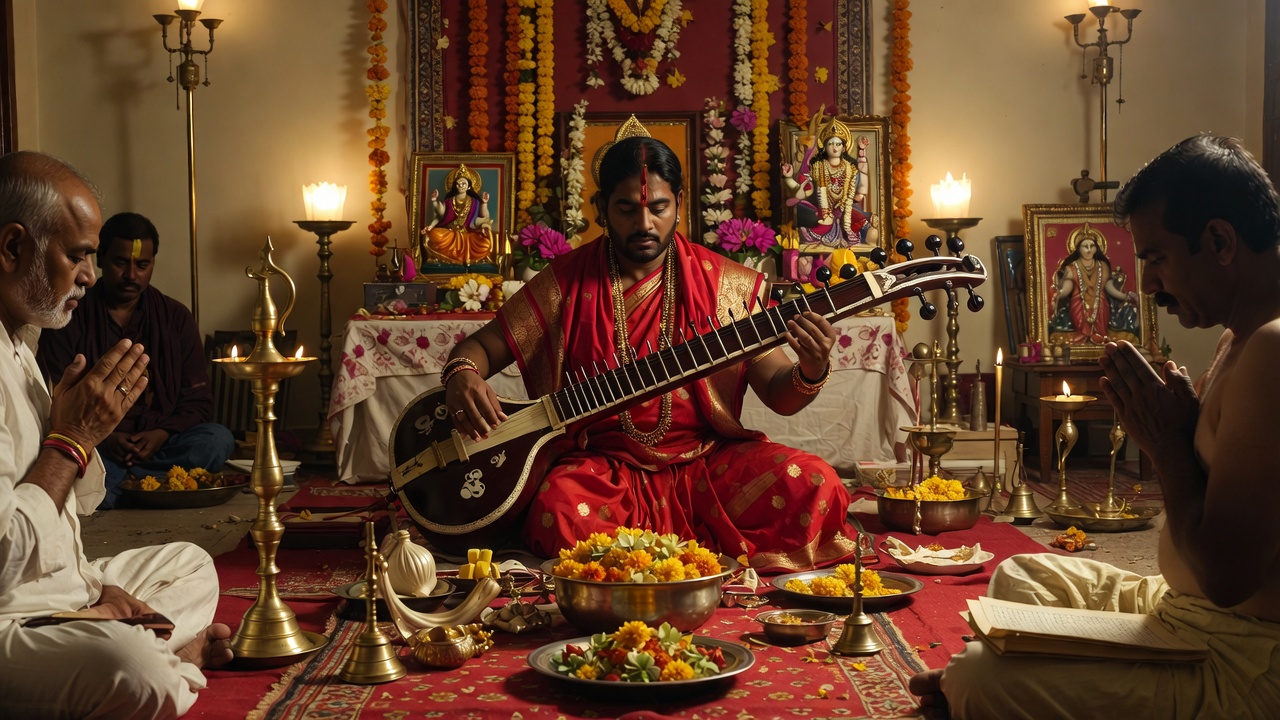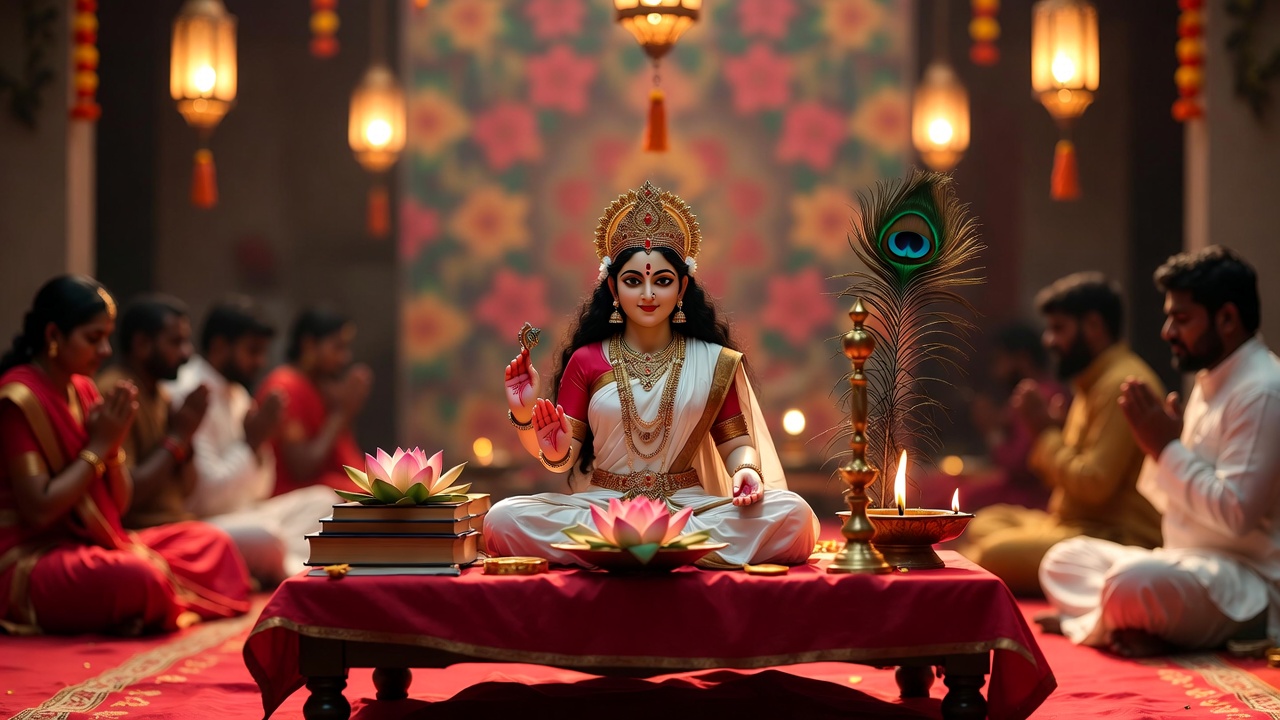
The mustard fields of North India blaze gold. The winter chill softens into a gentle warmth. Children in crisp yellow kurtas line up outside school pandals, clutching marigold garlands. This is Vasant Panchami — the day India celebrates the arrival of spring and bows before the Goddess of wisdom, Maa Saraswati.
In 2026, Saraswati Puja falls on Friday, January 23. From the narrow lanes of Kolkata to the ghats of Varanasi, from college campuses in Patna to Telangana’s ancient Basar temple, millions of students, artists, musicians, and scholars will offer prayers seeking knowledge, creativity, and clarity of thought.
Whether you are performing the puja at home for the first time or guiding your child through Vidyarambham (the sacred first-writing ceremony), this guide walks you through every step — from setting up the altar to chanting the final mantra.
What Is Vasant Panchami and Why Is Saraswati Puja Celebrated on This Day?
Vasant Panchami (also spelled Basant Panchami) is a Hindu festival observed on the fifth day (Panchami Tithi) of Shukla Paksha in the lunar month of Magha. The word Vasant means spring. Panchami means fifth. Together, they mark the day that signals the end of winter and the stirring of new life across the subcontinent.
But Vasant Panchami is far more than a seasonal marker. According to Hindu tradition, this is the appearance day of Goddess Saraswati — the divine embodiment of knowledge, speech, music, art, and wisdom. Ancient scriptures describe how Lord Brahma, after creating the universe, found it silent and joyless. He then manifested Saraswati, who filled creation with sound, rhythm, and consciousness. This is why Vasant Panchami is also called Saraswati Panchami or Shri Panchami.
The festival also marks the beginning of Holi preparations. Holi arrives exactly 40 days after Vasant Panchami, as the Hindu tradition holds that any season’s transition spans 40 days before it reaches full bloom.
Key Facts at a Glance
| Detail | Information |
|---|---|
| Festival Name | Vasant Panchami / Basant Panchami / Saraswati Puja |
| 2026 Date | Friday, January 23, 2026 |
| Panchami Tithi Begins | 02:28 AM on January 23, 2026 |
| Panchami Tithi Ends | 01:46 AM on January 24, 2026 |
| Auspicious Puja Window | 07:15 AM to 12:50 PM |
| Madhyahna Moment | 12:50 PM |
| Celebrated By | Hindus across India, Nepal, Bangladesh, Indonesia (Bali) |
| Primary Deity | Goddess Saraswati |
| Sacred Colour | Yellow (Basanti) |
Note: Exact sunrise and puja timings vary by city. The times above are general references based on data from DrikPanchang. Always confirm with your local panchang or family priest.
Who Is Goddess Saraswati? Symbolism, Iconography & Spiritual Meaning
Understanding the puja begins with understanding the deity. Goddess Saraswati is the consort of Lord Brahma and one of the Tridevi (the three supreme goddesses alongside Lakshmi and Parvati). Her name comes from the Sanskrit root saras (flow) and wati (she who possesses), meaning “she who flows” — a reference to both knowledge and the ancient Saraswati River.
Her iconography is rich with meaning:
- Four Hands: Represent the four aspects of human personality in the pursuit of learning — mind (manas), intellect (buddhi), ego (ahamkara), and alertness (chitta).
- Veena: The musical instrument in her hands symbolises the harmony between intellect and emotion. True knowledge, Saraswati reminds us, is not merely academic — it also carries beauty and feeling.
- Book (Vedas): Represents sacred and universal knowledge.
- Sphatik Mala (Crystal Rosary): Symbolises the power of meditation and inner reflection.
- White Dress: Stands for purity, truth, and the sattvic (pure) nature of true wisdom.
- White Swan (Hamsa): Her mount represents discernment — the mythic ability to separate milk from water, or truth from falsehood.
- White Lotus Seat: Indicates that she is rooted in truth and supreme reality.
Saraswati is not just the goddess of book-learning. She presides over all creative and intellectual pursuits — classical dance, painting, sculpture, scientific inquiry, music, technology, and craftsmanship. This is why everyone from a kindergarten student to a doctoral researcher, from a tabla player to a software engineer, seeks her blessing on Vasant Panchami.
Vasant Panchami 2026 Shubh Muhurat: Best Time to Perform Saraswati Puja
Timing matters deeply in Hindu worship. Purvahna Kala — the period between sunrise and midday — is traditionally the ideal window for Saraswati Puja on Vasant Panchami. Most schools, colleges, and households across India perform the puja during this morning window.
Saraswati Puja Muhurat 2026
| Timing | Details |
|---|---|
| Panchami Tithi Start | 02:28 AM, January 23, 2026 |
| Panchami Tithi End | 01:46 AM, January 24, 2026 |
| Recommended Puja Time | 07:15 AM – 12:50 PM |
| Madhyahna Muhurat | Around 12:50 PM |
Many astrologers regard Vasant Panchami as an Abujha day — a universally auspicious day that requires no separate muhurat calculations to begin important work. Starting a new business, entering a new home, performing a child’s Annaprasana (first feeding), or beginning a course of study are all considered favourable on this day.
That said, ensure the Panchami Tithi is still active when you perform your puja. The tithi runs from the early hours of January 23 through the early hours of January 24, so morning worship comfortably falls within the auspicious window.
Complete Saraswati Puja Samagri List: Items You Need for the Ritual
Preparation is half the prayer. Before beginning the puja, gather every item you will need so the worship flows without interruption. Below is the complete samagri (materials) list for a traditional Saraswati Puja at home.
Essential Puja Items
| Category | Items |
|---|---|
| Idol or Image | Clay idol (murti) or framed picture of Goddess Saraswati |
| Altar Setup | Clean yellow or white cloth, wooden chowki (low platform) |
| Kalash | Brass or copper pot filled with water, mango leaves, coconut |
| Flowers | Yellow marigolds, white jasmine, yellow roses, seasonal blooms |
| Garland | Yellow and white flower garland for the deity |
| Sandalwood Paste | Chandan (for anointing the idol) |
| Kumkum & Haldi | Vermillion powder and turmeric |
| Akshat | Unbroken rice grains (mixed with turmeric) |
| Incense & Lamp | Dhoop (incense sticks), ghee diya or oil lamp, camphor |
| Naivedya (Offerings) | Kesar halwa, boondi laddoo, kheer, fruits, mishri (rock sugar) |
| Sacred Thread | Moli (red/yellow cotton thread) |
| Paan & Supari | Betel leaf and betel nut |
| Books & Instruments | Place textbooks, notebooks, pens, musical instruments, or work tools near the idol |
| Gangajal | Holy water (or clean water) |
| Yellow Attire | Yellow saree, kurta, or dupatta for the devotee |
Tip: Many families now also place laptops, tablets, and art supplies near the idol — a modern nod to Saraswati’s domain over all creative tools.
How to Perform Saraswati Puja at Home: Step-by-Step Ritual Guide (Shodashopachara Vidhi)
The traditional Saraswati Puja follows the Shodashopachara method — a worship format with 16 sacred steps. This method is described in classical puja texts and is used across North and East India. You do not need a priest to perform this puja at home. A sincere heart and proper intention are enough.
Step 1: Purification (Shuddhikaran)
Begin by cleaning the puja space. Sprinkle Gangajal (or clean water) on the altar, the offerings, and yourself while chanting:
Om Apavitrah Pavitro Va Sarvaavastham Gato’pi Va Yah Smaret Pundarikaksham Sa Bahyabhyantarah Shuchih
Meaning: Whether pure or impure, in whatever state, one who remembers the lotus-eyed Lord becomes cleansed inside and out.
Step 2: Meditation (Dhyanam)
Sit quietly before the idol. Close your eyes. Visualise Goddess Saraswati in her radiant white form — seated on a lotus, holding the veena and the Vedas. Chant the most famous Saraswati Dhyana Shloka:
Ya Kundendu Tushara Hara Dhavala, Ya Shubhra Vastravrita Ya Veena Vara Danda Mandita Kara, Ya Shveta Padmasana Ya Brahmachyuta Shankara Prabhritibhir Devaih Sada Vandita Sa Mam Patu Saraswati Bhagavati Nihshesha Jadyapaha
Meaning: May that Goddess Saraswati — who is fair as the jasmine flower, the moon, and snow; who wears pure white garments; whose hands are adorned with the veena; who sits on a white lotus; and who is always worshipped by Brahma, Vishnu, and Shiva — protect me and remove all my ignorance.
Step 3: Invocation (Avahanam)
Invite the Goddess to be present. Form the Avahana Mudra (join both palms and fold both thumbs inward). Then chant:
Agachchha Deva Deveshi Tejomayi Saraswati Kriyamanam Maya Pujam Grihana Sura Vandite
Meaning: O Goddess of all gods, O radiant Saraswati, please come and accept this humble worship.
Step 4: Offering a Seat (Asanam)
Take five flowers and place them before the idol, offering the Goddess a divine seat. Chant:
Om Shri Saraswati Devyai Namah, Asanam Samarpayami
Step 5: Washing the Feet (Padyam)
Offer a small amount of water at the base of the idol, symbolising the washing of the Goddess’s feet.
Om Shri Saraswati Devyai Namah, Padayoh Padyam Samarpayami
Step 6: Arghya (Water Offering)
Offer water over the idol’s head with a spoon or your cupped right hand.
Om Shri Saraswati Devyai Namah, Shirasi Arghyam Samarpayami
Step 7: Achamaniyam (Sipping Water)
Offer a few drops of water for the deity to symbolically sip.
Om Shri Saraswati Devyai Namah, Achamaniyam Samarpayami
Step 8: Snanam (Ceremonial Bath)
If using a small idol, give a gentle bath with Gangajal or clean water mixed with a drop of milk and honey. For a framed image, sprinkle a few drops.
Step 9: Vastra (Clothing)
Drape a yellow or white cloth over or near the idol. Yellow is the colour of Vasant Panchami — it mirrors the blooming mustard fields and represents the vitality of spring.
Step 10: Gandham (Sandalwood Paste)
Apply sandalwood paste (chandan) on the forehead of the idol. Chant:
Om Gandham Samarpayami Bhagavati Shri Saraswatyai Namah
Step 11: Akshat & Kumkum (Rice Grains & Vermillion)
Offer turmeric-tinted rice and kumkum. Also offer haldi (turmeric) and sindoor as saubhagya dravya (items of good fortune).
Step 12: Pushpam (Flowers)
Offer yellow and white flowers — marigold and jasmine are the most traditional choices. Chant:
Om Shri Saraswati Devyai Namah, Pushpam Samarpayami
Step 13: Dhupam (Incense)
Light incense sticks and wave them before the idol. The fragrant smoke purifies the space.
Om Shri Saraswati Devyai Namah, Dhupam Aghrapayami
Step 14: Deepam (Lamp)
Light a ghee or oil lamp. The flame represents the light of knowledge dispelling the darkness of ignorance. Move the lamp gently in a circular motion before the Goddess.
Om Shri Saraswati Devyai Namah, Deepam Darshayami
Step 15: Naivedya (Food Offering)
Place the prepared prasad — kesar halwa, kheer, boondi laddoo, fresh fruits, and mishri — before the idol. Chant:
Om Shri Saraswati Devyai Namah, Naivedyam Samarpayami
After the offering, provide water for symbolic sipping (Achamaniyam) and a betel leaf with nut (Tambulam).
Step 16: Aarti & Pushpanjali (Final Prayer)
Conclude with Aarti, circling the lit diya before the Goddess while singing the beloved hymn “Om Jai Saraswati Mata.” Then offer Pushpanjali — hold flowers in both palms, bow deeply, and release them at the Goddess’s feet while praying for wisdom, clarity, and success.
Om Shri Saraswatyai Namah Anena Pujanena Shri Saraswati Devi Priyatam Namo Namah
Meaning: With this worship, may Goddess Saraswati be pleased. I offer my deepest salutation.
Powerful Saraswati Puja Mantras for Knowledge, Wisdom & Academic Success
Mantras are the living heart of Saraswati Puja. Each carries a specific vibration believed to invoke the Goddess’s grace. Below are the most important mantras arranged by purpose.
The Saraswati Beej (Seed) Mantra
ॐ ऐं (Om Aim)
This single syllable — Aim — is the beej (seed) sound of Goddess Saraswati. It is the simplest yet most potent invocation. Chant it 108 times using a japa mala for focused meditation.
Saraswati Moola Mantra
ॐ ऐं सरस्वत्यै ऐं नमः Om Aim Saraswatyai Aim Namah
Meaning: I bow to Goddess Saraswati. This is the core devotional mantra used during all Saraswati pujas.
Saraswati Gayatri Mantra
ॐ वाग्देव्यै च विद्महे कामराजाय धीमहि। तन्नो देवी प्रचोदयात्॥
Om Vaagdevyai Cha Vidmahe Kaamarajaaya Dheemahi Tanno Devi Prachodayaat
Meaning: We meditate upon the Goddess of Speech. We contemplate the one who is desired by all seekers. May that Goddess inspire and illuminate our understanding.
Mantra for Students Before Exams (Vidyarambha Mantra)
सरस्वति नमस्तुभ्यं वरदे कामरूपिणि। विद्यारम्भं करिष्यामि सिद्धिर्भवतु मे सदा॥
Saraswati Namastubhyam Varade Kaamaroopini Vidyaarambham Karishyaami Siddhir Bhavatu Me Sadaa
Meaning: O Goddess Saraswati, giver of blessings and fulfiller of wishes, I bow to you as I begin my studies. May I always achieve success.
This mantra is traditionally chanted at the start of any new course of learning and during the Vidyarambham ceremony for young children.
Mahasaraswati Mantra
ॐ ऐं ह्रीं क्लीं महासरस्वत्यै देव्यै नमः Om Aim Hreem Kleem Maha Saraswatyai Devyai Namah
Meaning: Salutations to Mahasaraswati, the great goddess of supreme wisdom.
Saraswati Mantra for Speech & Communication
वद वद वाग्वादिनी स्वाहा Vad Vad Vaagvaadini Svaha
Meaning: O Goddess of Speech, bestow upon me the power of eloquent expression.
This mantra is especially recommended for those who wish to improve their communication skills, overcome speech difficulties, or excel in public speaking.
Tips for Chanting Saraswati Mantras Effectively
- Sit in a clean, quiet spot. A calm mind absorbs the vibrations better.
- Pronounce each syllable carefully. In Sanskrit mantras, every sound carries meaning.
- Use a japa mala (prayer beads). A mala of 108 beads helps you maintain count and rhythm.
- Chant with feeling. Do not repeat mechanically — connect with each word and its meaning.
- Best time to chant: During Brahma Muhurta (roughly 4:00–5:30 AM) or during the puja itself.
- Consistency matters. Regular chanting — even five minutes daily — builds a deeper connection over time.
The Sacred Tradition of Vidyarambham: How to Begin a Child’s Education on Vasant Panchami
One of the most cherished rituals of Vasant Panchami is Vidyarambham (also known as Akshar Abhyasam or Haate Khori in Bengal). This is the ceremony where young children aged three to five write their first letters, traditionally at the feet of Goddess Saraswati.
The ritual is simple and beautiful:
- The child sits before the Saraswati idol, dressed in yellow or white.
- A parent or elder holds the child’s hand.
- Together, they write “Om” or the first letter of the alphabet on a plate of rice, a slate, or the child’s tongue (with a gold ring dipped in honey).
- Books, pencils, and a slate are placed near the idol for the Goddess’s blessing.
- The family prays for the child’s lifelong love of learning.
Thousands of families travel to Sri Gnana Saraswati Temple in Basar, Telangana for this ceremony, believing that the Goddess’s blessings at this ancient temple ensure lifelong wisdom. In Odisha, the tradition is called Khadi Chuan. In Kerala, it takes place during Vijayadashami as Ezhuthiniruthu.
This is not mere ritual. It is a family’s first prayer for a child’s intellectual journey — a moment where education is treated as sacred, not just functional.
How Saraswati Puja Is Celebrated Across India: Regional Traditions & Customs
Vasant Panchami is observed across the subcontinent, but each region adds its own cultural texture. Here is how the festival unfolds in different parts of India.
West Bengal: The Heartland of Saraswati Pujo
Nowhere in India is Saraswati Puja celebrated with as much youthful energy as in West Bengal. Known locally as Saraswati Pujo, the festival is arguably the most beloved event in Bengal’s student community.
Preparations begin days in advance. Beautifully crafted clay idols of the Goddess appear in homes, schools, neighbourhood pandals, and college campuses. Girls wear the traditional basanti (yellow) saree with a red border, and boys don holud (yellow) kurtas.
A unique Bengali custom: students do not read or write on Saraswati Puja day. They place books, pens, notebooks, and even electronic gadgets at the Goddess’s feet, symbolising the surrender of knowledge to the divine. Study resumes only after the idol’s immersion the following day.
The traditional bhog (communal meal) features khichuri (a rice-and-lentil dish), begun bhaja (fried eggplant), labra (mixed vegetable curry), and payesh (sweet rice pudding). Eating the kul (jujube berry) is an important tradition — devotees taste this seasonal fruit only after offering it to the Goddess.
In Kolkata, Saraswati Pujo has earned the affectionate nickname “Bengali Valentine’s Day” among young people. The pleasant weather, festive atmosphere, and tradition of visiting pandals with friends make it a day of social celebration alongside the spiritual devotion.
Bihar & Jharkhand: Student-Led Devotion
In Bihar, Saraswati Puja is one of the most eagerly awaited festivals among students. Schools and neighbourhood committees organise elaborate pujas, and young people lead the celebrations with great enthusiasm. Yellow clothing, laddoos, and kheer are central to the day. Cultural programs featuring devotional songs and dance follow the morning puja.
In rural parts of Jharkhand, Saraswati Puja becomes a community gathering that blends tribal folk traditions with classical Hindu rituals. Simple, heartfelt food offerings — often local rice dishes and seasonal sweets — are shared among everyone.
Uttar Pradesh & Vrindavan: The Gateway to Holi
In Mathura and Vrindavan, Vasant Panchami is not only about Saraswati Puja — it is the official start of the Holi season. Temples are decorated with yellow flowers, idols are dressed in yellow, and priests at Vrindavan’s famous Banke Bihari Temple throw the first gulal (coloured powder) on devotees.
People also begin preparing the Holika Dahan woodpile on this day, installing the Holi Danda (wooden pole) that will be ritually burned 40 days later.
Punjab & Haryana: Kites in the Sky
In the Punjab region, Vasant Panchami is celebrated as the Basant Festival of Kites. Rooftops come alive with colourful kites dancing against blue skies. Women prepare traditional dishes like Meethe Chawal (sweet yellow rice), Makke ki Roti, and Sarson ka Saag — tying the festival to the blooming mustard fields that paint the landscape golden.
South India: Aksharabhyasam & Navratri Connections
In Andhra Pradesh and Telangana, Vasant Panchami is known as Shri Panchami. The Aksharabhyasam ceremony at the Basar Saraswati Temple draws enormous crowds. In Tamil Nadu and Karnataka, Saraswati Puja is more prominently observed during the Sharadiya Navratri period (September-October), as Saraswati Ayudha Puja, when tools and instruments receive blessings.
Bali, Indonesia: Hari Raya Saraswati
The Hindu community of Bali celebrates this day as Hari Raya Saraswati — one of the most important days in the 210-day Balinese Pawukon calendar. Balinese Hindus place offerings of flowers and incense on books, lontar manuscripts, and libraries. Schools hold ceremonies, and it is considered improper to read or write on this sacred day.
What to Wear on Vasant Panchami: The Meaning Behind Yellow Clothes
Yellow is the colour of Vasant Panchami. Walk through any North Indian city or Bengali neighbourhood on this day, and you will see a sea of basanti (golden yellow) flowing through the streets.
But why yellow?
- Mustard fields: January marks peak bloom for mustard (sarson) crops across North India. The golden fields are the visual signature of approaching spring.
- Saraswati’s association: Yellow represents knowledge, vitality, and the warmth of learning — qualities that define the Goddess.
- Spring energy: In Ayurvedic tradition, yellow is linked to the Kapha season, promoting vigour and renewal after the dormancy of winter.
What to wear:
- Women and girls: A yellow or basanti saree (Bengali style with a red border is traditional in Bengal), or a yellow salwar kameez or lehenga.
- Men and boys: A yellow kurta-pyjama or a kurta with a yellow dupatta.
- Children: Bright yellow traditional outfits are the norm in schools celebrating the puja.
Traditional Vasant Panchami Food and Prasad Recipes to Offer the Goddess
Food prepared for Vasant Panchami is deeply tied to the yellow theme of the festival. These dishes are offered as naivedya (food offering) to Saraswati and then shared as prasad.
Popular Dishes Across Regions
| Dish | Region | Description |
|---|---|---|
| Kesar Halwa | North India | Semolina pudding infused with saffron, ghee, and dry fruits |
| Boondi Laddoo | North India, Bihar | Round sweets made from chickpea batter drops in sugar syrup |
| Meethe Chawal | Punjab, UP | Sweet yellow rice flavoured with saffron and cardamom |
| Khichuri | West Bengal | A savoury rice-lentil dish — the quintessential Saraswati Pujo bhog |
| Payesh | Bengal, Odisha | Sweet rice pudding made with milk, rice, and sugar |
| Kesari Bhaat | Maharashtra, Karnataka | Saffron-flavoured semolina sweet |
| Panchakajjaya | South India | A five-ingredient sacred mix of jaggery, coconut, banana, ghee, and sesame |
Key rule: Food should be strictly vegetarian on Saraswati Puja day. In many Bengali households, the entire day is observed with a vegetarian diet — a rarity in a culture that normally enjoys fish and meat.
Saraswati Puja Decoration Ideas for Home and School Pandals
The decoration for Saraswati Puja is meant to create a sacred space that reflects the purity and wisdom of the Goddess. You do not need an elaborate setup — sincerity and cleanliness matter more than expense.
At Home
- Altar: Cover a low wooden table with a clean yellow or white cloth. Place the idol or framed image at the centre.
- Flowers: Surround the idol with yellow marigolds, white jasmine, and seasonal wildflowers.
- Rangoli: Draw a simple alpana (traditional floor art) using rice paste at the base of the altar. Lotus and swan motifs are traditional choices.
- Lighting: String fairy lights or place brass diyas around the altar. The warm glow adds both beauty and reverence.
- Books & Instruments: Arrange textbooks, musical instruments, and art tools near the idol. This visual representation of knowledge is central to the puja’s meaning.
At Schools and Community Pandals
- Pandal theme: Keep it clean and traditional — white and yellow draping, banana leaves, and mango leaf toran (garlands) at the entrance.
- Cultural stage: Set up a small stage nearby for singing, dance, and poetry recitation after the puja.
- Eco-friendly materials: Use clay idols, natural flowers, and biodegradable decorations. Many communities across India are now shifting toward sustainable puja practices, avoiding thermocol and plastic.
Do’s and Don’ts to Follow on Saraswati Puja Day
Vasant Panchami carries its own set of traditional customs and taboos. Observing these shows respect for the Goddess and the spirit of the day.
Do’s ✅
- Wear yellow clothing to honour the season and the Goddess.
- Wake early, bathe, and begin the puja during the morning muhurat.
- Offer yellow flowers and yellow sweets as naivedya.
- Place books, pens, instruments, and work tools near the idol for blessings.
- Begin new ventures — Vasant Panchami is an Abujha day, auspicious for starting anything new.
- Perform Vidyarambham for young children.
- Share prasad generously with family, neighbours, and community members.
- Attend cultural programs — music, dance, and poetry are offerings in their own right.
Don’ts ❌
- Do not study or write on puja day (this is especially observed in Bengal and parts of East India). Let your books rest in the Goddess’s presence.
- Avoid non-vegetarian food on this day.
- Do not disrespect books or learning materials — treat them with reverence, as they are Saraswati’s embodiment.
- Avoid dark or black clothing on puja day — these colours are considered inauspicious for the occasion.
- Do not start the puja after the Panchami Tithi has ended.
Frequently Asked Questions About Saraswati Puja on Vasant Panchami 2026
Q: When is Saraswati Puja in 2026? A: Saraswati Puja will be celebrated on Friday, January 23, 2026. The Panchami Tithi begins at 2:28 AM on January 23 and ends at 1:46 AM on January 24.
Q: What is the best time to perform Saraswati Puja in 2026? A: The auspicious puja window is 07:15 AM to 12:50 PM. However, astrologers consider the entire day auspicious as long as the Panchami Tithi is active.
Q: Can I perform Saraswati Puja at home without a priest? A: Absolutely. The 16-step Shodashopachara method outlined in this guide can be performed by anyone with devotion and clean intention. A priest (pandit) is helpful but not mandatory.
Q: Why do students not study on Saraswati Puja day? A: This tradition — especially strong in West Bengal — represents surrendering knowledge to the divine. Students place their books at the Goddess’s feet and resume study only after the idol is immersed the next day.
Q: Is Vasant Panchami a public holiday? A: Vasant Panchami is listed as an optional/restricted holiday by the Government of India. Government offices may close in certain states, but most private offices remain open. Schools in states like West Bengal, Bihar, and Odisha typically close for the celebration.
Q: What is the connection between Vasant Panchami and Holi? A: Vasant Panchami falls exactly 40 days before Holi. The festival marks the beginning of Holi preparations. In Vrindavan and Mathura, coloured powder is first thrown on this day.
Q: Can non-Hindus participate in Saraswati Puja? A: Yes. Knowledge has no religious boundary. Many educational institutions welcome students of all backgrounds to participate in the cultural celebrations and seek blessings for their academic journeys.
A Final Word: Why Saraswati Puja Still Matters in the Modern World
In an age of information overload — of algorithms, AI, and infinite scrolling — Saraswati Puja asks us to pause. To honour the act of learning itself. To remember that knowledge is not just data to be consumed, but a sacred gift to be received with humility, cultivated with discipline, and shared with generosity.
When a grandmother guides a three-year-old’s hand to write Om for the first time on a plate of rice, she is doing more than teaching a letter. She is performing an act of faith — faith that the pursuit of knowledge will lead her grandchild toward truth, beauty, and a meaningful life.
That is what Saraswati Puja celebrates. Not just intelligence, but wisdom. Not just skill, but devotion to the craft. Not just information, but the transformation that true learning brings.
This January 23, as the mustard fields glow gold and the first warm breeze of spring brushes across India, may Maa Saraswati’s blessings flow through your home, your books, and your life.
ॐ ऐं सरस्वत्यै नमः। Om Aim Saraswatyai Namah.