Celebrate the Year of the Snake with Traditional Korean Crafts, DIY Projects, and Cultural Activities for Children
Introduction: What is Seollal and Why Celebrate Korean Lunar New Year with Kids?
Seollal (설날), the Korean Lunar New Year, stands as one of the most significant traditional holidays in South Korea. This ancient celebration marks the first day of the Korean lunar calendar and typically falls between late January and mid-February. In 2025, Seollal begins on January 29th, ushering in the Year of the Snake according to the Korean zodiac.
For families around the world, Seollal offers a wonderful opportunity to teach children about Korean culture and traditions. Whether you have Korean heritage, are raising multicultural children, or simply want to expose your kids to global celebrations, Seollal crafts for kids provide hands-on learning experiences that make cultural education fun and memorable.
The beauty of Korean Lunar New Year activities lies in their accessibility. Many traditional Korean crafts can be adapted for children of all ages, from toddlers to teenagers. These activities teach valuable lessons about:
- Respect for elders (a cornerstone of Korean culture)
- Family unity and togetherness
- The importance of ancestral traditions
- Korean art and aesthetics
- Patience and craftsmanship
In this comprehensive guide, we’ll explore easy Korean Lunar New Year activities that families, teachers, and community groups can enjoy together. From traditional Bokjumeoni (lucky pouches) to colorful Korean paper fans, these projects bring the spirit of Seollal to life.
Understanding the Cultural Significance of Seollal for Children
The History and Meaning Behind Korean New Year Traditions
Before diving into crafts, it’s essential to help children understand why Koreans celebrate Seollal. This context makes craft activities more meaningful and educational.
Seollal has been celebrated on the Korean Peninsula for over 2,000 years. The holiday represents a time of renewal, gratitude, and hope for the coming year. Unlike Western New Year celebrations, Seollal is deeply rooted in Confucian values that emphasize family bonds and respect for ancestors.
Key Seollal traditions include:
| Tradition | Korean Name | Significance |
|---|---|---|
| New Year’s Bow | Sebae (세배) | Children bow to elders to show respect |
| Lucky Money | Sebaetdon (세뱃돈) | Elders give children money in envelopes |
| Ancestral Rites | Charye (차례) | Families honor deceased ancestors |
| Traditional Food | Tteokguk (떡국) | Rice cake soup eaten to gain a year of age |
| Traditional Games | Yunnori (윷놀이) | Board game played with wooden sticks |
| Traditional Dress | Hanbok (한복) | Colorful Korean clothing worn during celebrations |
Understanding these traditions helps children appreciate the cultural context behind their craft projects. When making a DIY Korean lucky envelope, for instance, they learn about the beautiful custom of elders blessing younger generations with prosperity.
Why Hands-On Korean Cultural Activities Matter for Child Development
Craft activities rooted in cultural traditions offer unique developmental benefits. According to early childhood education research, multicultural crafts help children:
- Develop fine motor skills through cutting, folding, and decorating
- Build cognitive connections between abstract cultural concepts and tangible objects
- Foster creativity within structured traditional frameworks
- Cultivate respect for diverse cultures and traditions
- Strengthen family bonds through shared activities
The National Association for the Education of Young Children (NAEYC) emphasizes the importance of culturally responsive teaching practices. Seollal crafts align perfectly with these educational principles by making Korean culture accessible and engaging for young learners.
Essential Materials for Korean Lunar New Year Craft Projects
Complete Supply List for Seollal Crafts at Home
Before starting your Korean New Year craft activities, gather these essential materials. Having everything ready ensures a smooth, enjoyable crafting experience.
Basic Craft Supplies:
- Hanji (Korean traditional paper) or colored construction paper
- White cardstock or heavy paper
- Scissors (child-safe for younger crafters)
- Glue sticks and white craft glue
- Markers, crayons, and colored pencils
- Acrylic paints and brushes
- Ribbon in red, pink, yellow, and blue
- Gold and silver metallic paper
- Wooden craft sticks
- String or yarn
Specialty Items for Authentic Korean Crafts:
| Item | Purpose | Where to Find |
|---|---|---|
| Hanji Paper | Traditional Korean paper crafts | Asian craft stores, online retailers |
| Korean Stamp Ink | Traditional red ink for seals | Korean stationery shops |
| Silk Fabric Scraps | Bokjumeoni pouches | Fabric stores |
| Korean Pattern Templates | Authentic design elements | Free printables online |
| Traditional Korean Stickers | Decoration | Korean gift shops |
Budget-Friendly Alternatives:
Not everyone has access to specialty Korean craft supplies. Here are affordable substitutions:
- Tissue paper can replace Hanji for younger children
- Red envelopes from Chinese New Year work for lucky money pouches
- Printed patterns can substitute for traditional stamps
- Felt fabric works well instead of silk for pouches
Traditional Korean Lucky Pouch Craft: How to Make Bokjumeoni
Step-by-Step Bokjumeoni Tutorial for Kids and Families
The Bokjumeoni (복주머니) is perhaps the most iconic Seollal craft for kids. These small, colorful pouches symbolize good fortune and are traditionally given during the Lunar New Year. The word “bok” means luck or fortune in Korean.
Skill Level: Beginner to Intermediate
Age Range: 5 years and up (with adult supervision)
Time Required: 30-45 minutes
Materials Needed:
- Felt fabric in traditional colors (red, yellow, blue, pink)
- Embroidery thread or yarn
- Scissors
- Needle (blunt-tipped for children)
- Cotton balls for stuffing (optional)
- Decorative elements (beads, buttons, sequins)
Instructions for Making a Simple Felt Bokjumeoni:
Step 1: Cut the Fabric Cut two identical circles from felt fabric. A diameter of 4-5 inches works well for children’s projects. Use a small plate or bowl as a template for perfect circles.
Step 2: Create the Pouch Shape Place the two circles together, aligning the edges. Using a hole punch, create evenly spaced holes around the perimeter, leaving the top open.
Step 3: Lace the Edges Thread yarn or ribbon through the holes in a simple running stitch. Leave long tails at the top for the drawstring closure.
Step 4: Add Decorations This is where creativity shines! Children can add:
- Korean characters using fabric paint
- Flower designs representing the plum blossom (a Seollal symbol)
- Lucky symbols like the taeguk (yin-yang) pattern
- Beads and sequins for sparkle
Step 5: Create the Closure Pull the yarn tails to cinch the top of the pouch. Tie a bow or add decorative beads to the ends.
Variations: No-Sew Bokjumeoni for Younger Children
For preschoolers and children who aren’t ready for sewing, try this no-sew version:
- Cut a circle from felt (6 inches diameter)
- Place small treats or wishes written on paper in the center
- Gather the edges upward
- Tie with a ribbon about 1 inch from the top
- Decorate with stickers and fabric markers
Pro Tip: Fill finished Bokjumeoni with small treats like Yakgwa (Korean honey cookies) or coins to maintain the traditional spirit of giving.
Easy Korean Paper Crafts: Hanji Art Projects for Seollal
Introduction to Traditional Korean Paper Folding Techniques
Hanji (한지), traditional Korean paper made from mulberry bark, has been used in Korean crafts for over 1,500 years. While authentic Hanji can be difficult to find outside Korea, the techniques translate beautifully to regular craft paper.
Korean paper crafts differ from Japanese origami in their emphasis on layering, texture, and practical objects. During Seollal, Koreans have traditionally created decorative items, fans, and ceremonial objects from paper.
How to Make a Korean Paper Fan for Lunar New Year
Traditional Korean fans (부채, buchae) make stunning Seollal decorations. This simplified version is perfect for kids.
Materials:
- Heavy cardstock or watercolor paper
- Markers or watercolors
- Wooden craft sticks
- Glue
- Scissors
- Optional: glitter, sequins, ribbon
Step-by-Step Instructions:
Step 1: Create the Fan Base Cut a semi-circle from cardstock. A radius of 8 inches creates a good-sized fan. Alternatively, fold paper accordion-style and secure at the bottom.
Step 2: Design Traditional Korean Patterns Discuss traditional Korean art motifs with children:
- Peonies (모란, moran) – symbolize wealth and honor
- Cranes (학, hak) – represent longevity
- Plum blossoms (매화, maehwa) – signify perseverance
- Taeguk symbol – represents balance and harmony
- Mountain and water scenes – traditional landscape art
Step 3: Paint or Color the Design Let children create their interpretations of these traditional patterns. Emphasize that Korean art often features bold colors and nature themes.
Step 4: Attach the Handle Glue two craft sticks to the base of the fan, forming a handle. For accordion-style fans, glue the bottom folds together around a single stick.
Step 5: Add Final Touches Attach a tassel or ribbon to the handle. Traditional fans often feature silk tassels in complementary colors.
Korean Paper Lantern Craft for Kids
Paper lanterns illuminate Korean celebrations and make wonderful Seollal decorations for classrooms and homes.
Simple Cylinder Lantern Tutorial:
- Cut a rectangular piece of paper (any color, though red and yellow are traditional)
- Fold in half lengthwise
- Cut slits from the folded edge, stopping 1 inch from the open edge
- Unfold and form into a cylinder, gluing the short edges together
- Attach a paper strip handle at the top
- Insert a battery-operated tea light (never real candles with paper crafts)
Advanced: Geometric Paper Lantern
For older children, introduce more complex geometric designs:
- Hexagonal lanterns using six identical paper strips
- Spherical lanterns using circular cutouts
- Traditional Korean designs with cut-out patterns for light to shine through
Korean Zodiac Crafts: Year of the Snake Activities for Kids
Understanding the Korean Zodiac System
The Korean zodiac shares many similarities with the Chinese zodiac but has distinct cultural interpretations. The system follows a 12-year cycle, with each year represented by a different animal.
The 12 Korean Zodiac Animals:
| Order | Animal | Korean Name | Years |
|---|---|---|---|
| 1 | Rat | 쥐 (Jwi) | 2020, 2032 |
| 2 | Ox | 소 (So) | 2021, 2033 |
| 3 | Tiger | 호랑이 (Horangi) | 2022, 2034 |
| 4 | Rabbit | 토끼 (Tokki) | 2023, 2035 |
| 5 | Dragon | 용 (Yong) | 2024, 2036 |
| 6 | Snake | 뱀 (Baem) | 2025, 2037 |
| 7 | Horse | 말 (Mal) | 2026, 2038 |
| 8 | Sheep | 양 (Yang) | 2027, 2039 |
| 9 | Monkey | 원숭이 (Wonsungi) | 2028, 2040 |
| 10 | Rooster | 닭 (Dak) | 2029, 2041 |
| 11 | Dog | 개 (Gae) | 2030, 2042 |
| 12 | Pig | 돼지 (Dwaeji) | 2031, 2043 |
Year of the Snake Craft Projects for 2025 Seollal
Since 2025 is the Year of the Snake, snake-themed crafts are especially appropriate. In Korean culture, snakes symbolize wisdom, transformation, and protection.
Paper Plate Snake Craft:
Materials:
- Paper plate
- Green, yellow, or patterned paint
- Scissors
- Googly eyes
- Red paper (for tongue)
- Glitter or sequins
Instructions:
- Paint the paper plate in snake colors—traditional Korean art often depicts snakes in green, gold, or multicolored patterns
- Once dry, cut the plate in a spiral from the outside edge toward the center
- The center becomes the snake’s head
- Add googly eyes and a forked tongue cut from red paper
- Decorate with patterns—Korean snakes are often shown with diamond or scale patterns
Sock Snake Puppet:
A wonderful craft that doubles as a toy!
- Use a long adult sock (preferably green or brown)
- Stuff with newspaper or cotton batting
- Sew or glue the opening closed
- Add felt eyes and a forked tongue
- Create scale patterns with fabric paint
- Add a ribbon around the “neck” for a festive touch
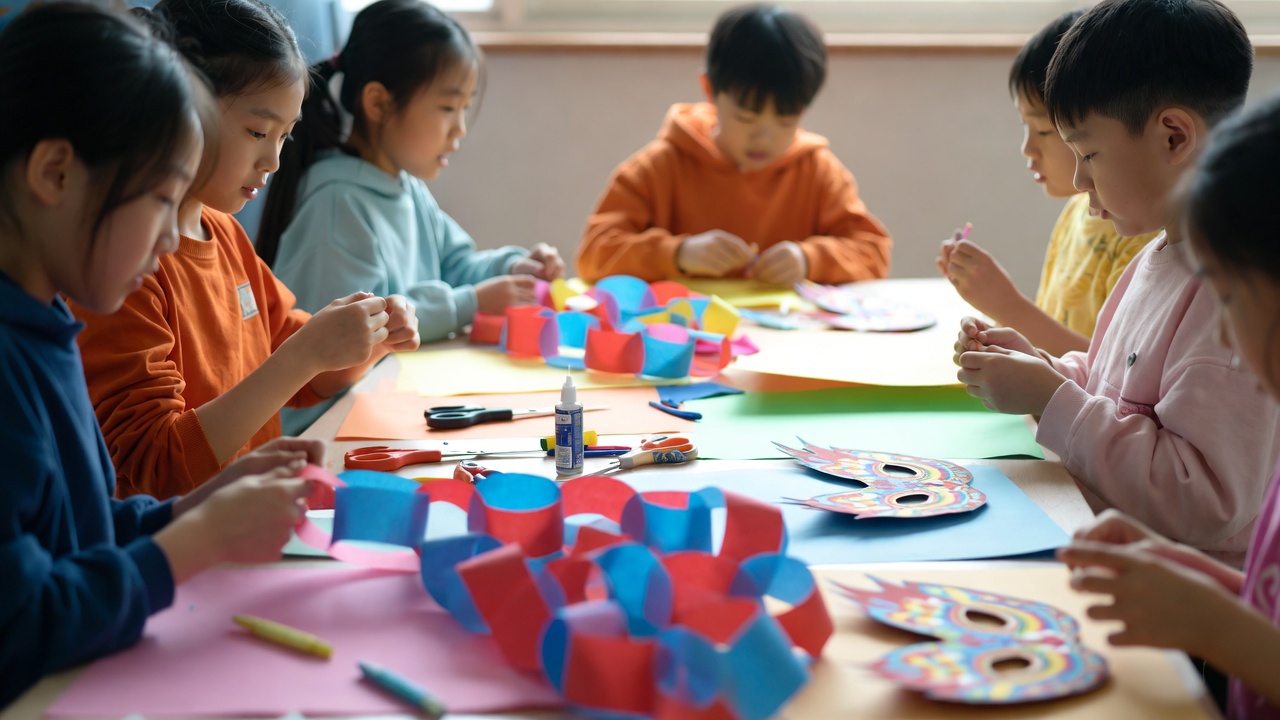
Snake Paper Chain Decoration:
Perfect for classroom decorations:
- Cut strips of paper in various colors
- Form loops and link them together
- Add a snake head to one end (cut from cardstock)
- Attach a paper tail to the other end
- Hang across windows or doorways
Traditional Korean Games Turned into Crafts: DIY Yunnori Board Game
What is Yunnori and How to Make Your Own Game Set
Yunnori (윷놀이) is the most popular traditional Korean game played during Seollal. This ancient board game dates back over 2,000 years and brings families together for hours of fun.
Creating your own DIY Yunnori game teaches children about Korean traditions while providing a craft they can actually use!
Components of Yunnori:
- Yutsticks: Four wooden sticks with flat and rounded sides
- Game board: Called “mal-pan” with a cross pattern
- Game pieces: Called “mal” (horses)
How to Make DIY Yunnori Sticks for Kids
Materials:
- 4 wooden craft sticks (large tongue depressor size)
- Acrylic paint (two colors)
- Paintbrush
- Clear sealant (optional)
Instructions:
Step 1: Prepare the Sticks Sand any rough edges on the craft sticks. Traditional Yutsticks are slightly curved, but flat sticks work well for children’s versions.
Step 2: Paint One Side Paint one side of each stick in a bright color (traditionally, the flat side is plain). Let dry completely.
Step 3: Paint the Other Side Paint the other side in a contrasting color or leave it natural wood. The contrast helps players see how the sticks land.
Step 4: Add Decorations (Optional) Older children can add small designs:
- Korean characters for luck
- Simple patterns like dots or lines
- Traditional symbols like small flowers
Step 5: Seal (Optional) Apply a clear sealant to protect the paint and make the sticks more durable for play.
Creating a Yunnori Game Board with Children
Materials:
- Large piece of cardboard or poster board (at least 18×18 inches)
- Markers or paint
- Ruler
- Circle template
Instructions:
- Draw a large cross shape on the board
- Add circles at each corner and intersection (29 stations total)
- Mark the starting position and end position
- Decorate with Korean patterns around the edges
- Label positions with numbers or Korean characters
How to Play:
| Throw Result | Name | Meaning | Moves |
|---|---|---|---|
| 1 flat side up | Do (도) | Pig | 1 space |
| 2 flat sides up | Gae (개) | Dog | 2 spaces |
| 3 flat sides up | Geol (걸) | Sheep | 3 spaces |
| 4 flat sides up | Yut (윷) | Ox | 4 spaces + extra turn |
| 0 flat sides up | Mo (모) | Horse | 5 spaces + extra turn |
Teaching children basic Yunnori rules alongside the craft makes this a complete cultural learning experience!
Korean New Year Card Making: How to Create Beautiful Seollal Greeting Cards
Traditional Korean Greeting Customs for Lunar New Year
In Korea, sending New Year greeting cards (연하장, yeonhajang) is an important tradition. These cards express wishes for health, happiness, and prosperity in the coming year.
Common Korean New Year Greetings:
- 새해 복 많이 받으세요 (Saehae bok mani badeuseyo) – “Receive many blessings in the new year”
- 건강하세요 (Geonganghaseyo) – “Be healthy”
- 행복한 새해 되세요 (Haengbokan saehae doeseyo) – “Have a happy new year”
Step-by-Step Korean New Year Card Tutorial
Materials:
- Cardstock (red, gold, or white)
- Colored paper
- Markers and colored pencils
- Korean character templates (optional)
- Glitter and sequins
- Envelopes
Basic Card Design:
Step 1: Prepare the Card Base Fold cardstock in half to create a standard card format. Red and gold are particularly auspicious colors for New Year cards.
Step 2: Create a Cover Design Choose from these traditional elements:
- Sun rising over mountains (represents new beginnings)
- Pine trees (symbolize longevity)
- Lucky bags (represent good fortune)
- Korean zodiac animal (snake for 2025)
- Hanbok-wearing figures (traditional Korean dress)
Step 3: Add Korean Characters Even non-Korean speakers can add simple Korean characters:
- 복 (bok) – Fortune/Luck
- 수 (su) – Longevity
- 희 (hui) – Happiness
Provide templates for children to trace these characters, explaining their meanings.
Step 4: Interior Message Write heartfelt wishes inside. Include both English and Korean greetings for an authentic touch.
Step 5: Decorate the Envelope Don’t forget the envelope! Add:
- Small drawings
- Stickers
- The recipient’s name in decorative lettering
Pop-Up Korean New Year Cards for Advanced Crafters
Older children can try more complex designs:
- Pop-up Hanbok figure: Cut and fold a paper figure that stands when the card opens
- Layered landscape: Create depth with multiple paper layers
- Interactive elements: Add pull tabs that reveal hidden messages
Hanbok Paper Doll Craft: Dress-Up Activity for Korean Lunar New Year
Introduction to Traditional Korean Hanbok Dress
The Hanbok (한복) is Korea’s traditional clothing, worn for centuries and still donned for special occasions like Seollal. Making Hanbok paper dolls teaches children about Korean fashion while developing creativity.
Key Hanbok Elements:
For Women/Girls (Yeosung Hanbok):
- Jeogori (저고리) – Short jacket
- Chima (치마) – High-waisted, full skirt
- Goreum (고름) – Ribbon ties at the jacket
- Binyeo (비녀) – Decorative hairpin
For Men/Boys (Namsung Hanbok):
- Jeogori (저고리) – Longer jacket
- Baji (바지) – Wide-legged pants
- Jokki (조끼) – Vest (optional)
- Durumagi (두루마기) – Overcoat for formal occasions
How to Create Hanbok Paper Dolls
Materials:
- Cardstock for doll base
- Patterned paper for Hanbok pieces
- Scissors
- Glue
- Markers for facial features
- Optional: fabric scraps, ribbon
Instructions:
Step 1: Create the Doll Base Draw or print a simple human figure outline on cardstock. Keep it approximately 6-8 inches tall for easy handling.
Step 2: Design Hanbok Pieces Create separate clothing pieces that can be placed on the doll:
For Girl Doll:
- Draw a short jeogori (jacket) with curved sleeves
- Create a flowing chima (skirt) with soft pleats
- Add small bows for the ribbon ties
- Design a simple hairstyle with a traditional bun
For Boy Doll:
- Design a longer jeogori with straight lines
- Create wide baji (pants)
- Add a vest or hat (gat)
Step 3: Color and Decorate Traditional Hanbok colors have specific meanings:
| Color | Meaning | When Worn |
|---|---|---|
| Red | Passion, good fortune | Weddings, celebrations |
| Blue | Calm, purity | Various occasions |
| Yellow | Center of universe | Royal garments |
| White | Modesty, purity | Everyday wear (historically) |
| Pink | Youth, beauty | Young women’s celebrations |
| Green | Youth, hope | Spring celebrations |
Step 4: Add Details Use gold markers or metallic paper to add:
- Embroidery patterns on the jeogori
- Border designs on the chima
- Decorative elements like flowers or geometric shapes
Step 5: Assembly Options Choose how to use the dolls:
- Glue permanently for display
- Use tabs for interchangeable outfits
- Laminate for durability and reuse
Printable Hanbok Paper Doll Templates
Many educational websites offer free printable Hanbok paper doll templates. Korea.net, the official Korean government culture portal, and various Korean cultural centers provide educational resources that can be useful for these projects.
Korean Mask Making: Traditional Tal Craft for Kids
History of Korean Traditional Masks (Tal)
Korean masks (탈, tal) have a rich history in Korean performing arts, particularly in talchum (mask dance dramas). While traditionally used for entertainment and shamanic rituals, mask making offers a fantastic Seollal craft activity.
Famous Korean Mask Types:
- Yangban Tal: Noble character with upturned expression
- Bune Tal: Female character mask
- Monk Tal: Religious figure mask
- Animal Masks: Various creatures including lions and dragons
Simple Korean Mask Craft for Children
Materials:
- Paper plates
- Acrylic paints
- Elastic string
- Scissors
- Hole punch
- Decorative elements
Basic Mask Instructions:
Step 1: Prepare the Plate Hold the paper plate up to the child’s face. Mark where to cut eye holes. The holes should be approximately 2 inches apart and centered.
Step 2: Cut Features Cut out the eye holes carefully. Optionally, cut and fold the plate to create a nose shape.
Step 3: Paint the Base Traditional Korean masks often feature:
- White base with colored accents
- Bold black outlines around features
- Red accents on cheeks or lips
- Exaggerated expressions
Step 4: Add Character Details Depending on the chosen character:
- Add paper eyebrows that extend outward
- Create rosy cheeks with paint or paper circles
- Attach paper mustaches or beards
- Add decorative headpieces
Step 5: Attach String Punch holes on each side and thread elastic string through for wearing.
Lion Dance Mask Craft for Seollal
Lion dances (사자춤, sajachum) are performed during Korean celebrations. Creating a lion mask makes an impressive Seollal project.
Materials:
- Large paper bag (grocery bag size)
- Yellow, orange, and red tissue paper
- Construction paper
- Markers
- Scissors
- Glue
Instructions:
- Turn the bag upside down (closed end becomes the top of the head)
- Cut eye holes on one side
- Create a large open mouth with red paper
- Add big googly eyes or paper eyes on top
- Layer strips of tissue paper around the edge for the mane
- Add decorative elements like sequins for a festive look
Korean Calligraphy Art Projects: Easy Hangul Activities for Kids
Introduction to Korean Writing System for Children
Hangul (한글), the Korean alphabet, was created by King Sejong the Great in 1443. It’s celebrated for being logical and easy to learn—making it perfect for introducing children to non-Latin writing systems.
Learning basic Korean calligraphy (서예, seoye) during Seollal connects children to centuries of Korean artistic tradition.
Basic Hangul Characters for Kids:
| Character | Pronunciation | Meaning (in words) |
|---|---|---|
| ㄱ | g/k | First consonant in “good” |
| ㄴ | n | Like English “n” |
| ㄷ | d/t | Like English “d” |
| ㅁ | m | Like English “m” |
| ㅂ | b/p | Like English “b” |
| ㅅ | s | Like English “s” |
| ㅇ | silent/ng | Silent at start, “ng” at end |
| ㅈ | j | Like English “j” |
Korean Calligraphy Craft Activities
Activity 1: Tracing Korean Characters
Materials:
- Printable Korean character worksheets
- Black markers
- Rice paper or regular paper
Instructions:
- Provide children with worksheets showing stroke order for simple characters
- Practice tracing with pencil first
- Go over with brush or marker
- Display finished characters as Seollal decorations
Activity 2: Lucky Word Scrolls
Create decorative scrolls with auspicious Korean words.
Materials:
- Long strips of paper (red or gold preferred)
- Black ink or paint
- Brushes
- Ribbon
Instructions:
- Write “복” (luck/fortune) prominently on the scroll
- Add decorative borders
- Attach ribbon at top for hanging
- Display on walls or doors for Seollal
Activity 3: Name Practice
Children can learn to write their names (or chosen Korean names) in Hangul using romanization guides.
Seollal Food Crafts: Edible Korean New Year Activities for Families
Traditional Korean New Year Foods
Food plays a central role in Seollal celebrations. While some dishes require complex cooking skills, several Korean food crafts are kid-friendly and delicious!
Iconic Seollal Foods:
| Food | Korean Name | Significance |
|---|---|---|
| Rice Cake Soup | Tteokguk (떡국) | Eating gains you a year of age |
| Rice Cakes | Tteok (떡) | Various types for celebration |
| Korean Pancakes | Jeon (전) | Offered to ancestors, enjoyed by all |
| Honey Cookies | Yakgwa (약과) | Traditional sweet treat |
| Korean Pear | Bae (배) | Symbol of prosperity |
Kid-Friendly Korean New Year Food Crafts
Activity 1: No-Bake Rice Cake Treats
While traditional tteok requires specialized equipment, this simplified version captures the essence.
Ingredients:
- 2 cups rice crispy cereal
- 3 tablespoons butter
- 2 cups marshmallows
- Food coloring (optional)
Instructions:
- Melt butter and marshmallows together
- Mix in rice cereal
- Shape into coin or cylinder shapes (like traditional tteok)
- Let cool and serve
Activity 2: Decorated Sugar Cookies
Make Korean-themed decorated cookies!
Decorating Themes:
- Bokjumeoni (lucky pouch) shapes
- Hanbok outlines
- Korean zodiac animals
- “福” character designs
Activity 3: Fruit Carving Introduction
Traditional Korean fruit presentations are artistic displays. Introduce children to simple fruit art:
- Apple “roses” (spiral-cut apples)
- Watermelon baskets
- Fruit flower arrangements
Korean Kite Making: Traditional Yeon Craft for Seollal
History of Korean Kite Flying Tradition
Korean kites (연, yeon) have flown in Korean skies for over 1,500 years. During Seollal, kite flying was traditionally believed to carry away bad luck for the coming year. People would write their troubles on kites and release them into the sky.
The most distinctive Korean kite is the shield kite (방패연, bangpaeyeon), rectangular with a hole in the center that helps stabilize flight.
How to Make a Simple Korean Kite with Kids
Materials:
- Large sheet of paper or lightweight fabric
- Thin wooden dowels or bamboo skewers
- String
- Tape or glue
- Markers for decoration
- Ribbon for tail
Instructions:
Step 1: Create the Frame Cross two dowels—one vertical (slightly longer) and one horizontal. Tie securely at the intersection.
Step 2: Cut the Sail Cut paper larger than the frame. Traditional Korean kites use a rectangular shape with curved corners.
Step 3: Attach the Sail Fold paper edges over the frame and tape or glue securely. Leave the center slightly loose for better flight.
Step 4: Add the Traditional Hole Cut a small oval in the center of the kite. This distinguishes Korean kites from other Asian designs and improves stability.
Step 5: Decorate Traditional Korean kites feature:
- Bold geometric patterns
- Taeguk (yin-yang) symbols
- The character for luck (복)
- Nature motifs like birds or clouds
Step 6: Attach String and Tail Tie flying string to the center point. Add a long ribbon tail for stability.
Indoor Kite Alternative
For those without outdoor space, create display kites or mini kites that can hang as decorations. Use lightweight materials and focus on the artistic elements.
Classroom Activities: Seollal Crafts for Teachers and Groups
How to Teach Korean Lunar New Year in Schools
Educators increasingly recognize the value of teaching world holiday traditions in diverse classrooms. Seollal crafts offer opportunities for cross-curricular learning.
Subject Connections:
| Subject | Seollal Connection |
|---|---|
| Social Studies | Korean culture, geography, history |
| Art | Traditional crafts, color symbolism |
| Math | Measuring for crafts, patterns, Yunnori probability |
| Language Arts | Korean vocabulary, greeting writing |
| Music | Traditional Korean songs |
| Science | Lunar calendar, astronomy |
Complete Lesson Plan: Seollal Celebration Day
Grade Level: K-5 (adaptable)
Duration: 2-3 hours
Preparation:
- Set up craft stations around the room
- Display Korean cultural artifacts or images
- Prepare Korean snacks (rice cakes, fruit)
- Play traditional Korean music in the background
Station Rotation (15-20 minutes each):
Station 1: Lucky Pouch Making Students create simple Bokjumeoni using the no-sew method.
Station 2: Korean New Year Cards Students make cards with Korean greetings.
Station 3: Zodiac Animal Craft Students create Year of the Snake crafts.
Station 4: Yunnori Game Play Students learn and play the traditional game.
Station 5: Korean Snack Tasting Students sample traditional foods with explanations.
Closing Activity: Gather students for a modified Sebae (New Year bow) lesson, teaching respectful greetings and cultural significance.
Multicultural Festival Ideas
For schools hosting multicultural celebrations, a Seollal booth can include:
- Live craft demonstrations
- Korean costume dress-up station
- Traditional game demonstrations
- Korean calligraphy name writing
- Cultural information displays
Free Printable Korean New Year Craft Templates
Where to Find Quality Seollal Craft Printables
Many organizations offer free printable resources for Korean Lunar New Year activities:
Recommended Sources:
- Korean Cultural Center websites (most major cities have these centers offering free educational materials)
- Public library resources (many libraries create holiday craft packets)
- Educational platforms like Teachers Pay Teachers (filter for free resources)
- Museum websites (Korean art museums often provide educational printables)
Types of Printables Available:
- Hanbok paper doll templates
- Korean zodiac coloring pages
- Yunnori game board designs
- Korean character practice sheets
- Bokjumeoni pattern templates
- Korean mask outlines
- Coloring pages featuring Seollal traditions
Creating Your Own Templates
For customized crafts, create simple templates using:
- Canva (free design platform)
- Microsoft Word or Google Docs
- Hand-drawn designs scanned and printed
Tips for Age-Appropriate Korean Lunar New Year Crafts
Craft Modifications by Age Group
Toddlers (Ages 2-3):
- Focus on sensory experiences
- Use large pieces that are easy to handle
- Avoid small choking hazards
- Keep activities short (10-15 minutes)
Suitable Activities:
- Tearing paper for collages
- Stamp printing with Korean patterns
- Simple coloring pages
- Playdough rice cakes
Preschoolers (Ages 3-5):
- Introduce simple cutting with safety scissors
- Begin gluing activities
- Allow more independence while supervising
Suitable Activities:
- No-sew Bokjumeoni
- Paper plate masks
- Finger painting Korean designs
- Building with blocks (Korean temples)
Early Elementary (Ages 5-8):
- Introduce basic sewing with blunt needles
- Practice following multi-step instructions
- Encourage creative interpretation of traditional designs
Suitable Activities:
- Felt lucky pouches
- Korean kite making
- Hangul calligraphy practice
- Yunnori game creation
Older Elementary (Ages 9-12):
- Attempt more complex techniques
- Incorporate research components
- Allow independent project planning
Suitable Activities:
- Traditional mask making with papier-mâché
- Complex paper folding
- Creating presentation boards about Korean culture
- Designing original Korean-inspired art
Decorating Your Home for Seollal: Korean Lunar New Year Decoration Ideas
Traditional Korean New Year Decorations
Transform your home into a Seollal celebration space using both purchased and handmade decorations.
Traditional Elements:
| Decoration | Purpose | DIY Alternative |
|---|---|---|
| Red and gold banners | Inviting good fortune | Paper banners with Korean characters |
| Lucky pouches | Displaying gifts | Handmade Bokjumeoni |
| Chrysanthemums | Traditional flowers | Paper flowers |
| Candles | Lighting for ancestors | Battery-operated candles |
| Fruit displays | Offerings and prosperity | Decorated fruit bowls |
DIY Seollal Banner Craft
Create a festive banner spelling out New Year greetings in Korean.
Materials:
- Triangle paper flags in red, gold, yellow
- String or ribbon
- Markers or printed Korean characters
- Hole punch
Instructions:
- Cut triangular flags from paper
- Write one character per flag spelling “새해 복 많이 받으세요”
- Punch holes and string together
- Hang across doorways or walls
Creating a Seollal Altar Display
For families wishing to honor ancestors (even symbolically), create a respectful display:
- White tablecloth or fabric
- Candles (battery-operated for safety)
- Fruit arrangement
- Rice cake representation
- Photos of ancestors or meaningful images
- Children’s craft projects as offerings of creativity
Connecting Seollal Crafts to Korean Language Learning
Basic Korean Vocabulary for Craft Time
Incorporating Korean language learning makes craft activities more educational. Here are essential words:
Craft-Related Vocabulary:
| English | Korean | Pronunciation |
|---|---|---|
| Paper | 종이 | Jong-i |
| Scissors | 가위 | Gawi |
| Glue | 풀 | Pool |
| Color | 색깔 | Saek-kkal |
| Red | 빨간색 | Ppal-gan-saek |
| Yellow | 노란색 | No-ran-saek |
| Blue | 파란색 | Pa-ran-saek |
| Beautiful | 아름다운 | A-reum-da-un |
| Lucky | 행운의 | Haeng-un-ui |
| Happy New Year | 새해 복 많이 받으세요 | Sae-hae bok ma-ni ba-deu-se-yo |
Practice Ideas:
- Label craft supplies with Korean words
- Count items in Korean while crafting
- Describe colors in Korean
- Say Korean phrases upon completing projects
Virtual and Digital Korean New Year Activities
Online Resources for Digital Seollal Crafts
In our digital age, virtual Korean New Year activities complement hands-on crafts.
Digital Activities:
- Virtual museum tours of Korean cultural institutions
- Online coloring pages that can be completed digitally
- Korean language learning apps (Duolingo offers Korean)
- YouTube tutorials for Korean crafts
- Virtual reality experiences of Korean celebrations
Hybrid Activities:
Combine digital and physical experiences:
- Watch traditional Korean drumming performances online while making craft drums
- Follow video tutorials for complex crafts
- Video call with relatives while making crafts together
- Create digital New Year cards to complement physical ones
Conclusion: Celebrating Seollal Through Crafts Creates Lasting Memories
Korean Lunar New Year crafts for kids offer more than just fun activities—they provide windows into a rich cultural heritage spanning thousands of years. From the simple joy of creating a Bokjumeoni lucky pouch to the strategic thinking involved in Yunnori game creation, these crafts engage children’s hands, minds, and hearts.
As you celebrate Seollal 2025 with your family, classroom, or community group, remember that the most important element isn’t perfection in craftsmanship. It’s the connections formed, the knowledge shared, and the appreciation cultivated for Korean culture and traditions.
Key Takeaways:
- Start simple: Even basic crafts teach important cultural concepts
- Emphasize meaning: Explain the significance behind each tradition
- Adapt for age: Modify activities to match children’s developmental levels
- Create together: Crafting together builds stronger bonds than crafting alone
- Celebrate diversity: Seollal crafts contribute to multicultural understanding
Whether you’re Korean, have Korean connections, or simply appreciate global cultures, Seollal crafts bring families together in celebration of new beginnings, respect for tradition, and hope for a prosperous year ahead.
새해 복 많이 받으세요! (Sae-hae bok ma-ni ba-deu-se-yo!) — May you receive many blessings in the new year!
Frequently Asked Questions About Korean Lunar New Year Crafts
What age is appropriate for Seollal crafts?
Most Seollal crafts can be adapted for children ages 2 and up. Toddlers can participate with simplified versions (tearing paper, finger painting), while older children can attempt more complex projects like sewn lucky pouches or intricate paper crafts.
Where can I buy authentic Korean craft supplies?
Korean specialty stores, Asian supermarkets, and online retailers like Amazon offer Hanji paper and traditional craft materials. For authentic supplies, consider ordering from Korean cultural center gift shops or websites specializing in Korean traditional crafts.
How do I pronounce Seollal?
Seollal is pronounced approximately as “SUHL-lahl” with the emphasis on the first syllable. The double ‘l’ creates a slightly longer sound than a single ‘l’ would.
Can non-Korean families celebrate Seollal?
Absolutely! Cultural appreciation through crafts and celebration is wonderful when approached respectfully. Learning about and participating in other cultures’ traditions builds understanding and enriches everyone involved.
What’s the difference between Seollal and Chinese New Year?
While both celebrate the Lunar New Year and share some similarities (zodiac animals, lucky money traditions), Seollal has distinctly Korean elements: specific foods like tteokguk, traditional games like Yunnori, the Sebae bow, and unique craft traditions. The dates often coincide but occasionally differ by a day.
Are there Seollal crafts for adults too?
Yes! Many traditional Korean crafts—Hanji paper art, calligraphy, traditional mask making, and textile arts—offer sophisticated challenges for adult crafters. Seollal provides an excellent excuse for families to craft together across generations.