As a folklore researcher who has spent over two decades documenting festivals across six continents, I can confidently say that Seollal (설날) stands among the world’s most enchanting celebrations of family, heritage, and playful tradition. The Korean Lunar New Year isn’t merely a date on the calendar—it’s a living tapestry of ancestral reverence, culinary artistry, and traditional Korean games that have survived for millennia.
In 2026, Seollal falls on February 17th, with the official three-day public holiday extending from February 16th to 18th. This marks the Year of the Fire Horse (말, mal), a year associated with energy, passion, and swift action in Korean astrology. Whether you’re a Korean family looking to reconnect with your roots, a curious traveler planning a winter trip to South Korea, or simply someone fascinated by global traditions, this comprehensive guide will immerse you in the fun family traditions that make Seollal truly special.
What Is Seollal? Understanding Korea’s Most Important Family Holiday
Seollal (pronounced “Seol-lal”) commemorates the first day of the Korean lunisolar calendar. The word itself carries profound meaning: “설” (seol) derives from Middle Korean and relates to “year of age,” while “날” (nal) simply means “day.” This etymology reflects an essential belief—eating Tteokguk (rice cake soup) on Seollal symbolically adds one year to your age.
Unlike the Western New Year on January 1st, which is celebrated with parties and fireworks, Seollal is inherently family-centered. According to Wikipedia’s comprehensive overview, the holiday has roots stretching back to the Three Kingdoms period (57 BCE–668 CE), with historical records appearing in the “Book of Sui” and “Book of Tang” documenting how the ancient Silla kingdom observed this celebration.
The three-day holiday follows a beautiful rhythm:
| Day | Primary Activities |
|---|---|
| Day Before Seollal | House cleaning, food preparation, travel to ancestral hometowns |
| Seollal Day | Charye (ancestral rites), Sebae (deep bow), Tteokguk breakfast, traditional games |
| Day After Seollal | Continued family gatherings, visiting relatives, playing folk games |
During this period, major Korean cities like Seoul and Busan become remarkably quiet as millions of Koreans embark on their annual pilgrimage home—a phenomenon that creates one of the world’s most intense travel periods.
Why Are Traditional Korean Seollal Games So Important for Family Bonding?
The games played during Seollal aren’t mere entertainment—they’re cultural vessels carrying centuries of wisdom, strategy, and communal spirit. In an era dominated by smartphones and digital distractions, these analog pastimes create irreplaceable opportunities for multi-generational connection.
As noted by the Cultural Heritage Administration of Korea, traditional games like Yutnori have been designated as national intangible cultural heritage due to their historical significance and the way they’ve been passed down through generations without interruption.
Key benefits of Seollal traditional games include:
- Intergenerational bonding between grandparents, parents, and children
- Cultural transmission of Korean values and worldviews
- Physical activity and coordination development
- Strategic thinking and probability understanding
- Language preservation through game-specific vocabulary
- Community building through team-based play
Let’s explore each major game in detail.
Yutnori (윷놀이): The Most Popular Korean New Year Board Game
What Is Yutnori and How Did This Ancient Game Originate?
Yutnori (also spelled Yunnori or Yut-nori) reigns as the undisputed champion of Seollal entertainment. This traditional Korean board game uses four specially carved wooden sticks instead of dice, creating a unique gaming experience that blends chance with strategy.
According to archaeological research, Yutnori’s origins trace back an astonishing 2,500 to 3,300 years to the late Bronze Age. Petroglyphs depicting Yut boards have been discovered at 85 sites across the Korean Peninsula and Manchuria, with 281 carvings found in total—many in ritual contexts suggesting the game’s initial use for harvest divination and agricultural forecasting.
The game’s cosmic symbolism is remarkable. The mid-Joseon scholar Gim Munpyo described the Yut board as representing:
- The circle of the cosmos
- The North Star at the center
- 28 constellations surrounding it
- The yin and yang principles (flat and curved stick sides)
This astronomical connection reflects how ancient Koreans understood their place in the universe—making every game of Yutnori a miniature recreation of celestial movement.
How to Play Yutnori: Complete Rules for Beginners
Equipment needed:
- 4 Yut sticks (윷, approximately 17.5 cm long, flat on one side, curved on the other)
- 1 game board (말판, malpan) with 29 stations
- 4 tokens (말, mal, meaning “horse”) per team
Basic gameplay:
- Divide into two teams (any number of players)
- Teams take turns throwing all four sticks into the air
- The combination determines movement:
| Stick Position | Name | Spaces | Meaning |
|---|---|---|---|
| 1 flat up, 3 curved up | 도 (Do) | 1 space | Pig |
| 2 flat up, 2 curved up | 개 (Gae) | 2 spaces | Dog |
| 3 flat up, 1 curved up | 걸 (Geol) | 3 spaces | Sheep |
| 4 flat up | 윷 (Yut) | 4 spaces + bonus throw | Cow |
| 4 curved up | 모 (Mo) | 5 spaces + bonus throw | Horse |
- Move your tokens around the board toward the finish
- Landing on an opponent’s token sends them back to start
- Multiple tokens can combine (“riding horses”) to move together
- First team to return all four tokens home wins
Pro tip: Throwing “Yut” or “Mo” grants an extra turn, potentially allowing multiple successive throws—these moments generate tremendous excitement during family gatherings!
Why Yutnori Was Designated Korean Intangible Cultural Heritage
In a groundbreaking decision, the Cultural Heritage Administration announced that Yutnori deserves heritage status because:
“Yunnori’s logic is based on the Korean people’s understanding of the universe and astronomy. There is the yin and yang and the 28 constellations.”
Unlike individual practitioners, no specific group or person was designated as the heritage holder—because Yutnori belongs to all Korean people, similar to kimchi and traditional sauce-making.
Regional Variations of Yutnori Across the Korean Peninsula
One fascinating aspect of Yutnori is how the game has evolved differently across various regions of Korea. According to historical documentation, several notable variations exist:
Geongung Yutnori: Prevalent in certain areas, this version is played without a physical board. Players use only tokens to track movement, relying on verbal agreements about positions. This simplification made the game ideal for outdoor gatherings where carrying a board was impractical.
Bam Yut (Chestnut Yut): In the southern Gyeongsang province, alternative sticks called “bam yut” were crafted from chestnuts rather than wood. These were especially popular due to the chestnuts’ availability and their distinct tossing dynamics, creating a slightly different feel during gameplay.
North Korean Variations: According to accounts from North Korean refugees documented by Liberty in North Korea, Yutnori remains popular in the North despite the political divide. Former North Korean leader Kim Jong Il reportedly encouraged the game’s continued practice. The rules remain largely consistent, though regional house rules may vary.
Yutnori Strategy Guide: Advanced Tips for Winning
While luck plays a significant role in Yutnori, experienced players know that strategic decision-making separates champions from beginners. Here are advanced tactics:
1. Token Consolidation Strategy When multiple tokens land on the same space, they can “ride” together, moving as one. This horseback riding technique allows:
- Faster board traversal
- Protection against single captures
- Strategic risk management
2. Capture Timing Sending opponents back to start (called “catching” or “잡기”) requires landing exactly on their position. Expert players calculate probabilities:
- “Do” (1 space) has approximately 37.5% probability
- “Mo” (5 spaces) occurs roughly 6.25% of the time
- Plan captures several moves ahead
3. Shortcut Navigation The board contains diagonal shortcuts through the center. Landing exactly on corner positions allows taking these shorter paths—reducing the total stations needed to complete the circuit.
4. Defensive Positioning Sometimes spreading tokens strategically prevents opponents from capturing multiple pieces simultaneously. The psychological aspect of Yutnori—reading opponents’ reactions to throws—adds another dimension to competitive play.
The Social Spectacle of Yutnori During Family Gatherings
What truly distinguishes Yutnori from ordinary board games is its communal atmosphere. As noted in historical accounts, the game transforms into a social spectacle:
- Onlookers shout encouragement to players
- Team members strategize loudly about moves
- Cheers erupt when rare “Yut” or “Mo” throws occur
- Multiple consecutive bonus throws generate tremendous excitement
This boisterous energy explains why Yutnori remains the centerpiece of Seollal entertainment—it’s not just a game but a celebration of togetherness.
Jegichagi (제기차기): The Korean Shuttlecock Kicking Game
How to Play the Traditional Korean Hacky Sack Game
Jegichagi (제기차기) combines the Korean words “제기” (jegi, meaning “object used to play”) and “차기” (chagi, meaning “kicking”). Think of it as Korea’s answer to hacky sack—but with a rich history predating Western footbag games by centuries.
According to Wikipedia’s detailed entry, the game likely evolved from Cuju, the ancient Chinese ball-kicking game that also influenced modern soccer. Historical legends suggest it developed from young martial artists’ training exercises involving kicking small leather pouches to build leg strength and reflexes.
Traditional jegi construction:
- A small perforated copper coin (historically a “yeop-jeon”)
- Wrapped in hanji (traditional Korean mulberry paper)
- Paper cut into colorful tassels
- Ideal weight: approximately 10 grams
Basic rules:
- Toss the jegi into the air
- Use the instep of your foot to kick it upward
- Keep it airborne as long as possible
- Count consecutive kicks
- Whoever achieves the most kicks without dropping wins
Jegichagi Variations and Advanced Techniques for All Ages
The game offers multiple difficulty levels:
| Variation | Korean Name | Description |
|---|---|---|
| Basic Kick | 발차기 | Standard instep kicks, foot returns to ground between kicks |
| Hover Kick | — | Kicking foot never touches ground |
| Alternating | 양발차기 | Use both feet alternately |
| Heel Kick | 딧발차기 | Kick with heels instead of instep |
| Group Pass | — | Circle of players passes jegi to each other |
Physical benefits include:
- Balance improvement and core strengthening
- Concentration enhancement
- Hand-eye (foot-eye) coordination
- Cardiovascular exercise during winter months
The Korean Jegichagi Association, founded in 2000, has modernized rules to keep this tradition alive. South Korea’s Board of Education even mandated jegichagi as a required physical education activity in schools—typically for 3rd and 4th graders.
Why Did Jegichagi Become Popular After Squid Game?
The Netflix phenomenon “Squid Game” introduced millions of global viewers to Korean childhood games, sparking renewed international interest. While jegichagi wasn’t featured in the show, the cultural wave elevated awareness of all traditional Korean pastimes.
In August 2011, an American company released “Kikbo,” a children’s toy based directly on jegichagi—demonstrating the game’s cross-cultural appeal.
Health Benefits of Playing Jegichagi Regularly
Beyond cultural significance, jegichagi offers remarkable physical and mental health benefits that make it relevant for modern fitness enthusiasts:
Physical Benefits:
- Cardiovascular conditioning: Continuous kicking elevates heart rate
- Leg strength development: Repetitive motions build quadriceps and calf muscles
- Core stability: Balancing on one foot engages abdominal muscles
- Flexibility improvement: High kicks stretch hip flexors and hamstrings
- Proprioception enhancement: Body awareness improves through spatial coordination
Mental Benefits:
- Focus and concentration: Tracking the jegi’s trajectory requires intense attention
- Stress relief: Rhythmic, meditative quality of continuous kicking
- Patience development: Mastering techniques requires persistent practice
- Self-competition: Personal best scores provide intrinsic motivation
Research from Korean physical education studies suggests that 10-15 minutes of jegichagi provides exercise equivalent to moderate jogging, making it an efficient winter workout when outdoor running isn’t practical.
How to Organize a Jegichagi Competition for All Skill Levels
For families or community groups wanting to host jegichagi events, consider these competition formats:
Individual Challenge:
- Each participant gets three attempts
- Highest single count wins
- Categories divided by age group
Relay Format:
- Teams of 4-6 players
- Each player kicks until dropping, then tags next teammate
- Team with highest combined total wins
Endurance Challenge:
- Single elimination bracket
- Two players compete simultaneously
- First to drop is eliminated
Trick Competition (Advanced):
- Points awarded for variety and difficulty
- Judges score creativity, execution, and style
- Encourages exploration of advanced techniques
Prizes can include traditional Korean sweets (약과, 유과) or small cash envelopes mimicking sebaetdon—maintaining the Seollal spirit.
Neolttwigi (널뛰기): The Korean Seesaw Jumping Game for Girls and Women
What Makes the Korean Standing Seesaw Game Unique?
Neolttwigi (널뛰기, literally “board jumping”) bears superficial resemblance to Western seesaws—but the differences are profound. According to historical records, participants stand on each end of a wooden plank and jump, propelling the opposite person into the air.
Key differences from Western seesaws:
| Feature | Korean Neolttwigi | Western Seesaw |
|---|---|---|
| Position | Standing | Sitting |
| Fulcrum | Unattached (straw mat or wooden block) | Fixed pivot |
| Movement | Jumping and landing | Rocking |
| Participants | Traditionally women and girls | All genders |
| Skill level | Requires balance and athleticism | Minimal skill |
The neol (board) typically measures 4 to 6 meters in length, decorated with colorful ribbons during festivities. Skilled performers execute acrobatic tricks—flips, skipping rope mid-air, and synchronized jumps that transform the simple game into breathtaking spectacle.
The Fascinating Historical Reason Korean Women Invented Neolttwigi
Perhaps no Korean game carries more poignant historical significance. As documented by scholar Yu Deuk Gong (1749-1807), neolttwigi originated during the Joseon Dynasty among yangban (noble class) women who lived essentially imprisoned within high-walled compounds.
The heartbreaking truth: Women were rarely permitted outside their homes’ walls. Neolttwigi provided the only way to catch tiny glimpses of the outside world—and perhaps be glimpsed by potential suitors.
“Women dressed up, and wore their jewelry and makeup, to play because if they jumped high enough to look out, that also meant that anyone outside the walls could look and see them.”
Pastoral poems describe women “with slicked back hair” and “radiant faces” jumping high enough for young men to fall in love. Women would tie their hanboks with sashes to prevent tripping, wearing jingling jewelry that caught attention and sound.
The game became popular during holidays and winter when household duties lightened, transforming confinement into moments of freedom, community, and hope.
Modern Neolttwigi Performances and Where to Watch Them
Today, neolttwigi has evolved from necessity into spectacular entertainment. Professional performers at cultural festivals execute breathtaking routines:
Common Performance Elements:
- Synchronized jumping: Two performers matching rhythms perfectly
- Aerial acrobatics: Somersaults and flips while airborne
- Costume displays: Colorful hanbok flowing mid-air
- Drum accompaniment: Traditional percussion enhancing rhythm
- Jump rope tricks: Skipping rope while launched into the air
Best Places to Watch Neolttwigi Performances:
| Location | Event Type | When |
|---|---|---|
| Korean Folk Village (Yongin) | Daily demonstrations | Year-round |
| Gyeongbokgung Palace | Seollal special events | February |
| Andong Hahoe Village | Traditional festival | Spring/Fall |
| Namsangol Hanok Village | Cultural programs | Weekends |
| National Museum of Korea | Special exhibitions | Varies |
Safety Considerations for Playing Neolttwigi at Home
While seemingly simple, neolttwigi requires proper precautions:
Equipment Requirements:
- Board length: 4-6 meters of sturdy hardwood
- Board width: At least 30 cm for stable footing
- Fulcrum: Stable cylindrical support (traditionally rolled straw mats)
- Surface: Soft ground (grass or mats) in case of falls
Safety Guidelines:
- Always have a third person sitting on the fulcrum for stabilization
- Start with gentle, low jumps before increasing height
- Wear flat, non-slip footwear (traditionally, rubber-soled beoseon)
- Avoid loose clothing that might tangle
- Children should only play with adult supervision
- Never attempt acrobatic tricks without professional training
The game’s deceptive difficulty often surprises beginners—maintaining balance while landing requires significant core strength and body awareness.
Tuho (투호): The Traditional Korean Arrow Throwing Game
How to Play the Confucian Arrow Tossing Game
Tuho (투호, 投壺, “pitch-pot”) challenges players to throw slender arrows into a narrow-necked vase from a set distance. This elegant game originated in China before the Han Dynasty (206 BCE – 220 CE) and reached Korea during the Goryeo period (918-1392 CE).
According to historical documentation, tuho appears in the “Chunqiuzuochuan” (Spring and Autumn Annals Commentary) as a banquet game between lords of the Jin and Qi states—making it over 2,500 years old.
Equipment:
- Arrow vase (투호병): Tall vessel with narrow neck, sometimes featuring “ears” (side tubes)
- Arrows (살): 50-60 cm long, rubber-tipped in modern versions
- Standing distance: Originally 10 paces, now 3-5 paces for casual play
Scoring system:
- Points awarded for arrows landing inside the vase
- Bonus points for hitting the “ears”
- Winner traditionally called “현” (hyeon, meaning “wise”)
- Loser called “불승” (bulseung, meaning “no success”)
Why Was Tuho Featured on Korean Currency?
The game’s cultural importance is immortalized in Korean monetary history. Tuho appeared on the 1000 won note from 1983 to 2002, alongside a portrait of Yi Hwang (1501-1570), the renowned Confucian scholar who was an avid player and recommended tuho to his students for developing “physical health and mental focus.”
The tuho pot preserved at Dosan Confucian Academy (Dosanseowon) is believed to have belonged to Yi Hwang himself—treated as a national relic.
Interestingly, King Jungjong defended the game in 1518 against critics who considered it inappropriate—likely because many played it as a drinking game, with losers taking one drink per missed arrow!
Complete Tuho Rules: From Basic to Tournament Play
For those wanting to play tuho authentically, here are comprehensive rules based on historical documentation:
Basic Setup:
- Place tuho vase on stable surface
- Mark throwing line (traditionally 10 paces, modern: 3-5 paces)
- Divide into two teams (red and blue arrows traditionally)
- Each player receives 4-12 arrows depending on game version
Throwing Order:
- Guests throw first (Confucian courtesy)
- Teams alternate players
- Each player throws all arrows before passing
Scoring System:
| Result | Points | Notes |
|---|---|---|
| Arrow in main opening | 10 | Standard score |
| Arrow in left ear | 20 | Bonus difficulty |
| Arrow in right ear | 20 | Bonus difficulty |
| Arrow leaning on rim | 5 | Partial credit |
| Complete miss | 0 | No penalty |
Advanced Rules:
- Consecutive hits: Bonus points for unbroken streaks
- “Perfect round”: All arrows in pot doubles score
- Drinking penalty: One drink per miss (optional adult version)
Tuho Vase Design: Understanding Traditional Korean Pottery
The tuho vase (투호병) itself represents sophisticated ceramic craftsmanship:
Traditional Specifications:
- Height: Approximately 28 cm (1 foot 2 inches historical)
- Belly diameter: 12 cm
- Neck length: 16 cm (7 inches)
- Mouth opening: 6 cm (2.5 inches)
- Filled with small beans to prevent arrow bounce-out
Design Features:
- Long narrow neck: Creates difficulty
- Wide belly: Stable base
- “Ears” (side tubes): Added challenge, bonus points
- Elegant glazing: Reflects high-status origins
Museum collections at the National Museum of Korea and Cleveland Museum of Art preserve historical tuho pots showcasing the evolution of designs from the Song Dynasty through Joseon period.
Where to Buy or Make Tuho Sets for Home Play
Commercial Options:
- Traditional craft shops in Insadong (Seoul)
- Korean cultural center gift shops
- Online marketplaces (search “Korean arrow toss game”)
- Folk village souvenir stores
DIY Alternatives:
- Vase substitute: Tall cylindrical container (coffee can, poster tube)
- Arrows: Wooden chopsticks or dowels (30-60 cm)
- Safety tips: Blunt ends essential (rubber caps work well)
- Decoration: Paint with traditional patterns
Modern plastic tuho sets are available for approximately $20-40 USD, making this ancient royal game accessible to anyone.
Ddakji (딱지): The Paper Flipping Game Made Famous by Squid Game
How the Korean Paper Tile Game Conquered Global Audiences
Before Netflix’s “Squid Game” became a worldwide phenomenon, few outside Korea had heard of ddakji (딱지). The show’s opening scene—featuring the now-iconic recruiter challenging desperate players to flip paper tiles—introduced this traditional children’s game to millions.
According to Wikipedia’s comprehensive entry, ddakji has been played since at least the Joseon period (1392-1897). The game uses folded paper squares (or rectangles) that players throw with force to flip opponents’ tiles.
How to make ddakji:
- Use two square pieces of thick paper (different colors work best)
- Fold each into thirds horizontally
- Create triangular folds at each end (opposite directions)
- Stack papers perpendicular to each other
- Fold corners inward sequentially, tucking the final flap under
Neomgyeomeokgi (넘겨먹기) rules—the Squid Game variant:
- Players place one ddakji on the ground
- Opponents throw their ddakji to flip the target
- Successfully flipped tiles are captured
- The game can continue indefinitely
Pro tip from experienced players: Aim for the “puffiest” part of the opponent’s tile—the compressed air creates a springboard effect!
Ddakji Throwing Techniques from Korean Champions
Mastering ddakji requires understanding physics and perfecting technique:
The Overhead Slam (Standard Technique):
- Hold ddakji flat in dominant hand
- Raise arm above shoulder height
- Swing downward with wrist snap at release
- Aim for slight angle—not perfectly parallel
- Follow through toward target
Advanced Techniques:
| Technique | Description | Best For |
|---|---|---|
| Wrist Flick | Quick snap at release | Precision shots |
| Helicopter Spin | Rotating throw for momentum | Heavy tiles |
| Underhand Scoop | Upward trajectory | Low targets |
| Edge Strike | Hitting tile edge | Stubborn targets |
The Hyun-ju Trick (from Squid Game): Throwing the ddakji upside down (folded side down) actually works because the folded portion concentrates impact better, making flips more likely.
How to Make Professional-Quality Ddakji at Home
While basic ddakji requires only paper, tournament-quality tiles demand attention to detail:
Material Selection:
- Best: Heavy cardstock or construction paper (200+ gsm)
- Good: Thick origami paper
- Avoid: Thin printer paper (too light)
Size Recommendations:
- Beginner: 15 cm squares (easier to flip)
- Standard: 10 cm squares
- Competition: 8 cm squares (more challenging)
Weight Optimization:
- Some players add small coins or washers inside folds
- Heavier tiles resist flipping but hit harder
- Balance weight for your throwing style
Paper Direction:
- Paper has a “grain” direction
- Fold perpendicular to grain for cleaner creases
- Test by bending—less resistance indicates grain direction
The Dark Urban Legend Behind Squid Game’s Red and Blue Ddakji
The choice between red and blue ddakji in Squid Game isn’t random. It references Aka Manto (Red Cloak), a Japanese urban legend about a bathroom ghost who asks victims to choose between red and blue paper—both choices leading to gruesome deaths.
This dark symbolism transforms an innocent children’s game into a chilling metaphor for impossible choices and predetermined fate—themes central to the series.
Yeonnalligi (연날리기): Korean Kite Flying Traditions for New Year
The Symbolic Meaning of Flying Kites During Seollal
Yeonnalligi (연날리기) transcends mere entertainment—it’s a spiritual practice for releasing the old year’s misfortunes. According to traditional beliefs, Koreans write their troubles on kites and then cut the string at sunset, symbolically sending bad luck away while welcoming good fortune.
The practice is called “송액영복” (songaegyeongbok)—literally “send off bad luck, greet good fortune.”
Traditional Korean kites include:
| Kite Type | Korean Name | Description |
|---|---|---|
| Shield Kite | 방패연 (Bangpaeyeon) | Rectangular with circular hole |
| Stingray Kite | 가오리연 (Gaoriyeon) | Resembles stingray shape |
| Fighter Kite | 전투연 | Used for kite battles |
Historical records in the Samguk Sagi mention the Silla general Kim Yu-sin using a kite with a scarecrow to reassure frightened citizens after a fallen star caused panic—demonstrating kites’ ceremonial importance since at least the 7th century.
Where to Experience Traditional Korean Kite Flying in Seoul
During Seollal, several Seoul locations host kite-flying activities:
- Namsangol Hanok Village: Kite-making workshops and flying areas
- Gyeongbokgung Palace: Open grounds perfect for kite activities
- Han River Parks: Wide spaces popular with families
- Korean Folk Village (Yongin): Traditional kite demonstrations
Many families gather in open fields early in the Seollal morning, filling the sky with colorful kites carrying prayers for the new year.
How to Make a Traditional Korean Kite (Bangpaeyeon)
The shield kite (방패연, Bangpaeyeon) is Korea’s most distinctive kite design. Here’s how to create one:
Materials Needed:
- Thin bamboo strips (5 pieces)
- Korean hanji paper or strong tissue paper
- Natural rice glue or white glue
- Strong kite string
- Scissors and ruler
Construction Steps:
- Frame Assembly
- Create rectangular frame (approximately 40 cm × 55 cm)
- Add diagonal crosspiece
- Add horizontal stabilizer at top third
- Bind intersections with thread
- Paper Covering
- Cut paper slightly larger than frame
- Apply glue to bamboo edges
- Stretch paper taut over frame
- Fold edges and secure
- The Signature Hole
- Cut circular hole (약 8 cm diameter) in upper center
- This hole provides stability in wind
- Unique to Korean kite design
- Bridle Attachment
- Attach strings at top corners and center
- Join to single flying line
- Adjust angle for wind conditions
Decoration Ideas:
- Traditional patterns (dragons, phoenixes)
- Family wishes in brush calligraphy
- Zodiac animal of the current year
- Abstract geometric designs
The Art of Kite Fighting in Korean Tradition
Beyond peaceful flying, Korean kites have a competitive history. Kite fighting (연 싸움, yeon ssaum) involves:
Preparing Fighting Line:
- Traditional lines coated with crusite (ground glass mixed with glue)
- Creates abrasive surface for cutting opponent’s string
- Modern versions use specially manufactured coated lines
Fighting Techniques:
- Crossing: Maneuvering your line across opponent’s
- Sawing: Pulling and releasing to create cutting motion
- Height advantage: Attacking from above
- Wind reading: Using gusts strategically
Safety Warning: Modern kite fighting with coated lines can be dangerous and is banned in many areas. Only participate in organized events with proper safety measures.
Seollal Kite Writing: What Messages Korean Families Send to the Sky
The practice of writing on kites before releasing them carries deep meaning. Common inscriptions include:
Types of Messages:
| Category | Example Messages | Purpose |
|---|---|---|
| Releasing troubles | Names of illnesses, debts, worries | Symbolic banishment |
| Wishes | Health, success, love | Sending prayers skyward |
| Gratitude | Thanks to ancestors | Honoring the past |
| Resolutions | Goals for new year | Commitment making |
The moment of cutting the string (연 끊기, yeon kkeunki) is particularly powerful—watching troubles literally fly away creates psychological relief and symbolic fresh starts.
Other Traditional Seollal Games and Activities Worth Knowing
Gonggi (공기): The Korean Stone Picking Game Similar to Jacks
Gonggi (공기, also spelled Gongginori) resembles Western jacks but uses five small stones or plastic pieces instead of metal jacks and a ball. Players progress through increasingly difficult rounds:
- First round: Throw one stone, pick up one from ground, catch falling stone
- Second round: Pick up two stones at once
- Continue until picking up all four remaining stones simultaneously
Traditionally a girls’ game, gonggi develops extraordinary hand-eye coordination and dexterity.
Paengichigi (팽이치기): Traditional Korean Top Spinning
Paengichigi involves spinning wooden tops in enclosed spaces, where players either compete for longest spin times or attempt tricks. The game requires:
- Carved wooden top (팽이, paengi)
- Whip or string for spinning
- Flat playing surface
Children delight in “battles” where spinning tops collide, with the last one standing declared winner.
Hwatu (화투): The Korean Card Game for Adults
While children play active games, Korean adults often gather around hwatu (화투, “flower cards”). This card game, also called Go-Stop, uses beautifully illustrated cards featuring flowers and nature scenes for each month.
Though technically gambling when played for money, most families play for fun during Seollal—sometimes with small prizes or penalties like household chores for losers!
Ssireum (씨름): Traditional Korean Wrestling at Seollal
While not played in living rooms, ssireum (Korean wrestling) remains an important Seollal tradition, especially at village festivals:
Basic Rules:
- Two wrestlers grasp opponent’s satba (cloth belt)
- Match begins at referee’s signal
- Victory achieved when opponent’s upper body touches ground
- No striking, only grappling and throwing techniques
Historical Significance: Ssireum dates back to the Goguryeo Kingdom (37 BCE–668 CE), with tomb murals depicting wrestling matches. The sport was designated as a UNESCO Intangible Cultural Heritage in 2018—jointly recognized for both North and South Korea.
During Seollal, major ssireum tournaments broadcast on Korean television attract millions of viewers, with champions becoming national celebrities.
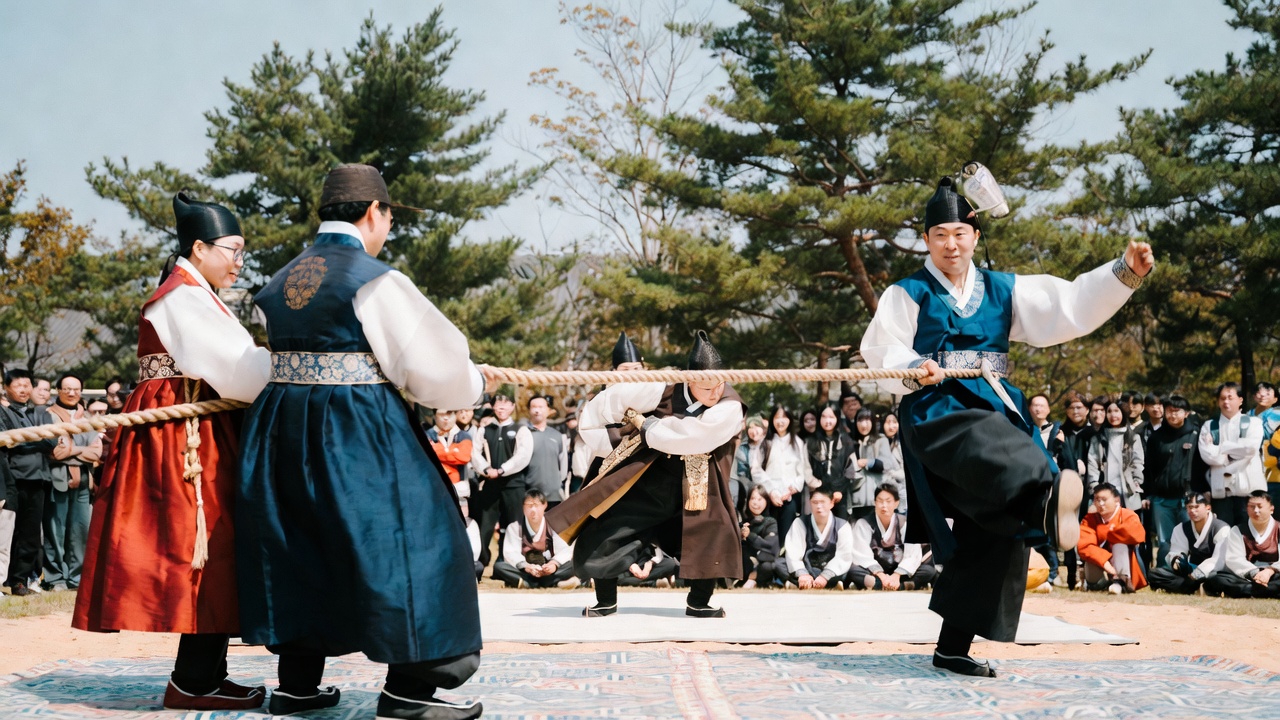
Juldarigi (줄다리기): Korean Tug of War Traditions
Juldarigi transforms ordinary tug of war into a grand community event:
Traditional Setup:
- Two enormous rice-straw ropes
- Ropes connected by central wooden peg
- Teams represent East vs. West villages
- Hundreds of participants per side
Symbolic Elements:
- East team: Male energy (양, yang)
- West team: Female energy (음, yin)
- Competition often “rigged” for West to win
- West victory symbolizes bountiful harvest (female fertility)
During Seollal, smaller-scale juldarigi games occur at family gatherings and community centers, maintaining the tradition on an accessible scale.
Gonu (고누): Korean Strategy Board Games
For families wanting quieter entertainment, gonu offers strategic depth similar to checkers:
Variations Include:
- Pond Gonu: Capture opponent’s pieces by jumping
- Line Gonu: Block opponent’s movement
- Pumpkin Gonu: Territorial control
Simple Materials:
- Game board drawn on paper or ground
- Stones, buttons, or coins as pieces
- 2 players
These games teach strategic thinking and patience—valued qualities in Confucian education.
Biseokchigi (비석치기): Stone Throwing Games
Biseokchigi (“stone hitting”) involves setting up target stones and attempting to knock them down from distance:
Basic Version:
- Set up standing stones (traditionally flat rocks)
- Players take turns throwing from marked distance
- Score points for each knockdown
- Highest total wins
This simple game requires no equipment beyond rocks found outdoors—perfect for rural Seollal celebrations where fancy games weren’t available.
Essential Seollal Rituals: Charye, Sebae, and Traditional Foods
What Is Charye? Understanding Korean Ancestral Memorial Rites
Charye (차례) represents the spiritual heart of Seollal morning. Families prepare elaborate tables with carefully arranged dishes as offerings to ancestors, whose spirits are believed to visit on this special day.
Traditional charye table arrangement follows specific rules:
- Rice and soup placed closest to the ancestral tablets
- Fruits arranged by color (red east, white west)
- Fish heads pointing east
- Meat dishes on the west side
The ritual involves multiple bows and prayers, expressing gratitude for ancestors’ guidance and requesting blessings for the coming year.
Sebae: The Korean New Year Deep Bow Tradition
Sebae (세배) is the most visible Seollal tradition. Younger family members kneel and perform deep bows before elders while reciting:
“새해 복 많이 받으세요” (Saehae bok mani badeuseyo) “Please receive lots of luck in the new year”
Elders respond with deokdam (덕담)—words of wisdom and blessing—followed by sebaetdon (세뱃돈), New Year’s money given in colorful envelopes called bokjumeoni (복주머니, “fortune pouches”).
Traditional Seollal Foods: What Korean Families Eat During Lunar New Year
Essential Seollal dishes include:
| Dish | Korean Name | Significance |
|---|---|---|
| Rice Cake Soup | 떡국 (Tteokguk) | Adds one year to age; white color symbolizes purity |
| Savory Pancakes | 전 (Jeon) | Celebratory sharing; various fillings |
| Glass Noodles | 잡채 (Japchae) | Originally a royal dish; harmony of ingredients |
| Dumplings | 만두 (Mandu) | Family collaboration in preparation |
| Braised Short Ribs | 갈비찜 (Galbijjim) | Special occasion luxury |
| Honey Cookies | 약과 (Yakgwa) | Sweet treats for guests |
The oval-shaped rice cakes in tteokguk traditionally resemble old Korean coins (엽전, yeopjeon), symbolizing wishes for wealth and prosperity.
How to Make Tteokguk: Traditional Korean Rice Cake Soup Recipe
For those wanting to prepare authentic Seollal cuisine:
Ingredients (Serves 4):
- 400g sliced rice cakes (떡, tteok)
- 600g beef brisket or chuck
- 8 cups water
- 2 eggs
- 4 green onions
- 2 cloves garlic
- 2 tablespoons soy sauce
- 1 tablespoon sesame oil
- Salt and pepper to taste
- Gim (seaweed) for garnish
Preparation Steps:
- Make the broth (1.5-2 hours)
- Simmer beef in water until tender
- Remove meat, slice thin
- Strain broth, skim fat
- Prepare rice cakes (30 minutes)
- Soak rice cakes in cold water to soften
- Drain before adding to soup
- Cook the soup (15 minutes)
- Bring broth to boil
- Add rice cakes, cook until soft
- Season with soy sauce, garlic
- Prepare toppings
- Beat eggs, make thin omelet, slice into strips
- Slice green onions
- Shred seaweed
- Serve
- Ladle into bowls
- Top with beef, egg strips, green onion, seaweed
- Drizzle sesame oil
The Cultural Rule: You must eat tteokguk on Seollal morning to properly “age” for the year. Refusing means symbolically rejecting the new year’s blessings!
Complete Seollal Menu: Beyond Tteokguk
A full Seollal feast includes numerous dishes:
Main Dishes:
| Dish | Description | Symbolism |
|---|---|---|
| Galbi-jjim | Braised short ribs | Abundance, celebration |
| Bulgogi | Marinated beef | Prosperity |
| Japchae | Glass noodles with vegetables | Longevity (long noodles) |
| Mandu | Dumplings | Wealth (shaped like gold ingots) |
Side Dishes (Banchan):
| Dish | Description |
|---|---|
| Jeon (various) | Savory pancakes (seafood, vegetable, meat) |
| Namul | Seasoned vegetables (spinach, fernbrake, bellflower) |
| Kimchi | Fermented cabbage (essential at every meal) |
| Sikhye | Sweet rice drink |
Desserts:
| Treat | Description |
|---|---|
| Yakgwa | Honey cookies |
| Yugwa | Puffed rice treats |
| Songpyeon | Half-moon rice cakes |
| Sujeonggwa | Cinnamon persimmon punch |
Fruit Arrangement: Fruits are carefully selected for the charye table, following the principle of “홍동백서” (hongdongbaekseo): red fruits placed on the east, white fruits on the west.
How to Experience Seollal Games and Activities in South Korea in 2026
Best Places to Celebrate Korean Lunar New Year as a Tourist
For travelers visiting Korea during Seollal 2026 (February 16-18), several destinations offer authentic experiences:
Seoul:
- Gyeongbokgung Palace: Free admission on Seollal; traditional games, hanbok experiences
- Namsangol Hanok Village: Folk game demonstrations, food tastings
- National Folk Museum: Interactive cultural programs
Jeonju:
- Jeonju Hanok Village: Authentic atmosphere without Seoul crowds; famous bibimbap
Suwon:
- Hwaseong Fortress (UNESCO): Sunrise viewing, folk activities
Jeju Island:
- Seongsan Ilchulbong: New Year sunrise watching
- Relaxed alternative to mainland celebrations
Seollal Travel Tips for Foreigners Visiting Korea
Essential advice:
- Book transportation early: KTX tickets sell out weeks in advance; 2026 Seollal tickets go on general sale January 21st
- Expect closures: Many small restaurants and shops close; check Naver Maps for opening hours
- Enjoy empty cities: Major attractions are surprisingly peaceful
- Dress warmly: February temperatures average -2°C to 4°C
- Learn basic greetings: Saying “새해 복 많이 받으세요” earns warm smiles
How to Host Your Own Seollal Games Party at Home
DIY Traditional Korean New Year Games for International Families
You don’t need to be in Korea to celebrate Seollal! Here’s how to recreate the experience:
Yutnori (budget version):
- Cut popsicle sticks, marking one side with dots (flat) and one with stripes (curved)
- Draw a game board on poster paper
- Use buttons or coins as tokens
Jegichagi (homemade jegi):
- Stack 4-5 coins
- Wrap in plastic bag or tissue paper
- Secure with rubber band
- Cut strips for tassels
Ddakji:
- Fold construction paper following origami tutorials
- Use thick, heavy paper for better flipping action
Suggested party schedule:
- Morning: Prepare simple tteokguk (available at Asian grocery stores)
- Late morning: Sebae practice with children
- Afternoon: Yutnori tournament, jegichagi contests
- Evening: Hwatu or Western card games, sharing hopes for new year
Seollal Games for Kids: Age-Appropriate Activities
Ages 3-5:
- Simple ddakji flipping with extra-large tiles
- Gonggi with plastic stones (supervised)
- Kite watching (too young to fly independently)
- Dancing to traditional Korean children’s songs
- Hanbok dress-up and photo sessions
Ages 6-10:
- Full yutnori participation (understanding rules)
- Jegichagi practice (beginning techniques)
- Ddakji competitions
- Simple kite flying with adult help
- Traditional storytelling sessions
Ages 11+:
- Competitive yutnori with strategic depth
- Advanced jegichagi techniques
- Kite making workshops
- Hwatu card games (teens)
- Helping prepare traditional foods
Seollal Crafts and Activities Beyond Games
Fortune Envelopes (복주머니, Bokjumeoni):
- Small silk pouches for sebaetdon
- Traditional colors: red, yellow, blue
- Often decorated with embroidery
- Easy to sew or purchase ready-made
Korean New Year Cards:
- Create with traditional patterns
- Include zodiac animal artwork
- Write wishes in Korean calligraphy
- Practice “새해 복 많이 받으세요”
Paper Crafts:
- Traditional Korean paper cutting
- Origami variations
- Lucky charm creation
- Lantern making
Educational Seollal Activities for Schools and Libraries
For educators incorporating Korean culture:
Curriculum Connections:
- Geography: Map of Korean Peninsula
- History: Three Kingdoms period, Joseon Dynasty
- Math: Yutnori probability calculations
- Physical Education: Jegichagi, neolttwigi
- Art: Traditional patterns, kite decorating
- Language Arts: Korean alphabet (Hangul) basics
Program Ideas:
- Invite Korean community members as guest speakers
- Partner with local Korean cultural centers
- Screen appropriate Korean children’s programming
- Create interactive museum-style displays
- Host intergenerational events connecting Korean elders with students
The Future of Seollal Traditions: Preserving Korean Cultural Heritage
Why Traditional Korean Games Matter in the Digital Age
As Korea modernizes, concerns about cultural erosion grow. Yet Seollal traditions demonstrate remarkable resilience:
- Squid Game’s global success introduced Korean childhood games to billions
- Government heritage designations protect games like Yutnori
- School curriculum integration ensures children learn traditional games
- Cultural tourism brings international appreciation
Organizations like the Korean Cultural Center actively promote these traditions worldwide, hosting workshops and demonstrations in countries from Norway to the Philippines.
How Families Are Adapting Seollal for Modern Times
Contemporary families balance tradition with convenience:
- Shortened charye ceremonies focusing on essential elements
- Video calls connecting relatives across continents
- Online Yutnori apps for digital-native children
- Restaurant-ordered Seollal meals reducing preparation burden
- K-pop playlists alongside traditional music
The essence remains unchanged: family connection, ancestral respect, and playful togetherness.
Conclusion: Why Seollal Games Create Lasting Family Memories
After two decades documenting festivals worldwide, I’ve learned that the most enduring traditions share common elements: simplicity, accessibility, and emotional resonance. Seollal games embody all three.
A grandfather teaching his granddaughter Yutnori strategy. A mother and daughter shrieking with laughter on the neolttwigi. A child’s pride at achieving 50 consecutive jegichagi kicks. These moments transcend language, culture, and time.
As Seollal 2026 approaches, I encourage you—whether Korean or not—to explore these beautiful traditions. Play a round of Yutnori with friends. Make ddakji with your children. Fly a kite inscribed with your hopes for the coming year.
Because in the end, Seollal teaches us something universal: the greatest fortune we can receive is time spent with those we love.
새해 복 많이 받으세요! (Saehae bok mani badeuseyo!) Wishing you abundant blessings in the New Year!
Quick Reference: Seollal 2026 Essential Information
| Detail | Information |
|---|---|
| Seollal 2026 Date | Tuesday, February 17, 2026 |
| Official Holiday Period | February 16-18, 2026 (Monday-Wednesday) |
| Zodiac Year | Year of the Fire Horse (말, Mal) |
| Traditional Greeting | 새해 복 많이 받으세요 (Saehae bok mani badeuseyo) |
| Most Popular Game | Yutnori (윷놀이) |
| Essential Food | Tteokguk (떡국, Rice Cake Soup) |