A Complete Guide to the Korean Lunar New Year Celebration, Traditions, and Cultural Significance
The scent of simmering beef broth fills the air. Generations gather under one roof. Children don colorful hanbok and practice their deep bows. This is Seollal (설날), the Korean Lunar New Year—one of the most significant traditional holidays in Korean culture.
But how did this beloved celebration come to be? What ancient roots gave rise to the customs millions of Koreans observe today? In this comprehensive guide, we’ll journey through time to explore the Seollal history and origins, from prehistoric agricultural festivals to modern-day celebrations.
What Is Seollal and When Is Korean Lunar New Year Celebrated?
Seollal is the Korean traditional festival commemorating the first day of the Korean lunisolar calendar. The word itself carries profound meaning: “Seol” (설) derives from Middle Korean and means “year of age,” while “nal” (날) simply means “day.”
Unlike the Western New Year on January 1st, Seollal follows the lunar calendar and typically falls between late January and mid-February. The exact date shifts each year, occurring on the second new moon after the winter solstice.
| Year | Seollal Date |
|---|---|
| 2024 | February 10 |
| 2025 | January 29 |
| 2026 | February 17 |
| 2027 | February 6 |
| 2028 | January 26 |
The celebration spans three consecutive days:
- The day before Seollal (preparations and travel)
- Seollal itself (main ceremonies and celebrations)
- The day after Seollal (continued family gatherings)
During this period, Korea experiences what’s called “the great migration”—millions of people traveling to their ancestral hometowns to reunite with family. According to the Korea Expressway Corporation, over 36 million South Koreans travel during this period, making it one of the busiest travel times in the nation.
The Ancient Origins of Seollal: Prehistoric Agricultural Roots
How Did Korean New Year Traditions Begin in Ancient Korea?
The origins of Seollal stretch back over 2,000 years to the agricultural societies of the Korean Peninsula. In these early communities, survival depended entirely on understanding nature’s rhythms. The lunar calendar wasn’t merely a timekeeping system—it was essential for farming.
Early Korean farmers relied on the moon’s cycles to determine optimal times for:
- Planting crops
- Harvesting grains
- Predicting weather patterns
- Planning community activities
The arrival of a new lunar year represented far more than a calendar change. It symbolized:
- The rebirth of nature
- Hope for abundant harvests
- Renewal of community bonds
- Connection with ancestral spirits
Pre-Confucian Folk Beliefs and Spiritual Traditions
Before Confucianism shaped Korean society, early New Year celebrations blended shamanistic beliefs with agricultural rituals. Ancient Koreans believed in numerous deities governing different aspects of life:
| Deity Type | Domain | New Year Significance |
|---|---|---|
| Village gods | Community protection | Received offerings for safety |
| Household spirits | Family welfare | Honored during home ceremonies |
| Mountain deities | Natural abundance | Prayed to for good harvests |
| Ancestral spirits | Family lineage | Believed to guide descendants |
During major seasonal transitions like the New Year, Koreans believed the boundary between the living and spirit worlds became permeable. Ancestors drew close, offering guidance and protection for the coming year.
Seollal During the Three Kingdoms Period (57 BCE – 668 CE)
The Earliest Historical Records of Korean New Year Celebrations
The Three Kingdoms Period marked a crucial era in Korean history when three powerful kingdoms—Goguryeo, Baekje, and Silla—competed for dominance on the peninsula. Each kingdom contributed to developing the cultural traditions that would become Seollal.
The earliest written references to Korean New Year celebrations appear in Chinese historical texts:
Key Historical Sources:
- Book of Wei (魏書) – Records national festivals in the Korean kingdoms
- Book of Sui (隋書) – Contains 7th-century accounts of Silla’s seasonal celebrations
- Old Book of Tang (舊唐書) – Documents Korean ritual practices
According to these sources, the kingdoms held grand festivals that included:
- Worship of celestial bodies (sun and moon deities)
- Ancestral veneration ceremonies
- Community feasting and celebrations
- Prayers for agricultural prosperity
How the Three Kingdoms Shaped Seollal Traditions
Each of the Three Kingdoms contributed unique elements to what would become modern Seollal:
Goguryeo (37 BCE – 668 CE):
- Located in the northern peninsula and Manchuria
- Known for the Dongmaeng (東盟) festival honoring ancestors
- Developed elaborate ancestral rites that influenced later Confucian practices
- Created warrior aristocracy traditions reflected in festival celebrations
Baekje (18 BCE – 660 CE):
- Southwestern coastal kingdom
- Strong cultural exchanges with China and Japan
- Buddhism arrived in 384 CE, adding religious dimensions to celebrations
- Contributed artistic and ceremonial refinement to festivals
Silla (57 BCE – 935 CE):
- Southeastern kingdom that eventually unified the peninsula
- According to the Samguk yusa (13th-century historical text), Seollal was celebrated during King Bicheo’s reign (488 CE)
- Developed the bone-rank system that influenced social hierarchy in celebrations
- The kingdom’s gold craftsmanship created ceremonial objects for festivals
The Samguk sagi (‘Historical Records of the Three States’), compiled in the 12th century, contains the oldest surviving Korean records describing New Year customs during the Silla period.
The Goryeo Dynasty and Buddhist Influences (918 – 1392)
How Buddhism Transformed Korean New Year Traditions
When the Goryeo Dynasty rose to power, Buddhism was already well-established as the state religion. This profoundly influenced how Koreans celebrated the New Year.
During Goryeo, Seollal celebrations incorporated:
Buddhist Elements:
- Temple visits for New Year prayers
- Offerings at Buddhist shrines
- Lighting of ceremonial candles and incense
- Recitation of sutras for ancestral spirits
Continued Folk Traditions:
- Palgwanhoe (八關會) – A national festival combining Buddhist and native Korean religious elements
- Village-level celebrations honoring local deities
- Agricultural rituals for harvest blessings
The Goryeo period also saw the formalization of Samhan consciousness—the idea of Korean unity derived from the Three Kingdoms. This strengthened the communal aspects of Seollal as a pan-Korean celebration.
The Evolution of Ancestral Rites During Goryeo
While Buddhist rituals dominated state ceremonies, ancestor worship remained central to family celebrations. However, the specific form of these rites was still evolving. The elaborate Confucian-style ceremonies that would later define Seollal were not yet standardized.
During this period:
- Families maintained personal shrines for ancestors
- Offerings of food and drink were made during the New Year
- Buddhist monks sometimes participated in household ceremonies
- Social hierarchy influenced the scale and formality of celebrations
The Joseon Dynasty: Confucianism Shapes Modern Seollal (1392 – 1910)
How Confucian Values Transformed Korean New Year Traditions
The Joseon Dynasty (1392–1910) represents the most transformative period in Seollal’s evolution. When King Taejo established the new dynasty, he adopted Neo-Confucianism as the state ideology—a decision that would reshape every aspect of Korean society, including how families celebrated the New Year.
Confucian principles that influenced Seollal:
| Confucian Value | Impact on Seollal |
|---|---|
| Filial piety (孝) | Sebae bowing rituals to elders |
| Ancestor veneration | Formalized charye ceremonies |
| Social hierarchy | Strict protocols based on age and status |
| Family harmony | Multi-generational gatherings |
| Ritual propriety | Standardized ceremonial procedures |
The Formalization of Charye Ancestral Rites
The most significant Joseon-era development was the standardization of charye (차례, 茶禮)—the ancestral memorial rite performed during Seollal.
The term “charye” literally means “tea ceremony”, reflecting its origins as a humble offering of tea to ancestors. Over time, as documented by the National Folk Museum of Korea, the ceremony became increasingly elaborate.
Charye was influenced by:
- Zhu Xi’s Family Rituals (朱子家禮) – A Chinese Confucian text adopted in Korea
- Royal court protocols that filtered down to common people
- Regional variations that developed across different provinces
According to historical records, Confucian-style charye emerged in the early Joseon period but didn’t become widespread among common people until the mid-16th century, when Neo-Confucianism spread beyond the yangban (aristocratic) class.
Key Developments Under Joseon Rulers
King Taejong (r. 1400-1418):
- In 1412, performed Chuseok rites at his father Taejo’s gravesite
- Set precedent for royal ancestral veneration
King Sejong (r. 1418-1450):
- Officially declared major seasonal festivals as important national holidays
- Commissioned Samgang haengsildo—a moral handbook promoting filial piety
- Emphasized proper observation of ancestral rites
King Yeongjo (r. 1724-1776):
- Following devastating wars (Japanese Invasions, Manchu Invasions), modified ritual requirements
- Allowed alcohol to replace expensive tea in ceremonies due to economic hardship
- Made charye more accessible to ordinary families
The Dongguk Sesigi and Documentation of Seollal Customs
One of the most important sources for understanding Joseon-era Seollal is the Dongguk Sesigi (동국세시기, 東國歲時記), written by scholar Hong Seok-mo during King Sunjo’s reign (1790-1834).
This comprehensive book documents seasonal customs throughout the year, including detailed descriptions of:
- Tteokguk preparation and consumption
- Family gathering protocols
- Traditional games and activities
- Regional variations in celebrations
The Dongguk Sesigi describes tteokguk as ritual food prepared for ancestors, noting that “Koreans cook rice soup with coin-shaped, sliced rice cakes” on New Year’s morning.
The Symbolism of Tteokguk: Rice Cake Soup and Gaining a Year
Why Do Koreans Eat Tteokguk on New Year’s Day?
No Seollal celebration is complete without tteokguk (떡국)—the iconic rice cake soup that carries profound symbolic meaning. Understanding this dish illuminates the deeper philosophy behind Korean New Year traditions.
Symbolic meanings of tteokguk:
| Element | Symbolism |
|---|---|
| White color | Purity, cleanliness, fresh start |
| Round rice cake slices | Resemble old Korean coins (yeopjeon) — prosperity |
| Long garaetteok | Extended fortune and longevity |
| Clear broth | Clarity of mind for the new year |
According to historian Choe Nam-seon (1890-1957), writing in “The Customs of Joseon” (조선 상식 문답), tteokguk originated as ritual food prepared for ancestral rites in ancient times. The white rice cakes, symbolizing purity, were considered appropriate offerings to welcome the new year with cleanliness.
The Tradition of “Gaining a Year” Through Tteokguk
One of the most charming Seollal traditions involves the belief that eating tteokguk adds one year to your age. The Dongguk Sesigi documents the custom of asking “How many bowls of tteokguk have you eaten?” as a playful way to inquire about someone’s age.
This tradition connects to Korea’s traditional age-counting system, where everyone aged one year on New Year’s Day regardless of their actual birthday. (Note: South Korea officially transitioned to the international age-counting system in 2023, though the tteokguk tradition continues.)
Children’s attempts to “age faster” by eating multiple bowls of tteokguk have been noted in historical records, though the efficacy of this method remains—as documented by the Asia Society—”still out” on whether extra bowls actually accelerate aging!
Sebae: The Traditional Korean New Year Bow to Elders
What Is Sebae and Why Is It Important?
Sebae (세배, 歲拜) is the deep ceremonial bow performed by younger family members to their elders during Seollal. This ritual embodies Confucian values of filial piety and respect for elders that form the foundation of Korean family relationships.
The sebae ritual:
- Children and younger family members dress in hanbok (traditional Korean clothing)
- They kneel before elders (parents, grandparents, aunts, uncles)
- Perform a deep bow with hands touching the ground
- Recite the traditional greeting: “새해 복 많이 받으세요!” (Saehae bok mani badeuseyo! — “Please receive much luck in the New Year!”)
- Elders offer blessings and wise words for the coming year
- Children receive sebaetdon (세배돈) — New Year’s money
The Cultural Significance of Sebaetdon (New Year’s Money)
The gift of money following sebae represents elders’ wishes for prosperity and good fortune. Traditionally, this money was placed in beautifully embroidered silk pouches called bokjumeoni (복주머니, “luck pouches”).
According to 2024 surveys cited by Kculture, the current “standard” gift for nieces and nephews has risen to approximately 50,000 KRW (~$40 USD), though amounts vary by relationship and family circumstances.
In earlier times, parents might give:
- Rice cakes
- Fruit
- Other food items
- Small amounts of money
Today, digital payment apps allow families to send “digital sebaetdon” across distances, preserving the gesture even when family members can’t gather in person.
Traditional Seollal Games and Family Activities
Yutnori: The Ancient Korean Board Game
Yutnori (윷놀이) is perhaps the most beloved traditional game played during Seollal. Dating back to the Three Kingdoms Period (57 BCE – 668 CE), this game brings families together in spirited competition.
How Yutnori works:
| Component | Description |
|---|---|
| Yut sticks | Four half-round wooden sticks |
| Mal | Game pieces (traditionally called “horses”) |
| Board | Path with 29 stations |
| Goal | Move all your pieces around the board first |
Throwing results:
- Do (도) – 1 stick flat, 3 round = Move 1 space (pig)
- Gae (개) – 2 flat, 2 round = Move 2 spaces (dog)
- Geol (걸) – 3 flat, 1 round = Move 3 spaces (sheep)
- Yut (윷) – All 4 flat = Move 4 spaces + extra turn (cow)
- Mo (모) – All 4 round = Move 5 spaces + extra turn (horse)
Beyond entertainment, Yutnori historically served divinatory purposes. The game was believed to predict agricultural abundance when played by groups (pyeon yut) and individual fortunes (yut jeom). According to the Yeolyangsesigi, playing Yutnori past the fifteenth day of the lunar calendar was thought to harm the year’s harvest.
The game’s design reflects East Asian cosmology:
- Yut sticks with flat and round sides symbolize yin and yang
- The leftward movement mirrors the Big Dipper’s counterclockwise rotation
- The 29 stations correspond to astronomical concepts
Other Traditional Seollal Games
Yeonnalligi (연날리기) — Kite Flying:
- Traditionally enjoyed by men and boys
- Kites called yeon are rectangular with bamboo frames
- Some people write wishes on kites
- Cutting the string symbolizes releasing bad luck
Jegichagi (제기차기) — Korean Hacky Sack:
- Players kick a jegi (coin wrapped in paper/cloth) to keep it airborne
- Similar to Western footbag games
- Especially popular in winter
Neolttwigi (널뛰기) — Seesaw Jumping:
- Traditionally played by women and girls
- Players stand on opposite ends of a board
- Take turns jumping to propel the other person upward
- Historically, one of few athletic activities available to women
Gongginori (공기놀이) — Five Stones:
- Played with small pebbles or plastic stones
- Similar to jacks
- Requires dexterity and hand-eye coordination
Paengi (팽이) — Top Spinning:
- Popular among children
- Wooden tops spun with string whips
The Dark Period: Japanese Colonial Suppression (1910 – 1945)
How Did Japanese Rule Affect Seollal Celebrations?
The Japanese colonial period (1910–1945) represents one of the most challenging eras for Korean traditional culture, including Seollal. As part of broader efforts to erase Korean cultural identity, Japanese authorities suppressed traditional Korean celebrations.
Key suppressions:
1907: Even before formal annexation, during the final years of the Korean Empire, celebrating Seollal was banned. Emperor Sunjong, under intense Japanese pressure, reluctantly enacted this prohibition despite opposition from the Korean people.
1910–1945: After Korea’s formal annexation by Japan:
- Seollal was officially prohibited
- The Korean New Year was forced to follow the Japanese New Year (January 1st on the Gregorian calendar)
- The original lunar New Year became disparagingly called “gujeong” (구정, 舊正) meaning “old New Year”
- The new January 1st celebration was called “sinjeong” (신정, 新正) meaning “new New Year”
Impact on traditional practices:
- Ritual implements were confiscated
- Family shrines were dismantled
- Public celebrations were suppressed
- Traditional games and customs were discouraged
According to the National Folk Museum of Korea, “Sinjeong was forcibly encouraged so as to eradicate Korean culture” during this period.
Preservation Through Resistance
Despite official suppression, many Korean families continued to observe Seollal privately. This quiet resistance helped preserve traditions that might otherwise have been lost:
- Families gathered secretly for charye ceremonies
- Traditional foods were prepared despite restrictions
- Cultural knowledge was passed orally to younger generations
- The lunar calendar was maintained in private life
This period of suppression ultimately strengthened Seollal’s significance as a symbol of Korean cultural identity and resilience.
Liberation and the Complicated Road to Revival (1945 – 1989)
Post-War Challenges to Traditional Celebrations
After Korea’s liberation from Japan in 1945, one might expect Seollal to have immediately returned to prominence. However, the path to full restoration was complicated by:
Korean War (1950–1953):
- National division into North and South Korea
- Massive displacement and family separations
- Economic devastation that limited celebrations
Post-war South Korea:
- Government emphasis on modernization and Westernization
- Economic development prioritized over traditional customs
- Official calendar remained Gregorian
For decades, while Koreans continued celebrating the lunar New Year privately, it wasn’t recognized as an official national holiday. The government designated January 1–3 as public holidays, while the traditional lunar New Year remained without official status.
North Korea’s Approach to Seollal
In North Korea, Seollal faced even stricter suppression. Under Kim Il-sung’s regime, the lunar New Year was not designated as a public holiday until the late 1980s, deemed inconsistent with socialist ideology.
However, as noted by Amy Poehler’s Smart Girls, Kim Jong-il began reviving the holiday in 1989, and it has been celebrated annually since then, though with different emphases than in the South.
The Official Revival of Seollal in 1989
How Seollal Became a National Holiday Again
The 1989 restoration of Seollal as an official national holiday marked a watershed moment in Korean cultural history. This wasn’t simply a government decision—it resulted from persistent public demand.
Timeline of revival:
| Year | Development |
|---|---|
| 1985 | South Korean government declares Seollal a “folk day” |
| 1985-1988 | Designation as folk day continues, but not full national holiday |
| 1989 | President Roh Tae-woo accepts public opinion |
| 1989 | Seollal officially designated as national holiday |
| 1989 | First official Seollal holiday: February 5-7 |
The Wikipedia article on Korean New Year notes that the Roh Tae-woo administration “accepted public opinion that the old New Year’s Day should be re-vitalized,” designating Seollal as both the official Korean New Year and a three-day national holiday.
This change reflected broader democratization movements in South Korea during the 1980s. As the country transitioned from military dictatorship toward democracy, there was increasing recognition that traditional culture deserved official protection and celebration.
Modern Seollal Celebrations in South Korea Today
Contemporary Korean New Year Traditions and Customs
Today’s Seollal celebrations blend ancient traditions with modern conveniences. While core practices remain unchanged, contemporary life has brought adaptations.
Traditional elements that persist:
✅ Charye (ancestral rites) — Still practiced by approximately 78% of South Koreans according to a 2023 Korea Research Institute study
✅ Sebae (bowing to elders) — Approximately 85% participation rate
✅ Tteokguk consumption
✅ Hanbok wearing (though declining among younger generations)
✅ Family gatherings
✅ Traditional games
Modern adaptations:
🔄 Simplified charye — Fewer dishes, shorter ceremonies
🔄 Modern transportation — KTX high-speed trains, domestic flights
🔄 Digital sebaetdon — Money transfers via mobile apps
🔄 Video calls — Connecting with family members abroad
🔄 “Seollal tourism” — Some families choose vacation travel instead
🔄 Restaurant-ordered foods — Pre-made charye dishes available
The Great Migration: Traveling Home for Seollal
The Seollal travel rush remains one of the most dramatic aspects of the modern holiday. When millions of Koreans attempt to return to their hometowns simultaneously, the result is legendary traffic congestion.
Travel statistics:
- Over 36 million people travel during the Seollal period
- Major highways implement special measures (reversible lanes)
- Train and bus tickets sell out months in advance
- Airlines add extra flights and extend service hours
The Korea Expressway Corporation provides real-time traffic updates and implements emergency measures to manage the annual migration.
Challenges Facing Modern Seollal
Contemporary Seollal faces several challenges:
Housing changes: With multi-generational households becoming rare and urban apartments smaller, large family gatherings are harder to organize.
Labor distribution concerns: Traditionally, Seollal preparation fell heavily on women, leading to what some call “Myung Cheol Chung Hu Kun” (명절 증후군) or “post-holiday trauma”—exhaustion from days of cooking, hosting, and cleaning.
Financial pressure: Gift-giving expectations, travel costs, and sebaetdon create financial stress for many families.
Work-life balance: Despite official holidays, some workers struggle to take full time off.
Generational shifts: Younger Koreans increasingly question the relevance of elaborate rituals.
Seollal vs. Chinese New Year: Understanding the Difference
Is Korean Lunar New Year the Same as Chinese New Year?
One of the most common misconceptions about Seollal involves confusing it with Chinese New Year. While both celebrations occur around the same time and share historical connections, they are distinct cultural celebrations.
Key differences:
| Aspect | Seollal (Korea) | Chinese New Year |
|---|---|---|
| Name | 설날 (Seollal) | 春节 (Chūnjié) / 农历新年 |
| Duration | 3 days officially | 15 days (through Lantern Festival) |
| Key food | Tteokguk (rice cake soup) | Various (dumplings, fish, etc.) |
| Clothing | Hanbok | Various traditional Chinese dress |
| Ancestral rites | Charye (Confucian-style) | Ancestor worship varies by region |
| Games | Yutnori, jegichagi | Mahjong, card games |
Historical connections:
Both celebrations derive from:
- Lunar calendar systems with shared astronomical foundations
- Confucian influences on ancestral veneration
- Agricultural traditions tied to seasonal cycles
However, as Korea.net emphasizes, Korea developed its own distinct traditions over millennia. The customs, foods, rituals, and cultural meanings have diverged significantly from Chinese practices.
The Korean lunisolar calendar, while historically derived from Chinese systems, has been maintained independently. The Korea Astronomy and Space Science Institute now calculates the calendar based on the moon’s appearance as seen from Korea, occasionally causing the two countries’ New Year dates to differ by one day.
The Korean Zodiac and Seollal: Understanding the Twelve Animal Cycle
What Is the Korean Zodiac System?
Like other East Asian cultures, Korea follows a twelve-year zodiac cycle (띠, tti) where each year is represented by a different animal. This system profoundly influences Seollal celebrations and Korean cultural beliefs about personality, compatibility, and fortune.
The Twelve Zodiac Animals:
| Year | Animal (Korean) | Character Traits |
|---|---|---|
| 1 | 쥐 (Jwi) – Rat/Mouse | Clever, resourceful, quick-witted |
| 2 | 소 (So) – Ox | Diligent, dependable, strong |
| 3 | 호랑이 (Horangi) – Tiger | Brave, competitive, confident |
| 4 | 토끼 (Tokki) – Rabbit | Gentle, elegant, responsible |
| 5 | 용 (Yong) – Dragon | Confident, intelligent, ambitious |
| 6 | 뱀 (Baem) – Snake | Wise, enigmatic, intuitive |
| 7 | 말 (Mal) – Horse | Animated, active, energetic |
| 8 | 양 (Yang) – Sheep/Goat | Calm, gentle, sympathetic |
| 9 | 원숭이 (Wonsung-i) – Monkey | Witty, curious, playful |
| 10 | 닭 (Dak) – Rooster | Observant, hardworking, confident |
| 11 | 개 (Gae) – Dog | Loyal, honest, kind |
| 12 | 돼지 (Dwaeji) – Pig | Compassionate, generous, diligent |
How the Zodiac Influences Seollal Celebrations
Each Seollal marks the transition to a new zodiac year, and this carries significant cultural weight:
Decorations and Imagery:
- Holiday displays feature the incoming zodiac animal
- Greeting cards depict the year’s animal
- Gift packaging often includes zodiac imagery
- Department stores create elaborate zodiac-themed installations
Fortune-Telling Traditions: Many Koreans engage in saju (사주, 四柱)—traditional fortune-telling—around Seollal. Based on the four pillars (year, month, day, and hour of birth), practitioners predict fortunes for the coming year. This practice intensifies during Seollal as people seek guidance for the new year ahead.
Birth Year Significance: Koreans often believe that a person’s birth year animal influences their personality and compatibility with others. Parents may consider zodiac compatibility when hoping for children, and some business decisions factor in these beliefs.
The Cultural Significance of Certain Zodiac Years
Some zodiac years carry special significance in Korean culture:
Year of the Dragon (용띠):
- Considered the most auspicious year
- Historical increases in birth rates during dragon years
- Associated with power, success, and good fortune
Year of the Horse (말띠):
- Historically avoided by some families for daughters
- Based on traditional beliefs about strong-willed women
- Modern attitudes have largely moved past this superstition
Year of the Tiger (호랑이띠):
- The tiger holds special significance in Korean folklore
- Associated with protection against evil spirits
- Featured prominently in traditional art and mythology
Regional Variations in Seollal Celebrations Across Korea
How Different Korean Provinces Celebrate the Lunar New Year
Seollal traditions vary significantly across Korea’s different regions, reflecting local cultures, climates, and historical influences.
Northern regions (including North Korea):
- Greater emphasis on manduguk (dumpling soup) over tteokguk
- Larger, heartier dumplings reflecting colder climate needs
- Historical ties to Manchurian culinary traditions
Gaeseong region (now in North Korea):
- Famous for jogaengi tteokguk — rice cakes shaped like small gourds/cocoons
- Unique cooking techniques passed through generations
Jeolla Province (southwestern Korea):
- Known for elaborate charye food spreads
- Strong preservation of traditional customs
- Famous for kimchi and fermented food traditions
Gyeongsang Province (southeastern Korea):
- Regional variations in charye table arrangements
- Historical Silla kingdom influences
- Distinct local dishes incorporated into Seollal meals
Jeju Island:
- Uses jeolpyeon tteok instead of standard garaetteok
- Unique island traditions influenced by isolation
- Distinctive local ingredients in holiday foods
The Future of Seollal: Preserving Traditions in a Changing World
How Are Younger Generations Keeping Seollal Alive?
As Korean society continues to modernize, Seollal faces both challenges and opportunities. Understanding how younger generations engage with the holiday reveals the festival’s evolving nature.
Positive trends:
📱 Social media sharing: Young Koreans share Seollal experiences online, spreading awareness globally
🎬 K-drama representation: Korean television frequently depicts Seollal, introducing traditions to international audiences
👗 Hanbok revival: Fashion interest in traditional clothing has increased
🌏 Diaspora celebrations: Korean communities worldwide maintain Seollal traditions
Concerning trends:
📉 Declining charye participation among very young adults
🏠 Smaller family gatherings due to housing constraints
✈️ “Escape Seollal” travel trend among some families
👵 Loss of elderly knowledge as older generations pass away
The Role of Korean Wave (Hallyu) in Globalizing Seollal
The international popularity of Korean culture—known as Hallyu or the Korean Wave—has brought unprecedented global attention to Seollal.
International awareness spreads through:
- K-pop groups posting Seollal greetings and celebrations
- Korean dramas depicting traditional holiday scenes
- Mukbang content featuring Seollal foods
- K-beauty brand seasonal campaigns
- BTS and other artists wearing hanbok during New Year
This global interest helps reinforce cultural pride among young Koreans while introducing traditions to new audiences worldwide.
Complete Guide to Traditional Seollal Foods and Recipes
What Are the Most Important Foods for Korean Lunar New Year?
Beyond tteokguk, Seollal celebrations feature an elaborate spread of traditional dishes. Understanding these foods deepens appreciation for the holiday’s cultural richness.
Main Dishes:
Tteokguk (떡국) — Rice Cake Soup: The undisputed star of Seollal cuisine. As documented by Maangchi, the soup traditionally uses:
- Sliced garaetteok (rice cakes)
- Beef, chicken, or anchovy broth
- Egg garnish (gyeran jidan)
- Sliced scallions
- Roasted seaweed (gim)
- Sesame oil seasoning
Manduguk (만두국) — Dumpling Soup: Especially popular in northern Korean regions, this hearty soup features:
- Hand-made mandu filled with pork, beef, or vegetables
- Clear meat broth
- Often combined with tteokguk to create tteok-manduguk
Galbi-jjim (갈비찜) — Braised Short Ribs: Luxurious beef short ribs braised until tender in a sweet-savory sauce made with:
- Soy sauce
- Asian pear or apple
- Garlic and ginger
- Sesame oil
- Various vegetables (radish, carrots, chestnuts)
Side Dishes (Banchan):
Jeon (전) — Savory Pancakes: These pan-fried delicacies come in many varieties:
- Haemul-pajeon: Seafood and green onion pancakes
- Dongtae-jeon: Pollack pancakes
- Hobak-jeon: Zucchini pancakes
- Wanja-jeon: Meatball pancakes
Jeon are typically served with a dipping sauce of soy sauce, vinegar, and gochugaru (red pepper flakes).
Japchae (잡채) — Glass Noodle Stir-Fry: Originally created for King Gwangaegun, this dish features:
- Sweet potato glass noodles (dangmyeon)
- Assorted vegetables (spinach, carrots, mushrooms)
- Beef or pork
- Sesame oil and soy sauce seasoning
Namul (나물) — Seasoned Vegetables: Various vegetable side dishes prepared through blanching and seasoning:
- Gosari (fernbrake)
- Sigeumchi (spinach)
- Sukju (mung bean sprouts)
- Doraji (bellflower root)
Traditional Beverages:
Sikhye (식혜) — Sweet Rice Punch: A traditional dessert drink featuring:
- Malted barley water
- Cooked rice grains floating inside
- Subtle sweetness
- Served chilled
Sujeongwa (수정과) — Cinnamon Ginger Punch: A warming winter beverage made with:
- Cinnamon sticks
- Fresh ginger
- Brown sugar or honey
- Dried persimmons (gotgam)
- Pine nuts for garnish
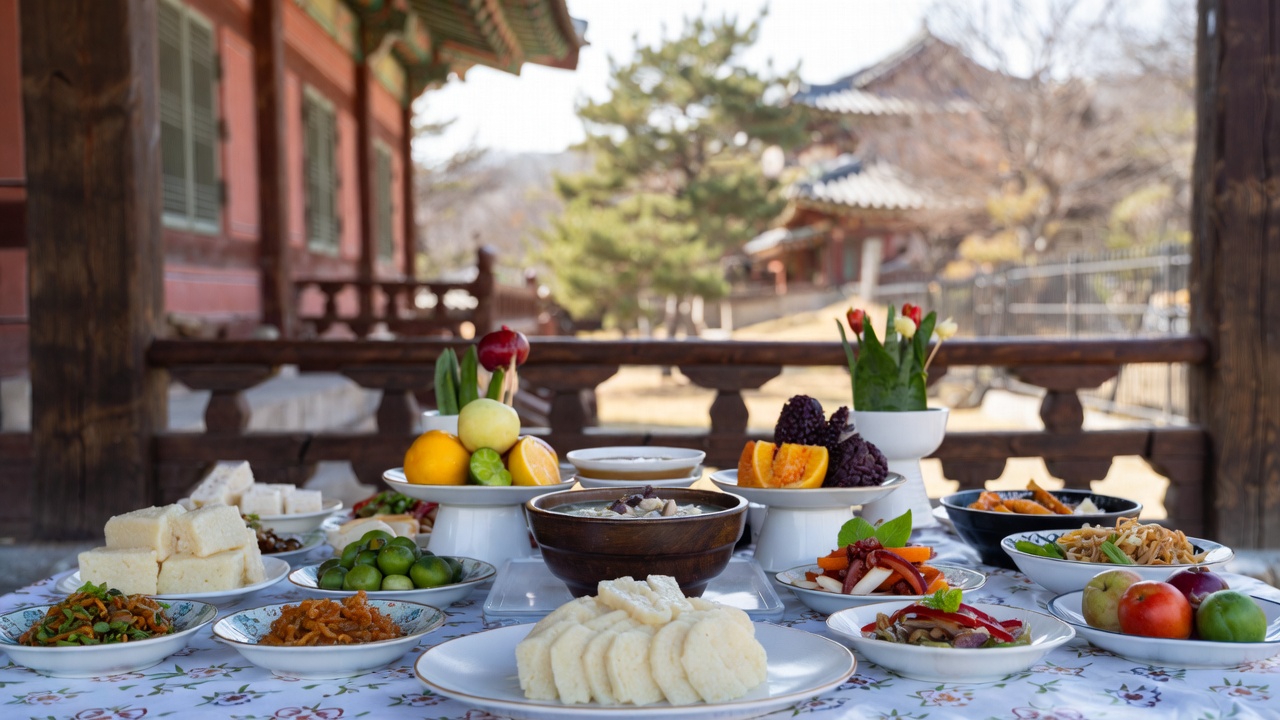
The Art of Setting the Charye Table
The arrangement of foods on the charye altar follows specific protocols that vary by region but share common principles:
| Direction | Foods Placed |
|---|---|
| North | Rice and soup |
| South | Fruits and vegetables |
| East | Rice cakes and drinks |
| West | Meat dishes |
The hongdong-baekseo (紅東白西) principle dictates that red-colored foods go on the east side while white foods go west. Similarly, dushiggup (頭西尾東) means fish should be placed with heads facing west and tails east.
These intricate arrangements demonstrate the Confucian emphasis on proper ritual conduct and attention to detail.
Essential Seollal Vocabulary and Phrases
Key Korean Terms for Lunar New Year Celebrations
Understanding these terms enhances appreciation of Seollal traditions:
| Korean | Romanization | Meaning |
|---|---|---|
| 설날 | Seollal | Korean Lunar New Year |
| 새해 복 많이 받으세요 | Saehae bok mani badeuseyo | Happy New Year (formal) |
| 차례 | Charye | Ancestral memorial rite |
| 세배 | Sebae | New Year’s bow |
| 세배돈 | Sebaetdon | New Year’s money |
| 떡국 | Tteokguk | Rice cake soup |
| 한복 | Hanbok | Traditional Korean clothing |
| 윷놀이 | Yutnori | Traditional board game |
| 설빔 | Seolbim | New clothes worn for Seollal |
| 복주머니 | Bokjumeoni | Luck pouch |
| 가래떡 | Garaetteok | Long cylindrical rice cake |
| 만두 | Mandu | Korean dumplings |
| 전 | Jeon | Savory pancakes |
| 잡채 | Japchae | Glass noodle dish |
Planning Your Visit to Korea During Seollal
Tips for Travelers Experiencing Korean Lunar New Year
If you’re planning to visit South Korea during Seollal, here’s what you should know:
Advantages of visiting during Seollal:
- Experience authentic traditional culture
- Many cultural centers offer special programs for visitors
- Folk villages host traditional game demonstrations
- Less crowded tourist attractions (as Koreans visit family)
- Unique photographic opportunities
Challenges to consider:
- Transportation: Domestic travel extremely difficult; book months ahead
- Business closures: Many restaurants and shops close
- Accommodation: Hotels in popular areas fill quickly
- Prices: Airfares and some services may increase
Best places to experience Seollal as a visitor:
- Namsangol Hanok Village (Seoul) — Traditional activities and performances
- Korean Folk Village (Yongin) — Demonstrations of traditional customs
- National Folk Museum of Korea (Seoul) — Cultural exhibits
- Gyeongbokgung Palace (Seoul) — Free hanbok rentals, photo opportunities
Conclusion: The Enduring Spirit of Seollal
From its ancient origins in prehistoric agricultural festivals to its modern celebration across the globe, Seollal represents the resilient heart of Korean culture. Through invasions, occupations, wars, and rapid modernization, this cherished holiday has endured.
The story of Seollal is ultimately a story of:
- Connection — linking generations through shared rituals
- Resilience — surviving suppression to emerge stronger
- Identity — defining what it means to be Korean
- Adaptation — evolving while preserving core values
- Community — bringing families and nation together
As millions of Koreans gather each year to bow before their elders, share bowls of steaming tteokguk, and play ancient games that echo through centuries, they participate in living history. Each sebae, each charye, each game of yutnori connects modern Koreans to ancestors stretching back over two millennia.
Whether you’re Korean by heritage, fascinated by Korean culture, or simply curious about one of Asia’s most significant holidays, understanding Seollal offers a window into values that transcend borders: respect for elders, gratitude for ancestors, hope for the future, and the irreplaceable warmth of family.
새해 복 많이 받으세요! May you receive many blessings in the New Year.
Frequently Asked Questions About Seollal
What is the difference between Seollal and Chuseok?
Seollal (Lunar New Year) and Chuseok (Harvest Moon Festival, often called “Korean Thanksgiving”) are Korea’s two most important traditional holidays. Both involve family gatherings and ancestral rites, but they occur at different times:
- Seollal: First day of lunar calendar (January/February)
- Chuseok: 15th day of 8th lunar month (September/October)
The foods and specific customs also differ, with songpyeon (half-moon rice cakes) being central to Chuseok and tteokguk to Seollal.
Can foreigners participate in Seollal celebrations?
Absolutely! Many cultural centers, folk villages, and museums offer Seollal programs specifically for international visitors. These may include:
- Hanbok wearing experiences
- Traditional game instructions
- Tteokguk making classes
- Sebae demonstrations
Why do Koreans wear hanbok during Seollal?
Wearing hanbok during Seollal honors Korean heritage and adds formality to the celebration. The colorful traditional clothing is considered appropriate attire for performing sebae and participating in charye ceremonies. While daily hanbok wearing has declined, Seollal remains one of the primary occasions when Koreans don traditional dress.
How long has Seollal been celebrated?
Historical evidence suggests Seollal celebrations date back over 2,000 years, with written records from the Three Kingdoms Period (57 BCE – 668 CE) documenting New Year festivals. The specific customs have evolved significantly, particularly during the Joseon Dynasty (1392–1910) when Confucian influences shaped modern practices.
For more information about Korean culture and traditions, visit Korea.net and the National Folk Museum of Korea.